

|
시장보고서
상품코드
2154858
볼 베어링 : 시장 점유율 분석, 업계 동향과 통계, 성장 예측(2026-2031년)Ball Bearing - Market Share Analysis, Industry Trends & Statistics, Growth Forecasts (2026 - 2031) |
||||||
 Mordor Intelligence
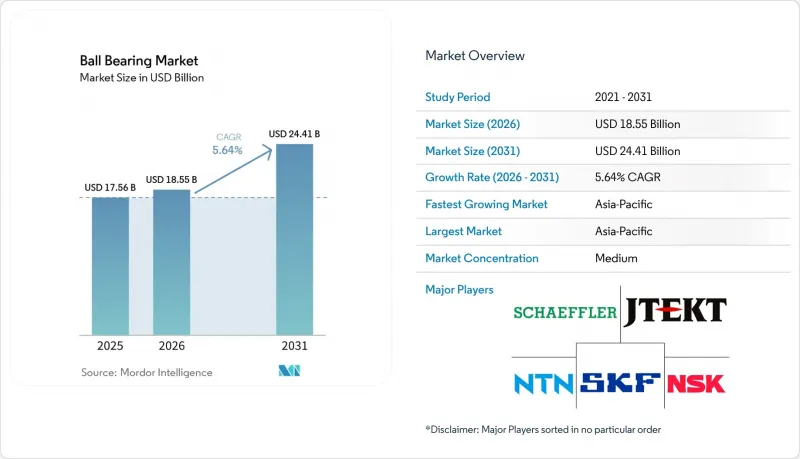
에 따르면 볼 베어링 시장 규모는 2025년에 175억 6,000만 달러로 평가되며, 2026년 185억 5,000만 달러에서 2031년까지 244억 1,000만 달러에 달할 것으로 예측되고 있으며, 예측 기간(2026-2031년)에 CAGR은 5.64%에 달할 전망입니다.
세계 볼 베어링 시장의 동향 및 인사이트
자동차의 전동화와 고속 E-액슬 도입
전기 구동 아키텍처는 단순히 기존의 성능 요건을 높이는 데 그치지 않고, 베어링의 사양 자체를 변화시키고 있습니다. E-액슬의 트랙션 모터는 15,000-20,000 r/min으로 작동하지만, 차세대 설계에서는 40,000 r/min을 넘는 수준으로 진화하고 있습니다. 이러한 회전 속도에 대응하기 위해서는 내연기관 파워트레인에서 사용되는 설계와는 다른 케이지 형상, 윤활유 보유성 및 피로 성능이 요구됩니다. JTEKT 주식회사는 2026년 6월, 전기자동차용 eAxle을 위한 정격 회전수 40,000 r/min의 깊은 홈 볼 베어링의 양산을 시작했습니다. 이 베어링에는 기존 설계에 비해 원심 변형을 70% 저감하도록 설계된 수지제 케이지가 채택되어 있습니다. NTN 주식회사는 2026년 5월부터 중국 제조 거점에서 eAxle 용도의 ‘수지 성형 절연 베어링’ 시제품 공급을 시작했습니다. 이는 전기적 피칭 문제를 해결함과 동시에 현지 전기자동차 및 하이브리드 전기자동차 제조사의 요구에 부응하기 위한 것입니다. 이처럼 볼 베어링 시장에서는 고속 운전, 전기 절연, 현지 공급 능력이 중요한 구매 요건이 되는 전문 분야가 확대되고 있습니다.
산업 자동화, 로봇 공학 및 스마트 팩토리의 확대
국제로봇연맹(IFR) 보고서에 따르면 2024년에는 전 세계에서 54만 2,000대의 산업용 로봇이 도입되었으며, 466만 4,000대가 가동 중이었습니다. 이 도입 대수는 신규 로봇 도입에 따른 수요뿐만 아니라 베어링 교체 및 업그레이드 수요도 지원하고 있습니다. 협동 로봇의 관절이나 고속 선택적 컴플라이언스 조립 로봇 암 시스템에는 10미크론 미만의 공차를 가진 소형 또는 박형 베어링이 필요합니다. 서버의 냉각팬 모터나 스토리지 장치의 스핀들 모터에도 소형 베어링이 사용되고 있으며, 수요는 인공지능(AI) 데이터센터의 인프라 분야로 확대되고 있습니다. 미네베아 미츠미 주식회사는 2026년 7월, AI 데이터센터의 수요에 대응하기 위해 생산 능력을 30% 증강하는 것을 목표로 동남아시아의 정밀 베어링 제조 시설에 580억 엔(약 3억 6,000만 달러)을 투자한다고 발표했습니다. 그 결과, 볼 베어링 시장은 기존의 산업 기기 분야에 그치지 않고, 더욱 폭넓은 정밀 모션 및 인프라 용도로 활용되고 있습니다.
베어링용 강재 및 합금 원소의 원가 변동
베어링 제조업체들은 GCr15 고탄소 크롬강 및 관련 합금 재료의 원가 변동에 영향을 받고 있습니다. 미국 지질조사국(USGS)의 보고서에 따르면 페로크롬 가격은 2022년 파운드당 3.19달러에서 2025년에는 파운드당 1.60달러로 하락했습니다. 이러한 하락은 현물 가격에 노출된 생산자들에게 일시적인 안도감을 주었지만, 이러한 움직임은 제품 개발 주기 전반에 걸쳐 투입 비용이 얼마나 급격하게 변동할 수 있는지를 보여줍니다. 페로크롬 생산 지역의 에너지 비용이나 크롬 철광석 유통에 영향을 미치는 무역 정책의 변화는 유리한 비용 상황을 뒤집을 가능성이 있습니다. 장기 조달 계약이나 철강 공급망을 갖추지 못한 소규모 생산자들은 이러한 변화의 영향을 더 크게 받게 됩니다. 이러한 제약으로 인해 볼 베어링 시장에서 대규모 제조업체의 비용 우위가 더욱 확대되고, 우선순위가 낮은 등급의 품질관리에 압박이 가해질 가능성이 있습니다.
부문 분석
2025년, 깊은 홈 볼 베어링은 볼 베어링 시장 가치의 32.67%를 차지했습니다. 이 베어링은 레이디얼 하중 및 축방향 하중 수용 능력 덕분에 자동차, 전기 모터, 가전제품, 펌프, 산업 장비에 사용될 수 있습니다. 또한 광범위한 회전 속도, 온도, 장착 구성에 대응합니다. JTEKT 주식회사의 40,000 r/min e-axle 제품은 개발을 통해 이 유형의 성능 한계가 높아지고 있음을 보여줍니다. 앵귤러 볼 베어링, 스러스트 볼 베어링, 미니어처 볼 베어링 및 계측용 볼 베어링은 정밀 스핀들, 변속기, 기어박스, 데이터센터용 팬, 의료용 영상 진단 시스템 등에 사용되고 있습니다.
자동 정렬 볼 베어링 시장은 2031년까지 연평균 성장률(CAGR) 6.12%로 성장할 것으로 예측됩니다. 이 베어링은 샤프트의 처짐이 발생하기 쉬운 농업기계, 제지·섬유 장비, 광산용 컨베이어 등에 사용됩니다. 구면형 외륜 덕분에 고정 정렬 설계로는 대응할 수 없는 위치 편차를 허용합니다. 이를 통해 정렬 작업이 줄어들고, 유지보수 체계가 제한적인 기계의 소유 비용을 절감할 수 있습니다. 동남아시아 및 남아시아의 스마트 팩토리 투자로 인해 이 기능이 필요한 기계의 기반이 확대되고 있습니다.
지역별 분석
아시아태평양은 2025년 볼 베어링 시장 점유율의 41.78%를 차지하고 있으며, 2031년까지 연평균 성장률(CAGR) 6.45%로 확대될 것으로 예측됩니다. 중국내 통합형 eAxle 플랫폼의 보급으로 인해 전기 피트 내성 및 고속 대응이 가능한 깊은 홈 볼 베어링 어셈블리에 대한 수요가 증가하고 있습니다. NTN 주식회사는 2026년 5월에 절연형 eAxle용 베어링의 중국내 생산 체제를 구축한 반면, JTEKT 주식회사는 2026년 6월에 40,000 r/min의 eAxle용 베어링 생산을 시작했습니다. 일본은 전기자동차, 로봇 공학, 인공지능(AI) 인프라를 위한 제조 및 OEM 수요의 중심지이며, 미네베아 미츠미 주식회사는 2025년 12월에 월간 3억 5,000만 개의 베어링 생산을 기록했습니다. 인도는 2024년에 풍력발전 용량을 3.4GW 증설하여 21% 증가했습니다. 한편, 한국 및 아세안(ASEAN) 국가들은 전자 및 자동차용 베어링 수요를 지원하고 있습니다.
북미 볼 베어링 시장의 수요는 항공우주·방위 분야의 조달, 전기자동차 제조 및 산업용 자동화가 주도하고 있습니다. 미국에는 엄격한 승인 요건이 적용되는 항공우주, 의료, 방위 용도에 대응하는 고정밀 공급업체가 존재합니다. RBC 베어링은 2026 회계연도에 18억 7,000만 달러의 순매출을 기록했으며, 그중 항공우주·방위 부문의 매출은 32.9% 증가했습니다. 캐나다와 멕시코에서는 제조 분야의 수요가 더해지고 있으며, 예측 유지보수가 애프터마켓의 교체 수요를 지원하고 있습니다.
유럽에서는 자동차의 전동화, 정밀 기계, 재생 가능 에너지 설비를 통해 볼 베어링 시장의 수요가 견인되고 있습니다. 독일은 고급 자동차 제조 및 공작 기계 생산을 통해 수요의 기반을 형성하고 있습니다. 유로 7 기준이 초저마찰 베어링 수요를 지원하는 한편, 셰플러(Schaeffler AG)는 2026년 말까지 슈타인하겐의 생산 거점을 슈바인푸르트로 통합할 예정입니다. 북유럽의 해상 풍력발전 프로젝트가 추가적인 수요를 창출하고 있는 반면, 남미, 중동 및 아프리카에서는 자동차 조립, 농업기계, 광업, 석유 및 가스 처리, 그리고 신흥 풍력발전 프로젝트가 수요의 주축을 이루고 있습니다. 이 지역들의 볼 베어링 시장에는 현지 산업 투자, 정밀 베어링 수입, 그리고 물류 상황이 영향을 미치고 있습니다.
기타 혜택:
- 엑셀 형식의 시장 예측(ME) 시트
- 3개월간의 애널리스트 지원
자주 묻는 질문
목차
제1장 서론
- 조사 전제조건과 시장 정의
- 조사 범위
제2장 조사 방법
제3장 개요
제4장 시장 구도
- 시장 개요
- 시장 성장 촉진요인
- 시장 성장 억제요인
- 밸류체인 분석
- Porter's Five Forces 분석
제5장 시장 규모와 성장 예측
- 유형별
- 소재별
- 용도별
- 지역별
- 아시아태평양
- 중국
- 인도
- 일본
- 한국
- ASEAN 국가
- 기타 아시아태평양 국가
- 북미
- 미국
- 캐나다
- 멕시코
- 유럽
- 독일
- 영국
- 프랑스
- 이탈리아
- 북유럽 국가
- 기타 유럽 국가
- 남미
- 브라질
- 아르헨티나
- 기타 남미 국가
- 중동 및 아프리카
- 사우디아라비아
- 남아프리카공화국
- 기타 중동 및 아프리카 국가
- 아시아태평양
제6장 경쟁 구도
- 시장 집중도
- 전략적 동향
- 시장 점유율·순위 분석
- 기업 개요
- C&U Group
- Harbin Bearing Manufacturing Co., Ltd.
- JTEKT Corporation
- MinebeaMitsumi Inc.
- Nachi America Inc.
- NACHI-FUJIKOSHI Corp.
- NSK Ltd.
- NTN Corporation
- RBC Bearings Incorporated
- Regal Rexnord Corporation
- Schaeffler AG
- SKF
- The Timken Company
- Wafangdian Bearing Group Corporation Limited
- ZWZ Bearings
제7장 시장 기회와 향후 전망
KSA 26.10.28According to Mordor Intelligence, the ball bearing market size was valued at USD 17.56 billion in 2025 and is estimated to grow from USD 18.55 billion in 2026 to reach USD 24.41 billion by 2031, at a CAGR of 5.64% during the forecast period (2026-2031).
Global Ball Bearing Market Trends and Insights
Automotive Electrification and High-Speed E-Axle Deployment
Electric drive architectures are changing bearing specifications rather than simply raising existing performance requirements. E-axle traction motors operate at 15,000-20,000 r/min, while next-generation designs are moving beyond 40,000 r/min. These speeds require different cage geometry, lubricant retention, and fatigue performance from designs used in internal combustion powertrains. JTEKT Corporation commenced mass production in June 2026 of a deep-groove ball bearing for electric vehicle e-axles rated at 40,000 r/min, using a resin cage designed to reduce centrifugal deformation by 70% against conventional designs. NTN Corporation began supplying prototype Resin Mold Insulated Bearings for e-axle applications from its China manufacturing operation in May 2026, addressing electrical pitting and the needs of local electric vehicle and hybrid electric vehicle producers. The ball bearing market is therefore gaining specialized positions where high-speed operation, electrical insulation, and local supply capability are important purchasing requirements.
Industrial Automation, Robotics, and Smart Factory Expansion
The International Federation of Robotics reported that 542,000 industrial robots were installed globally in 2024, and 4,664,000 units were in operation. This installed base supports demand for replacement bearings and upgrades alongside demand from new robot installations. Collaborative robot joints and high-speed Selective Compliance Assembly Robot Arm systems require miniature or thin-section bearings with sub-10-micron tolerances. Server cooling fan motors and storage-device spindle motors also use miniature bearings, extending demand into artificial intelligence data center infrastructure. MinebeaMitsumi Inc. announced in July 2026 that it would invest JPY 58 billion (approximately USD 360 million) in a Southeast Asian precision-bearing facility intended to increase capacity by 30% in response to artificial intelligence data center demand. The ball bearing market is consequently serving a broader set of precision-motion and infrastructure applications than its traditional industrial equipment base.
Volatility in Bearing-Grade Steel and Alloying-Element Costs
Bearing manufacturers are exposed to the cost of GCr15 high-carbon chromium steel and related alloying materials. The U.S. Geological Survey reported that ferrochromium prices declined from USD 3.19 per pound in 2022 to USD 1.60 per pound in 2025. The decline gave temporary relief to producers with spot-price exposure, but the movement also shows how sharply input costs can change over a product development cycle. Energy costs in ferrochromium-producing regions and trade-policy changes affecting chromite flows can reverse a favorable cost position. Smaller producers without long-term procurement contracts or integrated steel supply are more exposed to these changes. This restraint can widen the cost advantage of scale manufacturers in the ball bearing market and create pressure on quality controls for lower-priority grades.
Other drivers and restraints analyzed in the detailed report include:
- Renewable Energy and Wind-Turbine Capacity Additions
- Aerospace, Defense, and Precision-Equipment Demand
- Counterfeit Bearings and Uneven Quality Assurance Across Distribution Channels
For complete list of drivers and restraints, kindly check the Table Of Contents.
Segment Analysis
Deep groove ball bearings held 32.67% of the ball bearing market value in 2025. Their radial and axial load capability supports use in vehicles, electric motors, appliances, pumps, and industrial equipment. They operate across a wide range of speeds, temperatures, and mounting configurations. JTEKT Corporation's 40,000 r/min e-axle product shows that development is raising performance limits for this type. Angular contact, thrust, miniature, and instrument ball bearings serve precision spindles, transmissions, gearboxes, data center fans, and medical imaging systems.
Self-aligning ball bearings are projected to advance at a 6.12% CAGR through 2031. They are used in agricultural machinery, paper and textile equipment, and mining conveyors where shaft deflection is common. Their spherical outer raceway permits misalignment that fixed-alignment designs cannot manage. This reduces alignment work and can lower ownership costs for machinery with limited maintenance support. Smart-factory investment in Southeast Asia and South Asia is expanding the machinery base that needs this capability.
Complete Report Scope:
- By Type
- Deep Groove Ball Bearings
- Angular Contact Ball Bearings
- Self-Aligning Ball Bearings
- Thrust Ball Bearings
- Other Types
- By Material
- Chrome Steel
- Stainless Steel
- Ceramic
- Other Materials
- By Application
- Automotive
- Industrial Machinery
- Mining and Construction
- Aerospace and Defense
- Medical
- Other Applications
- By Geography
- Asia-Pacific
- China
- India
- Japan
- South Korea
- ASEAN Countries
- Rest of Asia-Pacific
- North America
- United States
- Canada
- Mexico
- Europe
- Germany
- United Kingdom
- France
- Italy
- NORDIC Countries
- Rest of Europe
- South America
- Brazil
- Argentina
- Rest of South America
- Middle East and Africa
- Saudi Arabia
- South Africa
- Rest of Middle East and Africa
- Asia-Pacific
Geography Analysis
Asia-Pacific held 41.78% of the ball bearing market share in 2025 and is projected to advance at a 6.45% CAGR through 2031. China's integrated e-axle platforms are increasing demand for electrical-pitting-resistant and high-speed deep-groove assemblies. NTN Corporation established a Chinese manufacturing capability for insulated e-axle bearings in May 2026, while JTEKT Corporation commenced 40,000 r/min e-axle bearing production in June 2026. Japan is a manufacturing and original equipment manufacturer demand center for electric vehicles, robotics, and artificial intelligence infrastructure, with MinebeaMitsumi Inc. recording a monthly output of 350 million bearing units in December 2025. India added 3.4 GW of wind capacity in 2024, a 21% increase, while South Korea and ASEAN countries support electronics and automotive bearing demand.
North America's ball bearing market demand is led by aerospace and defense procurement, electric vehicle manufacturing, and industrial automation. The United States has high-precision suppliers serving aerospace, medical, and defense applications with demanding approval requirements. RBC Bearings Incorporated recorded USD 1.87 billion in fiscal year 2026 net sales, including 32.9% growth in Aerospace and Defense revenue. Canada and Mexico add manufacturing demand, while predictive maintenance supports a replacement aftermarket.
Europe drives ball bearing market demand through automotive electrification, precision machinery, and renewable-energy equipment. Germany anchors demand through premium automotive manufacturing and machine-tool production. Euro 7 standards are supporting ultra-low-friction bearing demand, while Schaeffler AG will integrate Steinhagen production into Schweinfurt by the end of 2026. Nordic offshore wind projects provide further demand, while South America and Middle East and Africa depend on vehicle assembly, agricultural equipment, mining, oil and gas processing, and emerging wind projects. Local industrial investment, precision-bearing imports, and logistics conditions influence the ball bearing market across these regions.
- C&U Group
- Harbin Bearing Manufacturing Co., Ltd.
- JTEKT Corporation
- MinebeaMitsumi Inc.
- Nachi America Inc.
- NACHI-FUJIKOSHI Corp.
- NSK Ltd.
- NTN Corporation
- RBC Bearings Incorporated
- Regal Rexnord Corporation
- Schaeffler AG
- SKF
- The Timken Company
- Wafangdian Bearing Group Corporation Limited
- ZWZ Bearings
Additional Benefits:
- The market estimate (ME) sheet in Excel format
- 3 months of analyst support
TABLE OF CONTENTS
1 Introduction
- 1.1 Study Assumptions and Market Definition
- 1.2 Scope of the Study
2 Research Methodology
3 Executive Summary
4 Market Landscape
- 4.1 Market Overview
- 4.2 Market Drivers
- 4.2.1 Automotive Electrification and High-Speed E-Axle Deployment
- 4.2.2 Industrial Automation, Robotics, and Smart Factory Expansion
- 4.2.3 Renewable Energy and Wind-Turbine Capacity Additions
- 4.2.4 Aerospace, Defense, and Precision-Equipment Demand
- 4.2.5 Installed-Base Replacement and Predictive-Maintenance Demand
- 4.3 Market Restraints
- 4.3.1 Volatility in Bearing-Grade Steel and Alloying-Element Costs
- 4.3.2 Counterfeit Bearings and Uneven Quality Assurance Across Distribution Channels
- 4.3.3 Qualification Bottlenecks for New EV and Aerospace Bearing Designs
- 4.4 Value Chain Analysis
- 4.5 Porter's Five Forces Analysis
- 4.5.1 Threat of New Entrants
- 4.5.2 Bargaining Power of Suppliers
- 4.5.3 Bargaining Power of Buyers
- 4.5.4 Threat of Substitutes
- 4.5.5 Competitive Rivalry
5 Market Size and Growth Forecasts (Value)
- 5.1 By Type
- 5.1.1 Deep Groove Ball Bearings
- 5.1.2 Angular Contact Ball Bearings
- 5.1.3 Self-Aligning Ball Bearings
- 5.1.4 Thrust Ball Bearings
- 5.1.5 Other Types
- 5.2 By Material
- 5.2.1 Chrome Steel
- 5.2.2 Stainless Steel
- 5.2.3 Ceramic
- 5.2.4 Other Materials
- 5.3 By Application
- 5.3.1 Automotive
- 5.3.2 Industrial Machinery
- 5.3.3 Mining and Construction
- 5.3.4 Aerospace and Defense
- 5.3.5 Medical
- 5.3.6 Other Applications
- 5.4 By Geography
- 5.4.1 Asia-Pacific
- 5.4.1.1 China
- 5.4.1.2 India
- 5.4.1.3 Japan
- 5.4.1.4 South Korea
- 5.4.1.5 ASEAN Countries
- 5.4.1.6 Rest of Asia-Pacific
- 5.4.2 North America
- 5.4.2.1 United States
- 5.4.2.2 Canada
- 5.4.2.3 Mexico
- 5.4.3 Europe
- 5.4.3.1 Germany
- 5.4.3.2 United Kingdom
- 5.4.3.3 France
- 5.4.3.4 Italy
- 5.4.3.5 NORDIC Countries
- 5.4.3.6 Rest of Europe
- 5.4.4 South America
- 5.4.4.1 Brazil
- 5.4.4.2 Argentina
- 5.4.4.3 Rest of South America
- 5.4.5 Middle East and Africa
- 5.4.5.1 Saudi Arabia
- 5.4.5.2 South Africa
- 5.4.5.3 Rest of Middle East and Africa
- 5.4.1 Asia-Pacific
6 Competitive Landscape
- 6.1 Market Concentration
- 6.2 Strategic Moves
- 6.3 Market Share (%)/Ranking Analysis
- 6.4 Company Profiles (includes Global Overview, Market Overview, Core Segments, Financials as available, Strategic Information, Products and Services, and Recent Developments)
- 6.4.1 C&U Group
- 6.4.2 Harbin Bearing Manufacturing Co., Ltd.
- 6.4.3 JTEKT Corporation
- 6.4.4 MinebeaMitsumi Inc.
- 6.4.5 Nachi America Inc.
- 6.4.6 NACHI-FUJIKOSHI Corp.
- 6.4.7 NSK Ltd.
- 6.4.8 NTN Corporation
- 6.4.9 RBC Bearings Incorporated
- 6.4.10 Regal Rexnord Corporation
- 6.4.11 Schaeffler AG
- 6.4.12 SKF
- 6.4.13 The Timken Company
- 6.4.14 Wafangdian Bearing Group Corporation Limited
- 6.4.15 ZWZ Bearings
7 Market Opportunities and Future Outlook
- 7.1 White-Space and Unmet-Need Assessment


