

|
시장보고서
상품코드
2154861
종자 처리 살균제 : 시장 점유율 분석, 업계 동향과 통계, 성장 예측(2026-2031년)Seed Treatment Fungicides - Market Share Analysis, Industry Trends & Statistics, Growth Forecasts (2026 - 2031) |
||||||
 Mordor Intelligence
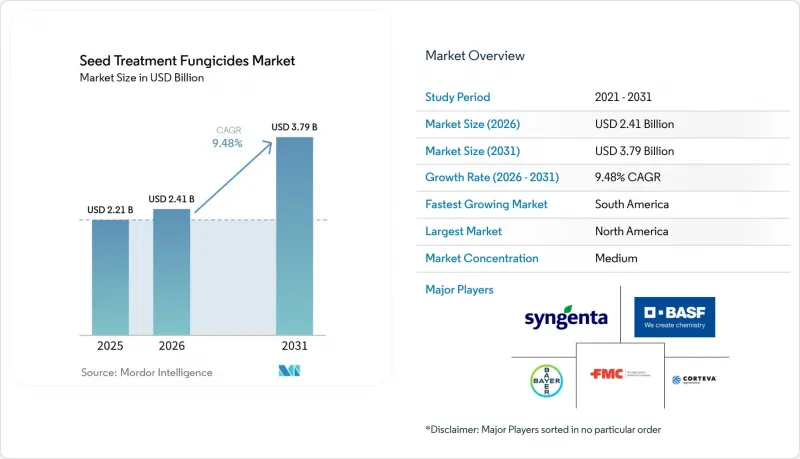
에 따르면 종자 처리용 살균제 시장 규모는 2025년 22억 1,000만 달러, 2026년 24억 1,000만 달러에서 2031년까지 37억 9,000만 달러로 확대될 것으로 예측되고 있으며, 2026-2031년까지 연평균 성장률(CAGR)은 9.48%에 달할 전망입니다.
전 세계 종자 처리용 살균제 시장의 동향 및 인사이트
종자 전염성 및 토양 전염성 병해의 위협 증가
북미 및 유럽에서는 서늘하고 습한 재배 조건으로 인해 종자나 묘목이 푸사리움, 리조크토니아, 피시움에 노출될 기회가 증가하고 있습니다. 이러한 병원체는 식물의 방어 기능이 충분히 확립되기 전에 피해를 줄 가능성이 있으므로 예방 처리가 중요합니다. 'Agronomy'지에 게재된 2025년 총설에 따르면 곰팡이성 병해는 전 세계 작물 손실의 15%에서 20%를 차지하며, 심각한 병해가 발생할 경우 그 비율이 50%까지 상승하는 것으로 밝혀졌습니다. 병해 예측 서비스를 통해 생산자는 눈에 보이는 증상이 나타날 때까지 기다리지 않고, 파종 전 처리 프로토콜을 채택할 수 있게 되었습니다. 이러한 변화는 병해 발생률이 낮은 계절을 포함하여 종자 처리용 살균제 시장의 수요 안정화를 지원하는 동시에, 다양한 재배 조건에서 작물의 초기 생육을 보호하는 처리의 가치를 높이고 있습니다.
시판되는 처리된 종자의 보급 확대
현재 북미와 남미에서는 곡물 및 줄기 작물의 종자 처리 대부분을 상업용 종자 회사나 전문 종자 처리 업체가 담당하고 있습니다. 정밀하게 조정된 설비를 통해 유효 성분의 분포, 종자 코팅률 및 제품 간 적합성이 향상되고 있습니다. 이러한 접근 방식은 농장에서의 처리에 따른 편차를 줄여주어 제품의 성능을 더 예측하기 쉽게 만듭니다. 또한 구매처가 더 대규모의 상업용 종자 처리 업체로 이동함에 따라 농장 차원의 경쟁이 완화되고 있습니다. 한편, 기타 신흥 시장의 하이브리드 종자 프로그램은 자가 채종에서 처리된 품종으로의 점진적인 전환을 촉진하고 있습니다. 이러한 추세로 인해 종자 처리용 살균제 시장에 진입하는 공급업체의 대상 고객 기반이 확대되고 있습니다.
살균제 내성 및 작용 기전의 선택지 축소
북유럽 및 동유럽 전역의 Zymoseptoria tritici 개체군에서 숙신산 탈수소효소 억제제(SDHI)에 대한 내성이 진행되고 있습니다. 2026년 'European Journal of Plant Pathology'에 게재된 연구에서는 살균제 감수성 저하 및 SDHI 계열 살균제 간의 높은 교차 내성과 관련된 SDHI 표적 부위의 변화가 보고되었습니다. 내성 관리로 인해 재배 주기 중 특정 유효 성분을 사용할 수 있는 빈도가 제한될 가능성이 있으며, 단일 작용 기전에 의존하는 제품의 유연성이 저하됩니다. 따라서 제품 개발자는 보다 광범위한 혼합 전략 및 스튜어드십 전략의 일환으로 새로운 유효 성분의 도입을 계획해야 합니다. 이러한 제약으로 인해 기존 화학물질의 사용 지침이 더욱 엄격해지고 있는 종자 처리용 살균제 시장에서 제품의 보급이 지연될 가능성이 있습니다.
부문 분석
2025년, 화학계 살균제는 확립된 등록, 입증된 효능, 그리고 상업용 처리 시설에서의 실용적인 사용에 힘입어 종자 처리용 살균제 시장 규모의 72%를 차지했습니다. 화학계 제품의 종자 처리용 살균제 시장 규모는 대량의 종자에 효율적으로 살포할 수 있는 고농도 합성 유효 성분과 여전히 밀접한 관련이 있습니다. 2025년 한 해 동안, 트리아졸계와 SDHI계의 조합, 스트로빌린계, 페닐피롤계는 곡물, 지방종자, 두류 처리 프로그램에서 계속해서 널리 사용되었습니다. 화학계 제품은 주요 생산 지역 전반에 걸쳐 종자 전염성 및 토양 전염성 병원체에 대해 광범위한 방제 효과를 발휘하며, 그 입증된 성능을 바탕으로 파종시 예측 가능한 보호가 필요한 생산자들의 지속적인 사용을 지원하고 있습니다.
생물 유래 살균제는 나머지 시장 점유율을 차지하고 있으며, 2031년까지 연평균 성장률(CAGR) 10%로 성장할 것으로 예측됩니다. 이 부문은 잔류 기준을 준수하는 처리 및 유기농 재배나 저잔류 작물 프로그램에 적합한 제품에 대한 수요의 혜택을 받고 있습니다. BASF SE의 ‘Integral Pro’ 플랫폼은 2025년 11월 프랑스에서 해바라기 등록이 확대되기 전부터 유럽에서 매년 수백만 헥타르의 유채를 보호해 왔습니다. 제형 개선을 통해 생물 유래 제품은 상업용 처리 장비 및 보관 조건을 견딜 수 있게 되었으며, 이에 따라 그 용도는 고부가가치 틈새 작물에 그치지 않고 더 대규모의 곡물 및 지방종자 프로그램으로 확대될 가능성이 있습니다.
트리아졸계는 푸사리움병, 스마트병, 반트병, 녹병에 대해 폭넓은 방제 효과를 발휘하므로 2025년 유효 성분 매출의 28%를 차지했습니다. 이 계열은 전 세계에서 폭넓은 등록 실적을 보유하고 있으며, 곡물 및 지방종자 보호에서 여전히 중요한 위치를 차지하고 있습니다. 스트로빌린계, 카르복사미드계, 페닐아미드계도 2025년 시장에서 큰 점유율을 차지했습니다. 플루지옥소닐을 필두로 하는 페닐피롤 계열은 내성 관리에 중요한 역할을 했습니다. 이러한 계열은 단일 성분 제품보다 혼합제로 사용되는 사례가 늘고 있습니다.
카르복사미드 계열은 2031년까지 연평균 성장률(CAGR) 10.2%로 성장할 것으로 예측되며, 이는 유효 성분 계열 중 가장 높은 성장률입니다. 이러한 성장은 트리아졸 계열로는 완전히 방제할 수 없는 리조크토니아 솔라니에 대한 그 효과를 반영하고 있습니다. 바이엘 AG는 2025년 12월 캐나다에서 두류 병해 방제를 목적으로 여러 유효 성분을 배합한 ‘EverGol Rise’를 출시했습니다. 콩과 작물 및 감자에서 발생하는 오오미균 방제에는 페닐아미드계가 여전히 필수적입니다. 또한 개발중인 신제품이 상업적 규모에 도달함에 따라 새로운 SDHI 하위 분류 및 생물 유래 유효 성분도 판매량을 끌어올릴 것으로 예상됩니다.
지역별 분석
북미는 2025년 매출의 31%를 차지하고 있으며, 이는 종자 처리 관행이 정착된 비교적 성숙한 시장임을 반영합니다. 이 지역의 시장은 고부가가치 처리 솔루션에 대한 수요와 지속적인 제품 개발이 특징입니다. 미국에서는 규제 당국의 승인이 진행됨에 따라 상업용 제제 제조업체가 이용할 수 있는 종자 처리용 살균제 선택지가 지속적으로 확대되고 있습니다. 미국 환경보호청(US EPA)은 2025년 5월, 광범위 살균제인 플로릴피코콰미드를 등록하여 유효 성분 파이프라인을 확대하는 한편, 생산자 및 제제 제조업체에 병해 방제 및 내성 관리를 위한 새로운 작용 기전을 제공했습니다.
남미 시장은 2031년까지 연평균 성장률(CAGR) 10.1%로 성장할 것으로 예측됩니다. 브라질과 아르헨티나는 광대한 대두 및 옥수수 재배 면적과 시판 중인 종자 처리제의 보급으로 수요를 주도하고 있습니다. 칠레 및 기타 지역 시장은 특수 작물과 채소용 종자 처리제에 대한 수요를 견인하고 있습니다. 또한 브라질은 생물 유래 제품의 생산에 대한 투자 및 상용화 측면에서도 중요한 위치를 차지하고 있습니다. 현지 잔류 기준이 강화됨에 따라 저잔류 생물 유래 제품 및 인캡슐레이션된 화학 제품에 대한 관심이 높아지고 있으며, 이는 주요 작물에서 종자 처리용 살균제 시장의 지속적인 확장을 지원하고 있습니다.
유럽에서는 종자 처리용 살균제에 대한 수요가 여전히 견고하지만, 유효 성분의 단계적 폐지 및 유럽연합(EU)의 심사 절차로 인해 화학 제품의 선택지가 제한되는 반면, 생물 유래 대체 제품에 대한 기회가 생겨나고 있습니다. 아시아태평양은 상업 농업의 확대와 처리 종자의 채택 증가에 힘입어 성장하고 있으며, 중국과 인도는 곡물, 지방종자, 채소의 생산 기반이 방대하므로 주요 수요 거점으로 자리 잡고 있습니다. 중동 및 아프리카는 터키, 남아프리카공화국, 나이지리아, 이집트에서 작물 보호에 대한 수요 증가, 특히 곡물 및 원예 작물 분야의 수요 증가에 힘입어 성장하고 있습니다. 아프리카에서는 심각한 병해 위협이 있음에도 불구하고 구매력의 한계와 정식 종자 유통 시스템의 보급 범위 부족으로 인해 시장 침투가 여전히 제한되고 있습니다.
기타 혜택:
- 엑셀 형식의 시장 예측(ME) 시트
- 3개월간의 애널리스트 지원
자주 묻는 질문
목차
제1장 서론
- 조사 전제조건과 시장 정의
- 조사 범위
제2장 조사 방법
제3장 개요
제4장 시장 구도
- 시장 개요
- 시장 성장 촉진요인
- 시장 성장 억제요인
- 규제 상황
- 기술 전망
- Porter's Five Forces 분석
제5장 시장 규모와 성장 예측
- 살균제 유형별
- 유효 성분 유형별
- 제제별
- 작물 유형별
- 지역별
- 북미
- 미국
- 캐나다
- 멕시코
- 기타 북미 국가
- 남미
- 브라질
- 아르헨티나
- 칠레
- 기타 남미 국가
- 유럽
- 러시아
- 프랑스
- 독일
- 이탈리아
- 스페인
- 영국
- 네덜란드
- 기타 유럽 국가
- 아시아태평양
- 중국
- 인도
- 일본
- 호주
- 인도네시아
- 태국
- 베트남
- 필리핀
- 기타 아시아태평양 국가
- 중동
- 튀르키예
- 사우디아라비아
- 아랍에미리트
- 기타 중동 국가
- 아프리카
- 남아프리카공화국
- 이집트
- 나이지리아
- 기타 아프리카 국가
- 북미
제6장 경쟁 구도
- 시장 집중도
- 전략적 동향
- 시장 점유율 분석
- 기업 개요
- Bayer AG
- Syngenta Group AG
- BASF SE
- Corteva Agriscience, Inc.
- FMC Corporation
- UPL Limited
- Sumitomo Chemical Company, Limited
- Nufarm Limited
- Certis Belchim B.V.
- Koppert Biological Systems B.V.
- PI Industries Limited
- Rallis India Limited
- Albaugh, LLC
- Gowan Company, LLC
- Germains Seed Technology Ltd.
제7장 시장 기회와 향후 전망
KSA 26.10.28According to Mordor Intelligence, the seed treatment fungicides market size is projected to grow from USD 2.21 billion in 2025 and USD 2.41 billion in 2026 to USD 3.79 billion by 2031, registering a CAGR of 9.48% between 2026 to 2031.
Global Seed Treatment Fungicides Market Trends and Insights
Rising Seed-Borne and Soil-Borne Disease Pressure
Cool and wet planting conditions have increased seed and seedling exposure to Fusarium, Rhizoctonia, and Pythium in North America and Europe. These pathogens can damage plants before their defenses are fully established, making preventive treatment important. A 2025 review published in Agronomy found that fungal diseases cause 15% to 20% of global crop losses, rising to 50% during severe disease events. Disease forecasting services are helping growers adopt preseason treatment protocols rather than waiting for visible symptoms. This shift supports steadier demand in the seed treatment fungicides market, including in seasons with lower disease incidence, and increases the value of treatments that protect early crop establishment across varied planting conditions.
Higher Adoption of Commercially Treated Seed
Commercial seed companies and professional treaters now handle a large share of cereal and row-crop seed treatment in North America and South America. Calibrated equipment improves active ingredient placement, seed coverage, and product compatibility. This approach reduces the variability associated with on-farm treatment and supports more predictable product performance. It also shifts purchasing decisions toward larger commercial treaters, reducing farm-level price competition. Meanwhile, hybrid seed programs across other emerging markets are supporting a gradual transition from farm-saved seed to treated varieties. This pattern creates a broader addressable base for suppliers serving the seed treatment fungicides market.
Fungicide Resistance and Shrinking Mode-of-Action Options
Resistance to succinate dehydrogenase inhibitors is advancing in Zymoseptoria tritici populations across Northern and Eastern Europe. A 2026 study published in the European Journal of Plant Pathology documented SDHI target site alterations associated with reduced fungicide sensitivity and high cross resistance between SDHI fungicides. Resistance management can limit how often particular active ingredients are used during a crop cycle, reducing the flexibility of products that rely on a single mode of action. Product developers therefore need to plan new active ingredients as part of a broader mixture and stewardship strategy. These restrictions can slow product adoption in the Seed treatment fungicides market where established chemistries face tighter use guidance.
Other drivers and restraints analyzed in the detailed report include:
- Biological Fungicide Pipeline Expansion
- Multi-Mode Fungicide Premixes for Resistance Management
- National Registration and Data-Compliance Burden
For complete list of drivers and restraints, kindly check the Table Of Contents.
Segment Analysis
Chemical fungicides accounted for 72% of the seed treatment fungicides market size in 2025, supported by established registrations, recognized efficacy, and practical use at commercial treatment facilities. The Seed treatment fungicides market size for chemical products remains linked to concentrated synthetic actives that can be applied efficiently to high seed volumes. Triazole-SDHI combinations, strobilurins, and phenylpyrroles remained widely used in cereal, oilseed, and pulse treatment programs during 2025. Chemical products offer broad coverage against seed-borne and soil-borne pathogens across the main producing regions, and their established performance supports continued use where growers need predictable protection at planting.
Biological fungicides represented the remaining value and are forecast to grow at a 10% CAGR through 2031. This segment benefits from demand for residue-compliant treatments and products suitable for organic or lower-residue crop programs. BASF SE's Integral Pro platform had protected several million hectares of oilseed rape annually in Europe before its sunflower registration expanded in France during November 2025. Formulation improvements are helping biological products withstand commercial treatment equipment and storage conditions, which can extend their use beyond high-value niche crops into larger cereal and oilseed programs.
Triazoles held 28% of 2025 active ingredient revenue because they provide broad control of Fusarium, smut, bunt, and rust diseases. This class has a broad global registration base and remains important in cereal and oilseed protection. Strobilurins, carboxamides, and phenylamides also represented significant shares of the market in 2025. Phenylpyrroles, led by fludioxonil provided an important resistance-management role. These classes are increasingly used in mixtures rather than in standalone products.
Carboxamides are forecast to grow at a 10.2% CAGR through 2031, the fastest rate among active ingredient classes. Their growth reflects their activity against Rhizoctonia solani, which triazoles do not fully manage. Bayer AG introduced EverGol Rise in Canada during December 2025 with multiple active ingredients for pulse disease control. Phenylamides remain necessary for oomycete management in legumes and potatoes. New SDHI subclasses and biological actives are also anticipated to add volume as more pipeline products reach commercial scale.
Complete Report Scope:
- By Fungicide Type
- Chemical Fungicides
- Biological Fungicides
- By Active Ingredient Class
- Triazoles
- Strobilurins
- Carboxamides
- Phenylamides
- Phenylpyrroles
- Other Active Ingredient Classes
- By Formulation
- Liquid
- Powder and Dry
- Flowable Concentrate
- Suspension Concentrate
- By Crop Type
- Cereals and Grains
- Oilseeds and Pulses
- Fruits and Vegetables
- Turf and Ornamentals
- Fiber Crops
- Silage and Forage Crops
- By Geography
- North America
- United States
- Canada
- Mexico
- Rest of North America
- South America
- Brazil
- Argentina
- Chile
- Rest of South America
- Europe
- Russia
- France
- Germany
- Italy
- Spain
- United Kingdom
- Netherlands
- Rest of Europe
- Asia-Pacific
- China
- India
- Japan
- Australia
- Indonesia
- Thailand
- Vietnam
- Philippines
- Rest of Asia-Pacific
- Middle East
- Turkey
- Saudi Arabia
- United Arab Emirates
- Rest of Middle East
- Africa
- South Africa
- Egypt
- Nigeria
- Rest of Africa
- North America
Geography Analysis
North America accounted for 31% of 2025 revenue, reflecting a relatively mature market with established commercial seed-treatment practices. The regional market is characterized by demand for higher-value treatment solutions and continued product development. In the United States, regulatory approvals continue to expand the range of seed-applied fungicide tools available to commercial formulators. The U.S. Environmental Protection Agency (US EPA) registered florylpicoxamid, a broad-spectrum fungicide, in May 2025, expanding the active-ingredient pipeline and providing growers and formulators with an additional mode of action for disease control and resistance management.
South America is forecast to grow at an 10.1% CAGR through 2031. Brazil and Argentina drive demand through large soybean and corn cultivation areas and widespread use of commercially treated seed. Chile and other regional markets contribute demand for specialty and vegetable seed treatments. Brazil is also relevant for biological production investment and commercialization. Local residue requirements are increasing interest in low-residue biological and encapsulated chemical products, supporting continued expansion in the seed treatment fungicides market across major row crops.
Europe maintains strong demand for seed treatment fungicides, although active ingredient phase-outs and European Union review processes are limiting chemical options and creating opportunities for biological alternatives. Asia-Pacific is supported by expanding commercial agriculture and increasing adoption of treated seeds, with China and India serving as major demand centers due to their large cereal, oilseed, and vegetable production bases. The Middle East and Africa are driven by increasing demand for crop protection in Turkey, South Africa, Nigeria, and Egypt, particularly across cereal and horticultural crops. Limited purchasing power and constrained formal seed-system reach continue to limit African market penetration despite significant disease pressure.
- Bayer AG
- Syngenta Group AG
- BASF SE
- Corteva Agriscience, Inc.
- FMC Corporation
- UPL Limited
- Sumitomo Chemical Company, Limited
- Nufarm Limited
- Certis Belchim B.V.
- Koppert Biological Systems B.V.
- PI Industries Limited
- Rallis India Limited
- Albaugh, LLC
- Gowan Company, LLC
- Germains Seed Technology Ltd.
Additional Benefits:
- The market estimate (ME) sheet in Excel format
- 3 months of analyst support
TABLE OF CONTENTS
1 Introduction
- 1.1 Study Assumptions and Market Definition
- 1.2 Scope of the Study
2 Research Methodology
3 Executive Summary
4 Market Landscape
- 4.1 Market Overview
- 4.2 Market Drivers
- 4.2.1 Rising Seed-Borne and Soil-Borne Disease Pressure
- 4.2.2 Higher Adoption of Commercially Treated Seed
- 4.2.3 Biological Fungicide Pipeline Expansion
- 4.2.4 Precision Seed Coating and Micro-Dosing
- 4.2.5 Multi-Mode Fungicide Premixes for Resistance Management
- 4.2.6 Low-Dust Encapsulation and Residue-Compliance Upgrades
- 4.3 Market Restraints
- 4.3.1 Fungicide Resistance and Shrinking Mode-of-Action Options
- 4.3.2 National Registration and Data-Compliance Burden
- 4.3.3 Microbial Shelf-Life and Field-Consistency Constraints
- 4.3.4 Specialty-Polymer and Active-Ingredient Supply Volatility
- 4.4 Regulatory Landscape
- 4.5 Technological Outlook
- 4.6 Porter's Five Forces Analysis
- 4.6.1 Threat of New Entrants
- 4.6.2 Bargaining Power of Suppliers
- 4.6.3 Bargaining Power of Buyers
- 4.6.4 Threat of Substitutes
- 4.6.5 Competitive Rivalry
5 Market Size and Growth Forecasts (Value)
- 5.1 By Fungicide Type
- 5.1.1 Chemical Fungicides
- 5.1.2 Biological Fungicides
- 5.2 By Active Ingredient Class
- 5.2.1 Triazoles
- 5.2.2 Strobilurins
- 5.2.3 Carboxamides
- 5.2.4 Phenylamides
- 5.2.5 Phenylpyrroles
- 5.2.6 Other Active Ingredient Classes
- 5.3 By Formulation
- 5.3.1 Liquid
- 5.3.2 Powder and Dry
- 5.3.3 Flowable Concentrate
- 5.3.4 Suspension Concentrate
- 5.4 By Crop Type
- 5.4.1 Cereals and Grains
- 5.4.2 Oilseeds and Pulses
- 5.4.3 Fruits and Vegetables
- 5.4.4 Turf and Ornamentals
- 5.4.5 Fiber Crops
- 5.4.6 Silage and Forage Crops
- 5.5 By Geography
- 5.5.1 North America
- 5.5.1.1 United States
- 5.5.1.2 Canada
- 5.5.1.3 Mexico
- 5.5.1.4 Rest of North America
- 5.5.2 South America
- 5.5.2.1 Brazil
- 5.5.2.2 Argentina
- 5.5.2.3 Chile
- 5.5.2.4 Rest of South America
- 5.5.3 Europe
- 5.5.3.1 Russia
- 5.5.3.2 France
- 5.5.3.3 Germany
- 5.5.3.4 Italy
- 5.5.3.5 Spain
- 5.5.3.6 United Kingdom
- 5.5.3.7 Netherlands
- 5.5.3.8 Rest of Europe
- 5.5.4 Asia-Pacific
- 5.5.4.1 China
- 5.5.4.2 India
- 5.5.4.3 Japan
- 5.5.4.4 Australia
- 5.5.4.5 Indonesia
- 5.5.4.6 Thailand
- 5.5.4.7 Vietnam
- 5.5.4.8 Philippines
- 5.5.4.9 Rest of Asia-Pacific
- 5.5.5 Middle East
- 5.5.5.1 Turkey
- 5.5.5.2 Saudi Arabia
- 5.5.5.3 United Arab Emirates
- 5.5.5.4 Rest of Middle East
- 5.5.6 Africa
- 5.5.6.1 South Africa
- 5.5.6.2 Egypt
- 5.5.6.3 Nigeria
- 5.5.6.4 Rest of Africa
- 5.5.1 North America
6 Competitive Landscape
- 6.1 Market Concentration
- 6.2 Strategic Moves
- 6.3 Market Share Analysis
- 6.4 Company Profiles (Includes Global Level Overview, Market Level Overview, Core Segments, Financials as Available, Strategic Information, Market Rank/Share, Products and Services, Recent Developments)
- 6.4.1 Bayer AG
- 6.4.2 Syngenta Group AG
- 6.4.3 BASF SE
- 6.4.4 Corteva Agriscience, Inc.
- 6.4.5 FMC Corporation
- 6.4.6 UPL Limited
- 6.4.7 Sumitomo Chemical Company, Limited
- 6.4.8 Nufarm Limited
- 6.4.9 Certis Belchim B.V.
- 6.4.10 Koppert Biological Systems B.V.
- 6.4.11 PI Industries Limited
- 6.4.12 Rallis India Limited
- 6.4.13 Albaugh, LLC
- 6.4.14 Gowan Company, LLC
- 6.4.15 Germains Seed Technology Ltd.


