

|
시장보고서
상품코드
2154921
가족성 아밀로이드 다발신경병증 : 시장 점유율 분석, 업계 동향과 통계, 성장 예측(2026-2031년)Familial Amyloid Polyneuropathy - Market Share Analysis, Industry Trends & Statistics, Growth Forecasts (2026 - 2031) |
||||||
 Mordor Intelligence
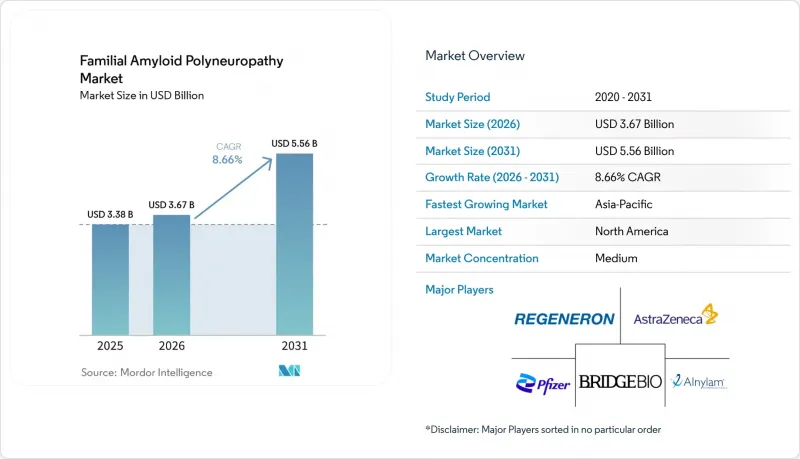
에 따르면 가족성 아밀로이드 다발 신경장애 시장 규모는 2025년 33억 8,000만 달러에서 2026년에는 36억 7,000만 달러로 확대하며, 2026-2031년에 CAGR 8.66%로 추이하며, 2031년에는 55억 6,000만 달러에 달할 것으로 예측됩니다.
전 세계 가족성 아밀로이드성 다발성 신경병증 시장의 동향 및 인사이트
질환 수정 요법의 승인 확대
2024년 하반기부터 2026년 중반에 걸쳐, 여러 치료법이 중요한 규제 관련 이정표를 달성함에 따라 가족성 아밀로이드 다발성 신경병증 시장은 확대되었습니다. FDA는 2025년 3월, ATTR-CM을 대상으로 ‘AMVUTTRA’라는 상품명으로 판매되고 있는 부토리실란의 추가 신약 신청을 승인했습니다. 이 승인으로 ‘AMVUTTRA’는 hATTR-PN과 ATTR-CM 모두에 대해 승인된 최초의 의약품이 되었습니다. 또한 이를 통해 의료 서비스 제공자들은 확립된 전문 약국 인프라를 통해 두 질환 모두를 치료할 수 있게 되었습니다. 유럽 집행위원회는 2025년 3월, 1기 및 2기 ATTRv-PN을 대상으로 상품명 ‘WAINZUA’로 판매되는 에프론텔센을 승인했습니다. 당시 WAINZUA는 이 적응증에서 월 1회 자가 투여용 오토인젝터를 통해 투여 가능한, EU에서 승인된 유일한 의약품이었습니다. 또한 유럽 집행위원회는 2025년 7월, Purpose Pharma사의 디플루니살 제제 ‘ATTROGY’에 대해 1기 또는 2기 다발성 신경병증을 가진 성인을 대상으로 한 판매 승인을 부여했습니다. 주요 3상 임상시험에서는 24개월 시점에 위약에 비해 NIS+7 점수가 18점 더 높은 결과가 나타났습니다.
RNA 사이렌서 적용 확대
RNA 사이렌싱 약물은 가족성 아밀로이드 다발성 신경병증 시장에서 중요한 치료 기전으로 자리 잡고 있습니다. 이러한 의약품에는 트랜스티레틴 생성을 억제하는 작은 간섭 RNA(siRNA) 및 안티센스 올리고뉴클레오티드가 포함됩니다. 이러한 약물의 사용으로 인해 트랜스티레틴 생성을 억제하는 데 있으며, 과거 핵심적인 역할을 했던 간 이식의 중요성은 감소했습니다. 분기별 피하 투여형 siRNA인 ‘AMVUTTRA’는 2025년 전 세계에서 23억 1,000만 달러의 순제품 매출을 기록했습니다. 이는 2025년 3월 ATTR-CM 적응증 승인을 받아 2024년의 9억 7,000만 달러에서 138% 증가한 수치입니다. ONPATTRO의 매출은 환자들이 분기당 1회 투여 제제로 전환함에 따라 2025년에는 32% 감소한 1억 7,280만 달러를 기록했습니다. 에프론텔센은 EU에서의 출시가 진행되는 가운데, 2025년에 2억 1,200만 달러의 매출을 기록했으며, 2026년에는 ATTR-CM에 대한 승인이 예상되고 있었습니다. 분기별 및 월 1회 투여로 전환됨에 따라 재택 투여가 주류를 이루고 있으며, 가족성 아밀로이드 다발성 신경병증 시장에서의 유통 수요도 변화하고 있습니다.
극도로 고액인 치료비와 보험 급여를 둘러싼 과제
치료비는 가족성 아밀로이드 다발성 신경병증 시장에서 환자의 접근성에 대한 지속적인 장벽이 되고 있습니다. 연간 정가는 아콜라미디스 출시 당시의 24만 4,000달러에서 부토리실란의 46만 4,000달러까지 폭이 넓습니다. 유럽의 의료기술평가기관은 종종 보험 급여를 시판 후 증거 제출 의무와 연계합니다. 이러한 접근 방식은 보험사의 급여 결정 심사가 진행되는 동안 진단을 받은 환자가 치료를 받지 못하는 상황이 발생할 수 있습니다. 또한 여러 브랜드 의약품이 동일한 환자층을 놓고 경쟁하는 경우, 보험자가 처방약 리스트 등재나 리베이트율에 대해 더 큰 영향력을 행사하게 될 수도 있습니다. EU의 희귀질환 의약품에 관한 규정이나 일본 및 독일의 국내 가격 책정 제도는 시장 진입을 지원하는 한편, 제품의 수명 주기 전반에 걸쳐 순수익에 압박을 가하는 요인이 될 수도 있습니다. 따라서 진단 능력이 향상되고 있더라도, 비용 측면의 압박이 접근 패턴에 영향을 미칠 가능성이 높다고 볼 수 있습니다.
부문 분석
2025년, 가족성 아밀로이드 다발성 신경병증 시장에서 치료제의 점유율은 82.31%를 차지했습니다. 이러한 위상을 지원한 것은 질병 수정 작용을 가진 트랜스티레틴 안정화제 및 RNA 사이렌서였습니다. TTR 유전자 사일렌서는 치료 분야에서 주요 성장 동력으로 자리 잡고 있습니다. AMVUTTRA는 2025년에 23억 1,000만 달러의 순제품 매출을 기록한 반면, 에프론텔센은 출시 첫해에 2억 1,200만 달러를 기록했습니다. TTR 안정화제는 여전히 상당한 규모의 기존 환자 기반을 유지하고 있습니다. 임상적 증거에 따르면 유전자 침묵 요법은 혈중 트랜스티레틴을 80%에서 90%까지 감소시킬 수 있는 반면, 경구용 약물은 부분적인 안정화 효과에 그칩니다. 진행성 다발성 신경병증을 치료하는 임상의들 사이에서는 처방 경향이 계속해서 사일런서 계열 약물로 이동할 가능성이 있습니다. 유전자 편집 요법은 2026년 시점에도 여전히 임상시험 단계에 있으며, MAGNITUDE-2 임상시험은 FDA의 보류 조치가 해제된 후 피험자 등록을 재개했습니다.
진단 건수는 2031년까지 연평균 성장률(CAGR) 10.25%로 증가할 것으로 예측됩니다. 가족성 아밀로이드성 다발성 신경병증 진단 시장 규모는 유전성 아밀로이드증 유전자 염기서열 분석 패널 및 핵의학 신티그래피에 대한 보험 적용에 힘입어 성장하고 있습니다. 단일 유전자 TTR 시퀀싱에서는 유전학 부서로 의뢰된 환자 집단에서 15.6%의 양성률이 나타났습니다. 이 결과를 바탕으로 고위험군에서 표적화된 프로토콜을 채택할 근거가 마련되었습니다. AL 아밀로이드증이 배제된 경우, 골 친화성이 높은 방사성 추적자를 이용한 영상 진단을 통해 생검이 필요 없는 ATTR 진단이 가능해집니다. 영상 진단 결과가 불분명하거나 면역조직화학 검사가 필요한 경우에는 조직 생검 및 아밀로이드 아형 판정이 여전히 중요합니다. 유전학적 검사와 영상 진단을 결합한 다중 평가 방식을 통해 단일 진단 과정에서 서비스 이용 건수를 늘릴 수 있습니다. 이를 통해 가족성 아밀로이드 다발성 신경병증 시장 전체의 성장률을 상회하는 진단 분야의 수익 성장이 촉진될 것입니다.
지역별 분석
2025년, 북미는 가족성 아밀로이드 다발성 신경병증 시장의 45.61%를 차지했습니다. 미국은 주요 트랜스티레틴 표적 의약품의 주요 승인 및 출시 지역입니다. 2025년 3월, FDA가 ATTR-CM에 대한 부트리실란을 승인함에 따라 처방 범위가 신경과에서 심혈관과로 확대되었습니다. 이로 인해 이미 hATTR-PN 환자를 대상으로 하고 있는 전문 약국 시스템에 더 많은 환자 그룹이 추가되었습니다. 캐나다와 멕시코는 매출 점유율이 비교적 낮은 편입니다. 이들 국가에서의 보급 상황은 약제 리스트 심사 일정과 주요 대도시권에 전문 의료 센터가 있는지 여부에 영향을 받고 있습니다. 또한 북미 지역의 경쟁 상황은 브랜드 의약품이 수행하는 중요한 상업적 역할을 반영하고 있습니다.
유럽에서는 포르투갈과 스웨덴에 지역 특유의 환자 집단이 집중되어 있으며, 임상 연구 기반도 잘 갖춰져 있습니다. 의료 기술 평가 및 보험 급여 결정은 국가마다 다르기 때문에 도입 양상은 다양합니다. 에프론텔센은 2025년 3월 유럽집행위원회로부터 ATTRv-PN에 대한 1단계 및 2단계 승인을 획득했습니다. 독일, 프랑스, 스페인, 이탈리아, 그리고 영국은 가족성 아밀로이드 다발성 신경병증 시장에서 여전히 주요 수입원으로 자리 잡고 있습니다. EU의 희귀질환 의약품 지정은 접근성 지원으로 이어지지만, 그 후에는 가격 협상 및 증거 제시 의무가 따릅니다. 포르투갈의 가족 모니터링 노력은 풍토병 클러스터내 조기 발견을 지원하고 있습니다. 이 지역에서는 강력한 임상 역량과 고가 의약품에 대한 접근성 격차가 공존하고 있습니다.
아시아태평양은 2031년까지 연평균 성장률(CAGR) 11.25%로 성장할 것으로 예측됩니다. 일본의 다직종 협력을 통한 치료 경로에서는 지역 연계 네트워크를 통해 유전자 검사, 신경학적 평가, 심장 영상 진단이 연계되어 있습니다. 중국에서는 2025년에 에프론텔센이 승인되어, 대규모 희귀질환 환자 집단에서 RNA 침묵 요법에 대한 접근성이 확대되었습니다. 한국과 호주에서는 각각 RNAi 조사 활동 및 희귀질환 의약품 접근 경로를 통해 지원 체계가 마련되어 있습니다. 브라질 역시 Val30Met 클러스터가 풍토병으로 존재하므로 계속해서 중요한 시장으로 남아 있습니다. ANVISA는 2026년 5월, 브라질에서 ATTR-CM 치료제인 아콜라미디스(BEYONTTRA)를 승인했습니다. BridgeBio는 2026년 하반기에 Biopas사와 공동으로 상용화를 계획하고 있습니다.
기타 혜택:
- 엑셀 형식의 시장 예측(ME) 시트
- 3개월간의 애널리스트 지원
자주 묻는 질문
목차
제1장 서론
- 조사 전제조건과 시장 정의
- 조사 범위
제2장 조사 방법
제3장 개요
제4장 시장 구도
- 시장 개요
- 시장 성장 촉진요인
- 시장 성장 억제요인
- 밸류체인 분석
- 규제 상황
- 기술 전망
- Porter's Five Forces 분석
제5장 시장 규모와 성장 예측
- 모달리티별
- 질환 스테이지별
- 유통 채널별
- 지역별
- 북미
- 미국
- 캐나다
- 멕시코
- 유럽
- 독일
- 영국
- 프랑스
- 이탈리아
- 스페인
- 기타 유럽 국가
- 아시아태평양
- 중국
- 일본
- 인도
- 호주
- 한국
- 기타 아시아태평양 국가
- 중동 및 아프리카
- GCC
- 남아프리카공화국
- 기타 중동 및 아프리카 국가
- 남미
- 브라질
- 아르헨티나
- 기타 남미 국가
- 북미
제6장 경쟁 구도
- 시장 집중도
- 시장 점유율 분석
- 기업 개요
- Alnylam Pharmaceuticals, Inc.
- Ambry Genetics
- Arcturus Therapeutics Holdings Inc.
- ARUP Laboratories
- AstraZeneca PLC
- Attralus, Inc.
- BridgeBio Pharma, Inc.
- Corino Therapeutics, Inc.
- Intellia Therapeutics, Inc.
- Invitae Corporation
- Ionis Pharmaceuticals, Inc.
- Labcorp
- Life Molecular Imaging GmbH
- Neurimmune AG
- Novo Nordisk A/S
- Pfizer Inc.
- Proclara Biosciences, Inc.
- Prothena Corporation plc
- Regeneron Pharmaceuticals, Inc.
- Silence Therapeutics plc
- SOM BIOTECH, S.L.
- Takeda Pharmaceutical Company Limited
- YolTech Therapeutics Co., Ltd.
제7장 시장 기회와 향후 전망
KSA 26.10.28According to Mordor Intelligence, the familial amyloid polyneuropathy market size is expected to grow from USD 3.38 billion in 2025 to USD 3.67 billion in 2026 and is forecast to reach USD 5.56 billion by 2031 at 8.66% CAGR over 2026-2031.
Global Familial Amyloid Polyneuropathy Market Trends and Insights
Expansion of Disease-Modifying Therapy Approvals
The familial amyloid polyneuropathy market broadened between late 2024 and mid-2026 as several therapies reached key regulatory milestones. The FDA approved a supplemental new drug application for vutrisiran, marketed as AMVUTTRA, for ATTR-CM in March 2025. The approval made AMVUTTRA the first medicine approved for both hATTR-PN and ATTR-CM. It also enabled providers to serve both conditions through an established specialty pharmacy infrastructure. The European Commission approved eplontersen, marketed as WAINZUA, for Stage 1 and Stage 2 ATTRv-PN in March 2025. WAINZUA was the only EU-approved medicine for this indication that could be delivered through a monthly self-administered autoinjector at that time. The European Commission also granted marketing authorization for ATTROGY, diflunisal from Purpose Pharma, in July 2025 for adults with Stage 1 or Stage 2 polyneuropathy. The pivotal Phase 3 study showed an 18-point NIS+7 advantage over placebo at 24 months.
Growing RNA-Silencer Adoption
RNA-silencing medicines have become an important treatment mechanism in the familial amyloid polyneuropathy market. These medicines include small interfering RNAs and antisense oligonucleotides that reduce transthyretin production. Their use has reduced the central role once held by liver transplantation for suppressing transthyretin production. AMVUTTRA, a quarterly subcutaneous siRNA, generated USD 2.31 billion in 2025 global net product revenue. This represented a 138% increase from USD 970 million in 2024, following the March 2025 ATTR-CM approval. ONPATTRO revenue declined 32% to USD 172.8 million in 2025 as patients moved to the once-quarterly formulation. Eplontersen generated USD 212 million in 2025 while its EU launch progressed, and an ATTR-CM application was expected in 2026. The shift toward quarterly and monthly dosing is moving care toward home-based administration and is changing distribution needs in the familial amyloid polyneuropathy market.
Ultra-High Treatment Cost and Reimbursement Friction
Treatment cost is a continuing limit on patient access in the familial amyloid polyneuropathy market. Annual list prices ranged from USD 244,000 for acoramidis at launch to USD 464,000 for vutrisiran. European health-technology assessment bodies have often linked reimbursement to post-marketing evidence obligations. This approach can leave diagnosed patients untreated while coverage decisions move through payer systems. It can also give payers greater influence over formulary placement and rebate rates when several branded medicines compete for the same patients. EU orphan-medicine rules and national pricing systems in Japan and Germany can support entry while also placing pressure on net revenue through the product lifecycle. Cost pressure is therefore likely to affect access patterns even where diagnostic capacity is improving.
Other drivers and restraints analyzed in the detailed report include:
- Earlier Genetic Testing and Multisystem Diagnosis
- Family Cascade Testing and Specialist Care Capacity
- Regulatory, Safety-Monitoring, and Vitamin A Management Requirements
For complete list of drivers and restraints, kindly check the Table Of Contents.
Segment Analysis
Treatment accounted for 82.31% of the familial amyloid polyneuropathy market share in 2025. Disease-modifying transthyretin stabilizers and RNA silencers supported this position. TTR gene silencers have become a major source of growth within treatment. AMVUTTRA recorded USD 2.31 billion in 2025 net product revenue, while eplontersen recorded USD 212 million in its launch year. TTR stabilizers retain a substantial installed patient base. Clinical evidence indicates that gene-silencing approaches can reduce circulating transthyretin by 80% to 90%, while oral medicines provide partial stabilization. Prescribing may continue to move toward silencers among clinicians treating progressive polyneuropathy. Gene-editing therapies remained investigational in 2026, and MAGNITUDE-2 resumed enrollment after the FDA lifted its hold.
Diagnosis is forecast to grow at a 10.25% CAGR through 2031. The familial amyloid polyneuropathy market size for diagnosis is supported by reimbursement for hereditary amyloidosis sequencing panels and nuclear scintigraphy. Single-gene TTR sequencing has shown a 15.6% positivity rate in genetics-referred cohorts. This performance creates a reason to use targeted protocols in high-suspicion groups. Bone-avid radiotracer imaging can enable biopsy-free ATTR diagnosis when AL amyloidosis has been excluded. Tissue biopsy and amyloid subtyping remain relevant when imaging results are unclear or when immunohistochemistry is needed. Multisystem assessments that combine genetics and imaging can increase the number of services used in each diagnostic episode. This supports diagnostic revenue growth above the overall rate for the familial amyloid polyneuropathy market.
Complete Report Scope:
- By Modality
- Treatment
- TTR Stabilizers
- TTR Gene Silencers
- Gene-Editing Therapies
- Supportive Care
- Diagnosis
- TTR Single-Gene Sequencing
- Hereditary Amyloidosis Next-Generation Sequencing Panels
- Targeted Variant Testing
- Tissue Biopsy and Amyloid Subtyping
- Nuclear Scintigraphy and Cardiac Imaging
- Others
- Treatment
- By Disease Stage
- Stage 1, Ambulation Without Assistance
- Stage 2, Ambulation With Assistance
- Stage 3, Wheelchair-Dependent Disease
- Presymptomatic Pathogenic TTR-Variant Carriers
- By Distribution Channel
- Hospital Pharmacies
- Retail Pharmacies
- Online and Digital Fulfillment
- Other Distribution Channels
- By Geography
- North America
- United States
- Canada
- Mexico
- Europe
- Germany
- United Kingdom
- France
- Italy
- Spain
- Rest of Europe
- Asia-Pacific
- China
- Japan
- India
- Australia
- South Korea
- Rest of Asia-Pacific
- Middle East and Africa
- GCC
- South Africa
- Rest of Middle East and Africa
- South America
- Brazil
- Argentina
- Rest of South America
- North America
Geography Analysis
North America held 45.61% of the familial amyloid polyneuropathy market share in 2025. The United States has been the primary approval and launch location for major transthyretin-targeting medicines. The March 2025 FDA approval of vutrisiran for ATTR-CM expanded prescribing beyond neurology into cardiology. This added a larger patient group to specialty pharmacy systems already serving hATTR-PN. Canada and Mexico contribute smaller revenue shares. Their uptake is affected by formulary review schedules and specialist center availability in major metropolitan areas. North American competition also reflects the substantial commercial role of branded therapy.
Europe has concentrated endemic clusters in Portugal and Sweden and a developed clinical research base. Its adoption patterns vary because health-technology assessments and reimbursement decisions are made country by country. Eplontersen received European Commission approval for Stage 1 and Stage 2 ATTRv-PN in March 2025. Germany, France, Spain, Italy, and the United Kingdom remain major revenue pools for the familial amyloid polyneuropathy market. EU orphan-medicine designations can support access but are followed by price negotiations and evidence obligations. Portugal's approach to family monitoring supports earlier identification within endemic clusters. The region combines strong clinical capacity with uneven access to high-cost medicines.
Asia-Pacific is forecast to grow at an 11.25% CAGR through 2031. Japan's multidisciplinary care pathways coordinate genetic testing, neurological assessment, and cardiac imaging through regional referral networks. China's approval of eplontersen in 2025 expanded access to an RNA-silencing option in a large rare-disease population. South Korea and Australia have supporting conditions through RNAi research activity and an orphan-drug access pathway, respectively. Brazil also remains important because of its endemic Val30Met cluster. ANVISA approved BEYONTTRA, acoramidis, for ATTR-CM in Brazil in May 2026. BridgeBio planned commercialization with Biopas in the second half of 2026.
- Alnylam Pharmaceuticals
- Ambry Genetics
- Arcturus Therapeutics Holdings Inc.
- ARUP Laboratories
- AstraZeneca
- Attralus, Inc.
- BridgeBio Pharma, Inc.
- Corino Therapeutics, Inc.
- Intellia Therapeutics, Inc.
- Invitae
- Ionis Pharmaceuticals
- LabCorp
- Life Molecular Imaging GmbH
- Neurimmune AG
- Novo Nordisk
- Pfizer
- Proclara Biosciences, Inc.
- Prothena Corporation plc
- Regeneron Pharmaceuticals
- Silence Therapeutics plc
- SOM BIOTECH, S.L.
- Takeda Pharmaceuticals
- YolTech Therapeutics Co., Ltd.
Additional Benefits:
- The market estimate (ME) sheet in Excel format
- 3 months of analyst support
TABLE OF CONTENTS
1 Introduction
- 1.1 Study Assumptions and Market Definition
- 1.2 Scope of the Study
2 Research Methodology
3 Executive Summary
4 Market Landscape
- 4.1 Market Overview
- 4.2 Market Drivers
- 4.2.1 Earlier Genetic Testing and Multisystem Diagnosis
- 4.2.2 Expansion of Disease-Modifying Therapy Approvals
- 4.2.3 Growing RNA-Silencer Adoption
- 4.2.4 Expansion of Specialist Amyloidosis Centers
- 4.2.5 Family Cascade Testing in Endemic Variant Clusters
- 4.2.6 Monthly and Quarterly Self-Administration Shifting the Site of Care
- 4.3 Market Restraints
- 4.3.1 Ultra-High Treatment Cost and Reimbursement Friction
- 4.3.2 Regulatory, Safety-Monitoring and Vitamin A Management Requirements
- 4.3.3 Genotype and Phenotype Heterogeneity Complicating Endpoint Design
- 4.3.4 Limited Infusion, Genetic-Counseling and Rare-Disease Laboratory Capacity
- 4.4 Value Chain Analysis
- 4.5 Regulatory Landscape
- 4.6 Technological Outlook
- 4.7 Porter's Five Forces Analysis
- 4.7.1 Threat of New Entrants
- 4.7.2 Bargaining Power of Suppliers
- 4.7.3 Bargaining Power of Buyers
- 4.7.4 Threat of Substitutes
- 4.7.5 Competitive Rivalry
5 Market Size & Growth Forecasts (Value, USD)
- 5.1 By Modality
- 5.1.1 Treatment
- 5.1.1.1 TTR Stabilizers
- 5.1.1.2 TTR Gene Silencers
- 5.1.1.3 Gene-Editing Therapies
- 5.1.1.4 Supportive Care
- 5.1.2 Diagnosis
- 5.1.2.1 TTR Single-Gene Sequencing
- 5.1.2.2 Hereditary Amyloidosis Next-Generation Sequencing Panels
- 5.1.2.3 Targeted Variant Testing
- 5.1.2.4 Tissue Biopsy and Amyloid Subtyping
- 5.1.2.5 Nuclear Scintigraphy and Cardiac Imaging
- 5.1.2.6 Others
- 5.1.1 Treatment
- 5.2 By Disease Stage
- 5.2.1 Stage 1, Ambulation Without Assistance
- 5.2.2 Stage 2, Ambulation With Assistance
- 5.2.3 Stage 3, Wheelchair-Dependent Disease
- 5.2.4 Presymptomatic Pathogenic TTR-Variant Carriers
- 5.3 By Distribution Channel
- 5.3.1 Hospital Pharmacies
- 5.3.2 Retail Pharmacies
- 5.3.3 Online and Digital Fulfillment
- 5.3.4 Other Distribution Channels
- 5.4 By Geography
- 5.4.1 North America
- 5.4.1.1 United States
- 5.4.1.2 Canada
- 5.4.1.3 Mexico
- 5.4.2 Europe
- 5.4.2.1 Germany
- 5.4.2.2 United Kingdom
- 5.4.2.3 France
- 5.4.2.4 Italy
- 5.4.2.5 Spain
- 5.4.2.6 Rest of Europe
- 5.4.3 Asia-Pacific
- 5.4.3.1 China
- 5.4.3.2 Japan
- 5.4.3.3 India
- 5.4.3.4 Australia
- 5.4.3.5 South Korea
- 5.4.3.6 Rest of Asia-Pacific
- 5.4.4 Middle East and Africa
- 5.4.4.1 GCC
- 5.4.4.2 South Africa
- 5.4.4.3 Rest of Middle East and Africa
- 5.4.5 South America
- 5.4.5.1 Brazil
- 5.4.5.2 Argentina
- 5.4.5.3 Rest of South America
- 5.4.1 North America
6 Competitive Landscape
- 6.1 Market Concentration
- 6.2 Market Share Analysis
- 6.3 Company Profiles (includes Global Level Overview, Market Level Overview, Core Segments, Financials as available, Strategic Information, Market Rank/Share, Products and Services, Recent Developments)
- 6.3.1 Alnylam Pharmaceuticals, Inc.
- 6.3.2 Ambry Genetics
- 6.3.3 Arcturus Therapeutics Holdings Inc.
- 6.3.4 ARUP Laboratories
- 6.3.5 AstraZeneca PLC
- 6.3.6 Attralus, Inc.
- 6.3.7 BridgeBio Pharma, Inc.
- 6.3.8 Corino Therapeutics, Inc.
- 6.3.9 Intellia Therapeutics, Inc.
- 6.3.10 Invitae Corporation
- 6.3.11 Ionis Pharmaceuticals, Inc.
- 6.3.12 Labcorp
- 6.3.13 Life Molecular Imaging GmbH
- 6.3.14 Neurimmune AG
- 6.3.15 Novo Nordisk A/S
- 6.3.16 Pfizer Inc.
- 6.3.17 Proclara Biosciences, Inc.
- 6.3.18 Prothena Corporation plc
- 6.3.19 Regeneron Pharmaceuticals, Inc.
- 6.3.20 Silence Therapeutics plc
- 6.3.21 SOM BIOTECH, S.L.
- 6.3.22 Takeda Pharmaceutical Company Limited
- 6.3.23 YolTech Therapeutics Co., Ltd.
7 Market Opportunities and Future Outlook
- 7.1 White-Space and Unmet-Need Assessment


