

|
시장보고서
상품코드
2154923
멜라닌 : 시장 점유율 분석, 업계 동향과 통계, 성장 예측(2026-2031년)Melanin - Market Share Analysis, Industry Trends & Statistics, Growth Forecasts (2026 - 2031) |
||||||
 Mordor Intelligence
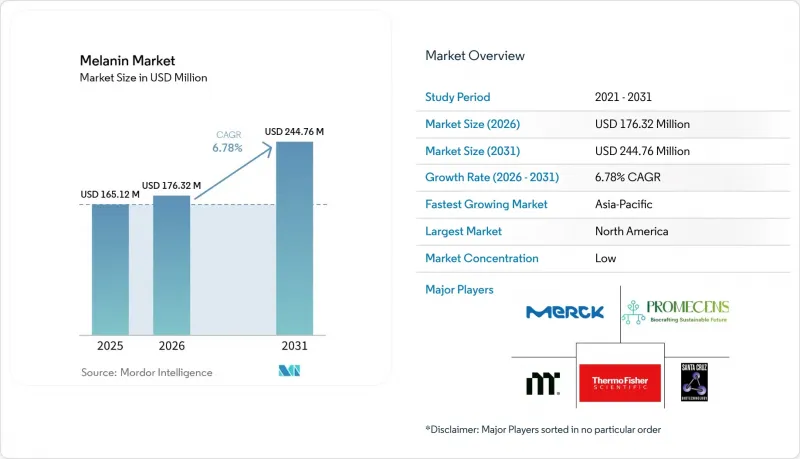
에 따르면 멜라닌 시장 규모는 2025년에 1억 6,512만 달러로 평가되며, 2026년 1억 7,632만 달러에서 2031년까지 2억 4,476만 달러에 달할 것으로 예측되고 있으며, 예측 기간(2026-2031년)에 CAGR은 6.78%에 달할 전망입니다.
세계 멜라닌 시장의 동향 및 인사이트
천연 자외선 차단 성분에 대한 수요 증가
멜라닌은 자외선 C부터 가시광선에 이르는 파장을 흡수하며, 큰 열 부하를 발생시키지 않고 흡수한 에너지를 방출합니다. 이러한 특성으로 인해 멜라닌 시장은 더 광범위한 빛에 대한 노출을 처리하도록 설계된 제품에서 중요한 역할을 하고 있습니다. 멜라닌 및 관련 나노 화장품 소재에 대한 조사에서는 광보호 및 헤어 컬러링에 대한 활용이 보고되고 있는 반면, 안전성과 성능에 대한 증거의 필요성도 지적되고 있습니다. 가시광선이나 장파장 자외선에 노출되면 피부색이 어두운 사람의 경우 색소침착이 악화될 가능성이 있으며, 이에 따라 기존 자외선 차단제 제형의 개선에 대한 압박이 커지고 있습니다. 한 유럽 특허 공개 자료에는 라카아제를 매개로 한 산화에 의해 생성된 수용성 멜라닌이 자외선 차단제 제형에서 자외선 차단 지수(SPF)를 높이는 첨가제로 사용된다고 기재되어 있습니다. 이러한 발전은 멜라닌이 승인된 자외선 필터의 대체재가 아니라 보완적인 성분으로 사용된다는 점을 지원하고 있습니다.
포괄적인 스킨케어와 광보호의 확대
멜라닌 시장은 피츠패트릭 분류 기준 피부 유형 III부터 VI에 이르기까지 가시광선에 대한 반응이 다르다는 점을 인식한 스킨케어 수요에 힘입어 성장하고 있습니다. 피부과학 연구에 따르면 유색 자외선 차단 제품은 근자외선 A 및 가시광선의 투과율에 광범위한 편차가 있으며, 이는 보호 성능에 영향을 미칠 수 있습니다. 멜라닌은 피부에 본래의 광보호 작용을 가지고 있으므로 피부색을 고려한 제품 개발에서 유력한 후보로 떠오르고 있습니다. EltaMD는 2025년, 피부색이 어두운 분들을 위한 ‘Deep Tint’ 시리즈를 출시하며, 이 소비자층에 대한 상업적 관심이 높아지고 있음을 보여주었습니다. Avisa Myko는 2026년 1월, 인도에서 균류 발효를 기반으로 한 바이오 유래 멜라닌 선크림을 출시했습니다. 또한 유럽에서 성분 안전성 요건이 강화됨에 따라 명확한 성분 구성 및 안전성 관련 문서를 제공할 수 있는 공급업체들이 주목받고 있습니다.
복잡한 안전성 및 규제 적합성 요건
규제상 인증 요건으로 인해 멜라닌 시장의 단기적 적용 범위는 제한되어 있습니다. 멜라닌 나노입자는 자외선 차단 가능성을 보여주고 있지만, 미국, 유럽연합(EU), 아세안(ASEAN)의 관련 화장품 규제에서 자외선 차단제로 승인되지 않았습니다. 따라서 필요한 안전성 및 유효성 자료가 승인되지 않는 한, 제형 개발자는 SPF를 포함하지 않는 방식으로 이를 사용해야 합니다. 유럽에서는 나노입자 형태의 제품이 화학물질 등록, 평가, 허가 및 제한(REACH) 체계에 따른 요건을 충족해야 하며, 신고 전에 관련 안전성 평가를 받아야 합니다. 2026년 1월에 시행된 유럽위원회 규정(EU) 2026/78에 따라 발암성, 변이원성 또는 생식독성이 있는 화장품 성분에 대한 규제가 강화되었습니다. 이 규정은 문서화에 대한 투자를 촉진하는 한편, 상품화까지의 비용과 시간을 증가시키고 있습니다.
부문 분석
합성 멜라닌은 2025년 전 세계 멜라닌 시장 규모의 64.67%를 차지하고 있으며, 2026-2031년까지 연평균 성장률(CAGR) 7.23%로 성장할 것으로 예측됩니다. 이러한 위상은 규제 대상인 의약품 및 화장품 용도에서 재현성의 우위를 반영하고 있습니다. 폴리도파민을 이용한 제조법이나 화학적 DOPA 중합을 통해 소정의 분자량 분포를 얻을 수 있습니다. 또한 이러한 방법은 천연 추출법에 비해 더 예측 가능한 자외선 감쇠 프로파일을 제공할 수도 있습니다. 제제 개발자들은 제조 배치 간 일관된 성능이 요구되는 경우, 이러한 제어성을 높이 평가하고 있습니다.
또한 이 부문은 첨단 소재 연구 분야에서도 주도적인 위치를 차지하고 있습니다. 2025년 연구에서는 분자 설계된 셀레늄 멜라닌 나노입자를 통해 1g당 1.76×10¹⁸ 스핀의 지속적인 라디칼 농도가 달성되었습니다. 해당 연구에서는 체중 1kg당 7.5mg의 투여량으로 6Gy의 전신 감마선 조사를 시행한 후, 30일간의 생쥐 생존율이 100%였다고 보고되었습니다. 생체 적합성을 최우선으로 하는 용도에서는 천연 멜라닌이 여전히 중요한 역할을 하고 있습니다. 2026년 실험에서 Thermothelomyces hinnuleus SP1 유래의 진균성 유멜라닌은 SPF 값 10.67을 보였으며, 인간 성인 유래의 저칼슘·고온(HaCaT) 세포의 생존율은 94.9%에서 98.83%였습니다. 수용화법을 활용함으로써, 고부가가치 제제에서 천연 형태의 기능적 역할을 향상시킬 수 있는 가능성이 있습니다.
지역별 분석
2025년, 북미는 멜라닌 시장 점유율의 38.23%를 차지했습니다. 의약품 연구에 대한 막대한 투자와 확립된 퍼스널 케어 제품 제조 체계가 이 지역의 수요를 지원하고 있습니다. 미국에서는 피부과용 의약품 및 자외선 차단 화장품에 대한 수요가 있습니다. 또한 규제 당국의 기대가 높아짐에 따라 공급업체의 품질관리 시스템과 안전 실적의 중요성도 커지고 있습니다. 이에 따라 연구용 등급 및 의약품 등급 원료를 안정적으로 공급할 수 있는 제조사가 유리한 입장에 서게 됩니다.
아시아태평양은 2026-2031년까지 연평균 성장률(CAGR) 7.12%로 성장할 것으로 예측됩니다. 이 지역에서는 중국과 인도의 의약품 제조, 한국과 일본의 화장품 개발, 그리고 아세안(ASEAN) 국가 전반에 걸친 생명공학 생산 능력 확대가 멜라닌 시장을 지원하고 있습니다. 한국과 일본은 각각의 화장품 제형 생태계를 활용하여 색소침착 관리 제품 및 자외선 차단 제품을 개발하고 있습니다. 인도의 Avisa Myko사는 2026년 1월, 곰팡이 발효 유래 멜라닌을 함유한 선크림을 출시했습니다. 중국 국가식품의약품감독관리총국은 2025년 12월, 원료의 안전성과 사용 제한 성분에 초점을 맞춘 2026년 화장품 기준에 관한 제안을 공모했습니다. 이 제안 과정은 지역 공급망 전반에 걸친 바이오 유래 원료 조달 요건을 형성할 가능성이 있습니다.
유럽은 독일, 영국, 프랑스를 통해 중요한 위치를 차지하고 있습니다. 이 지역에서는 제약 분야의 혁신과 지속가능한 화장품 원료에 대한 수요가 융합되고 있습니다. 멜라닌 시장은 규정(EC) 제1223/2009호 및 그 후속 개정안의 준수 영향 하에 있습니다. 북유럽 국가들은 순환형 바이오 기반 공급망에 관심을 보이고 있으며, Melatech ApS는 이 지역의 혁신 그룹에 참여하고 있습니다. 남미, 중동 및 아프리카는 여전히 기여도가 낮은 상황입니다. 이 지역들의 수요는 일조 시간이 길다는 점과 햇빛에 노출된 사람들의 색소침착에 대한 우려를 해소해 주는 제품에 의해 지원되고 있습니다.
기타 혜택:
- 엑셀 형식의 시장 예측(ME) 시트
- 3개월간의 애널리스트 지원
자주 묻는 질문
목차
제1장 서론
- 조사 전제조건과 시장 정의
- 조사 범위
제2장 조사 방법
제3장 개요
제4장 시장 구도
- 시장 개요
- 시장 성장 촉진요인
- 시장 성장 억제요인
- 밸류체인 분석
- Porter's Five Forces 분석
제5장 시장 규모와 성장 예측
- 유형별
- 용도별
- 지역별
- 아시아태평양
- 중국
- 인도
- 일본
- 한국
- ASEAN 국가
- 기타 아시아태평양 국가
- 북미
- 미국
- 캐나다
- 멕시코
- 유럽
- 독일
- 영국
- 프랑스
- 이탈리아
- 북유럽 국가
- 기타 유럽 국가
- 남미
- 브라질
- 아르헨티나
- 기타 남미 국가
- 중동 및 아프리카
- 사우디아라비아
- 남아프리카공화국
- 기타 중동 및 아프리카 국가
- 아시아태평양
제6장 경쟁 구도
- 시장 집중도
- 전략적 동향
- 시장 점유율·순위 분석
- 기업 개요
- Avisa Myko
- Biosynth
- Cayman Chemical
- Cephalosource
- Insectta
- MedChemExpress
- Melatech ApS
- Melsa Biotech Inc.
- Merck KGaA
- Oxyco
- Photoprotective Technologies, Inc.
- Promecens
- Santa Cruz Biotechnology, Inc.
- SimSon Pharma Limited
- Thermo Fisher Scientific Inc.
제7장 시장 기회와 향후 전망
KSA 26.10.28According to Mordor Intelligence, the melanin market size was valued at USD 165.12 million in 2025 and is estimated to grow from USD 176.32 million in 2026 to reach USD 244.76 million by 2031, at a CAGR of 6.78% during the forecast period (2026-2031).
Global Melanin Market Trends and Insights
Rising Demand for Natural UV-Protective Ingredients
Melanin absorbs wavelengths from ultraviolet-C through visible light and dissipates absorbed energy without producing a large thermal burden. This property gives the melanin market a role in products designed to address broader light exposure. Research on melanin and related nanocosmetic materials describes its use in photoprotection and hair coloration, while also noting the need for evidence on safety and performance. Visible light and long-wave ultraviolet exposure can worsen hyperpigmentation in darker skin types, which adds pressure to improve conventional sunscreen formulations. A European patent publication described water-soluble melanin produced through laccase-mediated oxidation for use as a Sun Protection Factor (SPF)-boosting additive in sunscreen compositions. These developments support the use of melanin as a complementary ingredient rather than a replacement for approved ultraviolet filters.
Expansion of Inclusive Skincare and Photoprotection
The melanin market is supported by skincare demand that recognizes different responses to visible light across Fitzpatrick skin types III to VI. Dermatology research reports that tinted sunscreen products show a wide range of near-visible ultraviolet A and visible-light transmittance, which can affect their protection performance. Melanin has a native photoprotective role in skin, making it a relevant candidate for shade-inclusive product development. EltaMD introduced its Deep Tint line for darker skin tones in 2025, illustrating greater commercial attention to this consumer group. Avisa Myko launched a bio-based melanin sunscreen in India in January 2026, based on fungal fermentation. Tighter ingredient safety requirements in Europe also favor suppliers that can provide clear composition and safety documentation.
Complex Safety and Regulatory Qualification Requirements
Regulatory qualification limits the near-term addressable applications of the melanin market. Melanin nanoparticles have shown photoprotective potential, but they are not approved as ultraviolet filters under the relevant United States, European Union, and ASEAN cosmetic rules. Formulators must therefore use them in non-SPF pathways unless the required safety and efficacy dossiers are accepted. In Europe, nanoparticle formats must meet requirements under the Registration, Evaluation, Authorisation and Restriction of Chemicals (REACH) framework and undergo relevant safety assessment before notification. Commission Regulation (EU) 2026/78 strengthened restrictions on carcinogenic, mutagenic, or reprotoxic cosmetic substances in January 2026. The rules encourage investment in documentation but add cost and time before commercial launch.
Other drivers and restraints analyzed in the detailed report include:
- Advances in Synthetic Biology and Microbial Fermentation
- Growth of Melanin-Based Biomedical Research
- High Extraction, Purification, and Formulation Costs
For complete list of drivers and restraints, kindly check the Table Of Contents.
Segment Analysis
Synthetic melanin accounted for 64.67% of the global melanin market size in 2025 and is projected to grow at a 7.23% CAGR from 2026 to 2031. Its position reflects reproducibility advantages in regulated pharmaceutical and cosmetics applications. Polydopamine-based production and chemical DOPA polymerization can provide defined molecular-weight distributions. These methods can also provide more predictable ultraviolet attenuation profiles than natural extraction. Formulators value that control when they need consistent performance across production batches.
The segment also has a lead in advanced materials research. Molecularly engineered selenomelanin nanoparticles achieved a persistent radical concentration of 1.76 X 10¹⁸ spins g-1 in a 2025 study. The study reported 100% 30-day murine survival following 6 Gy total-body gamma-ray irradiation at 7.5 mg kg-1 body weight. Natural melanin remains relevant for applications that prioritize biocompatibility. Fungal eumelanin from Thermothelomyces hinnuleus SP1 demonstrated SPF values of 10.67 and human adult low Calcium high Temperature (HaCaT) cell viability from 94.9% to 98.83% in 2026 testing. Water-solubilization methods may improve the functional role of natural forms in high-value formulations.
Complete Report Scope:
- By Type
- Synthetic Melanin
- Natural Melanin
- By Application
- Pharmaceuticals
- Beauty and Personal Care
- Research and Advanced Materials
- Food, Nutraceuticals, and Functional Ingredients
- Other Applications
- By Geography
- Asia-Pacific
- China
- India
- Japan
- South Korea
- ASEAN Countries
- Rest of Asia-Pacific
- North America
- United States
- Canada
- Mexico
- Europe
- Germany
- United Kingdom
- France
- Italy
- NORDIC Countries
- Rest of Europe
- South America
- Brazil
- Argentina
- Rest of South America
- Middle East and Africa
- Saudi Arabia
- South Africa
- Rest of Middle East and Africa
- Asia-Pacific
Geography Analysis
North America held 38.23% of the melanin market share in 2025. High pharmaceutical research spending and established personal care manufacturing support regional demand. The United States has a demand for dermatological pharmaceuticals and photoprotection cosmetics. Regulatory expectations are also raising the importance of supplier quality systems and safety records. This favors producers that can offer consistent research-grade and pharmaceutical-grade materials.
Asia-Pacific is projected to grow at a 7.12% CAGR from 2026 to 2031. The region supports the melanin market through pharmaceutical manufacturing in China and India, cosmetics development in South Korea and Japan, and expanding biotechnology capacity across ASEAN economies. South Korea and Japan use their cosmetics formulation ecosystems to develop pigmentation-management and ultraviolet-defense products. India's Avisa Myko launched a fungal-fermentation melanin sunscreen in January 2026. China's National Institutes for Food and Drug Control invited proposals for 2026 cosmetic standards focused on raw-material safety and restricted ingredients in December 2025. The proposal process can shape procurement requirements for bio-derived inputs across regional supply chains.
Europe has a significant position through Germany, the United Kingdom, and France. The region combines pharmaceutical innovation with demand for sustainable cosmetic ingredients. The melanin market is influenced by compliance with Regulation (EC) No. 1223/2009 and later amendments. Nordic countries show interest in circular bio-based supply chains, and Melatech ApS participates in this regional innovation group. South America and Middle East and Africa remain smaller contributors. Their demand is supported by high solar exposure and products addressing pigmentation concerns among sun-exposed populations.
- Avisa Myko
- Biosynth
- Cayman Chemical
- Cephalosource
- Insectta
- MedChemExpress
- Melatech ApS
- Melsa Biotech Inc.
- Merck KGaA
- Oxyco
- Photoprotective Technologies, Inc.
- Promecens
- Santa Cruz Biotechnology, Inc.
- SimSon Pharma Limited
- Thermo Fisher Scientific Inc.
Additional Benefits:
- The market estimate (ME) sheet in Excel format
- 3 months of analyst support
TABLE OF CONTENTS
1 Introduction
- 1.1 Study Assumptions and Market Definition
- 1.2 Scope of the Study
2 Research Methodology
3 Executive Summary
4 Market Landscape
- 4.1 Market Overview
- 4.2 Market Drivers
- 4.2.1 Rising Demand for Natural UV-Protective Ingredients
- 4.2.2 Expansion of Inclusive Skincare and Photoprotection
- 4.2.3 Advances in Synthetic Biology and Microbial Fermentation
- 4.2.4 Growth of Melanin-Based Biomedical Research
- 4.2.5 Commercialization of Melanin Bioelectronics and Radiation-Shielding Materials
- 4.3 Market Restraints
- 4.3.1 Complex Safety and Regulatory Qualification Requirements
- 4.3.2 High Extraction, Purification, and Formulation Costs
- 4.3.3 Batch-to-Batch Variability in Bio-Derived Melanin
- 4.4 Value Chain Analysis
- 4.5 Porter's Five Forces Analysis
- 4.5.1 Threat of New Entrants
- 4.5.2 Bargaining Power of Suppliers
- 4.5.3 Bargaining Power of Buyers
- 4.5.4 Threat of Substitutes
- 4.5.5 Competitive Rivalry
5 Market Size and Growth Forecasts (Value)
- 5.1 By Type
- 5.1.1 Synthetic Melanin
- 5.1.2 Natural Melanin
- 5.2 By Application
- 5.2.1 Pharmaceuticals
- 5.2.2 Beauty and Personal Care
- 5.2.3 Research and Advanced Materials
- 5.2.4 Food, Nutraceuticals, and Functional Ingredients
- 5.2.5 Other Applications
- 5.3 By Geography
- 5.3.1 Asia-Pacific
- 5.3.1.1 China
- 5.3.1.2 India
- 5.3.1.3 Japan
- 5.3.1.4 South Korea
- 5.3.1.5 ASEAN Countries
- 5.3.1.6 Rest of Asia-Pacific
- 5.3.2 North America
- 5.3.2.1 United States
- 5.3.2.2 Canada
- 5.3.2.3 Mexico
- 5.3.3 Europe
- 5.3.3.1 Germany
- 5.3.3.2 United Kingdom
- 5.3.3.3 France
- 5.3.3.4 Italy
- 5.3.3.5 NORDIC Countries
- 5.3.3.6 Rest of Europe
- 5.3.4 South America
- 5.3.4.1 Brazil
- 5.3.4.2 Argentina
- 5.3.4.3 Rest of South America
- 5.3.5 Middle East and Africa
- 5.3.5.1 Saudi Arabia
- 5.3.5.2 South Africa
- 5.3.5.3 Rest of Middle East and Africa
- 5.3.1 Asia-Pacific
6 Competitive Landscape
- 6.1 Market Concentration
- 6.2 Strategic Moves
- 6.3 Market Share (%)/Ranking Analysis
- 6.4 Company Profiles (includes Global Overview, Market Overview, Core Segments, Financials as available, Strategic Information, Products and Services, and Recent Developments)
- 6.4.1 Avisa Myko
- 6.4.2 Biosynth
- 6.4.3 Cayman Chemical
- 6.4.4 Cephalosource
- 6.4.5 Insectta
- 6.4.6 MedChemExpress
- 6.4.7 Melatech ApS
- 6.4.8 Melsa Biotech Inc.
- 6.4.9 Merck KGaA
- 6.4.10 Oxyco
- 6.4.11 Photoprotective Technologies, Inc.
- 6.4.12 Promecens
- 6.4.13 Santa Cruz Biotechnology, Inc.
- 6.4.14 SimSon Pharma Limited
- 6.4.15 Thermo Fisher Scientific Inc.
7 Market Opportunities and Future Outlook
- 7.1 White-Space and Unmet-Need Assessment


