

|
시장보고서
상품코드
2154948
소화기계 OTC 의약품 : 시장 점유율 분석, 업계 동향과 통계, 성장 예측(2026-2031년)Gastrointestinal OTC Drugs - Market Share Analysis, Industry Trends & Statistics, Growth Forecasts (2026 - 2031) |
||||||
 Mordor Intelligence
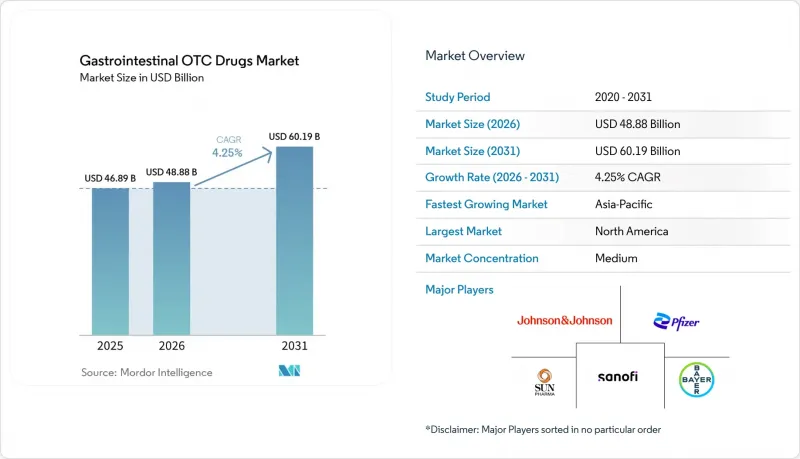
에 따르면 위장계 OTC 의약품 시장 규모는 2025년에 468억 9,000만 달러로 평가되며, 2026년 488억 8,000만 달러에서 2031년까지 601억 9,000만 달러에 달할 것으로 추정되고 있으며, 예측 기간(2026-2031년)에 CAGR은 4.25%에 달할 전망입니다.
전 세계 위장계 일반의약품 시장의 동향 및 인사이트
속쓰림, 변비 및 급성 위장 증상의 부담 증가
위장계 일반의약품 시장은 속쓰림, 변비 및 급성 소화기 증상이 반복적으로 발생함에 따라 혜택을 보고 있으며, 소비자들은 일반적으로 처방전 없이 이러한 증상을 관리하고 있습니다. 식습관, 앉아 있는 생활 방식, 고령화 및 비만이 제산제 및 변비약에 대한 수요를 지원하고 있으며, 비만은 위식도 역류 질환(GERD)과 변비 모두와 관련이 있습니다. 속쓰림과 소화불량은 저가의 제산제 및 산 분비 억제 제품에 대한 수요를 지원하는 반면, 식이섬유 섭취 부족과 운동 부족은 완하제 수요를 촉진했습니다. 2026년, 한 체계적 문헌인사이트에 따르면 GLP-1 수용체 작용제 투여를 시작한 환자의 50%-60%에서 소화기 계통의 부작용이 보고되었으며, 이는 제산제, 설사약, 식이섬유 제품 및 구토 억제제의 수요를 지원하고 있습니다.
OTC로의 전환 및 산 억제 요법에 대한 접근성 확대
위장계 일반의약품(OTC) 시장은 산 억제 요법의 처방약에서 일반의약품(OTC)으로의 전환에 힘입어 성장세를 보였습니다. 일본에서는 2025년에 라베프라졸 제제인 ‘파리에트 S’의 처방약에서 일반의약품(OTC)으로의 전환이 승인되었으며, 이후 에자이가 일본 최초로 처방약에서 일반의약품(OTC)으로 전환된 프로톤 펌프 억제제로 이를 출시했습니다. 미국에서는 2025년 5월 27일 FDA의 ‘비처방약 사용에 관한 추가 조건’ 규정이 시행되어, 표시 정보만으로는 불충분한 경우 기술 지원 절차나 약사의 상담 등 추가 조건이 허용되게 되었습니다. 이러한 움직임으로 소비자의 접근성은 확대되었으나, 약사의 지도 필요성도 높아지는 한편, 소매업체 및 제네릭 의약품 공급업체 간의 가격 경쟁도 격화되었습니다.
장기적인 산 분비 억제에 대한 안전성 우려와 오용
안전성에 대한 우려로 인해 적절한 지도 없이 산 분비 억제 제품을 반복적으로 사용하는 것은 제한되었습니다. 2025년 및 2026년에 발표된 리뷰에서는 프로톤 펌프 억제제의 장기 사용과 몇 가지 건강 결과 간의 잠재적 연관성이 논의되었으나, 일부 사례에서는 인과 관계를 입증하는 것이 여전히 어려웠습니다. 이러한 우려로 인해 약사 및 의료 종사자들은 반복되는 자가 치료에 대해 더욱 신중해졌습니다. 위장계 일반의약품(OTC) 시장에서는 접근 용이성과 명확한 사용법, 진료 상담, 적절한 표시 간의 균형을 모색해야 했습니다. 또한 지역 약국은 특히 처방약 수준의 치료제가 일반의약품으로 구입 가능해짐에 따라 소비자가 가끔 발생하는 속쓰림과 의사의 진찰이 필요한 증상을 구별할 수 있도록 지원했습니다.
부문 분석
2025년 기준, 약제 분류별 위장계 일반의약품 시장 점유율 중 제산제가 28.67%를 차지했습니다. 이러한 주도적인 위상은 폭넓은 접근성, 합리적인 가격, 그리고 1-5분 이내에 일시적인 증상을 신속하게 완화하는 효과를 반영한 것입니다. 설사약, 설사 억제제, 구토 억제제, 그리고 파모티딘이나 시메티딘을 주성분으로 하는 제품을 포함한 H2 수용체 길항제도 자가 관리되는 위장 질환 분야에서 수요를 유지했습니다.
프로톤 펌프 억제제(PPI)는 2026-2031년까지 연평균 성장률(CAGR) 5.67%로 가장 높은 성장률을 기록할 것으로 예측됩니다. 일본의 2025년 스위치 승인 및 미국의 ACNU 패스웨이를 통해 재발성 역류성 식도염 관리에 있으며, PPI에 대한 접근성이 향상되었습니다. PPI는 지속적인 산 분비 억제 효과를 제공하지만, 안전성에 대한 우려로 인해 약사의 지도 필요성이 높아지고 있으며, 소화 효소, 시메티콘 및 전문 제품에 대한 수요를 지원하고 있습니다.
2025년, 속쓰림 및 소화불량은 적응증별 시장 점유율의 32.44%를 차지했습니다. 위장계 일반의약품(OTC) 시장은 식후 단기적인 불편감이나 재발성 증상의 관리에 대응하고 있으며, 즉각적인 증상 완화를 위해 제산제가 일반적으로 사용되고 있습니다. 변비, 설사, 메스꺼움, 구토, 가스, 복부 팽만감 또한 시메티콘이나 프로바이오틱스를 주성분으로 하는 제품을 포함한 자가치료 제품의 수요를 지원했습니다.
GERD(위식도 역류 질환) 시장은 2026-2031년까지 연평균 성장률(CAGR) 6.23%로 성장할 것으로 예측됩니다. 이 부문은 지속적인 산 억제 수요를 반영하고 있으며, 소비자들은 기존의 제산제보다 PPI(프로톤 펌프 억제제)나 H2 수용체 길항제를 선호하는 경향이 있습니다. 규제 변경으로 인해 약국에서 제품을 쉽게 구입할 수 있게 되었지만, 증상이 지속될 경우 약사의 지도가 필요하며, 의사의 진찰이 필요한 경우도 있습니다.
지역별 분석
북미는 OTC 헬스케어에 대한 높은 지출과 성숙한 소매 약국 인프라에 힘입어 2025년 위장계 OTC 의약품 시장 점유율의 40.44%를 차지했습니다. 2025년 5월에 발효된 FDA의 ACNU 규정은 안전한 사용을 위해 추가 조건이 필요한 제품의 일반의약품 전환을 촉진했습니다. 이 프레임워크는 향후 산 억제제 및 설사약 제품의 일반의약품 전환을 촉진할 가능성이 있습니다. 캐나다는 미국의 규제 기준을 거의 따르고 있는 반면, 멕시코는 COFEPRIS의 체계를 따랐습니다.
유럽은 여전히 2위 지역 시장이었으나, 국가별 요건이 제휴 제품 출시 속도를 늦추고 있었습니다. 프랑스, 이탈리아, 스페인에서는 지역 약국이 제품 선택을 돕거나 지속적인 증상에 대해 의료 기관으로의 의뢰를 진행하는 등 중요한 조언자 역할을 수행했습니다. 영국과 독일에서는 자체 브랜드 간의 경쟁이 여전히 치열하여, 슈퍼마켓과 약국 진열대의 상당 부분을 자체 브랜드 제품이 차지하고 있었습니다. 이 지역에서는 자가 관리에 대한 강한 수요와 가격 책정 및 전문가의 지도에 대한 중시가 결합되어 있었습니다.
아시아태평양은 2026-2031년까지 연평균 성장률(CAGR) 6.98%로 성장할 것으로 예측됩니다. 중국은 도시 지역의 E-Commerce 접근성에 힘입어 2025년 아시아태평양 OTC 의약품 시장의 36.05%를 차지했으나, 인도는 하위 지역 중 가장 높은 연평균 성장률(CAGR)을 기록할 것으로 전망됩니다. 바이엘은 인도에서 ‘알카셀처’의 판매망을 10만개 점포로 확대하고, 4년 동안 1억 가구를 목표로 하고 있습니다. 남미, 중동 및 아프리카에서는 약국 네트워크 확대, 자가 치료 관련 규제, 디지털 소매에 대한 접근성 확대를 통해 장기적인 성장 가능성이 전망됩니다.
기타 혜택:
- 엑셀 형식의 시장 예측(ME) 시트
- 3개월간의 애널리스트 지원
자주 묻는 질문
목차
제1장 서론
- 조사 전제조건과 시장 정의
- 조사 범위
제2장 조사 방법
제3장 개요
제4장 시장 구도
- 시장 개요
- 시장 성장 촉진요인
- 시장 성장 억제요인
- 밸류·공급망 분석
- 규제 상황
- 기술 전망
- Porter's Five Forces 분석
제5장 시장 규모와 성장 예측
- 약제 클래스별
- 적응증별
- 제제별
- 투여 경로별
- 유통 채널별
- 지역별
- 북미
- 미국
- 캐나다
- 멕시코
- 유럽
- 독일
- 영국
- 프랑스
- 이탈리아
- 스페인
- 기타 유럽 국가
- 아시아태평양
- 중국
- 인도
- 일본
- 호주
- 한국
- 기타 아시아태평양 국가
- 중동 및 아프리카
- GCC
- 남아프리카공화국
- 기타 중동 및 아프리카 국가
- 남미
- 브라질
- 아르헨티나
- 기타 남미 국가
- 북미
제6장 경쟁 구도
- 시장 집중도
- 시장 점유율 분석
- 기업 개요
- Abbott Laboratories
- Alkem Laboratories Limited
- Bayer AG
- Boehringer Ingelheim International GmbH
- Cipla Limited
- Dr. Reddy's Laboratories Limited
- Haleon plc
- Johnson & Johnson
- Kenvue Inc.
- Nestle S.A.
- Perrigo Company plc
- Pfizer Inc.
- Prestige Consumer Healthcare Inc.
- Reckitt Benckiser Group plc
- Sanofi
- Sun Pharmaceutical Industries Limited
- Takeda Pharmaceutical Company Limited
- Teva Pharmaceutical Industries Limited
- The Procter & Gamble Company
- Zydus Lifesciences Limited
제7장 시장 기회와 향후 전망
KSA 26.10.28According to Mordor Intelligence, the gastrointestinal OTC drugs market size was valued at USD 46.89 billion in 2025 and is estimated to grow from USD 48.88 billion in 2026 to reach USD 60.19 billion by 2031, at a CAGR of 4.25% during the forecast period (2026-2031).
Global Gastrointestinal OTC Drugs Market Trends and Insights
Rising Burden of Heartburn, Constipation, and Acute Gastrointestinal Symptoms
The gastrointestinal OTC drugs market benefited from the recurring prevalence of heartburn, constipation, and acute digestive symptoms, which consumers commonly managed without prescriptions. Dietary habits, sedentary lifestyles, aging populations, and obesity sustained demand for acid-relief and constipation products, with obesity linked to both GERD and constipation. Heartburn and indigestion supported demand for low-cost antacids and acid-suppression products, while low fiber intake and limited activity drove laxative demand. In 2026, a systematic review reported gastrointestinal adverse effects in 50%-60% of patients initiating GLP-1 receptor agonists, supporting demand for antacids, anti-diarrheals, fiber products, and anti-emetics.
OTC Switches and Broader Access to Acid-Control Therapies
The gastrointestinal OTC drugs market gained momentum from prescription-to-OTC switches for acid-control therapies. Japan approved the Rx-to-OTC switch of Pariet S, a rabeprazole product, in 2025, and Eisai subsequently launched it as Japan's first proton pump inhibitor to transition from prescription status to OTC availability. In the United States, the FDA's Additional Condition for Nonprescription Use rule became effective on May 27, 2025, enabling additional conditions such as technology-assisted processes or pharmacist consultation when labeling alone was insufficient. These developments expanded consumer access but also increased the need for pharmacist guidance, while creating greater price competition from retailers and generic suppliers.
Safety Concerns and Misuse of Long-Term Acid Suppression
Safety concerns limited the repeat use of acid-suppression products without appropriate guidance. Reviews published in 2025 and 2026 discussed potential associations between long-term proton pump inhibitor use and several health outcomes, although causal relationships remained difficult to establish in some cases. These concerns made pharmacists and healthcare providers more cautious about repeated self-treatment. The gastrointestinal OTC drugs market needed to balance accessibility with clear use instructions, referral guidance, and appropriate labeling. Community pharmacies also helped consumers distinguish occasional heartburn from symptoms requiring medical assessment, particularly as more prescription-grade therapies became available over the counter.
Other drivers and restraints analyzed in the detailed report include:
- E-Commerce and Omnichannel Availability of Digestive-Health Products
- GLP-1-Associated Gastrointestinal Symptom Management
- Retailer Private-Label and Price-Led Substitution
For complete list of drivers and restraints, kindly check the Table Of Contents.
Segment Analysis
Antacids held 28.67% of the gastrointestinal OTC drugs market share by drug class in 2025. Their leading position reflected broad availability, affordable pricing, and rapid relief for occasional symptoms within 1-5 minutes. Laxatives, antidiarrheals, antiemetics, and H2 receptor antagonists, including famotidine- and cimetidine-based products, also maintained demand across self-managed gastrointestinal conditions.
Proton pump inhibitors (PPIs) are forecast to record the highest growth at a CAGR of 5.67% from 2026 to 2031. Japan's 2025 switch approvals and the U.S. ACNU pathway supported access to PPIs for recurring reflux management. While PPIs provide sustained acid suppression, safety concerns reinforce the need for pharmacist guidance and support demand for digestive enzymes, simethicone, and specialty products.
Heartburn and indigestion held 32.44% of the indication-based market share in 2025. The gastrointestinal OTC drugs market addressed short-term post-meal discomfort and recurring symptom management, with antacids commonly used for immediate relief. Constipation, diarrhea, nausea, vomiting, gas, flatulence, and bloating also supported demand for self-medication products, including simethicone and probiotic-oriented offerings.
GERD is forecast to grow at a CAGR of 6.23% from 2026 to 2031. This segment reflects demand for sustained acid control, leading consumers to prefer PPIs and H2 receptor antagonists over traditional antacids. Regulatory switches improved pharmacy access; however, persistent symptoms require pharmacist guidance and may need medical evaluation.
Complete Report Scope:
- By Drug Class
- Antacids
- Laxatives
- Anti-Diarrheals
- Anti-Emetics
- Proton Pump Inhibitors
- H2-Receptor Antagonists
- Digestive Enzymes, Simethicone, and Other Products
- By Indication
- Heartburn and Indigestion
- Gastroesophageal Reflux Disease
- Constipation
- Diarrhea
- Nausea and Vomiting
- Motion Sickness
- Gas, Flatulence, and Bloating
- Others
- By Formulation
- Tablets
- Chewable Tablets and Gummies
- Capsules and Softgels
- Liquids and Suspensions
- Effervescent Granules and Tablets
- Fast-Dissolve Strips and Powders
- Others
- By Route of Administration
- Oral
- Topical
- Rectal
- By Distribution Channel
- Retail Pharmacies
- Hospital Pharmacies
- Supermarkets and Hypermarkets
- Online Pharmacies
- Others
- By Geography
- North America
- United States
- Canada
- Mexico
- Europe
- Germany
- United Kingdom
- France
- Italy
- Spain
- Rest of Europe
- Asia-Pacific
- China
- India
- Japan
- Australia
- South Korea
- Rest of Asia-Pacific
- Middle East and Africa
- GCC
- South Africa
- Rest of Middle East and Africa
- South America
- Brazil
- Argentina
- Rest of South America
- North America
Geography Analysis
North America held 40.44% of the gastrointestinal OTC drugs market share in 2025, supported by high OTC healthcare spending and mature retail pharmacy infrastructure. The FDA's ACNU rule, effective in May 2025, supported nonprescription access for products requiring additional conditions for safe use. This framework could support future switches for acid-control and anti-diarrheal products. Canada aligned closely with U.S. regulatory standards, while Mexico followed the COFEPRIS framework.
Europe remained the second-largest regional market, although country-specific requirements slowed coordinated product launches. Community pharmacies played a key advisory role in France, Italy, and Spain by supporting product selection and referrals for persistent symptoms. Private-label competition remained significant in the United Kingdom and Germany, where store brands occupied substantial supermarket and pharmacy shelf space. The region combined strong self-care demand with a focus on pricing and professional guidance.
Asia-Pacific is forecast to grow at a CAGR of 6.98% from 2026 to 2031. China held 36.05% of the Asia-Pacific OTC drugs market in 2025, supported by urban e-commerce access, while India is expected to register the highest sub-regional CAGR. Bayer expanded Alka-Seltzer in India across 100,000 retail outlets, targeting 100 million households over four years. South America, the Middle East, and Africa offer long-term potential through expanding pharmacy networks, self-care regulations, and digital retail access.
- Abbott Laboratories
- Alkem Laboratories Limited
- Bayer
- Boehringer Ingelheim
- Cipla
- Dr. Reddy's Laboratories
- Haleon plc
- Johnson & Johnson
- Kenvue Inc.
- Nestle S.A.
- Perrigo Company
- Pfizer
- Prestige Consumer Healthcare
- Reckitt Benckiser Group
- Sanofi
- Sun Pharmaceuticals Industries
- Takeda Pharmaceuticals
- Teva Pharmaceutical Industries
- Procter & Gamble
- Zydus Lifesciences Limited
Additional Benefits:
- The market estimate (ME) sheet in Excel format
- 3 months of analyst support
TABLE OF CONTENTS
1 INTRODUCTION
- 1.1 Study Assumptions and Market Definition
- 1.2 Scope of the Study
2 RESEARCH METHODOLOGY
3 EXECUTIVE SUMMARY
4 MARKET LANDSCAPE
- 4.1 Market Overview
- 4.2 Market Drivers
- 4.2.1 Rising Burden of Heartburn, Constipation, and Acute Gastrointestinal Symptoms
- 4.2.2 Expansion of Self-Care and Pharmacist-Led Treatment
- 4.2.3 OTC Switches and Broader Access to Acid-Control Therapies
- 4.2.4 E-Commerce and Omnichannel Availability of Digestive-Health Products
- 4.2.5 Consumer Shift Toward Proactive Gut-Health Solutions
- 4.2.6 GLP-1-Associated Gastrointestinal Symptom Management
- 4.3 Market Restraints
- 4.3.1 Safety Concerns and Misuse of Long-Term Acid Suppression
- 4.3.2 Diagnostic Substitution and Delayed Referral for Alarm Symptoms
- 4.3.3 Regulatory and Evidence Complexity for Probiotic and Herbal Claims
- 4.3.4 Retailer Private-Label and Price-Led Substitution
- 4.4 Value/Supply-Chain Analysis
- 4.5 Regulatory Landscape
- 4.6 Technological Outlook
- 4.7 Porter's Five Forces Analysis
- 4.7.1 Threat of New Entrants
- 4.7.2 Bargaining Power of Suppliers
- 4.7.3 Bargaining Power of Buyers
- 4.7.4 Threat of Substitutes
- 4.7.5 Intensity of Competitive Rivalry
5 MARKET SIZE AND GROWTH FORECASTS (VALUE, USD)
- 5.1 By Drug Class
- 5.1.1 Antacids
- 5.1.2 Laxatives
- 5.1.3 Anti-Diarrheals
- 5.1.4 Anti-Emetics
- 5.1.5 Proton Pump Inhibitors
- 5.1.6 H2-Receptor Antagonists
- 5.1.7 Digestive Enzymes, Simethicone, and Other Products
- 5.2 By Indication
- 5.2.1 Heartburn and Indigestion
- 5.2.2 Gastroesophageal Reflux Disease
- 5.2.3 Constipation
- 5.2.4 Diarrhea
- 5.2.5 Nausea and Vomiting
- 5.2.6 Motion Sickness
- 5.2.7 Gas, Flatulence, and Bloating
- 5.2.8 Others
- 5.3 By Formulation
- 5.3.1 Tablets
- 5.3.2 Chewable Tablets and Gummies
- 5.3.3 Capsules and Softgels
- 5.3.4 Liquids and Suspensions
- 5.3.5 Effervescent Granules and Tablets
- 5.3.6 Fast-Dissolve Strips and Powders
- 5.3.7 Others
- 5.4 By Route of Administration
- 5.4.1 Oral
- 5.4.2 Topical
- 5.4.3 Rectal
- 5.5 By Distribution Channel
- 5.5.1 Retail Pharmacies
- 5.5.2 Hospital Pharmacies
- 5.5.3 Supermarkets and Hypermarkets
- 5.5.4 Online Pharmacies
- 5.5.5 Others
- 5.6 By Geography
- 5.6.1 North America
- 5.6.1.1 United States
- 5.6.1.2 Canada
- 5.6.1.3 Mexico
- 5.6.2 Europe
- 5.6.2.1 Germany
- 5.6.2.2 United Kingdom
- 5.6.2.3 France
- 5.6.2.4 Italy
- 5.6.2.5 Spain
- 5.6.2.6 Rest of Europe
- 5.6.3 Asia-Pacific
- 5.6.3.1 China
- 5.6.3.2 India
- 5.6.3.3 Japan
- 5.6.3.4 Australia
- 5.6.3.5 South Korea
- 5.6.3.6 Rest of Asia-Pacific
- 5.6.4 Middle East and Africa
- 5.6.4.1 GCC
- 5.6.4.2 South Africa
- 5.6.4.3 Rest of Middle East and Africa
- 5.6.5 South America
- 5.6.5.1 Brazil
- 5.6.5.2 Argentina
- 5.6.5.3 Rest of South America
- 5.6.1 North America
6 COMPETITIVE LANDSCAPE
- 6.1 Market Concentration
- 6.2 Market Share Analysis
- 6.3 Company Profiles (includes Global Level Overview, Market Level Overview, Core Segments, Financials as available, Strategic Information, Market Rank/Share, Products and Services, Recent Developments)
- 6.3.1 Abbott Laboratories
- 6.3.2 Alkem Laboratories Limited
- 6.3.3 Bayer AG
- 6.3.4 Boehringer Ingelheim International GmbH
- 6.3.5 Cipla Limited
- 6.3.6 Dr. Reddy's Laboratories Limited
- 6.3.7 Haleon plc
- 6.3.8 Johnson & Johnson
- 6.3.9 Kenvue Inc.
- 6.3.10 Nestle S.A.
- 6.3.11 Perrigo Company plc
- 6.3.12 Pfizer Inc.
- 6.3.13 Prestige Consumer Healthcare Inc.
- 6.3.14 Reckitt Benckiser Group plc
- 6.3.15 Sanofi
- 6.3.16 Sun Pharmaceutical Industries Limited
- 6.3.17 Takeda Pharmaceutical Company Limited
- 6.3.18 Teva Pharmaceutical Industries Limited
- 6.3.19 The Procter & Gamble Company
- 6.3.20 Zydus Lifesciences Limited
7 MARKET OPPORTUNITIES AND FUTURE OUTLOOK
- 7.1 White-Space and Unmet-Need Assessment


