

|
시장보고서
상품코드
2154979
벤즈알데히드 : 시장 점유율 분석, 업계 동향과 통계, 성장 예측(2026-2031년)Benzaldehyde - Market Share Analysis, Industry Trends & Statistics, Growth Forecasts (2026 - 2031) |
||||||
 Mordor Intelligence
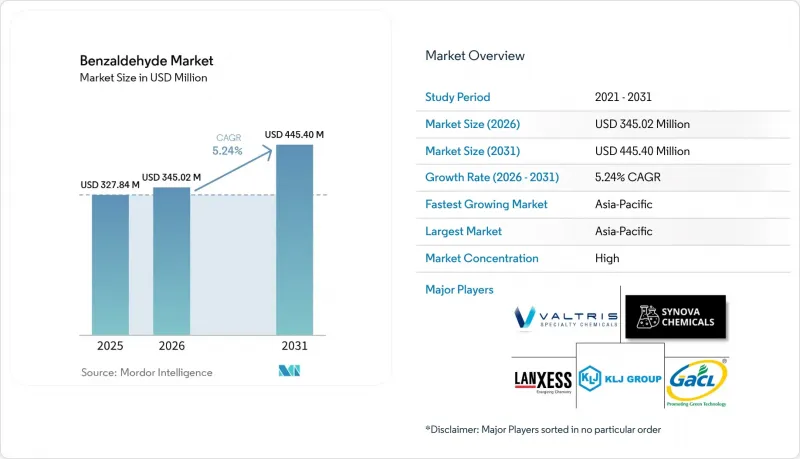
에 따르면 벤즈알데히드 시장 규모는 2025년에 3억 2,784만 달러로 평가되며, 2026년 3억 4,502만 달러에서 2031년까지 4억 4,540만 달러에 달할 것으로 예측되고 있으며, 예측 기간(2026-2031년)에 CAGR은 5.24%에 달할 전망입니다.
전 세계 벤즈알데히드 시장의 동향 및 인사이트
의약품 중간체 생산 확대
벤즈알데히드는 슈도에페드린, 페닐글리신 및 일부 강압제 유효 성분의 전구체로 기능합니다. 제약 기업의 구매자들은 신뢰할 수 있는 순도, 추적 가능한 문서 및 일관된 로트를 요구하고 있습니다. '식품화학코덱스' 및 '유럽약전'의 요건에 따라 의약품 등급 원료와 산업용 등급 원료가 구분됩니다. 중국은 2024년에 강력한 생산 능력을 보유하고 있었으나, 고순도 의약품 등급 원료에 대해서는 여전히 수입에 의존할 수밖에 없었습니다. 이러한 격차로 인해 엄격한 사양을 충족할 수 있는 국내 생산 능력에 대한 투자가 촉진되고 있습니다. 벤즈알데히드 시장에서는 99.95%의 순도를 유지하고 완벽한 로트 기록을 제공할 수 있는 공급업체가 높이 평가됩니다. 이러한 요건으로 인해 신뢰할 수 있는 정제, 분석 시험 및 로트 출하 관리가 공급업체 선정의 핵심 요소가 되고 있습니다. 또한 이는 고객이 규제 대상 제품 포트폴리오를 관리할 때 신뢰할 수 있는 문서를 더욱 중요하게 여긴다는 것을 의미합니다.
향료 및 프래그런스 배합의 성장
향료·프래그런스 분야의 수요에는 프리미엄 제품 및 클린 라벨 제품용 천연 벤즈알데히드 외에도, 산업용 식품 가공 및 대중용 퍼스널 케어 제품용 합성 원료가 포함됩니다. 벤즈알데히드는 우수 제조 기준(GMP)에 따라 식품 향료로 사용될 경우, 미국 식품의약국(FDA)으로부터 ‘일반적으로 안전하다고 인정되는(GRAS)’ 인증을 받았습니다. 유엔 식량농업기구(FAO) 및 세계보건기구(WHO)의 지침에 따르면 식품, 화장품, 의약품에서의 사용이 허용되며, 벤조산 환산 기준으로 체중 1kg당 하루 5mg의 허용 일일 섭취량(ADI)이 설정되어 있습니다. 이러한 용도는 제과, 과자, 음료, 향료, 퍼스널 케어 제품에 이르기까지 다양한 분야의 수요를 지원하고 있습니다. 동일한 화학 물질이 여러 배합 범주에 활용될 수 있으므로 벤즈알데히드 시장은 그 혜택을 누리고 있습니다.
톨루엔 원료 가격의 변동
톨루엔의 공급 상황과 가격은 벤즈알데히드 생산의 수익성에 영향을 미칠 수 있습니다. 원유 및 나프타 시황의 변동은 방향족 원료 비용에 파급될 가능성이 있습니다. 이러한 변동으로 인해 이익률이 축소되고, 고정 가격 공급 계약의 매력이 떨어질 우려가 있습니다. 그 결과, 하류 의약품 및 식품 구매자는 계약 조건에 대한 확실성을 잃을 수 있습니다. 톨루엔 공급원에 직접 접근할 수 없는 생산자는 원가 상승기에 큰 압박에 직면할 우려가 있습니다. 벤즈알데히드 시장은 중국, 인도 및 기타 아시아 공급 거점에서 이러한 위험에 노출되어 있습니다.
부문 분석
벤조산은 2025년 벤잘데히드 시장 점유율의 33.45%를 차지하고 있으며, 2031년까지 연평균 성장률(CAGR) 6.13%로 확대될 것으로 예측됩니다. 그 수요는 벤조산나트륨을 이용한 식품 보존, 의약품 첨가제 및 알키드 수지 생산에 의해 지원되고 있습니다. 벤조산용 벤잘데히드 시장 규모는 소비자용 및 산업용 밸류체인 모두에서의 용도에 의해 지원되고 있습니다. 벤조산 나트륨에 대한 수요는 아시아태평양의 가공 식품 소비와 밀접한 관련이 있습니다. 의약품 합성도 이 유도체의 확립된 용도 중 하나입니다. LANXESS는 네덜란드 보트렉 공장에서 ISO 14067 탄소발자국 조사 방법론 및 ‘International Sustainability and Carbon Certification Plus’ 인증에 따라 ‘Purox B’ 벤조산을 생산하고 있습니다. 이러한 인증은 규정 준수가 어떻게 프리미엄 포지셔닝을 지원하는지를 보여줍니다. 이 유도체는 방부제, 의약품, 수지 용도로 사용되므로 공급업체는 고객마다 다른 기대에 부응해야 합니다. 식품 보존 용도에서는 안정적인 규제 관련 문서가 요구되는 반면, 의약품 용도에서는 더 높은 순도가 요구되며, 수지 고객은 신뢰할 수 있는 산업적 성능을 중시하는 경우가 있습니다. 이러한 요구 사항으로 인해 제품 포트폴리오는 단일 최종 용도 범주에 국한되지 않고 폭넓게 확장되고 있습니다. 이러한 다양성으로 인해 벤즈알데히드 시장 전체에서 제품 등급 및 관련 문서가 중요한 요소로 대두되고 있습니다.
벤질알코올은 의약품용 용매, 화장품용 방부제 및 산업용 코팅제로 사용되고 있습니다. 벤조산나트륨은 아세안(ASEAN) 및 남아시아 전역의 가공식품 시장 확대에 힘입어 계속해서 수혜를 입고 있습니다. 카네펠산은 향료 배합 및 자외선 흡수제 합성에 사용됩니다. 벤조인 및 만델산의 중간체는 규모는 작지만 고부가가치 유도체 용도로 자리 잡고 있습니다. 염소화 경로를 통한 표준 등급의 벤조산은 중국에서 대량으로 공급되고 있습니다. 한편, 미국 약전(National Formulary), 식품 화학 물질 코덱스(Food Chemicals Codex), 유럽 약전(European Pharmacopoeia)의 요건을 충족하는 의약품 등급의 벤조산은 여전히 공급이 부족한 상황입니다. 따라서 벤즈알데히드 업계에서는 표준 등급과 규제 대상인 유도체 등급에서 각각 상이한 경쟁 환경이 형성되고 있습니다.
지역별 분석
아시아태평양은 2025년 벤즈알데히드 시장 점유율의 40.38%를 차지하고 있으며, 2031년까지 연평균 성장률(CAGR) 5.89%로 확대될 것으로 예측됩니다. 중국은 생산 규모를 제공하고, 인도는 생산을 확대하고 있으며, 아세안(ASEAN)은 소비를 늘리고 있습니다. 장쑤성, 산둥성, 저장성이 중국의 핵심 생산 지역을 형성하고 있습니다. 아시아태평양의 벤즈알데히드 시장 규모는 식품 가공 및 퍼스널 케어 분야의 수요에 힘입어 성장하고 있습니다. 이 지역에는 주요 생산 거점과 다수의 하류 제조 고객사가 집중되어 있습니다. 이러한 조합은 지역내 공급 체계를 유지할 뿐만 아니라 타 지역으로의 수출도 촉진하고 있습니다.
구자라트 알칼리 앤드 케미컬스(Gujarat Alkalis & Chemicals)는 2025년 7월부터 다헤지 공장에서 벤즈알데히드 출하를 시작했습니다. 이 공장의 벤즈알데히드 생산 능력은 연간 7,200메트릭톤이며, 인도 최대 클로로톨루엔 제조 시설이기도 합니다. 이번 증산으로 의약품, 향수, 향료, 용제 용도를 위한 국내 공급이 확보됩니다. 또한 이 생산 능력은 유럽, 미국, 남아시아의 수출 고객사에 대한 공급 선택지도 창출합니다. 일본과 한국은 의약품 등급 원료에 대한 고부가가치 수요 거점입니다. 아세안(ASEAN) 국가들은 식품 가공 및 퍼스널 케어 제품 제조가 발전함에 따라 중요한 소비국으로 부상하고 있습니다. 이를 통해 지역 생산자들은 이미 확립된 고부가가치 시장과 발전 중인 시장 모두의 수요에 접근할 수 있게 됩니다. 또한 인도는 벤즈알데히드 시장에서 생산 거점 및 소비 거점으로서의 역할을 확대하고 있습니다.
북미는 의약품 등급 및 식품 화학 물질 코덱스(FCC) 등급 벤즈알데히드에 대한 수요가 활발한 지역입니다. LANXESS는 미국 칼라마 공장에서 염소를 사용하지 않는 산화법을 채택하여 식품 및 향료 컴파운더에 인증된 원료를 공급하고 있습니다. 유럽에서는 방향족 알데히드에 대해 엄격한 등록 및 품질 요건이 마련되어 있습니다. 독일, 영국, 프랑스 및 북유럽 국가들은 향료, 의약품 합성, 코팅 분야를 통해 수요를 지원하고 있습니다. LANXESS는 연간 비용 절감 프로그램의 일환으로 2026년 중 영국 위드니스에 위치한 생산 거점을 폐쇄할 것이라고 발표했습니다. 남미에서는 브라질이 농업 관련 산업 및 퍼스널 케어 분야를 통해 수요를 견인하고 있으며, 중동 및 아프리카에서는 사우디아라비아와 남아프리카공화국이 소비를 주도하고 있습니다. 이러한 시장은 아시아태평양에 비해 규모는 작지만, 현지 식품, 화장품, 의약품, 특수 화학품 관련 사업이 발전함에 따라 수요가 확대될 여지가 있습니다. 이러한 시장의 역할은 하류 산업의 지속적인 성숙도와 밀접한 관련이 있습니다.
기타 혜택:
- 엑셀 형식의 시장 예측(ME) 시트
- 3개월간의 애널리스트 지원
자주 묻는 질문
목차
제1장 서론
- 조사 전제조건과 시장 정의
- 조사 범위
제2장 조사 방법
제3장 개요
제4장 시장 구도
- 시장 개요
- 시장 성장 촉진요인
- 시장 성장 억제요인
- 밸류체인 분석
- Porter's Five Forces 분석
제5장 시장 규모와 성장 예측
- 유도체별
- 프로세스별
- 용도별
- 지역별
- 아시아태평양
- 중국
- 인도
- 일본
- 한국
- ASEAN 국가
- 기타 아시아태평양 국가
- 북미
- 미국
- 캐나다
- 멕시코
- 유럽
- 독일
- 영국
- 프랑스
- 이탈리아
- 북유럽 국가
- 기타 유럽 국가
- 남미
- 브라질
- 아르헨티나
- 기타 남미 국가
- 중동 및 아프리카
- 사우디아라비아
- 남아프리카공화국
- 기타 중동 및 아프리카 국가
- 아시아태평양
제6장 경쟁 구도
- 시장 집중도
- 전략적 동향
- 시장 점유율·순위 분석
- 기업 개요
- Axxence Aromatic GmbH
- Golden Glory Chemical Limited
- Gujarat Alkalies and Chemicals Limited
- Hefei TNJ Chemical Industry Co., Ltd.
- Hosea Chem
- Hubei Kelin Bolun New Materials Co., Ltd.
- Jayshree Aromatics Limited
- Kadillac
- KLJ Group
- LANXESS
- Synova Chemicals
- Valtris Specialty Chemicals
- Wuhan Youji Industries Co., Ltd.
- Zaoyang Cixiang Pharmtech Co., Ltd.
제7장 시장 기회와 향후 전망
KSA 26.10.28According to Mordor Intelligence, the benzaldehyde market size was valued at USD 327.84 million in 2025 and is estimated to grow from USD 345.02 million in 2026 to reach USD 445.40 million by 2031, at a CAGR of 5.24% during the forecast period (2026-2031).
Global Benzaldehyde Market Trends and Insights
Expansion of Pharmaceutical Intermediate Manufacturing
Benzaldehyde serves as a precursor for pseudoephedrine, phenylglycine, and several antihypertensive active pharmaceutical ingredients. Pharmaceutical buyers require reliable purity, traceable documentation, and consistent batches. Food Chemicals Codex and European Pharmacopoeia requirements distinguish pharmaceutical-grade material from industrial grades. China had strong production capacity in 2024, but high-purity pharmaceutical-grade material still faced import dependence. That gap supports investment in domestic capacity that can meet demanding specifications. The benzaldehyde market rewards suppliers that can maintain 99.95% purity and provide complete batch records. This requirement makes reliable purification, analytical testing, and batch release controls central to supplier selection. It also means that customers can place greater value on dependable documentation when they manage regulated product portfolios.
Growth in Flavor and Fragrance Formulations
Flavor and fragrance demand includes natural benzaldehyde for premium and clean-label products and synthetic material for industrial food processing and mass-market personal care. Benzaldehyde has a Generally Recognized as Safe status from the U.S. Food and Drug Administration when used as a food flavoring under good manufacturing practice. Food and Agriculture Organization (FAO) and World Health Organization guidance recognize its use in food, cosmetics, and pharmaceutical products, with an acceptable daily intake of 5 mg/kg body weight per day expressed as benzoic acid equivalents. These uses support demand across bakery, confectionery, beverages, fragrances, and personal care. The benzaldehyde market benefits because the same chemistry can serve several formulation categories.
Toluene Feedstock Price Volatility
Toluene availability and pricing can affect the economics of benzaldehyde production. Changes in crude oil and naphtha conditions can pass through to aromatic feedstock costs. Such movements can narrow margins and make fixed-price supply agreements less attractive. Downstream pharmaceutical and food buyers may then have less certainty over contract terms. Producers without direct access to toluene supply can face greater pressure during higher-cost periods. The benzaldehyde market is exposed to this risk in China, India, and other Asian supply centers.
Other drivers and restraints analyzed in the detailed report include:
- Rising Agrochemical Intermediate Consumption
- Increasing Demand for Food Preservatives and Flavoring
- Environmental and Process-Residue Compliance Costs
For complete list of drivers and restraints, kindly check the Table Of Contents.
Segment Analysis
Benzoic acid held 33.45% of the benzaldehyde market share in 2025 and is projected to advance at a 6.13% CAGR through 2031. Its demand rests on food preservation through sodium benzoate, pharmaceutical excipients, and alkyd resin production. The benzaldehyde market size for benzoic acid is supported by its use across both consumer and industrial value chains. Sodium benzoate demand is linked to processed food consumption in the Asia-Pacific. Pharmaceutical synthesis gives the derivative another established application. LANXESS produces Purox B benzoic acid at Botlek in the Netherlands under an ISO 14067 carbon-footprint methodology and International Sustainability and Carbon Certification Plus certification. These credentials show how compliance can support premium positioning. The derivative serves preservation, pharmaceutical, and resin applications, so its suppliers must address different customer expectations. Food preservation demand can call for stable regulatory documentation, pharmaceutical uses can require higher purity, and resin customers can emphasize dependable industrial performance. These requirements make the product portfolio broader than a single end-use category. This diversity makes product grade and supporting documentation relevant throughout the benzaldehyde market.
Benzyl alcohol serves as a pharmaceutical solvent, a cosmetic preservative, and an industrial coating. Sodium benzoate continues to benefit from expansion in processed foods across ASEAN and South Asia. Cinnamic acid is used in fragrance formulations and ultraviolet absorber synthesis. Benzoin and mandelic acid intermediates remain smaller but higher-value derivative applications. Standard-grade benzoic acid from chlorination routes faces a substantial Chinese supply. Pharmaceutical-grade benzoic acid that meets National Formulary, Food Chemicals Codex, and European Pharmacopoeia requirements remains more constrained. The benzaldehyde industry, therefore, has distinct competitive conditions for standard and regulated derivative grades.
Complete Report Scope:
- By Derivative
- Benzoic Acid
- Benzyl Alcohol
- Sodium Benzoate
- Cinnamic Acid
- Other Derivatives
- By Process
- Toluene Oxidation Process
- Toluene Chlorination Process
- By Application
- Aroma Chemicals
- Pharmaceuticals
- Agrochemicals
- Food and Beverages
- Dyes and Coatings
- Cosmetics and Personal Care
- Other Applications
- By Geography
- Asia-Pacific
- China
- India
- Japan
- South Korea
- ASEAN Countries
- Rest of Asia-Pacific
- North America
- United States
- Canada
- Mexico
- Europe
- Germany
- United Kingdom
- France
- Italy
- NORDIC Countries
- Rest of Europe
- South America
- Brazil
- Argentina
- Rest of South America
- Middle East and Africa
- Saudi Arabia
- South Africa
- Rest of Middle East and Africa
- Asia-Pacific
Geography Analysis
Asia-Pacific held 40.38% of the benzaldehyde market share in 2025 and is projected to advance at a 5.89% CAGR through 2031. China provides production scale, while India is expanding manufacturing, and ASEAN is adding consumption. Jiangsu, Shandong, and Zhejiang form China's core production areas. The benzaldehyde market size in the Asia-Pacific also benefits from food processing and personal care demand. The region combines major production locations with a large set of downstream manufacturing customers. This combination supports local supply relationships as well as exports to other regions.
Gujarat Alkalies and Chemicals Limited began dispatching benzaldehyde from its Dahej facility in July 2025. The plant has 7,200 metric tons per annum of benzaldehyde capacity and is India's largest chlorotoluenes facility. Its added capacity supports domestic availability for pharmaceutical, perfumery, flavoring, and solvent applications. It also creates a supply option for export customers in Europe, the United States, and South Asia. Japan and South Korea are high-value demand centers for pharmaceutical-grade material. ASEAN countries are important consumers as food processing and personal care manufacturing develop. This gives regional producers exposure to demand from both established high-value markets and developing markets. India also has a growing role as a production hub and consumption center within the benzaldehyde market.
North America is a premium-demand region for pharmaceutical-grade and Food Chemicals Codex-grade benzaldehyde. LANXESS operates its Kalama site in the United States using a chlorine-free oxidation route and supplies certified material to food and fragrance compounders. Europe has stringent registration and quality requirements for aromatic aldehydes. Germany, the United Kingdom, France, and Nordic countries support demand through fragrances, pharmaceutical synthesis, and coatings. LANXESS announced the closure of its Widnes, United Kingdom, production site during 2026 as part of an annual savings program. Brazil leads South American demand through agribusiness and personal care, while Saudi Arabia and South Africa lead consumption in the Middle East and Africa. These markets are smaller than Asia-Pacific but have room for demand as local food, cosmetic, pharmaceutical, and specialty chemical activities develop. Their role is linked to the continuing maturity of downstream industries.
- Axxence Aromatic GmbH
- Golden Glory Chemical Limited
- Gujarat Alkalies and Chemicals Limited
- Hefei TNJ Chemical Industry Co., Ltd.
- Hosea Chem
- Hubei Kelin Bolun New Materials Co., Ltd.
- Jayshree Aromatics Limited
- Kadillac
- KLJ Group
- LANXESS
- Synova Chemicals
- Valtris Specialty Chemicals
- Wuhan Youji Industries Co., Ltd.
- Zaoyang Cixiang Pharmtech Co., Ltd.
Additional Benefits:
- The market estimate (ME) sheet in Excel format
- 3 months of analyst support
TABLE OF CONTENTS
1 Introduction
- 1.1 Study Assumptions and Market Definition
- 1.2 Scope of the Study
2 Research Methodology
3 Executive Summary
4 Market Landscape
- 4.1 Market Overview
- 4.2 Market Drivers
- 4.2.1 Expansion of Pharmaceutical Intermediate Manufacturing
- 4.2.2 Growth in Flavor and Fragrance Formulations
- 4.2.3 Rising Agrochemical Intermediate Consumption
- 4.2.4 Increasing Demand for Food Preservatives and Flavoring
- 4.2.5 Shift to Chlorine-Free Catalytic Oxidation
- 4.3 Market Restraints
- 4.3.1 Toluene Feedstock Price Volatility
- 4.3.2 Environmental and Process-Residue Compliance Costs
- 4.3.3 Purity-Specification Fragmentation Across End Uses
- 4.4 Value Chain Analysis
- 4.5 Porter's Five Forces Analysis
- 4.5.1 Bargaining Power of Suppliers
- 4.5.2 Bargaining Power of Buyers
- 4.5.3 Threat of New Entrants
- 4.5.4 Threat of Substitutes
- 4.5.5 Competitive Rivalry
5 Market Size and Growth Forecasts (Value)
- 5.1 By Derivative
- 5.1.1 Benzoic Acid
- 5.1.2 Benzyl Alcohol
- 5.1.3 Sodium Benzoate
- 5.1.4 Cinnamic Acid
- 5.1.5 Other Derivatives
- 5.2 By Process
- 5.2.1 Toluene Oxidation Process
- 5.2.2 Toluene Chlorination Process
- 5.3 By Application
- 5.3.1 Aroma Chemicals
- 5.3.2 Pharmaceuticals
- 5.3.3 Agrochemicals
- 5.3.4 Food and Beverages
- 5.3.5 Dyes and Coatings
- 5.3.6 Cosmetics and Personal Care
- 5.3.7 Other Applications
- 5.4 By Geography
- 5.4.1 Asia-Pacific
- 5.4.1.1 China
- 5.4.1.2 India
- 5.4.1.3 Japan
- 5.4.1.4 South Korea
- 5.4.1.5 ASEAN Countries
- 5.4.1.6 Rest of Asia-Pacific
- 5.4.2 North America
- 5.4.2.1 United States
- 5.4.2.2 Canada
- 5.4.2.3 Mexico
- 5.4.3 Europe
- 5.4.3.1 Germany
- 5.4.3.2 United Kingdom
- 5.4.3.3 France
- 5.4.3.4 Italy
- 5.4.3.5 NORDIC Countries
- 5.4.3.6 Rest of Europe
- 5.4.4 South America
- 5.4.4.1 Brazil
- 5.4.4.2 Argentina
- 5.4.4.3 Rest of South America
- 5.4.5 Middle East and Africa
- 5.4.5.1 Saudi Arabia
- 5.4.5.2 South Africa
- 5.4.5.3 Rest of Middle East and Africa
- 5.4.1 Asia-Pacific
6 Competitive Landscape
- 6.1 Market Concentration
- 6.2 Strategic Moves
- 6.3 Market Share (%)/Ranking Analysis
- 6.4 Company Profiles (includes Global Overview, Market Overview, Core Segments, Financials as available, Strategic Information, Products and Services, and Recent Developments)
- 6.4.1 Axxence Aromatic GmbH
- 6.4.2 Golden Glory Chemical Limited
- 6.4.3 Gujarat Alkalies and Chemicals Limited
- 6.4.4 Hefei TNJ Chemical Industry Co., Ltd.
- 6.4.5 Hosea Chem
- 6.4.6 Hubei Kelin Bolun New Materials Co., Ltd.
- 6.4.7 Jayshree Aromatics Limited
- 6.4.8 Kadillac
- 6.4.9 KLJ Group
- 6.4.10 LANXESS
- 6.4.11 Synova Chemicals
- 6.4.12 Valtris Specialty Chemicals
- 6.4.13 Wuhan Youji Industries Co., Ltd.
- 6.4.14 Zaoyang Cixiang Pharmtech Co., Ltd.
7 Market Opportunities and Future Outlook
- 7.1 White-Space and Unmet-Need Assessment


