

|
시장보고서
상품코드
2154984
코어 재료 : 시장 점유율 분석, 업계 동향과 통계, 성장 예측(2026-2031년)Core Materials - Market Share Analysis, Industry Trends & Statistics, Growth Forecasts (2026 - 2031) |
||||||
 Mordor Intelligence
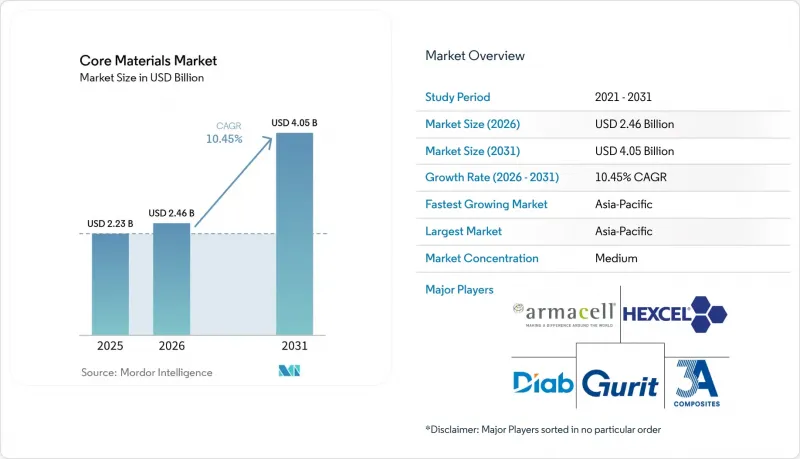
에 따르면 코어 재료 시장 규모는 2025년에 22억 3,000만 달러로 평가되며, 2026년 24억 6,000만 달러에서 2031년까지 40억 5,000만 달러에 달할 것으로 예측되고 있으며, 예측 기간(2026-2031년)에 CAGR은 10.45%에 달할 전망입니다.
전 세계 코어 소재 시장의 동향 및 인사이트
복합재료 구조에서의 경량화 수요
코어 소재 시장은 제조업체가 강성이나 내구성을 저해하지 않으면서 더 가벼운 구조체를 필요로 할 때 혜택을 받습니다. 샌드위치 구조는 동등한 강성을 제공하는 모놀리식 적층재에 비해 구조 질량을 30%-50% 줄일 수 있으며, 더 대형의 모빌리티 구조물에 대한 채택이 촉진되고 있습니다. 복합재 패널은 무게가 운영 효율에 영향을 미치는 전기자동차 배터리 케이스, 철도 차량의 실내 내장재, 선박의 선체, 항공기 부품 등에 사용되고 있습니다. 무인 항공기(UAV)용으로 최적화된 샌드위치 코어에 대한 조사 결과, 더 무거운 모놀리식 설계에 비해 에너지 흡수성과 충돌 안전성이 향상되는 것으로 밝혀졌습니다. 이러한 성능상 이점은 구조물이 대형화됨에 따라 특히 해상 풍력발전용 블레이드나 와이드바디 항공기 부품에서 그 중요성이 더욱 커지고 있습니다. 재활용 폴리에틸렌 테레프탈레이트(PET) 폼이나 열가소성 수지로 제작된 코어는 샌드위치 구조의 유용성을 지원하는 구조적 기능을 유지하면서, 순환형 소재의 선택지를 제공합니다.
풍력 터빈 블레이드의 치수 확대
터빈 블레이드가 길어질수록 코어 재료 시장에 대한 수요가 높아집니다. 이는 더 큰 외피에는 더 높은 강성과 낮은 밀도의 재료가 필요하기 때문입니다. 상업용 해상 풍력 터빈에서는 115미터를 초과하는 블레이드가 사용되고 있으며, 향후 플랫폼에서는 블레이드 길이가 120-135미터가 될 계획이 추진되고 있습니다. 블레이드의 스팬이 1미터 길어질 때마다 굽힘 하중이 증가하므로, 쉘이나 전단 웹 내의 코어 배치를 신중하게 설계할 필요성이 높아집니다. Gurit사의 98미터 기준 블레이드 모델에서는 최적화된 재생 폴리에틸렌 테레프탈레이트(PET) 코어 배치를 통해 코어의 질량을 줄이면서도 좌굴 여유를 유지할 수 있음이 입증되었습니다. Gurit Holding AG는 2026년 1월, 자사의 ‘OptiCore’ 설계 접근 방식을 활용한 코어 재료 키트를 공급하는 총액 2억 5,000만 스위스 프랑(약 2억 7,500만-2억 8,300만 달러) 규모의 5년 계약을 발표했습니다. 이 계약에서는 블레이드의 경량화와 생산 효율이 핵심 요소로 자리 잡고 있습니다. 이 계약은 풍력발전 고객들이 재료 가격뿐만 아니라 설계상의 기하학적 특성과 가공상 이점도 고려하고 있음을 보여줍니다.
고액의 인증·승인 비용
항공우주용 코어 소재는 인증된 항공기에 채택이 승인되기까지 수년에 걸친 개발과 대규모 시험이 필요할 수 있습니다. 미국 연방항공청(FAA)의 자문 회람 20-107B 및 유럽항공안전청(EASA)의 적합성 수단(AMC) 20-29에서는 시험편에서 실물 크기의 구조물로 단계적으로 진행하는 빌딩 블록 방식이 채택되어 있습니다. 이러한 요건으로 인해 신규 공급업체가 항공우주 프로그램에 신속하게 진입하기는 어렵습니다. 재료 데이터베이스를 공유하여 중복 작업을 줄일 수는 있지만, 공급업체는 여전히 문서화된 제조 공정과 고객별 사양에 기반한 승인을 받아야 합니다. 또한 항공우주 업계의 고객들은 AS9100D나 전미 항공우주·방위 계약업체 인증 프로그램(NADCAP) 인증 등 공인된 품질 시스템의 도입도 요구하고 있습니다. 이러한 요건으로 인해 성능이 적절하더라도 새로운 열가소성 수지나 바이오 기반 코어 소재의 채택이 지연될 가능성이 있습니다.
부문별 분석
2025년, 발포재는 코어 재료 시장 매출의 49.45%를 차지했습니다. 비용 효율을 중시하는 선박용 및 건설용 패널부터 항공우주 구조물에 사용되는 오토클레이브 대응 폴리메타크릴이미드 등급에 이르기까지 폭넓은 용도로 활용되고 있습니다. 이 범주에는 폴리염화비닐, 폴리에틸렌 테레프탈레이트, 폴리우레탄, 스티렌-아크릴로니트릴, 그리고 폴리메타크릴이미드 소재가 포함됩니다. 폴리에틸렌 테레프탈레이트(PET) 발포재는 일관된 기계적 특성을 갖추고 재활용 목표를 지원할 수 있으며, 풍력발전용 블레이드에서의 사용이 확대되고 있습니다. ARMACELL사는 자사의 ‘ArmaPET’ 시리즈가 20년에 걸친 상업적 생산 과정에서 50억 개의 재활용 PET병을 구조용 발포 코어로 전환했다고 밝혔습니다. 발사 목재는 중량 대비 높은 압축 강도와 낮은 가공 비용이 중요한 상황에서 여전히 유용하지만, 추적성 및 산림 인증으로 인해 조달 요건이 추가되고 있습니다.
허니컴 구조는 2031년까지 연평균 성장률(CAGR) 11.74%로 확대될 것으로 예측됩니다. 항공우주용 캐빈 패널, 플로어 패널, 나셀 및 기타 경량 구조물은 알루미늄, 아라미드 종이 및 폴리머 제 허니컴에 대한 수요를 지원하고 있습니다. 헥셀 코퍼레이션은 700종 이상의 ‘HexWeb’ 허니컴 제품을 제공하고 있으며, 모로코 카사블랑카에 항공우주 공급망을 지원하는 시설을 운영하고 있습니다. 에보닉 인더스트리즈 AG는 2026년에 개최된 재료 및 공정 공학 진흥 협회(SAMPE) 회의에서 두꺼운 부위의 항공우주 및 도시 항공 모빌리티 용도를 위한 새로운 ‘ROHACELL’ 인몰드 발포 제품을 발표했습니다. 이 제품들은 자동 제조 공정에서 코어를 일체화함으로써 폐기물을 줄일 수 있습니다. 또한 EconCore N.V.의 열가소성 허니컴 기술은 항공기 내장재용으로 재활용이 가능하고 내화성이 뛰어난 패널을 목표로 하고 있으며, 기존의 열경화성 아라미드 솔루션에서 벗어나는 길을 열어가고 있습니다.
지역별 분석
아시아태평양은 2025년 코어 소재 시장 매출의 38.12%를 차지하고 있으며, 2031년까지 연평균 성장률(CAGR) 11.56%로 확대될 것으로 예측됩니다. 중국의 블레이드 제조 거점은 발포재, 발사재 및 엔지니어링 코어 키트에 대한 수요를 지원하고 있습니다. 또한 인도가 2030년까지 140기가와트의 풍력발전 용량을 달성하겠다는 목표는 이 지역의 추가적인 수요 원천이 되고 있습니다. 일본과 한국은 해양 구조물, 철도 차량 내장재, 항공우주 관련 제조 분야에서 품질을 중시하는 용도를 지원하고 있습니다. 동남아시아 국가들은 전기자동차 조립 및 재생에너지 인프라 확장에 따라 새로운 수요 거점으로 부상하고 있습니다.
중국의 블레이드 제조업체들은 현지 프로젝트를 수행하고 수출 시장에 공급하기 위해 동남아시아에 거점을 설립하고 있습니다. 이러한 움직임은 코어 소재 시장에서 더욱 통합된 지역 공급망 구축을 촉진하고 있습니다. 북미와 유럽은 항공우주 제조 거점 및 해상 풍력발전 프로그램의 존재로 인해 여전히 중요한 시장입니다. 에어버스와 보잉의 생산 계획은 1차 및 2차 공급업체의 항공우주용 허니콤 소재 수요를 지원하고 있습니다. 유럽의 풍력 블레이드 재활용 요건은 폴리에틸렌 테레프탈레이트(PET) 폼이나 폴리프로필렌 허니콤과 같은 대체 소재에 대한 관심을 촉진하고 있습니다. 에콰도르와 파푸아뉴기니는 수요의 상당 부분이 다른 지역에 집중되어 있음에도 불구하고 발사 목재의 중요한 공급처로 자리 잡고 있습니다.
중동 및 아프리카는 코어 소재 시장에서 비교적 작은 비중을 차지하고 있지만, 재생 가능 에너지 프로젝트와 항공우주 제조업이 특정 분야에서 비즈니스 기회를 창출하고 있습니다. 사우디아라비아의 풍력발전 계획과 남아프리카공화국의 재생 가능 에너지 조달 프로그램은 터빈 나셀 및 민간 구조물에서 복합재 패널의 사용을 촉진할 가능성이 있습니다. 모로코는 MidParc 자유무역지대에 항공우주 클러스터를 구축했습니다. 헥셀 코퍼레이션의 카사블랑카 공장은 인근에 위치한 에어버스, 사프란, 봄바르디아의 사업 거점에 서비스를 제공하고 있으며, 항공우주 업계 고객과 가까운 곳에 기반을 둔 것의 가치를 여실히 보여주고 있습니다. 이 지역은 항공기 생산의 다각화에 따른 공급업체의 투자로 혜택을 볼 수 있습니다. 이 지역의 성장 전망은 재생에너지 프로젝트의 추진 속도와 항공우주 공급망의 확대에 달려 있습니다.
기타 혜택:
- 엑셀 형식의 시장 예측(ME) 시트
- 3개월간의 애널리스트 지원
자주 묻는 질문
목차
제1장 서론
- 조사 전제조건과 시장 정의
- 조사 범위
제2장 조사 방법
제3장 개요
제4장 시장 구도
- 시장 개요
- 시장 성장 촉진요인
- 시장 성장 억제요인
- 밸류체인 분석
- Porter's Five Forces 분석
제5장 시장 규모와 성장 예측
- 유형별
- 최종 용도 산업별
- 지역별
- 아시아태평양
- 중국
- 인도
- 일본
- 한국
- ASEAN 국가
- 기타 아시아태평양 국가
- 북미
- 미국
- 캐나다
- 멕시코
- 유럽
- 독일
- 영국
- 프랑스
- 이탈리아
- 북유럽 국가
- 기타 유럽 국가
- 남미
- 브라질
- 아르헨티나
- 기타 남미 국가
- 중동 및 아프리카
- 사우디아라비아
- 남아프리카공화국
- 기타 중동 및 아프리카 국가
- 아시아태평양
제6장 경쟁 구도
- 시장 집중도
- 전략적 동향
- 시장 점유율·순위 분석
- 기업 개요
- 3A Composites GmbH
- ARMACELL
- Carbon-Core Corp.
- Changzhou Tiansheng New Materials Co., Ltd.
- Diab Group
- EconCore N.V.
- EURO-COMPOSITES
- Evonik Industries AG
- Gurit Holding AG
- Hexcel Corporation
- Lantor BV
- Maricell S.r.l.
- NMG EUROPE SRL
- Plascore, Inc.
- Polyumac USA, LLC
제7장 시장 기회와 향후 전망
KSA 26.10.28According to Mordor Intelligence, the core materials market size was valued at USD 2.23 billion in 2025 and is estimated to grow from USD 2.46 billion in 2026 to reach USD 4.05 billion by 2031, at a CAGR of 10.45% during the forecast period (2026-2031).
Global Core Materials Market Trends and Insights
Lightweighting Requirements Across Composite Structures
The core materials market benefits when manufacturers need lighter structures without reducing stiffness or durability. Sandwich structures can reduce structural mass by 30%-50% compared with monolithic laminates that offer equivalent stiffness, which supports their use in larger mobility structures. Composite panels are used in electric vehicle battery enclosures, rail interiors, marine hulls, and aircraft components where weight affects operating efficiency. Research on optimized sandwich cores for unmanned aerial vehicles found improvements in energy absorption and crashworthiness compared with a heavier monolithic design. The performance benefit becomes more relevant as structures become larger, particularly in offshore blades and wide-body aircraft components. Recycled polyethylene terephthalate foam and thermoplastic cores add a circular material option, while retaining the structural function that makes sandwich construction useful.
Expansion of Wind Turbine Blade Dimensions
The core materials market gains demand when turbine blades become longer because larger shells require more stiff, lower-density material. Commercial offshore turbines use blades longer than 115 meters, and future platforms are planned with blade lengths of 120-135 meters. Each additional meter of blade span increases bending loads and raises the need for carefully designed core placement in shells and shear webs. The Gurit 98m reference blade model showed that optimized recycled polyethylene terephthalate core layouts can maintain buckling margins while reducing core mass. Gurit Holding AG announced a CHF 250 million (approximately USD 275-283 million) five-year agreement in January 2026 to supply core material kits using its OptiCore design approach, which placed blade weight reduction and production efficiency at the center of the contract. The agreement shows that wind customers are considering engineered geometry and processing benefits alongside material price.
High Qualification and Certification Costs
Aerospace core materials can require years of development and substantial testing before they are approved for a certified aircraft. Federal Aviation Administration Advisory Circular 20-107B and European Union Aviation Safety Agency Acceptable Means of Compliance 20-29 use a building-block approach that moves from coupons to full-scale structures. The requirements make it difficult for new suppliers to enter aerospace programs quickly. Shared material databases can reduce duplicated work, but suppliers still need a documented manufacturing process and approval under customer-specific specifications. Aerospace customers also expect recognized quality systems, including AS9100D and National Aerospace and Defense Contractors Accreditation Program accreditation. These requirements can delay the use of newer thermoplastic and bio-based core options even when their performance is suitable.
Other drivers and restraints analyzed in the detailed report include:
- Aircraft Production and Composite Airframe Penetration
- Electrification and Commercial-Transport Weight Reduction
- Polymer Precursor and Raw-Material Price Volatility
For complete list of drivers and restraints, kindly check the Table Of Contents.
Segment Analysis
Foam accounted for 49.45% of the core materials market revenue in 2025. It serves applications from cost-sensitive marine and construction panels to autoclave-capable polymethacrylimide grades used in aerospace structures. The category includes polyvinyl chloride, polyethylene terephthalate, polyurethane, styrene-acrylonitrile, and polymethacrylimide materials. Polyethylene terephthalate foam is gaining use in wind blades because it offers consistent mechanical properties and can support recycling objectives. ARMACELL stated that its ArmaPET range had converted 5 billion recycled polyethylene terephthalate bottles into structural foam cores during 20 years of commercial production. Balsa remains useful where high compressive strength relative to weight and lower processing cost are important, although traceability and forestry certification add procurement requirements.
Honeycomb is projected to advance at an 11.74% CAGR through 2031. Aerospace cabin panels, floor panels, nacelles, and other lightweight structures support demand for aluminum, aramid-paper, and polymer honeycomb. Hexcel Corporation offers more than 700 HexWeb honeycomb variants and operates a facility in Casablanca, Morocco, that supports aerospace supply chains. Evonik Industries AG presented new ROHACELL in-mold foaming products at the Society for the Advancement of Material and Process Engineering (SAMPE) 2026 for thick-section aerospace and urban air mobility applications. These products can reduce waste by integrating the core during automated manufacturing. EconCore N.V.'s thermoplastic honeycomb technology is also directed at recyclable, fire-safe panels for aircraft interiors, which creates a path away from conventional thermoset aramid solutions.
Complete Report Scope:
- By Type
- Foam
- Balsa
- Honeycomb
- By End-Use Industry
- Wind Energy
- Aerospace and Defense
- Marine
- Automotive
- Construction and Industrial
- Other End-use Industries
- By Geography
- Asia-Pacific
- China
- India
- Japan
- South Korea
- ASEAN Countries
- Rest of Asia-Pacific
- North America
- United States
- Canada
- Mexico
- Europe
- Germany
- United Kingdom
- France
- Italy
- NORDIC Countries
- Rest of Europe
- South America
- Brazil
- Argentina
- Rest of South America
- Middle East and Africa
- Saudi Arabia
- South Africa
- Rest of Middle East and Africa
- Asia-Pacific
Geography Analysis
Asia-Pacific held 38.12% of the core materials market revenue in 2025 and is projected to advance at an 11.56% CAGR through 2031. China's blade manufacturing base supports demand for foam, balsa, and engineered core kits. India's wind capacity target of 140 gigawatts by 2030 adds a further source of regional demand. Japan and South Korea support quality-focused applications in marine structures, rail interiors, and aerospace-related manufacturing. Southeast Asian countries are becoming additional demand centers as electric vehicle assembly and renewable infrastructure expand.
China's blade manufacturers are establishing facilities in Southeast Asia to serve local projects and supply export markets. This development supports a more integrated regional supply chain for the core materials market. North America and Europe remain important because of their aerospace manufacturing bases and offshore wind programs. Airbus and Boeing production plans support demand for aerospace honeycomb from Tier 1 and Tier 2 suppliers. Europe's recycling requirements for wind blades support interest in polyethylene terephthalate foam and polypropylene honeycomb alternatives. Ecuador and Papua New Guinea are important supply locations for balsa, even though much of the demand is in other regions.
The Middle East and Africa represent a smaller part of the core materials market, but renewable energy projects and aerospace manufacturing are creating targeted opportunities. Saudi Arabia's wind plans and South Africa's renewable procurement program can support the use of composite panels in turbine nacelles and civil structures. Morocco has developed an aerospace cluster in the MidParc Free Trade Zone. Hexcel Corporation's Casablanca facility serves nearby Airbus, Safran, and Bombardier operations and reflects the value of locating close to aerospace customers. The region can benefit from supplier investment that follows aircraft production diversification. Its growth prospects depend on the pace of renewable project execution and aerospace supply-chain expansion.
- 3A Composites GmbH
- ARMACELL
- Carbon-Core Corp.
- Changzhou Tiansheng New Materials Co., Ltd.
- Diab Group
- EconCore N.V.
- EURO-COMPOSITES
- Evonik Industries AG
- Gurit Holding AG
- Hexcel Corporation
- Lantor BV
- Maricell S.r.l.
- NMG EUROPE SRL
- Plascore, Inc.
- Polyumac USA, LLC
Additional Benefits:
- The market estimate (ME) sheet in Excel format
- 3 months of analyst support
TABLE OF CONTENTS
1 Introduction
- 1.1 Study Assumptions and Market Definition
- 1.2 Scope of the Study
2 Research Methodology
3 Executive Summary
4 Market Landscape
- 4.1 Market Overview
- 4.2 Market Drivers
- 4.2.1 Lightweighting Requirements Across Composite Structures
- 4.2.2 Expansion of Wind Turbine Blade Dimensions
- 4.2.3 Aircraft Production and Composite Airframe Penetration
- 4.2.4 Electrification and Commercial-Transport Weight Reduction
- 4.2.5 Recycled PET and Thermoplastic Core Adoption
- 4.3 Market Restraints
- 4.3.1 High Qualification and Certification Costs
- 4.3.2 Polymer Precursor and Raw-Material Price Volatility
- 4.3.3 End-of-Life Recycling Constraints for Thermoset Sandwich Structures
- 4.4 Value Chain Analysis
- 4.5 Porter's Five Forces Analysis
- 4.5.1 Threat of New Entrants
- 4.5.2 Bargaining Power of Suppliers
- 4.5.3 Bargaining Power of Buyers
- 4.5.4 Threat of Substitutes
- 4.5.5 Competitive Rivalry
5 Market Size and Growth Forecasts (Value)
- 5.1 By Type
- 5.1.1 Foam
- 5.1.2 Balsa
- 5.1.3 Honeycomb
- 5.2 By End-Use Industry
- 5.2.1 Wind Energy
- 5.2.2 Aerospace and Defense
- 5.2.3 Marine
- 5.2.4 Automotive
- 5.2.5 Construction and Industrial
- 5.2.6 Other End-use Industries
- 5.3 By Geography
- 5.3.1 Asia-Pacific
- 5.3.1.1 China
- 5.3.1.2 India
- 5.3.1.3 Japan
- 5.3.1.4 South Korea
- 5.3.1.5 ASEAN Countries
- 5.3.1.6 Rest of Asia-Pacific
- 5.3.2 North America
- 5.3.2.1 United States
- 5.3.2.2 Canada
- 5.3.2.3 Mexico
- 5.3.3 Europe
- 5.3.3.1 Germany
- 5.3.3.2 United Kingdom
- 5.3.3.3 France
- 5.3.3.4 Italy
- 5.3.3.5 NORDIC Countries
- 5.3.3.6 Rest of Europe
- 5.3.4 South America
- 5.3.4.1 Brazil
- 5.3.4.2 Argentina
- 5.3.4.3 Rest of South America
- 5.3.5 Middle East and Africa
- 5.3.5.1 Saudi Arabia
- 5.3.5.2 South Africa
- 5.3.5.3 Rest of Middle East and Africa
- 5.3.1 Asia-Pacific
6 Competitive Landscape
- 6.1 Market Concentration
- 6.2 Strategic Moves
- 6.3 Market Share (%)/Ranking Analysis
- 6.4 Company Profiles (includes Global Overview, Market Overview, Core Segments, Financials as available, Strategic Information, Products and Services, and Recent Developments)
- 6.4.1 3A Composites GmbH
- 6.4.2 ARMACELL
- 6.4.3 Carbon-Core Corp.
- 6.4.4 Changzhou Tiansheng New Materials Co., Ltd.
- 6.4.5 Diab Group
- 6.4.6 EconCore N.V.
- 6.4.7 EURO-COMPOSITES
- 6.4.8 Evonik Industries AG
- 6.4.9 Gurit Holding AG
- 6.4.10 Hexcel Corporation
- 6.4.11 Lantor BV
- 6.4.12 Maricell S.r.l.
- 6.4.13 NMG EUROPE SRL
- 6.4.14 Plascore, Inc.
- 6.4.15 Polyumac USA, LLC
7 Market Opportunities and Future Outlook
- 7.1 White-Space and Unmet-Need Assessment


