

|
시장보고서
상품코드
2154999
남미의 액티브 및 지능형 포장 : 시장 점유율 분석, 업계 동향과 통계, 성장 예측(2026-2031년)South America Active and Intelligent Packaging - Market Share Analysis, Industry Trends & Statistics, Growth Forecasts (2026 - 2031) |
||||||
 Mordor Intelligence
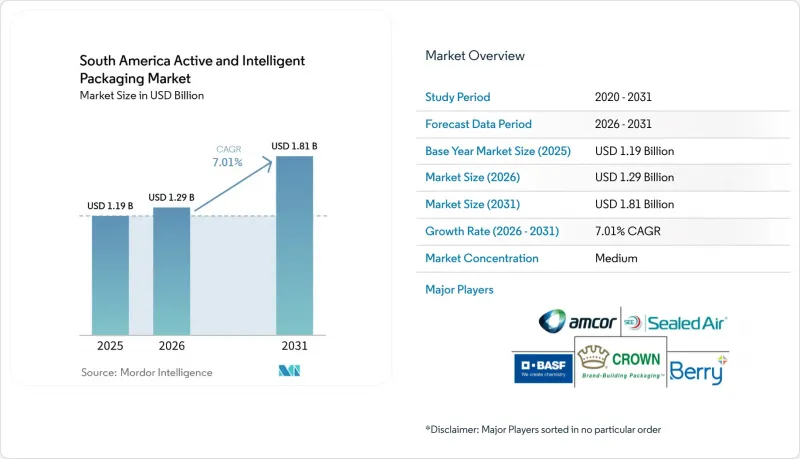
에 따르면 남미의 액티브·지능형 포장 시장 규모는 2025년 11억 9,000만 달러에서 2026년에는 12억 9,000만 달러로 확대하며, 2026-2031년에 CAGR 7.01%로 추이하며, 2031년에는 18억 1,000만 달러에 달할 것으로 예측됩니다.
남미 액티브·지능형 포장 시장의 동향 및 인사이트
제품 유통기한 연장에 대한 수요 증가
유통기한 연장은 남미 전역에서 액티브 포장이 채택되는 가장 직접적인 이유로 계속해서 꼽히고 있습니다. 브라질의 단백질 수출업체들은 중국, 유럽, 중동으로 향하는 30-90일간의 냉장 운송 기간 중 제품의 상태를 유지할 수 있는 포장을 필요로 합니다. 이러한 요건을 충족하지 못하는 선적은 수출 자격을 상실할 가능성이 있으며, 수출업체에 막대한 상업적 손실을 초래할 우려가 있습니다. 2026년 6월, Amcor는 브라질의 Barra Mansa Alimentos에 자사의 ‘Moda Vac’ 회전식 진공 챔버 실링 기술을 도입하여, 하나의 뼈 제거 라인에서 최대 9대의 기존 벨트식 챔버 기계를 대체했습니다. 이 도입 사례는 대형 가공업체가 진공 밀봉 기술을 활용하여 유통 기한을 연장하는 동시에 라인의 처리 능력을 향상시키고 있음을 보여주는 실례입니다. 또한 능동형 포장에 관한 조사에 따르면 에틸렌 스캐빈저, 가스 방출제 및 가스치환포장을 통해 수동형 포장에 비해 신선 식품의 유통 기한을 40-60% 연장할 수 있는 것으로 보고되었으며, 이를 통해 칠레, 콜롬비아, 페루의 수출 경로에서 발생하는 손실을 줄일 수 있을 것으로 보입니다.
식품 안전 및 품질 요건
남미의 능동형·지능형 포장 시장에서 식품 안전 규제는 기본적인 라벨 표시 준수에 그치지 않고 포장 사양에도 변화를 가져오고 있습니다. 브라질의 ANVISA는 RDC 제961/2025호를 발표하여 식품 접촉용 플라스틱 용기에 승인된 단량체 및 중합체의 포지티브 리스트를 변경했습니다. 이 변경으로 인해 식품 가공업체에 서비스를 제공하는 컨버터에게 있으며, 소재 선정에 대한 문서화 및 식품 접촉 관련 검증의 중요성이 높아지고 있습니다. 따라서 검증된 기능성 소재는 소재 가격뿐만 아니라 입증된 성능과 규정 준수 지원 측면에서 경쟁력을 발휘할 수 있습니다. 2025년에 발표된 조사에 따르면 카테큐 및 탄산칼슘 계열을 포함한 식물 유래 산소 제거제는 식품 안전 용도에서 생분해성 기능성 포장을 지원할 수 있는 것으로 밝혀졌습니다. 이로 인해 유통 기한 성능, 규제 관련 문서화, 그리고 환경 부하가 낮은 소재 옵션을 결합할 수 있는 공급업체에게 새로운 기회가 열리고 있습니다.
도입 및 검증 비용의 높음
첨단 포장 시스템 도입을 검토 중인 중견 식품 가공업체에게 비용은 여전히 가장 시급한 장벽으로 남아 있습니다. RFID 리더 네트워크, 센서 지원 충전 라인, 가스 플러싱 장비에는 생산 라인 1개당 수십만 달러의 비용이 소요될 수 있습니다. 또한 기업은 식품 접촉 재료 및 의약품에 관한 규정 준수 체계에서 요구하는 재료 검증 작업 비용도 부담해야 합니다. ABRE 및 FGV IBRE의 보고서에 따르면 브라질의 포장 생산량은 2024년 6.7% 성장에 이어 2025년에는 0.4% 증가에 그칠 것으로 나타나, 컨버터들에게 투자 환경이 더욱 어려워지고 있음을 보여줍니다. 대규모 다국적 기업은 검증 비용을 더 많은 생산량이나 지역별 조달 프로그램에 분산시킬 수 있습니다. 반면, 브라질이나 콜롬비아의 중소 가공업체들은 훨씬 더 작은 수익 기반에 대해 유사한 규정 준수 비용을 부담해야 하므로, 이는 남미의 능동형 지능형 포장 시장에서 광범위한 도입을 제한하고 있습니다.
부문 분석
2025년, 포장 기능별로 보면 ‘제품 신선도 유지’가 남미의 능동형 지능형 포장 시장 점유율의 43.18%를 차지했습니다. 이러한 주도적인 위상은 단백질, 신선 농산물, 가공식품의 전체 수출 경로에서 차단 성능과 가스 관리가 요구되고 있음을 반영합니다. 식품 기업은 냉장 제품이 장기간의 운송 및 취급 기간 중도 품질을 유지해야 하므로 유통기한 관리를 수출 요건으로 간주하고 있습니다. 산소, 수분, 가스 구성을 제어하는 포장은 제품 자체를 변화시키지 않으면서 외관, 식감 및 사용 가능 기간을 유지하는 데 도움이 됩니다.
이러한 기능의 규모는 해당 지역이 콜드 체인에 의존하는 농산물 무역에 크게 의존하고 있음을 반영합니다. 소육류, 가금류, 치즈, 제빵 제품, 신선 식품은 모두 가공 공장에서 해외 유통에 이르기까지 일관된 포장 성능이 요구됩니다. 수출업체는 액티브 포장을 활용함으로써 제품이 목표 시장에 도달하기 전에 상태가 악화될 위험을 줄일 수 있습니다. 이를 통해 남미의 액티브·지능형 포장 시장은 단순한 포장의 선택적 업그레이드가 아닌, 업무상 요구 사항에 기반한 기반을 구축하고 있습니다.
브랜드 보호 시장은 2031년까지 연평균 성장률(CAGR) 7.94%로 확대될 것으로 예상되며, 포장 기능 중 가장 빠르게 성장하는 분야입니다. 제약 제조사와 고급 식품 브랜드는 위조를 어렵게 하고 제품 검증을 용이하게 하기 위해 진위 확인 기능을 활용하고 있습니다. NFC 지원 라벨은 진위 확인을 지원하며, QR코드 기반 형식은 제품 정보 제공 및 소비자와의 소통을 촉진합니다. 이러한 접근 방식은 브랜드 소유자가 물리적 패키지와 신뢰할 수 있는 디지털 기록 사이에 명확한 연관성을 확립해야 할 때 특히 유용합니다.
공급망 관리 및 제품 정보 기능 또한 E-Commerce와 의약품 유통 분야에서 중요성이 커지고 있습니다. QR코드 기반의 추적성 및 스마트 라벨은 제품이 포장, 보관, 주문 처리, 배송의 각 단계를 거칠 때 책임 추적을 지원합니다. 이러한 기능은 포장에 고가의 센서나 RFID 인프라가 필요하지 않은 경우에도 유용합니다. 소비자 편의성과 관련된 기능은 여전히 규모가 가장 작은 편이지만, 브라질과 아르헨티나에서는 전자레인지용 포장이 조리 식품의 보급을 서서히 촉진하고 있습니다.
2025년 기준, 액티브 패키징은 포장 기술 부문의 63.21%를 차지했습니다. 가스 스캐빈저, 습도 제어 방식 및 조절된 대기 시스템은 긴 유통망 전반에 걸친 보존에 있으며, 여전히 확고한 선택지로 자리 잡고 있습니다. 이러한 방식은 물리적 포장 요건을 충족시키며, 지능형 대체 기술에 필요한 리더 네트워크나 데이터 시스템을 반드시 필요로 하지 않습니다. 식품 보존 분야에서 입증된 사용 실적을 바탕으로, 무엇보다도 신뢰할 수 있는 신선도 유지를 필요로 하는 가공업체에게 실용적인 선택지가 되고 있습니다.
액티브 포장이 선호되는 배경에는 해당 지역의 식품 및 농산물 수출 구조도 관련되어 있습니다. 가공업체는 새로운 디지털 데이터 수집 프로세스를 구축하지 않고도 포장내 산소 및 습도 제어 기능을 활용할 수 있습니다. 이를 통해 정보 기술 인프라가 제한적인 사업체에서도 이 기술을 쉽게 도입할 수 있게 됩니다. 이러한 실용적인 적합성야말로 남미의 능동형 및 지능형 포장 시장에서 능동형 시스템이 여전히 큰 점유율을 유지하고 있는 이유를 설명해 줍니다.
지능형 포장은 2031년까지 연평균 성장률(CAGR) 8.36%로 확대될 것으로 예측됩니다. 가장 유력한 사용 사례는 추적 정보 및 제품 상태 정보가 측정 가능한 업무적 가치를 창출하는 제약 및 물류 분야에서 찾아볼 수 있습니다. RFID, NFC, 코딩, 스마트 라벨은 품목 식별, 제품 인증 및 이동 상황의 가시화를 지원합니다. 따라서 이 기술은 사용자가 포장에 기록된 정보를 수집·읽고, 이를 바탕으로 조치를 취할 명확한 이유가 있을 때 가장 큰 의미를 갖습니다.
최신 하이브리드 시스템은 산소 흡수 등의 능동적 기능과, 해당 기능이 사용되었음을 나타내는 디지털 센서를 결합하고 있습니다. 이러한 조합을 통해 두 기술 범주의 경계가 모호해지며, 하나의 형태로 보호 기능과 정보를 모두 제공할 수 있게 됩니다. 에이버리 데니슨(Avery Dennison)은 자사의 스마트 라벨 사업이 2024년까지 15%의 성장을 달성할 것이며, 남미 관련 식품 및 의약품 분야에서 이와 유사한 수준의 장기적인 유기적 성장률을 목표로 하고 있다고 보고했습니다. 따라서 남미의 액티브·지능형 포장 시장에서는 추가된 정보가 가공, 품질 또는 추적성과 관련된 의사결정을 직접 지원하는 용도에서 지능형 형식을 채택할 수 있습니다.
기타 혜택:
- 엑셀 형식의 시장 예측(ME) 시트
- 3개월간의 애널리스트 지원
자주 묻는 질문
목차
제1장 서론
- 조사 전제조건과 시장 정의
- 조사 범위
제2장 조사 방법
제3장 개요
제4장 시장 구도
- 시장 개요
- 시장 성장 촉진요인
- 시장 성장 억제요인
- 업계 밸류체인 분석
- 규제 상황
- 기술 전망
- Porter's Five Forces 분석
- 거시경제 요인이 시장에 미치는 영향
제5장 시장 규모와 성장 예측
- 포장 기능별
- 포장 기술별
- 활성포장 유형별
- 지능형 패키지 유형별
- 최종사용자 산업별
- 국가별
- 브라질
- 아르헨티나
- 콜롬비아
- 기타 남미 국가
제6장 경쟁 구도
- 시장 집중도
- 전략적 동향
- 시장 점유율 분석
- 기업 개요
- Amcor plc
- Sealed Air Corporation
- BASF SE
- Crown Holdings, Inc.
- Ball Corporation
- Berry Global, Inc.
- Smurfit Westrock plc
- Avery Dennison Corporation
- CCL Industries Inc.
- Tetra Pak International S.A.
- Huhtamaki Oyj
- Sonoco Products Company
- Mondi plc
- Stora Enso Oyj
- Braskem S.A.
- Multisorb Technologies
- Timestrip Ltd
- Zebra Technologies Corporation
- Impinj, Inc.
- Loftware, Inc.
- Markem-Imaje
- Haco Etiquetas Ltda.
제7장 시장 기회와 향후 전망
KSA 26.10.28According to Mordor Intelligence, the South America active and intelligent packaging market size is expected to grow from USD 1.19 billion in 2025 to USD 1.29 billion in 2026 and is forecast to reach USD 1.81 billion by 2031 at 7.01% CAGR over 2026-2031.
South America Active and Intelligent Packaging Market Trends and Insights
Rising Demand for Extended Product Shelf Life
Extended shelf life remains the most immediate reason for active packaging adoption across South America. Brazil's protein exporters need packaging that preserves product condition during refrigerated journeys lasting 30-90 days to China, Europe, and the Middle East. A shipment that does not meet these requirements can lose export eligibility and expose exporters to substantial commercial losses. In June 2026, Amcor installed its Moda Vac rotary vacuum chamber sealing technology at Barra Mansa Alimentos in Brazil, replacing up to 9 conventional belt chamber machines on 1 deboning line. The installation shows how a major processor is using vacuum sealing to extend shelf life while increasing line throughput. Research on active formats also reported that ethylene scavengers, gas emitters, and modified-atmosphere packaging can extend fresh-produce shelf life by 40-60% compared with passive packaging, which can reduce losses in Chilean, Colombian, and Peruvian export corridors.
Food Safety and Quality Requirements
Food safety rules are changing packaging specifications beyond basic label compliance in the South America active and intelligent packaging market. Brazil's ANVISA issued RDC No. 961/2025, which changed the positive list of monomers and polymers authorized for plastic containers in food contact. The change increases the importance of documented material selection and food-contact validation for converters serving food processors. Validated active materials can therefore compete on demonstrated performance and compliance support, rather than on material price alone. Research published in 2025 found that plant-based oxygen scavengers, including catechu-calcium carbonate systems, could support biodegradable active packaging with food-safety applications. This creates an opening for suppliers that can combine shelf-life performance, regulatory documentation, and lower-impact material options.
High Implementation and Validation Costs
Cost remains the most immediate obstacle for mid-tier food processors considering advanced packaging systems. RFID reader networks, sensor-compatible filling lines, and gas-flush equipment can require hundreds of thousands of USD for each production line. Companies must also fund material validation work required by food-contact and pharmaceutical compliance frameworks. ABRE and FGV IBRE reported that Brazilian packaging production rose only 0.4% in 2025, following 6.7% expansion in 2024, indicating a more constrained investment setting for converters. Large multinationals can spread validation expenses across broader volumes and regional procurement programs. Smaller Brazilian and Colombian processors bear similar compliance costs against a much smaller revenue base, which limits wider deployment in the South America active and intelligent packaging market.
Other drivers and restraints analyzed in the detailed report include:
- Export-Oriented Food and Beverage Supply Chains
- Pharmaceutical Serialization and Traceability
- Regulatory and Food-Contact Compliance Complexity
For complete list of drivers and restraints, kindly check the Table Of Contents.
Segment Analysis
Product Freshness held 43.18% of the South America active and intelligent packaging market share by packaging function in 2025. The leading position reflects the need for barrier performance and gas management across protein, fresh produce, and processed-food export routes. Food companies view shelf-life control as an export requirement because chilled products must maintain quality during extended transit and handling periods. Packaging that controls oxygen, moisture, and gas composition can help preserve appearance, texture, and usable life without changing the product itself.
The scale of this function also reflects the region's reliance on cold-chain-dependent agricultural trade. Beef, poultry, cheese, bakery products, and fresh produce each require packaging performance that remains consistent from the processing plant through overseas distribution. Exporters can use active formats to reduce the risk that the product condition deteriorates before products reach the destination market. This gives the South America active and intelligent packaging market a foundation in operational requirements rather than discretionary packaging upgrades.
Brand Protection is projected to expand at a 7.94% CAGR through 2031, making it the fastest-moving packaging function. Pharmaceutical manufacturers and premium food brands are using authentication features to make counterfeiting harder and product verification easier. NFC-enabled labels can support authentication, while QR-based formats can provide product information and consumer engagement. These approaches are particularly useful where brand owners need to establish a clear connection between a physical pack and a trusted digital record.
Supply Chain Management and Product Information functions are also gaining relevance in e-commerce and pharmaceutical distribution. QR-code-based traceability and smart labels can support accountability as products move through packing, storage, fulfillment, and delivery. These functions can be useful even when a pack does not need a high-cost sensor or RFID infrastructure. Consumer Convenience remains the smallest function, although microwave-susceptor packaging is gradually supporting ready-to-cook products in Brazil and Argentina.
Active Packaging held 63.21% of the packaging technology segment in 2025. Gas scavengers, moisture-control formats, and modified-atmosphere systems remain established choices for preservation across long distribution chains. These formats address a physical packaging requirement and do not always need the reader networks or data systems required by intelligent alternatives. Their established use in food preservation makes them practical for processors that first need dependable freshness protection.
The preference for active formats is also connected to the region's food and agricultural export profile. A processor can apply an oxygen or moisture-control function within the pack without building a new digital data-capture process. This makes the technology easier to use for operations with limited information technology infrastructure. This practical fit explains why active systems retain the larger position in the South America active and intelligent packaging market.
Intelligent Packaging is projected to expand at an 8.36% CAGR through 2031. Its strongest use cases occur in pharmaceutical and logistics applications where tracking and product-condition information produce measurable operational value. RFID, NFC, coding, and smart labels can support item identification, product authentication, and movement visibility. The technology is therefore most relevant when the user has a defined reason to collect, read, and act on the information carried by the pack.
Newer hybrid systems pair an active function, such as oxygen scavenging, with a digital sensor that shows when the function has been used. This combination can blur the boundary between the two technology categories and can provide both protection and information in 1 format. Avery Dennison reported that its intelligent labels business achieved a 15% growth by 2024 and targeted the same long-term organic rate, with food and pharmaceutical uses relevant to South America. The South America active and intelligent packaging market can therefore adopt intelligent formats in applications where the added information directly supports a processing, quality, or traceability decision.
Complete Report Scope:
- By Packaging Function
- Supply Chain Management
- Product Freshness
- Consumer Convenience
- Brand Protection
- Product Information
- By Packaging Technology
- Active Packaging
- Intelligent Packaging
- By Active Packaging Type
- Gas Scavengers/Emitters
- Moisture Scavengers
- Microwave Susceptors
- Other Active Packaging Types
- By Intelligent Packaging Type
- Coding and Markings
- Antenna, RFID and NFC
- Sensors and Output Devices
- Other Intelligent Packaging Types
- By End-user Industry
- Food
- Beverages
- Pharmaceuticals
- Industrial
- Logistics
- Other End-user Industries
- By Country
- Brazil
- Argentina
- Colombia
- Rest of South America
List of Companies Covered in this Report:
- Amcor plc
- Sealed Air Corporation
- BASF SE
- Crown Holdings, Inc.
- Ball Corporation
- Berry Global, Inc.
- Smurfit Westrock plc
- Avery Dennison Corporation
- CCL Industries Inc.
- Tetra Pak International S.A.
- Huhtamaki Oyj
- Sonoco Products Company
- Mondi plc
- Stora Enso Oyj
- Braskem S.A.
- Multisorb Technologies
- Timestrip Ltd
- Zebra Technologies Corporation
- Impinj, Inc.
- Loftware, Inc.
- Markem-Imaje
- Haco Etiquetas Ltda.
Additional Benefits:
- The market estimate (ME) sheet in Excel format
- 3 months of analyst support
TABLE OF CONTENTS
1 INTRODUCTION
- 1.1 Study Assumptions and Market Definition
- 1.2 Scope of the Study
2 RESEARCH METHODOLOGY
3 EXECUTIVE SUMMARY
4 MARKET LANDSCAPE
- 4.1 Market Overview
- 4.2 Market Drivers
- 4.2.1 Rising Demand for Extended Product Shelf Life
- 4.2.2 Food Safety and Quality Requirements
- 4.2.3 Export-Oriented Food and Beverage Supply Chains
- 4.2.4 Pharmaceutical Serialization and Traceability
- 4.2.5 Low-Cost Digital Connectivity Through QR Codes and Smart Labels
- 4.2.6 Localization of Active Materials and Packaging Intelligence
- 4.3 Market Restraints
- 4.3.1 High Implementation and Validation Costs
- 4.3.2 Regulatory and Food-Contact Compliance Complexity
- 4.3.3 Dependence on Imported RFID, NFC, Sensor, and Electronic Components
- 4.3.4 Uneven Recycling Infrastructure for Multicomponent Smart Packs
- 4.4 Industry Value Chain Analysis
- 4.5 Regulatory Landscape
- 4.6 Technological Outlook
- 4.7 Porter's Five Forces Analysis
- 4.7.1 Bargaining Power of Suppliers
- 4.7.2 Bargaining Power of Buyers
- 4.7.3 Threat of New Entrants
- 4.7.4 Threat of Substitutes
- 4.7.5 Competitive Rivalry
- 4.8 Impact of Macroeconomic Factors on the Market
5 MARKET SIZE AND GROWTH FORECASTS (VALUE)
- 5.1 By Packaging Function
- 5.1.1 Supply Chain Management
- 5.1.2 Product Freshness
- 5.1.3 Consumer Convenience
- 5.1.4 Brand Protection
- 5.1.5 Product Information
- 5.2 By Packaging Technology
- 5.2.1 Active Packaging
- 5.2.2 Intelligent Packaging
- 5.3 By Active Packaging Type
- 5.3.1 Gas Scavengers/Emitters
- 5.3.2 Moisture Scavengers
- 5.3.3 Microwave Susceptors
- 5.3.4 Other Active Packaging Types
- 5.4 By Intelligent Packaging Type
- 5.4.1 Coding and Markings
- 5.4.2 Antenna, RFID and NFC
- 5.4.3 Sensors and Output Devices
- 5.4.4 Other Intelligent Packaging Types
- 5.5 By End-user Industry
- 5.5.1 Food
- 5.5.2 Beverages
- 5.5.3 Pharmaceuticals
- 5.5.4 Industrial
- 5.5.5 Logistics
- 5.5.6 Other End-user Industries
- 5.6 By Country
- 5.6.1 Brazil
- 5.6.2 Argentina
- 5.6.3 Colombia
- 5.6.4 Rest of South America
6 COMPETITIVE LANDSCAPE
- 6.1 Market Concentration
- 6.2 Strategic Moves
- 6.3 Market Share Analysis
- 6.4 Company Profiles (includes Global Level Overview, Market Level Overview, Core Segments, Financials as available, Strategic Information, Market Rank/Share, Products and Services, Recent Developments)
- 6.4.1 Amcor plc
- 6.4.2 Sealed Air Corporation
- 6.4.3 BASF SE
- 6.4.4 Crown Holdings, Inc.
- 6.4.5 Ball Corporation
- 6.4.6 Berry Global, Inc.
- 6.4.7 Smurfit Westrock plc
- 6.4.8 Avery Dennison Corporation
- 6.4.9 CCL Industries Inc.
- 6.4.10 Tetra Pak International S.A.
- 6.4.11 Huhtamaki Oyj
- 6.4.12 Sonoco Products Company
- 6.4.13 Mondi plc
- 6.4.14 Stora Enso Oyj
- 6.4.15 Braskem S.A.
- 6.4.16 Multisorb Technologies
- 6.4.17 Timestrip Ltd
- 6.4.18 Zebra Technologies Corporation
- 6.4.19 Impinj, Inc.
- 6.4.20 Loftware, Inc.
- 6.4.21 Markem-Imaje
- 6.4.22 Haco Etiquetas Ltda.
7 MARKET OPPORTUNITIES AND FUTURE OUTLOOK
- 7.1 White-space and Unmet-Need Assessment


