

|
시장보고서
상품코드
2155006
산업용 비전 시스템 통합 서비스 : 시장 점유율 분석, 업계 동향과 통계, 성장 예측(2026-2031년)Industrial Vision System Integration Services - Market Share Analysis, Industry Trends & Statistics, Growth Forecasts (2026 - 2031) |
||||||
 Mordor Intelligence
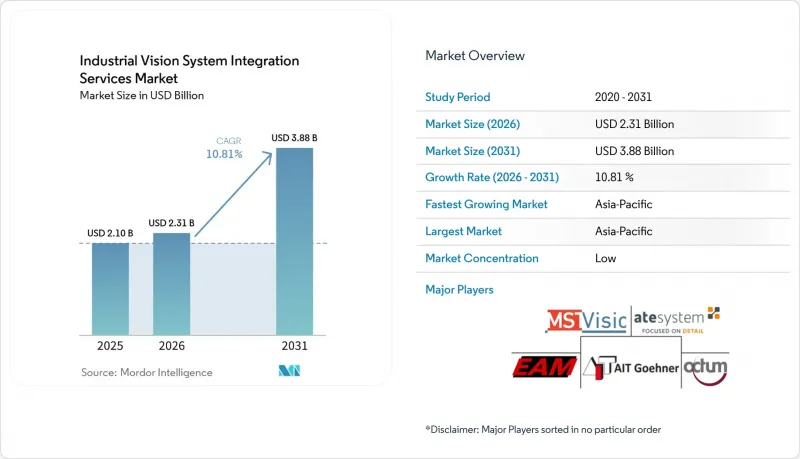
에 따르면 산업용 비전 시스템 통합 서비스 시장 규모는 2025년에 21억 달러로 평가되며, 2026년 23억 1,000만 달러에서 2031년까지 38억 8,000만 달러에 달할 것으로 예측되고 있으며, 예측 기간(2026-2031년)에 CAGR은 10.81%에 달할 전망입니다.
전 세계 산업용 비전 시스템 통합 서비스 시장의 동향 및 인사이트
무결점 제조 및 자동화된 품질 보증
무결점 생산은 많은 1차 자동차 및 항공우주 공급업체에게 계약상 필수 요건이 되었습니다. 이러한 요건으로 인해 자동 시각 검사는 폐쇄 루프 품질 시스템의 핵심 설계에 통합되었습니다. 2026년 체계적 검토에 따르면 딥러닝을 활용한 머신 비전은 진동, 분진, 불균일한 조명 등 변화하는 생산 조건에서도 물체를 인식할 수 있는 것으로 밝혀졌습니다. 고속 가동 중에 이러한 조건이 변화할 경우, 규칙 기반 시스템은 적응력이 떨어집니다. 제조업체가 검사 데이터를 생산 관리 및 품질 기록과 연계하려면 전문 지식이 필요하므로 산업용 비전 시스템 통합 서비스 시장은 그 혜택을 누리고 있습니다. 또한 측정 시스템 분석에 관한 AIAG의 지침에 따라 자동차 부품 공급업체가 AI를 활용한 품질 시스템을 검증할 때 통합업체에게는 문서화 역할이 부여됩니다. 검사 이미지는 초기 프로젝트 완료 후에도 유용한 운영 자산이 될 수 있습니다. 제조 실행 시스템(MES)과 연동함으로써, 이미지 기록은 결함이 광범위한 품질 불량으로 발전하기 전에 반복되는 결함 패턴을 식별하는 데 도움이 됩니다. 이러한 요구 사항으로 인해 업무 범위는 단순한 카메라 설치에서 지속적인 데이터 및 공정 제어 서비스로 변화합니다. 따라서 산업용 비전 시스템 통합 서비스 시장에서는 시운전 후에도 모델 유지 관리, 이미지 데이터 관리, 품질 팀 지원을 수행할 수 있는 공급업체가 우위를 점하게 됩니다. 또한 무결점 요구 사항으로 인해 프로젝트 일정은 일반적인 설비 투자 주기에 대한 의존도가 낮아집니다. 공급업체는 공장 투자 중 일부를 연기할 수는 있지만, 계약상 품질 성과를 지원하는 관리 체계를 도입하는 것을 미룰 여지는 제한적입니다.
비전 가이드형 로봇 공학 및 유연한 자동화
비전 유도형 로봇 공학은 대량 생산이 이루어지는 자동차 분야를 넘어, 빈번한 제품 변경이나 소량 생산이 이루어지는 제조 현장으로 확대되고 있습니다. 미국 자동화 진흥 협회(Association for Advancing Automation)의 보고서에 따르면 2025년 북미 지역의 로봇 수주 대수는 3만 6,766대, 수주액은 22억 5,000만 달러에 달할 것으로 예상됩니다. 이러한 환경에서는 부품의 방향이나 수납 위치, 표면의 편차가 변화하더라도 부품을 식별할 수 있는 시스템이 요구됩니다. 산업용 비전 시스템 통합 서비스 시장은 카메라, 로봇 제어 장치 및 생산 안전 시스템을 연동하기 위해 필요한 추가 작업으로 인해 혜택을 보고 있습니다. 또한 3D 구조화된 빛이나 깊이 감지 장치는 고정 좌표의 로봇 애플리케이션보다 더 신중한 설계를 필요로 합니다. 비전에서 로봇으로의 인터페이스에는 대부분의 경우 각 생산 라인별로 맞춤화된 통신 및 동작 로직이 필요합니다. 여러 로봇 브랜드를 지원하는 라이브러리를 보유한 통합 업체는 반복적인 엔지니어링 작업을 줄이고 프로젝트 납기 기간을 단축할 수 있습니다. KUKA사는 로봇 시스템의 2D 및 3D 이미지 처리를 위한 AI 기반 비전 툴을 소개하며, 자동화 분야에서 기계 지각으로의 광범위한 전환을 보여주고 있습니다. 산업용 비전 시스템 통합 서비스 시장에서는 혼합 생산 환경에서 이러한 툴을 안전하게 작동시킬 수 있는 공급업체에 대한 수요가 있습니다. 또한 유럽의 안전 및 AI 관련 규제로 인해 자율 시스템을 위한 명확한 기술 기록을 작성할 수 있는 공급업체의 가치도 높아지고 있습니다.
기존 생산 자산 전반에 걸친 높은 통합 복잡성
브라운필드 공장에서는 신규 생산 거점과는 다른 기술적 및 상업적 조건이 발생합니다. 구형 프로그래머블 로직 컨트롤러(PLC), 컨베이어 시스템, 인간-기계 인터페이스(HMI)는 현재의 비전 플랫폼이 가정하는 통신 방식을 채택하지 않은 경우가 있습니다. 산업용 비전 시스템 통합 서비스 시장에서는 프로젝트 초기 단계의 범위 수립시 간과되기 쉬운 인터페이스 호환성 문제를 해결해야 합니다. 여러 공급업체가 관여하는 생산 라인에서는 여러 제조사의 장비마다 개별적인 드라이버 스택이나 안전 점검이 필요할 수 있습니다. 이러한 발견은 도입시 공수를 증가시키고, 고정 가격 계약의 이익률을 저하시킬 가능성이 있습니다. 장비 조달 전에 상세한 통신 매핑을 수행함으로써 향후 발생할 수 있는 혼란을 줄일 수 있습니다. 이 작업에서는 라인 전체에 걸친 제어 시스템, 안전 로직, 이용 가능한 가동 중단 시간 및 데이터 인터페이스를 파악해야 합니다. 산업용 비전 시스템 통합 서비스 시장은 체계적인 브라운필드 평가 및 관리된 업그레이드 서비스를 통해 이에 대응할 수 있습니다. 이러한 서비스를 통해 제품 구성이 변경되었을 때 정기적인 소프트웨어 업데이트나 알고리즘 재학습을 제공할 수 있습니다. 다만, 개조 공사는 대부분의 경우 계획된 단기간의 가동 중단 기간 내에 완료해야 하며, 예상치 못한 호환성 문제가 발생했을 때의 유연성이 거의 없기 때문에 여전히 큰 제약으로 남아 있습니다.
부문 분석
소프트웨어, 알고리즘 및 제어 시스템의 통합은 2031년까지 연평균 성장률(CAGR) 12.34%로 확대될 것으로 예측되며, 가장 빠르게 성장하는 서비스 유형이 될 전망입니다. 2025년 시점에 시스템 설계 및 엔지니어링은 산업용 비전 시스템 통합 서비스 시장 점유율의 25.45%를 차지했습니다. 모든 도입 과정에서 타당성 검토, 광학 시스템 선정, 조명 설계, 통신 계획이 필요하므로 설계 작업은 여전히 필수적입니다. 이러한 결정에 따라 검사 시스템이 정확도와 사이클 타임 요건을 모두 충족할 수 있는지 여부가 결정됩니다. 소프트웨어 관련 업무에 대한 수요는 제조사 고유의 결함 패턴을 사용하여 모델을 학습시켜야 할 필요성에 의해 지원되고 있습니다.
코그넥스의 ‘OneVision’ 환경은 AI 개발의 일부가 어떻게 표준화되고 있는지를 보여줍니다. 표준 툴을 사용하면 일상적인 설정을 간소화할 수 있지만, 맞춤형 모델에는 여전히 막대한 기술적 작업이 필요합니다. 시스템 설치 및 시운전 서비스는 신규 공장의 가동 일정과 밀접하게 연결되어 있습니다. 규제 대상 제조에서 성능에 대한 재현 가능한 증거가 요구되는 경우, 테스트, 검증 및 교정은 중요합니다. 제품이나 생산 조건이 변하면 모델을 재학습해야 하므로, 유지보수, 지원 및 업그레이드는 정기적인 활동이 되어가고 있습니다. 지속적인 소프트웨어 수익을 창출하는 공급업체는 주로 일회성 하드웨어 이익률에 의존하는 공급업체와 비즈니스 모델이 다를 수 있습니다.
2025년에는 북미 및 아시아태평양의 공장 건설에 힘입어 신규 시스템 통합이 매출의 64.78%를 차지했습니다. 개조 및 현대화는 2031년까지 연평균 성장률(CAGR) 12.78%로 확대될 것으로 예측됩니다. 신규 사이트의 경우, 초기 라인 설계 단계에서 비전 장비 및 데이터 연결을 통합할 수 있습니다. 이를 통해 기존 설비를 개조하는 경우에 비해 통합상의 장벽을 어느 정도 완화할 수 있습니다. 개조 작업을 위한 산업용 비전 시스템 통합 서비스 시장의 규모는 수명 주기의 끝자락에 다다른 구형 검사 장비의 존재에 힘입어 성장하고 있습니다.
개조 프로젝트에서는 통신 인터페이스, 안전 인증 및 생산 중단 시간 제한을 고려해야 합니다. 이러한 요구 사항으로 인해 검사 시스템 교체가 단순한 장비 교체로 끝나는 경우는 거의 없습니다. 라인 아키텍처와 인터페이스가 사전에 파악되어 있다면, 모듈식 접근 방식을 통해 설치에 따른 업무 차질을 줄일 수 있습니다. 산업용 비전 시스템 통합 서비스 시장에서는 가동중인 생산 라인에서 신속한 시운전 실적을 보유한 기업이 유리합니다. 또한 완료된 브라운필드 프로젝트 각각에서 얻은 운영 노하우는 신규 진입 기업이 단기간에 재현하기 어렵습니다. 이러한 작업 범위를 신중하게 설정하는 공급업체는 프로젝트의 이익률을 지키고, 장기적인 업그레이드 관계를 구축할 수 있습니다.
지역별 분석
아시아태평양은 2025년에 매출의 37.65%를 차지할 것으로 예상되며, 2031년까지 연평균 성장률(CAGR) 11.93%로 확대될 전망입니다. 중국에서는 반도체 제조, 전자기기 수탁 조립 및 스마트 제조 프로그램을 통해 수요가 지원되고 있습니다. 인도는 수출 품질 요건을 충족하는 제약 및 자동차 부품 공급업체의 검사 프로젝트에서 점점 더 중요한 거점으로 부상하고 있습니다. 말레이시아 페낭 산업단지에서는 반도체 및 소비자 가전 제품 생산을 위한 신규 공장의 시운전 작업이 진행되고 있습니다. 일본과 한국에서는 정밀 조립 및 첨단 패키징 검사에 대한 수요가 지속되고 있습니다.
북미는 리쇼어링 투자, 식품 이력추적 요건 및 의약품 일련번호 부여 활동에 힘입어 2위 규모를 차지하고 있습니다. 이 지역의 2025년 로봇 수주는 비전 시스템의 시운전, 유지보수 및 지원 업무에 있으며, 중요한 기반이 되고 있습니다. STEMMER IMAGING은 2025년 10월 Phase 1 Technology의 STEMMER IMAGING USA로의 이전을 완료했습니다. 유럽에서는 커넥티드 팩토리 시스템에 대한 AI, 사이버 보안 및 제품 보안 요건이 더욱 엄격해지고 있습니다. 독일은 자동차, 기계, 정밀 제조 각 분야에서 계속해서 주요 프로젝트의 공급처 역할을 하고 있습니다.
남미, 중동 및 아프리카는 지역적으로 규모가 작고, 시장 확대까지 갈 길이 먼 부문입니다. 브라질에서는 자동차 제조 및 식품 가공 분야에 업무가 집중되어 있으며, 현지 공급업체는 언어적 이점과 지역적 근접성이라는 장점을 가지고 있습니다. 사우디아라비아와 아랍에미리트에서는 산업단지 개발과 ‘자동화 우선’ 공장 설계를 통해 수요가 지원되고 있습니다. 남아프리카공화국에서는 자동차 조립 및 식품 가공 분야에서 활동이 이루어지고 있습니다. 이집트 및 기타 북아프리카 국가에서는 제조업 다각화와 관련된 초기 단계의 비즈니스 기회가 예상됩니다. 산업용 비전 시스템 통합 서비스 시장은 지역적으로 폭넓은 기반을 갖추고 있지만, 2031년까지 이러한 소규모 지역이 어느 정도 속도로 발전할지는 현지 엔지니어링 역량에 좌우될 것입니다.
기타 혜택:
- 엑셀 형식의 시장 예측(ME) 시트
- 3개월간의 애널리스트 지원
자주 묻는 질문
목차
제1장 서론
- 조사 전제조건과 시장 정의
- 조사 범위
제2장 조사 방법
제3장 개요
제4장 시장 구도
- 시장 개요
- 시장 성장 촉진요인
- 시장 성장 억제요인
- 거시경제 요인이 시장에 미치는 영향
- 업계 밸류체인 분석
- 규제 상황
- 기술 전망
- Porter's Five Forces 분석
제5장 시장 규모와 성장 예측
- 서비스 유형별
- 프로젝트 유형별
- 고객 규모별
- 최종사용자 산업별
- 지역별
- 북미
- 미국
- 캐나다
- 멕시코
- 남미
- 브라질
- 아르헨티나
- 기타 남미 국가
- 유럽
- 독일
- 영국
- 프랑스
- 이탈리아
- 스페인
- 기타 유럽 국가
- 아시아태평양
- 중국
- 일본
- 인도
- 한국
- ASEAN
- 기타 아시아태평양 국가
- 중동
- 사우디아라비아
- 아랍에미리트
- 기타 중동 국가
- 아프리카
- 남아프리카공화국
- 기타 아프리카 국가
- 북미
제6장 경쟁 구도
- 시장 집중도
- 전략적 동향
- 시장 점유율 분석
- 기업 개요
- AIT Goehner GmbH
- Avenir Vision Industrie
- ATEsystem s.r.o.
- Automatica y Control Numerico, S.L.
- Attentra GmbH
- DISYS S.r.l.
- EAM, Inc.
- Eberle Automatische Systeme GmbH & Co. KG
- GEFATEC Sistemas Software e Consultoria Ltda.
- Greatech Integration(M) Sdn. Bhd.
- Integro Technologies, LLC
- JLI vision A/S
- MSTVision GmbH
- OCTUM GmbH
- phil-vision GmbH
- Qualitas Technologies Pvt. Ltd.
- Smart Services VS GmbH
- STEMMER IMAGING AG
- USS Vision, Inc.
- VST Taiwan Co., Ltd.
- Vision and Control Systems, Inc.
제7장 시장 기회와 향후 전망
KSA 26.10.28According to Mordor Intelligence, the industrial vision system integration services market size was valued at USD 2.10 billion in 2025 and is estimated to grow from USD 2.31 billion in 2026 to reach USD 3.88 billion by 2031, at a CAGR of 10.81% during the forecast period (2026-2031).
Global Industrial Vision System Integration Services Market Trends and Insights
Zero-Defect Manufacturing and Automated Quality Assurance
Zero-defect production has become a contractual requirement for many Tier 1 automotive and aerospace suppliers. This requirement places automated visual inspection within the core design of closed-loop quality systems. A 2026 systematic review found that deep-learning machine vision can recognize objects under changing production conditions, including vibration, dust, and uneven lighting. Rule-based systems are less adaptable when those conditions change during high-speed operations. The industrial vision system integration services market benefits because manufacturers need expertise to connect inspection data with production controls and quality records. AIAG guidance on measurement system analysis also gives integrators a documentation role when automotive suppliers validate AI-supported quality systems. Inspection images can become a useful operating asset after the initial project is complete. When linked to manufacturing execution systems, image records can help teams identify repeated defect patterns before they become broader quality failures. That requirement changes the scope of work from a camera installation into a continuing data and process-control service. The industrial vision system integration services market, therefore, favors providers that can maintain models, manage image data, and support quality teams after commissioning. Zero-defect requirements also make project timing less dependent on general equipment spending cycles. Suppliers can postpone some factory investments, but they have less room to postpone controls that support contractual quality performance.
Vision-Guided Robotics and Flexible Automation
Vision-guided robotics is extending beyond high-volume automotive work into manufacturing settings with frequent product changes and lower production volumes. The Association for Advancing Automation reported 36,766 robot orders in North America during 2025, valued at USD 2.25 billion. These environments require a system to locate components despite changing orientation, bin location, or surface variation. The industrial vision system integration services market gains from the additional work needed to connect cameras, robot controls, and production safety systems. 3D structured-light and depth-sensing equipment also require more careful design than fixed-coordinate robotic applications. A vision-to-robot interface often requires customized communication and motion logic for each production line. Integrators with libraries that support several robot brands can reduce repetitive engineering work and improve project delivery speed. KUKA describes AI-based vision tools for 2D and 3D image processing in robotic systems, showing the wider shift toward machine perception in automation. The industrial vision system integration services market has room for providers that can make these tools work safely in mixed production environments. European safety and AI rules also increase the value of suppliers that can prepare clear technical records for autonomous systems.
High Integration Complexity Across Legacy Production Assets
Brownfield factories create different technical and commercial conditions from new production sites. Older programmable logic controllers, conveyor systems, and human-machine interfaces may not use the communication methods expected by current vision platforms. The industrial vision system integration services market must address interface work that may not be visible during early project scoping. Multi-vendor production lines can require separate driver stacks and safety checks for equipment from several manufacturers. These discoveries add labor hours during deployment and can reduce margins on fixed-price contracts. Detailed communication mapping before equipment procurement can help reduce later disruption. The work must identify controls, safety logic, available downtime, and data interfaces across the complete line. The industrial vision system integration services market can respond with structured brownfield assessments and managed upgrade services. Such services can provide regular software updates and algorithm retraining when product mixes change. The restraint remains material because retrofit installations often need to fit into brief planned shutdowns, leaving little flexibility when unexpected compatibility issues appear.
Other drivers and restraints analyzed in the detailed report include:
- Artificial Intelligence and Deep-Learning Inspection
- Traceability Requirements Across Regulated Manufacturing
- Shortage of Qualified Vision and Automation Specialists
For complete list of drivers and restraints, kindly check the Table Of Contents.
Segment Analysis
Software, algorithm, and controls integration is projected to expand at a 12.34% CAGR through 2031, making it the fastest-expanding service type. System design and engineering held 25.45% of the industrial vision system integration services market share in 2025. Design work remains essential because every installation needs a feasibility review, optics selection, lighting design, and communication plan. These decisions determine whether an inspection system can meet both accuracy and cycle-time requirements. Demand for software-related work is supported by the need to train models using a manufacturer's own defect patterns.
Cognex's OneVision environment shows how some parts of AI development are becoming more standardized. Standard tools can simplify routine configuration, but custom models still require significant technical work. System installation and commissioning services remain closely tied to new-factory schedules. Testing, validation, and calibration are important where regulated manufacturing requires repeatable evidence of performance. Maintenance, support, and upgrades are becoming recurring activities because models need retraining after products or production conditions change. Providers with ongoing software revenue may have a different commercial profile from those that rely largely on one-time hardware margins.
New system integration accounted for 64.78% of revenue in 2025, supported by factory construction in North America and Asia-Pacific. Retrofit and modernization is forecast to expand at a 12.78% CAGR through 2031. New sites can incorporate vision equipment and data connections during the initial line design. This reduces some integration barriers compared with modifying established equipment. The industrial vision system integration services market size for retrofit work is supported by legacy inspection equipment that is approaching the end of its useful life.
Retrofit projects must account for communication interfaces, safety approvals, and limited production downtime. These requirements mean that replacing an inspection system is rarely a simple equipment exchange. A modular approach can reduce installation disruption when the line architecture and interfaces have been identified in advance. The industrial vision system integration services market favors firms with a record of rapid commissioning on active production lines. Each completed brownfield project also creates operating knowledge that is difficult for new competitors to reproduce quickly. Providers that scope such work carefully can protect project margins and build longer-term upgrade relationships.
Complete Report Scope:
- By Service Type
- System Design and Engineering
- System Installation and Commissioning
- Software, Algorithm, and Controls Integration
- Testing, Validation, and Calibration
- Maintenance, Support, and Upgrades
- By Project Type
- New System Integration
- Retrofit and Modernization
- By Customer Size
- Large Enterprises
- Small and Medium-Sized Enterprises (SMEs)
- By End-User Industry
- Automotive and Mobility
- Electronics and Semiconductor
- Food and Beverage
- Pharmaceuticals and Medical Devices
- Packaging
- Industrial Manufacturing
- Logistics and Warehousing
- Other End-User Industries
- By Geography
- North America
- United States
- Canada
- Mexico
- South America
- Brazil
- Argentina
- Rest of South America
- Europe
- Germany
- United Kingdom
- France
- Italy
- Spain
- Rest of Europe
- Asia-Pacific
- China
- Japan
- India
- South Korea
- ASEAN
- Rest of Asia-Pacific
- Middle East
- Saudi Arabia
- United Arab Emirates
- Rest of the Middle East
- Africa
- South Africa
- Rest of Africa
- North America
Geography Analysis
Asia-Pacific held 37.65% of revenue in 2025 and is expected to expand at an 11.93% CAGR through 2031. China supports demand through semiconductor fabrication, contract electronics assembly, and intelligent manufacturing programs. India is becoming a more important location for pharmaceutical and automotive supplier inspection projects that support export quality requirements. Malaysia's Penang industrial zones support new-factory commissioning work for semiconductor and consumer electronics production. Japan and South Korea sustain demand for precision assembly and advanced packaging inspection.
North America held the second-largest position, supported by reshoring investment, food traceability requirements, and pharmaceutical serialization activity. The region's 2025 robot orders provide a large base for vision commissioning, maintenance, and support work. STEMMER IMAGING completed the transition of Phase 1 Technology into STEMMER IMAGING USA in October 2025. Europe is shaped by stricter AI, cybersecurity, and product-security requirements for connected factory systems. Germany remains a major source of projects across automotive, machinery, and precision manufacturing.
South America, the Middle East, and Africa represent smaller geographic segments with a longer expansion path. Brazil concentrates work in automotive manufacturing and food processing, where local providers have language and proximity advantages. Saudi Arabia and the United Arab Emirates support demand through industrial-zone development and automation-first factory designs. South Africa has activity in automotive assembly and food processing. Egypt and other North African countries offer earlier-stage opportunities connected to manufacturing diversification. The industrial vision system integration services market has a broad geographic base, but local engineering capacity will affect how rapidly these smaller regions develop through 2031.
- AIT Goehner GmbH
- Avenir Vision Industrie
- ATEsystem s.r.o.
- Automatica y Control Numerico, S.L.
- Attentra GmbH
- DISYS S.r.l.
- EAM, Inc.
- Eberle Automatische Systeme GmbH & Co. KG
- GEFATEC Sistemas Software e Consultoria Ltda.
- Greatech Integration (M) Sdn. Bhd.
- Integro Technologies, LLC
- JLI vision A/S
- MSTVision GmbH
- OCTUM GmbH
- phil-vision GmbH
- Qualitas Technologies Pvt. Ltd.
- Smart Services VS GmbH
- STEMMER IMAGING AG
- USS Vision, Inc.
- VST Taiwan Co., Ltd.
- Vision and Control Systems, Inc.
Additional Benefits:
- The market estimate (ME) sheet in Excel format
- 3 months of analyst support
TABLE OF CONTENTS
1 INTRODUCTION
- 1.1 Study Assumptions and Market Definition
- 1.2 Scope of the Study
2 RESEARCH METHODOLOGY
3 EXECUTIVE SUMMARY
4 MARKET LANDSCAPE
- 4.1 Market Overview
- 4.2 Market Drivers
- 4.2.1 Zero-Defect Manufacturing and Automated Quality Assurance
- 4.2.2 Vision-Guided Robotics and Flexible Automation
- 4.2.3 Artificial Intelligence and Deep-Learning Inspection
- 4.2.4 Traceability Requirements Across Regulated Manufacturing
- 4.2.5 Semiconductor, Battery and Electronics Miniaturization
- 4.2.6 Shortage of In-House Machine Vision Engineering Talent
- 4.3 Market Restraints
- 4.3.1 High Integration Complexity Across Legacy Production Assets
- 4.3.2 Shortage of Qualified Vision and Automation Specialists
- 4.3.3 Cybersecurity and Data-Governance Risks in Connected Vision Systems
- 4.3.4 Hardware Commoditization and OEM-Bundled Vision Solutions
- 4.4 Impact of Macroeconomic Factors on the Market
- 4.5 Industry Value Chain Analysis
- 4.6 Regulatory Landscape
- 4.7 Technological Outlook
- 4.8 Porter's Five Forces Analysis
- 4.8.1 Bargaining Power of Suppliers
- 4.8.2 Bargaining Power of Buyers
- 4.8.3 Threat of New Entrants
- 4.8.4 Threat of Substitute Products
- 4.8.5 Intensity of Competitive Rivalry
5 MARKET SIZE AND GROWTH FORECASTS (VALUE)
- 5.1 By Service Type
- 5.1.1 System Design and Engineering
- 5.1.2 System Installation and Commissioning
- 5.1.3 Software, Algorithm, and Controls Integration
- 5.1.4 Testing, Validation, and Calibration
- 5.1.5 Maintenance, Support, and Upgrades
- 5.2 By Project Type
- 5.2.1 New System Integration
- 5.2.2 Retrofit and Modernization
- 5.3 By Customer Size
- 5.3.1 Large Enterprises
- 5.3.2 Small and Medium-Sized Enterprises (SMEs)
- 5.4 By End-User Industry
- 5.4.1 Automotive and Mobility
- 5.4.2 Electronics and Semiconductor
- 5.4.3 Food and Beverage
- 5.4.4 Pharmaceuticals and Medical Devices
- 5.4.5 Packaging
- 5.4.6 Industrial Manufacturing
- 5.4.7 Logistics and Warehousing
- 5.4.8 Other End-User Industries
- 5.5 By Geography
- 5.5.1 North America
- 5.5.1.1 United States
- 5.5.1.2 Canada
- 5.5.1.3 Mexico
- 5.5.2 South America
- 5.5.2.1 Brazil
- 5.5.2.2 Argentina
- 5.5.2.3 Rest of South America
- 5.5.3 Europe
- 5.5.3.1 Germany
- 5.5.3.2 United Kingdom
- 5.5.3.3 France
- 5.5.3.4 Italy
- 5.5.3.5 Spain
- 5.5.3.6 Rest of Europe
- 5.5.4 Asia-Pacific
- 5.5.4.1 China
- 5.5.4.2 Japan
- 5.5.4.3 India
- 5.5.4.4 South Korea
- 5.5.4.5 ASEAN
- 5.5.4.6 Rest of Asia-Pacific
- 5.5.5 Middle East
- 5.5.5.1 Saudi Arabia
- 5.5.5.2 United Arab Emirates
- 5.5.5.3 Rest of the Middle East
- 5.5.6 Africa
- 5.5.6.1 South Africa
- 5.5.6.2 Rest of Africa
- 5.5.1 North America
6 COMPETITIVE LANDSCAPE
- 6.1 Market Concentration
- 6.2 Strategic Moves
- 6.3 Market Share Analysis
- 6.4 Company Profiles (includes Global Level Overview, Market Level Overview, Core Segments, Financials as available, Strategic Information, Market Rank/Share, Products and Services, Recent Developments)
- 6.4.1 AIT Goehner GmbH
- 6.4.2 Avenir Vision Industrie
- 6.4.3 ATEsystem s.r.o.
- 6.4.4 Automatica y Control Numerico, S.L.
- 6.4.5 Attentra GmbH
- 6.4.6 DISYS S.r.l.
- 6.4.7 EAM, Inc.
- 6.4.8 Eberle Automatische Systeme GmbH & Co. KG
- 6.4.9 GEFATEC Sistemas Software e Consultoria Ltda.
- 6.4.10 Greatech Integration (M) Sdn. Bhd.
- 6.4.11 Integro Technologies, LLC
- 6.4.12 JLI vision A/S
- 6.4.13 MSTVision GmbH
- 6.4.14 OCTUM GmbH
- 6.4.15 phil-vision GmbH
- 6.4.16 Qualitas Technologies Pvt. Ltd.
- 6.4.17 Smart Services VS GmbH
- 6.4.18 STEMMER IMAGING AG
- 6.4.19 USS Vision, Inc.
- 6.4.20 VST Taiwan Co., Ltd.
- 6.4.21 Vision and Control Systems, Inc.
7 MARKET OPPORTUNITIES AND FUTURE OUTLOOK
- 7.1 White-Space and Unmet-Need Assessment


