

|
시장보고서
상품코드
2155008
모듈러 머신 비전 시스템 : 시장 점유율 분석, 업계 동향과 통계, 성장 예측(2026-2031년)Modular Machine Vision Systems - Market Share Analysis, Industry Trends & Statistics, Growth Forecasts (2026 - 2031) |
||||||
 Mordor Intelligence
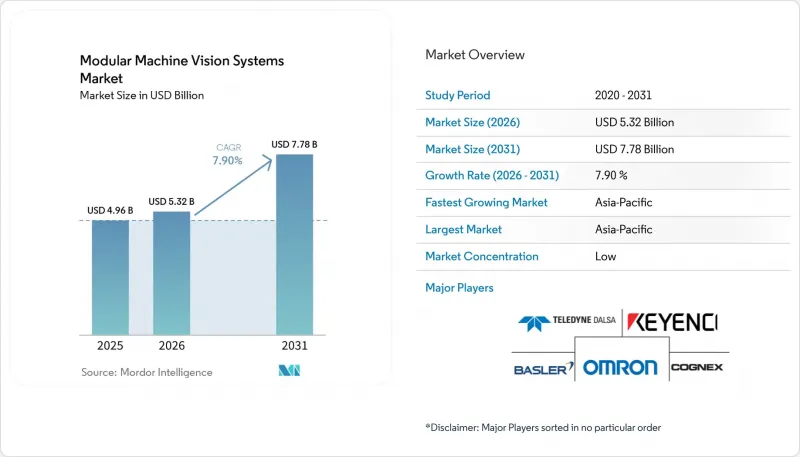
에 따르면 모듈러형 머신 비전 시스템 시장 규모는 2025년에 49억 6,000만 달러로 평가되며, 2026년 53억 2,000만 달러에서 2031년까지 77억 8,000만 달러에 달할 것으로 예측되고 있으며, 예측 기간(2026-2031년)에 CAGR은 7.90%에 달할 전망입니다.
전 세계 모듈형 머신 비전 시스템 시장의 동향 및 인사이트
공장 자동화 및 인더스트리 4.0 도입
스마트 제조에 대한 투자는 모듈형 머신 비전 시스템 시장의 주요 원동력입니다. 제조사들은 제품 설계나 생산량 변화에 따라 조정 가능한 검사 시스템을 필요로 합니다. 개방형 통신 표준을 통해 카메라, 조명, 프로세서 및 플랜트 제어 시스템을 손쉽게 연동할 수 있습니다. 이러한 요구 사항은 호환 가능한 입출력 모듈을 갖춘 모듈형 시스템의 성장을 촉진하고 있습니다. 일본, 독일, 중국은 중요한 제조 거점이며, 이 지역에서는 현대화 프로그램이 조달 결정에 영향을 미치고 있습니다. 이 지역에서는 규정 준수 요건이 기대되는 재무적 수익과 마찬가지로 업그레이드 시기에 영향을 미칠 수 있습니다.
AI를 활용한 결함 감지 및 공정 최적화
AI를 활용한 결함 검출은 모듈형 머신 비전 시스템 시장 전반에서 시범 프로젝트 단계에서 실제 운영 단계로 전환되고 있습니다. NVIDIA는 비전 기반 모델과 자가 지도 학습을 활용한 반도체 다이 수준의 결함 분류에서 98.51%의 정확도를 달성했다고 보고했습니다. 이 접근 방식을 통해 특수한 검사 작업에 필요한 라벨링된 데이터의 양도 감소했습니다. 이는 결함 발생 빈도가 낮고 라벨링된 이미지가 제한적인 경우에 특히 중요합니다. 2025년 조사에 따르면 데이터세트에 1만 건 이상의 샘플이 포함된 경우, 일부 산업용 검사 환경에서 딥러닝이 기존 기계학습보다 우수한 성능을 발휘하는 것으로 나타났습니다. 이러한 모델을 지원하는 처리 모듈은 시스템의 전체 수명 주기에 걸친 라벨링 및 재학습 작업을 경감시킬 수 있습니다.
높은 시스템 통합 비용 및 수명 주기 비용
모듈형 머신 비전 시스템 시장에서는 총 소유 비용이 구매자의 예상을 초과하는 경우가 있습니다. 프로젝트 비용의 40-60%를 하드웨어가 차지하는 반면, 나머지는 통합 엔지니어링, 라이선싱, 보정, 조명 설계 등이 차지합니다. 여러 벤더로 구성된 시스템에서는 구성 요소 계층 간의 호환성을 확보하기 위해 맞춤형 미들웨어가 필요할 수 있습니다. 또한 렌즈와 조명 모듈은 교체 주기도 다릅니다. 이로 인해 유지보수는 모놀리식 스마트 카메라의 경우보다 복잡해집니다. 표준 인터페이스나 인증 프로그램을 통해 이러한 부담을 줄일 수는 있지만, 벤더별 도입 현황에는 여전히 편차가 있습니다.
부문 분석
2025년, 카메라 및 이미징 모듈은 모듈형 머신 비전 시스템 시장 점유율의 31.56%를 차지했습니다. 카메라 선정은 해상도, 센서 포맷, 셔터 유형, 인터페이스 프로토콜의 선택을 좌우합니다. 따라서 모듈식 시스템 내에서 이후 이루어지는 많은 결정에 영향을 미칩니다. 광학·렌즈 모듈, 조명 모듈, 그리고 이미지 획득·인터페이스 모듈이 하드웨어 지출에서 다음으로 큰 비중을 차지하고 있습니다. 표면의 질감이나 재료의 구성을 구별해야 하는 상황에서는 조광이 가능한 LED 조명이 주목받고 있습니다. 또한 엣지 처리를 지원하는 AI 가속기가 고성능 시스템의 일부로 자리 잡으면서, 처리·연산 모듈도 변화하고 있습니다.
코그넥스는 2026년 4월, NVIDIA Jetson 기술을 탑재하고 최대 157 TOPS의 AI 성능을 자랑하는 ‘In-Sight 6900 비전 컨트롤러’를 발표했습니다. 비전 소프트웨어 및 AI 모듈은 2031년까지 9.11%라는 구성 요소 중 가장 높은 연평균 성장률(CAGR)을 기록할 것으로 예측됩니다. 소프트웨어는 여러 거점에 걸친 훈련, 개선, 도입을 지원할 수 있으므로 고객과의 보다 긴밀한 관계 구축으로 이어집니다. 코그넥스는 100개 이상의 기업 고객을 대상으로 한 베타 테스트를 거쳐, 2026년 5월에 ‘OneVision’의 일반 제공을 시작했습니다. I/O 및 통신 모듈은 여전히 비교적 표준화되어 있지만, 디지털 제조 프로그램에서 호환 가능한 데이터 연결이 요구되는 경우 OPC-UA 지원 인터페이스에 대한 수요가 증가하고 있습니다.
2025년, 2D 비전 시스템은 모듈형 머신 비전 시스템 시장 규모의 68.76%를 차지했습니다. 이러한 대규모 도입 실적은 친숙한 통합 방식, 확립된 소프트웨어 지원, 그리고 검사 지점당 비용이 낮다는 점을 반영합니다. 포장, 전자기기 조립 및 물류 분야의 바코드 판독에는 일반적으로 고속 글로벌 셔터 카메라가 사용됩니다. LMI Technologies는 2026년 1월, 엣지 네이티브 AI, IP67 규격의 하우징, 최대 84프레임/초의 성능을 특징으로 하는 ‘Gocator 2D 스마트 카메라’를 출시했습니다. 이러한 기능 덕분에, 기존에는 더 높은 비용이 드는 3D 구성이 필요했던 환경에서도 2D 시스템의 도입 범위를 확대할 수 있게 되었습니다.
3D 비전 시스템은 빈 피킹, 납땜 접합부 검사, 자동차 차체 갭 측정 등 깊이 정보가 필요한 상황에서 사용됩니다. Basler사와 Orbbec사는 2026년 3월, 산업용 3D 비전 분야에서의 제휴를 발표했습니다. 여기에는 자율주행 로봇 및 무인운반차(AGV)의 내비게이션을 위한 ‘Basler Stereo mini’가 포함됩니다. 하이퍼스펙트럼 및 멀티스펙트럼 이미징 시스템은 2031년까지 연평균 성장률(CAGR) 9.88%로 성장할 것으로 예측됩니다. 검출기 비용 감소와 온칩 신경망의 도입으로 인해 스냅숏 카메라의 추론 지연 시간은 10밀리초 미만으로 단축되었습니다. 식품 선별, 의약품 검사, 배터리 양극재 검증 및 입고 자재 인증에는 RGB 시스템으로는 제공할 수 없는 스펙트럼 정보가 필요합니다.
지역별 분석
아시아태평양은 2025년 모듈형 머신 비전 시스템 시장 점유율의 38.76%를 차지하고 있으며, 2031년까지 연평균 성장률(CAGR) 8.32%로 확대될 것으로 예측됩니다. 이 지역에서는 중국이 가장 큰 내수 시장을 보유하고 있으며, 반도체 자동 광학 검사, AI 탑재 비전 시스템, 로봇 비전에 대한 투자가 활발해지고 있습니다. 일본에서는 제조업체들이 상호 운용 가능한 공장 시스템을 도입함에 따라 구형 검사 라인의 교체가 진행되고 있습니다. 한국에서는 반도체 메모리 및 디스플레이 패널용으로 고속 라인 스캔 센서와 계측 등급 센서에 대한 수요가 증가하고 있습니다. 바슬러(Basler)는 2025년 10월, Alpha TechSys Automation의 지분 76%를 인수하고, 해당 회사의 사명을 ‘Basler India’로 변경함으로써 인도내 판매 및 서비스 체계를 강화했습니다.
북미와 유럽은 합쳐서 모듈형 머신 비전 시스템 시장에서 두 번째로 큰 수요 지역을 형성하고 있습니다. 미국에서는 AI 비전 소프트웨어 및 반도체 제조 장비와의 통합에 대한 수요가 활발합니다. 또한 국방 및 국가 안보 프로그램에서도 추론 데이터를 로컬에 보관하는 온디바이스형 시스템이 선호되고 있습니다. 독일은 자동차 부품 공급업체와 정밀 기계 제조업체를 통해 유럽의 수요를 주도하고 있습니다. 영국, 프랑스, 이탈리아, 스페인에서는 포장 기계 및 식품 및 음료 검사에 중점을 두고 있습니다. 캐나다와 멕시코는 반도체 및 자동차 공급망에 대한 투자의 혜택을 받고 있지만, 그 규모는 미국보다 작습니다.
중동 및 아프리카에서는 도입이 초기 단계에 있지만, 제조 분야에 대한 투자가 새로운 기회를 창출하고 있습니다. 사우디아라비아와 아랍에미리트는 국내 제조 역량을 구축하고 있으며, 이를 통해 신설되는 제약, 식품 가공, 전자기기 공장에서 비전 가이드형 검사가 지원되고 있습니다. 그린필드 프로젝트의 경우, 라인 설계 초기 단계부터 모듈식 표준이 반영되어 있으며, 통합 장벽을 낮출 수 있습니다. 아프리카에서는 남아프리카공화국이 자동차 조립 및 식품 가공을 주축으로 가장 확고한 머신 비전 수요를 보이고 있습니다. 남미에서는 브라질이 주도적인 입지를 차지하고 있으며, 자동차 및 식품 가공 분야가 체계적인 투자를 지원하고 있습니다. 아르헨티나를 비롯한 다른 남미 국가들에서는 자본 설비의 가격이 점차 저렴해지고 있으며, 시장 규모는 여전히 작지만 비즈니스 기회가 확대되고 있습니다.
기타 혜택:
- 엑셀 형식의 시장 예측(ME) 시트
- 3개월간의 애널리스트 지원
자주 묻는 질문
목차
제1장 서론
- 조사 전제조건과 시장 정의
- 조사 범위
제2장 조사 방법
제3장 개요
제4장 시장 구도
- 시장 개요
- 시장 성장 촉진요인
- 시장 성장 억제요인
- 거시경제 요인이 시장에 미치는 영향
- 업계 밸류체인 분석
- 규제 상황
- 기술 전망
- Porter's Five Forces 분석
제5장 시장 규모와 성장 예측
- 모듈러 컴포넌트별
- 이미징 유형별
- 용도별
- 최종사용자 산업별
- 지역별
- 북미
- 미국
- 캐나다
- 멕시코
- 남미
- 브라질
- 아르헨티나
- 기타 남미 국가
- 유럽
- 독일
- 영국
- 프랑스
- 이탈리아
- 스페인
- 기타 유럽 국가
- 아시아태평양
- 중국
- 일본
- 인도
- 한국
- ASEAN
- 기타 아시아태평양 국가
- 중동
- 사우디아라비아
- 아랍에미리트
- 기타 중동 국가
- 아프리카
- 남아프리카공화국
- 기타 아프리카 국가
- 북미
제6장 경쟁 구도
- 시장 집중도
- 전략적 동향
- 시장 점유율 분석
- 기업 개요
- Cognex Corporation
- KEYENCE CORPORATION
- Basler AG
- Teledyne Technologies Incorporated
- OMRON Corporation
- Allied Vision Technologies GmbH
- IDS Imaging Development Systems GmbH
- MVTec Software GmbH
- LMI Technologies Inc.
- Matrox Imaging Inc.
- Euresys S.A.
- Chromasens GmbH
- JAI A/S
- Vieworks Co., Ltd.
- Tordivel AS
- Opto Engineering S.p.A.
- A&B Software LLC
- Advanced Illumination, Inc.
- CCS Inc.
- Smart Vision Lights, Inc.
- Edmund Optics Inc.
제7장 시장 기회와 향후 전망
KSA 26.10.28According to Mordor Intelligence, the modular machine vision systems market size was valued at USD 4.96 billion in 2025 and is estimated to grow from USD 5.32 billion in 2026 to reach USD 7.78 billion by 2031, at a CAGR of 7.90% during the forecast period (2026-2031).
Global Modular Machine Vision Systems Market Trends and Insights
Factory Automation and Industry 4.0 Adoption
Smart manufacturing investment is a major force behind the modular machine vision systems market. Manufacturers need inspection systems that can be adjusted as product designs and production volumes change. Open communication standards make it easier to link cameras, lighting, processors, and plant controls. This requirement supports modular systems with compatible input and output modules. Japan, Germany, and China are important manufacturing centers where modernization programs are influencing procurement decisions. In these locations, compliance requirements can affect the timing of upgrades as much as the expected financial return.
AI-Enabled Defect Detection and Process Optimization
AI-based defect detection is moving from pilot projects into production use across the modular machine vision systems market. NVIDIA reported 98.51% accuracy for die-level semiconductor defect classification using a vision foundation model and self-supervised learning. The approach also reduced the labeled data needed for specialized inspection tasks. This matters where defects occur rarely and labeled images are limited. A 2025 review found that deep learning outperformed classical machine learning in several industrial inspection settings when datasets included more than 10,000 samples. Processing modules that support these models can reduce annotation and retraining work over the system life cycle.
High System Integration and Lifecycle Costs
Total ownership costs can be higher than buyers expect in the modular machine vision systems market. Hardware can represent 40-60% of a project cost, while integration engineering, licenses, calibration, and lighting design make up the balance. Multi-vendor configurations can need custom middleware to ensure compatibility between component layers. Lens and lighting modules also have different replacement schedules. This makes maintenance more complicated than it is for a monolithic smart camera. Standard interfaces and certification programs can reduce this burden, but adoption remains uneven across the vendor base.
Other drivers and restraints analyzed in the detailed report include:
- Electronics, Semiconductor, and Battery Inspection Complexity
- Vision-Guided Robotics and Autonomous Material Handling
- Shortage of Machine Vision Integration Skills
For complete list of drivers and restraints, kindly check the Table Of Contents.
Segment Analysis
Camera and Imaging Modules held 31.56% of the modular machine vision systems market share in 2025. Camera selection drives choices for resolution, sensor format, shutter type, and interface protocol. It therefore affects many later decisions within a modular system. Optics and Lens Modules, Lighting Modules, and Image Acquisition and Interface Modules make up the next group of hardware spending. Tunable LED lighting is gaining attention where surface texture or material composition must be distinguished. Processing and Computing Modules have also changed as edge-capable AI accelerators become part of higher-performance systems.
Cognex introduced its In-Sight 6900 Vision Controller in April 2026 with NVIDIA Jetson technology and up to 157 TOPS of AI performance. Vision Software and AI Modules are projected to record the fastest component CAGR at 9.11% through 2031. Software creates a closer customer relationship because it can support training, refinement, and deployment across several sites. Cognex made OneVision generally available in May 2026 after a beta involving more than 100 enterprise customers. I/O and Communication Modules remain relatively standardized, but demand for OPC-UA-ready interfaces is improving where digital manufacturing programs specify compatible data connections.
2D Vision Systems accounted for 68.76% of the modular machine vision systems market size in 2025. Their large installed base reflects familiar integration methods, established software support, and a lower cost per inspection point. Packaging, electronics assembly, and logistics code-reading commonly use high-speed global-shutter cameras. LMI Technologies launched Gocator 2D Smart Cameras in January 2026 with edge-native AI, IP67 enclosures, and support for up to 84 frames per second. These capabilities can extend 2D deployment into settings that previously needed a more costly 3D configuration.
3D Vision Systems are used in bin picking, solder-joint inspection, and automotive body-gap measurement, where depth information is necessary. Basler and Orbbec announced an industrial 3D vision partnership in March 2026, including the Basler Stereo mini for autonomous mobile robot and automated guided vehicle navigation. Hyperspectral and Multispectral Imaging Systems are projected to expand at a 9.88% CAGR through 2031. Lower detector costs and on-chip neural networks have reduced inference latency to less than 10 milliseconds on snapshot cameras. Food sorting, pharmaceutical inspection, battery-cathode verification, and incoming material authentication need spectral information that RGB systems cannot provide.
Complete Report Scope:
- By Modular Component
- Camera and Imaging Modules
- Optics and Lens Modules
- Lighting Modules
- Image Acquisition and Interface Modules
- Processing and Computing Modules
- Vision Software and AI Modules
- I/O and Communication Modules
- By Imaging Type
- 2D Vision Systems
- 3D Vision Systems
- Hyperspectral and Multispectral Imaging Systems
- By Application
- Inspection and Defect Detection
- Measurement and Metrology
- Identification and Code Reading
- Guidance and Positioning
- Other Applications
- By End-User Industry
- Automotive
- Electronics and Semiconductors
- Food and Beverage
- Healthcare and Pharmaceuticals
- Logistics and Retail
- Packaging
- Other End-User Industries
- By Geography
- North America
- United States
- Canada
- Mexico
- South America
- Brazil
- Argentina
- Rest of South America
- Europe
- Germany
- United Kingdom
- France
- Italy
- Spain
- Rest of Europe
- Asia-Pacific
- China
- Japan
- India
- South Korea
- ASEAN
- Rest of Asia-Pacific
- Middle East
- Saudi Arabia
- United Arab Emirates
- Rest of the Middle East
- Africa
- South Africa
- Rest of Africa
- North America
Geography Analysis
Asia-Pacific held 38.76% of the modular machine vision systems market share in 2025 and is projected to expand at an 8.32% CAGR through 2031. China has the largest national demand in the region, with semiconductor automated optical inspection, AI-enabled vision systems, and robot vision attracting investment. Japan is upgrading older inspection lines as manufacturers adopt interoperable factory systems. South Korea needs high-speed line-scan and metrology-grade sensors for semiconductor memory and display panels. Basler acquired a 76% stake in Alpha TechSys Automation in October 2025 and rebranded it as Basler India, strengthening its sales and service presence in India.
North America and Europe together form the second-largest combined demand area in the modular machine vision systems market. The United States has a strong demand for AI vision software and semiconductor capital equipment integration. Defense and national security programs also favor on-device systems that keep inference data local. Germany anchors European demand through automotive suppliers and precision engineering companies. The United Kingdom, France, Italy, and Spain focus more on packaging machinery and food and beverage inspection. Canada and Mexico benefit from semiconductor and automotive supply-chain investment, though their volumes are lower than those of the United States.
The Middle East and Africa are at earlier stages of adoption, but manufacturing investment is creating new opportunities. Saudi Arabia and the United Arab Emirates are building domestic manufacturing capacity, which supports vision-guided inspection in new pharmaceutical, food processing, and electronics plants. Greenfield projects can reduce integration barriers because modular standards are included in line design from the start. South Africa has the most established machine vision demand in Africa, driven by automotive assembly and food processing. Brazil leads South America, where automotive and food processing support structured investment. Argentina and other South American countries remain smaller opportunities as capital equipment becomes more affordable.
- Cognex Corporation
- KEYENCE CORPORATION
- Basler AG
- Teledyne Technologies Incorporated
- OMRON Corporation
- Allied Vision Technologies GmbH
- IDS Imaging Development Systems GmbH
- MVTec Software GmbH
- LMI Technologies Inc.
- Matrox Imaging Inc.
- Euresys S.A.
- Chromasens GmbH
- JAI A/S
- Vieworks Co., Ltd.
- Tordivel AS
- Opto Engineering S.p.A.
- A&B Software LLC
- Advanced Illumination, Inc.
- CCS Inc.
- Smart Vision Lights, Inc.
- Edmund Optics Inc.
Additional Benefits:
- The market estimate (ME) sheet in Excel format
- 3 months of analyst support
TABLE OF CONTENTS
1 INTRODUCTION
- 1.1 Study Assumptions and Market Definition
- 1.2 Scope of the Study
2 RESEARCH METHODOLOGY
3 EXECUTIVE SUMMARY
4 MARKET LANDSCAPE
- 4.1 Market Overview
- 4.2 Market Drivers
- 4.2.1 Factory Automation and Industry 4.0 Adoption
- 4.2.2 AI-Enabled Defect Detection and Process Optimization
- 4.2.3 Rising Electronics, Semiconductor, and Battery Inspection Complexity
- 4.2.4 Vision-Guided Robotics and Autonomous Material Handling
- 4.2.5 Edge AI Inference in Space-Constrained Machines
- 4.2.6 Machine-Readable Product Identity Requirements
- 4.3 Market Restraints
- 4.3.1 High System Integration and Lifecycle Costs
- 4.3.2 Shortage of Machine Vision Integration Skills
- 4.3.3 Dataset Drift Across Product and Lighting Variants
- 4.3.4 Industrial Cybersecurity and Data-Ownership Concerns
- 4.4 Impact of Macroeconomic Factors on the Market
- 4.5 Industry Value Chain Analysis
- 4.6 Regulatory Landscape
- 4.7 Technological Outlook
- 4.8 Porter's Five Forces Analysis
- 4.8.1 Threat of New Entrants
- 4.8.2 Bargaining Power of Suppliers
- 4.8.3 Bargaining Power of Buyers
- 4.8.4 Threat of Substitutes
- 4.8.5 Competitive Rivalry
5 MARKET SIZE AND GROWTH FORECASTS (VALUE)
- 5.1 By Modular Component
- 5.1.1 Camera and Imaging Modules
- 5.1.2 Optics and Lens Modules
- 5.1.3 Lighting Modules
- 5.1.4 Image Acquisition and Interface Modules
- 5.1.5 Processing and Computing Modules
- 5.1.6 Vision Software and AI Modules
- 5.1.7 I/O and Communication Modules
- 5.2 By Imaging Type
- 5.2.1 2D Vision Systems
- 5.2.2 3D Vision Systems
- 5.2.3 Hyperspectral and Multispectral Imaging Systems
- 5.3 By Application
- 5.3.1 Inspection and Defect Detection
- 5.3.2 Measurement and Metrology
- 5.3.3 Identification and Code Reading
- 5.3.4 Guidance and Positioning
- 5.3.5 Other Applications
- 5.4 By End-User Industry
- 5.4.1 Automotive
- 5.4.2 Electronics and Semiconductors
- 5.4.3 Food and Beverage
- 5.4.4 Healthcare and Pharmaceuticals
- 5.4.5 Logistics and Retail
- 5.4.6 Packaging
- 5.4.7 Other End-User Industries
- 5.5 By Geography
- 5.5.1 North America
- 5.5.1.1 United States
- 5.5.1.2 Canada
- 5.5.1.3 Mexico
- 5.5.2 South America
- 5.5.2.1 Brazil
- 5.5.2.2 Argentina
- 5.5.2.3 Rest of South America
- 5.5.3 Europe
- 5.5.3.1 Germany
- 5.5.3.2 United Kingdom
- 5.5.3.3 France
- 5.5.3.4 Italy
- 5.5.3.5 Spain
- 5.5.3.6 Rest of Europe
- 5.5.4 Asia-Pacific
- 5.5.4.1 China
- 5.5.4.2 Japan
- 5.5.4.3 India
- 5.5.4.4 South Korea
- 5.5.4.5 ASEAN
- 5.5.4.6 Rest of Asia-Pacific
- 5.5.5 Middle East
- 5.5.5.1 Saudi Arabia
- 5.5.5.2 United Arab Emirates
- 5.5.5.3 Rest of the Middle East
- 5.5.6 Africa
- 5.5.6.1 South Africa
- 5.5.6.2 Rest of Africa
- 5.5.1 North America
6 COMPETITIVE LANDSCAPE
- 6.1 Market Concentration
- 6.2 Strategic Moves
- 6.3 Market Share Analysis
- 6.4 Company Profiles (includes Global Level Overview, Market Level Overview, Core Segments, Financials as available, Strategic Information, Market Rank/Share, Products and Services, Recent Developments)
- 6.4.1 Cognex Corporation
- 6.4.2 KEYENCE CORPORATION
- 6.4.3 Basler AG
- 6.4.4 Teledyne Technologies Incorporated
- 6.4.5 OMRON Corporation
- 6.4.6 Allied Vision Technologies GmbH
- 6.4.7 IDS Imaging Development Systems GmbH
- 6.4.8 MVTec Software GmbH
- 6.4.9 LMI Technologies Inc.
- 6.4.10 Matrox Imaging Inc.
- 6.4.11 Euresys S.A.
- 6.4.12 Chromasens GmbH
- 6.4.13 JAI A/S
- 6.4.14 Vieworks Co., Ltd.
- 6.4.15 Tordivel AS
- 6.4.16 Opto Engineering S.p.A.
- 6.4.17 A&B Software LLC
- 6.4.18 Advanced Illumination, Inc.
- 6.4.19 CCS Inc.
- 6.4.20 Smart Vision Lights, Inc.
- 6.4.21 Edmund Optics Inc.
7 MARKET OPPORTUNITIES AND FUTURE OUTLOOK
- 7.1 White-Space and Unmet-Need Assessment


