

|
시장보고서
상품코드
2155212
스마트 팩토리 시각 시스템 : 시장 점유율 분석, 업계 동향과 통계, 성장 예측(2026-2031년)Smart Factory Vision Systems - Market Share Analysis, Industry Trends & Statistics, Growth Forecasts (2026 - 2031) |
||||||
 Mordor Intelligence
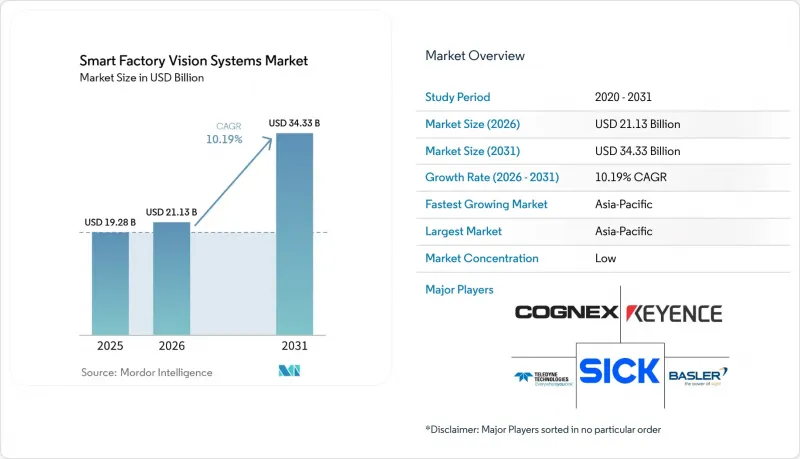
에 따르면 스마트 팩토리용 비전 시스템 시장 규모는 2025년에 192억 8,000만 달러로 평가되며, 2026년 211억 3,000만 달러에서 2031년까지 343억 3,000만 달러에 달할 것으로 예측되고 있으며, 예측 기간(2026-2031년)에 CAGR은 10.19%에 달할 전망입니다.
전 세계 스마트 팩토리용 비전 시스템 시장의 동향 및 인사이트
결함 탐지 분야에서 딥러닝의 정확도
딥러닝은 결함 패턴이 형상, 표면 또는 제품 설계에 따라 달라지는 공장 검사에서 더욱 적합한 기술로 자리 잡고 있습니다. 2026년 리뷰에 따르면 복잡한 결함 탐지 작업에서 하이브리드 CNN-트랜스포머 모델이 순수 CNN 모델보다 2.8-12.6퍼센트 포인트 더 우수한 성능을 보였습니다. 이 연구 결과는 불규칙한 균열, 반도체 결함, 전극의 핀홀 등의 결함을 대상으로 했습니다. 이러한 능력 덕분에 제조업체는 규칙 기반 검사로는 일관되게 처리할 수 없는 작업에 대해 스마트 팩토리 비전 시스템 시장을 활용하여야 할 더 강력한 근거를 얻게 됩니다. 불확실한 경우에는 여전히 사람의 눈으로 확인하는 것이 중요하며, 이는 인력을 완전히 대체하는 것이 아니라 하이브리드 검사 셀을 보완하는 역할을 합니다. 모델 훈련 및 지속적인 개선 툴을 제공하는 공급업체는 이러한 운영 모델을 지원하는 데 있으며, 더 유리한 입장에 있습니다.
EV 배터리 및 반도체 제조의 확대
전기자동차용 배터리 및 반도체 제조 시설에서는 많은 기존 생산 라인보다 더 많은 검사 공정이 필요합니다. 국제로봇연맹(IFR) 보고서에 따르면 2024년 전 세계 산업용 로봇 도입 대수는 59만 대였으며, 그 중 신규 도입의 70%를 아시아가 차지했습니다. 로봇 셀에서는 피킹, 배치 및 조립 검사를 위해 비전 기반 안내가 필요한 경우가 많습니다. 또한 반도체 제조에서도 웨이퍼, 코팅 및 패키징에 대한 치밀한 검사가 요구됩니다. 유럽의 ‘칩 법(European Chips Act)’은 유럽의 반도체 생산 능력 강화를 위해 민관을 합쳐 430억 유로의 정책 지원을 지시하고 있습니다. 이러한 투자를 통해 반도체의 인증 요건 및 재현성 요건을 충족할 수 있는 공급업체에게 스마트 팩토리용 비전 시스템 시장의 기회가 확대되고 있습니다.
높은 도입 및 통합 비용
생산 등급 비전 시스템을 도입하려면 카메라와 소프트웨어 이상의 것이 필요합니다. 비용에는 조명 설계, 렌즈 선정, 고정 장치, 통신 매핑, 그리고 기존 PLC 및 제조 실행 시스템(MES)과의 검증 등이 포함될 수 있습니다. 식품, 음료, 의약품 제조 현장에서는 위생, 방진·방수 및 제품 전환 요건으로 인해 추가적인 설계 작업이 필요할 수 있습니다. 안전성 및 기록 보관 요건으로 인해 문서 작성 작업이 증가하고, 설치 기간이 길어질 가능성도 있습니다. 이러한 비용은 전담 머신 비전 팀을 보유하고 있지 않은 중소규모 제조업체에게는 부담이 될 수 있습니다. 따라서 코그넥스의 ‘In-Sight SnAPP’ 센서나 SICK의 ‘Inspector83x’ 시스템과 같은 간단한 플랫폼은 설정의 복잡성을 줄여줄 수 있으며, 스마트 팩토리용 비전 시스템 시장에서 중요한 역할을 하고 있습니다.
부문 분석
2025년, 하드웨어는 스마트 팩토리 비전 시스템 시장의 70.34% 점유율을 차지했습니다. 이 범주에는 카메라, 광학 시스템, 프레임 그래버, 프로세서, 엣지 AI 가속기가 포함됩니다. 모든 시스템에서 이미지 획득이 필요하므로 카메라는 여전히 가장 큰 하드웨어 하위 카테고리로 남아 있습니다. 제조업체들이 기존 카메라 플랫폼에 추론 기능을 추가함에 따라 프로세서 및 엣지 가속기의 인기도 높아지고 있습니다. 소프트웨어는 2026-2031년까지 연평균 성장률(CAGR) 11.45%로 성장할 것으로 예상되며, 이는 스마트 팩토리 비전 시스템 시장 전체의 성장률을 상회하는 수치입니다. 이러한 성장은 이미지 처리, 딥러닝 툴 및 통합 미들웨어에 대한 수요 증가를 반영합니다.
코그넥스(Cognex)는 2025년 6월 베타 버전을 출시한 후, 2025년에 ‘OneVision’의 일반 제공을 시작했습니다. 베타 기간 중 100개 이상의 고객사가 이 플랫폼을 활용하여 통합된 모델 훈련 및 여러 사업장 간 엣지 배포를 수행했습니다. 소프트웨어를 활용함으로써 제조업체는 모든 카메라 하드웨어를 교체하지 않고도 여러 공장에 걸쳐 검사 모델을 업데이트할 수 있게 됩니다. 기존의 이미지 처리 기술은 예측 가능한 출력과 라이선스 비용 측면에서 여전히 경쟁력을 유지하고 있습니다. AI 툴이 주목을 받고 있지만, 사용자에게는 어노테이션, 모델 버전 관리, 합성 데이터 및 배포 관리도 필요합니다. 또한 카메라의 출력을 PLC, MES, SCADA 시스템과 연동해야 하므로 통합 소프트웨어의 중요성도 높아지고 있습니다. 따라서 스마트 팩토리 비전 시스템 업계에서는 초기 하드웨어 판매에 그치지 않는 소프트웨어 지원으로 가치의 일부가 이동하고 있습니다.
2025년 시점에 2D 비전 시스템은 스마트 팩토리 비전 시스템 시장의 63.78% 점유율을 차지했습니다. 이 시스템들은 평면 검사, 바코드 판독, 라벨 검증 분야에서 여전히 널리 활용되고 있습니다. 이러한 도입 실적, 폭넓은 적용 범위, 그리고 비용 측면에서의 우위가 지속적인 경쟁 우위를 지원하고 있습니다. 3D 비전 시스템은 2031년까지 연평균 성장률(CAGR) 11.91%로 성장할 것으로 예측됩니다. 배터리 셀 검사에서는 전극 정렬을 위해 깊이 데이터가 필요하지만, 이는 기존의 2D 이미지로 해결할 수 없습니다. 또한 로봇을 이용한 빈 피킹에서도 부품의 위치와 방향을 파악하기 위해 3D 포인트 클라우드가 사용되고 있습니다.
LMI Technologies는 2024년 8월 Liberty Robotics를 인수하여 자동차, 포장, 물류 분야의 애플리케이션을 위해 3D 비전과 로봇 유도 기능을 통합했습니다. 다중 스펙트럼 및 하이퍼 스펙트럼 시스템은 의약품 코팅 검사, 반도체 박막 매핑, 식품 이물질 검출과 같은 특정 용도로 사용되고 있습니다. 열화상 및 적외선 시스템은 납땜 결함, 베어링 과열, 콜드 체인 검증 등 온도와 관련된 검사에 중점을 두고 있습니다. Teledyne FLIR IIS는 2024년 8월, 산업용 검사, 환경 모니터링, 재활용 분류를 위한 ‘Forge 1GigE SWIR’ 카메라 시리즈를 출시했습니다. 이 시스템들은 가시광선에서는 비슷해 보이는 소재를 구별할 수 있습니다. 그 결과, ‘스마트 팩토리 비전 시스템 시장’은 표준 이미지에 더해 깊이, 열 또는 스펙트럼 정보가 필요한 용도로 확대되고 있습니다.
지역별 분석
아시아태평양은 2025년 스마트 팩토리 비전 시스템 시장의 34.21% 점유율을 차지하고 있으며, 2031년까지 연평균 성장률(CAGR) 11.56%로 성장할 것으로 예측됩니다. 중국은 엣지 카메라 및 이미지 처리 소프트웨어의 국내 공급업체에 힘입어 이 지역에서 가장 큰 국내 시장을 형성하고 있습니다. 일본 및 한국의 제조업체들은 고정밀 광학 시스템 및 이미징 센서 분야에서 여전히 중요한 위치를 차지하고 있습니다. 미쓰비시 전기와 소니 세미컨덕터 솔루션즈는 2026년 7월, 공장 자동화 제어, 이미지 센서, 엣지 AI 기술에 대한 전문 지식을 결집하여 일본에 ‘Advanced Vision Solutions’를 설립하기로 합의했습니다. 인도의 ‘생산 연계형 인센티브(PLI)’ 프로그램은 새로운 전자기기 제조 역량 확대를 지원하고 있으며, 이는 비전 시스템 도입을 위한 그린필드 기회를 창출하고 있습니다. 이러한 상황은 스마트 팩토리 비전 시스템 시장에서 아시아태평양의 역할을 더욱 공고히 하고 있습니다.
북미 시장은 자동차 조립, 반도체 검사, 물류 자동화에 의해 지탱되고 있습니다. 미국의 ‘CHIPS and Science Act(CHIPS·과학법)’는 설계 단계에서 2D 및 3D 비전 시스템 도입이 지정 가능한 시설에 대한 투자를 촉진하고 있습니다. 코그넥스(Cognex)는 2026년 1분기 매출이 2억 6,800만 달러(전년 동기 대비 24% 증가)를 기록했다고 보고하며, 소비자 가전 및 자동차 최종 시장의 호조를 그 이유로 꼽았습니다. 캐나다와 멕시코는 해당 지역의 자동차 공급망과 밀접하게 연관되어 있으며, OEM(주문자 상표 제조업체)의 생산 능력에 대한 결정에 좌우됩니다. 수요는 대개 웨이퍼, 자동차, 창고 용도의 고사양 시스템에 집중되어 있습니다. 따라서 북미의 스마트 팩토리 비전 시스템 시장은 이러한 부문의 설비 투자 주기와 밀접하게 연결되어 있습니다.
유럽 시장은 첨단 산업 자동화와 더욱 엄격한 문서화 요건이 특징입니다. 독일은 유럽 최대 시장이며, Basler, IDS Imaging Development Systems, MVTec Software와 같은 기업이 거점을 두고 있습니다. 유럽연합(EU)의 AI 규제에서는 특정 규제 대상 애플리케이션에 있으며, 훈련 데이터, 검증 및 소프트웨어 문서화가 특히 중시되고 있습니다. 이러한 요건으로 인해 카메라, 소프트웨어 및 연결 기기에 걸쳐 일관된 기록을 제공할 수 있는 공급업체가 유리한 입지를 차지할 가능성이 있습니다. 남미, 중동 및 아프리카는 여전히 도입 초기 단계에 있으며, 식품 가공, 광업, 물류 및 투자 주도형 산업 프로젝트에 도입이 집중되고 있습니다. 브라질 상파울루의 자동차 클러스터와 아부다비의 산업 프로그램은 확고한 수요 거점으로 자리 잡고 있습니다.
기타 혜택:
- 엑셀 형식의 시장 예측(ME) 시트
- 3개월간의 애널리스트 지원
목차
제1장 서론
- 조사 전제조건과 시장 정의
- 조사 범위
제2장 조사 방법
제3장 개요
제4장 시장 구도
- 시장 개요
- 시장 성장 촉진요인
- 시장 성장 억제요인
- 거시경제 요인이 시장에 미치는 영향
- 업계 밸류체인 분석
- 규제 상황
- 기술 전망
- Porter's Five Forces 분석
제5장 시장 규모와 성장 예측
- 컴포넌트별
- 비전 시스템 유형별
- 배포 모드별
- 용도별
- 최종사용자 산업별
- 지역별
- 북미
- 미국
- 캐나다
- 멕시코
- 남미
- 브라질
- 아르헨티나
- 기타 남미 국가
- 유럽
- 독일
- 영국
- 프랑스
- 이탈리아
- 스페인
- 기타 유럽 국가
- 아시아태평양
- 중국
- 일본
- 인도
- 한국
- 기타 아시아태평양 국가
- 중동 및 아프리카
- 중동
- 사우디아라비아
- 아랍에미리트
- 기타 중동 국가
- 아프리카
- 남아프리카공화국
- 기타 아프리카 국가
- 중동
- 북미
제6장 경쟁 구도
- 시장 집중도
- 전략적 동향
- 시장 점유율 분석
- 기업 개요
- Cognex Corporation
- KEYENCE CORPORATION
- Basler AG
- Teledyne Technologies Incorporated
- SICK AG
- Allied Vision Technologies GmbH
- IDS Imaging Development Systems GmbH
- JAI A/S
- LMI Technologies Inc.
- Datalogic S.p.A.
- Baumer Holding AG
- Euresys S.A.
- Photonfocus AG
- Chromasens GmbH
- Vieworks Co., Ltd.
- Zivid AS
- Photoneo s.r.o.
- SPECIM Spectral Imaging Ltd.
- Vision Components GmbH
- Emergent Vision Technologies Inc.
- Adimec Electronic Imaging B.V.
- Imperx, Inc.
- LUCID Vision Labs Inc.
- FLIR Systems, Inc.
제7장 시장 기회와 향후 전망
KSAAccording to Mordor Intelligence, the smart factory vision systems market size was valued at USD 19.28 billion in 2025 and estimated to grow from USD 21.13 billion in 2026 to reach USD 34.33 billion by 2031, at a CAGR of 10.19% during the forecast period (2026-2031).
Global Smart Factory Vision Systems Market Trends and Insights
Deep Learning Accuracy in Defect Detection
Deep learning has become more suitable for factory inspection, where defect patterns vary by shape, surface, or product design. Hybrid CNN-transformer models performed better than pure CNN models by 2.8 to 12.6 percentage points in complex defect tasks in a 2026 review. The findings covered defects such as irregular cracks, semiconductor failures, and electrode pinholes. This capability gives manufacturers a stronger reason to use the Smart Factory Vision Systems Market for tasks that rule-based inspection cannot handle consistently. Human review remains important for unclear cases, supporting hybrid inspection cells rather than complete labor replacement. Suppliers that offer model training and continuous improvement tools are better placed to support these operating models.
Expansion of EV Battery and Semiconductor Manufacturing
Electric vehicle battery and semiconductor facilities need more inspection steps than many conventional production lines. The International Federation of Robotics reported 590,000 industrial robot installations worldwide in 2024, and Asia accounted for 70% of new installations. Robot cells often need vision guidance for picking, placement, and assembly checks. Semiconductor manufacturing also requires close inspection of wafers, coatings, and packaging. The European Chips Act has directed EUR 43 billion of public and private policy support toward European semiconductor capacity. These investments broaden the Smart Factory Vision Systems Market opportunity for suppliers capable of meeting semiconductor qualification and repeatability requirements.
High Implementation and Integration Costs
A production-grade vision installation requires more than cameras and software. Costs can include lighting design, lens selection, fixtures, communications mapping, and validation for existing PLC and manufacturing execution systems. Food, beverage, and pharmaceutical sites may require additional design work due to hygiene, ingress protection, and product changeover requirements. Safety and recordkeeping requirements can also add documentation and extend installation periods. These costs are difficult for smaller manufacturers that do not employ dedicated machine vision teams. Simpler platforms such as Cognex In-Sight SnAPP sensors and SICK Inspector83x systems are therefore relevant to the Smart Factory Vision Systems Market because they reduce setup complexity.
Other drivers and restraints analyzed in the detailed report include:
- Declining Edge AI Hardware Costs
- Labor Shortages in Quality Inspection Roles
- Shortage of Skilled Vision-System Integrators
For complete list of drivers and restraints, kindly check the Table Of Contents.
Segment Analysis
Hardware held 70.34% of the Smart Factory Vision Systems Market share in 2025. The category includes cameras, optics, frame grabbers, processors, and edge AI accelerators. Cameras remained the largest hardware subcategory because every system requires image capture. Processors and edge accelerators are growing in popularity as manufacturers add inference capabilities to installed camera platforms. Software is projected to grow at an 11.45% CAGR from 2026 to 2031, faster than the overall Smart Factory Vision Systems Market. This growth reflects increasing demand for image processing, deep learning tools, and integration middleware.
Cognex made OneVision generally available in 2025 after a beta launch in June 2025. More than 100 customers used the platform during its beta period for centralized model training and cross-site edge deployment. Software can help manufacturers update inspection models across multiple plants without replacing all camera hardware. Traditional image processing continues to compete on predictable output and license cost. AI tools command attention, but users also need annotation, model version control, synthetic data, and deployment management. Integration software is also gaining importance because camera output must connect with PLC, MES, and SCADA systems. The Smart Factory Vision Systems industry is therefore shifting part of its value toward software support that extends beyond the initial hardware sale.
2D vision systems held 63.78% of the Smart Factory Vision Systems Market share in 2025. They remain widely used for flat-surface inspection, barcode reading, and label verification. Their installed base, broad application range, and cost profile support their continuing lead. 3D vision systems are forecast to grow at an 11.91% CAGR through 2031. Battery cell inspection needs depth data for electrode alignment that conventional 2D images cannot resolve. Robotic bin-picking also uses 3D point clouds to identify the position and orientation of parts.
LMI Technologies acquired Liberty Robotics in August 2024 to combine 3D vision with robot guidance capabilities for automotive, packaging, and logistics applications. Multispectral and hyperspectral systems are used for selected applications in pharmaceutical coating checks, semiconductor thin-film mapping, and food foreign-body detection. Thermal and infrared systems focus on temperature-related inspection, including soldering defects, bearing overheating, and cold-chain verification. Teledyne FLIR IIS launched its Forge 1GigE SWIR camera series in August 2024 for industrial inspection, environmental monitoring, and recycling classification. These systems can distinguish materials that look similar in visible light. The Smart Factory Vision Systems Market is consequently expanding into applications that require depth, thermal, or spectral information alongside standard images.
Complete Report Scope:
- By Component
- Hardware
- Cameras
- Optics and Lenses
- Frame Grabbers
- Processors and Edge AI Accelerators
- Other Hardware
- Software
- Image Processing Software
- Deep Learning and Artificial Intelligence Software
- Vision System Integration Software
- Other Software
- Hardware
- By Vision System Type
- 2D Vision Systems
- 3D Vision Systems
- Multispectral / Hyperspectral Vision Systems
- Thermal / Infrared Vision Systems
- Other Vision Systems
- By Deployment Mode
- Edge-Based
- On-Premises
- Cloud-Connected
- Hybrid
- By Application
- Quality Inspection and Defect Detection
- Measurement and Metrology
- Identification, OCR, and Code Reading
- Positioning, Guidance, and Robotics
- Process Monitoring and Control
- Other Applications
- By End-User Industry
- Automotive and Automotive Components
- Electronics and Semiconductors
- Food and Beverage
- Pharmaceuticals and Life Sciences
- Consumer Goods
- Industrial Machinery and Equipment
- Metals and Manufacturing
- Other End-User Industries
- By Geography
- North America
- United States
- Canada
- Mexico
- South America
- Brazil
- Argentina
- Rest of South America
- Europe
- Germany
- United Kingdom
- France
- Italy
- Spain
- Rest of Europe
- Asia-Pacific
- China
- Japan
- India
- South Korea
- Rest of Asia-Pacific
- Middle East and Africa
- Middle East
- Saudi Arabia
- United Arab Emirates
- Rest of the Middle East
- Africa
- South Africa
- Rest of Africa
- Middle East
- North America
Geography Analysis
Asia-Pacific held 34.21% of the Smart Factory Vision Systems Market share in 2025 and is forecast to grow at an 11.56% CAGR through 2031. China is the largest national market in the region, supported by domestic suppliers of edge cameras and image processing software. Japanese and South Korean manufacturers retain importance in high-precision optics and imaging sensors. Mitsubishi Electric and Sony Semiconductor Solutions agreed in July 2026 to establish Advanced Vision Solutions in Japan, bringing together expertise in factory automation control, image sensors, and edge AI technology. India's Production Linked Incentive program is supporting new electronics manufacturing capacity, which creates greenfield opportunities for vision deployment. These conditions reinforce Asia-Pacific's role in the Smart Factory Vision Systems Market.
North America is supported by automotive assembly, semiconductor inspection, and logistics automation. The U.S. CHIPS and Science Act has encouraged investment in facilities where 2D and 3D vision systems can be specified at the design stage. Cognex reported USD 268 million in first-quarter 2026 revenue, a 24% year-over-year increase, and cited strength in consumer electronics and automotive end markets. Canada and Mexico are linked to the region's automotive supply chain and follow original equipment manufacturer capacity decisions. Demand often centers on high-specification systems for wafer, vehicle, and warehouse applications. The Smart Factory Vision Systems Market in North America is, therefore, closely tied to capital investment cycles in these sectors.
Europe is shaped by advanced industrial automation and stricter documentation requirements. Germany is the leading European market and is home to Basler, IDS Imaging Development Systems, and MVTec Software. The European Union's AI rules add emphasis on training data, validation, and software documentation for certain regulated applications. These requirements can favor suppliers that provide consistent records across cameras, software, and connected equipment. South America, the Middle East, and Africa remain earlier-stage areas where adoption is concentrated in food processing, mining, logistics, and investment-led industrial projects. Brazil's Sao Paulo automotive cluster and Abu Dhabi's industrial programs offer established demand corridors.
- Cognex Corporation
- KEYENCE CORPORATION
- Basler AG
- Teledyne Technologies Incorporated
- SICK AG
- Allied Vision Technologies GmbH
- IDS Imaging Development Systems GmbH
- JAI A/S
- LMI Technologies Inc.
- Datalogic S.p.A.
- Baumer Holding AG
- Euresys S.A.
- Photonfocus AG
- Chromasens GmbH
- Vieworks Co., Ltd.
- Zivid AS
- Photoneo s.r.o.
- SPECIM Spectral Imaging Ltd.
- Vision Components GmbH
- Emergent Vision Technologies Inc.
- Adimec Electronic Imaging B.V.
- Imperx, Inc.
- LUCID Vision Labs Inc.
- FLIR Systems, Inc.
Additional Benefits:
- The market estimate (ME) sheet in Excel format
- 3 months of analyst support
TABLE OF CONTENTS
1 INTRODUCTION
- 1.1 Study Assumptions and Market Definition
- 1.2 Scope of the Study
2 RESEARCH METHODOLOGY
3 EXECUTIVE SUMMARY
4 MARKET LANDSCAPE
- 4.1 Market Overview
- 4.2 Market Drivers
- 4.2.1 Deep Learning Accuracy in Defect Detection
- 4.2.2 Expansion of EV Battery and Semiconductor Manufacturing
- 4.2.3 Declining Edge AI Hardware Costs
- 4.2.4 Labor Shortages in Quality Inspection Roles
- 4.2.5 Vision-Guided Robotics Adoption
- 4.2.6 Traceability Requirements in Food, Pharmaceutical, and Medical Manufacturing
- 4.3 Market Restraints
- 4.3.1 High Implementation and Integration Costs
- 4.3.2 Shortage of Skilled Vision-System Integrators
- 4.3.3 Cybersecurity Risks in Connected Vision Systems
- 4.3.4 Training-Data, Model-Validation, and Model-Drift Burden
- 4.4 Impact of Macroeconomic Factors on the Market
- 4.5 Industry Value Chain Analysis
- 4.6 Regulatory Landscape
- 4.7 Technological Outlook
- 4.8 Porter's Five Forces Analysis
- 4.8.1 Bargaining Power of Suppliers
- 4.8.2 Bargaining Power of Buyers
- 4.8.3 Threat of New Entrants
- 4.8.4 Threat of Substitutes
- 4.8.5 Intensity of Competitive Rivalry
5 MARKET SIZE AND GROWTH FORECASTS (VALUE)
- 5.1 By Component
- 5.1.1 Hardware
- 5.1.1.1 Cameras
- 5.1.1.2 Optics and Lenses
- 5.1.1.3 Frame Grabbers
- 5.1.1.4 Processors and Edge AI Accelerators
- 5.1.1.5 Other Hardware
- 5.1.2 Software
- 5.1.2.1 Image Processing Software
- 5.1.2.2 Deep Learning and Artificial Intelligence Software
- 5.1.2.3 Vision System Integration Software
- 5.1.2.4 Other Software
- 5.1.1 Hardware
- 5.2 By Vision System Type
- 5.2.1 2D Vision Systems
- 5.2.2 3D Vision Systems
- 5.2.3 Multispectral / Hyperspectral Vision Systems
- 5.2.4 Thermal / Infrared Vision Systems
- 5.2.5 Other Vision Systems
- 5.3 By Deployment Mode
- 5.3.1 Edge-Based
- 5.3.2 On-Premises
- 5.3.3 Cloud-Connected
- 5.3.4 Hybrid
- 5.4 By Application
- 5.4.1 Quality Inspection and Defect Detection
- 5.4.2 Measurement and Metrology
- 5.4.3 Identification, OCR, and Code Reading
- 5.4.4 Positioning, Guidance, and Robotics
- 5.4.5 Process Monitoring and Control
- 5.4.6 Other Applications
- 5.5 By End-User Industry
- 5.5.1 Automotive and Automotive Components
- 5.5.2 Electronics and Semiconductors
- 5.5.3 Food and Beverage
- 5.5.4 Pharmaceuticals and Life Sciences
- 5.5.5 Consumer Goods
- 5.5.6 Industrial Machinery and Equipment
- 5.5.7 Metals and Manufacturing
- 5.5.8 Other End-User Industries
- 5.6 By Geography
- 5.6.1 North America
- 5.6.1.1 United States
- 5.6.1.2 Canada
- 5.6.1.3 Mexico
- 5.6.2 South America
- 5.6.2.1 Brazil
- 5.6.2.2 Argentina
- 5.6.2.3 Rest of South America
- 5.6.3 Europe
- 5.6.3.1 Germany
- 5.6.3.2 United Kingdom
- 5.6.3.3 France
- 5.6.3.4 Italy
- 5.6.3.5 Spain
- 5.6.3.6 Rest of Europe
- 5.6.4 Asia-Pacific
- 5.6.4.1 China
- 5.6.4.2 Japan
- 5.6.4.3 India
- 5.6.4.4 South Korea
- 5.6.4.5 Rest of Asia-Pacific
- 5.6.5 Middle East and Africa
- 5.6.5.1 Middle East
- 5.6.5.1.1 Saudi Arabia
- 5.6.5.1.2 United Arab Emirates
- 5.6.5.1.3 Rest of the Middle East
- 5.6.5.2 Africa
- 5.6.5.2.1 South Africa
- 5.6.5.2.2 Rest of Africa
- 5.6.5.1 Middle East
- 5.6.1 North America
6 COMPETITIVE LANDSCAPE
- 6.1 Market Concentration
- 6.2 Strategic Moves
- 6.3 Market Share Analysis
- 6.4 Company Profiles (includes Global Level Overview, Market Level Overview, Core Segments, Financials as available, Strategic Information, Market Rank/Share, Products and Services, Recent Developments)
- 6.4.1 Cognex Corporation
- 6.4.2 KEYENCE CORPORATION
- 6.4.3 Basler AG
- 6.4.4 Teledyne Technologies Incorporated
- 6.4.5 SICK AG
- 6.4.6 Allied Vision Technologies GmbH
- 6.4.7 IDS Imaging Development Systems GmbH
- 6.4.8 JAI A/S
- 6.4.9 LMI Technologies Inc.
- 6.4.10 Datalogic S.p.A.
- 6.4.11 Baumer Holding AG
- 6.4.12 Euresys S.A.
- 6.4.13 Photonfocus AG
- 6.4.14 Chromasens GmbH
- 6.4.15 Vieworks Co., Ltd.
- 6.4.16 Zivid AS
- 6.4.17 Photoneo s.r.o.
- 6.4.18 SPECIM Spectral Imaging Ltd.
- 6.4.19 Vision Components GmbH
- 6.4.20 Emergent Vision Technologies Inc.
- 6.4.21 Adimec Electronic Imaging B.V.
- 6.4.22 Imperx, Inc.
- 6.4.23 LUCID Vision Labs Inc.
- 6.4.24 FLIR Systems, Inc.
7 MARKET OPPORTUNITIES AND FUTURE OUTLOOK
- 7.1 White-Space and Unmet-Need Assessment


