

|
시장보고서
상품코드
2155232
대규모 태양광발전소 : 시장 점유율 분석, 업계 동향과 통계, 성장 예측(2026-2031년)Utility-Scale Solar Power Plant - Market Share Analysis, Industry Trends & Statistics, Growth Forecasts (2026 - 2031) |
||||||
 Mordor Intelligence
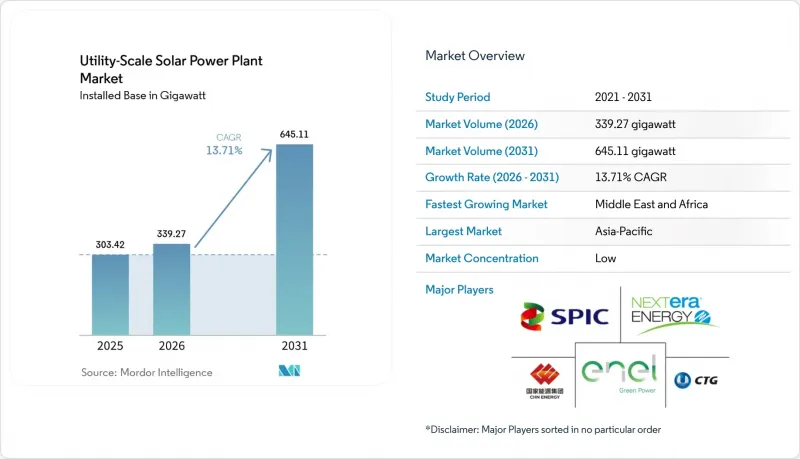
에 따르면 설치용량 기반에서의 유틸리티 규모 태양광발전소 시장 규모는 2025년에 1.26 테라와트, 2026년에는 1.56 테라와트가 되어, 2031년까지 3.92 테라와트에 달할 것으로 전망되고 있으며, 2026-2031년에 CAGR 20.24%로 성장할 것으로 예측됩니다.
전 세계 유틸리티 규모 태양광발전소 시장의 동향 및 인사이트
화석 연료 발전에 대한 유틸리티 규모 태양광발전의 비용 경쟁력
많은 시장에서 태양광발전이 여전히 저비용의 신규 전력원인 만큼, 유틸리티 규모 태양광발전소 시장의 성장은 계속되고 있습니다. IRENA 보고서에 따르면 2025년에 가동을 시작한 유틸리티급 재생에너지 프로젝트의 90% 이상이 각 시장에서 가장 저렴한 신규 화석연료 발전 비용보다 낮은 가격으로 전력을 생산했습니다. IRENA는 2025년 전 세계 유틸리티 규모 태양광발전의 평균 비용을 44달러/MWh로 추정하고 있습니다. 이러한 비용 상황으로 인해 개발 판단 기준은 단순히 낮 동안 가능한 한 많은 전력을 생산하는 것에서 전력망이 필요로 하는 시점에 전력을 공급할 수 있는 능력으로 전환되고 있으며, 프로젝트의 경제성 측면에서 태양광발전 설비, 에너지 저장 시스템, 전력망 제약 및 고객 수요 간의 상호 관계가 점점 더 중요해지고 있습니다. 따라서 개발업체들은 에너지 저장 설비를 도입하고, 안정적인 전력 공급을 보장하는 계약을 모색하고 있습니다. 또한 공공 태양광발전 연구 프로그램도 지속적인 비용 절감과 기술 향상을 지원하고 있습니다.
기업용 전력 구매 계약(PPA)과 하이퍼스케일러의 전력 조달
기업용 전력 구매 계약(PPA)은 유틸리티 규모의 태양광발전소 시장에 보다 명확한 수요 기반을 창출하고 있습니다. 데이터센터는 대량의 전력을 필요로 하며, 건설을 진행하기 전에 장기 공급 계약을 체결해야 하는 경우가 적지 않습니다. 이러한 계약은 개발 사업자에게 수익 전망을 개선해 주고, 프로젝트 자금 조달에도 기여합니다. 이는 대출 기관이나 투자자가 자산의 운영 기간 중 불확실한 도매 시장 가격에 의존하기보다는 알려진 고객, 명확한 계약 기간, 그리고 보다 예측 가능한 현금 흐름을 평가할 수 있기 때문입니다. 이러한 자금 조달 모델은 송전망 업그레이드나 에너지 저장 설비가 필요한 태양광발전 프로젝트에 특히 중요합니다. 구글과 토탈에너지(TotalEnergies)는 2026년 2월, 텍사스주 데이터센터를 대상으로 총 1GW에 달하는 2건의 장기 태양광발전 계약을 체결했습니다. 기업 구매자들이 더 긴 계약 기간을 수용하고 프로젝트 실행에 직접 참여하게 된다면, 유틸리티 규모의 태양광발전소 시장은 그 혜택을 누리게 될 것입니다.
계통 연계 대기열과 송전 병목 현상
송전망 연결은 북미 및 유럽 일부 지역의 유틸리티 규모 태양광발전소 시장에 큰 제약 요인으로 작용하고 있습니다. 로렌스 버클리 국립연구소의 기록에 따르면 2024년 말 기준으로 미국에서는 1만 300건 이상의 프로젝트가 계통 연계를 신청했으며, 그 발전 용량은 1,400GW에 달합니다. 신청부터 상업 운전 개시까지의 기간 중앙값은 2000-2007년 사이의 프로젝트군에서는 2년 미만이었으나, 2018-2024년 사이의 프로젝트군에서는 4년 이상으로 늘어났습니다. 장기적인 조사 및 불확실한 송전망 개보수 비용으로 인해 건설 전에 필요한 자본이 증가하고, 개발 예산이 장기간 묶이게 됩니다. 그 결과, 송전망 개보수 비용과 시기가 확정된 후에도 프로젝트 후원자가 후보지가 충분한 가치를 가져다줄지 판단하기 어려워지고 있습니다. 이러한 상황에서는 장기간에 걸친 승인 절차를 견뎌낼 수 있는 개발사가 유리합니다. 동료 심사를 거친 연구에 따르면 미국의 계통 연계 대기 리스트에 등록된 프로젝트의 80%가 최종적으로 신청을 철회한 것으로 나타났습니다.
부문 분석
2025년 현재, 태양광발전(PV)은 유틸리티 규모 태양광발전소 시장 규모의 97.2%를 차지하고 있으며, 2031년까지 연평균 성장률(CAGR) 14.7%로 확대될 것으로 예측됩니다. 이러한 위상은 모듈 비용의 하락, 확립된 설계 및 건설 역량, 그리고 여러 국가에 걸친 대규모 조달 프로그램을 지원할 수 있는 공급망을 반영합니다. 개발사는 부지, 계통 연계, 설비 및 전력 구매 계약을 확보한 후 신속하게 태양광발전 설비를 설치할 수 있습니다. 따라서 이 기술은 정해진 계획 기간 내에 발전 용량 증설을 필요로 하는 전력 회사에 유용하며, 수요 예측에서 대체할 대규모 발전 설비가 도입되기 전에 상당한 규모의 신규 발전 용량이 필요하다고 나타날 경우, 계획 담당자에게 실용적인 선택지가 됩니다. 중국 사막과 고비 사막의 프로젝트는 집중형 태양광발전 개발을 위한 중요한 기반을 제공하며, 토지 계획이 어떻게 매우 대규모 프로젝트를 지원할 수 있는지를 보여줍니다.
또한 태양광발전 개발 사업자는 더욱 복잡해진 조달 환경에도 대응하고 있습니다. 무역 규정이나 소유권 요건으로 인해 프로젝트 자격 요건을 충족하는 모듈 공급업체 리스트이 변경되거나, 설비 발주 시기에 영향을 미치거나, 규정을 준수하는 제품의 비용이 변동될 뿐만 아니라, 프로젝트 개발 사업자, 공급업체, 투자자, 전력 구매처 간에 더욱 긴밀한 협력이 요구되기 때문입니다. 양면수광형, TOPCon 및 백컨택트형 셀 제품은 이용 가능한 토지에서 생산되는 발전량을 향상시킬 수 있으며, 이를 통해 개발 사업자는 일사량이 다른 부지를 보다 효율적으로 활용할 수 있게 됩니다. 데이터센터나 정부 관련 구매자를 대상으로 하는 프로젝트에서는 ‘우려 대상 외국 기업(FEOC)’ 규정을 충족하는 공급망이 필요한 경우가 있으며, 투명성이 높은 조달과 확실한 납기 계획의 중요성이 더욱 커지고 있습니다. 집광형 태양열발전(CSP)은 여전히 소규모 기술이지만, 축열 기술을 활용함으로써 독립적인 배터리 시스템에 의존하지 않고도 일몰 후에도 발전이 가능합니다. 중국에서는 2026년 중반 기준으로 2.1 GW의 CSP 가동 용량이 있으며, 추가로 26개 프로젝트에서 3.2GW가 건설 중인 반면, IRENA 보고서에 따르면 2025년 CSP 비용은 115달러/MWh로 나타났습니다.
지역별 분석
2025년 기준, 아시아태평양은 설치 용량의 68.4%를 차지하며, 유틸리티 규모의 태양광발전소 시장에서 여전히 가장 큰 지역 거점으로 자리 잡고 있습니다. 중국, 인도, 일본, 한국, 호주는 대규모 전력 시스템과 활발한 태양광발전 개발을 모두 갖추고 있지만, 각국의 입찰 규정, 송전망 계획, 국내 제조 정책 및 프로젝트 승인 절차는 서로 다릅니다. 2025년에는 전 세계 태양광발전 설비 용량이 3 TW를 돌파했으며, 약 40개국이 처음으로 1 GW 이상의 설비를 도입했습니다. 이는 태양광발전 도입이 가장 오랜 역사를 가진 시장을 넘어 확산되고 있음을 보여줍니다. 중국은 광대한 국토 면적, 국내 제조 능력, 그리고 정부의 지원에 힘입은 개발이 초대형 프로젝트를 지원할 수 있으므로 여전히 중심적인 위치를 차지하고 있습니다. 한편, 인도는 입찰 중심의 주요 파이프라인과 설비 조달 및 건설 활동을 지원하는 급성장하는 현지 공급 기반을 바탕으로, 집중 개발 구역과 경쟁적인 조달 절차 양쪽을 통해 해당 지역내 유틸리티 규모 프로젝트의 도입 능력을 확대하고 있습니다.
중동 및 아프리카는 2031년까지 연평균 성장률(CAGR) 15.2%를 기록할 것으로 예측되며, 이는 유틸리티 규모 태양광발전소 시장에서 지역별 가장 높은 성장률입니다. 사우디아라비아의 재생에너지 계획에 따라 대규모 프로젝트에 대한 다년간의 수요가 창출되고 있으며, 걸프 국가들에서는 국영 전력회사의 전력 매입, 정부의 조달, 그리고 일사량이 풍부한 토지가 규모 확대를 지원하고 있습니다. 아프리카 시장은 소규모 프로젝트 파이프라인에서 보다 광범위한 유틸리티 규모 활동으로 전환되고 있지만, 자금 조달 조건, 송전망, 개발사의 역량, 그리고 전력 구매자의 신용도는 국가마다 크게 다릅니다. 따라서 프로젝트의 성공은 신중한 계약 설계, 현지 경험이 풍부한 개발 파트너, 그리고 상업 운영 개시 전에 필요한 송전망 구축에 대한 현실적인 평가에 달려 있는 경우가 많습니다. 이러한 기회를 활용하기 위해서는 단일 개발 역량에 의존하기보다는 프로젝트 개발, 자금 조달, 건설 관리, 현지 이해관계자와의 협력, 그리고 장기적인 운영을 결합한 기업이 유리합니다. 각국이 태양광발전 도입량을 확대하고, 전력이 송전망에 공급되는 시점을 보다 세밀하게 제어하며, 낮 시간대에 발전량이 풍부할 때 발생하는 수익 위험에 대응해 나감에 따라 전력 저장 시스템의 중요성은 더욱 높아질 것입니다. 왜냐하면 발전량의 적어도 일부를 조정할 수 있는 태양광발전 설비는 저녁 시간대의 수요에 효과적에 대응할 수 있고, 계약 조건을 개선하며, 도매 가격이 침체되는 기간에 미치는 영향을 완화할 수 있기 때문입니다.
북미와 유럽에서는 전력 시스템이 성숙되어 있으며, 유틸리티 규모의 태양광발전소 시장에서 더 엄격한 실행상의 제약에 직면하고 있습니다. 미국 에너지 정보국(EIA) 보고서에 따르면 2026년까지 미국에서 계획된 유틸리티 규모의 태양광발전소 증설 용량은 43.4GW이며, 그중 텍사스주가 계획 용량의 40%를 차지하고 있습니다. 또한 데이터센터의 수요는 장기 전력 구매 계약의 타당성을 지원하고 있습니다. 계통 연계 조사, 송전망 업그레이드, 연방 정부 소유지 사용 허가 등의 절차로 인해 개발사가 잠재적 구매자, 설비, 건설 자금을 확보한 후에도 북미 프로젝트는 지연될 가능성이 있습니다. 유럽 시장에서는 태양광발전에 대한 정책 지원이 지속되고 있지만, 주간 공급이 수요를 초과하여 도매 가격이 하락할 경우 시장 거래를 통한 수익이 감소할 가능성이 있으므로, 계약, 에너지 저장 및 수요 유연성의 중요성이 높아지고 있습니다. 남미에서는 브라질과 칠레에서 풍부한 태양광 자원을 이용할 수 있지만, 송전 용량 제약이나 각국 고유의 정책 리스크로 인해 프로젝트 일정이 제약을 받을 가능성이 있으므로, 개발사는 입지에 맞는 송전망 및 전력 매입 전략을 채택해야 합니다.
기타 혜택:
- 엑셀 형식의 시장 예측(ME) 시트
- 3개월간의 애널리스트 지원
자주 묻는 질문
목차
제1장 서론
- 조사 전제조건과 시장 정의
- 조사 범위
제2장 조사 방법
제3장 개요
제4장 시장 구도
- 시장 개요
- 시장 성장 촉진요인
- 시장 성장 억제요인
- 공급망 분석
- Porter's Five Forces 분석
- 기술 동향
- 규제 상황
- 투자 분석
제5장 시장 규모와 성장 예측
- 기술별
- 지역별
- 북미
- 미국
- 캐나다
- 멕시코
- 유럽
- 독일
- 프랑스
- 이탈리아
- 스페인
- 영국
- 폴란드
- 러시아
- 기타 유럽 국가
- 아시아태평양
- 중국
- 인도
- 일본
- 한국
- 호주
- 인도네시아
- 베트남
- 태국
- 기타 아시아태평양 국가
- 남미
- 브라질
- 아르헨티나
- 칠레
- 기타 남미 국가
- 중동 및 아프리카
- 사우디아라비아
- 아랍에미리트
- 이집트
- 남아프리카공화국
- 모로코
- 기타 중동 및 아프리카 국가
- 북미
제6장 경쟁 구도
- 시장 집중도
- 전략적 동향
- 시장 점유율 분석
- 기업 개요
- ACWA Power
- Adani Green Energy Limited
- Brookfield Renewable Partners L.P.
- Canadian Solar Inc.
- China Three Gorges Renewables(Group) Co., Ltd.
- CHN Energy Investment Group Co., Ltd.
- EDF Renewables
- Enel Green Power S.p.A.
- ENGIE
- First Solar, Inc.
- Iberdrola, S.A.
- JinkoSolar Holding Co., Ltd.
- Lightsource bp
- Masdar
- NextEra Energy, Inc.
- Repsol, S.A.
- RWE Renewables Europe and Australia GmbH
- State Power Investment Corporation Limited
- TotalEnergies SE
- Trina Solar Co., Ltd.
제7장 시장 기회와 향후 전망
KSA 26.10.28According to Mordor Intelligence, the Utility-Scale solar power plant market size in terms of installed base is projected to be 1.26 Terawatt in 2025, 1.56 Terawatt in 2026, and reach 3.92 Terawatt by 2031, growing at a CAGR of 20.24% from 2026 to 2031.
Global Utility-Scale Solar Power Plant Market Trends and Insights
Utility-Scale Solar Cost Competitiveness Against Fossil Generation
Utility-scale solar power plant market growth continues because solar remains a low-cost source of new electricity in many markets. IRENA reported that more than 90% of utility-scale renewable projects commissioned in 2025 generated power below the cost of the cheapest new fossil fuel alternative in their markets. IRENA placed the global average utility-scale solar PV cost at USD 44/MWh in 2025. This cost position shifts development decisions toward the ability to deliver electricity when the system needs it, rather than simply producing the largest possible volume during daylight hours, and it makes the interaction between solar assets, storage systems, grid constraints, and customer demand increasingly important to project economics. Developers are therefore adding storage and seeking contracts that recognize dependable delivery. Public solar research programs also continue to support further cost reductions and technology improvement.
Corporate PPAs and Hyperscaler Electricity Procurement
Corporate power purchase agreements are creating a clearer demand base for the utility-scale solar power plant market. Data centers need large volumes of electricity and often need long-term supply agreements before construction can proceed. These contracts improve revenue visibility for developers and can help attract project financing, because lenders and investors can assess a known customer, a defined contract term, and a more predictable stream of payments instead of relying on uncertain wholesale market prices throughout the operating life of an asset. The financing model is especially important for solar projects that require transmission upgrades or storage assets. Google and TotalEnergies signed 2 long-term solar agreements totaling 1 GW for Texas data centers in February 2026. The utility-scale solar power plant market benefits when corporate buyers accept longer terms and more direct involvement in project delivery.
Grid Interconnection Queues and Transmission Bottlenecks
Grid access is a major constraint on the utility-scale solar power plant market in North America and parts of Europe. Lawrence Berkeley National Laboratory recorded more than 10,300 U.S. projects seeking interconnection at the end of 2024, representing 1,400 GW of generation capacity. The median time from application to commercial operation had increased from under 2 years for the 2000 to 2007 cohort to more than 4 years for the 2018 to 2024 cohort. Long studies and uncertain upgrade costs increase the capital needed before construction, tying up development budgets for longer periods and making it harder for project sponsors to decide whether a prospective site can deliver enough value after the cost and timing of network upgrades are known. They favor developers that can carry projects through extended approval periods. A peer-reviewed study found that 80% of projects entering U.S. interconnection queues ultimately withdraw.
Other drivers and restraints analyzed in the detailed report include:
- Solar-Plus-Storage for Firm Renewable Capacity
- Renewable-Energy Targets and Energy-Security Policies
- Permitting, Land-Use, and Community-Consent Delays
For complete list of drivers and restraints, kindly check the Table Of Contents.
Segment Analysis
Solar PV accounted for 97.2% of the utility-scale solar power plant market size in 2025 and is projected to expand at a 14.7% CAGR through 2031. Its position reflects lower module costs, established engineering and construction capability, and a supply chain that can support large procurement programs across many countries. Developers can install PV rapidly after they secure land, grid access, equipment, and a power purchase agreement, which makes the technology useful for utilities seeking capacity additions within a defined planning period and gives planners a practical option when demand forecasts indicate the need for material new generation before alternative large power assets can be delivered. China's desert and Gobi projects provide a substantial base for centralized solar PV development and show how land planning can support projects at a very large scale.
PV developers are also responding to a more complex procurement environment, because trade rules and ownership requirements can change the list of module suppliers that qualify for a project, affect the timing of equipment orders, alter the cost of compliant products, and require closer coordination between project developers, suppliers, investors, and offtake counterparties. Bifacial, TOPCon, and back-contact cell products can improve output from available land, which helps developers make better use of sites with different levels of solar irradiation. Projects serving data centers or government-linked buyers may require supply chains that meet Foreign Entity of Concern rules, increasing the value of transparent sourcing and dependable delivery schedules. Concentrated solar power remains a smaller technology, but thermal storage can support generation after sunset without relying on standalone battery systems. China had 2.1 GW of operational CSP capacity by mid-2026 and 3.2 GW under construction across 26 additional projects, while IRENA reported a CSP cost of USD 115/MWh in 2025.
Complete Report Scope:
- By Technology
- Solar Photovoltaic (PV)
- Concentrated Solar Power (CSP)
- By Geography
- North America
- United States
- Canada
- Mexico
- Europe
- Germany
- France
- Italy
- Spain
- United Kingdom
- Poland
- Russia
- Rest of Europe
- Asia-Pacific
- China
- India
- Japan
- South Korea
- Australia
- Indonesia
- Vietnam
- Thailand
- Rest of Asia-Pacific
- South America
- Brazil
- Argentina
- Chile
- Rest of South America
- Middle East and Africa
- Saudi Arabia
- United Arab Emirates
- Egypt
- South Africa
- Morocco
- Rest of Middle East and Africa
- North America
Geography Analysis
Asia-Pacific accounted for 68.4% of installed capacity in 2025 and remains the largest regional base for the utility-scale solar power plant market. China, India, Japan, South Korea, and Australia combine large electricity systems with active solar development, although their auction rules, grid planning, domestic manufacturing policies, and project approval procedures differ. Global PV capacity passed 3 TW in 2025, and nearly 40 countries installed at least 1 GW for the first time, showing that solar deployment is broadening beyond its longest-established markets. China remains central because large land areas, domestic manufacturing, and state-backed development can support very large projects, while India adds a major auction-driven pipeline and a growing local supply base that supports equipment procurement and construction activity, broadening the region's ability to deploy utility projects through both centralized development zones and competitive procurement processes.
The Middle East and Africa is projected to record a 15.2% CAGR through 2031, the fastest regional rate in the utility-scale solar power plant market. Saudi Arabia's renewable plans create a multi-year requirement for large projects, and state utility offtake, government procurement, and high-irradiance land support scale in the Gulf. African markets are moving from smaller project pipelines toward broader utility activity, although financing terms, transmission networks, developer capability, and the credit quality of electricity buyers vary considerably across countries, meaning that project success often depends on careful contract design, development partners with local experience, and realistic assessment of the grid work needed before commercial operations begin. The opportunity favors companies that combine project development, financing, construction management, local stakeholder engagement, and long-term operations rather than relying on a single development capability. Storage is likely to become more relevant as countries add large solar volumes, seek greater control over when power reaches the grid, and respond to the revenue risk created when daytime generation is plentiful, because solar assets that can shift at least part of their output can better match evening demand, improve their contractual offer, and reduce exposure to periods of weak wholesale pricing.
North America and Europe face mature power systems and a more demanding set of execution constraints within the utility-scale solar power plant market. The U.S. Energy Information Administration reported 43.4 GW of planned utility-scale solar additions in the United States for 2026, with Texas representing 40% of planned capacity and data center demand reinforcing the case for long-term offtake agreements. Interconnection studies, transmission upgrades, and federal land approvals can delay North American projects even after developers secure prospective buyers, equipment, and construction funding. European markets retain policy support for solar, yet merchant revenue can weaken when daytime supply exceeds demand and pushes down wholesale prices, increasing the importance of contracts, storage, and flexible demand. South America offers high solar resource in Brazil and Chile, while transmission limits and country-specific policy risks can restrain project timing and require developers to adopt location-specific grid and offtake strategies.
- ACWA Power
- Adani Green Energy Limited
- Brookfield Renewable Partners L.P.
- Canadian Solar Inc.
- China Three Gorges Renewables (Group) Co., Ltd.
- CHN Energy Investment Group Co., Ltd.
- EDF Renewables
- Enel Green Power S.p.A.
- ENGIE
- First Solar, Inc.
- Iberdrola, S.A.
- JinkoSolar Holding Co., Ltd.
- Lightsource bp
- Masdar
- NextEra Energy, Inc.
- Repsol, S.A.
- RWE Renewables Europe and Australia GmbH
- State Power Investment Corporation Limited
- TotalEnergies SE
- Trina Solar Co., Ltd.
Additional Benefits:
- The market estimate (ME) sheet in Excel format
- 3 months of analyst support
TABLE OF CONTENTS
1 INTRODUCTION
- 1.1 Study Assumptions and Market Definition
- 1.2 Scope of the Study
2 RESEARCH METHODOLOGY
3 EXECUTIVE SUMMARY
4 MARKET LANDSCAPE
- 4.1 Market Overview
- 4.2 Market Drivers
- 4.2.1 Utility-Scale Solar Cost Competitiveness Against Fossil Generation
- 4.2.2 Corporate PPAs and Hyperscaler Electricity Procurement
- 4.2.3 Solar-Plus-Storage for Firm Renewable Capacity
- 4.2.4 Renewable-Energy Targets and Energy-Security Policies
- 4.2.5 Safe-Harbored Project Pipelines Before Incentive Deadlines
- 4.2.6 Co-Located Solar, Green Hydrogen, and Industrial Loads
- 4.3 Market Restraints
- 4.3.1 Grid Interconnection Queues and Transmission Bottlenecks
- 4.3.2 Permitting, Land-Use, and Community-Consent Delays
- 4.3.3 Trade Restrictions and Foreign-Entity Sourcing Rules
- 4.3.4 Midday Curtailment, Negative Pricing, and Revenue Cannibalization
- 4.4 Supply-Chain Analysis
- 4.5 Porter's Five Forces Analysis
- 4.5.1 Bargaining Power of Suppliers
- 4.5.2 Bargaining Power of Buyers
- 4.5.3 Threat of New Entrants
- 4.5.4 Threat of Substitutes
- 4.5.5 Competitive Rivalry
- 4.6 Technology Outlook
- 4.7 Regulatory Landscape
- 4.8 Investment Analysis
5 MARKET SIZE AND GROWTH FORECASTS
- 5.1 By Technology
- 5.1.1 Solar Photovoltaic (PV)
- 5.1.2 Concentrated Solar Power (CSP)
- 5.2 By Geography
- 5.2.1 North America
- 5.2.1.1 United States
- 5.2.1.2 Canada
- 5.2.1.3 Mexico
- 5.2.2 Europe
- 5.2.2.1 Germany
- 5.2.2.2 France
- 5.2.2.3 Italy
- 5.2.2.4 Spain
- 5.2.2.5 United Kingdom
- 5.2.2.6 Poland
- 5.2.2.7 Russia
- 5.2.2.8 Rest of Europe
- 5.2.3 Asia-Pacific
- 5.2.3.1 China
- 5.2.3.2 India
- 5.2.3.3 Japan
- 5.2.3.4 South Korea
- 5.2.3.5 Australia
- 5.2.3.6 Indonesia
- 5.2.3.7 Vietnam
- 5.2.3.8 Thailand
- 5.2.3.9 Rest of Asia-Pacific
- 5.2.4 South America
- 5.2.4.1 Brazil
- 5.2.4.2 Argentina
- 5.2.4.3 Chile
- 5.2.4.4 Rest of South America
- 5.2.5 Middle East and Africa
- 5.2.5.1 Saudi Arabia
- 5.2.5.2 United Arab Emirates
- 5.2.5.3 Egypt
- 5.2.5.4 South Africa
- 5.2.5.5 Morocco
- 5.2.5.6 Rest of Middle East and Africa
- 5.2.1 North America
6 COMPETITIVE LANDSCAPE
- 6.1 Market Concentration
- 6.2 Strategic Moves
- 6.3 Market Share Analysis
- 6.4 Company Profiles (includes Global Level Overview, Market Level Overview, Core Segments, Financials as available, Strategic Information, Products and Services, Recent Developments)
- 6.4.1 ACWA Power
- 6.4.2 Adani Green Energy Limited
- 6.4.3 Brookfield Renewable Partners L.P.
- 6.4.4 Canadian Solar Inc.
- 6.4.5 China Three Gorges Renewables (Group) Co., Ltd.
- 6.4.6 CHN Energy Investment Group Co., Ltd.
- 6.4.7 EDF Renewables
- 6.4.8 Enel Green Power S.p.A.
- 6.4.9 ENGIE
- 6.4.10 First Solar, Inc.
- 6.4.11 Iberdrola, S.A.
- 6.4.12 JinkoSolar Holding Co., Ltd.
- 6.4.13 Lightsource bp
- 6.4.14 Masdar
- 6.4.15 NextEra Energy, Inc.
- 6.4.16 Repsol, S.A.
- 6.4.17 RWE Renewables Europe and Australia GmbH
- 6.4.18 State Power Investment Corporation Limited
- 6.4.19 TotalEnergies SE
- 6.4.20 Trina Solar Co., Ltd.
7 MARKET OPPORTUNITIES AND FUTURE OUTLOOK
- 7.1 White-Space and Unmet-Need Assessment


