

|
시장보고서
상품코드
2155261
다스펙트럼 산업용 이미징 시스템 : 시장 점유율 분석, 업계 동향과 통계, 성장 예측(2026-2031년)Multispectral Industrial Imaging Systems - Market Share Analysis, Industry Trends & Statistics, Growth Forecasts (2026 - 2031) |
||||||
 Mordor Intelligence
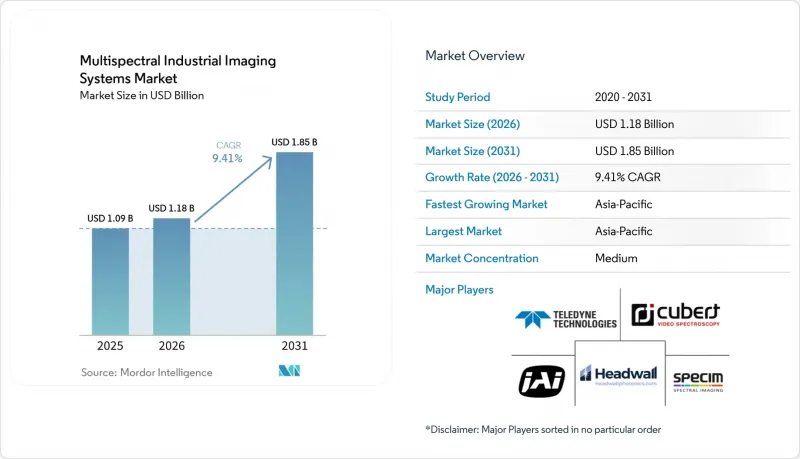
에 따르면 멀티스펙트럴 산업용 이미징 시스템 시장 규모는 2025년 10억 9,000만 달러에서 2026년에는 11억 8,000만 달러로 확대하며, 2031년까지 18억 5,000만 달러에 달할 것으로 예측되고 있으며, 2026-2031년에 CAGR 9.41%를 기록할 전망입니다.
전 세계 멀티스펙트럼 산업용 이미징 시스템 시장의 동향 및 인사이트
산업용 품질 검사 자동화
자동 검사는 합격·불합격을 판정하는 결함 점검에서 화학적 이상, 수분 변동, 코팅의 불균일성을 특정하는 재료 분류로 전환되고 있습니다. 최신 시스템은 2 kHz를 초과하는 라인 속도로 작동할 수 있으며, 높은 처리량을 자랑하는 생산 라인에서의 지속적인 검사를 지원합니다. 이러한 접근 방식을 통해 공장은 일정 간격으로 채취한 샘플에 의존하지 않고 전체 생산량을 검사할 수 있게 됩니다. 이로 인해 기존의 표본 검사 절차에서 발생하던 검사 누락이 감소할 뿐만 아니라, 멀티스펙트럼 산업용 이미징 시스템 시장의 잠재적 도입 범위도 확대됩니다. CVPR 2026에서 발표된 ‘UniSpector’는 변화하는 산업 환경에서도 재학습 없이 스펙트럼 콘트라스트를 활용한 결함 식별을 입증했습니다. 따라서 그 가치 제안은 광학적 사양뿐만 아니라 실제 생산 환경에서의 신뢰할 수 있는 추론으로 전환되고 있습니다.
AI를 활용한 스펙트럼 분류
AI를 활용한 분류를 통해 검사 모델 개발에 필요한 시간을 단축하고, 시설에서 전담 분광 전문가를 고용해야 할 필요성을 줄일 수 있습니다. 물리 법칙에 기반한 자기 지도 학습 스펙트럼 트랜스포머는 라벨이 없는 스펙트럼 데이터를 활용하여 단일 추론 단계에서 정량화, 등급 매기기 및 이상 감지를 실현합니다. 또한 이러한 모델은 기존에 도입 후 분류기의 안정성을 저해해 온 센서 드리프트 문제에도 대응하고 있습니다. 파나소닉은 2026년 8월에 ‘AG-HSS10’ 소프트웨어를 발표했으며, 2026년 10월부터 상용화를 시작할 예정입니다. 이 소프트웨어는 식품 가공, 제조, 전자기기 조립 분야를 위해 스펙트럼 수집과 AI 학습을 단일 플랫폼에 통합하고 있습니다. 변화하는 공장 환경 하에서 데이터 품질과 재현성이 높은 결과는 멀티스펙트럼 산업용 이미징 시스템 시장에서 점점 더 중요한 경쟁 요소가 되고 있습니다.
높은 통합 비용과 교정 비용
통합과 보정은 다중 스펙트럼 산업용 이미징 시스템 시장에서 여전히 큰 장벽으로 작용하고 있으며, 특히 엔지니어링 역량이 제한적인 중소규모 제조업체의 경우 더욱 그렇습니다. 스펙트럼 시스템에는 파장별로 특화된 조명, 보정 패널, 온도 제어된 케이스, 그리고 지속적인 재보정이 필요합니다. 이러한 요구 사항은 기존의 머신 비전 시스템 도입 요건과는 다르며, 프로젝트 전체 비용을 증가시킬 가능성이 있습니다. 조명, 소프트웨어 및 분류기 훈련과 관련된 초기 작업 비용은 카메라 하드웨어 비용을 초과할 수도 있습니다. 따라서 다중 스펙트럼 산업용 이미징 시스템 시장에서 총 소유 비용(TCO)은 구매 결정의 중요한 요소가 되고 있습니다. 사전 학습된 라이브러리, 턴키식의 통합, 원격 교정 지원을 제공하는 공급업체는 소규모 공장의 부담을 줄이고 도입을 촉진할 수 있습니다.
부문 분석
2025년에는 표준 라인 스캔 카메라가 34.60%의 점유율을 차지했습니다. 이는 인쇄 검사, 웹 가공, 표면 품질관리 분야에서 입증된 활용 실적을 반영한 것입니다. 이 카메라의 속도와 간편한 통합성은 분광 분해능보다 공간적 세부 사항이 더 중요한 용도에 적합합니다. 컬러 라인 스캔 시스템은 중규모 식품 선별 및 섬유 검사 요구 사항을 충족합니다. 시간 지연 적분 방식의 라인 스캔 카메라는 반도체 웨이퍼 검사 및 의약품 블리스터 팩 검증을 지원합니다. 이러한 카메라의 다단계 전하 축적 기능 덕분에 고속 컨베이어 환경에서도 신호 대 잡음비가 향상됩니다. 다중 스펙트럼 및 하이퍼 스펙트럼 라인 스캔 카메라는 2026-2031년까지 연평균 성장률(CAGR) 10.84%로 성장할 것으로 예측됩니다. 배터리 제조업체와 재활용 시설에서는 스냅숏 시스템으로는 유지할 수 없는 속도로 화학 물질 수준에서 재료를 식별해야 합니다.
또한 공급업체들이 특정 공장 업무에 맞춘 플랫폼을 개발함에 따라 멀티스펙트럼 산업용 이미징 시스템 시장도 진화하고 있습니다. JAI는 2026년에 Wave 시리즈를 확충하여, 에어리어 스캔 및 라인 스캔 구성에서 단일 InGaAs 센서로 가시광선 및 SWIR(단파 적외선) 감도를 실현했습니다. 400nm에서 1,700nm의 파장 범위를 커버함으로써, 2대의 카메라를 사용하는 검사 구성이 불필요해집니다. Teledyne DALSA는 2026년 5월, 1,800 dpi, 최대 스캔 길이 1,500mm의 멀티라인 CMOS 접촉식 이미지 센서를 탑재한 ‘AxCIS’를 확장했습니다. 이 설계는 최대 80 kHz의 흑백 라인 속도를 갖춘 웨이퍼 및 배터리 검사를 목표로 합니다. 제품 개발은 광범위한 하드웨어 업그레이드에서 특정 생산 업무의 통합 작업을 경감하는 아키텍처로 전환되고 있습니다.
지역별 분석
아시아태평양은 2025년에 37.42%의 점유율을 차지할 것으로 예상되며, 2026-2031년까지 연평균 성장률(CAGR) 11.18%로 성장할 것으로 전망되어, 주요 지역 거점이자 동시에 가장 빠르게 성장하는 지역이 될 것입니다. 중국의 반도체 자급자족 프로그램은 첨단 패키징 검사 투자를 촉진하고 있습니다. 한국의 배터리 기가팩토리 확장은 전극 및 셀 품질 검사 시스템에 대한 수요를 더욱 높이고 있습니다. 또한 일본의 정밀 제조 거점도 까다로운 생산 환경에서 스펙트럼 검사의 활용을 지원하고 있습니다. 파나소닉은 2026년, 하이퍼스펙트럼 카메라 ‘AG-HSV10M’과 검사 소프트웨어 ‘AG-HSS10’을 발표했습니다. 이 시스템은 식품 가공 및 전자기기 조립을 대상으로 합니다. 이러한 요인들로 인해 아시아태평양에서는 멀티스펙트럼 산업용 이미징 시스템의 도입 기반이 확대되고 있습니다.
북미와 유럽에서는 멀티스펙트럼 산업용 이미징 시스템 시장에서 각각 상이한 수요 추세가 나타나고 있습니다. 이 시장에서 북미의 수요는 의약품 우수 제조 기준(GMP)에 기반한 검사, 식품 가공의 현대화, 그리고 미국내 배터리 공장 건설과 관련이 있습니다. 신설 시설의 경우, 건설 후 추가하는 것이 아니라 시운전 단계에서 인라인 분광 검사를 도입할 수 있습니다. 유럽에서의 도입은 산업 자동화 및 재활용 분야에 집중되어 있습니다. 독일은 정밀 제조 분야에서 중요한 역할을 하고 있으며, 한편 스칸디나비아 지역에는 Specim, HySpex, Norsk Elektro Optikk 등 여러 하이퍼스펙트럼 카메라 기업이 거점을 두고 있습니다. Headwall Photonics는 2025년 11월 inno-spec GmbH를 인수하여 인라인 선별에 관한 노하우와 푸시블룸 광학 기술을 통합했습니다. 이를 통해 이 회사의 유럽내 산업용 제품 라인업 규모가 확대되었습니다.
남미, 중동 및 아프리카에서는 지역별로 서로 다른 속도로 발전이 진행되고 있습니다. 브라질과 아르헨티나에서는 수출용 과일 가공, 곡물 혼입 검사, 농약 잔류물 스크리닝에 스펙트럼 검사가 활용되고 있습니다. 이러한 용도는 수출 대상국의 규정 준수 요건과 밀접하게 관련되어 있습니다. 칠레와 남아프리카에서는 광석의 등급 분류를 위한 컨베이어식 시스템의 시범 운영이 진행되고 있습니다. 2024년에 취득한 미국 특허에는 굴착기에 장착된 이미징 장치를 이용한 성분 분석을 위한 다중 스펙트럼 및 하이퍼스펙트럼 기법이 기재되어 있습니다. 중동 지역의 도입 사례는 MWIR 및 LWIR 시스템을 활용한 석유화학 및 유전 품질 모니터링이 주를 이루고 있습니다. 아프리카에서의 활동은 광산 지역에 집중되어 있으며, 암반의 특성 평가를 통해 기존의 시료 채취 방식에 비해 품위 관리의 정확도를 높일 수 있습니다.
기타 혜택:
- 엑셀 형식의 시장 예측(ME) 시트
- 3개월간의 애널리스트 지원
자주 묻는 질문
목차
제1장 서론
- 조사 전제조건과 시장 정의
- 조사 범위
제2장 조사 방법
제3장 개요
제4장 시장 구도
- 시장 개요
- 시장 성장 촉진요인
- 시장 성장 억제요인
- 거시경제 요인이 시장에 미치는 영향
- 업계 밸류체인 분석
- 규제 상황
- 기술 전망
- Porter's Five Forces 분석
제5장 시장 규모와 성장 예측
- 카메라 아키텍처별
- 스펙트럼 범위별
- 최종사용자별
- 지역별
- 북미
- 미국
- 캐나다
- 멕시코
- 남미
- 브라질
- 아르헨티나
- 칠레
- 기타 남미 국가
- 유럽
- 독일
- 영국
- 프랑스
- 이탈리아
- 스페인
- 기타 유럽 국가
- 아시아태평양
- 중국
- 일본
- 인도
- 한국
- 호주
- 기타 아시아태평양 국가
- 중동
- 아랍에미리트
- 사우디아라비아
- 카타르
- 기타 중동 국가
- 아프리카
- 남아프리카공화국
- 이집트
- 나이지리아
- 기타 아프리카 국가
- 북미
제6장 경쟁 구도
- 시장 집중도
- 전략적 동향
- 시장 점유율 분석
- 기업 개요
- JAI A/S
- Teledyne DALSA, Inc.
- Specim, Spectral Imaging Ltd.
- Headwall Photonics, Inc.
- Cubert GmbH
- BaySpec, Inc.
- Resonon, Inc.
- Surface Optics Corporation
- Spectral Devices Inc.
- Photon etc. Inc.
- XIMEA GmbH
- Photonfocus AG
- Torrent Photonics, Inc.
- SILIOS Technologies S.A.S.
- EVK DI Kerschhaggl GmbH
- Telops Inc.
- Diaspective Vision GmbH
- Raptor Photonics Limited
- SWIR Vision Systems, Inc.
- HinaLea Imaging Corporation
- HySpex AS
- Norsk Elektro Optikk AS
제7장 시장 기회와 향후 전망
KSA 26.10.28According to Mordor Intelligence, the multispectral industrial imaging systems market size is projected to expand from USD 1.09 billion in 2025 to USD 1.18 billion in 2026, and to USD 1.85 billion by 2031, registering a CAGR of 9.41% from 2026 to 2031.
Global Multispectral Industrial Imaging Systems Market Trends and Insights
Industrial Quality Inspection Automation
Automated inspection is moving from pass-or-fail defect checks to material classification that identifies chemical anomalies, moisture variation, and coating inconsistencies. Modern systems can operate at line rates above 2 kHz, which supports continuous checks on high-throughput production lines. The approach allows factories to inspect the full output instead of relying on samples taken at intervals. This reduces the gaps left by traditional spot-check procedures and broadens potential deployments for the multispectral industrial imaging systems market. UniSpector, presented at CVPR 2026, demonstrated spectral-contrastive defect localization without retraining across changing industrial settings. The value proposition is therefore shifting toward reliable inference in real production conditions, not only optical specifications.
AI-Enabled Spectral Classification
AI-based classification can shorten the time needed to develop inspection models and reduce the need for facilities to employ dedicated spectroscopists. Physics-guided, self-supervised spectral transformers leverage unlabeled spectral data to enable quantification, grading, and anomaly detection in a single inference step. These models also address sensor drift, which has historically made classifiers less stable after deployment. Panasonic announced its AG-HSS10 software in August 2026, with commercial availability planned for October 2026. The software integrates spectral acquisition and AI learning into a single platform for food processing, manufacturing, and electronics assembly. Data quality and repeatable results under changing factory conditions are becoming more important competitive factors in the multispectral industrial imaging systems market.
High Integration and Calibration Costs
Integration and calibration remain major barriers in the multispectral industrial imaging systems market, particularly for small- and mid-sized manufacturers with limited engineering capacity. Spectral systems need wavelength-specific lighting, calibration panels, temperature-controlled housings, and ongoing recalibration. These requirements differ from those of conventional machine-vision installations and can increase the overall project cost. Initial work on illumination, software, and classifier training can cost more than the camera hardware. This makes total ownership cost a central purchasing issue in the multispectral industrial imaging systems market. Suppliers that provide trained libraries, turnkey integration, and remote calibration support can reduce the burden on smaller factories and improve adoption.
Other drivers and restraints analyzed in the detailed report include:
- Semiconductor and Battery Manufacturing Inspection
- Food Safety and Material Sorting Requirements
- Data Processing and Storage Bottlenecks
For complete list of drivers and restraints, kindly check the Table Of Contents.
Segment Analysis
Standard line-scan cameras held 34.60% share in 2025, reflecting their established use in print inspection, web processing, and surface-quality control. Their speed and simpler integration suit applications where spatial detail matters more than spectral resolution. Color line-scan systems serve mid-range food-sorting and textile-inspection needs. Time-delay integration line-scan cameras support semiconductor wafer inspection and pharmaceutical blister-pack verification. Their multi-stage charge accumulation improves signal-to-noise performance at fast conveyor speeds. Multispectral and hyperspectral line-scan cameras are projected to grow at a 10.84% CAGR from 2026 to 2031. Battery manufacturers and recycling facilities require chemical-level material differentiation at speeds that snapshot systems cannot maintain.
The multispectral industrial imaging systems market is also evolving as suppliers develop platforms tailored to specific factory tasks. JAI expanded its Wave Series in 2026 to include visible and SWIR sensitivity in a single InGaAs sensor across area-scan and line-scan configurations. The 400 nm to 1,700 nm range can remove the need for two-camera inspection arrangements. Teledyne DALSA expanded AxCIS in May 2026 with multiline CMOS contact image sensors at 1,800 dpi and scan lengths up to 1,500 mm. This design targeted wafer and battery inspection with monochrome line rates up to 80 kHz. Product development is moving away from broad hardware upgrades and toward architectures that reduce integration work for defined production tasks.
Complete Report Scope:
- By Camera Architecture
- Standard Line-Scan Cameras
- Color Line-Scan Cameras
- Time-Delay Integration (TDI) Line-Scan Cameras
- Multispectral and Hyperspectral Line-Scan Cameras
- By Spectral Range
- Visible
- Visible + Near-Infrared (VIS-NIR)
- Short-Wave Infrared (SWIR)
- Mid-Wave Infrared (MWIR)
- Long-Wave Infrared (LWIR)
- By End User
- Manufacturing and Industrial Equipment
- Food, Beverage, and Agriculture
- Electronics, Semiconductor, and Battery
- Automotive and Transportation
- Pharmaceutical and Life Sciences
- Recycling, Mining, and Materials
- Textile and Paper
- Research and Development Organizations
- Other End-user Industries
- By Geography
- North America
- United States
- Canada
- Mexico
- South America
- Brazil
- Argentina
- Chile
- Rest of South America
- Europe
- Germany
- United Kingdom
- France
- Italy
- Spain
- Rest of Europe
- Asia-Pacific
- China
- Japan
- India
- South Korea
- Australia
- Rest of Asia-Pacific
- Middle East
- United Arab Emirates
- Saudi Arabia
- Qatar
- Rest of Middle East
- Africa
- South Africa
- Egypt
- Nigeria
- Rest of Africa
- North America
Geography Analysis
Asia-Pacific held 37.42% share in 2025 and is projected to grow at a 11.18% CAGR from 2026 to 2031, making it the leading regional base and the fastest-growing geography. China's semiconductor self-sufficiency program supports investment in advanced packaging inspection. South Korea's battery gigafactory expansion adds demand for electrode and cell-quality systems. Japan's precision manufacturing base also supports the use of spectral inspection in demanding production environments. Panasonic announced the AG-HSV10M hyperspectral camera and the AG-HSS10 inspection software in 2026. The system targets food processing and electronics assembly. These factors support a large installed base of multispectral industrial imaging systems in Asia-Pacific.
North America and Europe have distinct demand profiles within the multispectral industrial imaging systems market. In the multispectral industrial imaging systems market, North American demand is linked to pharmaceutical good manufacturing practice inspections, food-processing modernization, and battery factory construction in the United States. New facilities can incorporate inline spectral inspection during commissioning instead of adding it after construction. European deployment is concentrated in industrial automation and recycling. Germany is important in precision manufacturing, while Scandinavia hosts several hyperspectral-camera companies, including Specim, HySpex, and Norsk Elektro Optikk. Headwall Photonics acquired inno-spec GmbH in November 2025, combining inline sorting experience with pushbroom optics. This move added scale to its European industrial offering.
South America, the Middle East, and Africa are developing at different rates. Brazil and Argentina are applying spectral inspection to export-oriented fruit processing, grain contamination checks, and pesticide-residue screening. These uses are linked to compliance requirements in export destinations. Chile and South Africa are piloting conveyor-based systems for ore-grade classification. A 2024 U.S. patent described multispectral and hyperspectral methods for compositional analysis through shovel-mounted imaging. Middle East installations center on petrochemical and oil-field quality monitoring using MWIR and LWIR systems. African activity is concentrated in mining locations, where rock-face characterization can improve grade control compared with conventional sampling.
- JAI A/S
- Teledyne DALSA, Inc.
- Specim, Spectral Imaging Ltd.
- Headwall Photonics, Inc.
- Cubert GmbH
- BaySpec, Inc.
- Resonon, Inc.
- Surface Optics Corporation
- Spectral Devices Inc.
- Photon etc. Inc.
- XIMEA GmbH
- Photonfocus AG
- Torrent Photonics, Inc.
- SILIOS Technologies S.A.S.
- EVK DI Kerschhaggl GmbH
- Telops Inc.
- Diaspective Vision GmbH
- Raptor Photonics Limited
- SWIR Vision Systems, Inc.
- HinaLea Imaging Corporation
- HySpex AS
- Norsk Elektro Optikk AS
Additional Benefits:
- The market estimate (ME) sheet in Excel format
- 3 months of analyst support
TABLE OF CONTENTS
1 INTRODUCTION
- 1.1 Study Assumptions and Market Definition
- 1.2 Scope of the Study
2 RESEARCH METHODOLOGY
3 EXECUTIVE SUMMARY
4 MARKET LANDSCAPE
- 4.1 Market Overview
- 4.2 Market Drivers
- 4.2.1 Industrial Quality Inspection Automation
- 4.2.2 AI-Enabled Spectral Classification
- 4.2.3 Compact Snapshot Sensor Adoption
- 4.2.4 Food Safety and Material Sorting Requirements
- 4.2.5 Semiconductor and Battery Manufacturing Inspection
- 4.2.6 Spectral Sensor Cost Declines
- 4.3 Market Restraints
- 4.3.1 High Integration and Calibration Costs
- 4.3.2 Limited Industrial Spectral Libraries
- 4.3.3 Data Processing and Storage Bottlenecks
- 4.3.4 Interoperability and Standards Gaps
- 4.4 Impact of Macroeconomic Factors on the Market
- 4.5 Industry Value Chain Analysis
- 4.6 Regulatory Landscape
- 4.7 Technological Outlook
- 4.8 Porter's Five Forces Analysis
- 4.8.1 Threat of New Entrants
- 4.8.2 Bargaining Power of Suppliers
- 4.8.3 Bargaining Power of Buyers
- 4.8.4 Threat of Substitutes
- 4.8.5 Competitive Rivalry
5 MARKET SIZE AND GROWTH FORECASTS (VALUE)
- 5.1 By Camera Architecture
- 5.1.1 Standard Line-Scan Cameras
- 5.1.2 Color Line-Scan Cameras
- 5.1.3 Time-Delay Integration (TDI) Line-Scan Cameras
- 5.1.4 Multispectral and Hyperspectral Line-Scan Cameras
- 5.2 By Spectral Range
- 5.2.1 Visible
- 5.2.2 Visible + Near-Infrared (VIS-NIR)
- 5.2.3 Short-Wave Infrared (SWIR)
- 5.2.4 Mid-Wave Infrared (MWIR)
- 5.2.5 Long-Wave Infrared (LWIR)
- 5.3 By End User
- 5.3.1 Manufacturing and Industrial Equipment
- 5.3.2 Food, Beverage, and Agriculture
- 5.3.3 Electronics, Semiconductor, and Battery
- 5.3.4 Automotive and Transportation
- 5.3.5 Pharmaceutical and Life Sciences
- 5.3.6 Recycling, Mining, and Materials
- 5.3.7 Textile and Paper
- 5.3.8 Research and Development Organizations
- 5.3.9 Other End-user Industries
- 5.4 By Geography
- 5.4.1 North America
- 5.4.1.1 United States
- 5.4.1.2 Canada
- 5.4.1.3 Mexico
- 5.4.2 South America
- 5.4.2.1 Brazil
- 5.4.2.2 Argentina
- 5.4.2.3 Chile
- 5.4.2.4 Rest of South America
- 5.4.3 Europe
- 5.4.3.1 Germany
- 5.4.3.2 United Kingdom
- 5.4.3.3 France
- 5.4.3.4 Italy
- 5.4.3.5 Spain
- 5.4.3.6 Rest of Europe
- 5.4.4 Asia-Pacific
- 5.4.4.1 China
- 5.4.4.2 Japan
- 5.4.4.3 India
- 5.4.4.4 South Korea
- 5.4.4.5 Australia
- 5.4.4.6 Rest of Asia-Pacific
- 5.4.5 Middle East
- 5.4.5.1 United Arab Emirates
- 5.4.5.2 Saudi Arabia
- 5.4.5.3 Qatar
- 5.4.5.4 Rest of Middle East
- 5.4.6 Africa
- 5.4.6.1 South Africa
- 5.4.6.2 Egypt
- 5.4.6.3 Nigeria
- 5.4.6.4 Rest of Africa
- 5.4.1 North America
6 COMPETITIVE LANDSCAPE
- 6.1 Market Concentration
- 6.2 Strategic Moves
- 6.3 Market Share Analysis
- 6.4 Company Profiles (includes Global Level Overview, Market Level Overview, Core Segments, Financials as available, Strategic Information, Market Rank/Share, Products and Services, Recent Developments)
- 6.4.1 JAI A/S
- 6.4.2 Teledyne DALSA, Inc.
- 6.4.3 Specim, Spectral Imaging Ltd.
- 6.4.4 Headwall Photonics, Inc.
- 6.4.5 Cubert GmbH
- 6.4.6 BaySpec, Inc.
- 6.4.7 Resonon, Inc.
- 6.4.8 Surface Optics Corporation
- 6.4.9 Spectral Devices Inc.
- 6.4.10 Photon etc. Inc.
- 6.4.11 XIMEA GmbH
- 6.4.12 Photonfocus AG
- 6.4.13 Torrent Photonics, Inc.
- 6.4.14 SILIOS Technologies S.A.S.
- 6.4.15 EVK DI Kerschhaggl GmbH
- 6.4.16 Telops Inc.
- 6.4.17 Diaspective Vision GmbH
- 6.4.18 Raptor Photonics Limited
- 6.4.19 SWIR Vision Systems, Inc.
- 6.4.20 HinaLea Imaging Corporation
- 6.4.21 HySpex AS
- 6.4.22 Norsk Elektro Optikk AS
7 MARKET OPPORTUNITIES AND FUTURE OUTLOOK
- 7.1 White-Space and Unmet-Need Assessment


