

|
시장보고서
상품코드
2155276
다스펙트럼 산업용 카메라 : 시장 점유율 분석, 업계 동향과 통계, 성장 예측(2026-2031년)Multispectral Industrial Camera - Market Share Analysis, Industry Trends & Statistics, Growth Forecasts (2026 - 2031) |
||||||
 Mordor Intelligence
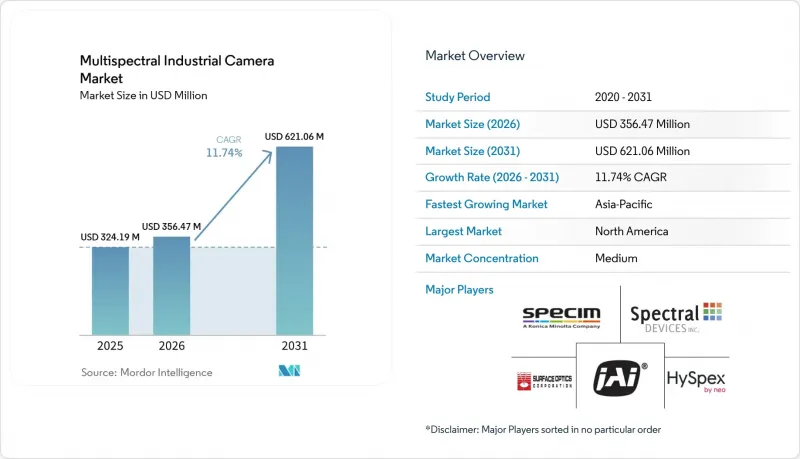
에 따르면 멀티스펙트럴 산업용 카메라 시장 규모는 2025년 3억 2,419만 달러, 2026년 3억 5,647만 달러에서 2031년까지 6억 2,106만 달러로 확대될 것으로 예측되고 있으며, 2026-2031년까지 연평균 성장률(CAGR)은 11.74%에 달할 전망입니다.
전 세계 멀티스펙트럼 산업용 카메라 시장의 동향 및 인사이트
AI를 활용한 자동 검사 확대
스펙트럼 시그니처를 활용하여 학습된 AI 모델은 RGB나 구조화된 광 시스템에 그치지 않고, 오염 물질, 표면 아래 균열, 유효 성분의 분포 문제 등 전체 라인에 걸친 검출을 포함하여 산업용 품질 검사의 범위를 확대할 수 있습니다. 2025년 연구에서는 시료를 파괴하지 않고, 서브 THz 및 적외선 주파수 대역에 걸친 탄소 나노튜브 광열전 이미저를 활용한 인라인 다파장 의약품 모니터링 시스템이 실증되었습니다. 이를 통해 생산 속도에서 AI와 스펙트럼 이미징의 결합이 가능해집니다. 카메라 근처에서 스펙트럼 데이터를 처리함으로써, 기존에는 검사를 샘플링 방식으로만 제한했던 데이터 전송 지연을 줄일 수 있습니다. 센싱, 추론 및 학습된 모델을 결합한 솔루션을 제공하는 공급업체는 스펙트럼에 대한 전문 지식이 제한적인 공장에 보다 포괄적인 패키지를 제공할 수 있습니다. 따라서 다중 스펙트럼 산업용 카메라 시장에서는 일반적인 생산 환경에서 지속적인 스펙트럼 분류를 실용화하는 시스템이 선호되고 있습니다.
식품 및 의약품 제조 분야의 스펙트럼 검사
식품 및 의약품 제조 라인에서는 제품을 손상시키지 않는 검사 방법이 요구됩니다. 미국의 ‘식품 안전 현대화법’ 및 유럽연합(EU)의 ‘공식 관리 규정’은 추적 가능한 검사가 중요한 규정 준수 체계를 정하고 있습니다. 2025년 제약 관련 연구에 따르면 근적외선 하이퍼스펙트럼 이미징이 유효 성분의 분포를 보여주는 스펙트럼 맵을 통해 정제의 품질 평가를 개선할 수 있는 것으로 밝혀졌습니다. 이러한 맵은 배치 샘플링만으로는 모든 정제에 대해 얻을 수 없는 정보를 제공합니다. 2025년 식품 품질에 관한 리뷰에서는 생산 라인 간 모델의 전이 가능성이 카메라의 감도보다 더 큰 확장성상 과제라고 지적되었습니다. 감사 실무가 보편화됨에 따라 안정적인 보정, 실용적인 보고서 작성, 재현성 있는 검사에 대한 수요가 높아지고 있으며, 다중 스펙트럼 산업용 카메라 시장이 그 혜택을 보고 있습니다.
높은 시스템 통합 비용 및 교정 비용
생산 현장에 도입하려면 광학 시스템, 조명, 스펙트럼 분석 소프트웨어 및 공장 제어 시스템 간의 연동이 필요하며, 이로 인해 첫 번째 생산 스캔을 수행하기 전에 카메라 단가가 40-80% 증가할 가능성이 있습니다. 2025년 리뷰에 따르면 도입 실패의 대부분은 하드웨어의 한계가 아니라 설치 후 보정 과정의 미비에서 기인한다고 지적되고 있습니다. 대규모 가공 업체는 이러한 비용을 대량 생산 라인에 분산시킬 수 있지만, 중소규모 제조업체는 보다 단순한 RGB+NIR 구성을 선택할 수 있습니다. 공정 분석 기술 지침 및 기계 안전 요구 사항에 따라 하드웨어 시운전 후 검증 작업이 추가될 가능성이 있습니다. 도입 기간이나 시운전 작업이 구매 기업의 사내 대응 능력을 초과하는 경우, 다중 스펙트럼 산업용 카메라 시장 진출은 여전히 어렵습니다. 사전 보정된 시스템이나 간소화된 인터페이스는 설치별 편차를 줄여주고, 소규모 사용자의 진입 장벽을 낮출 수 있습니다.
부문 분석
2025년, 멀티스펙트럼 카메라 시스템은 멀티스펙트럼 산업용 카메라 시장 점유율의 44.62%를 차지했습니다. 식품 선별, 의약품 검사, 반도체 웨이퍼 검증은 광학 시스템과 분광 시스템을 통합한 시스템에 대한 수요를 지원하고 있습니다. 구매자는 광학 시스템, 조명, 센싱 및 보정 등 각 요소가 유기적으로 연동되어 작동하기를 원합니다. 또한 분광 분해능, 처리 능력 및 보정의 안정성에 대한 문서화된 성능 데이터도 요구하고 있습니다. 멀티스펙트럼 카메라 어레이는 창고나 물류 거점에서의 고정식 다각도 검사에 활용되고 있습니다.
다중 스펙트럼 카메라 모듈 및 센서 시장은 2031년까지 연평균 성장률(CAGR) 14.18%로 확대될 것으로 예측됩니다. 각 OEM 업체들은 농업용 드론, 로봇 피킹 암, 그리고 휴대용 검사 장비에 소형 모듈을 탑재하고 있습니다. Leopard Imaging사와 소니 세미컨덕터 솔루션즈는 2025년 5월 LI-IMX454 카메라를 발표했습니다. 이 시스템은 포토다이오드 1개당 8개의 스펙트럼 필터를 사용하여, 450-850 nm 범위에 있는 41개의 파장을 한 번의 촬영으로 포착합니다. 이러한 제품들은 다중 스펙트럼 산업용 카메라 시장에서 OEM의 수요를 높이고, 업계의 역할을 확대하고 있습니다.
2025년 시점에 푸시블룸 이미징(Pushbloom Imaging)은 기술 가치의 39.84%를 차지했습니다. 이 회사는 컨베이어식 식품 선별 및 의약품 정제 검사 분야에서 여전히 중요한 역할을 수행하고 있습니다. 이 설계는 제어된 라인 스캔 환경에서 높은 분광 분해능과 뛰어난 신호 대 잡음비를 실현하고 있습니다. 스펙임(Specim)사는 2026년 2월, 1,130-1,920 nm의 파장 범위를 지원하며, 공간 해상도 640픽셀, 최대 527 fps의 ‘FX19’를 발표했습니다. 이 제품의 출시는 멀티스펙트럼 산업용 카메라 시장에서 푸시블룸 방식의 처리량이 지속적으로 향상되고 있음을 보여줍니다.
스냅숏 이미징 시장은 2031년까지 연평균 성장률(CAGR) 13.72%로 확대될 것으로 예측됩니다. 이는 로봇의 빈 피킹, UAV(무인 항공기) 감시, 폐기물 분류 등 피사체의 움직임으로 인해 연속 촬영이 어려운 상황에서 활용되고 있습니다. 2026년 연구에서는 가정용 플라스틱 분류를 위한 9대의 카메라로 구성된 NIR 대역 통과 어레이가 실증되었습니다. 보고된 시스템은 픽셀당 2.6μs의 실행 시간으로 86.7%의 분류 정확도를 달성했습니다. 다중 스펙트럼 산업용 카메라 시장은 이러한 고속 이동 물체 검사 애플리케이션으로의 전환을 지원하고 있습니다.
지역별 분석
2025년, 북미는 멀티스펙트럼 산업용 카메라 시장 점유율의 34.91%를 차지했습니다. 이 지역의 정밀농업 인프라와 첨단 제조 기반이 광범위한 도입을 지원하고 있습니다. 식품 가공업체, 제약 제조사, 반도체 제조 시설에서는 대규모 통합 검사 도입이 정당화됩니다. 연방 정부의 방위 조달도 MWIR 및 SWIR에 대한 수요를 지원하고 있습니다. 캐나다에서는 광업 용도를 통해 수요가 지탱되고 있으며, 멕시코의 자동차 및 전자 산업 클러스터에서는 인라인 품질 검사가 추진되고 있습니다.
아시아태평양은 2031년까지 연평균 성장률(CAGR) 14.83%로 확대될 것으로 예측됩니다. 중국의 다중 스펙트럼 산업용 카메라 시장은 식품 가공, 전자기기 제조, 재활용 분야의 수요에 힘입어 성장하고 있습니다. 국내산 InGaAs 센서의 생산 확대에 따라 수입 부품에 대한 의존도를 낮출 수 있습니다. 일본의 반도체 제조 생태계는 첨단 SWIR 및 MWIR 플랫폼을 지원하고 있습니다. 인도의 드론 정책 자유화와 한국의 디스플레이 패널 및 전기자동차 배터리 분야가 검사 수요를 견인하고 있습니다.
유럽은 본 분석에서 2위 지역 시장으로 나타났습니다. 독일, 영국, 네덜란드 및 북유럽 국가들의 멀티스펙트럼 산업용 카메라 시장은 자동화, 식품 이력추적 및 재활용 규제에 힘입어 성장하고 있습니다. 유럽연합(EU)의 ‘순환 경제 행동 계획’ 및 ‘확대 생산자 책임(EPR)’ 정책에 따라 자재 회수 시설에서의 스펙트럼 선별이 더욱 중요해지고 있습니다. 남미, 중동 및 아프리카는 여전히 초기 단계의 시장이며, 수요는 농업, 수자원 제약, 국경 경비, 도입 능력 및 인력 확보 상황에 따라 좌우되고 있습니다.
기타 혜택:
- 엑셀 형식의 시장 예측(ME) 시트
- 3개월간의 애널리스트 지원
자주 묻는 질문
목차
제1장 서론
- 조사 전제조건과 시장 정의
- 조사 범위
제2장 조사 방법
제3장 개요
제4장 시장 구도
- 시장 개요
- 시장 성장 촉진요인
- 시장 성장 억제요인
- 거시경제 요인이 시장에 미치는 영향
- 업계의 공급망 분석
- 기술 동향
- 규제 상황
- Porter's Five Forces 분석
제5장 시장 규모와 성장 예측
- 제품 유형별
- 기술별
- 스펙트럼 범위별
- 최종사용자 산업별
- 지역별
- 북미
- 미국
- 캐나다
- 멕시코
- 남미
- 브라질
- 아르헨티나
- 기타 남미 국가
- 유럽
- 독일
- 영국
- 프랑스
- 이탈리아
- 스페인
- 기타 유럽 국가
- 아시아태평양
- 중국
- 일본
- 인도
- 한국
- 호주
- 기타 아시아태평양 국가
- 중동
- 아랍에미리트
- 사우디아라비아
- 기타 중동 국가
- 아프리카
- 남아프리카공화국
- 이집트
- 기타 아프리카 국가
- 북미
제6장 경쟁 구도
- 시장 집중도
- 전략적 동향
- 시장 점유율 분석
- 기업 개요
- Jai A/S
- Specim, Spectral Imaging Ltd.
- Spectral Devices Inc.
- Tetracam Inc.
- SILIOS Technologies S.A.S.
- Cubert GmbH
- Telops Inc.
- Surface Optics Corporation
- Videometer A/S
- Resonon Inc.
- BaySpec, Inc.
- Photonfocus AG
- NIREOS S.r.l.
- Unispectral Ltd.
- XIMEA GmbH
- EOPTIS S.r.l.
- imec
- Photon etc. Inc.
- Middleton Spectral Vision, Inc.
- Torrent Photonics, Inc.
- ZEISS Group
- Headwall Photonics, Inc.
제7장 시장 기회와 향후 전망
KSA 26.10.28According to Mordor Intelligence, the multispectral industrial camera market size is projected to expand from USD 324.19 million in 2025 and USD 356.47 million in 2026 to USD 621.06 million by 2031, registering a CAGR of 11.74% between 2026 and 2031.
Global Multispectral Industrial Camera Market Trends and Insights
Expansion of AI-Enabled Automated Inspection
AI models trained on spectral signatures can extend industrial quality checks beyond RGB and structured-light systems, including full-line detection of contaminants, subsurface cracks, and active-ingredient distribution issues. A 2025 study demonstrated an inline, multi-wavelength pharmaceutical monitoring system using carbon nanotube photothermoelectric imagers across sub-THz and infrared frequencies without destroying the sample. This supports combined AI and spectral imaging at production speed. Processing spectral data near the camera can reduce transfer delays that previously limited inspection to sampled workflows. Suppliers that combine sensing, inference, and trained models can provide a more complete package for plants with limited spectral expertise. The multispectral industrial camera market, therefore, favors systems that make continuous spectral classification practical in ordinary production settings.
Spectral Inspection in Food and Pharmaceutical Production
Food and pharmaceutical lines require inspection methods that do not damage products. The US Food Safety Modernization Act and the European Union Official Controls Regulation establish compliance frameworks in which traceable checks matter. A 2025 pharmaceutical study found that near-infrared hyperspectral imaging improved tablet quality assessment through spectral maps of active ingredient distribution. These maps provide information that batch sampling cannot provide across every tablet. A 2025 food-quality review identified model transferability between production lines as a larger scaling issue than camera sensitivity. The multispectral industrial camera market benefits as audit practice increases demand for stable calibration, usable reporting, and repeatable inspection.
High System Integration and Calibration Costs
Production-floor deployment requires coordination among optics, illumination, spectral software, and factory-control systems, which can add 40-80% to the camera unit cost before the first production scan. A 2025 review attributed many deployment failures to shortcomings in post-installation calibration rather than to hardware limitations. Large processors can distribute these costs across high-volume lines, while small- and mid-sized manufacturers may choose simpler RGB-plus-NIR configurations. Process analytical technology guidance and machine-safety requirements can add validation work after hardware commissioning. The multispectral industrial camera market remains less accessible when deployment time and commissioning work exceed a buyer's internal capacity. Pre-calibrated systems and simplified interfaces can reduce variation between installations and lower the barrier for smaller users.
Other drivers and restraints analyzed in the detailed report include:
- Precision Agriculture and Resource-Efficient Farming
- Defense and Border-Surveillance Modernization
- Shortage of Spectral-Imaging and Machine-Vision Specialists
For complete list of drivers and restraints, kindly check the Table Of Contents.
Segment Analysis
Multispectral Camera Systems captured 44.62% of the multispectral industrial camera market share in 2025. Food sorting, pharmaceutical inspection, and semiconductor wafer verification support demand for integrated optical and spectral systems. Buyers need the optics, illumination, sensing, and calibration elements to work together. They also seek documented performance for spectral resolution, throughput, and calibration stability. Multispectral Camera Arrays serve fixed, multi-angle inspection in warehouses and logistics sites.
Multispectral Camera Modules and Sensors are projected to expand at a 14.18% CAGR through 2031. OEMs are embedding compact modules in agricultural drones, robotic picking arms, and handheld inspection equipment. Leopard Imaging and Sony Semiconductor Solutions announced the LI-IMX454 camera in May 2025. The system used 8 spectral filters per photodiode to capture 41 wavelengths from 450-850 nm in a single shot. These products increase OEM demand in the multispectral industrial camera market and broaden the industry's role.
Pushbroom Imaging held 39.84% of the technology value in 2025. It remains important for conveyor-based food sorting and pharmaceutical tablet inspection. The design offers strong spectral resolution and signal-to-noise performance in controlled line-scan environments. Specim introduced the FX19 in February 2026 for the 1,130-1,920 nm range, with 640 spatial pixels and up to 527 fps. This release shows continued improvement in pushbroom throughput within the multispectral industrial camera market.
Snapshot Imaging is projected to expand at a 13.72% CAGR through 2031. It is used for robotic bin picking, UAV monitoring, and waste classification, where movement complicates sequential capture. A 2026 study demonstrated a 9-camera NIR bandpass array for household plastic classification. The reported system reached 86.7% classification accuracy with a 2.6 µs per-pixel runtime. The multispectral industrial camera market supports this shift toward fast-moving inspection applications.
Complete Report Scope:
- By Product Type
- Multispectral Camera Systems
- Multispectral Camera Modules and Sensors
- Multispectral Camera Arrays
- Integrated Camera and Illumination Systems
- By Technology
- Snapshot Imaging
- Pushbroom Imaging
- Multiline and TDI Imaging
- Filter-Based Imaging
- By Spectral Range
- Visible to Near-Infrared (VIS-NIR)
- Short-Wave Infrared (SWIR)
- Thermal Infrared (MWIR/LWIR)
- Multi-Band Systems
- By End-User Industry
- Food and Agriculture
- Electronics and Semiconductors
- Automotive and Transportation
- Pharmaceuticals and Medical Devices
- Aerospace and Defense
- Recycling and Waste Management
- Mining and Minerals
- Research and Scientific Laboratories
- Other End-User Industries
- By Geography
- North America
- United States
- Canada
- Mexico
- South America
- Brazil
- Argentina
- Rest of South America
- Europe
- Germany
- United Kingdom
- France
- Italy
- Spain
- Rest of Europe
- Asia-Pacific
- China
- Japan
- India
- South Korea
- Australia
- Rest of Asia-Pacific
- Middle East
- United Arab Emirates
- Saudi Arabia
- Rest of Middle East
- Africa
- South Africa
- Egypt
- Rest of Africa
- North America
Geography Analysis
North America held 34.91% of the multispectral industrial camera market share in 2025. Its precision-agriculture infrastructure and advanced manufacturing base support broad deployment. Food processors, pharmaceutical producers, and semiconductor facilities can justify integrated inspection at scale. Federal defense procurement also sustains demand for MWIR and SWIR. Canada supports demand through mining applications, while Mexico's automotive and electronics corridor supports inline quality inspection.
Asia-Pacific is projected to expand at a 14.83% CAGR through 2031. The multispectral industrial camera market in China is supported by demand from the food processing, electronics manufacturing, and recycling sectors. Domestic InGaAs sensor output can reduce reliance on imported components. Japan's semiconductor fabrication ecosystem supports sophisticated SWIR and MWIR platforms. India's drone policy liberalization and South Korea's display panel and EV battery sectors drive inspection demand.
Europe is the second-largest regional market in the supplied analysis. The multispectral industrial camera market in Germany, the United Kingdom, the Netherlands, and the Nordic countries is supported by automation, food traceability, and recycling rules. The European Union Circular Economy Action Plan and Extended Producer Responsibility policies make spectral sorting more relevant for material recovery facilities. South America, the Middle East, and Africa remain earlier-stage markets, with demand tied to farming, water constraints, border security, deployment capacity, and skills availability.
- Jai A/S
- Specim, Spectral Imaging Ltd.
- Spectral Devices Inc.
- Tetracam Inc.
- SILIOS Technologies S.A.S.
- Cubert GmbH
- Telops Inc.
- Surface Optics Corporation
- Videometer A/S
- Resonon Inc.
- BaySpec, Inc.
- Photonfocus AG
- NIREOS S.r.l.
- Unispectral Ltd.
- XIMEA GmbH
- EOPTIS S.r.l.
- imec
- Photon etc. Inc.
- Middleton Spectral Vision, Inc.
- Torrent Photonics, Inc.
- ZEISS Group
- Headwall Photonics, Inc.
Additional Benefits:
- The market estimate (ME) sheet in Excel format
- 3 months of analyst support
TABLE OF CONTENTS
1 INTRODUCTION
- 1.1 Study Assumptions and Market Definition
- 1.2 Scope of the Study
2 RESEARCH METHODOLOGY
3 EXECUTIVE SUMMARY
4 MARKET LANDSCAPE
- 4.1 Market Overview
- 4.2 Market Drivers
- 4.2.1 Expansion of AI-Enabled Automated Inspection
- 4.2.2 Adoption of Spectral Inspection in Food and Pharmaceutical Production
- 4.2.3 Demand for Precision Agriculture and Resource-Efficient Farming
- 4.2.4 Defense and Border-Surveillance Modernization
- 4.2.5 Embedded On-Chip Spectral Filters Enabling Compact Industrial Cameras
- 4.2.6 Growing Availability of Curated Spectral Training Data for Material Classification
- 4.3 Market Restraints
- 4.3.1 High System Integration and Calibration Costs
- 4.3.2 Shortage of Spectral-Imaging and Machine-Vision Specialists
- 4.3.3 Calibration Drift Under Variable Industrial Lighting and Temperature
- 4.3.4 Limited Interoperability Between Spectral Data Pipelines and Factory-Control Systems
- 4.4 Impact of Macroeconomic Factors on the Market
- 4.5 Industry Supply-Chain Analysis
- 4.6 Technology Outlook
- 4.7 Regulatory Landscape
- 4.8 Porter's Five Forces Analysis
- 4.8.1 Threat of New Entrants
- 4.8.2 Bargaining Power of Suppliers
- 4.8.3 Bargaining Power of Buyers
- 4.8.4 Threat of Substitutes
- 4.8.5 Intensity of Competitive Rivalry
5 MARKET SIZE AND GROWTH FORECASTS (VALUE)
- 5.1 By Product Type
- 5.1.1 Multispectral Camera Systems
- 5.1.2 Multispectral Camera Modules and Sensors
- 5.1.3 Multispectral Camera Arrays
- 5.1.4 Integrated Camera and Illumination Systems
- 5.2 By Technology
- 5.2.1 Snapshot Imaging
- 5.2.2 Pushbroom Imaging
- 5.2.3 Multiline and TDI Imaging
- 5.2.4 Filter-Based Imaging
- 5.3 By Spectral Range
- 5.3.1 Visible to Near-Infrared (VIS-NIR)
- 5.3.2 Short-Wave Infrared (SWIR)
- 5.3.3 Thermal Infrared (MWIR/LWIR)
- 5.3.4 Multi-Band Systems
- 5.4 By End-User Industry
- 5.4.1 Food and Agriculture
- 5.4.2 Electronics and Semiconductors
- 5.4.3 Automotive and Transportation
- 5.4.4 Pharmaceuticals and Medical Devices
- 5.4.5 Aerospace and Defense
- 5.4.6 Recycling and Waste Management
- 5.4.7 Mining and Minerals
- 5.4.8 Research and Scientific Laboratories
- 5.4.9 Other End-User Industries
- 5.5 By Geography
- 5.5.1 North America
- 5.5.1.1 United States
- 5.5.1.2 Canada
- 5.5.1.3 Mexico
- 5.5.2 South America
- 5.5.2.1 Brazil
- 5.5.2.2 Argentina
- 5.5.2.3 Rest of South America
- 5.5.3 Europe
- 5.5.3.1 Germany
- 5.5.3.2 United Kingdom
- 5.5.3.3 France
- 5.5.3.4 Italy
- 5.5.3.5 Spain
- 5.5.3.6 Rest of Europe
- 5.5.4 Asia-Pacific
- 5.5.4.1 China
- 5.5.4.2 Japan
- 5.5.4.3 India
- 5.5.4.4 South Korea
- 5.5.4.5 Australia
- 5.5.4.6 Rest of Asia-Pacific
- 5.5.5 Middle East
- 5.5.5.1 United Arab Emirates
- 5.5.5.2 Saudi Arabia
- 5.5.5.3 Rest of Middle East
- 5.5.6 Africa
- 5.5.6.1 South Africa
- 5.5.6.2 Egypt
- 5.5.6.3 Rest of Africa
- 5.5.1 North America
6 COMPETITIVE LANDSCAPE
- 6.1 Market Concentration
- 6.2 Strategic Moves
- 6.3 Market Share Analysis
- 6.4 Company Profiles (includes Global Level Overview, Market Level Overview, Core Segments, Financials as available, Strategic Information, Market Rank/Share, Products and Services, Recent Developments)
- 6.4.1 Jai A/S
- 6.4.2 Specim, Spectral Imaging Ltd.
- 6.4.3 Spectral Devices Inc.
- 6.4.4 Tetracam Inc.
- 6.4.5 SILIOS Technologies S.A.S.
- 6.4.6 Cubert GmbH
- 6.4.7 Telops Inc.
- 6.4.8 Surface Optics Corporation
- 6.4.9 Videometer A/S
- 6.4.10 Resonon Inc.
- 6.4.11 BaySpec, Inc.
- 6.4.12 Photonfocus AG
- 6.4.13 NIREOS S.r.l.
- 6.4.14 Unispectral Ltd.
- 6.4.15 XIMEA GmbH
- 6.4.16 EOPTIS S.r.l.
- 6.4.17 imec
- 6.4.18 Photon etc. Inc.
- 6.4.19 Middleton Spectral Vision, Inc.
- 6.4.20 Torrent Photonics, Inc.
- 6.4.21 ZEISS Group
- 6.4.22 Headwall Photonics, Inc.
7 MARKET OPPORTUNITIES AND FUTURE OUTLOOK
- 7.1 White-Space and Unmet-Need Assessment


