

|
시장보고서
상품코드
2155308
남미의 에어백 시스템 : 시장 점유율 분석, 업계 동향과 통계, 성장 예측(2026-2031년)South America Airbag Systems - Market Share Analysis, Industry Trends & Statistics, Growth Forecasts (2026 - 2031) |
||||||
 Mordor Intelligence
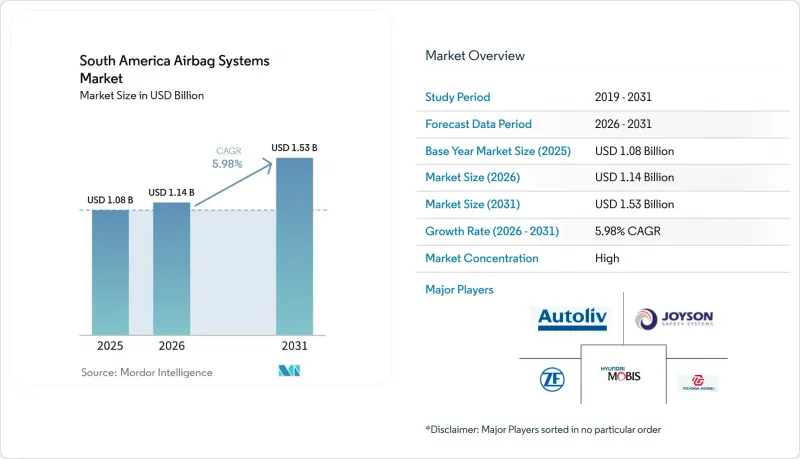
에 따르면 남미의 에어백 시스템 시장 규모는 2025년에 10억 8,000만 달러로 평가되며, 2026년에는 11억 4,000만 달러로 추정되고 있으며, 2031년까지 15억 3,000만 달러에 달할 것으로 예측됩니다.
2026-2031년까지 연평균 성장률(CAGR) 5.98%로 성장할 것으로 전망됩니다.
남미 에어백 시스템 시장의 동향 및 인사이트
지역 전반에 걸친 에어백 규제 강화
남미 전역의 안전 기준은 최소한의 장비 요건에서 충돌 성능에 대한 기대치로 점차 전환되고 있습니다. 브라질의 CONTRAN 결의 제964/2022호는 M1 및 N1 차량에 전면 에어백 장착을 의무화하고 있으며, 국내 생산 차량과 수입 차량 모두에 대해 명확한 기준을 정하고 있습니다. 또한 결의안 제949/2022호에서는 세단, SUV, 픽업 트럭에 대한 측면 탑승자 보호 시험 요건도 규정되었습니다. Latin NCAP의 2026-2029년 프로토콜에서는 시속 60km의 측면 배리어 시험 및 시속 32km의 측면 폴 시험이 도입되어, 차량 설계에서 측면 및 커튼 에어백을 통한 보호의 중요성이 더욱 높아지고 있습니다. 또한 이 프로토콜에서는 ISOFIX 장착 여부와 조수석 에어백 비활성화 기능도 고려되어 있으며, 이를 통해 어린이 안전 기능과 구속 시스템의 결정이 연계되고 있습니다. 이러한 요건으로 인해 자동차 제조사들은 마이너 체인지나 신차 출시를 앞두고 보다 광범위한 에어백 패키지의 표준화를 촉진하게 될 것입니다.
브라질내 OEM의 생산 확대
브라질의 신차 프로그램은 현지에서 공급되는 에어백 시스템에 대한 지속적인 수요를 창출하고 있습니다. 제너럴 모터스(GM)는 하이브리드차량, 제조 설비의 현대화 및 엔지니어링 역량 강화를 위해 브라질내 투자 계획을 확대했습니다. 창안자동차(Changan)와 CAOA는 2026-2028년까지 이어지는 9억 5,000만 달러 규모의 투자 주기의 일환으로, 2026년 3월 아나폴리스에서 SUV ‘Uni-T’의 현지 생산을 시작했습니다. 새로운 플랫폼에는 전용 형식 승인이 필요하며, 이는 공급업체에게 각 생산 주기 기간 중 계약을 확보할 수 있는 기회가 됩니다. 브라질에 진출하는 중국 자동차 제조사들은 일반적으로 포괄적인 안전 장비를 갖춘 차량을 도입하고 있으며, 이로 인해 현지 생산 차량 1대당 에어백 평균 장착 수가 증가할 가능성이 있습니다. 남미의 에어백 시스템 시장은 현지 조립 프로그램이 단순한 생산 대수에 의존하는 것이 아니라, 생산량 증가와 안전 장비 확충을 결합함으로써 혜택을 볼 것입니다.
가격에 민감한 엔트리 레벨 부문이 도입을 제한
규제로 의무화되지 않은 경우, 엔트리 레벨 차량에 추가 에어백을 장착하는 것은 여전히 어렵습니다. 이 부문의 자동차 제조사들은 사양 업그레이드와 구매자가 기대하는 합리적인 가격 사이의 균형을 맞춰야 합니다. 이러한 제약은 수입 부품이나 거시경제의 불확실성으로 인해 조달 비용이 급등할 가능성이 있는 브라질이나 아르헨티나에서 더욱 두드러집니다. 제조사들은 차량 가격 범위 내에서 안전 장비 패키지를 탑재하기 쉬운 고가형 SUV나 픽업 트럭에 4개 또는 6개의 에어백을 더 쉽게 추가할 수 있습니다. 그 결과, 남미의 에어백 시스템 시장에서는 양극화가 발생하고 있으며, 중급차 및 프리미엄 차량에서 장비 증설이 두드러지고 있습니다. 엔트리 레벨 부문에서는 옵션으로 제공되는 안전 장치의 도입이 여전히 더딘 양상을 보이고 있습니다.
부문 분석
프론트 모듈은 이미 신차 탑재율이 100%에 가까워지고 있으며, 그 방대한 수량 덕분에 2025년 매출의 46.24%를 차지하고 있습니다. 커튼 에어백은 콜롬비아와 칠레가 방출 저감 성능을 법제화함에 따라 2026-2031년까지 연평균 성장률(CAGR) 6.19%로 성장할 것으로 예측되며, 향후 10년 말까지 남미 에어백 시스템 시장의 4분의 1 가까이를 차지할 전망입니다. 사이드·솔락스 유닛은 NCAP의 폴 충돌 기준의 혜택을 받고 있으며, 시장 가치의 상당 부분을 차지하고 있습니다. 무릎 에어백은 프리미엄 기능으로 자리매김하고 있으며, 폭스바겐 ‘타오스’나 토요타 ‘코롤라 크로스’의 트림 간 차별화를 이끄는 역할을 하고 있습니다. 센터 에어백과 안전벨트 에어백의 시장 점유율은 극히 미미하지만, 이들은 주로 고급 크로스오버 차량이나 독일산 고급 수입차에 탑재되고 있습니다. 각 공급업체들은 캐스케이드식 루프 레일이나 도어 장착형 커튼 에어백과 같은 혁신 기술에서 이익률 확대의 최대 가능성을 찾고 있습니다.
프론트 모듈은 규모의 경제를 실현하며 시장을 독점하고 있지만, 그 성장은 정체 국면에 접어들고 있습니다. 한편, 안데스 국가들의 각 시장에서 규제 도입 일정이 구체화됨에 따라 커튼 에어백과 흉부 보호 장치가 차량에 새로운 사양 계층을 형성할 전망입니다. 향후 기술 동향으로는 더 가벼운 소재로의 전환, 충전 가스량을 줄이는 밀봉 처리된 솔기, 그리고 탑승자의 자세에 적응하는 AI 기반 인플레이터 제어 로직이 주목받고 있습니다. 에어백 관련 수익의 감소는 남미 에어백 시스템 시장의 성장을 주도할 것으로 예상됩니다.
2025년, 남미 에어백 시스템 시장에서 승용차가 73.16%를 차지하고 있으며, 이는 해당 지역에서 이 차종 카테고리의 대수가 많음을 반영합니다. 승용차는 전면 에어백 모듈 및 관련 전자제어 장치의 기본적인 수요 원천이 되고 있습니다. 소형 상용차는 2031년까지 연평균 성장률(CAGR) 6.23%로 성장할 것으로 예측됩니다. 픽업 트럭은 개인용 및 상업용 운송 모두에 사용되므로 이러한 성장의 주요 부분을 차지하고 있습니다. 이러한 차량에는 일반적으로 표준 안전 장비로 4-6개의 에어백이 장착되어 있습니다. 장착되는 에어백의 수가 많기 때문에 등록 대수만으로는 추정되는 것보다 에어백이 매출에 기여하는 비중이 더 큽니다. 따라서 현재 진행 중인 픽업트럭 및 SUV로의 전환은 승용차의 수요 기반을 넘어 에어백 수요를 지원하고 있습니다.
중형 및 대형 상용차, 그리고 버스 및 장거리 버스는 절대적인 점유율은 작지만, 해당 지역의 승용차 안전 요건에 비해 안전 요건의 정비가 역사적으로 뒤처져 왔습니다. 그럼에도 불구하고 차량 운영 사업자들은 탑승자 보호 및 보험상의 고려 사항을 더욱 중시하고 있습니다. 볼보 트럭은 2026년 2월, 북미 시장용 신형 VNL 및 VNR 모델에 일체형 사이드 커튼 에어백을 기본 사양으로 장착했습니다. 이러한 움직임은 전 세계 플랫폼 간 차량 안전 사양이 점차 통합되고 있음을 보여주는 좋은 사례라고 할 수 있습니다. 남미에서 상용차 안전 장비의 보급은, 차량 구매자들이 더 광범위한 안전 장비를 요구하게 되면 공식적인 규제 일정에 앞서 진행될 가능성이 있습니다. 이미 해당 지역의 차량 구매자들에게 제품을 공급하고 있는 유서 깊은 공급업체들은 이러한 수요에 대응할 수 있는 체제를 갖추고 있습니다.
기타 혜택:
- 엑셀 형식의 시장 예측(ME) 시트
- 3개월간의 애널리스트 지원
자주 묻는 질문
목차
제1장 서론
- 조사 전제조건과 시장 정의
- 조사 범위
제2장 조사 방법
제3장 개요
제4장 시장 구도
- 시장 개요
- 시장 성장 촉진요인
- 시장 성장 억제요인
- 밸류·공급망 분석
- 규제 상황
- 기술 전망
- Porter's Five Forces 분석
제5장 시장 규모와 성장 예측
- 에어백 유형별
- 차종별
- 컴포넌트별
- 판매 채널별
- 국가별
- 브라질
- 아르헨티나
- 콜롬비아
- 칠레
- 기타 남미 국가
제6장 경쟁 구도
- 시장 집중도
- 전략적 동향
- 시장 점유율 분석
- 기업 개요
- Autoliv Inc.
- ZF Friedrichshafen AG(ZF TRW)
- Joyson Safety Systems
- Toyoda Gosei Co., Ltd.
- Hyundai Mobis Co., Ltd.
- Continental AG
- Robert Bosch GmbH
- Denso Corporation
- Faurecia SE
- Yanfeng Safety Systems
- Kolon Industries, Inc.
- Toyobo Co., Ltd.
- TE Connectivity Ltd.
- Key Safety Systems
제7장 시장 기회와 향후 전망
KSA 26.10.28According to Mordor Intelligence, the South American airbag systems market size was valued at USD 1.08 billion in 2025, is estimated at USD 1.14 billion in 2026, and is projected to reach USD 1.53 billion by 2031, growing at a CAGR of 5.98% from 2026 to 2031.
South America Airbag Systems Market Trends and Insights
Stricter Region-Wide Airbag Regulations
Safety rules across South America are moving beyond minimum equipment requirements toward crash-performance expectations. Brazil's CONTRAN Resolution 964/2022 requires frontal airbags in M1 and N1 vehicles, establishing a clear baseline for both locally produced and imported models. Resolution 949/2022 also established lateral occupant-protection testing requirements for sedans, SUVs, and pickups. Latin NCAP's 2026-2029 protocol introduced a 60 km/h side-barrier test and a 32 km/h side-pole test, increasing the value of side and curtain protection in vehicle design. The protocol also considers ISOFIX availability and the ability to deactivate the passenger airbag, thereby connecting child safety features to restraint-system decisions. These requirements encourage automakers to standardize broader airbag packages before a facelift or a new model launch.
OEM Production Expansion in Brazil
Brazil's new vehicle programs create recurring demand for locally supplied airbag systems. General Motors increased its investment commitment in Brazil for hybrid vehicles, manufacturing modernization, and engineering capabilities. Changan and CAOA began local production of the Uni-T SUV in Anapolis in March 2026 as part of a USD 950 million investment cycle for 2026-2028 . The new platforms require dedicated homologation and give suppliers an opportunity to secure contracts for the duration of each production run. Chinese automakers entering Brazil commonly introduce vehicles with comprehensive safety equipment, which can raise the average number of airbags per locally produced vehicle. The South American airbag system market benefits when local assembly programs combine volume growth with higher safety content rather than relying only on unit output.
Price-Sensitive Entry-Level Segment Limits Adoption
Entry-level vehicles remain difficult to equip with additional airbags when rules do not require them. Vehicle makers in this category must balance equipment upgrades with the affordability buyers expect. This constraint is more evident in Brazil and Argentina, where imported components and macroeconomic uncertainty can raise sourcing costs. Manufacturers can more easily add 4 or 6 airbags to higher-priced SUVs and pickups, where the safety package is easier to support within the vehicle's price. The result is a split within the South American airbag system market, with stronger content growth in mid-range and premium vehicles. The entry-level segment continues to slow the adoption of optional restraint systems.
Other drivers and restraints analyzed in the detailed report include:
- Rising SUV and Pickup Penetration Boosting Multi-Airbag Count
- Growing Consumer Focus on NCAP Safety Ratings
- Prevalence of Counterfeit Airbag Imports
For complete list of drivers and restraints, kindly check the Table Of Contents.
Segment Analysis
Front modules already penetrate close to 100% of new builds, yet they still generated 46.24% of 2025 revenue owing to sheer volume. Curtain airbags are forecast to grow at a 6.19% CAGR between 2026 and 2031 as Colombia and Chile legislate ejection-mitigation performance, edging their share toward one-quarter of the South America airbag systems market by the end of the decade. Side-thorax units, benefiting from NCAP's pole-impact criteria, account for a significant portion of the market value. Knee airbags serve as a premium feature, distinguishing trims of the Volkswagen Taos and Toyota Corolla Cross. While center and seatbelt airbags hold a minimal share of the market, they're primarily found in high-end crossovers and luxury imports from Germany. Suppliers see the most promise for margin expansion in innovations such as cascading roof rails or door-mounted curtains.
While front modules dominate, offering scale efficiencies, their growth is beginning to plateau. On the other hand, as regulatory timelines come into play in various Andean markets, curtains and thorax units are set to introduce new content layers in vehicles. Future technology trends highlight a shift towards lighter fabrics, sealed seams that reduce fill gas volumes, and AI-driven inflator logic that adapts to occupant posture. Curtailed airbag revenues are expected to drive a significant portion of the growth in South America's airbag systems market.
Passenger cars accounted for 73.16% of the South American airbag system market in 2025, reflecting the high volume of this vehicle category in the region. Passenger cars provide the base demand for frontal airbag modules and related electronic controls. Light commercial vehicles are projected to grow at a 6.23% CAGR through 2031. Pickups make up a major part of this expansion because they are used for both personal and commercial transport. These vehicles typically include 4 to 6 airbags as standard safety equipment. The higher system count makes their contribution to airbag revenue greater than vehicle registrations alone suggest. The ongoing pickup-and-SUV shift, therefore, supports airbag demand beyond the passenger-car base.
Medium and heavy commercial vehicles, along with buses and coaches, hold smaller absolute shares. Their safety requirements have historically developed more slowly than requirements for passenger vehicles in the region. Fleet operators are nevertheless placing more weight on occupant protection and insurance considerations. Volvo Trucks made integrated side-curtain airbags standard on its new VNL and VNR models for North America in February 2026 . The move provides a relevant example as vehicle safety specifications converge across global platforms. South American commercial-vehicle adoption may emerge ahead of formal regulatory schedules when fleet buyers seek broader safety equipment. Established suppliers already serving regional fleets are positioned to address this demand.
Complete Report Scope:
- By Airbag Type
- Front Airbags
- Side Airbags
- Curtain Airbags
- Knee Airbags
- Center Airbags
- Seatbelt Airbags
- By Vehicle Type
- Passenger Cars
- Light Commercial Vehicles (LCVs)
- Medium & Heavy Commercial Vehicles (MHCVs)
- Buses and Coaches
- By Component
- Airbag Module
- Crash Sensor
- Inflator
- Diagnostic Sensor
- Control Unit
- Others
- By Sales Channel
- Original Equipment Manufacturer
- Aftermarket
- By Country
- Brazil
- Argentina
- Colombia
- Chile
- Rest of South America
List of Companies Covered in this Report:
- Autoliv Inc.
- ZF Friedrichshafen AG (ZF TRW)
- Joyson Safety Systems
- Toyoda Gosei Co., Ltd.
- Hyundai Mobis Co., Ltd.
- Continental AG
- Robert Bosch GmbH
- Denso Corporation
- Faurecia SE
- Yanfeng Safety Systems
- Kolon Industries, Inc.
- Toyobo Co., Ltd.
- TE Connectivity Ltd.
- Key Safety Systems
Additional Benefits:
- The market estimate (ME) sheet in Excel format
- 3 months of analyst support
TABLE OF CONTENTS
1 Introduction
- 1.1 Study Assumptions and Market Definition
- 1.2 Scope of the Study
2 Research Methodology
3 Executive Summary
4 Market Landscape
- 4.1 Market Overview
- 4.2 Market Drivers
- 4.2.1 Stricter Region-Wide Airbag Regulations
- 4.2.2 OEM Production Expansion in Brazil
- 4.2.3 Rising SUV and Pickup Penetration Boosting Multi-Airbag Count
- 4.2.4 Growing Consumer Focus on NCAP Safety Ratings
- 4.2.5 Fleet Insurance Incentives for Side-Curtain Airbags
- 4.2.6 Localization of Inflator Manufacturing Lowering Cost Barriers
- 4.3 Market Restraints
- 4.3.1 Price-Sensitive Entry-Level Segment Limits Adoption
- 4.3.2 Prevalence of Counterfeit Airbag Imports
- 4.3.3 Supply-Chain Disruptions for Specialized Propellant Chemicals
- 4.3.4 Integration Challenges of Center Airbags With Legacy Platforms
- 4.4 Value / Supply-Chain Analysis
- 4.5 Regulatory Landscape
- 4.6 Technological Outlook
- 4.7 Porter's Five Forces Analysis
- 4.7.1 Threat of New Entrants
- 4.7.2 Bargaining Power of Suppliers
- 4.7.3 Bargaining Power of Buyers
- 4.7.4 Threat of Substitutes
- 4.7.5 Intensity of Competitive Rivalry
5 Market Size and Growth Forecasts (Value in USD)
- 5.1 By Airbag Type
- 5.1.1 Front Airbags
- 5.1.2 Side Airbags
- 5.1.3 Curtain Airbags
- 5.1.4 Knee Airbags
- 5.1.5 Center Airbags
- 5.1.6 Seatbelt Airbags
- 5.2 By Vehicle Type
- 5.2.1 Passenger Cars
- 5.2.2 Light Commercial Vehicles (LCVs)
- 5.2.3 Medium & Heavy Commercial Vehicles (MHCVs)
- 5.2.4 Buses and Coaches
- 5.3 By Component
- 5.3.1 Airbag Module
- 5.3.2 Crash Sensor
- 5.3.3 Inflator
- 5.3.4 Diagnostic Sensor
- 5.3.5 Control Unit
- 5.3.6 Others
- 5.4 By Sales Channel
- 5.4.1 Original Equipment Manufacturer
- 5.4.2 Aftermarket
- 5.5 By Country
- 5.5.1 Brazil
- 5.5.2 Argentina
- 5.5.3 Colombia
- 5.5.4 Chile
- 5.5.5 Rest of South America
6 Competitive Landscape
- 6.1 Market Concentration
- 6.2 Strategic Moves
- 6.3 Market Share Analysis
- 6.4 Company Profiles {(Includes Global level Overview, Market level overview, Core Segments, Financials as available, Strategic Information, Market Rank/Share for key companies, Products & Services, and Recent Developments)}
- 6.4.1 Autoliv Inc.
- 6.4.2 ZF Friedrichshafen AG (ZF TRW)
- 6.4.3 Joyson Safety Systems
- 6.4.4 Toyoda Gosei Co., Ltd.
- 6.4.5 Hyundai Mobis Co., Ltd.
- 6.4.6 Continental AG
- 6.4.7 Robert Bosch GmbH
- 6.4.8 Denso Corporation
- 6.4.9 Faurecia SE
- 6.4.10 Yanfeng Safety Systems
- 6.4.11 Kolon Industries, Inc.
- 6.4.12 Toyobo Co., Ltd.
- 6.4.13 TE Connectivity Ltd.
- 6.4.14 Key Safety Systems


