

|
시장보고서
상품코드
2155311
열가소성 폴리올레핀 : 시장 점유율 분석, 업계 동향과 통계, 성장 예측(2026-2031년)Thermoplastic Polyolefins - Market Share Analysis, Industry Trends & Statistics, Growth Forecasts (2026 - 2031) |
||||||
 Mordor Intelligence
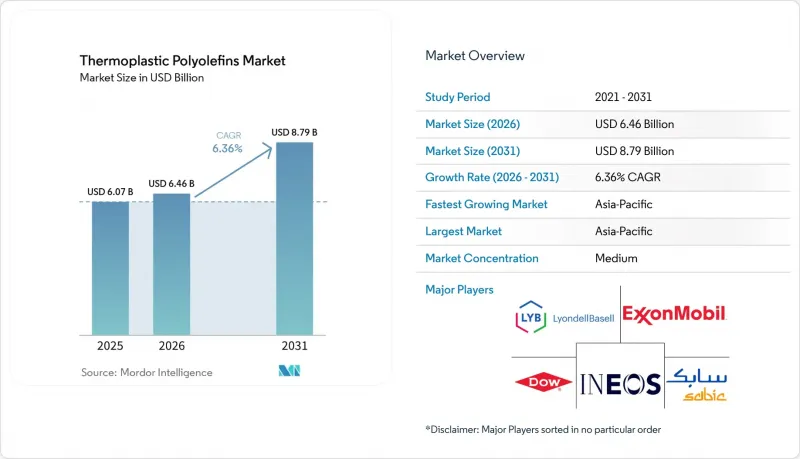
에 따르면 열가소성 폴리올레핀 시장 규모는 2025년에 60억 7,000만 달러로 평가되며, 2026년 64억 6,000만 달러에서 2031년까지 87억 9,000만 달러에 달할 것으로 예측되고 있으며, 예측 기간(2026-2031년)에 CAGR은 6.36%에 달할 전망입니다.
세계 열가소성 폴리올레핀 시장의 동향 및 인사이트
자동차 경량화 및 배기가스 규제 대응
자동차 경량화는 열가소성 폴리올레핀 시장 수요의 핵심 요인으로 계속 작용하고 있습니다. 유럽연합 집행위원회는 2025년 12월 16일 ‘자동차 패키지’를 발표하고, 2035년 이후 승용차의 배기관 배출량을 90% 감축한다는 목표를 설정했습니다. 나머지 10%에 대해서는 유럽연합(EU)에서 생산되는 저탄소강, e-연료 또는 바이오연료를 통해 대응할 수 있습니다. 열가소성 폴리올레핀의 밀도는 0.89-1.05 g/cm³이며, 범퍼 페시아, 도어 패널, 펜더 라이너 등 무거운 소재의 대체재로 사용할 수 있습니다. 이러한 조합을 통해 내충격성이나 외장 내구성을 저해하지 않으면서 경량화가 필요한 차량 프로그램을 실현할 수 있습니다. 배터리식 전기자동차(BEV) 플랫폼에서는 배터리 팩이 차량 전체의 무게를 증가시키기 때문에 추가적인 경량화에 대한 압박이 커지고 있으며, 열가소성 폴리올레핀 시장 전체에서 사용되는 소재의 중요성이 커지고 있습니다.
전기자동차 배터리 및 내장 부품에 대한 수요
전기자동차 설계는 내장 부품 및 배터리 관련 부품에 대한 열가소성 폴리올레핀 수요를 지원하고 있습니다. 파워트레인의 소음이 감소함에 따라 실내 패널의 소음·진동·거칠기(NVH) 제어에 대한 요구 사항이 높아지고 있습니다. 표준 열가소성 폴리올레핀(TPO) 등급은 내연 기관에 따른 고온에 노출되지 않는 실내 및 차체 하부 영역에 사용할 수 있습니다. 카우텍스 텍스트론(Cautex Textron)은 자사의 ‘펜타토닉(Pentatonic)’ 포트폴리오를 바탕으로, 멀티 브랜드 배터리 전기자동차 플랫폼용 배터리 하우징에 대한 2025년 계약을 수주했습니다. 이러한 추세에 따라 TPO 컴파운드 제조사들이 열가소성 폴리올레핀 시장에서 인증을 획득할 수 있는 차량 영역의 범위가 확대되고 있습니다.
폴리프로필렌 및 엘라스토머 원료 가격 변동
폴리프로필렌 및 엘라스토머 원료 가격 변동은 TPO 컴파운더의 이익률을 압박할 가능성이 있습니다. 프로필렌 가격은 정유소나 스팀 크래커의 가동 상황에 좌우되지만, 이는 TPO 수요와는 별개로 움직일 수 있습니다. 에틸렌·프로필렌·디엔 모노머(EPDM) 및 폴리올레핀 엘라스토머의 가격은 에틸렌 시장과 연동되어 있으므로, 또 다른 변동 요인이 됩니다. 소규모 컴파운더는 통합형 생산자가 누릴 수 있는 보호 조치 없이 현물 시장에서 원료를 구매할 경우 더 큰 위험에 노출됩니다. 고객 수요가 증가하고 있음에도 불구하고 이익률에 대한 압박이 생산 능력의 합리화로 이어질 가능성이 있습니다. 또한 탄소 국경 조정 메커니즘(CBAM)은 나프타 유래 원료를 수입하는 유럽의 컴파운더에게 추가적인 비용 압박을 가할 가능성이 있습니다.
부문 분석
폴리프로필렌은 확립된 밸류체인과 폭넓은 가공 호환성에 힘입어 2025년 시장 가치의 38.91%를 차지했습니다. 이 소재는 자동차, 건설, 가전, 산업용 부품에 사용되는 사출성형 및 압출 성형 공정에 폭넓게 활용되고 있습니다. 비용 측면에서의 우위는 다른 TPO 주력 소재들이 상업적 규모로 따라잡기에는 여전히 어려운 수준입니다. 또한 폴리프로필렌 컴파운드는 내충격성, 표면 품질, 저밀도가 요구되는 자동차 부품용으로 배합하는 것도 가능합니다. 이러한 규모와 유연성 덕분에 폴리프로필렌은 열가소성 폴리올레핀 업계에서 계속해서 중심적인 위치를 차지하고 있습니다.
폴리에틸렌은 2031년까지의 열가소성 폴리올레핀 시장 규모에서 연평균 성장률(CAGR) 6.89%로 확대될 것으로 예측됩니다. 메탈로센계 촉매를 사용한 폴리에틸렌의 변형 제품은 저온 성능을 갖추면서도 유연성과 내충격성을 겸비한 특성을 발휘합니다. 그 용도는 의료용 포장, 유연한 산업용 시트, 그리고 부드러운 촉감의 인테리어 용도에 집중되어 있습니다. 이러한 용도 덕분에 열가소성 폴리올레핀 시장은 단순히 재료 비용뿐만 아니라 유연성과 저온 충격 성능이 더 중시되는 분야로 진출할 수 있게 됩니다. ‘기타’ 범주에는 바이오 유래 구성 요소와 에틸렌·프로필렌·디엔 삼원 공중합체가 포함되지만, 원료의 확보 가능성과 가공의 일관성으로 인해 여전히 제약을 받고 있습니다.
지역별 분석
아시아태평양은 2025년에 시장 규모의 43.66%를 차지할 것으로 예상되며, 2031년까지 연평균 성장률(CAGR) 7.05%로 확대될 것으로 전망됩니다. 중국, 일본, 한국에서는 자동차 제조 및 관련 소재 수요가 집중되어 있습니다. 중국의 ‘국가 VI’ 자동차 배기가스 기준은 차량 부품의 경량화에 대한 지속적인 관심을 지원하고 있습니다. 인도의 자동차 생산 및 인프라 구축 활동 또한 자동차 및 지붕재 관련 소비를 지원하고 있습니다. 한국과 일본은 전기자동차 인테리어 스킨 및 가전용 TPO 소재 수요에 기여하고 있습니다.
북미는 자동차 연비 규제와 셰일 유래 에탄을 원료로 활용할 수 있다는 점에서 혜택을 보고 있습니다. ‘기업 평균 연비(CAFE)’ 체계는 계속해서 미국 자동차 제조사에 대한 연비 기준의 지침이 되고 있습니다. 원료 확보가 이루어지고 있다는 점은 건설 및 산업용 폴리에틸렌 계열 제품의 비용 경쟁력을 지원하고 있습니다. 미국이 해당 지역 시장 가치의 대부분을 차지하고 있지만, 멕시코는 아시아 및 유럽 제조업체들의 자동차 조립 투자로 인한 혜택을 누리고 있습니다. 유럽에서는 규정(EU) 2019/631 및 규정(EU) 2026/1738이 적용되고 있으며, 이는 경량 소재나 추적 가능한 재생 소재를 공급할 수 있는 공급업체를 우대하는 내용입니다.
남미, 중동 및 아프리카는 열가소성 폴리올레핀 시장 규모에서 비교적 작은 점유율을 차지하고 있습니다. 브라질은 자동차 조립 및 건설 활동을 통해 남미의 수요를 주도하고 있으며, 브라스크엠(Braskem)사가 이 지역에 통합적인 원료 공급 체계를 구축하고 있습니다. 아르헨티나에서는 인프라 수요가 있음에도 불구하고 경제의 변동성으로 인해 단기적인 수요가 제한되고 있습니다. 사우디아라비아의 ‘비전 2030’에 기반한 건설 프로그램은 방수 시트의 수요를 지원할 가능성이 있습니다. 남아프리카공화국은 산업 활동과 자동차 조립을 통해 보다 안정적인 기반을 제공하고 있으나, 수거 시스템의 미비로 인해 재활용 재료 함유율이 높은 프리미엄 TPO 등급의 수요가 억제되고 있습니다. 이러한 상황으로 인해 열가소성 폴리올레핀 시장의 성장은 현지 건설 수요, 자동차 분야에 대한 투자, 그리고 재활용 시스템의 개발에 좌우될 것입니다.
기타 혜택:
- 엑셀 형식의 시장 예측(ME) 시트
- 3개월간의 애널리스트 지원
자주 묻는 질문
목차
제1장 서론
- 조사 전제조건과 시장 정의
- 조사 범위
제2장 조사 방법
제3장 개요
제4장 시장 구도
- 시장 개요
- 시장 성장 촉진요인
- 시장 성장 억제요인
- 밸류체인 분석
- Porter's Five Forces 분석
제5장 시장 규모와 성장 예측
- 원재료별
- 용도별
- 지역별
- 아시아태평양
- 중국
- 인도
- 일본
- 한국
- 기타 아시아태평양 국가
- 북미
- 미국
- 캐나다
- 멕시코
- 유럽
- 독일
- 영국
- 프랑스
- 이탈리아
- 기타 유럽 국가
- 남미
- 브라질
- 아르헨티나
- 기타 남미 국가
- 중동 및 아프리카
- 사우디아라비아
- 남아프리카공화국
- 기타 중동 및 아프리카 국가
- 아시아태평양
제6장 경쟁 구도
- 시장 집중도
- 전략적 동향
- 시장 점유율·순위 분석
- 기업 개요
- Arkema
- Avient Corporation
- Borealis GmbH
- Braskem
- Celanese Corporation
- Dow
- Exxon Mobil Corporation
- Formosa Plastics Corporation
- INEOS
- LyondellBasell Industries Holdings B.V.
- Mitsui Chemicals, Inc.
- RTP Company
- SABIC
- Sumitomo Chemical Co., Ltd.
제7장 시장 기회와 향후 전망
KSA 26.10.28According to Mordor Intelligence, the thermoplastic polyolefins market size was valued at USD 6.07 billion in 2025 and is estimated to grow from USD 6.46 billion in 2026 to reach USD 8.79 billion by 2031, at a CAGR of 6.36% during the forecast period (2026-2031).
Global Thermoplastic Polyolefins Market Trends and Insights
Automotive Lightweighting and Emissions Compliance
Automotive lightweighting remains a central source of demand for the thermoplastic polyolefins market. The European Commission presented its Automotive Package on December 16, 2025, setting a 90% tailpipe-emissions reduction target for cars from 2035. The remaining 10% can be addressed through low-carbon steel produced in the European Union, e-fuels, or biofuels. Thermoplastic polyolefins have densities of 0.89 to 1.05 g/cm3 and can replace heavier materials in bumper fascias, door panels, and fender liners. This combination supports vehicle programs that need lower mass without sacrificing impact resistance or exterior durability. Battery electric vehicle platforms add further pressure to reduce vehicle weight because battery packs increase overall vehicle mass and raise the importance of materials used across the thermoplastic polyolefins market.
Electric Vehicle Battery and Interior Component Demand
Electric vehicle designs support demand for thermoplastic polyolefins in interior and battery-related components. Lower powertrain noise raises requirements for noise, vibration, and harshness control in cabin panels. Standard thermoplastic polyolefins (TPO) grades can serve interior and underbody areas that do not face the high temperatures associated with combustion engines. Kautex Textron won a 2025 contract for a battery housing on a multi-brand battery electric vehicle platform under its Pentatonic portfolio. These developments expand the range of vehicle areas in which TPO compounders can seek qualification in the thermoplastic polyolefins market.
Polypropylene and Elastomer Feedstock Price Volatility
Polypropylene and elastomer feedstock price volatility can weaken margins for TPO compounders. Propylene pricing follows refinery and steam-cracker conditions, which can move separately from TPO demand. Ethylene-propylene-diene monomer and polyolefin elastomer prices introduce another source of variability because they are linked to ethylene markets. Smaller compounders are more exposed when they purchase feedstocks in the spot market without the protection available to integrated producers. Margin pressure can lead to capacity rationalization when customer demand is increasing. The Carbon Border Adjustment Mechanism can add cost pressure for European compounders that import naphtha-derived feedstocks.
Other drivers and restraints analyzed in the detailed report include:
- Recyclable and Low-VOC Material Adoption
- Growth of TPO Roofing and Waterproofing Membranes
- Limited High-Temperature Performance
For complete list of drivers and restraints, kindly check the Table Of Contents.
Segment Analysis
Polypropylene held 38.91% of the value in 2025, supported by established supply chains and broad processing compatibility. The material works across injection molding and extrusion processes used for automotive, construction, appliance, and industrial parts. Its cost position remains difficult for another TPO backbone to match at a commercial scale. Polypropylene compounds can also be formulated for vehicle components that require impact resistance, surface quality, and low density. This scale and flexibility keep polypropylene central to the thermoplastic polyolefins industry.
Polyethylene is projected to advance at a 6.89% CAGR through 2031 within the thermoplastic polyolefins market size. Metallocene-catalyzed polyethylene variants support soft and impact-tolerant profiles with low-temperature performance. Their use is concentrated in medical packaging, flexible industrial sheeting, and soft-touch interior applications. These uses give the thermoplastic polyolefins market access to applications where flexibility and low-temperature impact performance carry greater weight than material cost alone. The others category includes bio-sourced building blocks and ethylene-propylene-diene terpolymers, but it remains constrained by feedstock availability and processing consistency.
Complete Report Scope:
- By Raw Material
- Polypropylene
- Polyethylene
- Others
- By Application
- Automotive
- Building and Construction
- Home Appliances
- Medical
- Industrial
- Others
- By Geography
- Asia-Pacific
- China
- India
- Japan
- South Korea
- Rest of Asia-Pacific
- North America
- United States
- Canada
- Mexico
- Europe
- Germany
- United Kingdom
- France
- Italy
- Rest of Europe
- South America
- Brazil
- Argentina
- Rest of South America
- Middle East and Africa
- Saudi Arabia
- South Africa
- Rest of Middle East and Africa
- Asia-Pacific
Geography Analysis
Asia-Pacific held 43.66% of the value in 2025 and is projected to advance at a 7.05% CAGR through 2031. China, Japan, and South Korea concentrate substantial automotive manufacturing and related materials demand. China's National VI vehicle emissions standard supports continued interest in lighter vehicle components. India's vehicle production and infrastructure activity also support automotive and roofing-related consumption. South Korea and Japan contribute to the demand for electric vehicle interior skin and appliance-grade TPO materials.
North America benefits from vehicle fuel-economy requirements and shale-derived ethane feedstock availability. The Corporate Average Fuel Economy framework continues to guide fuel-economy standards for vehicle manufacturers in the United States. Feedstock access supports the cost position of polyethylene-based grades in construction and industrial applications. The United States represents much of the regional value, while Mexico gains from automotive assembly investment by Asian and European manufacturers. Europe relies on Regulation (EU) 2019/631 and Regulation (EU) 2026/1738, which favor suppliers with lightweight materials and traceable recycled-content supply.
South America and the Middle East and Africa have smaller positions in the thermoplastic polyolefins market size. Brazil leads South American demand through automotive assembly and construction activity, with Braskem providing an integrated regional feedstock presence. Argentina's economic volatility limits near-term demand, despite its infrastructure needs. Saudi Arabia's Vision 2030 construction programs can support waterproofing membrane demand. South Africa provides a steadier base through industrial activity and vehicle assembly, while limited recovery systems restrain premium recycled-content TPO grades. These conditions leave growth linked to local construction, automotive investment, and recycling system development in the thermoplastic polyolefins market.
- Arkema
- Avient Corporation
- Borealis GmbH
- Braskem
- Celanese Corporation
- Dow
- Exxon Mobil Corporation
- Formosa Plastics Corporation
- INEOS
- LyondellBasell Industries Holdings B.V.
- Mitsui Chemicals, Inc.
- RTP Company
- SABIC
- Sumitomo Chemical Co., Ltd.
Additional Benefits:
- The market estimate (ME) sheet in Excel format
- 3 months of analyst support
TABLE OF CONTENTS
1 Introduction
- 1.1 Study Assumptions and Market Definition
- 1.2 Scope of the Study
2 Research Methodology
3 Executive Summary
4 Market Landscape
- 4.1 Market Overview
- 4.2 Market Drivers
- 4.2.1 Automotive Lightweighting and Emissions Compliance
- 4.2.2 Electric Vehicle Battery and Interior Component Demand
- 4.2.3 Recyclable and Low-VOC Material Adoption
- 4.2.4 Growth of TPO Roofing and Waterproofing Membranes
- 4.2.5 Recycled-TPO Performance Recovery Through Compatibilizers
- 4.3 Market Restraints
- 4.3.1 Polypropylene and Elastomer Feedstock Price Volatility
- 4.3.2 Limited High-Temperature Performance
- 4.3.3 Inconsistent End-of-Life Recovery Infrastructure
- 4.4 Value Chain Analysis
- 4.5 Porter's Five Forces Analysis
- 4.5.1 Bargaining Power of Suppliers
- 4.5.2 Bargaining Power of Buyers
- 4.5.3 Threat of New Entrants
- 4.5.4 Threat of Substitutes
- 4.5.5 Competitive Rivalry
5 Market Size and Growth Forecasts (Value)
- 5.1 By Raw Material
- 5.1.1 Polypropylene
- 5.1.2 Polyethylene
- 5.1.3 Others
- 5.2 By Application
- 5.2.1 Automotive
- 5.2.2 Building and Construction
- 5.2.3 Home Appliances
- 5.2.4 Medical
- 5.2.5 Industrial
- 5.2.6 Others
- 5.3 By Geography
- 5.3.1 Asia-Pacific
- 5.3.1.1 China
- 5.3.1.2 India
- 5.3.1.3 Japan
- 5.3.1.4 South Korea
- 5.3.1.5 Rest of Asia-Pacific
- 5.3.2 North America
- 5.3.2.1 United States
- 5.3.2.2 Canada
- 5.3.2.3 Mexico
- 5.3.3 Europe
- 5.3.3.1 Germany
- 5.3.3.2 United Kingdom
- 5.3.3.3 France
- 5.3.3.4 Italy
- 5.3.3.5 Rest of Europe
- 5.3.4 South America
- 5.3.4.1 Brazil
- 5.3.4.2 Argentina
- 5.3.4.3 Rest of South America
- 5.3.5 Middle East and Africa
- 5.3.5.1 Saudi Arabia
- 5.3.5.2 South Africa
- 5.3.5.3 Rest of Middle East and Africa
- 5.3.1 Asia-Pacific
6 Competitive Landscape
- 6.1 Market Concentration
- 6.2 Strategic Moves
- 6.3 Market Share (%)/Ranking Analysis
- 6.4 Company Profiles (includes Global Overview, Market Overview, Core Segments, Financials as available, Strategic Information, Products and Services, and Recent Developments)
- 6.4.1 Arkema
- 6.4.2 Avient Corporation
- 6.4.3 Borealis GmbH
- 6.4.4 Braskem
- 6.4.5 Celanese Corporation
- 6.4.6 Dow
- 6.4.7 Exxon Mobil Corporation
- 6.4.8 Formosa Plastics Corporation
- 6.4.9 INEOS
- 6.4.10 LyondellBasell Industries Holdings B.V.
- 6.4.11 Mitsui Chemicals, Inc.
- 6.4.12 RTP Company
- 6.4.13 SABIC
- 6.4.14 Sumitomo Chemical Co., Ltd.
7 Market Opportunities and Future Outlook
- 7.1 White-Space and Unmet-Need Assessment


