

|
시장보고서
상품코드
2155312
방향성 용매 : 시장 점유율 분석, 업계 동향과 통계, 성장 예측(2026-2031년)Aromatic Solvents - Market Share Analysis, Industry Trends & Statistics, Growth Forecasts (2026 - 2031) |
||||||
 Mordor Intelligence
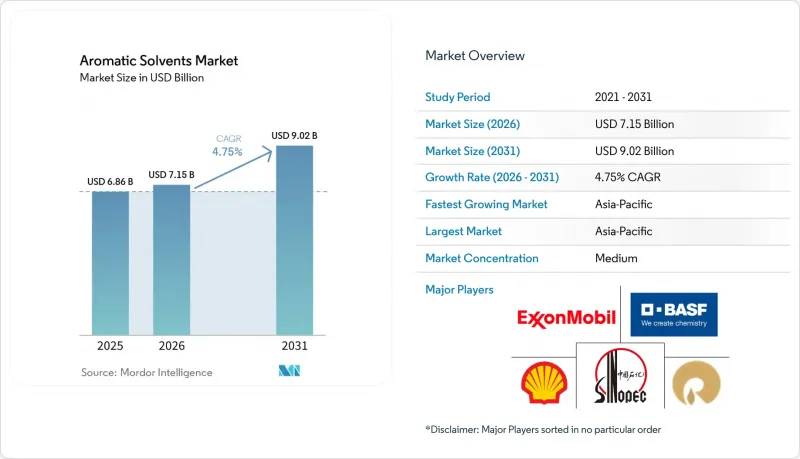
에 따르면 방향족 용제 시장 규모는 2025년에 68억 6,000만 달러로 평가되며, 2026년 71억 5,000만 달러에서 2031년까지 90억 2,000만 달러에 달할 것으로 예측되고 있으며, 예측 기간(2026-2031년)에 CAGR은 4.75%에 달할 전망입니다.
세계 방향족 용제 시장의 동향 및 인사이트
도료 및 코팅에 대한 수요 증가
도료 및 코팅은 여전히 방향족 용제 시장에서 가장 큰 소비 채널입니다. 용제형 알키드, 에폭시, 폴리우레탄 및 아크릴계 시스템은 산업용 유지보수, 선박, 자동차 재도장 용도로 사용됩니다. 크실렌과 톨루엔의 혼합물은 다양한 사용 조건 하에서 증발 속도 제어와 수지와의 호환성을 동시에 충족시킵니다. 수성 시스템은 일부 장식용 도료 용도를 대체했으나, 산업용 코팅의 모든 기술적 요건을 충족시키지는 못합니다. 규제적 압력으로 인해 성능이 낮은 건축용도와 성능을 중시하는 산업 용도는 구분되게 되었습니다. 2026년 조사에 따르면 EU 도료 지침에 따라 영국의 장식용 도료는 알칸계 용매에서 알코올, 케톤, 에스테르, 실록산으로 전환되고 있는 것으로 밝혀졌습니다.
장식용 도료 분야의 이러한 변화가 모든 도료 배합에서 방향족 용제의 필요성을 배제하는 것은 아닙니다. 산업 사용자는 용제형을 대체하기 전에 도료의 재인증을 필요로 하는 경우가 많으며, 이 과정이 보호 도료, 선박용 도료, 자동차 재도장 용도에서의 변경을 지연시킬 가능성이 있습니다. 따라서 방향족 용제 시장은 성능, 공정 제어 및 기질과의 적합성이 밀접하게 관련된 분야에서 여전히 수요를 유지하고 있습니다. 사용자가 엄격한 기술 사양을 준수해야 하는 분야에서는 고순도 등급에 대한 수요가 더욱 확고한 위치를 차지하고 있습니다. 이러한 차이는 장식용 도료에서 많은 산업용 시스템보다 배합 변경이 더 진전된 이유를 설명하는 요인 중 하나입니다.
확대되는 자동차 및 운송 장비 생산
자동차 생산은 도료, 접착제, 고무 가공 및 세정 공정을 통해 방향족 용제 시장을 지원하고 있습니다. 차량 조립에는 정의된 도포 조건 및 경화 조건을 충족하는 재료가 필요합니다. 전기자동차 조립에서도 다중 소재 구조의 차량 설계에 구조용 접착제가 사용되고 있으며, 이러한 접착제는 도포시 점도와 오픈 타임을 제어하기 위해 용제 캐리어가 필요합니다. 따라서 구조용 접착은 자동차 제조 분야에서 방향족 용제의 새로운 수요원이 되고 있으며, 중국, 인도, 한국 및 기타 지역 생산 거점에서 중요한 역할을 하고 있습니다.
운송 장비 제조가 모든 방향족 용제 용도에 동등한 영향을 미치는 것은 아닙니다. 도료는 보호, 보수, 마감에서 여전히 중요하며, 반면 접착제는 접합 및 조립을 지원합니다. 이러한 용도가 대규모 제조 공급망 내에서 발생할 경우, 방향족 용제 시장은 혜택을 받게 됩니다. 인도의 자동차 부품에 대한 정책 지원은 국내 제조 활동의 기반을 강화하고 있습니다. 또한 중국의 막대한 자동차 생산 대수 덕분에 그 공급망은 도료와 접착제에게 중요한 수요처가 되고 있습니다. 수요는 승용차 판매 대수뿐만 아니라 산업 활동과도 연동되어 있습니다.
변동이 심한 원자재 및 원유 가격에 연동된 가격 책정
방향족 용제는 나프타의 경제 상황 및 원유 가격 변동과 밀접한 관련이 있습니다. 원유 가격 변동은 공급망을 통해 신속하게 파급될 가능성이 있습니다. 가격이 상승할 때는 생산자가 투입 비용 상승에 직면하는 한편, 고객은 향후 가격 동향을 파악하기 위해 구매를 미룰 가능성이 있습니다. 이로 인해 수요와 이익률 모두에 동시에 압박이 가해질 수 있습니다. 이러한 영향은 원자재 헤지나 일괄 생산을 하지 않는 판매업체에게 특히 가혹하게 작용합니다. 벤젠, 톨루엔, 크실렌(BTX) 및 그 파생 제품의 각 사업 부문에서 이익률의 균형을 잘 맞출 수 있는 기업은 방향족 용제 시장에서 더 유리한 입장에 있습니다. 또한 구매자는 운전자금을 관리하고 급격한 가격 변동시 구매를 피하기 위해 발주 시기를 조정하기도 합니다. 이러한 행동으로 인해 기초 소비량이 변하지 않았더라도 단기적인 수요가 약해 보일 수 있습니다. 원자재 가격 변동 위험에 대한 노출은 용제 밸류체인 전반에 걸쳐 공급업체 선정, 재고 계획, 계약 협상에서 여전히 중요한 고려 사항으로 남아 있습니다.
일괄 생산을 하는 정제 업체는 보다 광범위한 정제 및 화학 사업 내에서 비용 압박의 일부를 관리할 수 있습니다. 순수한 판매업체는 현물 가격의 급격한 변동을 상쇄할 수 있는 능력이 제한적입니다. 수입에 의존하는 지역에서는 운임과 원료 비용이 동시에 상승할 경우 추가적인 위험에 직면하게 됩니다. 중국의 정제에서 화학 제품으로의 투자는 현지 공급량을 증가시킬 가능성이 있지만, 신규 생산 능력 확충은 개별 등급에서 일시적인 공급 과잉을 초래하여 지역 시장 가격에 영향을 미칠 수도 있습니다. 가격 변동성은 용제를 많이 사용하는 재료의 배합업체, 판매업체 및 구매업체에게 여전히 계획상 과제로 남아 있습니다.
부문별 분석
2025년 기준, 크실렌은 방향족 용제 시장 점유율의 38.13%를 차지하고 있으며, 크실렌의 방향족 용제 시장 규모는 2031년까지 연평균 성장률(CAGR) 5.13%로 확대될 것으로 예측됩니다. 자일렌은 산업용 도료 및 접착제에서 기능성 용매로 작용할 뿐만 아니라, 파라크실렌, 정제 테레프탈산, 폴리에스터의 밸류체인과도 연계되어 있습니다. 이러한 이중 역할 덕분에 통합형 생산자는 용매 용도와 파생 제품 용도 간에 원료를 배분할 때 유연성을 발휘할 수 있습니다. 일반 시장 수요와 자체 수요 간의 관계는 공급 상황 및 가격 책정에 영향을 미칠 수 있습니다. 크실렌의 성장은 하류 화학 제품 생산과 용제를 소비하는 용도 양측에서 발생하는 수요를 반영하고 있습니다.
톨루엔은 두 번째로 큰 제품 유형으로, 도료, 접착제, 인쇄 잉크에 사용됩니다. 또한 트랜스알킬화의 원료로서 추가적인 크실렌을 생산할 수도 있으며, 그 수요 주기는 크실렌은 물론 벤젠, 톨루엔, 크실렌(BTX)의 경제 상황과 밀접하게 연결되어 있습니다. 에틸벤젠은 주로 스티렌 통합 단지 내에서 생산되므로 일반 용제로서의 위상은 제한적입니다. 특수 용도로는 실험실, 의약품 및 전자기기 세정 용도가 포함됩니다. 트리메틸벤젠 분획 및 C9-C10 방향족 나프타를 포함한 기타 방향족 물질은 고고형분 산업용 도료에 사용되며, 휘발성이 낮다는 점이 고고형분 함량 달성에 기여하고 있습니다.
중국석유화학(Sinopec)의 차세대 통합 방향족 기술은 2026년 4월에 공식적인 평가를 받았습니다. 이 기술에는 연간 89만 메트릭톤의 생산 능력을 갖춘 방향족 플랜트에서 파라크실렌용 흡착제 및 에틸벤젠에서 자일렌으로의 이성질화 촉매가 포함되어 있습니다. 중국석유화학공업연합회가 이 기술을 인증했으며, 25건의 국가 발명 특허가 부여되었습니다. 이번 개발은 분리 효율과 수율 최적화에 대한 지속적인 노력을 반영하고 있습니다. 대규모 통합 플랜트의 경우 이러한 개선 사항을 활용하여 운영 경제성을 강화할 수 있지만, 소규모 생산자의 경우 유사한 기술력을 갖추지 못하면 이러한 성과를 따라잡기 어려울 수 있습니다.
지역별 분석
아시아태평양은 2025년에 41.32%의 점유율을 차지할 것으로 예상되며, 2031년까지 연평균 성장률(CAGR) 5.67%로 성장할 것으로 전망됩니다. 중국, 인도, 한국 및 아세안(ASEAN) 국가들이 이 지역의 주요 성장 기반을 형성하고 있습니다. 수요는 건설, 인프라, 제조, 석유화학 분야에 대한 투자에 의해 지원되고 있습니다. 중국에서는 석유화학 및 최종 용도 생산 능력이 양쯔강 삼각주, 주강 삼각주, 베이징·톈진·허베이 회랑에 집중되어 있습니다. 이러한 클러스터는 용제 공급과 도료, 포장, 자동차, 화학 제품 제조 간의 연계를 도모하고 있습니다. 새로운 통합 생산 능력은 지역내 공급 가능성과 경쟁을 모두 높일 가능성이 있습니다. 또한 이러한 지역적 집중은 현지 공급업체 네트워크, 하류 조달 관계 및 전문 유통 인프라 구축을 지원하고 있습니다.
인도에서는 견고한 제조업 수요에 힘입어 국내 방향족 생산이 확대되고 있으며, 계속해서 중요한 위치를 차지하고 있습니다. 인도 석유공사(Indian Oil Corporation Limited)의 파니파트 정유소 P-25 프로젝트는 2026년 말까지 최종 시운전 단계에 접어들 것으로 보도되고 있습니다. 아다니 페트로케미칼스(Adani Petrochemicals)의 발로르 페트로케미칼스(Valor Petrochemicals) 프로젝트는 2026년에 1단계 완공을 목표로 하고 있습니다. MRPL의 2025년 톨루엔 출하 역시 수입 의존도 감소를 위한 국내 차원의 한 걸음이 되었습니다. 한국은 지역내 전자기기 및 자동차용 도료 제조업체에 고순도 크실렌을 공급하고 있습니다. 이러한 동향들이 맞물리면서 아시아태평양은 방향족 용제 시장에서 계속해서 중심적인 위치를 차지하고 있습니다.
북미는 생산량이 성숙 단계에 접어든 분야와 자동차 수리 도장, 산업용 유지보수, 건설, 포장용 접착제 및 일반용 용제 공급에서 여전히 중요한 역할을 수행하고 있습니다. 에탄을 원료로 하는 스팀 크래커에서 생산되는 벤젠, 톨루엔, 크실렌(BTX)의 제품별 생산량 감소는 특정 방향족 유체의 공급 상황에 영향을 미칠 가능성이 있으며, 안정적인 품질을 추구하는 고객에게는 정유소와 일체화된 공급 체제의 중요성이 높아지고 있습니다. 유럽에서는 수년에 걸친 휘발성 유기 화합물(VOC) 배합 재검토 노력의 결과, 장식용 도료용 용제의 사용량이 감소하고 있습니다. 2026년 영국에서 보고된 조사에 따르면 새로운 장식용 도료의 배합에서 알칸계 용매가 알코올, 케톤, 에스테르, 실록산으로 대체되고 있는 것으로 나타났습니다. 유럽에서는 명확한 공정 성능과 제품의 신뢰성이 요구되는 산업용 분야에서 수요가 비교적 안정적입니다. 남미에서는 주로 브라질의 자동차 및 포장 산업에서의 수요가 시장을 지탱하고 있습니다. 중동 및 아프리카에서는 화학 산업의 다각화와 자동차 제조를 통해 수요가 증가할 것으로 전망됩니다.
기타 혜택:
- 엑셀 형식의 시장 예측(ME) 시트
- 3개월간의 애널리스트 지원
자주 묻는 질문
목차
제1장 서론
- 조사 전제조건과 시장 정의
- 조사 범위
제2장 조사 방법
제3장 개요
제4장 시장 구도
- 시장 개요
- 시장 성장 촉진요인
- 시장 성장 억제요인
- 밸류체인 분석
- Porter's Five Forces 분석
제5장 시장 규모와 성장 예측
- 제품 유형별
- 용도별
- 지역별
- 아시아태평양
- 중국
- 인도
- 일본
- 한국
- ASEAN 국가
- 기타 아시아태평양 국가
- 북미
- 미국
- 캐나다
- 멕시코
- 유럽
- 독일
- 영국
- 프랑스
- 이탈리아
- 북유럽 국가
- 기타 유럽 국가
- 남미
- 브라질
- 아르헨티나
- 기타 남미 국가
- 중동 및 아프리카
- 사우디아라비아
- 남아프리카공화국
- 기타 중동 및 아프리카 국가
- 아시아태평양
제6장 경쟁 구도
- 시장 집중도
- 전략적 동향
- 시장 점유율·순위 분석
- 기업 개요
- BASF
- Bharat Petroleum Corporation Limited
- Braskem
- Chevron Phillips Chemical Company LLC
- China Petroleum & Chemical Corporation
- CNPC
- Eastman Chemical Company
- Exxon Mobil Corporation
- Formosa Chemicals & Fibre Corp.
- Indian Oil Corporation Ltd
- INEOS
- Reliance Industries Limited
- Shell plc
- SK geo centric Co., Ltd.
- TotalEnergies
제7장 시장 기회와 향후 전망
KSA 26.10.28According to Mordor Intelligence, the aromatic solvents market size was valued at USD 6.86 billion in 2025 and is estimated to grow from USD 7.15 billion in 2026 to reach USD 9.02 billion by 2031, at a CAGR of 4.75% during the forecast period (2026-2031).
Global Aromatic Solvents Market Trends and Insights
Rising Demand for Paints and Coatings
Paints and coatings remain the largest consumption channel for the aromatic solvents market. Solvent-borne alkyd, epoxy, polyurethane, and acrylic systems are used in industrial maintenance, marine, and automotive refinish applications. Mixed xylene and toluene support controlled evaporation and resin compatibility across varied application conditions. Waterborne systems have replaced some decorative paint applications, but they do not meet all technical requirements in industrial coatings. Regulatory pressure has separated lower-performance architectural applications from performance-driven industrial uses. A 2026 study found that UK decorative paints had shifted away from alkane solvents toward alcohols, ketones, esters, and siloxanes following the EU Paints Directive.
This shift in decorative coatings does not eliminate the need for aromatic solvents in all coating formulations. Industrial users often need to requalify coatings before replacing a solvent system, a process that can delay changes in protective, marine, and automotive refinish applications. The aromatic solvents market, therefore, retains demand where performance, process control, and substrate compatibility are closely linked. High-purity grades hold a stronger position where users face strict technical specifications. This distinction helps explain why reformulation is more advanced in decorative coatings than in many industrial systems.
Expanding Automotive and Transportation Production
Automotive production supports the aromatic solvents market through coatings, adhesives, rubber processing, and cleaning operations. Vehicle assembly requires materials that meet defined application and curing conditions. Electric vehicle assembly also uses structural adhesives in multi-material vehicle designs, and these adhesives require solvent carriers to control viscosity and open time during application. Structural bonding, therefore, creates an additional demand route for aromatic solvents in vehicle manufacturing, relevant across China, India, South Korea, and other regional production centers.
Transportation manufacturing does not affect all uses of aromatic solvents equally. Coatings remain important for protection, repair, and finishing, while adhesives support joining and assembly. The aromatic solvents market benefits when these uses occur within large manufacturing supply chains. India's policy support for automotive components strengthens the conditions for domestic manufacturing activity. China's large vehicle output also makes its supply chain an important destination for coating and bonding materials. Demand is linked to industrial activity rather than passenger vehicle sales alone.
Volatile Feedstock and Crude-Oil-Linked Pricing
Aromatic solvents are closely tied to naphtha economics and crude oil price movements. Changes in crude prices can pass through the supply chain rapidly. During price increases, producers face higher input costs, while customers may delay purchases as they assess future price direction. This can pressure demand and margins simultaneously. The effect is particularly difficult for distributors without feedstock hedging or integrated production. Companies that can balance margins across Benzene, Toluene, and Xylene (BTX) and derivative operations are better positioned in the aromatic solvents market. Buyers may also adjust order timing to manage working capital and avoid purchasing during sudden price movements. This behavior can make short-term demand appear weaker even when underlying consumption has not changed. Feedstock exposure remains an important consideration in supplier selection, inventory planning, and contract discussions across the solvent value chain.
Integrated refiners can manage some cost pressure within broader refinery and chemical operations. Pure distributors have less ability to offset rapid movements in spot prices. Import-dependent regions face added exposure when freight and feedstock costs rise together. China's refinery-to-chemicals investments can increase local availability, but new capacity can also create temporary oversupply in individual grades, influencing regional merchant pricing. Price volatility remains a planning challenge for formulators, distributors, and buyers of solvent-intensive materials.
Other drivers and restraints analyzed in the detailed report include:
- Growth in Industrial Cleaning, Adhesives and Sealants, and Printing Inks
- Expansion of Petrochemical and Chemical-Intermediate Manufacturing in Asia-Pacific
- Volatile Organic Compound (VOC), Worker-Exposure, and Hazardous-Material Restrictions
For complete list of drivers and restraints, kindly check the Table Of Contents.
Segment Analysis
Xylene held 38.13% of the aromatic solvents market share in 2025, and the aromatic solvents market size for xylene is forecast to grow at a CAGR of 5.13% through 2031. Xylene serves as a functional solvent in industrial coatings and adhesives, and also connects to para-xylene, purified terephthalic acid, and polyester value chains. This dual role gives integrated producers flexibility when allocating material between solvent and derivative uses. The relationship between merchant and captive demand can influence availability and pricing. Xylene's growth reflects demand from both downstream chemical production and solvent-consuming applications.
Toluene is the second-largest product type and is used in paints, adhesives, and printing inks. It can also serve as a transalkylation feedstock to produce additional xylene, linking its demand cycle closely to xylene and broader benzene, toluene, and xylene (BTX) economics. Ethylbenzene is mainly produced within styrene-integrated complexes, which limits its position as a merchant solvent. Its specialized uses include laboratory, pharmaceutical, and electronics cleaning applications. Other aromatic materials, including trimethylbenzene fractions and C9-C10 aromatic naphthas, are used in high-solids industrial coatings, where lower volatility can support higher solids content.
Sinopec's new-generation integrated aromatics technology received official appraisal in April 2026. The technology includes a para-xylene adsorbent and an ethylbenzene-to-xylene isomerization catalyst at an 890,000 metric tons per year aromatics unit. The China Petroleum and Chemical Industry Federation recognized the technology, and 25 national invention patents were granted. The development reflects continued focus on separation efficiency and yield optimization. Large integrated sites can use such improvements to strengthen their operating economics, while smaller producers may find it harder to match these gains without similar technical capabilities.
Complete Report Scope:
- By Product Type
- Toluene
- Xylene
- Ethylbenzene
- Other Aromatic Solvents
- By Application
- Paints and Coatings
- Adhesives and Sealants
- Printing Inks
- Cleaning and Degreasing
- Other Applications
- By Geography
- Asia-Pacific
- China
- India
- Japan
- South Korea
- ASEAN Countries
- Rest of Asia-Pacific
- North America
- United States
- Canada
- Mexico
- Europe
- Germany
- United Kingdom
- France
- Italy
- NORDIC Countries
- Rest of Europe
- South America
- Brazil
- Argentina
- Rest of South America
- Middle East and Africa
- Saudi Arabia
- South Africa
- Rest of Middle East and Africa
- Asia-Pacific
Geography Analysis
Asia-Pacific held a 41.32% share in 2025 and is forecast to grow at a CAGR of 5.67% through 2031. China, India, South Korea, and ASEAN form the main regional growth base. Demand is supported by investment in construction, infrastructure, manufacturing, and petrochemicals. China has concentrated petrochemical and end-use capacity in the Yangtze River Delta, the Pearl River Delta, and the Beijing-Tianjin-Hebei corridor. These clusters link solvent supply with coating, packaging, automotive, and chemical manufacturing. New integrated capacity can increase both regional availability and competition. This geographic concentration also supports local supplier networks, downstream purchasing relationships, and specialized distribution infrastructure.
India remains important as domestic aromatic production expands alongside strong manufacturing demand. Indian Oil Corporation Limited's Panipat Refinery P-25 project was reported to be approaching final commissioning by the end of 2026. Adani Petrochemicals' Valor Petrochemicals project is targeting completion of Phase I in 2026. MRPL's 2025 toluene shipment also marked a domestic step toward lower import dependence. South Korea supplies regional electronics and automotive coating manufacturers with high-purity xylene. Together, these developments keep Asia-Pacific central to the aromatic solvents market.
North America is mature in output but remains important for automotive refinish, industrial maintenance, construction, packaging adhesives, and merchant solvent supply. Reduced Benzene, Toluene, and Xylene (BTX) co-product output from ethane-fed steam crackers can affect the availability of certain aromatic streams, making refinery-integrated supply more important for customers seeking consistent grades. Europe has lower use of decorative paint solvents following long-running Volatile Organic Compounds (VOC) reformulation efforts. Research documented in 2026 in the UK showed that newer decorative paint formulations replaced alkane solvents with alcohols, ketones, esters, and siloxanes. European demand remains more stable in industrial uses that require defined process performance and product reliability. South America is supported mainly by demand from the Brazilian automotive and packaging industries. The Middle East and Africa region is seeing emerging demand growth through chemical diversification and automotive manufacturing.
- BASF
- Bharat Petroleum Corporation Limited
- Braskem
- Chevron Phillips Chemical Company LLC
- China Petroleum & Chemical Corporation
- CNPC
- Eastman Chemical Company
- Exxon Mobil Corporation
- Formosa Chemicals & Fibre Corp.
- Indian Oil Corporation Ltd
- INEOS
- Reliance Industries Limited
- Shell plc
- SK geo centric Co., Ltd.
- TotalEnergies
Additional Benefits:
- The market estimate (ME) sheet in Excel format
- 3 months of analyst support
TABLE OF CONTENTS
1 Introduction
- 1.1 Study Assumptions and Market Definition
- 1.2 Scope of the Study
2 Research Methodology
3 Executive Summary
4 Market Landscape
- 4.1 Market Overview
- 4.2 Market Drivers
- 4.2.1 Rising Demand for Paints and Coatings
- 4.2.2 Expanding Automotive and Transportation Production
- 4.2.3 Growth in Industrial Cleaning, Adhesives, and Printing Inks
- 4.2.4 Expansion of Petrochemical and Chemical-Intermediate Manufacturing in Asia-Pacific
- 4.2.5 Solvent Recovery and Closed-Loop Reclamation Adoption
- 4.3 Market Restraints
- 4.3.1 Volatile Feedstock and Crude-Oil-Linked Pricing
- 4.3.2 VOC, Worker-Exposure, and Hazardous-Material Restrictions
- 4.3.3 Formulation Qualification Costs for Low-Aromatic Substitution
- 4.4 Value Chain Analysis
- 4.5 Porter's Five Forces Analysis
- 4.5.1 Bargaining Power of Suppliers
- 4.5.2 Bargaining Power of Buyers
- 4.5.3 Threat of New Entrants
- 4.5.4 Threat of Substitutes
- 4.5.5 Competitive Rivalry
5 Market Size and Growth Forecasts (Value)
- 5.1 By Product Type
- 5.1.1 Toluene
- 5.1.2 Xylene
- 5.1.3 Ethylbenzene
- 5.1.4 Other Aromatic Solvents
- 5.2 By Application
- 5.2.1 Paints and Coatings
- 5.2.2 Adhesives and Sealants
- 5.2.3 Printing Inks
- 5.2.4 Cleaning and Degreasing
- 5.2.5 Other Applications
- 5.3 By Geography
- 5.3.1 Asia-Pacific
- 5.3.1.1 China
- 5.3.1.2 India
- 5.3.1.3 Japan
- 5.3.1.4 South Korea
- 5.3.1.5 ASEAN Countries
- 5.3.1.6 Rest of Asia-Pacific
- 5.3.2 North America
- 5.3.2.1 United States
- 5.3.2.2 Canada
- 5.3.2.3 Mexico
- 5.3.3 Europe
- 5.3.3.1 Germany
- 5.3.3.2 United Kingdom
- 5.3.3.3 France
- 5.3.3.4 Italy
- 5.3.3.5 NORDIC Countries
- 5.3.3.6 Rest of Europe
- 5.3.4 South America
- 5.3.4.1 Brazil
- 5.3.4.2 Argentina
- 5.3.4.3 Rest of South America
- 5.3.5 Middle East and Africa
- 5.3.5.1 Saudi Arabia
- 5.3.5.2 South Africa
- 5.3.5.3 Rest of Middle East and Africa
- 5.3.1 Asia-Pacific
6 Competitive Landscape
- 6.1 Market Concentration
- 6.2 Strategic Moves
- 6.3 Market Share (%)/Ranking Analysis
- 6.4 Company Profiles (includes Global Overview, Market Overview, Core Segments, Financials as available, Strategic Information, Products and Services, and Recent Developments)
- 6.4.1 BASF
- 6.4.2 Bharat Petroleum Corporation Limited
- 6.4.3 Braskem
- 6.4.4 Chevron Phillips Chemical Company LLC
- 6.4.5 China Petroleum & Chemical Corporation
- 6.4.6 CNPC
- 6.4.7 Eastman Chemical Company
- 6.4.8 Exxon Mobil Corporation
- 6.4.9 Formosa Chemicals & Fibre Corp.
- 6.4.10 Indian Oil Corporation Ltd
- 6.4.11 INEOS
- 6.4.12 Reliance Industries Limited
- 6.4.13 Shell plc
- 6.4.14 SK geo centric Co., Ltd.
- 6.4.15 TotalEnergies
7 Market Opportunities and Future Outlook
- 7.1 White-Space and Unmet-Need Assessment


