

|
시장보고서
상품코드
2155330
청력 보호 기기 : 시장 점유율 분석, 업계 동향과 통계, 성장 예측(2026-2031년)Hearing Protection Devices - Market Share Analysis, Industry Trends & Statistics, Growth Forecasts (2026 - 2031) |
||||||
 Mordor Intelligence
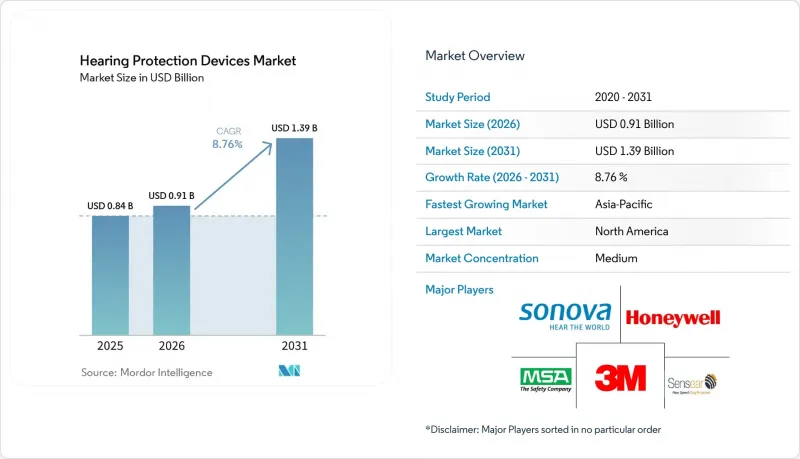
에 따르면 청력 보호 기기 시장 규모는 2025년에 8억 4,000만 달러로 평가되며, 2026년 9억 1,000만 달러에서 2031년까지 13억 9,000만 달러에 달할 것으로 예측되고 있으며, 예측 기간(2026-2031년)에 CAGR은 8.76%에 달할 전망입니다.
전 세계 청력 보호 기기 시장의 동향 및 인사이트
병원 및 임상 시설에서의 소음 노출 증가
병원내 소음 노출은 직장 안전상 우려 사항으로 그 중요성이 점점 더 커지고 있으며, 임상적 증거에 따르면 지속적인 소음 수준과 급격한 소음 피크가 나타나고 있습니다. 중환자실(ICU)의 소음 수준은 일반적으로 60-70 dB(A) 범위이지만, 인용된 코호트 연구에서는 피크 수준이 90 dB(A)를 초과했습니다. 이러한 수치는 치료실 및 회복실에 대해 세계보건기구(WHO)가 권장하는 35 dB(A)를 초과하는 수준입니다. 2026년에 한 대학 치과 병원에서 실시된 연구에서는 치과 종사자의 30.4%에게 청력 손실이 확인되어, 임상 현장에서의 소음 노출과 산업보건상의 결과 간의 연관성이 밝혀졌습니다. 그 결과, 병원에서는 청력 보호 장비를 단순한 선택적 비품이 아닌 직원의 위험 관리 요건으로 간주하는 경향이 강해질 가능성이 있습니다. 이는 지속적인 조달을 촉진하고, 소음 노출이 심한 환경에서의 청력 보호 장비 시장에 명확한 성장 기회를 가져다줄 것입니다. 병원 관리자들은 보호구 도입 결정을 청력 검사 결과, 직원 이직률, 그리고 예방 가능한 청각 장애와 관련된 운영 비용과 연계할 수 있기 때문입니다.
의료 종사자를 위한 직업성 청력 보호 프로그램
OSHA(미국 직업안전보건청)는 의료 종사자를 포함한 일반 산업 분야의 고용주에게, 근로자가 8시간 시간 가중 평균 85 dBA 이상의 소음에 노출될 경우 청각 보호 프로그램을 시행할 것을 의무화하고 있습니다. 이 프로그램에는 소음 모니터링, 연 1회 청력 검사, 그리고 개인용 보호구 제공이 포함됩니다. 2025년 1월, NIOSH는 지침을 갱신하여 각 근로자가 실제로 받고 있는 보호 수준을 측정하기 위해 개별적인 정량적 착용 적합성 테스트(fit test) 실시를 권장했습니다. 이 지침에 따라 실제 착용 상태를 대신하여 제품 라벨에 기재된 소음 저감률에 대한 의존도가 낮아집니다. 의료 시설에서는 착용 적합성 테스트를 활용하여 밀폐성 결함을 파악하고, 개별 이용자의 요구 사항을 충족하는 제품을 선정할 수 있습니다. 이러한 접근 방식을 통해 범용 일회용 귀마개에서 해부학적으로 설계되고 착용 적합성을 검증할 수 있는 제품으로의 수요 전환이 기대됩니다. 또한 특히 다양한 귀 모양, 직무, 임상용 보호 장비의 조합에 걸쳐 적합성과 성능 입증이 요구되는 시설에서는 청력 보호 기기 시장에서 고부가가치 제품의 도입을 촉진하는 결과로 이어질 것입니다.
감염 관리 및 재처리 요건
재사용 가능한 제품은 산업 현장에 비해 임상 현장에서 감염 관리상의 부담이 커질 가능성이 있습니다. 맞춤형 성형품이나 다중 부품으로 구성된 제품은 사용자나 교대 근무가 바뀔 때마다 소독이 필요하지만, 화학 물질에 대한 반복적인 노출은 특정 엘라스토머 소재에 영향을 미칠 수 있습니다. 조인트 커미션(Joint Commission)의 개정된 감염 예방 지침에서는 재사용 가능한 개인 보호 장비(PPE)에 관한 서면 정책과 제조업체의 지침에 따른 문서화된 세척 절차가 요구됩니다. 소규모 임상 시설의 경우, 반복적인 재처리 타당성을 검증하고 관리할 자원이 부족한 경우가 있으며, 그 결과 고품질의 재사용 가능한 제품이 수명이 더 길음에도 불구하고 일회용 제품을 선호하는 경향이 있습니다. 이러한 구매 행태의 차이로 인해 청력 보호 기기 시장의 일부 공급업체는 고객사당 수익 성장이 제한될 가능성이 있습니다. 확립된 재처리 프로토콜을 갖춘 의료 시스템은 재사용 가능한 제품의 장기적인 가치를 누릴 수 있지만, 소규모 시설에서는 더 단순한 일회용 제품을 선택하는 경향이 있습니다.
부문 분석
2025년 기준, 제품별 청력 보호 기기 시장에서 귀마개는 42.6%를 차지하며 주요 제품 부문로 자리 잡고 있습니다. 일회용 폼 및 성형 귀마개는 방사선과, 치과, 외래 수술 센터 등 환자 수용 수가 많고 처리량이 많은 환경에서 널리 사용되고 있습니다. 또한 이러한 제품은 재처리 능력이 제한된 시설에서 일회용 사용을 전제로 한 감염 관리 프로토콜에도 부합합니다. 구매 담당자에게 친숙할 뿐만 아니라 대규모 시설 전체에 광범위하게 배포할 수 있다는 점도 수요를 더욱 촉진하고 있습니다. 이어머프는 소음 수준이 높은 운송 현장이나 영상 진단 현장에서 여전히 중요한 역할을 하고 있습니다. 그러나 그 대형 디자인은 작업자가 마스크, 보호 안경 또는 통신용 헤드셋을 동시에 착용할 경우 불편함을 유발할 수 있습니다. 균일 감쇠형 귀마개는 임상의가 환자나 동료와 효과적으로 소통해야 하는 보다 소규모의 프리미엄 부문에 대응하고 있습니다. 치과나 청각학 진료 현장에서는 소통이 치료에 필수적이기 때문에 이러한 제품에 대한 수요가 더욱 높아지고 있습니다. 2025년에 개발된 다이내믹형 귀마개 프로토타입은 고주파 대역의 감쇠와 음성 주파수 대역의 증폭을 결합한 제품 개발이 가능함을 입증했습니다. 이 기능을 통해 모든 임상 현장에 획일적인 제품을 제공하는 대신, 전문성이 높은 제품 포지셔닝이 가능해집니다.
청각 밴드 및 외이도 캡은 2026-2031년까지 연평균 성장률(CAGR) 10.5%로 성장할 것으로 예측되며, 이 제품 카테고리 내에서 가장 높은 성장률을 보이고 있습니다. 세미 인서트형 외이도 캡은 외이도 바깥쪽에 착용되므로 마스크나 청진기와의 간섭 가능성을 줄여줍니다. 이러한 설계는 시끄러운 방과 조용한 방을 자주 오가는 의료 종사자에게 유용하며, 짧은 시간 동안의 임상 업무 중 깊게 삽입하는 유형의 귀마개를 자주 착용하고 벗어야 하는 번거로움을 줄여줍니다. 개인 보호 장비(PPE)와의 호환성은 수술실이나 응급실에서 실용적인 이점이 됩니다. 이어머프는 소음 수준이 특정 소형 인이어형 제품의 실용적인 감쇠 범위를 초과하는 환경에서 여전히 가치를 제공합니다. 따라서 제품 선정은 소음 노출원, 노출 시간 및 노출 패턴에 따라 달라집니다. 공급업체가 소음 제어 요건과 임상 워크플로우 요구 사항을 모두 충족하는 형태의 제품을 제공함으로써 청력 보호 기기 시장은 혜택을 받게 됩니다. 또한 이 제품 범주는 저비용 일회용 제품과 재사용 가능한 전용 장비 간의 균형을 유지하고 있으며, 조달 담당자는 근무 시간, 예상 노출량, 세척 능력 및 진료 중 반복적인 의사소통의 필요성에 맞춰 제품을 선정할 수 있습니다. 이러한 균형은 의료 시설마다 다른 예산과 감염 관리 절차를 반영한 것입니다.
2025년, 수동형 보호구는 보호 기술 부문의 68.5%를 차지했습니다. 이러한 선도적 지위는 오랜 기간에 걸친 조달 실적, 익숙한 가격 체계, 그리고 일회용 제품의 높은 연간 판매량을 반영한 것입니다. 병원은 확립된 안전 및 공급 경로를 통해 수동형 귀마개나 귀덮개를 조달할 수 있습니다. 이러한 보호구는 명확한 의사소통이나 경보 인식이 그다지 중요하지 않은 환경에서 여전히 적합합니다. 또한 단가가 낮은 점도 시설 전반에 걸친 광범위한 보급을 지원하고 있습니다. 그러나 수동적인 소음 감소 효과로 인해 경보나 구두 지시, 기타 임상 신호를 인식하기 어려울 수 있습니다. 이러한 한계는 수술실, 중환자실 및 응급 상황에서 특히 중요합니다. 2025년 리뷰에서는 관련 경보음을 다른 소리와 구별하기 어렵다는 점에서 비롯된 ‘경보 피로’가 환자 안전상 우려 사항으로 지적되었습니다. 따라서 임상 거버넌스 팀은 청력 보호 기기를 선정할 때 경보 신호의 무결성을 고려할 수 있습니다. 이 요인으로 인해 수동형 제품의 중요성은 유지되지만, 긴급성이 높은 모든 업무 흐름에서의 적합성은 제한됩니다.
능동형 장치는 2031년까지 연평균 성장률(CAGR) 10.7%로 성장할 것으로 예측되며, 이는 청각 보호 기술 부문에서 가장 높은 성장률입니다. 이러한 제품은 유해한 소리를 선택적으로 감쇠시키면서도 특정 음성 주파수나 경보 신호를 들을 수 있게 해줍니다. 능동형 시스템은 청각 보호 장치 시장에서 수동형 제품보다 점유율은 낮지만, 그 임상적 중요성은 확대되고 있습니다. 2026년에 예정된 외과적 연구에서는 스마트 청각 보호 장치를 사용했을 때, 수동적인 차음 환경에 비해 보고되는 작업 부하가 낮다는 사실이 밝혀질 전망입니다. 능동형 시스템은 단일 구매 결정을 통해 환자 안전, 근로자 안전 및 의사소통 목표를 지원할 수 있습니다. 2026년 7월에 예정된 FDA 조치에 따라 21 CFR 880.5405에 기반하여 신생아 인큐베이터용 능동형 소음 저감 시스템에 대해 클래스 II 분류가 확립될 전망입니다. 이 분류를 통해 신생아 치료 분야에서 환자 수준의 소음 관리를 위한 규제적 기반이 마련될 것입니다. 또한 이는 직원 중심의 청각 보호를 넘어선 전문적인 기술 분야를 명확히 하는 것이기도 합니다. 따라서 임상적 목적에는 환자 안전, 의사소통의 질, 적절한 경보 인식을 유지하면서 작업자를 보호하는 것이 포함될 수 있으므로, 이 기술 범주는 단순한 소음 감쇠가 아닌, 제어된 음성이 필요한 임상 응용을 통해 그 가치를 높일 가능성이 높다고 볼 수 있습니다.
지역별 분석
북미는 2025년에 전 세계 매출의 43.5%를 차지할 것으로 예측되며, 청력 보호 기기 시장에서 가장 큰 지역 점유율을 차지할 전망입니다. OSHA의 요건은 소음 노출 기준치를 충족하는 의료 종사자에 대한 수요를 지원하고 있으며, NIOSH의 2025년 지침에서는 개인별 정량적 착용 적합성 테스트가 권장될 전망입니다. 미국은 영상 진단, 외과수술, 응급의료 인프라를 통해 지역 수요의 상당 부분을 주도하고 있습니다. 캐나다에서는 유사한 산업위생 관행에 대한 조화가 진행되고 있으며, 멕시코에서는 사립 병원의 확장을 통해 수요에 기여하고 있습니다. 2026년 1월에 예정된 병원 종사자를 대상으로 한 조사에서는 OSHA의 ‘역치 이동’ 기준에 따른 청력 손실 유병률이 9%인 반면, ISO 7029:2017 기준에 따른 경우에는 46%에 달하는 것으로 보고될 전망입니다.
공급 분석에 따르면 유럽은 독일, 영국, 프랑스를 필두로 지역 시장에서 2위 규모를 차지하고 있습니다. EU 지침 2003/10/EC는 소음 노출 위험의 체계적인 관리를 의무화하고 있으며, 개인용 보호구(PPE) 선정에 앞서 위험 평가를 수행하는 것을 중시하고 있습니다. 이러한 요건들은 첨단 의료 시스템 전반에 걸쳐 모니터링, 청력 검사, 착용 적합성 테스트 및 청력 보호 장비에 대한 수요를 지원하고 있습니다. 영국의 국민보건서비스(NHS)는 주요 기관 구매자 역할을 수행하고 있는 반면, 스페인과 이탈리아에서는 의료 시설의 개보수가 수요를 지탱하고 있습니다.
아시아태평양은 2031년까지 연평균 성장률(CAGR) 9.6%로 성장할 것으로 예측되며, 본 예측 대상 지역 중 가장 높은 성장률을 보이고 있습니다. 중국과 인도는 의료 체계 및 의료기기에 대한 투자를 통해 수요 증가분의 상당 부분을 차지하고 있습니다. 자료에 따르면 중국에는 38,710개의 병원과 104만 곳 이상의 외래 진료소 및 1차 의료 시설이 있습니다. 일본과 한국은 성숙한 의료 기준에 힘입어 수요를 유지하고 있는 반면, 호주와 동남아시아는 성장하는 시장으로 부상하고 있습니다. 중동 및 아프리카 및 남미는 여전히 소규모 시장이지만, 그 성장은 의료 투자 및 산업보건 인프라 구축과 밀접한 관련이 있습니다.
기타 혜택:
- 엑셀 형식의 시장 예측(ME) 시트
- 3개월간의 애널리스트 지원
자주 묻는 질문
목차
제1장 서론
- 조사 전제조건과 시장 정의
- 조사 범위
제2장 조사 방법
제3장 개요
제4장 시장 구도
- 시장 개요
- 시장 성장 촉진요인
- 시장 성장 억제요인
- 공급망 분석
- 규제 상황
- 기술 전망
- Porter's Five Forces 분석
제5장 시장 규모와 성장 예측
- 제품별
- 보호 기술별
- 폼팩터별
- 용도별
- 유통 채널별
- 지역
제6장 경쟁 구도
- 시장 집중도
- 시장 점유율 분석
- 기업 개요
- 3M
- ACS Custom
- Alpine Hearing Protection B.V.
- Cotral Lab
- Delta Plus Group
- EAR Inc.
- Etymotic Research, Inc.
- Honeywell International Inc.
- Loop Earplugs
- MSA Safety Incorporated
- Moldex-Metric, Inc.
- PIP Global Safety
- Phonak Communications
- QuietOn Oy
- Radians, Inc.
- Sensear Pty Ltd.
- Sonova Holding AG
- Uvex group
제7장 시장 기회와 향후 전망
KSA 26.10.28According to Mordor Intelligence, the hearing protection devices market size was valued at USD 0.84 billion in 2025 and is estimated to grow from USD 0.91 billion in 2026 to reach USD 1.39 billion by 2031, at a CAGR of 8.76% during the forecast period (2026-2031).
Global Hearing Protection Devices Market Trends and Insights
Increasing Noise Exposure in Hospitals and Clinical Facilities
Noise exposure in hospitals is an increasingly important workplace safety concern, with clinical evidence indicating persistent sound levels and sharp noise peaks. Noise levels in intensive care units commonly range from 60 to 70 dB(A), while peak levels exceeded 90 dB(A) in the cited cohort study. These levels surpass the World Health Organization recommendation of 35 dB(A) for treatment and recovery rooms. A 2026 university dental hospital study found hearing loss among 30.4% of dental personnel, linking clinical noise exposure to an occupational health outcome. As a result, hospitals may increasingly position hearing protection as a workforce risk-management requirement rather than an optional supply item. This supports recurring procurement and creates a clear growth opportunity for the hearing protection devices market in high-exposure settings, as hospital managers can connect protective equipment decisions with audiometry outcomes, employee retention, and the operational costs associated with preventable hearing injuries.
Occupational Hearing-Conservation Programs for Healthcare Workers
OSHA requires general industry employers, including healthcare providers, to implement a hearing conservation program when workers are exposed to an 8-hour time-weighted average of 85 dBA or higher. The program includes noise monitoring, annual audiometry, and the provision of personal protective equipment. In January 2025, NIOSH updated its guidance and recommended individual quantitative fit testing to measure the level of protection each worker actually receives. This guidance reduces reliance on the labeled noise reduction rating as a substitute for real-world fit. Healthcare facilities can use fit testing to identify inadequate seals and select devices that meet individual user requirements. This approach can shift demand from generic disposable earplugs toward anatomically designed and testable products. It also strengthens the compliance case for higher-value formats in the hearing protection devices market, particularly among facilities that require documented fit and performance across different ear shapes, job roles, and combinations of clinical protective equipment.
Infection-Control and Reprocessing Requirements
Reusable products can place a greater infection-control burden on clinical settings than on industrial workplaces. Custom-molded and multi-component devices require disinfection between users or shifts, while repeated chemical exposure can affect certain elastomeric materials. The Joint Commission's revised infection-prevention materials require written policies for reusable personal protective equipment (PPE) and documented cleaning procedures that follow manufacturers' instructions. Smaller clinical facilities may lack the resources to validate and manage repeated reprocessing, leading them to prefer disposable products despite the longer service life of premium reusable formats. This variation in purchasing behavior can limit revenue growth per account for some suppliers in the hearing protection devices market. Health systems with established reprocessing protocols can capture the long-term value of reusable products, while smaller facilities often opt for simpler single-use alternatives.
Other drivers and restraints analyzed in the detailed report include:
- Expansion of Diagnostic Imaging, Dental, and Surgical Infrastructure
- Demand for Communication-Preserving Protection in Clinical Workflows
- Compatibility Constraints with Stethoscopes, Masks, Headsets, and Other PPE
For complete list of drivers and restraints, kindly check the Table Of Contents.
Segment Analysis
Earplugs accounted for 42.6% of the hearing protection devices market by product in 2025, making them the leading product segment. Disposable foam and pre-molded earplugs are widely used in high-throughput settings, including radiology suites, dental clinics, and ambulatory surgery centers. These formats also support single-use infection-control protocols in facilities with limited reprocessing capacity. Their familiarity among purchasing teams and ability to be distributed at scale across large facilities further support demand. Earmuffs remain relevant in transport and imaging settings with high noise levels. However, their larger design can create discomfort when workers also wear masks, eyewear, or communication headsets. Uniform-attenuation earplugs serve a smaller premium segment where clinicians must communicate effectively with patients and colleagues. Dental and audiology practices have a stronger need for these products because communication is integral to treatment. A dynamic-earplug prototype in 2025 demonstrated that product development can combine high-frequency attenuation with amplification at speech frequencies. This capability supports specialized product positioning rather than a standardized offering across all clinical sites.
Hearing bands and canal caps are forecast to grow at a CAGR of 10.5% from 2026 to 2031, representing the fastest growth rate within the product category. Semi-insert canal caps sit outside the ear canal, reducing potential interference with masks and stethoscopes. This design benefits workers who frequently move between noisy and quiet rooms and reduces the need to insert and remove deeply fitted earplugs during short clinical tasks. Their compatibility with PPE configurations provides a practical advantage in operating rooms and emergency departments. Earmuffs continue to provide value in environments where noise levels exceed the practical attenuation range of certain small in-ear products. Product selection therefore depends on the source, duration, and pattern of sound exposure. The hearing protection devices market benefits when suppliers offer formats that address both noise-control requirements and clinical workflow needs. The product category also maintains a balance between low-cost disposable products and reusable specialty devices, enabling purchasing teams to align product selection with shift duration, expected exposure, cleaning capabilities, and the need for repeated communication during care delivery. This balance reflects the varied budgets and infection-control processes across healthcare facilities.
Passive devices accounted for 68.5% of the protection technology segment in 2025. Their leadership reflects a long procurement history, familiar pricing structures, and high annual volumes of disposable units. Hospitals can procure passive earplugs and earmuffs through established safety and supply channels. These devices remain suitable in settings where clear communication and alarm recognition are less critical. Their low unit cost also supports broad distribution across facilities. However, passive attenuation can make alarms, spoken instructions, and other clinical signals more difficult to recognize. This limitation is particularly important in operating rooms, intensive care units, and emergency environments. A review in 2025 identified alarm fatigue as a patient-safety concern shaped by the difficulty of distinguishing relevant alarms from other sounds. Clinical governance teams can therefore consider alarm-signal integrity when selecting hearing protection. This factor sustains the importance of passive products while limiting their suitability across all high-acuity workflows.
Active devices are projected to grow at a CAGR of 10.7% through 2031, the fastest rate in the protection technology category. These products selectively attenuate harmful sounds while allowing selected speech frequencies and alarm cues to remain audible. Active systems represent a smaller share of the hearing protection devices market than passive formats, but their clinical relevance is expanding. A surgical study anticipated in 2026 links smart hearing protection with lower reported workload than passive sound-dampening conditions. Active systems can support patient safety, worker safety, and communication objectives within a single purchasing decision. FDA action anticipated in July 2026 is expected to establish a Class II classification for active noise attenuation systems for infant incubators under 21 CFR 880.5405. This classification would create a regulatory pathway for patient-level noise management in neonatal care. It also identifies a specialized technology area beyond staff-centered hearing protection. The technology category is therefore likely to gain value through clinical applications that require controlled sound rather than simple attenuation, as clinical objectives may include protecting workers while preserving patient safety, communication quality, and appropriate alarm awareness.
Complete Report Scope:
- By Product
- Earplugs
- Earmuffs
- Hearing Bands and Canal Caps
- Uniform-Attenuation Earplugs
- By Protection Technology
- Passive Hearing Protection Devices
- Active Hearing Protection Devices
- By Form Factor
- In-Ear Devices
- Over-Ear Devices
- Helmet-Integrated Devices
- Neckband and Banded Devices
- Custom Otoplastic Devices
- By Application
- Diagnostic Imaging and Radiology Equipment Areas
- Operating Rooms and Surgical Suites
- Emergency Departments and Trauma Centers
- Ambulance and Patient Transport Services
- Other Applications
- By Distribution Channel
- Group Purchasing Organizations
- Hospital and Health-System Direct Procurement
- Medical Supply Distributors
- Occupational Health and Safety Providers
- Retail Pharmacies and Medical Retail
- E-Commerce and Brand-Owned Online Channels
- Geography
- North America
- United States
- Canada
- Mexico
- Europe
- Germany
- United Kingdom
- France
- Italy
- Spain
- Rest of Europe
- Asia-Pacific
- China
- Japan
- India
- Australia
- South Korea
- Rest of Asia-Pacific
- Middle East and Africa
- GCC
- South Africa
- Rest of Middle East and Africa
- South America
- Brazil
- Argentina
- Rest of South America
- North America
Geography Analysis
North America is projected to account for 43.5% of global revenue in 2025, representing the leading regional share of the hearing protection devices market. OSHA requirements support demand among healthcare workers who meet noise-exposure thresholds, while NIOSH's 2025 guidance is expected to recommend individual quantitative fit testing. The United States drives a significant share of regional demand through its imaging, surgical, and emergency care infrastructure. Canada is increasingly aligning with comparable occupational health practices, while Mexico contributes to demand through the expansion of private hospitals. A hospital-worker study scheduled for January 2026 is expected to report hearing-loss prevalence ranging from 9% under OSHA Standard Threshold Shift criteria to 46% under ISO 7029:2017 criteria.
Europe represents the second-largest regional market in the supply analysis, led by Germany, the United Kingdom, and France. EU Directive 2003/10/EC requires structured management of noise-exposure risks and emphasizes risk assessment before selecting personal protective equipment (PPE). These requirements support demand for monitoring, audiometry, fit testing, and hearing protection devices across developed healthcare systems. The United Kingdom's National Health Service serves as a major institutional buyer, while clinical facility upgrades support demand in Spain and Italy.
Asia-Pacific is projected to grow at a CAGR of 9.6% through 2031, the highest regional growth rate in the supplied forecast. China and India generate a substantial share of incremental demand through investments in healthcare capacity and equipment. According to the source material, China had 38,710 hospitals and more than 1.04 million outpatient and primary care centers. Japan and South Korea sustain demand through mature healthcare standards, while Australia and Southeast Asia represent expanding markets. The Middle East and Africa and South America remain smaller markets, with growth linked to healthcare investment and the development of occupational health infrastructure.
- 3M
- ACS Custom
- Alpine Hearing Protection B.V.
- Cotral Lab
- Delta Plus Group
- EAR Inc.
- Etymotic Research, Inc.
- Honeywell International
- Loop Earplugs
- MSA Safety Incorporated
- Moldex-Metric, Inc.
- PIP Global Safety
- Phonak Communications
- QuietOn Oy
- Radians, Inc.
- Sensear Pty Ltd.
- Sonova
- Uvex group
Additional Benefits:
- The market estimate (ME) sheet in Excel format
- 3 months of analyst support
TABLE OF CONTENTS
1 Introduction
- 1.1 Study Assumptions & Market Definition
- 1.2 Scope Of The Study
2 Research Methodology
3 Executive Summary
4 Market Landscape
- 4.1 Market Overview
- 4.2 Market Drivers
- 4.2.1 Increasing Noise Exposure in Hospitals and Clinical Facilities
- 4.2.2 Occupational Hearing-Conservation Programs for Healthcare Workers
- 4.2.3 Expansion of Diagnostic Imaging, Dental and Surgical Infrastructure
- 4.2.4 Demand for Communication-Preserving Protection in Clinical Workflows
- 4.2.5 Growth of Customized and Reusable Protection for Long Shifts
- 4.2.6 Noise-Control Requirements in Neonatal and Critical-Care Environments
- 4.3 Market Restraints
- 4.3.1 Infection-Control and Reprocessing Requirements
- 4.3.2 Compatibility Constraints with Stethoscopes, Masks, Headsets and Other PPE
- 4.3.3 Limited Healthcare-Specific Procurement Standards and Awareness
- 4.3.4 Risk of Masking Clinical Alarms and Patient Speech
- 4.4 Supply-Chain Analysis
- 4.5 Regulatory Landscape
- 4.6 Technological Outlook
- 4.7 Porter's Five Forces Analysis
- 4.7.1 Threat Of New Entrants
- 4.7.2 Bargaining Power Of Buyers
- 4.7.3 Bargaining Power Of Suppliers
- 4.7.4 Threat Of Substitutes
- 4.7.5 Competitive Rivalry
5 Market Size & Growth Forecasts (Value, USD)
- 5.1 By Product
- 5.1.1 Earplugs
- 5.1.2 Earmuffs
- 5.1.3 Hearing Bands and Canal Caps
- 5.1.4 Uniform-Attenuation Earplugs
- 5.2 By Protection Technology
- 5.2.1 Passive Hearing Protection Devices
- 5.2.2 Active Hearing Protection Devices
- 5.3 By Form Factor
- 5.3.1 In-Ear Devices
- 5.3.2 Over-Ear Devices
- 5.3.3 Helmet-Integrated Devices
- 5.3.4 Neckband and Banded Devices
- 5.3.5 Custom Otoplastic Devices
- 5.4 By Application
- 5.4.1 Diagnostic Imaging and Radiology Equipment Areas
- 5.4.2 Operating Rooms and Surgical Suites
- 5.4.3 Emergency Departments and Trauma Centers
- 5.4.4 Ambulance and Patient Transport Services
- 5.4.5 Other Applications
- 5.5 By Distribution Channel
- 5.5.1 Group Purchasing Organizations
- 5.5.2 Hospital and Health-System Direct Procurement
- 5.5.3 Medical Supply Distributors
- 5.5.4 Occupational Health and Safety Providers
- 5.5.5 Retail Pharmacies and Medical Retail
- 5.5.6 E-Commerce and Brand-Owned Online Channels
- 5.6 Geography
- 5.6.1 North America
- 5.6.1.1 United States
- 5.6.1.2 Canada
- 5.6.1.3 Mexico
- 5.6.2 Europe
- 5.6.2.1 Germany
- 5.6.2.2 United Kingdom
- 5.6.2.3 France
- 5.6.2.4 Italy
- 5.6.2.5 Spain
- 5.6.2.6 Rest of Europe
- 5.6.3 Asia-Pacific
- 5.6.3.1 China
- 5.6.3.2 Japan
- 5.6.3.3 India
- 5.6.3.4 Australia
- 5.6.3.5 South Korea
- 5.6.3.6 Rest of Asia-Pacific
- 5.6.4 Middle East and Africa
- 5.6.4.1 GCC
- 5.6.4.2 South Africa
- 5.6.4.3 Rest of Middle East and Africa
- 5.6.5 South America
- 5.6.5.1 Brazil
- 5.6.5.2 Argentina
- 5.6.5.3 Rest of South America
- 5.6.1 North America
6 Competitive Landscape
- 6.1 Market Concentration
- 6.2 Market Share Analysis
- 6.3 Company Profiles {(Includes Global Level Overview, Market Level Overview, Core Segments, Financials As Available, Strategic Information, Market Rank/Share For Key Companies, Products & Services, And Recent Developments)}
- 6.3.1 3M
- 6.3.2 ACS Custom
- 6.3.3 Alpine Hearing Protection B.V.
- 6.3.4 Cotral Lab
- 6.3.5 Delta Plus Group
- 6.3.6 EAR Inc.
- 6.3.7 Etymotic Research, Inc.
- 6.3.8 Honeywell International Inc.
- 6.3.9 Loop Earplugs
- 6.3.10 MSA Safety Incorporated
- 6.3.11 Moldex-Metric, Inc.
- 6.3.12 PIP Global Safety
- 6.3.13 Phonak Communications
- 6.3.14 QuietOn Oy
- 6.3.15 Radians, Inc.
- 6.3.16 Sensear Pty Ltd.
- 6.3.17 Sonova Holding AG
- 6.3.18 Uvex group
7 Market Opportunities & Future Outlook
- 7.1 White-Space & Unmet-Need Assessment


