

|
시장보고서
상품코드
2155544
배터리 첨가제 : 시장 점유율 분석, 업계 동향과 통계, 성장 예측(2026-2031년)Battery Additives - Market Share Analysis, Industry Trends & Statistics, Growth Forecasts (2026 - 2031) |
||||||
 Mordor Intelligence
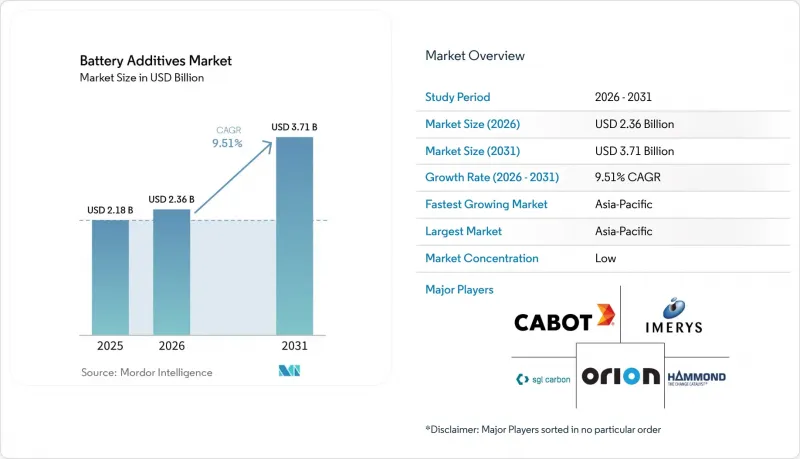
에 의하면, 배터리 첨가제 시장 규모는 2025년 21억 8,000만 달러, 2026년 23억 6,000만 달러에서 2031년까지 37억 1,000만 달러에 달할 것으로 예측되며, 2026-2031년 연평균 복합 성장률(CAGR)은 9.51%를 기록할 전망입니다.
세계 배터리 첨가제 시장 동향 및 인사이트
전기차용 배터리 생산 확대
각 생산 라인에서는 재현성 있는 원료 투입이 요구되므로, 셀 수준의 생산량 증가는 배터리 첨가제 시장 수요를 견인하는 핵심 요인으로 자리 잡고 있습니다. LG 에너지솔루션은 2026년 8월 미시간주 랜싱에 위치한 시설에서 생산을 시작했습니다. 이 시설은 LFP(인산철리튬) 에너지 저장용 및 NMC(니켈-망간-코발트) 전기차용 용도를 위해 연간 35GWh 이상의 셀 생산 능력을 목표로 하고 있습니다. LG 에너지솔루션은 2026년 말까지 북미 전역에서 50GWh를 초과하는 LFP 셀 생산 능력을 확보할 계획입니다. 생산 능력이 1기가와트시 증가할 때마다 셀 제조에 전도성 소재, 다공성 소재, 핵형성 소재가 필요합니다. LFP와 NMC의 생산이 병행하여 확대됨에 따라, 수요가 특정 화학 조성에 집중되기보다는 배합에 대한 요구가 광범위하게 확산될 것입니다.
그리드 규모의 에너지 저장 도입
고정형 에너지 저장 시스템은 자동차 생산 이외의 분야에서 대량의 배터리를 사용하기 때문에 배터리 첨가제 시장의 추가 수요를 창출하는 주요 원천이 되고 있습니다. 국제에너지기구(IEA) 보고서에 따르면, 2025년에는 108GW 규모의 에너지 저장 설비가 신설되었습니다. 미국 에너지 정보국(EIA)의 추적 조사에 따르면, 2026년에 미국에서 계획된 유틸리티 규모의 배터리 설비 증설량은 24GW로, 2025년의 15GW를 상회합니다. 그리드 규모 시스템에서는 주로 LFP 셀이 사용되며, 그 첨가제 요구 사항은 자동차용 NMC 셀과는 다릅니다. 따라서 에너지 저장 시장의 성장에 따라 배터리 제조업체가 필요로 하는 첨가제 패키지의 범위도 확대되고 있습니다. 이러한 수요는 긴 사이클 수명, 안정적인 전극 가공, 그리고 유틸리티 규모에서 신뢰할 수 있는 작동을 실현하도록 설계된 소재를 뒷받침하고 있습니다.
높은 인증 비용과 긴 셀 검증 주기
검증 주기가 길기 때문에 신소재가 배터리 첨가제 시장에 진입하는 속도는 제한됩니다. 공급업체는 고객별로 성능, 안전성, 가공성 및 문서화에 관한 증거를 제시해야 합니다. 사양은 화학 조성, 셀 형식, 제조 방식에 따라 다르기 때문에 이 과정을 셀 제조업체 간에 쉽게 적용할 수 없습니다. 전기화학학회(Electrochemical Society)의 2026년 회의에서 발표된 조사에 따르면, 수년에 걸쳐 진행되는 인증 프로그램의 비용이 미국에서 부상하고 있는 셀 제조업체가 확보할 수 있는 자금을 초과할 가능성이 있다고 설명되었습니다. UN 38.3 운송 시험 및 IEC 62133 요건으로 인해, 여러 지역에 공급하는 공급업체에게는 추가적인 시험 절차가 부과됩니다. 확립된 배합은 그 검증 기록을 통해 재주문이나 신규 고객 프로그램에 필요한 작업 부담을 줄여주므로 유리하게 작용합니다.
부문 분석
2025년 기준, 전도성 첨가제는 배터리용 첨가제 시장 점유율의 36.78%를 차지하고 있으며, 2031년까지 연평균 성장률(CAGR) 10.34%를 나타낼 것으로 예측됩니다. 카본블랙, 탄소나노튜브, 그래핀 및 하이브리드 분산액이 주요 제품군을 형성하고 있습니다. 이러한 소재들은 전극의 작동을 뒷받침하는 전도 경로를 형성합니다. 전극 엔지니어들은 활물질 밀도를 유지하면서 첨가량을 줄인 형태로 전환하고 있습니다. 이러한 변화는 더 빠른 충전 속도와 더 긴 사이클 수명을 요구하는 설계에 있어 중요합니다. 배터리 첨가제 업계에서는 점점 더 까다로워지는 전극 설계에서 전자 수송을 유지하기 위해 전도성 소재가 사용되고 있습니다. 빌라 카본(Bilra Carbon)은 Interbattery 2025에서 전고체 배터리 및 리튬-바나듐 산화물 배터리 등 차세대 화학계 배터리를 위한 배터리용 카본블랙 ‘Conductex i10’을 발표했습니다. 이번 발표는 범용 카본 소재에서 화학 계열에 특화된 제품으로의 전환을 보여줍니다.
다공성 첨가제는 유형별 부문에서 2위 시장 점유율을 차지하고 있습니다. 그 비표면적과 이온 수송 특성은 고에너지 밀도 전극 설계에 적합합니다. 핵생성 첨가제는 전극 활물질의 결정화를 제어해야 하는 보다 전문적인 배합에 사용됩니다. 이러한 소재는 반복적인 충방전 사이클에서 구조적 열화를 억제하는 데 도움이 됩니다. 그 밖의 형태로는 시스템 수준의 최적화를 지원하는 신흥 프리리티에이션 첨가제 등이 있습니다. 또한, 배터리용 첨가제 업계는 PVDF 바인더 및 불소계 공용매를 대체할 불소 무함유 대체제에 대한 관심에도 부응하고 있습니다. 이러한 변화로 인해 대체 배합이 더 광범위하게 사용되게 되면, 유형별 카테고리 간의 가치 분포가 변화할 가능성이 있습니다. 제품 공급업체는 전기화학적 성능, 가공 신뢰성, 그리고 고객의 셀 설계와의 적합성 사이에서 균형을 맞추어야 합니다. 이러한 균형은 리튬 이온 배터리, 납축 전지, 그리고 신흥 배터리용도에 따라 달라집니다.
지역별 분석
아시아태평양은 2025년에 전 세계 매출의 46.06%를 차지할 것으로 예상되며, 2031년까지 연평균 성장률(CAGR) 10.73%로 성장할 것으로 전망됩니다. 이러한 위상은 중국, 한국, 일본의 확립된 셀 제조 체계와 성숙한 배터리 재료 공급 기반을 반영한 것입니다. 중국의 배터리 재료 수출 규제는 2025년 11월 8일에 발효되었습니다. 이 규제로 인해 신뢰할 수 있는 적격 원자재의 안정적인 공급이 필요한 중국 외 구매자들 사이에서 공급 다각화에 대한 관심이 높아졌습니다. 또한, 국내 공급업체들이 통합된 소재 공급망을 강화하고 핵심 부품을 확보하도록 촉진하는 결과로 이어졌습니다. 배터리 첨가제 시장은 해당 지역의 탄탄한 리튬 이온 배터리 생산 기반, 확립된 배터리 재료 생태계, 그리고 다양한 배터리 화학 계열에 대응할 수 있는 능력과 여전히 밀접하게 연결되어 있습니다.
북미에서는 국내 셀 제조가 정책적 우선순위로 부상함에 따라 시장이 확대되고 있습니다. 미국에서는 2026년에 24GW 규모의 유틸리티급 에너지 저장 설비 증설이 계획되어 있으며, 이것이 LFP 관련 소재 수요를 뒷받침하고 있습니다. LG 에너지솔루션은 2026년 말까지 북미의 LFP 셀 생산 능력이 50GWh를 넘어설 것으로 전망하고 있습니다. 이 지역의 배터리 첨가제 시장 규모는 에너지 저장 설비 및 전기차용 셀 공장 확장에 따른 현지 인증 요건에 힘입어 성장하고 있습니다. 공급업체는 소재의 일관성, 기술 지원, 생산 체계 구축 등 고객의 요구 사항을 충족해야 합니다. 또한 유럽에서는 공급업체의 문서 작성에 영향을 미치는 배터리 탄소 발자국 공개 요건으로 인해 조달 체계가 재편되고 있습니다. 독일이 발표한 셀 생산 능력은 이 나라를 인증을 받은 지역 공급에 대한 중요한 잠재적 수요의 중심지로 만들고 있습니다.
남미, 중동 및 아프리카는 첨단 첨가제 수요 측면에서 여전히 초기 단계에 있는 지역입니다. 브라질과 아르헨티나에서는 자동차용 납축전지 생산과 리튬 이온 배터리애플리케이션 개발이 진행되고 있습니다. 아르헨티나의 리튬 자원은 계속해서 업스트림 부문 투자의 주목을 받고 있지만, 하류 부문의 첨가제 수요는 주요 배터리 생산 지역에 비해 여전히 제한적입니다. 사우디아라비아의 재생에너지 및 전력 저장 계획은 현지 배터리·모듈 조립이 발전함에 따라 수요를 끌어올릴 가능성이 있습니다. 남아프리카공화국에서는 전력망의 불안정성으로 인해 전력 회사용 및 상업용 배터리 저장 시설에 대한 투자가 촉진되고 있습니다. 두 지역 모두 아시아태평양 및 유럽 공급업체로부터의 첨단 소재 수입에 여전히 크게 의존하고 있습니다. 납산 배터리용 배합을 제외한 현지 첨가제 생산은 더 광범위한 배터리 제조에 대한 투자, 공급업체 인증, 그리고 국내 배터리 공장 수요에 달려 있습니다.
기타 혜택:
- 엑셀 형식 시장 예측(ME) 시트
- 3개월간의 애널리스트 지원
자주 묻는 질문
목차
제1장 서론
- 조사의 전제조건과 시장의 정의
- 조사 범위
제2장 조사 방법
제3장 주요 요약
제4장 시장 구도
- 시장 개요
- 시장 성장 촉진요인
- 시장 성장 억제요인
- 밸류체인 분석
- Porter의 Five Forces 분석
제5장 시장 규모와 성장 예측
- 유형별
- 용도별
- 지역별
- 아시아태평양
- 중국
- 인도
- 일본
- 한국
- 기타 아시아태평양 국가
- 북미
- 미국
- 캐나다
- 멕시코
- 유럽
- 독일
- 영국
- 프랑스
- 이탈리아
- 기타 유럽 국가
- 남미
- 브라질
- 아르헨티나
- 기타 남미 국가
- 중동 및 아프리카
- 사우디아라비아
- 남아프리카공화국
- 기타 중동 및 아프리카 국가
- 아시아태평양
제6장 경쟁 구도
- 시장 집중도
- 전략적 동향
- 시장 점유율(%)**/순위 분석
- 기업 개요
- 3M
- ALTANA AG
- Arkema S.A.
- Ascend Performance Materials
- BASF
- Birla Carbon
- Borregaard AS
- Cabot Corporation
- Guangzhou Tinci Materials Technology Co., Ltd.
- Hammond Group, Inc.
- Imerys
- Orion S.A.
- PENOX GmbH
- SGL Carbon
- Shenzhen Capchem Technology Co., Ltd.
- Taiwan Hopax Chemicals Mfg. Co., Ltd.
제7장 시장 기회와 향후 전망
LSH 26.10.29According to Mordor Intelligence, the battery additives market size is projected to expand from USD 2.18 billion in 2025 and USD 2.36 billion in 2026 to USD 3.71 billion by 2031, at a CAGR of 9.51% between 2026 and 2031.
Global Battery Additives Market Trends and Insights
Electric Vehicle Battery Production Expansion
Cell-level volume growth remains a central demand driver for the battery additives market because each production line requires repeatable material inputs. LG Energy Solution began production at its Lansing, Michigan, facility in August 2026. The facility targets more than 35GWh of annual cell capacity for LFP energy-storage and NMC electric-vehicle applications. LG Energy Solution plans more than 50GWh of LFP cell-making capacity across North America by the end of 2026. Each additional gigawatt-hour of capacity requires conductive, porous, and nucleating materials during cell production. Parallel growth in LFP and NMC production broadens formulation needs instead of concentrating demand in one chemistry.
Grid-Scale Energy Storage Deployment
Stationary storage is a major source of additional demand for the battery additives market because it uses large volumes of cells outside vehicle production. The International Energy Agency reported 108GW of battery storage additions in 2025. The U.S. Energy Information Administration tracks 24GW of planned utility-scale battery storage additions in the United States during 2026, compared with 15GW in 2025. Grid-scale systems predominantly use LFP cells with additive requirements that differ from automotive NMC cells. Storage growth, therefore, expands the range of additive packages required by battery manufacturers. This demand supports materials designed for long cycle life, stable electrode processing, and reliable operation at utility scale.
High Qualification Costs and Long Cell-Validation Cycles
Long validation cycles limit the speed at which new materials enter the battery additives market. Suppliers must generate performance, safety, processing, and documentation evidence for each customer relationship. The process is not easily transferable between cell makers because specifications vary by chemistry, cell format, and manufacturing approach. Research presented at the Electrochemical Society's 2026 meeting described how multiyear qualification programs can exceed the capital available to emerging United States cell manufacturers. UN 38.3 transportation testing and IEC 62133 requirements add further testing steps for suppliers serving more than one region. Established formulations benefit because their validation record reduces the work required for repeat orders and new customer programs.
Other drivers and restraints analyzed in the detailed report include:
- Higher-Voltage and Longer-Life Cell Formulations
- Silicon-Rich Anodes and High-Nickel Cathodes
- Raw-Material Price Volatility and High-Purity Supply Constraints
For complete list of drivers and restraints, kindly check the Table Of Contents.
Segment Analysis
Conductive additives held 36.78% of the battery additives market share in 2025 and are forecast to grow at a 10.34% CAGR through 2031. Carbon black, carbon nanotubes, graphene, and hybrid dispersions form the main product groups. These materials create conductive pathways that support electrode operation. Electrode engineers are moving toward lower-loading formats that preserve active-material density. The shift is relevant for designs that require faster charging and longer cycle life. The battery additives industry uses conductive materials to maintain electron transport within increasingly demanding electrode designs. Birla Carbon introduced Conductex i10 battery-grade carbon black at Interbattery 2025 for next-generation chemistries, including solid-state and lithium-vanadium-oxide batteries. The launch illustrates the shift from general-purpose carbon materials toward chemistry-specific products.
Porous additives hold the second-largest position in the type segmentation. Their surface area and ion-transport characteristics suit high-energy-density electrode designs. Nucleating additives serve more specialized formulations that need controlled crystallization of electrode active materials. These materials can help limit structural degradation during repeated cycling. Other formats include emerging pre-lithiation additives that support system-level optimization. The battery additives industry is also responding to interest in fluorine-free alternatives to PVDF binders and fluorinated co-solvents. This shift could alter value distribution among type categories as alternative formulations reach larger-scale use. Product suppliers must balance electrochemical performance, processing reliability, and compatibility with the customer's cell design. The balance differs across lithium-ion, lead-acid, and emerging battery applications.
Complete Report Scope:
- By Type
- Conductive Additive
- Porous Additive
- Nucleating Additive
- Others
- By Application
- Lithium-Ion Batteries
- Lead-Acid Batteries
- Others
- By Geography
- Asia-Pacific
- China
- India
- Japan
- South Korea
- Rest of Asia-Pacific
- North America
- United States
- Canada
- Mexico
- Europe
- Germany
- United Kingdom
- France
- Italy
- Rest of Europe
- South America
- Brazil
- Argentina
- Rest of South America
- Middle East and Africa
- Saudi Arabia
- South Africa
- Rest of Middle East and Africa
- Asia-Pacific
Geography Analysis
Asia-Pacific accounted for 46.06% of global revenue in 2025 and is forecast to grow at a 10.73% CAGR through 2031. This position reflects established cell manufacturing in China, South Korea, and Japan, alongside a mature battery-material supply base. China's export controls on battery materials took effect on November 8, 2025. The controls increased the focus on supply diversification among non-Chinese buyers who require dependable access to qualified inputs. They also encouraged domestic suppliers to strengthen integrated material supply chains and secure critical components. The battery additives market remains closely linked to the region's depth in lithium-ion production, established battery-material ecosystem, and ability to support several cell chemistries.
North America is expanding as domestic cell manufacturing becomes a policy priority. The United States has 24GW of planned utility-scale storage additions in 2026, supporting LFP-related material demand. LG Energy Solution expects its North American LFP cell-making capacity to exceed 50GWh by the end of 2026. The battery additives market size in the region is supported by local qualification needs as storage and electric vehicle cell plants expand. Suppliers must meet customer requirements for material consistency, technical support, and production readiness. Europe is also reshaping sourcing through battery carbon-footprint disclosure requirements that affect supplier documentation. Germany's announced cell capacity makes the country an important potential center of demand for qualified regional supply.
South America and the Middle East and Africa remain earlier-stage areas for advanced additive demand. Brazil and Argentina support automotive lead-acid production and developing lithium-ion applications. Argentina's lithium resources continue to attract upstream investment attention, although downstream additive demand remains more limited than in major cell-producing regions. Saudi Arabia's renewable energy and storage plans can add demand as local cell and module assembly develops. South Africa's grid instability supports investment in utility and commercial battery storage. Both regions continue to depend largely on imported advanced materials from Asia-Pacific and European suppliers. Local additive production beyond lead-acid formulations depends on broader cell-manufacturing investment, supplier qualification, and demand from domestic battery plants.
- 3M
- ALTANA AG
- Arkema S.A.
- Ascend Performance Materials
- BASF
- Birla Carbon
- Borregaard AS
- Cabot Corporation
- Guangzhou Tinci Materials Technology Co., Ltd.
- Hammond Group, Inc.
- Imerys
- Orion S.A.
- PENOX GmbH
- SGL Carbon
- Shenzhen Capchem Technology Co., Ltd.
- Taiwan Hopax Chemicals Mfg. Co., Ltd.
Additional Benefits:
- The market estimate (ME) sheet in Excel format
- 3 months of analyst support
TABLE OF CONTENTS
1 INTRODUCTION
- 1.1 Study Assumptions and Market Definition
- 1.2 Scope of the Study
2 RESEARCH METHODOLOGY
3 EXECUTIVE SUMMARY
4 MARKET LANDSCAPE
- 4.1 Market Overview
- 4.2 Market Drivers
- 4.2.1 Electric Vehicle Battery Production Expansion
- 4.2.2 Grid-Scale Energy Storage Deployment
- 4.2.3 Higher-Voltage and Longer-Life Cell Formulations
- 4.2.4 Silicon-Rich Anodes and High-Nickel Cathodes
- 4.2.5 Regional Gigafactory Qualification and Formulation Localization
- 4.3 Market Restraints
- 4.3.1 High Qualification Costs and Long Cell-Validation Cycles
- 4.3.2 Raw-Material Price Volatility and High-Purity Supply Constraints
- 4.3.3 Additive Loading Trade-Offs with Energy Density
- 4.4 Value Chain Analysis
- 4.5 Porter's Five Forces Analysis
- 4.5.1 Threat of New Entrants
- 4.5.2 Bargaining Power of Suppliers
- 4.5.3 Bargaining Power of Buyers
- 4.5.4 Threat of Substitutes
- 4.5.5 Competitive Rivalry
5 MARKET SIZE AND GROWTH FORECASTS (VALUE)
- 5.1 By Type
- 5.1.1 Conductive Additive
- 5.1.2 Porous Additive
- 5.1.3 Nucleating Additive
- 5.1.4 Others
- 5.2 By Application
- 5.2.1 Lithium-Ion Batteries
- 5.2.2 Lead-Acid Batteries
- 5.2.3 Others
- 5.3 By Geography
- 5.3.1 Asia-Pacific
- 5.3.1.1 China
- 5.3.1.2 India
- 5.3.1.3 Japan
- 5.3.1.4 South Korea
- 5.3.1.5 Rest of Asia-Pacific
- 5.3.2 North America
- 5.3.2.1 United States
- 5.3.2.2 Canada
- 5.3.2.3 Mexico
- 5.3.3 Europe
- 5.3.3.1 Germany
- 5.3.3.2 United Kingdom
- 5.3.3.3 France
- 5.3.3.4 Italy
- 5.3.3.5 Rest of Europe
- 5.3.4 South America
- 5.3.4.1 Brazil
- 5.3.4.2 Argentina
- 5.3.4.3 Rest of South America
- 5.3.5 Middle East and Africa
- 5.3.5.1 Saudi Arabia
- 5.3.5.2 South Africa
- 5.3.5.3 Rest of Middle East and Africa
- 5.3.1 Asia-Pacific
6 COMPETITIVE LANDSCAPE
- 6.1 Market Concentration
- 6.2 Strategic Moves
- 6.3 Market Share (%)**/Ranking Analysis
- 6.4 Company Profiles (includes Global Level Overview, Market Level Overview, Core Segments, Financials as available, Strategic Information, Products and Services, Recent Developments)
- 6.4.1 3M
- 6.4.2 ALTANA AG
- 6.4.3 Arkema S.A.
- 6.4.4 Ascend Performance Materials
- 6.4.5 BASF
- 6.4.6 Birla Carbon
- 6.4.7 Borregaard AS
- 6.4.8 Cabot Corporation
- 6.4.9 Guangzhou Tinci Materials Technology Co., Ltd.
- 6.4.10 Hammond Group, Inc.
- 6.4.11 Imerys
- 6.4.12 Orion S.A.
- 6.4.13 PENOX GmbH
- 6.4.14 SGL Carbon
- 6.4.15 Shenzhen Capchem Technology Co., Ltd.
- 6.4.16 Taiwan Hopax Chemicals Mfg. Co., Ltd.
7 MARKET OPPORTUNITIES AND FUTURE OUTLOOK
- 7.1 White-Space and Unmet-Need Assessment


