

|
시장보고서
상품코드
2155551
감염 예방 기기 : 시장 점유율 분석, 업계 동향과 통계, 성장 예측(2026-2031년)Infection Prevention Devices - Market Share Analysis, Industry Trends & Statistics, Growth Forecasts (2026 - 2031) |
||||||
 Mordor Intelligence
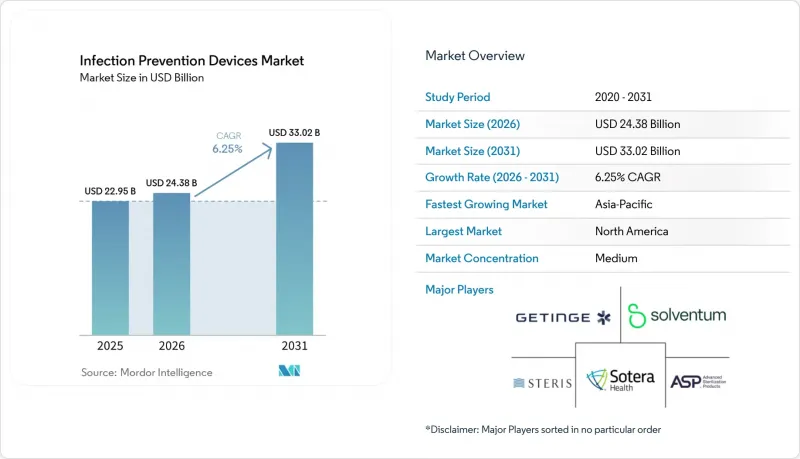
에 의하면, 감염 예방 기기 시장 규모는 2025년 229억 5,000만 달러에서 2026년에는 243억 8,000만 달러에 이르고, 2026-2031년 CAGR 6.25%로 성장을 지속하여, 2031년에는 330억 2,000만 달러에 이를 것으로 예측됩니다.
세계 감염 예방 기기 시장 동향 및 인사이트
의료 관련 감염 예방에 대한 지출 증가
자금 부족으로 어려움을 겪고 있는 각국의 감염 예방·관리 시스템은 정책상의 공약을 검증된 인프라 구축을 위한 조달로 전환하고 있습니다. 세계보건기구(WHO) 보고서에 따르면, 2023년부터 2024년에 걸쳐 71%의 국가가 감염 예방·관리 프로그램을 운영하고 있었으나, 모든 최소 요건을 충족한 국가는 고작 6%에 그쳤습니다. 이 기구의 2024년부터 2030년까지의 행동 계획에서는 2030년까지 이러한 요건을 충족하는 국가의 비율을 90% 이상으로 끌어올리는 것을 목표로 하고 있습니다. 저·중소득 국가의 환자들은 고소득 국가에 비해 최대 20배나 높은 의료 관련 감염 위험에 직면해 있습니다. 이러한 격차로 인해 자금은 멸균 모니터링, 생물학적 지표, 품질 보증용 소모품 등 검증된 감사 결과를 얻을 수 있는 분야로 집중되고 있습니다. 따라서 동남아시아와 사하라 이남 아프리카의 국가 프로그램이 정책 채택 단계에서 시설 차원의 실행 단계로 전환됨에 따라, 감염 예방 장비 시장은 혜택을 볼 가능성이 있습니다. 이러한 조달 주기는 감염 예방 장비 시장의 잠재 고객 기반을 확대할 가능성이 있습니다.
외과 수술 및 중재 시술 건수 증가
시술 건수 증가에 따라 시설 내 멸균 처리 능력에 대한 필요성이 높아지면서, 재처리 장비, 소모품 및 모니터링 장비에 대한 수요가 증가하고 있습니다. 외래 진료의 보급으로 인해 더 많은 외과적 시술이 소규모 시설에서 이루어지게 되었으며, 이러한 시설에서는 신뢰할 수 있는 멸균 처리 능력이 요구되고 있습니다. 많은 외래수술센터(ASC)는 수술실이 3개 미만이며, 전담 멸균 처리 인력을 배치하지 않습니다. 이러한 환경에서는 조작자 교육을 최소화할 수 있는 소형 자동화 감염 예방 장비가 선호됩니다. 또한, 시행되는 시술의 유형이 제한적이기 때문에 시술별 멸균 사양이 구매 결정에 있어 더욱 중요해집니다. 감염 예방 기기 시장에는 의료 제공업체가 분산된 거점 전체에 걸쳐 표준화된 기기와 서비스 지원을 필요로 한다는 기회가 있습니다. 이러한 환경에서는 조작의 용이성이 감염 예방 기기 구매의 핵심 요소가 됩니다.
에틸렌옥사이드 배출 규제 및 멸균 능력과 관련된 위험
에틸렌옥사이드(EO)는 의료기기 멸균에 필수적인 방법이지만, 발암성 물질로도 분류됩니다. 미국 환경보호청(EPA)은 2024년 4월, 상업용 멸균 시설의 에틸렌옥사이드 배출량을 90% 이상 감축하도록 의무화하는 개정안을 최종 확정했습니다. EPA는 이 조치가 미국 의료기기의 약 50%, 즉 연간 200억 개를 멸균하는 시설을 대상으로 한다고 밝혔습니다. 2026년 3월, EPA는 의료 공급망상의 이유로 2024년 상업용 멸균 시설에 관한 규정의 재검토를 제안했습니다. 이러한 불확실성은 멸균 사업자와 대체 기술 개발자들에게 투자 계획을 복잡하게 만들고 있습니다. 이로 인해 저온 멸균과 같은 대체 기술이 촉진되는 한편, 많은 복잡한 다강(多腔) 기기에 대해서는 완전한 대체 수단이 존재하지 않아 신규 생산 능력 확장이 제한될 가능성이 있습니다.
부문 분석
내시경 재처리 장치는 2031년까지 연평균 성장률(CAGR) 9.15%를 나타낼 것으로 예측되며, 이는 전체 시장의 예상 성장률인 6.25%를 상회합니다. 멸균 장비는 2025년에 매출 점유율의 38.31%를 차지하며 여전히 가장 큰 매출 카테고리로 남아 있습니다. 이 장비의 광범위한 역할은 병원의 중앙 멸균 공급 부서, 제약 제조 시설 및 외래 진료 시설에 이릅니다. 소독 장비는 중환자실, 격리실, 시술실의 환경 위생을 뒷받침합니다. 멸균 모니터링 및 보증 장비는 의료 기관이 인증 및 감사 요건에 따라 각 로트별 모니터링을 공식적으로 도입함에 따라 그 중요성이 커지고 있습니다.
감염 예방용 보호구는 직원의 보호에 도움이 되며, 의료 폐기물 및 봉쇄 장치는 생물학적 위험 관리를 지원합니다. ISO 374 및 EN 374와 같은 규격에서는 보호 장벽의 성능에 관한 요건이 규정되어 있습니다. 검사 지연이 지속되는 가운데, 내시경 부서에서는 동일한 내시경 그룹을 더 빈번하게 처리하고 있으므로, 처리 능력이 구매 시 중요한 요건이 되고 있습니다. 게팅게(Getinge)사의 ‘Aquadis Endo 110’은 이전 모델에 비해 처리 능력이 36% 향상되었으며, 표준 사이클 시간은 20분입니다. 또한, 이 시스템은 ‘FleetView’ 및 ‘T-DOC Endo’와의 연동을 통해 RFID를 활용한 추적 기능도 제공합니다. 어드밴스드 스터일라이제이션 프로덕츠(Advanced Sterilization Products)는 UVSmart를 인수하여, 단일 제품 포트폴리오 내에서 내시경의 고수준 소독과 환경용 광자 소독의 통합을 더욱 추진했습니다.
2025년에는 열 및 고온 멸균이 매출 점유율의 45.24%를 차지했습니다. 스테인리스제 외과용 기구가 여전히 수술 키트 재고의 대부분을 차지하고 있기 때문에 이 방법은 중앙 멸균 공급 부문에서 확고한 입지를 유지하고 있습니다. 저온 멸균은 로봇 수술, 최소 침습 수술 및 유연 내시경 검사에서 열에 취약한 기구의 사용이 일반화됨에 따라 2031년까지 연평균 성장률(CAGR) 8.22%를 나타낼 것으로 예측됩니다. 감마선 및 전자선 방식을 포함한 방사선 멸균은 일회용 의료기기의 위탁 멸균에서 여전히 중요한 역할을 하고 있습니다. 화학적 멸균 및 소독에는 내시경 재처리 및 환경 청소에 사용되는 과초산 및 액체 약제가 포함됩니다.
X선 조사 처리는 일부 용도에서 에틸렌옥사이드를 대체하는 보다 정밀한 기법으로 주목받고 있습니다. STERIS Applied Sterilization Technologies사는 2026년 7월 독일 호흐슈타트에 위치한 X선 조사 처리 시설의 확장을 완료하여, 의료기기 제조업체를 위한 지역 처리 능력을 확대했습니다. UV-C 및 포토닉 소독은 일부 임상 현장에서 보조적인 용도에서 보다 중심적인 역할로 전환되고 있는 비교적 소규모의 기술입니다. 2024년 11월부터 2025년 4월에 걸쳐 덴마크의 12개 장기 요양 시설에서 실시된 제2상 임상시험에서는 원자외선(far-UVC)을 도입한 공용 공간에서는 입소자 1만 명일당 10.4건의 병원 내 감염이 보고된 반면, 표준 치료 환경에서는 86.2건이었습니다. 조정된 발생률 비율은 0.12였으며, 95% 신뢰 구간은 0.04-0.34였습니다. 규정 준수 체계의 정비 및 임상적 검증의 필요성을 고려할 때, 감염 예방 기기 시장의 이 분야에서 기기의 성능과 실용적인 도입 요건을 조화시켜야 하므로, 공급업체 입장에서는 조속한 규제상의 명확화가 중요합니다.
지역별 분석
2025년, 북미는 매출 점유율의 36.61%를 차지했습니다. 의료기기 재처리에 관한 검증 기준, 의료 관련 감염 보고 요건, 그리고 조인트 커미션(Joint Commission)의 인증 의무가 미국 시장을 뒷받침하고 있습니다. 이러한 요건으로 인해, 시설이 규정 준수를 입증해야 하는 경우 조달을 미루기 어렵습니다. 캐나다에서는 각 주 보건 당국을 통해 동등한 멸균 요건이 엄격하게 적용되고 있습니다. 멕시코에서는 국가 의료 접근 프로그램 하에서 병원의 수용 능력이 확대됨에 따라 감염 예방 요건이 강화되고 있습니다.
아시아태평양은 2031년까지 연평균 성장률(CAGR) 7.45%를 나타낼 것으로 예측됩니다. 중국의 병원 신축 및 개보수 노력과 인도의 ‘아유슈만 바라트(Ayushman Bharat)’ 디지털 헬스 인프라 프로그램 덕분에 2차 및 3차 의료 서비스에 대한 접근성이 확대되고 있습니다. 2026년 중국 남서부의 주요 의료기관에서 발표된 10년간의 연구에 따르면, 항생제 사용량은 안정된 반면 의료 관련 감염률은 감소한 것으로 나타났습니다. 이 연구 결과는 의료기관 전반에 걸친 감염 예방에 대한 지속적인 투자의 가치를 입증합니다. 또한, 감염 예방 장비 시장에서 유효성이 입증된 시스템의 지속적인 도입을 뒷받침하고 있습니다. 일본의 병원 인증 제도는 멸균·재처리 장비의 교체 주기를 지원하고 있습니다. 한국과 호주 역시 엄격한 감염 관리 요건을 갖춘 성숙한 민간 병원 부문을 통해 기여하고 있습니다.
중동 및 아프리카(MEA) 및 남미는 여전히 시장 기여도가 낮은 편이지만, 병원 건설 및 품질 개선 프로그램이 지속됨에 따라 더 빠른 성장이 예상됩니다. GCC 국가들은 ‘비전 2030’ 및 관련 다각화 프로그램의 일환으로 병원 인프라에 대한 투자를 추진하고 있습니다. 이 국가들의 높은 소득 수준은 다른 MEA 국가들에서는 여전히 확보하기 어려운 첨단 저온 멸균 시스템의 도입을 뒷받침할 수 있습니다. 남아프리카공화국 및 더 광범위한 사하라 이남 아프리카은 세계보건기구(WHO)의 프로그램 전개와 개발 자금에 의한 체계적인 조달 지원을 통해 장기적인 기회를 내포하고 있습니다. 브라질에서는 공립 병원의 감염 관리 인프라 현대화가 진행되고 있는 반면, 아르헨티나의 민간 병원 부문에서는 멸균 능력 향상이 추진되고 있습니다. 이 지역들의 감염 예방 장비 시장 규모는 여전히 작지만, 예측 기간 후반에는 그 성장이 감염 예방 장비 시장에 있어 더 중요한 요소가 될 가능성이 있습니다.
기타 혜택:
- 엑셀 형식 시장 예측(ME) 시트
- 3개월간의 애널리스트 지원
자주 묻는 질문
목차
제1장 서론
- 조사의 전제조건과 시장의 정의
- 조사 범위
제2장 조사 방법
제3장 주요 요약
제4장 시장 구도
- 시장 개요
- 시장 성장 촉진요인
- 시장 성장 억제요인
- 공급망 분석
- 규제 상황
- 기술 전망
- Porter의 Five Forces 분석
제5장 시장 규모와 성장 예측
- 디바이스 유형별
- 기술별
- 이용 사례별
- 최종사용자별
- 지역별
- 북미
- 미국
- 캐나다
- 멕시코
- 유럽
- 독일
- 영국
- 프랑스
- 이탈리아
- 스페인
- 기타 유럽 국가
- 아시아태평양
- 중국
- 일본
- 인도
- 호주
- 한국
- 기타 아시아태평양 국가
- 중동 및 아프리카
- GCC
- 남아프리카공화국
- 기타 중동 및 아프리카 국가
- 남미
- 브라질
- 아르헨티나
- 기타 남미 국가
- 북미
제6장 경쟁 구도
- 시장 집중도
- 시장 점유율 분석
- 기업 개요
- Advanced Sterilization Products
- ANSELL LTD.
- Belimed AG
- Cardinal Health, Inc.
- Ecolab Inc.
- Getinge AB
- Kimberly-Clark Corporation
- MATACHANA GROUP
- Medline Industries, LP
- Midmark Corporation
- MMM Group
- Olympus Corporation
- PAUL HARTMANN AG
- PDI Healthcare
- Solventum Corporation
- Sotera Health Company
- SteelcoBelimed
- STERIS plc
- Tuttnauer
제7장 시장 기회와 향후 전망
LSH 26.10.29According to Mordor Intelligence, the infection prevention devices market size is expected to grow from USD 22.95 billion in 2025 to USD 24.38 billion in 2026 and is forecast to reach USD 33.02 billion by 2031 at 6.25% CAGR over 2026-2031.
Global Infection Prevention Devices Market Trends and Insights
Rising Healthcare-Associated Infection Prevention Spending
Underfunded national infection prevention and control systems are converting policy commitments into procurement for validated infrastructure. The World Health Organization reported that 71% of countries had an active infection prevention and control program, but only 6% met all minimum requirements in 2023-2024. Its 2024-2030 action plan seeks to raise the share of countries meeting those requirements above 90% by 2030. Patients in low- and middle-income countries faced up to 20 times the healthcare-associated infection risk seen in high-income countries. This gap directs funding toward categories that offer documented audit results, including sterilization monitoring, biological indicators, and assurance consumables. The infection prevention devices market can therefore benefit as national programs in Southeast Asia and Sub-Saharan Africa move from policy adoption toward facility-level implementation. These procurement cycles can widen the addressable base for the infection prevention devices market.
Increasing Surgical and Interventional Procedure Volumes
Higher procedure volumes raise sterilization throughput needs within facilities and increase demand for reprocessing equipment, consumables, and monitoring devices. Outpatient care has moved more surgical activity into smaller settings that require dependable sterile processing capacity. Many ambulatory surgery centers have fewer than 3 operating rooms and do not maintain dedicated sterile processing staff. This setting favors compact and automated infection prevention devices that require limited operator training. A concentrated range of procedures can also make procedure-specific sterilization specifications more important in purchasing decisions. The infection prevention devices market has an opportunity where providers need standardized equipment and service support across distributed sites. This setting places ease of operation at the center of the purchasing of infection prevention devices.
Ethylene Oxide Emission Controls and Sterilization Capacity Risk
Ethylene oxide is an essential sterilization method for medical devices, but it is also classified as a carcinogen. The EPA finalized amendments in April 2024 that required more than 90% reductions in ethylene oxide emissions at commercial sterilization facilities. The agency stated that the action addressed facilities that sterilize roughly 50% of U.S. medical devices, or 20 billion devices annually. In March 2026, the EPA proposed reconsidering the 2024 commercial sterilizer rule on medical supply-chain grounds. This uncertainty complicates investment planning for sterilization operators and alternative technology developers. It can promote low-temperature alternatives while limiting new capacity for a method that has no complete substitute for many complex multi-lumen devices.
Other drivers and restraints analyzed in the detailed report include:
- Expansion of Low-Temperature Sterilization for Heat-Sensitive Devices
- Digitization of Sterilization Assurance and Instrument Tracking
- High Capital and Lifecycle Costs of Advanced Systems
For complete list of drivers and restraints, kindly check the Table Of Contents.
Segment Analysis
Endoscope Reprocessing Devices are projected to grow at a 9.15% CAGR through 2031, ahead of the 6.25% overall forecast. Sterilization Equipment held 38.31% of revenue share in 2025 and remains the largest revenue category. Its broad role spans hospital central sterile supply departments, pharmaceutical manufacturing facilities, and ambulatory care settings. Disinfection Devices support environmental hygiene in intensive care units, isolation rooms, and procedure suites. Sterilization Monitoring and Assurance Devices are becoming more important as providers formalize every-load monitoring under accreditation and audit requirements.
Protective Infection-Prevention Devices provide staff protection, while Medical Waste and Containment Devices support biohazard management. Standards including ISO 374 and EN 374 establish requirements for protective barrier performance. Endoscopy units are processing the same scope fleets more often as procedure backlogs continue, which makes throughput a central purchasing requirement. Getinge's Aquadis Endo 110 delivers 36% higher throughput than its predecessor and a 20-minute standard cycle. The system also provides RFID-enabled traceability through its FleetView and T-DOC Endo connections. Advanced Sterilization Products acquired UVSmart, bringing endoscope high-level disinfection closer to environmental photonic disinfection within a single portfolio.
Heat and High-Temperature Sterilization accounted for 45.24% of revenue share in 2025. It remains established in central sterile supply departments because stainless-steel surgical instruments continue to make up much of the surgical kit inventory. Low-Temperature Sterilization is forecast to record an 8.22% CAGR through 2031 as thermolabile instruments become more common in robotic surgery, minimally invasive procedures, and flexible endoscopy. Radiation Sterilization, including gamma and electron beam methods, remains important for contract sterilization of single-use devices. Chemical Sterilization and Disinfection includes peracetic acid and liquid chemistries used in endoscope reprocessing and environmental cleaning.
X-ray radiation processing is gaining attention as a more precise alternative to ethylene oxide for some applications. STERIS Applied Sterilization Technologies completed an expansion of its X-ray radiation processing facility in Hochstadt, Germany, in July 2026, increasing regional processing capacity for medical device manufacturers. UV-C and photonic disinfection are smaller technologies that are moving from supplementary use toward more central roles in selected clinical settings. A phase II trial conducted from November 2024 to April 2025 in 12 long-term care facilities in Denmark reported 10.4 hospital-treated infections per 10,000 resident-days in far-UVC common rooms, compared with 86.2 under standard care. The adjusted incidence rate ratio was 0.12, with a 95% confidence interval of 0.04-0.34. Developing compliance frameworks and the need for clinical validation make early regulatory clarity important for suppliers in this part of the infection prevention devices market, where equipment performance must be matched with practical adoption requirements.
Complete Report Scope:
- By Device Type
- Sterilization Equipment
- Disinfection Devices
- Endoscope Reprocessing Devices
- Sterilization Monitoring and Assurance Devices
- Protective Infection-Prevention Devices
- Medical Waste and Containment Devices
- By Technology
- Heat and High-Temperature Sterilization
- Low-Temperature Sterilization
- Radiation Sterilization
- Chemical Sterilization and Disinfection
- UV-C and Photonic Disinfection
- Other Technologies
- By Use Case
- Healthcare-Associated Infection Prevention
- Surgical Site Infection Prevention
- Respiratory Infection Control
- Endoscope-Associated Infection Prevention
- Environmental and Surface Hygiene
- Other Use Cases
- By End User
- Hospitals and Clinics
- Ambulatory Surgery Centers
- Diagnostic Centers and Clinical Laboratories
- Long-Term Care Facilities
- Pharmaceutical and Medical Device Manufacturers
- Other End Users
- By Geography
- North America
- United States
- Canada
- Mexico
- Europe
- Germany
- United Kingdom
- France
- Italy
- Spain
- Rest of Europe
- Asia-Pacific
- China
- Japan
- India
- Australia
- South Korea
- Rest of Asia-Pacific
- Middle East and Africa
- GCC
- South Africa
- Rest of Middle East and Africa
- South America
- Brazil
- Argentina
- Rest of South America
- North America
Geography Analysis
North America held 36.61% of the revenue share in 2025. Device reprocessing validation standards, healthcare-associated infection reporting requirements, and Joint Commission accreditation obligations support the United States. These requirements make procurement difficult to defer when facilities need documented compliance. Canada aligns closely with comparable sterilization expectations through provincial health authorities. Mexico is reinforcing infection prevention requirements as hospital capacity expands under national healthcare access programs.
Asia-Pacific is projected to grow at a 7.45% CAGR through 2031. China's hospital construction and renovation commitments, and India's Ayushman Bharat digital health infrastructure program, are extending secondary and tertiary care access. A 10-year study published in 2026 at a major healthcare institution in Southwestern China found declining healthcare-associated infection rates while antimicrobial use stabilized. The finding supports the value of sustained institution-wide infection prevention investment. It also supports the continued adoption of validated systems in the infection prevention devices market. Japan's hospital accreditation framework supports replacement cycles for sterilization and reprocessing equipment. South Korea and Australia also contribute through mature private hospital sectors with stringent infection control requirements.
MEA and South America remain smaller contributors but can grow faster as hospital construction and quality improvement programs continue. GCC countries are investing in hospital infrastructure under Vision 2030 and related diversification programs. Their higher-income base can support advanced low-temperature sterilization systems that remain less accessible in other MEA countries. South Africa and the wider Sub-Saharan Africa region represent a longer-term opportunity as World Health Organization program rollout and development funding support structured procurement. Brazil is modernizing public hospital infection control infrastructure, while Argentina's private hospital sector is upgrading sterilization capacity. The infection prevention devices market size in these regions remains smaller, but their growth can become more relevant to the infection prevention devices market later in the forecast period.
- Advanced Sterilization Products
- ANSELL LTD.
- Belimed
- Cardinal Health
- Ecolab
- Getinge
- Kimberly-Clark Worldwide
- MATACHANA GROUP
- Medline Industries
- Midmark
- MMM Group
- Olympus
- Hartmann Group
- PDI Healthcare
- Solventum Corporation
- Sotera Health Company
- SteelcoBelimed
- STERIS
- Tuttnauer
Additional Benefits:
- The market estimate (ME) sheet in Excel format
- 3 months of analyst support
TABLE OF CONTENTS
1 Introduction
- 1.1 Study Assumptions and Market Definition
- 1.2 Scope of the Study
2 Research Methodology
3 Executive Summary
4 Market Landscape
- 4.1 Market Overview
- 4.2 Market Drivers
- 4.2.1 Rising Healthcare-Associated Infection Prevention Spending
- 4.2.2 Increasing Surgical and Interventional Procedure Volumes
- 4.2.3 Expansion of Low-Temperature Sterilization for Heat-Sensitive Devices
- 4.2.4 Stricter Sterilization Validation and Traceability Requirements
- 4.2.5 Outpatient and Ambulatory Care Migration
- 4.2.6 Digitization of Sterilization Assurance and Instrument Tracking
- 4.3 Market Restraints
- 4.3.1 High Capital and Lifecycle Costs of Advanced Systems
- 4.3.2 Complexity of Reprocessing and Protocol Compliance
- 4.3.3 Ethylene Oxide Emission Controls and Sterilization Capacity Risk
- 4.3.4 Single-Use Device Waste and Sustainability Trade-Offs
- 4.4 Supply-Chain Analysis
- 4.5 Regulatory Landscape
- 4.6 Technological Outlook
- 4.7 Porter's Five Forces Analysis
- 4.7.1 Bargaining Power of Suppliers
- 4.7.2 Bargaining Power of Buyers
- 4.7.3 Threat of New Entrants
- 4.7.4 Threat of Substitutes
- 4.7.5 Competitive Rivalry
5 Market Size & Growth Forecasts (Value, USD)
- 5.1 By Device Type
- 5.1.1 Sterilization Equipment
- 5.1.2 Disinfection Devices
- 5.1.3 Endoscope Reprocessing Devices
- 5.1.4 Sterilization Monitoring and Assurance Devices
- 5.1.5 Protective Infection-Prevention Devices
- 5.1.6 Medical Waste and Containment Devices
- 5.2 By Technology
- 5.2.1 Heat and High-Temperature Sterilization
- 5.2.2 Low-Temperature Sterilization
- 5.2.3 Radiation Sterilization
- 5.2.4 Chemical Sterilization and Disinfection
- 5.2.5 UV-C and Photonic Disinfection
- 5.2.6 Other Technologies
- 5.3 By Use Case
- 5.3.1 Healthcare-Associated Infection Prevention
- 5.3.2 Surgical Site Infection Prevention
- 5.3.3 Respiratory Infection Control
- 5.3.4 Endoscope-Associated Infection Prevention
- 5.3.5 Environmental and Surface Hygiene
- 5.3.6 Other Use Cases
- 5.4 By End User
- 5.4.1 Hospitals and Clinics
- 5.4.2 Ambulatory Surgery Centers
- 5.4.3 Diagnostic Centers and Clinical Laboratories
- 5.4.4 Long-Term Care Facilities
- 5.4.5 Pharmaceutical and Medical Device Manufacturers
- 5.4.6 Other End Users
- 5.5 By Geography
- 5.5.1 North America
- 5.5.1.1 United States
- 5.5.1.2 Canada
- 5.5.1.3 Mexico
- 5.5.2 Europe
- 5.5.2.1 Germany
- 5.5.2.2 United Kingdom
- 5.5.2.3 France
- 5.5.2.4 Italy
- 5.5.2.5 Spain
- 5.5.2.6 Rest of Europe
- 5.5.3 Asia-Pacific
- 5.5.3.1 China
- 5.5.3.2 Japan
- 5.5.3.3 India
- 5.5.3.4 Australia
- 5.5.3.5 South Korea
- 5.5.3.6 Rest of Asia-Pacific
- 5.5.4 Middle East and Africa
- 5.5.4.1 GCC
- 5.5.4.2 South Africa
- 5.5.4.3 Rest of Middle East and Africa
- 5.5.5 South America
- 5.5.5.1 Brazil
- 5.5.5.2 Argentina
- 5.5.5.3 Rest of South America
- 5.5.1 North America
6 Competitive Landscape
- 6.1 Market Concentration
- 6.2 Market Share Analysis
- 6.3 Company Profiles (includes Global Level Overview, Market Level Overview, Core Segments, Financials as available, Strategic Information, Market Rank/Share, Products and Services, Recent Developments)
- 6.3.1 Advanced Sterilization Products
- 6.3.2 ANSELL LTD.
- 6.3.3 Belimed AG
- 6.3.4 Cardinal Health, Inc.
- 6.3.5 Ecolab Inc.
- 6.3.6 Getinge AB
- 6.3.7 Kimberly-Clark Corporation
- 6.3.8 MATACHANA GROUP
- 6.3.9 Medline Industries, LP
- 6.3.10 Midmark Corporation
- 6.3.11 MMM Group
- 6.3.12 Olympus Corporation
- 6.3.13 PAUL HARTMANN AG
- 6.3.14 PDI Healthcare
- 6.3.15 Solventum Corporation
- 6.3.16 Sotera Health Company
- 6.3.17 SteelcoBelimed
- 6.3.18 STERIS plc
- 6.3.19 Tuttnauer
7 Market Opportunities and Future Outlook
- 7.1 White-Space and Unmet-Need Assessment


