

|
시장보고서
상품코드
2155578
남미의 항공기 MRO : 시장 점유율 분석, 업계 동향과 통계, 성장 예측(2026-2031년)South America Aircraft Maintenance, Repair, and Overhaul - Market Share Analysis, Industry Trends & Statistics, Growth Forecasts (2026 - 2031) |
||||||
 Mordor Intelligence
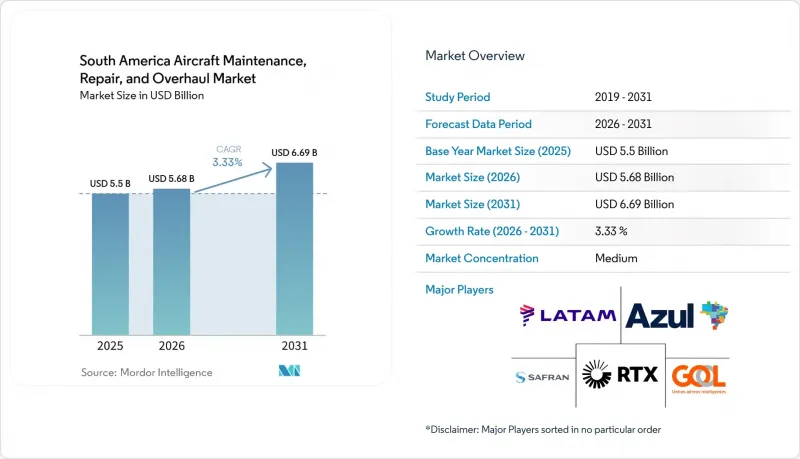
에 의하면, 남미의 항공기 MRO 시장 규모는 2025년에 55억 달러로 평가되었고, 2026년 56억 8,000만 달러에서 2031년까지 66억 9,000만 달러에 이를 것으로 예측되며, 예측 기간(2026년-2031년) CAGR은 3.33%를 기록할 전망입니다.
남미의 항공기 MRO 시장 동향 및 인사이트
상용 항공기 기단 및 여객 수송량의 회복
2025년, 남미의 주요 항공 시장에서 항공기 가동률은 계속해서 상승했습니다. 브라질에서는 전년 대비 9.4% 증가한 1억 2,960만 명의 승객을 수송했으며, 아르헨티나에서는 12% 증가한 5,065만 명에 달했습니다. 콜롬비아는 5,752만 명의 여객 수를 기록했으며, 페루는 5.5% 증가한 4,470만 명에 달했습니다. 페루에서는 항공기 운항 횟수도 4.6% 증가한 47만 6,000회 이상을 기록했습니다. 정비 주기는 비행 시간, 착륙 횟수 및 역시간과 연동되어 있으므로, 운항 활동 증가는 MRO 수요를 직접 뒷받침하게 됩니다. LATAM은 그 직접적인 사례를 보여주고 있습니다. 2025년 항공기 정비 비용은 5.7% 증가한 8억 6,270만 달러에 달했는데, 그 원인 중 하나는 운항 활동 증가에 있습니다. 따라서 지속적인 여객 수와 항공기 가동률은 남미의 항공기 MRO 시장 전체에서 라인 정비, 정기 점검, 부품 교체 및 기타 가동률과 연동된 서비스를 뒷받침하고 있습니다.
기체 노후화 및 감항성에 기반한 정비 수요
남미 항공사들의 기단은 구형 기종과 신세대 협폭기체가 혼재되어 있어, 다양한 정비 기술에 대한 수요를 견인하고 있습니다. LATAM은 24대의 A320 계열 협폭기체를 포함한 26대를 연간 추가한 결과, 2025년 말 기준으로 371대의 기체를 보유하게 되었으며, 기단의 평균 기령은 12.2년이 되었습니다. GOL Aerotech사는 B737 클래식, B737NG 및 B737 MAX 기종의 정비를 지원하며, CFM56-7B 및 일부 LEAP-1B 엔진의 정비를 수행하고 있습니다. 한편, LATAM사는 프랫 앤 휘트니(Pratt & Whitney)사와의 장기 정비 계약에 따라 PW1100G 엔진을 탑재한 A320neo 계열 항공기를 운항하고 있습니다. 규제 요건도 점점 더 신뢰성을 중시하는 방향으로 바뀌고 있습니다. ANAC는 2025년 3월에 IS 120-017A를 공표하여, 브라질 공공 항공 운송 사업자를 위한 허용 가능한 신뢰성 프로그램의 조사 기법을 확립하는 동시에, 정비 프로그램의 요건을 미국의 규제 접근 방식에 더욱 밀접하게 부합시켰습니다. 이러한 다양한 기체 구성과 규제 환경이 인증된 기체, 엔진, 부품 및 신뢰성 관리 역량에 대한 수요를 뒷받침하고 있습니다.
숙련된 기술자 및 자격을 갖춘 검사관의 부족
자격을 갖춘 정비 인력 확보는 남미의 항공기 정비·수리·정비(MRO) 시장에서 중요한 역량상의 제약 요인으로 대두되고 있습니다. 보잉사의 예측에 따르면, 라틴아메리카에서는 2045년까지 4만 2,000명의 새로운 정비 기술자가 필요할 것으로 예상되며, 이는 항공기 수 증가와 업계를 떠나는 근로자의 보충을 모두 반영한 것입니다. 브라질에서는 이미 기술 연수에 대한 강한 수요가 나타나고 있습니다. LATAM은 2024년 12월, 산 카를로스 MRO에 ‘메카닉 스쿨’을 개설하여 직원 겸 학생 70명을 모집했으며, 2025년 8월에는 외부 지원자에게도 프로그램을 개방했습니다. 첫 외부 모집에서는 당초 20명의 정원에 약 1,700명이 지원했으며, 이에 따라 회사는 모집 인원을 확대했습니다. 지속적인 채용 및 교육 수요는 MRO 사업자가 엔진, 항공전자, 구조 정비와 같은 전문 분야에서 역량을 확충하는 속도를 저해할 가능성이 있습니다. 이러한 분야에서는 인증 자격 취득이나 실무 경험 축적에 시간이 걸리기 때문입니다.
부문별 분석
2025년, 남미의 항공기 MRO 시장에서 엔진 MRO는 추정 44.50%를 차지했습니다. 이는 구형 기종과 차세대 기종 모두에서 엔진의 점검, 수리, 오버홀이 높은 부가가치와 기술적 복잡성을 수반함을 반영합니다. 이러한 수요는 해당 지역에 CFM56, V2500, LEAP, PW1100G 엔진을 탑재한 항공기가 혼재되어 있다는 점에 의해 뒷받침되고 있습니다. 아줄 항공은 LEAP-1A 엔진을 탑재한 A320neo를 운항하고 있으며, LATAM 항공은 PW1100G-JM 엔진을 탑재한 A320neo 계열 기종을 운항하고 있습니다. 또한 아비앙카 항공은 추가 A320neo 계열 기체에 LEAP-1A 엔진을 선정했으며, GOL 항공의 B737 MAX 기단에서는 LEAP-1B 엔진이 사용되고 있습니다. 엔진의 완전 정비(풀 오버홀) 능력을 확보하기 위해서는 여전히 막대한 자본, 전용 공구 및 인증이 필수적이기 때문에 엔진 MRO는 대형 항공사 산하, OEM과 제휴한 업체, 또는 전문화된 제공업체에 집중된 상태가 지속되고 있습니다.
부품 MRO는 랜딩 기어, 항공 전자 장비, 구조물 및 기타 수리 가능한 부품에 걸쳐 지역적 수리 역량이 발전함에 따라 2031년까지 연평균 성장률(CAGR) 4.75%로 확대되어, MRO 유형 중 가장 빠르게 성장할 것으로 예측됩니다. 2026년 4월, DTX Aerospace와 Liebherr-Aerospace는 라이선스 서비스 계약을 체결했습니다. 이를 통해 DTX사의 ANAC(브라질 민간항공청) 인증을 받은 리우데자네이루 시설은 엠브라에르(Embraer)사의 ERJ 제품군 노즈 랜딩 기어 부품의 정비를 수행할 수 있는 승인을 받았으며, OEM 기술 문서, 순정 예비 부품 및 엔지니어링 지원에 대한 접근이 가능해졌습니다. 기체, 라인 정비 및 개조 활동도 남미에 다수 도입된 항공기 군에 힘입어 계속해서 중요한 위치를 차지하고 있습니다. LATAM은 2025년 말 기준으로 A320ceo 계열 항공기 223대와 A320neo 계열 항공기 68대를 보유하고 있으며, 2027년부터 41대의 B787에 대해 RECARO사의 프리미엄 좌석을 사후 장착하는 개조 작업을 실시할 계획입니다. 이러한 동향은 엔진 오버홀을 넘어, 보다 광범위한 지역적 MRO 역량 강화를 뒷받침하고 있습니다.
2025년 남미의 항공기 MRO 시장에서 고정익기는 추정치 기준 84.25%를 차지했습니다. 이는 해당 지역의 방대한 민간 항공기 기단 및 군용 고정익기 플랫폼에 힘입은 결과입니다. 이 부문은 구형 기종 및 신세대 기종의 정기 정비(기체, 엔진, 부품의 정기 점검 포함)로부터 혜택을 받고 있습니다. 구형 항공기가 다수 도입되어 있는 만큼 정기 정비 수요는 계속해서 존재하며, 민간, 화물, 지역 항공, 정부 기관의 기단이 광범위하고 지속적인 작업량을 창출하고 있습니다. 회전익 항공기의 MRO는 여전히 소규모 부문이지만, 주로 브라질의 해양 에너지, 공공 서비스, 수색 및 구조, 항공 의료 헬리콥터 운영에 의해 뒷받침되고 있습니다.
또한, 고정익 항공기는 가장 빠르게 성장하는 기체 유형이 될 것으로 예측되며, 2031년까지 연평균 성장률(CAGR) 4.40%로 확대될 것으로 전망됩니다. 이는 신형 협폭체 항공기의 인도 증가로 인해 승인된 정비 프로그램, 공구, 기술 데이터, 훈련된 인력 및 부품 지원에 대한 수요가 증가하기 때문입니다. 2026년 7월, 아비앙카는 아브라 그룹과의 계약에 따라 A320neo 계열 항공기 50대를 위해 CFM LEAP-1A 엔진 100기를 선정했습니다. 이 계약에는 아비앙카의 A320neo 계열 항공기와 GOL의 LEAP-1B 엔진이 장착된 B737 MAX 항공기를 대상으로 한 예비 엔진 및 장기 서비스도 포함되어 있습니다. 아비앙카에 따르면, 아브라 그룹 산하 각 브랜드에서 이미 운항 중이거나 주문된 항공기를 합치면 LEAP 엔진을 탑재한 항공기는 650대 이상에 달할 전망입니다. 이처럼 확대되는 차세대 기체 기반은 남미 전역의 고정익 항공기에 대한 지속적인 정비 수요를 뒷받침하게 될 것입니다.
기타 혜택:
- 엑셀 형식 시장 예측(ME) 시트
- 3개월간의 애널리스트 지원
자주 묻는 질문
목차
제1장 서론
- 조사의 전제조건과 시장의 정의
- 조사 범위
제2장 조사 방법
제3장 주요 요약
제4장 시장 구도
- 시장 개요
- 시장 성장 촉진요인
- 시장 성장 억제요인
- 밸류체인 분석
- 규제 상황
- 기술 전망
- Porter의 Five Forces 분석
제5장 시장 규모와 성장 예측
- MRO 유형별
- 항공기 유형별
- 용도별
- 서비스 제공업체별
- 지역별
- 브라질
- 콜롬비아
- 아르헨티나
- 칠레
- 페루
- 에콰도르
- 기타 남미 국가
제6장 경쟁 구도
- 시장 집중도
- 전략적 동향
- 시장 점유율 분석
- 기업 개요
- MRO Holdings Group
- Azul S.A.(Azul TecOps)
- GOL Linhas Aereas S.A.
- RTX Corporation
- Embraer S.A.
- GE Aerospace(General Electric Company)
- Safran SA
- MTU Aero Engines AG
- Rolls-Royce Holdings plc
- FAdeA S.A.
- IAS-Industria de Aviacao e Servicos
- Helibras(Airbus SE)
- LATAM Airlines Group S.A.
- APAS Chile
제7장 시장 기회와 향후 전망
LSH 26.10.29According to Mordor Intelligence, the South America aircraft maintenance, repair, and overhaul market size was valued at USD 5.50 billion in 2025 and is forecast to grow from USD 5.68 billion in 2026 to reach USD 6.69 billion by 2031, at a CAGR of 3.33% during the forecast period (2026-2031).
South America Aircraft Maintenance, Repair, and Overhaul Market Trends and Insights
Commercial Fleet and Passenger Traffic Recovery
Aircraft utilization continued to increase across major South American aviation markets in 2025. Brazil transported 129.6 million passengers, up 9.4% year over year, while Argentina reached 50.65 million passengers, up 12%. Colombia recorded 57.52 million passengers, and Peru reached 44.7 million, up 5.5%. Peru also recorded more than 476,000 aircraft operations, an increase of 4.6%. Higher flight activity directly supports MRO demand because maintenance intervals are linked to flight hours, landings, and calendar time. LATAM provides a direct example: aircraft maintenance expense increased 5.7% to USD 862.7 million in 2025, partly due to higher operational activity. Continued traffic and fleet utilization therefore support line maintenance, scheduled checks, component replacement, and other utilization-driven services across the South America aircraft maintenance, repair, and overhaul market.
Fleet Aging and Airworthiness-Driven Maintenance Demand
South American airline fleets combine legacy aircraft with new-generation narrowbodies, driving demand for a range of maintenance technologies. LATAM ended 2025 with 371 aircraft and an average fleet age of 12.2 years after adding 26 aircraft during the year, including 24 A320-family narrowbodies. GOL Aerotech supports B737 Classic, B737NG, and B737 MAX aircraft and performs CFM56-7B and limited LEAP-1B engine work, while LATAM operates PW1100G-powered A320neo-family aircraft under a long-term Pratt & Whitney maintenance agreement. Regulatory requirements are also becoming more reliability-based. ANAC published IS 120-017A in March 2025, establishing an acceptable reliability program methodology for Brazilian public air transport operators and aligning maintenance program requirements more closely with the US regulatory approach. This mixed fleet and regulatory environment supports demand for certified airframe, engine, component, and reliability-management capabilities.
Skilled Technician and Licensed Inspector Shortages
The availability of qualified maintenance personnel is becoming an important capacity constraint for the South America aircraft maintenance, repair, and overhaul market. Boeing projects that Latin America will require 42,000 new maintenance technicians through 2045, reflecting both fleet growth and the replacement of workers leaving the industry. Brazil already shows strong demand for technical training. LATAM opened its School of Mechanics at the Sao Carlos MRO in December 2024, with 70 employee-students, and opened the program to external candidates in August 2025. The first external selection attracted around 1,700 applicants for an initial 20 places, prompting the airline to expand the class. Continued hiring and training requirements can constrain the pace at which MRO providers build capacity in specialist areas such as engines, avionics, and structural maintenance, where certification and practical experience take time to develop.
Other drivers and restraints analyzed in the detailed report include:
- Embraer-Centered Regional Jet and Executive Aviation Ecosystem
- Digital Predictive Maintenance and Connected-Aircraft Adoption
- Foreign-Exchange Volatility and Imported-Part Cost Exposure
For complete list of drivers and restraints, kindly check the Table Of Contents.
Segment Analysis
Engine MRO accounted for an estimated 44.50% of the South America aircraft maintenance, repair, and overhaul market in 2025, reflecting the high value and technical complexity of engine inspection, repair, and overhaul across legacy and new-generation fleets. Demand is supported by the region's mix of CFM56-, V2500-, LEAP-, and PW1100G-powered aircraft. Azul operates LEAP-1A-powered A320neos, LATAM operates PW1100G-JM-powered A320neo-family aircraft, and Avianca has selected LEAP-1A engines for additional A320neo-family aircraft, while GOL's B737 MAX fleet uses LEAP-1B engines. Full engine overhaul capability remains capital-, tooling-, and certification-intensive, which keeps engine MRO concentrated among larger airline-affiliated, OEM-linked, and specialized providers.
Component MRO is forecast to be the fastest-growing MRO type, expanding at a 4.75% CAGR through 2031, as regional repair capability develops across landing gear, avionics, structures, and other repairable components. In April 2026, DTX Aerospace and Liebherr-Aerospace signed a License Service Agreement authorizing DTX's ANAC-approved Rio de Janeiro facility to maintain Embraer ERJ-family nose landing gear components, with access to OEM technical documentation, genuine spare parts, and engineering support. Airframe, line maintenance, and modification activity also remain relevant, supported by South America's large installed fleet. LATAM ended 2025 with 223 A320ceo-family aircraft and 68 A320neo-family aircraft, and plans to retrofit 41 B787 shipsets with RECARO premium seating beginning in 2027. These developments support broader regional MRO capability beyond engine overhaul.
Fixed-wing aircraft accounted for an estimated 84.25% of the South America aircraft maintenance, repair, and overhaul market in 2025, supported by the region's large commercial airline fleet and military fixed-wing platforms. The segment benefits from recurring maintenance across legacy and new-generation aircraft, including scheduled airframe, engine, and component work. The large installed base of earlier-generation aircraft continues to require regular maintenance, while commercial, cargo, regional, and government fleets provide a broad and recurring workload. Rotary-wing MRO remains a smaller segment, supported primarily by Brazil's offshore energy, public service, search-and-rescue, and aeromedical helicopter operations.
Fixed-wing aircraft are also forecast to be the fastest-growing aircraft type, expanding at a 4.40% CAGR through 2031, as new narrowbody deliveries increase requirements for approved maintenance programs, tooling, technical data, trained personnel, and component support. In July 2026, Avianca selected 100 CFM LEAP-1A engines for 50 A320neo-family aircraft under an Abra Group agreement that also includes spare engines and long-term services covering Avianca's A320neo-family fleet and GOL's LEAP-1B-powered B737 MAX fleet. Avianca states that aircraft already in service and on order across Abra brands will represent more than 650 LEAP-powered aircraft. This expanding new-generation fleet base will support sustained fixed-wing maintenance demand across South America.
Complete Report Scope:
- By MRO Type
- Airframe MRO
- Engine MRO
- Component MRO
- Line Maintenance
- Modifications and Upgrades
- By Aircraft Type
- Fixed-Wing
- Rotary-Wing
- By Application
- Commercial Aviation
- Passenger
- Cargo/Freighter
- Military Aviation
- General Aviation
- Commercial Aviation
- By Service Provider
- Airline-affiliated MRO
- Independent Third-party MRO
- OEM-Captive MRO
- Military Depots
- By Geography
- Brazil
- Colombia
- Argentina
- Chile
- Peru
- Ecuador
- Rest of South America
List of Companies Covered in this Report:
- MRO Holdings Group
- Azul S.A. (Azul TecOps)
- GOL Linhas Aereas S.A.
- RTX Corporation
- Embraer S.A.
- GE Aerospace (General Electric Company)
- Safran SA
- MTU Aero Engines AG
- Rolls-Royce Holdings plc
- FAdeA S.A.
- IAS - Industria de Aviacao e Servicos
- Helibras (Airbus SE)
- LATAM Airlines Group S.A.
- APAS Chile
Additional Benefits:
- The market estimate (ME) sheet in Excel format
- 3 months of analyst support
TABLE OF CONTENTS
1 INTRODUCTION
- 1.1 Study Assumptions and Market Definition
- 1.2 Scope of the Study
2 RESEARCH METHODOLOGY
3 EXECUTIVE SUMMARY
4 MARKET LANDSCAPE
- 4.1 Market Overview
- 4.2 Market Drivers
- 4.2.1 Commercial fleet and passenger traffic recovery
- 4.2.2 Fleet aging and airworthiness-driven maintenance demand
- 4.2.3 Embraer-centered regional jet and executive aviation ecosystem
- 4.2.4 Expansion of outsourced MRO by low-cost and regional operators
- 4.2.5 MRO capacity localization and cross-border customer capture
- 4.2.6 Digital predictive maintenance and connected-aircraft adoption
- 4.3 Market Restraints
- 4.3.1 Skilled technician and licensed inspector shortages
- 4.3.2 Foreign-exchange volatility and imported-part cost exposure
- 4.3.3 Limited local repair depth for new-generation engines and avionics
- 4.3.4 Fragmented national approvals and cross-border release-to-service friction
- 4.4 Value Chain Analysis
- 4.5 Regulatory Landscape
- 4.6 Technological Outlook
- 4.7 Porter's Five Forces Analysis
- 4.7.1 Bargaining Power of Suppliers
- 4.7.2 Bargaining Power of Buyers
- 4.7.3 Threat of New Entrants
- 4.7.4 Threat of Substitutes
- 4.7.5 Intensity of Competitive Rivalry
5 MARKET SIZE AND GROWTH FORECASTS (VALUE)
- 5.1 By MRO Type
- 5.1.1 Airframe MRO
- 5.1.2 Engine MRO
- 5.1.3 Component MRO
- 5.1.4 Line Maintenance
- 5.1.5 Modifications and Upgrades
- 5.2 By Aircraft Type
- 5.2.1 Fixed-Wing
- 5.2.2 Rotary-Wing
- 5.3 By Application
- 5.3.1 Commercial Aviation
- 5.3.1.1 Passenger
- 5.3.1.2 Cargo/Freighter
- 5.3.2 Military Aviation
- 5.3.3 General Aviation
- 5.3.1 Commercial Aviation
- 5.4 By Service Provider
- 5.4.1 Airline-affiliated MRO
- 5.4.2 Independent Third-party MRO
- 5.4.3 OEM-Captive MRO
- 5.4.4 Military Depots
- 5.5 By Geography
- 5.5.1 Brazil
- 5.5.2 Colombia
- 5.5.3 Argentina
- 5.5.4 Chile
- 5.5.5 Peru
- 5.5.6 Ecuador
- 5.5.7 Rest of South America
6 COMPETITIVE LANDSCAPE
- 6.1 Market Concentration
- 6.2 Strategic Moves
- 6.3 Market Share Analysis
- 6.4 Company Profiles (includes Global level Overview, Market level overview, Core Segments, Financials as available, Strategic Information, Market Rank/Share for key companies, Products and Services, and Recent Developments)
- 6.4.1 MRO Holdings Group
- 6.4.2 Azul S.A. (Azul TecOps)
- 6.4.3 GOL Linhas Aereas S.A.
- 6.4.4 RTX Corporation
- 6.4.5 Embraer S.A.
- 6.4.6 GE Aerospace (General Electric Company)
- 6.4.7 Safran SA
- 6.4.8 MTU Aero Engines AG
- 6.4.9 Rolls-Royce Holdings plc
- 6.4.10 FAdeA S.A.
- 6.4.11 IAS - Industria de Aviacao e Servicos
- 6.4.12 Helibras (Airbus SE)
- 6.4.13 LATAM Airlines Group S.A.
- 6.4.14 APAS Chile
7 MARKET OPPORTUNITIES AND FUTURE OUTLOOK
- 7.1 White-space and Unmet-Need Assessment


