

|
시장보고서
상품코드
2155585
아시아태평양의 5G 기술 : 시장 점유율 분석, 업계 동향과 통계, 성장 예측(2026-2031년)Asia-Pacific 5G Technology - Market Share Analysis, Industry Trends & Statistics, Growth Forecasts (2026 - 2031) |
||||||
 Mordor Intelligence
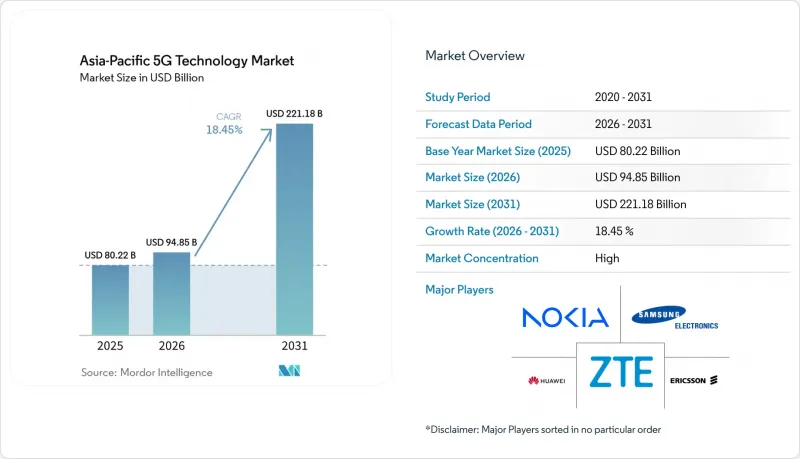
에 의하면, 아시아태평양의 5G 기술 시장 규모는 2025년에 802억 2,000만 달러로 평가되었고, 2026년 948억 5,000만 달러에서 2031년까지 2,211억 8,000만 달러에 이를 것으로 추정되고 있어 예측 기간(2026년-2031년)에 CAGR 18.45%를 기록할 전망입니다.
아시아태평양의 5G 기술 시장 동향 및 인사이트
소비자 및 기업 생태계 전반에 걸친 5G 기기 보급 가속화
5G 지원 기기의 보급으로 인해 아시아태평양의 5G 기술 시장에서 잠재적인 가입자 기반이 확대되고 있습니다. 2025년, 인도에서는 스마트폰 출하량의 90% 이상이 5G를 지원하게 되었으며, 월간 5G 트래픽은 12.9 엑사바이트에 달했습니다. 퀄컴은 2026년 5월, 인도에서 ‘Snapdragon 6Gen 5’ 및 ‘Snapdragon 4Gen 5’ 플랫폼을 발표하며 미드레인지 및 엔트리 레벨 단말기 개발을 지원했습니다. 인도에서는 2026년 1분기에 5G 가입자 수가 5억 건을 돌파했는데, 이는 호환 가능한 단말기가 빠르게 활성 연결로 전환되고 있음을 반영합니다. 동일한 디바이스 공급망은 공장 및 물류 거점에서 사용되는 산업용 IoT 모듈에도 대응할 수 있습니다. 소비자용 및 기업용 기기공급이 결합됨에 따라, 아시아태평양의 5G 기술 시장에서 더욱 광범위한 보급이 촉진되고 있습니다.
네트워크 가상화 및 클라우드 네이티브 코어로의 전환
클라우드 네이티브 코어로의 전환은 통신 사업자들이 아시아태평양의 5G 기술 시장을 구축하고 관리하는 방식을 변화시키고 있습니다. NTT 도코모와 NEC는 2026년 3월, Amazon Web Services(AWS) 상에서 일본 최초의 상용 5G 코어를 가동했습니다. 이 하이브리드 환경에서는 자동화된 네트워크 구축 방식이 채택되었으며, AWS Graviton2 프로세서 도입을 통해 전력 소비를 70% 절감했습니다. 에릭슨은 2026년 3월, 소프트뱅크와 다년간의 계약을 체결하여 클라우드 네이티브 듀얼 모드 5G 기술을 통해 코어 기능을 현대화하기로 했습니다. Tune Talk사는 2026년 1월, 말레이시아에서 클라우드 네이티브 5G 코어 현대화 프로그램의 1단계를 완료했습니다. 이러한 프로젝트들은 통신 사업자의 조달 과정에서 소프트웨어, 통합, 인프라 파트너가 수행하는 역할을 확대하는 것입니다. 또한, 아시아태평양의 5G 기술 시장이 하드웨어 주도형 구축에서 소프트웨어 관리형 네트워크로 전환됨에 따라 운영 역량의 중요성이 더욱 커지고 있습니다.
아시아태평양 국가들 간의 주파수 대역 조화 불균형
주파수 대역의 가용성에 차이가 있다는 점은 아시아태평양의 5G 기술 시장에서 고부가가치 구축을 지연시킬 가능성이 있습니다. 인도네시아와 태국은 기존 위성 서비스 이용으로 인해 3.5GHz 대역에서 제약에 직면해 있습니다. GSMA에 따르면, 아시아태평양 시장에서는 2030년까지 5G의 전면적인 확산을 뒷받침하기 위해 평균 2GHz의 중파 대역 주파수가 필요하다고 합니다. 인도네시아는 2026년에 700 MHz 및 2.6GHz 대역의 주파수 경매를 계획하고 있지만, 향후 3.5GHz 대역의 확보는 용량 확대를 위해 여전히 중요한 과제입니다. 조화로운 주파수 대역에 대한 접근이 제한되면 기업 사용자가 요구하는 성능이 제한될 가능성이 있습니다. 또한, 사설 네트워크 판매나 독립형 코어(stand-alone core)에 대한 투자가 연기될 가능성도 있습니다. 위성 활용 및 기존 네트워크의 재할당에 대한 각국의 노력은 앞으로도 이 지역 전체의 구축 시기를 좌우할 것입니다.
부문 분석
2025년, 하드웨어는 아시아태평양의 5G 기술 시장 점유율의 49.60%를 차지했습니다. 능동형 안테나 유닛, 기지국용 무선 장비, 그리고 고정 무선 액세스(FWA)용 고객 단말 장비가 이러한 위치를 뒷받침하고 있습니다. 중국에서는 2025년 말까지 484만 기의 5G 기지국이 구축되었습니다. 이 도입 대수는 중국 및 기타 지역 시장에서 장비 교체 주기의 규모를 보여줍니다. 통신 사업자가 커버리지를 확대하고 용량을 증강함에 따라 무선 유닛과 안테나는 계속해서 필수적입니다. 또한, 통신 사업자가 FWA(고정 무선 액세스) 서비스를 제공할 때 고객용 장비도 중요합니다. 소프트웨어는 네트워크 기능 가상화(NFV), 분석, AI를 활용한 무선 관리, 그리고 클라우드 네이티브 코어 오케스트레이션을 뒷받침하고 있습니다. MediaTek은 2025년 2월, 3GPP Release 17을 지원하며 최대 12 Gbps의 다운링크 성능과 듀얼 5G SIM 듀얼 액티브 기능을 갖춘 ‘M90 5G-Advanced’ 모뎀을 발표했습니다. 이러한 기능을 통해 디바이스 및 엣지 용도과 관련된 보다 고도화된 서비스를 지원할 수 있게 됩니다.
2026년부터 2031년에 걸쳐 지역별 시장 규모에서 서비스 분야는 연평균 성장률(CAGR) 19.61%로 확대될 것으로 예측됩니다. 매니지드 서비스, 프라이빗 네트워크 통합, 그리고 클라우드 네이티브 코어의 현대화가 이러한 성장을 뒷받침할 것입니다. 오픈 RAN에서는 네트워크 구성 요소가 개별적으로 조달되므로 통합에 대한 요구 사항이 증가할 가능성이 있습니다. 이로 인해 기존에는 단일 벤더 환경 내에서 처리되던 업무가 전문 공급업체로 이전하게 됩니다. 프로바이더는 테스트, 도입, 보안 및 지속적인 네트워크 최적화도 지원할 수 있습니다. 기업 네트워크가 시범 운영에서 본격적인 운영으로 전환됨에 따라 이러한 요구는 더욱 두드러지고 있습니다. 아시아태평양의 5G 기술 업계에서는 무선 계층에서도 치열한 경쟁이 벌어지고 있습니다. 화웨이, 에릭슨, 노키아, ZTE, 삼성은 매시브 MIMO, 맞춤형 실리콘, AI 기반 무선 처리 분야에서 경쟁하고 있습니다. 네트워크 밀도가 높아짐에 따라 장비의 효율성과 수명 주기 비용이 통신 사업자의 선택에 영향을 미치게 될 것입니다.
2025년 시점에서 주파수 대역별로 보면, 서브 6GHz 대역이 지역 전체 5G 기술 점유율의 63.88%를 차지했습니다. 이 대역의 전파 특성 덕분에 고밀도 도시 지역에서 광범위한 커버리지와 대용량 통신이 실현됩니다. 3.5GHz의 n78 대역은 한국, 싱가포르, 말레이시아, 뉴질랜드, 캄보디아에서 상용 서비스에 널리 활용되고 있습니다. 이 대역은 커버리지, 처리량, 그리고 장비의 가용성 측면에서 실용적인 균형을 제공합니다. mm파(mmWave)는 일본과 한국에서 고밀도 시설 및 기업 캠퍼스에 집중적으로 도입되고 있습니다. 이러한 도입을 통해 공장이나 경기장에서의 대용량 이용이 지원되고 있습니다. 통신 사업자들은 지역의 커버리지, 용량 및 주파수 대역 상황에 맞추어 서로 다른 대역을 활용하고 있습니다. 호주와 싱가포르는 2024년에 3G 서비스 종료를 완료했으며, 뉴질랜드는 2026년 초에 2G 및 3G 서비스 종료를 완료했습니다. 이러한 주파수 재할당 과정을 통해 저주파 대역의 주파수 대역을 5G 오버레이에 활용할 수 있게 되었습니다.
하이브리드(서브 6GHz 및 mm파)의 확산은 2026년부터 2031년에 걸쳐 연평균 성장률(CAGR) 19.88%로 확대될 것으로 예측됩니다. 통신 사업자들은 기존 무선 네트워크를 교체하지 않고도 피크 용량을 증강하기 위해 이 접근 방식을 채택하고 있습니다. 이를 통해 통신 사업자들은 서브 6GHz 대역의 광범위한 커버리지를 유지하면서 수요가 가장 높은 지역에 용량을 추가할 수 있게 됩니다. 2026년 5월, 호주에서 옵타스와 에릭슨은 실제 운영 중인 5G 독립형 네트워크에서 2.3GHz 대역과 3.5GHz 대역을 아우르는 180 MHz의 캐리어 어그리게이션 실증 실험을 수행했습니다. 이 실증 실험에서는 시판 단말기를 사용하여 피크 다운링크 속도 3.4Gbps를 달성했습니다. 이 결과는 캐리어 어그리게이션을 통해 기존 주파수 대역 내에서 용량을 향상시킬 수 있음을 보여줍니다. 주파수 대역 통합 및 용량 관리에 있어 소프트웨어 정의 무선(SDR)을 통한 관리의 중요성은 점점 더 커지고 있습니다. 통신 사업자들이 네트워크 이용률 향상을 도모하는 가운데, 아시아태평양의 5G 기술 시장은 이 기능에 의존하게 될 것입니다.
기타 혜택:
- 엑셀 형식 시장 예측(ME) 시트
- 3개월간의 애널리스트 지원
자주 묻는 질문
목차
제1장 서론
- 조사의 전제조건과 시장의 정의
- 조사 범위
제2장 조사 방법
제3장 주요 요약
제4장 시장 구도
- 시장 개요
- 시장 성장 촉진요인
- 시장 성장 억제요인
- 5G 연혁과 진화
- 현재 도입 사이클(선구자, 채택 사람, 후발자)
- 업계 밸류체인 분석
- 규제 상황 및 정책 동향
- 기술 전망
- Porter의 Five Forces 분석
- 5G와 Beyond 5G(6G에의 이치)
- 거시경제 요인이 시장에 미치는 영향
제5장 시장 규모와 성장 예측
- 컴포넌트별
- 주파수대별
- 용도별
- 최종사용자 산업별
- 네트워크 아키텍처별
- 국가별
- 중국
- 일본
- 인도
- 한국
- 호주 및 뉴질랜드
- 기타 아시아태평양 국가
제6장 경쟁 구도
- 시장 집중도
- 전략적 동향
- 시장 점유율 분석
- 기업 개요
- Huawei Technologies Co., Ltd.
- Telefonaktiebolaget LM Ericsson(Ericsson)
- Nokia Corporation
- Qualcomm Incorporated
- Samsung Electronics Co., Ltd.
- ZTE Corporation
- Intel Corporation
- MediaTek Inc.
- Cisco Systems, Inc.
- NEC Corporation
- Fujitsu Limited
- CommScope Holding Company, Inc.
- Rakuten Mobile, Inc.
- Skyworks Solutions, Inc.
- Analog Devices, Inc.
- Juniper Networks, Inc.
- Mavenir plc
- Parallel Wireless, Inc.
- Keysight Technologies, Inc.
제7장 시장 기회와 향후 전망
LSH 26.10.29According to Mordor Intelligence, the Asia-Pacific 5G technology market size was valued at USD 80.22 billion in 2025 and is estimated to grow from USD 94.85 billion in 2026 to reach USD 221.18 billion by 2031, at a CAGR of 18.45% during the forecast period (2026-2031).
Asia-Pacific 5G Technology Market Trends and Insights
Accelerating 5G Device Penetration Across Consumer and Enterprise Ecosystems
5G device availability is widening the addressable subscriber base across the Asia-Pacific 5G technology market. India had more than 90% of smartphone shipments equipped for 5G in 2025, and monthly 5G traffic reached 12.9 exabytes. Qualcomm introduced Snapdragon 6 Gen 5 and Snapdragon 4 Gen 5 platforms in India in May 2026, supporting mid-range and entry-level device development. India exceeded 500 million 5G subscriptions in Q1 2026, which reflects the rapid conversion of compatible devices into active connections. The same device supply chain can support industrial Internet of Things modules used in factories and logistics sites. This link between consumer-scale and enterprise equipment availability supports broader adoption of the Asia-Pacific 5G technology market.
Network Virtualization and Cloud-Native Core Migration
Cloud-native core migration is changing how operators build and manage the Asia-Pacific 5G technology market. NTT DOCOMO and NEC launched Japan's first commercial 5G core on Amazon Web Services in March 2026. The hybrid environment used automated network construction methods and reduced power consumption by 70% through AWS Graviton2 processors. Ericsson signed a multiyear agreement with SoftBank in March 2026 to modernize core functions through cloud-native dual-mode 5G technology. Tune Talk completed the first phase of a cloud-native 5G core modernization program in Malaysia during January 2026. These projects broaden the role of software, integration, and infrastructure partners in operator procurement. They also raise the importance of operational capability as the Asia-Pacific 5G technology market shifts from hardware-led deployment to software-managed networks.
Uneven Spectrum Harmonization Across Asia-Pacific Economies
Uneven spectrum availability can delay higher-value deployments in the Asia-Pacific 5G technology market. Indonesia and Thailand have faced constraints in the 3.5 GHz band because of existing satellite service use. The GSMA states that Asia-Pacific markets need an average of 2 GHz of mid-band spectrum to support full 5G deployment by 2030. Indonesia scheduled auctions for 700 MHz and 2.6 GHz spectrum during 2026, while future 3.5 GHz clearance remains material to capacity expansion. Limited access to harmonized bands can restrict the performance required by enterprise users. It can also postpone private-network sales and standalone core investment. National approaches to satellite use and legacy-network refarming will continue to shape deployment timing across the region.
Other drivers and restraints analyzed in the detailed report include:
- Private 5G for Industrial Automation and Low-Latency Control
- Open RAN Procurement in Cost-Sensitive Markets
- High Power Density and Site Energy Costs in Dense Urban Networks
For complete list of drivers and restraints, kindly check the Table Of Contents.
Segment Analysis
Hardware held 49.60% of the Asia-Pacific 5G technology market share in 2025. Active antenna units, base-station radios, and customer-premise equipment for fixed wireless access support this position. China had deployed 4.84 million 5G base stations by the end of 2025. This installed base shows the scale of the equipment cycle across China and other regional markets. Radio units and antennas remain necessary as operators extend coverage and add capacity. Customer equipment is also important when operators offer FWA services. Software supports network function virtualization, analytics, AI-enabled radio management, and cloud-native core orchestration. MediaTek introduced the M90 5G-Advanced modem in February 2025 with 3GPP Release 17 support, up to 12 Gbps downlink performance, and dual 5G SIM dual-active capability. These capabilities can support more advanced services around devices and edge applications.
Services are projected to expand at a 19.61% CAGR from 2026 to 2031 within the regional segment value. Managed services, private-network integration, and cloud-native core modernization will support this expansion. Open RAN can add integration requirements because network components are sourced separately. This shifts work that was previously handled within a single-vendor environment to specialized providers. Providers can also support testing, deployment, security, and ongoing network optimization. These needs are more visible as enterprise networks move from trials into operational use. The Asia-Pacific 5G technology industry is also seeing strong competition in the radio layer. Huawei, Ericsson, Nokia, ZTE, and Samsung are competing on massive MIMO, custom silicon, and AI-driven radio processing. Equipment efficiency and lifecycle cost will influence operator choices as networks become denser.
Sub-6 GHz held 63.88% of the regional 5G technology share by spectrum band in 2025. Its propagation characteristics support broad coverage and capacity in dense urban areas. The 3.5 GHz n78 band is widely used for commercial services in South Korea, Singapore, Malaysia, New Zealand, and Cambodia. It offers a practical balance of coverage, throughput, and equipment availability. mmWave is concentrated in high-density venues and enterprise campuses in Japan and South Korea. These deployments support high-capacity uses in factories and stadiums. Operators use different bands to meet local coverage, capacity, and spectrum conditions. Australia and Singapore completed 3G shutdowns in 2024, while New Zealand finalized its 2G and 3G shutdowns in early 2026. This refarming process can make lower-frequency spectrum available for 5G overlays.
Hybrid (sub-6 GHz and mmWave) deployments are projected to expand at a 19.88% CAGR from 2026 to 2031. Operators use this approach to add peak capacity without replacing their established radio networks. It allows operators to retain the broad reach of sub-6 GHz and add capacity where demand is highest. Optus and Ericsson demonstrated 180 MHz carrier aggregation across 2.3 GHz and 3.5 GHz bands on a live 5G standalone network in Australia in May 2026. The demonstration reached a peak downlink speed of 3.4 Gbps using commercial devices. This result shows that carrier aggregation can raise capacity within existing spectrum assets. Software-defined radio management is increasingly important for combining bands and managing capacity. The Asia-Pacific 5G technology market will depend on this capability as operators seek higher network utilization.
Complete Report Scope:
- By Component
- Hardware
- Software
- Services
- By Spectrum Band
- Sub-6 GHz
- mmWave
- Hybrid (Sub-6 GHz and mmWave)
- By Application
- Enhanced Mobile Broadband (eMBB)
- Fixed Wireless Access (FWA)
- Massive Machine-Type Communications (mMTC)
- Ultra-Reliable Low-Latency Communications (URLLC)
- By End-User Industry
- Consumer
- Manufacturing
- Healthcare
- Automotive
- Energy and Utilities
- Media and Entertainment
- Public Safety and Defense
- By Network Architecture
- Stand-Alone (SA)
- Non-Stand-Alone (NSA)
- By Country
- China
- Japan
- India
- South Korea
- Australia and New Zealand
- Rest of Asia-Pacific
List of Companies Covered in this Report:
- Huawei Technologies Co., Ltd.
- Telefonaktiebolaget LM Ericsson (Ericsson)
- Nokia Corporation
- Qualcomm Incorporated
- Samsung Electronics Co., Ltd.
- ZTE Corporation
- Intel Corporation
- MediaTek Inc.
- Cisco Systems, Inc.
- NEC Corporation
- Fujitsu Limited
- CommScope Holding Company, Inc.
- Rakuten Mobile, Inc.
- Skyworks Solutions, Inc.
- Analog Devices, Inc.
- Juniper Networks, Inc.
- Mavenir plc
- Parallel Wireless, Inc.
- Keysight Technologies, Inc.
Additional Benefits:
- The market estimate (ME) sheet in Excel format
- 3 months of analyst support
TABLE OF CONTENTS
1 INTRODUCTION
- 1.1 Study Assumptions and Market Definition
- 1.2 Scope of the Study
2 RESEARCH METHODOLOGY
3 EXECUTIVE SUMMARY
4 MARKET LANDSCAPE
- 4.1 Market Overview
- 4.2 Market Drivers
- 4.2.1 Accelerating 5G Device Penetration Across Consumer and Enterprise Ecosystems
- 4.2.2 Network Virtualization and Cloud-Native Core Migration
- 4.2.3 Open RAN Procurement in Cost-Sensitive Markets
- 4.2.4 Private 5G for Industrial Automation and Low-Latency Control
- 4.2.5 5G-Advanced Upgrade Cycles Across Tier-1 Operators
- 4.2.6 Non-Standalone to Stand-Alone Transition to Unlock New Monetization Models
- 4.3 Market Restraints
- 4.3.1 Uneven Spectrum Harmonization Across APAC Economies
- 4.3.2 High Power Density and Site Energy Costs in Dense Urban Networks
- 4.3.3 Cybersecurity and Supply-Chain Trust Concerns in Critical Infrastructure Deployments
- 4.3.4 Delayed Enterprise ROI for Private Network Rollouts
- 4.4 5G Timeline and Evolution
- 4.5 Current Adoption Cycle (Forerunners, Adopters, and Laggards)
- 4.6 Industry Value Chain Analysis
- 4.7 Regulatory and Policy Landscape
- 4.8 Technological Outlook
- 4.9 Porter's Five Forces Analysis
- 4.9.1 Threat of New Entrants
- 4.9.2 Bargaining Power of Suppliers
- 4.9.3 Bargaining Power of Buyers
- 4.9.4 Threat of Substitutes
- 4.9.5 Competitive Rivalry
- 4.10 5G and Beyond (6G Pathways)
- 4.11 Impact of Macroeconomic Factors on the Market
5 MARKET SIZE AND GROWTH FORECASTS (VALUE)
- 5.1 By Component
- 5.1.1 Hardware
- 5.1.2 Software
- 5.1.3 Services
- 5.2 By Spectrum Band
- 5.2.1 Sub-6 GHz
- 5.2.2 mmWave
- 5.2.3 Hybrid (Sub-6 GHz and mmWave)
- 5.3 By Application
- 5.3.1 Enhanced Mobile Broadband (eMBB)
- 5.3.2 Fixed Wireless Access (FWA)
- 5.3.3 Massive Machine-Type Communications (mMTC)
- 5.3.4 Ultra-Reliable Low-Latency Communications (URLLC)
- 5.4 By End-User Industry
- 5.4.1 Consumer
- 5.4.2 Manufacturing
- 5.4.3 Healthcare
- 5.4.4 Automotive
- 5.4.5 Energy and Utilities
- 5.4.6 Media and Entertainment
- 5.4.7 Public Safety and Defense
- 5.5 By Network Architecture
- 5.5.1 Stand-Alone (SA)
- 5.5.2 Non-Stand-Alone (NSA)
- 5.6 By Country
- 5.6.1 China
- 5.6.2 Japan
- 5.6.3 India
- 5.6.4 South Korea
- 5.6.5 Australia and New Zealand
- 5.6.6 Rest of Asia-Pacific
6 COMPETITIVE LANDSCAPE
- 6.1 Market Concentration
- 6.2 Strategic Moves
- 6.3 Market Share Analysis
- 6.4 Company Profiles (includes Global Level Overview, Market Level Overview, Core Segments, Financials as available, Strategic Information, Market Rank/Share, Products and Services, Recent Developments)
- 6.4.1 Huawei Technologies Co., Ltd.
- 6.4.2 Telefonaktiebolaget LM Ericsson (Ericsson)
- 6.4.3 Nokia Corporation
- 6.4.4 Qualcomm Incorporated
- 6.4.5 Samsung Electronics Co., Ltd.
- 6.4.6 ZTE Corporation
- 6.4.7 Intel Corporation
- 6.4.8 MediaTek Inc.
- 6.4.9 Cisco Systems, Inc.
- 6.4.10 NEC Corporation
- 6.4.11 Fujitsu Limited
- 6.4.12 CommScope Holding Company, Inc.
- 6.4.13 Rakuten Mobile, Inc.
- 6.4.14 Skyworks Solutions, Inc.
- 6.4.15 Analog Devices, Inc.
- 6.4.16 Juniper Networks, Inc.
- 6.4.17 Mavenir plc
- 6.4.18 Parallel Wireless, Inc.
- 6.4.19 Keysight Technologies, Inc.
7 MARKET OPPORTUNITIES AND FUTURE OUTLOOK
- 7.1 White-Space and Unmet-Need Assessment


