

|
시장보고서
상품코드
2155604
머신비전 시스템 리스 : 시장 점유율 분석, 업계 동향과 통계, 성장 예측(2026-2031년)Machine Vision System Leasing - Market Share Analysis, Industry Trends & Statistics, Growth Forecasts (2026 - 2031) |
||||||
 Mordor Intelligence
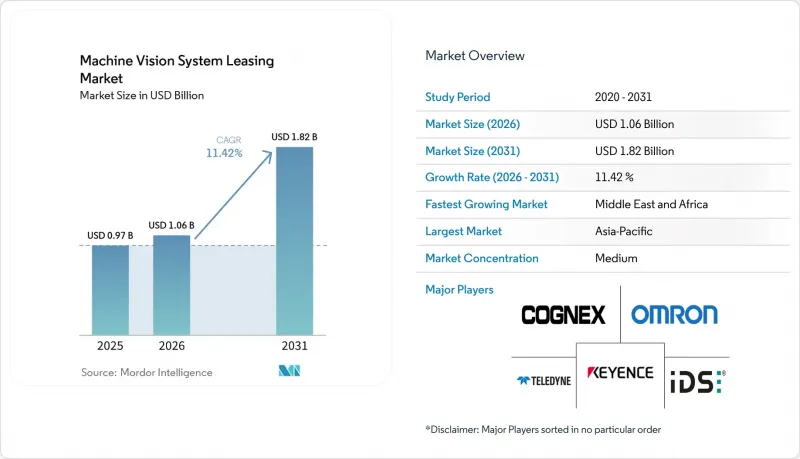
에 따르면 머신비전 시스템 리스 시장 규모는 2026년에 10억 6,000만 달러이며, 2031년까지 18억 2,000만 달러에 달할 것으로 예측되며, 2026년부터 2031년까지 CAGR 11.42%로 확대될 것으로 전망됩니다.
세계 머신비전 시스템 리스 시장의 동향 및 인사이트
인더스트리 4.0, 품질 자동화 및 무결점 제조
현재 무결점 요건은 항공우주 및 자동차 산업에 그치지 않고 반도체 패키징 및 의약품 정제 검사 분야로도 확대되고 있습니다. 머신비전 시스템 리스 시장은 검사 밀도 향상으로 인한 혜택을 누리고 있으며, 생산 기준이 더욱 엄격해짐에 따라 장비 교체가 필요해지고 있습니다. 코그넥스는 2026년 5월, 퀄컴(Qualcomm)의 드래곤윙(DragonWing) 기술을 탑재한 ‘In-Sight 3900 비전 시스템’을 발표했습니다. 이를 통해 외부 PC가 필요 없는 임베디드형 AI 검사가 가능해집니다. 이번 발표는 검사 깊이 및 라인 속도에 대한 대응이 독립적인 컴퓨팅 인프라가 아닌 임베디드 컴퓨팅을 통해 점점 더 실현되고 있음을 보여줍니다. 또한 코그넥스의 ‘OneVision’은 일원적으로 학습된 AI 모델을 지원하며, 여러 거점에 있는 시스템 전체에 배포할 수 있습니다. 따라서 머신비전 시스템의 리스 시장은 단순히 장비 자금 조달 수단으로서뿐만 아니라, 지속적인 품질 개선을 위한 채널로서도 기능할 수 있습니다.
비전 유도형 로봇 공학과 유연한 생산
비전 시스템은 독립된 검사 스테이션이 아니라 로봇 작업 셀에 필수적인 요소로 자리 잡고 있습니다. 국제로봇연맹(IFR) 보고서에 따르면, 2024년 전 세계 로봇 도입 대수는 54만 2,000대를 넘어섰으며, 그 중 70%가 아시아에 집중되어 있습니다. 이러한 도입 대수는 비전 유도, 위치 결정 및 검사 기능에 대한 지속적인 수요를 창출하고 있습니다. Basler사와 Orbbec사는 2026년 3월, AMR, AGV 및 산업용 3D 비전 용도를 위한 ‘Basler Stereo mini’ 카메라를 발표했습니다. 로봇 임대 업체들은 보다 광범위한 설비 계약에 카메라 및 관련 비전 부품을 포함시킬 수 있습니다. 그 결과, 머신비전 시스템 리스 시장은 최신 센서 및 연산 능력을 필요로 하는 유연한 생산 라인으로부터 수요를 확보하게 될 것입니다.
프리미엄 비전 시스템의 높은 총 소유 비용
프리미엄 3D 및 하이퍼스펙트럼 구성은 운영 리스를 통해 확보하더라도 여전히 비용이 많이 들 수 있습니다. 시스템 비용이 높으면 월별 지불액도 높아져, 소규모 고객의 경우 그 지불을 정당화하기 어려울 수 있습니다. 또한, 계약 종료 시 자산 가치가 당초 예상보다 낮을 경우, 리스 회사는 잔존 가치 위험을 부담하게 됩니다. 게다가 서비스 의무로 인해 각 계약에 필요한 자본이 더욱 증가합니다. 독일 리스 협회에 따르면, 자동차 및 화학 부문의 투자 결정 지연에 힘입어 2025년 생산 기계 리스 시장은 5.5% 감소한 49억 6,000만 유로(53억 8,000만 달러)를 기록했다고 보고되었습니다. 머신비전 시스템 리스 시장에서는 북미 및 서유럽 이외의 지역에서 이러한 위험을 관리하기 위해 보다 견고한 중고 장비 유통 채널이 요구되고 있습니다.
부문 분석
2025년, 머신비전 카메라는 장비 유형 부문의 31.23%를 차지했습니다. 이 점유율은 많은 생산 현장에서 산업 자동화, 인라인 검사, 로봇 유도 등에 활용되고 있음을 반영합니다. 카메라는 폭넓은 용도에 대응할 수 있기 때문에 리스 시스템 도입의 출발점이 되는 경우가 많습니다. 고객은 카메라 본체를 리스하고, 광학 시스템이나 조명은 별도로 구매할 수 있습니다. 이러한 접근 방식을 통해 기본적인 도입 시 초기 계약 부담을 줄일 수 있습니다. 머신비전 시스템의 리스 시장은 이러한 모듈식 구조의 혜택을 받고 있습니다. 이는 다양한 기술적 요구 사항에 적합한 계약을 가능하게 하기 때문입니다. 화질이나 시야를 특정 생산 라인에 맞춰 조정해야 하는 패키지의 경우, 광학 시스템과 렌즈가 여전히 중요한 역할을 하고 있습니다. 또한 조명 조건에 따라 카메라가 결함을 일관되게 식별할 수 있는지 여부가 결정되므로, 조명 시스템 역시 여전히 필수적입니다. 비전 처리 장비는 검사 모델을 실행하고 그 결과를 공장의 제어 시스템에 전달하는 데 필요한 연산 능력을 제공합니다.
통합형 비전 시스템은 여러 요소를 단일 솔루션으로 결합한 것으로, 조달 프로세스의 간소화를 중시하는 고객들에게 지지를 받고 있습니다. 이러한 시스템을 통해 하드웨어 공급업체, 통합업체 및 금융 제공업체 간의 조정 부담을 줄일 수 있습니다. 특수 이미징 시스템은 2031년까지 연평균 성장률(CAGR) 12.62%로 확대될 것으로 예측됩니다. 하이퍼스펙트럼, SWIR 및 멀티스펙트럼 플랫폼은 식품 안전 확보, 의약품 선별, 재활용 분야에서 더욱 폭넓게 활용되고 있습니다. Teledyne DALSA는 GigE Vision 및 GenICam 표준을 준수하는 10 GigE 인터페이스를 탑재한 ‘Kaleido’를 설계했습니다. 표준화된 인터페이스를 통해 공급업체와 고객 모두에게 시스템 통합이 간소화됩니다. 머신비전 시스템 리스 시장은 성능이 금세 구식이 될 수 있는 자산을 소유하지 않고도 사용자가 전문 장비를 도입할 수 있도록 돕습니다. 이는 새로운 이미징 기능이 검사 및 선별경제성을 바꿀 가능성이 있는 경우에 중요합니다.
2025년 기준, 2D 이미징은 비전 기술 부문의 65.54%를 차지했습니다. 바코드 판독, 표면 검사, 치수 측정, 라벨 검증 분야에서 여전히 널리 사용되고 있습니다. 이러한 폭넓은 용도로 인해 많은 임대 포트폴리오에서 핵심 기술 기반으로 자리 잡고 있습니다. 또한 2D 시스템은 계약 기간 중 소프트웨어 릴리스를 통해 업데이트할 수도 있습니다. 즉, 고객은 하드웨어의 모든 구성요소를 교체하지 않고도 개선된 검사 로직을 활용할 수 있습니다. 머신비전 시스템 리스 시장에서는 이 모델을 활용하여 최신 소프트웨어 및 시스템 지원에 대한 접근성을 제공하고 있습니다. 1D 이미징은 창고 및 물류 업무에서 보다 제한적인 스캔 및 추적성 역할을 계속해서 담당하고 있습니다. 3D 이미징은 자동차 조립 검증 및 전자기기의 납땜 접합부 검사에서 그 중요성이 커지고 있습니다. 이러한 용도에서는 표준 2D 카메라로는 획득할 수 없는 깊이 정보가 필요합니다.
하이퍼스펙트럼 및 멀티스펙트럼 이미징은 2031년까지 연평균 성장률(CAGR) 12.19%로 확대될 것으로 예측됩니다. 이 기술은 식품 오염 감지, 의약품 정제 코팅 검사, 재활용 재료 선별 등을 지원할 수 있습니다. 기존 카메라보다 더 넓은 파장 범위에 걸친 정보를 분석합니다. 그 결과 얻어지는 데이터를 통해 재료 식별 정확도를 향상시킬 수 있지만, 한편으로는 처리 및 통합에 관한 요구 사항도 추가됩니다. 텔레다인(Teledyne)은 2026년, 시스템 구축 업체가 통합의 복잡성을 줄일 수 있도록 지원하는 플랫폼인 ‘Kaleido’를 발표했습니다. 머신비전 시스템 리스 시장에서는 이러한 용도를 위해 광학 하드웨어와 AI 추론 소프트웨어를 패키지로 묶을 수 있습니다. 이를 통해 장비 이용, 데이터 처리, 지원을 결합한 계약이 탄생합니다. 이러한 구조를 통해 장비 임대와 ‘비전-어-서비스(Vision-as-a-Service)’ 간의 실질적인 차이가 좁혀집니다.
지역별 분석
2025년, 아시아태평양은 지역별 부문의 37.66%를 차지했습니다. 이 지역에는 전자기기 조립, 반도체 제조, 전기자동차(EV) 배터리 생산, 자동차 제조의 주요 거점이 집중되어 있습니다. 중국, 일본, 한국, 인도 및 아세안(ASEAN) 국가들은 각각 다른 산업적 강점을 통해 수요에 기여하고 있습니다. 일본과 한국은 정밀 제조 및 첨단 이미지 처리 기술 도입 환경이 성숙되어 있습니다. 중국의 현지 공급업체 기반은 리스 물량 확대를 뒷받침하고 있지만, 국제적인 공급업체에게는 프리미엄 가격 책정을 저해할 가능성이 있습니다. 인도는 여전히 초기 단계에 있으며, 전자기기 조립, 자동차, 제약 기업들이 검사 워크플로우 혁신을 추진하고 있습니다. TKH 그룹은 2026년 상반기 실적 보고서에서 배터리, FA(공장 자동화), 반도체, 소비자 가전 분야의 수요에 힘입어 머신비전 분야에서 아시아태평양이 큰 기여를 했다고 밝혔습니다. 제조 투자 규모와 속도가 해당 지역의 머신비전 시스템 리스 시장을 뒷받침하고 있습니다.
북미와 유럽은 그 다음으로 중요한 지역 블록이며, 리스 인프라가 확립되어 있습니다. 북미는 성숙한 자산 금융 환경과 자동차, 반도체, 식품 가공 분야의 고도화된 자동화의 혜택을 받고 있습니다. 인건비 및 생산의 국내 복귀(리쇼어링) 계획도 머신비전 장비에 대한 투자를 뒷받침하고 있습니다. 유럽은 산업 자동화의 기반이 탄탄하며, 독일은 여전히 이 분야의 중요한 지표로 자리 잡고 있습니다. 2025년, 독일의 리스 비율은 설비 투자 총액의 26.6%에 달했으며, 신규 계약액은 3.2% 증가한 831억 2,000만 유로(901억 9,000만 달러)를 기록했습니다. 이로 인해 설비 투자 결정이 신중한 경우에도 운영 리스 구조의 활용이 촉진되고 있습니다. 남미는 브라질의 자동차 및 식품 가공 부문에 집중된 비교적 소규모의 수요 기반을 형성하고 있습니다. 이러한 환경에서 리스는 자금 조달 제약이나 환율 변동 위험에 대응하는 수단이 될 수 있습니다.
중동 및 아프리카는 2031년까지 연평균 성장률(CAGR) 12.37%로 확대될 것으로 예측됩니다. 사우디아라비아와 아랍에미리트(UAE)의 산업 다각화 프로그램은 첨단 제조 역량에 대한 수요를 뒷받침하고 있습니다. 리스를 활용하면 시설이 완공될 때까지 영구적인 소유권을 부담하지 않고도 검사 장비를 이용할 수 있습니다. 남아프리카공화국은 광업 관련 및 식품 가공 제조업을 통해 확고한 기반을 제공하고 있습니다. 아프리카 전역의 비즈니스 기회는 여전히 초기 단계에 있지만 긍정적인 방향으로 나아가고 있습니다. 대규모 지역 프로젝트는 대개 국제적인 엔지니어링·조달·건설(EPC) 계약업체에 의해 수행됩니다. 이러한 계약업체들은 현지 판매 대리점이 아닌 전 세계적인 유통 경로를 통해 임대 장비를 조달하는 경우가 있습니다. 따라서 국제적인 공급업체는 현지 자회사에 즉시 투자하지 않고도 머신비전 시스템 리스 시장에 진입할 수 있습니다.
기타 혜택:
- 엑셀 형식의 시장 예측(ME) 시트
- 3개월간의 애널리스트 지원
자주 묻는 질문
목차
제1장 소개
- 조사 가정과 시장 정의
- 조사 범위
제2장 조사 방법
제3장 주요 요약
제4장 시장 구도
- 시장 개요
- 시장 성장 촉진요인
- 시장 성장 억제요인
- 거시경제 요인이 시장에 미치는 영향
- 업계 밸류체인 분석
- 규제 상황
- 기술 전망
- Porter's Five Forces 분석
제5장 시장 규모와 성장 예측
- 기기 유형별
- 비전 기술별
- 용도별
- 리스기간별
- 최종 이용 산업별
- 지역별
- 북미
- 미국
- 캐나다
- 멕시코
- 남미
- 브라질
- 아르헨티나
- 기타 남미 국가
- 유럽
- 독일
- 영국
- 프랑스
- 이탈리아
- 스페인
- 기타 유럽 국가
- 아시아태평양
- 중국
- 일본
- 인도
- 한국
- ASEAN
- 기타 아시아태평양 국가
- 중동 및 아프리카
- 중동
- 사우디아라비아
- 아랍에미리트
- 기타 중동 국가
- 아프리카
- 남아프리카공화국
- 기타 아프리카 국가
- 중동
- 북미
제6장 경쟁 구도
- 시장 집중도
- 전략적 동향
- 시장 점유율 분석
- 기업 개요
- Cognex Corporation
- KEYENCE CORPORATION
- OMRON Corporation
- Basler AG
- Teledyne Technologies Incorporated
- SICK AG
- Zebra Technologies Corporation
- Sony Group Corporation
- IDS Imaging Development Systems GmbH
- TKH Group N.V.
- MVTec Software GmbH
- Allied Vision Technologies GmbH
- Stemmer Imaging AG
- Datalogic S.p.A.
- Baumer Holding AG
- National Instruments Corporation
- NVIDIA Corporation
- Qualcomm Incorporated
- Emerson Electric Co.
- Panasonic Holdings Corporation
제7장 시장 기회와 향후 전망
KSM 26.10.30According to Mordor Intelligence, the machine vision system leasing market size was USD 1.06 billion in 2026 and is forecast to reach USD 1.82 billion by 2031, accelerating at a CAGR of 11.42% over 2026-2031.
Global Machine Vision System Leasing Market Trends and Insights
Industry 4.0 Quality Automation and Zero-Defect Manufacturing
Zero-defect requirements now extend beyond aerospace and automotive into semiconductor packaging and pharmaceutical tablet inspection. The machine vision system leasing market benefits from higher inspection density, which requires equipment that can be refreshed as production thresholds become more demanding. Cognex introduced the In-Sight 3900 Vision System in May 2026, featuring Qualcomm DragonWing technology to enable embedded AI inspection without an external PC. The release showed that inspection depth and line speed are increasingly addressed through embedded computing rather than through separate computing infrastructure. Cognex OneVision also supports centrally trained AI models that can be deployed across systems at several sites. The machine vision system leasing market can therefore serve as a channel for continuous quality improvement, not only as a means of financing equipment.
Vision-Guided Robotics and Flexible Production
Vision systems are becoming integral parts of robot work cells rather than separate inspection stations. The International Federation of Robotics reported more than 542,000 global robot installations in 2024, with 70% in Asia. This installed base creates recurring demand for vision guidance, positioning, and inspection capability. Basler and Orbbec introduced the Basler Stereo mini camera in March 2026 for AMR, AGV, and industrial 3D vision uses. Robot lessors can bundle cameras and related vision components within broader equipment contracts. The machine vision system leasing market consequently gains demand from flexible production lines that need current sensor and compute capability.
High Total Cost of Ownership for Premium Vision Systems
Premium 3D and hyperspectral configurations can remain costly even when acquired through an operating lease. High system costs can translate into monthly payments that smaller customers find difficult to justify. Lessors also bear residual-value risk if an asset's value at the end of the contract is lower than originally expected. Service obligations further increase the capital required for each contract. The German leasing association reported that production-machinery leasing declined by 5.5% to EUR 4.96 billion (USD 5.38 billion) in 2025, amid delayed investment decisions in the automotive and chemical sectors. The machine vision system leasing market needs stronger secondary equipment channels to manage this risk outside North America and Western Europe.
Other drivers and restraints analyzed in the detailed report include:
- AI-Enabled Inspection Across Key Manufacturing Sectors
- Labor Shortages and Demand for Consistent Inspection
- Shortage of Skilled Integrators and Application Engineers
For complete list of drivers and restraints, kindly check the Table Of Contents.
Segment Analysis
Machine vision cameras held 31.23% of the equipment-type segment in 2025. This position reflects their use in industrial automation, inline inspection, and robotic guidance across many production settings. Cameras are often the starting point for a leased system because they can support a wide range of applications. Customers can lease camera bodies while purchasing optics and illumination separately. This approach can lower the initial contractual commitment for basic deployments. The machine vision system leasing market benefits from this modular structure because it supports contracts suited to different technical requirements. Optics and lenses remain important in packages where image quality or field of view must be tailored to a specific line. Illumination systems also remain necessary because lighting conditions can determine whether a camera can consistently identify a defect. Vision processing equipment provides the computing capability needed to run inspection models and communicate results to factory controls.
Integrated vision systems combine several elements in a single offering and appeal to customers who value simpler procurement. These systems can reduce coordination requirements between hardware suppliers, integrators, and finance providers. Specialized imaging systems are projected to expand at a 12.62% CAGR through 2031. Hyperspectral, SWIR, and multispectral platforms are being used more widely in food safety, pharmaceutical sorting, and recycling. Teledyne DALSA designed the Kaleido with a 10 GigE interface that complies with GigE Vision and GenICam standards. Standardized interfaces can simplify system integration for providers and customers. The machine vision system leasing market can help users adopt specialized equipment while avoiding ownership of an asset whose performance may be surpassed quickly. This matters where new imaging capability can change the economics of inspection or sorting.
2D imaging accounted for 65.54% of the vision-technology segment in 2025. It remains widely used for barcode reading, surface inspection, dimensional measurement, and label verification. Its broad role makes it the main technology base for many lease portfolios. 2D systems can also be updated through software releases during the contract period. This means a customer may receive improving inspection logic without replacing every hardware component. The machine vision system leasing market uses this model to offer access to current software and system support. 1D imaging continues to serve narrower scanning and traceability roles in warehouse and logistics operations. 3D imaging has gained relevance in automotive assembly verification and electronics solder-joint inspection. These uses require depth information that cannot be captured through standard 2D cameras.
Hyperspectral and multispectral imaging is projected to expand at a 12.19% CAGR through 2031. This technology can support food contamination detection, pharmaceutical tablet coating checks, and sorting of recycled materials. It analyzes information across a broader range of wavelengths than a conventional camera. The resulting data can improve material distinction, although it also adds processing and integration requirements. Teledyne introduced the Kaleido in 2026 as a platform to help system builders reduce integration complexity. The machine vision system leasing market can package optical hardware with AI inference software for these applications. This creates contracts that combine equipment access, data processing, and support. Such structures narrow the practical difference between equipment leasing and vision-as-a-service.
Complete Report Scope:
- By Equipment Type
- Machine Vision Cameras
- Optics and Lenses
- Illumination Systems
- Vision Processing Equipment
- Integrated Vision Systems
- Specialized Imaging Systems
- By Vision Technology
- 1D Imaging
- 2D Imaging
- 3D Imaging
- Hyperspectral and Multispectral Imaging
- By Application
- Inspection and Quality Control
- Measurement and Metrology
- Identification and Traceability
- Guidance and Positioning
- Defect Detection
- Robotic Vision
- By Lease Duration
- Short-Term
- Medium-Term
- Long-Term
- By End-User Industry
- Automotive and EV
- Electronics and Semiconductor
- Food and Beverage
- Pharmaceuticals and Medical Devices
- Packaging
- Logistics and Warehousing
- Other End-User Industries
- By Geography
- North America
- United States
- Canada
- Mexico
- South America
- Brazil
- Argentina
- Rest of South America
- Europe
- Germany
- United Kingdom
- France
- Italy
- Spain
- Rest of Europe
- Asia-Pacific
- China
- Japan
- India
- South Korea
- ASEAN
- Rest of Asia-Pacific
- Middle East and Africa
- Middle East
- Saudi Arabia
- United Arab Emirates
- Rest of the Middle East
- Africa
- South Africa
- Rest of Africa
- Middle East
- North America
Geography Analysis
Asia-Pacific held 37.66% of the geographic segment in 2025. The region combines major centers for electronics assembly, semiconductor fabrication, EV battery production, and automotive manufacturing. China, Japan, South Korea, India, and ASEAN countries each contribute to demand through different industrial strengths. Japan and South Korea have mature adoption environments for precision manufacturing and advanced imaging. China's local supplier base supports leasing volume but can limit premium pricing for international providers. India remains at an earlier stage, with electronics assembly, automotive, and pharmaceutical companies updating inspection workflows. TKH Group reported a strong Asia-Pacific contribution to machine vision in its H1 2026 results, driven by demand from battery, factory automation, semiconductor, and consumer electronics. The scale and pace of manufacturing investment support the machine vision system leasing market in the region.
North America and Europe are the next major geographic blocks and have established leasing infrastructure. North America benefits from a mature asset-finance environment and higher levels of automation in automotive, semiconductor, and food processing. Labor costs and reshoring plans also support investment in machine vision equipment. Europe has a deep industrial automation base, with Germany remaining an important reference point for the sector. The German leasing quota reached 26.6% of total equipment investment in 2025, while new business rose 3.2% to EUR 83.12 billion (USD 90.19 billion). This supports the use of operating lease structures even when capital investment decisions are cautious. South America represents a smaller demand base concentrated in Brazil's automotive and food-processing sectors. Leasing can address capital-access constraints and currency volatility risk in those settings.
The Middle East and Africa are projected to expand at a 12.37% CAGR through 2031. Industrial diversification programs in Saudi Arabia and the UAE support demand for advanced manufacturing capability. Leasing lets users access inspection equipment without committing to permanent ownership while facilities are being developed. South Africa provides an established base through mining-related and food-processing manufacturing. The broader African opportunity remains in its early stages but is moving in a positive direction. Large regional projects are often delivered by international engineering, procurement, and construction contractors. These contractors may obtain leased equipment through global channels rather than local distributors. The machine vision system leasing market can therefore be accessible to international providers without immediate investment in a local subsidiary.
- Cognex Corporation
- KEYENCE CORPORATION
- OMRON Corporation
- Basler AG
- Teledyne Technologies Incorporated
- SICK AG
- Zebra Technologies Corporation
- Sony Group Corporation
- IDS Imaging Development Systems GmbH
- TKH Group N.V.
- MVTec Software GmbH
- Allied Vision Technologies GmbH
- Stemmer Imaging AG
- Datalogic S.p.A.
- Baumer Holding AG
- National Instruments Corporation
- NVIDIA Corporation
- Qualcomm Incorporated
- Emerson Electric Co.
- Panasonic Holdings Corporation
Additional Benefits:
- The market estimate (ME) sheet in Excel format
- 3 months of analyst support
TABLE OF CONTENTS
1 INTRODUCTION
- 1.1 Study Assumptions and Market Definition
- 1.2 Scope of the Study
2 RESEARCH METHODOLOGY
3 EXECUTIVE SUMMARY
4 MARKET LANDSCAPE
- 4.1 Market Overview
- 4.2 Market Drivers
- 4.2.1 Industry 4.0 Quality Automation and Zero-Defect Manufacturing
- 4.2.2 Vision-Guided Robotics and Flexible Production
- 4.2.3 AI-Enabled Inspection for Electronics, EV Batteries, Food and Pharmaceuticals
- 4.2.4 Labor Shortages and Demand for Consistent Inspection
- 4.2.5 Leasing and Vision-as-a-Service Lowering Upfront Capex
- 4.2.6 Faster Technology Replacement Cycles Favoring Access Over Ownership
- 4.3 Market Restraints
- 4.3.1 High Total Cost of Ownership for Premium Vision Systems
- 4.3.2 Shortage of Skilled Integrators and Application Engineers
- 4.3.3 Uncertain Residual Value of Fast-Obsolescing Vision Assets
- 4.3.4 Data-Residency, Cybersecurity and Model-Liability Concerns
- 4.4 Impact of Macroeconomic Factors on the Market
- 4.5 Industry Value Chain Analysis
- 4.6 Regulatory Landscape
- 4.7 Technological Outlook
- 4.8 Porter's Five Forces Analysis
- 4.8.1 Threat of New Entrants
- 4.8.2 Bargaining Power of Suppliers
- 4.8.3 Bargaining Power of Buyers
- 4.8.4 Threat of Substitutes
- 4.8.5 Intensity of Competitive Rivalry
5 MARKET SIZE AND GROWTH FORECASTS (VALUE)
- 5.1 By Equipment Type
- 5.1.1 Machine Vision Cameras
- 5.1.2 Optics and Lenses
- 5.1.3 Illumination Systems
- 5.1.4 Vision Processing Equipment
- 5.1.5 Integrated Vision Systems
- 5.1.6 Specialized Imaging Systems
- 5.2 By Vision Technology
- 5.2.1 1D Imaging
- 5.2.2 2D Imaging
- 5.2.3 3D Imaging
- 5.2.4 Hyperspectral and Multispectral Imaging
- 5.3 By Application
- 5.3.1 Inspection and Quality Control
- 5.3.2 Measurement and Metrology
- 5.3.3 Identification and Traceability
- 5.3.4 Guidance and Positioning
- 5.3.5 Defect Detection
- 5.3.6 Robotic Vision
- 5.4 By Lease Duration
- 5.4.1 Short-Term
- 5.4.2 Medium-Term
- 5.4.3 Long-Term
- 5.5 By End-User Industry
- 5.5.1 Automotive and EV
- 5.5.2 Electronics and Semiconductor
- 5.5.3 Food and Beverage
- 5.5.4 Pharmaceuticals and Medical Devices
- 5.5.5 Packaging
- 5.5.6 Logistics and Warehousing
- 5.5.7 Other End-User Industries
- 5.6 By Geography
- 5.6.1 North America
- 5.6.1.1 United States
- 5.6.1.2 Canada
- 5.6.1.3 Mexico
- 5.6.2 South America
- 5.6.2.1 Brazil
- 5.6.2.2 Argentina
- 5.6.2.3 Rest of South America
- 5.6.3 Europe
- 5.6.3.1 Germany
- 5.6.3.2 United Kingdom
- 5.6.3.3 France
- 5.6.3.4 Italy
- 5.6.3.5 Spain
- 5.6.3.6 Rest of Europe
- 5.6.4 Asia-Pacific
- 5.6.4.1 China
- 5.6.4.2 Japan
- 5.6.4.3 India
- 5.6.4.4 South Korea
- 5.6.4.5 ASEAN
- 5.6.4.6 Rest of Asia-Pacific
- 5.6.5 Middle East and Africa
- 5.6.5.1 Middle East
- 5.6.5.1.1 Saudi Arabia
- 5.6.5.1.2 United Arab Emirates
- 5.6.5.1.3 Rest of the Middle East
- 5.6.5.2 Africa
- 5.6.5.2.1 South Africa
- 5.6.5.2.2 Rest of Africa
- 5.6.5.1 Middle East
- 5.6.1 North America
6 COMPETITIVE LANDSCAPE
- 6.1 Market Concentration
- 6.2 Strategic Moves
- 6.3 Market Share Analysis
- 6.4 Company Profiles (includes Global Level Overview, Market Level Overview, Core Segments, Financials as available, Strategic Information, Market Rank/Share, Products and Services, Recent Developments)
- 6.4.1 Cognex Corporation
- 6.4.2 KEYENCE CORPORATION
- 6.4.3 OMRON Corporation
- 6.4.4 Basler AG
- 6.4.5 Teledyne Technologies Incorporated
- 6.4.6 SICK AG
- 6.4.7 Zebra Technologies Corporation
- 6.4.8 Sony Group Corporation
- 6.4.9 IDS Imaging Development Systems GmbH
- 6.4.10 TKH Group N.V.
- 6.4.11 MVTec Software GmbH
- 6.4.12 Allied Vision Technologies GmbH
- 6.4.13 Stemmer Imaging AG
- 6.4.14 Datalogic S.p.A.
- 6.4.15 Baumer Holding AG
- 6.4.16 National Instruments Corporation
- 6.4.17 NVIDIA Corporation
- 6.4.18 Qualcomm Incorporated
- 6.4.19 Emerson Electric Co.
- 6.4.20 Panasonic Holdings Corporation
7 MARKET OPPORTUNITIES AND FUTURE OUTLOOK
- 7.1 White-Space and Unmet-Need Assessment


