

|
시장보고서
상품코드
2155608
안과용 현탁액 : 시장 점유율 분석, 업계 동향과 통계, 성장 예측(2026-2031년)Ophthalmic Suspension - Market Share Analysis, Industry Trends & Statistics, Growth Forecasts (2026 - 2031) |
||||||
 Mordor Intelligence
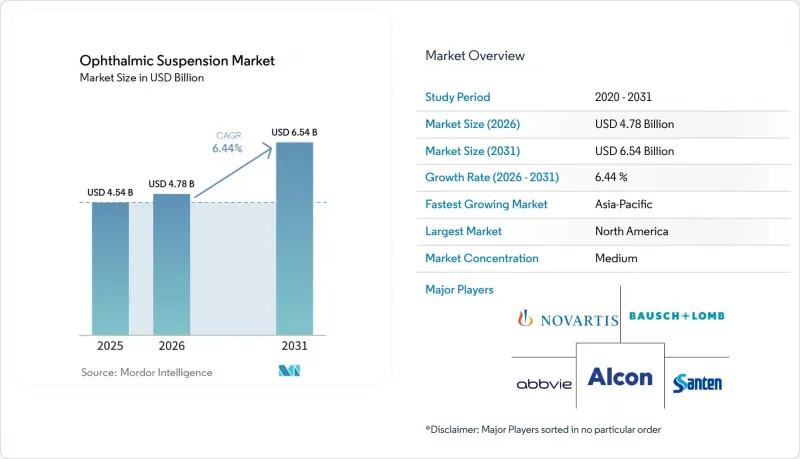
에 따르면 안과용 현탁액 시장은 2025년 45억 4,000만 달러에서 2026년에는 47억 8,000만 달러로 확대되고, 2031년까지 65억 4,000만 달러에 달할 것으로 예상되며, 예측 기간(2026-2031년) 동안 CAGR은 6.44%가 될 전망입니다.
세계 안과용 현탁액 시장의 동향 및 인사이트
안과 감염증 및 염증성 질환의 유병률 증가
세균성 결막염, 각막염, 안검염은 전 세계적으로 국소용 현탁액의 주요 적응증으로 자리 잡고 있습니다. 안과용 현탁액 시장은 1차 진료, 전문 의료 및 외과적 치료 각 분야의 치료 경로를 아우르고 있습니다. 비감염성 질환으로 인한 실명 및 시력 저하의 절대 환자 수는 147.4% 증가했습니다. 당뇨병 환자 및 면역 결핍 환자의 증가로 인해 항생제 및 항염증제에 대한 수요가 높아지고 있습니다. 또한, 백내장 수술 후에는 수술 후 감염 관리가 필요한 명확한 기간이 발생합니다. 전 세계적으로 연간 2,800만 건의 백내장 수술이 시행되고 있으며, 이는 수술 후 프로토콜에서 스테로이드 및 항생제 제제의 지속적인 사용을 뒷받침하고 있습니다.
고령화와 만성 안과 질환의 부담 증가
인구 고령화는 만성 안과 질환 치료법에 대한 장기적인 수요를 뒷받침하고 있습니다. 전 세계 녹내장 환자 수는 1990년부터 2021년까지 86.3% 증가했으며, 해당 연구에 따르면 유병 사례 수는 759만 건에 달했습니다. 동 연구에서는 인구 동태의 변화를 주요 요인으로 꼽으며, 2040년까지 1,180만 건에 달할 것으로 예측하고 있습니다. 70세 이상 성인 중 70-84세 연령층에서는 녹내장 유병률이 연평균 1%의 증가율을 기록했습니다. 개방각 녹내장 치료에는 대부분의 경우 2종류 이상의 점안약이 필요하기 때문에 환자 1인당 치료 수요가 높아집니다. 이러한 장기적인 사용으로 인해 안과용 현탁액 시장은 선택적 의료 분야에 비해 단기적인 경제 상황에 대한 의존도가 낮습니다.
엄격한 무균성, 생물학적 동등성 및 규제 요건
안과용 현탁액은 바이알의 유효 기간 동안 무균성 및 성능을 엄격하게 관리해야 합니다. 생물학적 동등성 평가에서는 입자 크기 분포, 제타 전위의 안정성, 그리고 투여량의 균일성에 대해 검토해야 합니다. 이러한 요건으로 인해 많은 용액 제제에 비해 개발이 더 어려워집니다. 또한 전문적인 제조 능력이 필요하며, 개발 프로그램 기간이 장기화될 가능성도 있습니다. 이러한 규제상의 부담으로 인해 안과용 현탁액 시장에 진입할 수 있는 공급업체의 선택지는 좁아집니다. 또한, 승인을 받은 제조업체가 생산 중단에 직면할 경우, 공급이 더욱 불안정해질 가능성도 있습니다.
부문 분석
2025년, 항생제를 함유한 안과용 현탁액은 35.14%의 시장 점유율을 차지했습니다. 이러한 위상은 1차 의료, 2차 의료 및 외과 의료 각 분야에서 세균성 감염의 치료 및 예방에 대한 수요가 지속되고 있음을 반영합니다. 이 범주에는 아미노글리코사이드계, 플루오로퀴놀론계, 그리고 항생제와 스테로이드의 복합제가 포함됩니다. 항염증성 안과용 현탁액은 계속해서 2위 제품 카테고리를 유지했습니다. 이러한 제품들은 스테로이드에 반응하는 염증성 질환이나, 수 주간 지속될 수 있는 수술 후 코르티코스테로이드 투여 프로토콜로부터 혜택을 받고 있습니다.
녹내장 치료용 안과용 현탁액은 2031년까지 연평균 성장률(CAGR) 6.85%로 성장할 것으로 예측됩니다. 고령화의 진행과 방부제가 첨가되지 않은 프로스타글란딘 제제의 선택지 확대가 이러한 성장률을 뒷받침하고 있습니다. 복합 현탁액은 여러 약물을 사용하는 환자에게 새로운 선택지가 될 것입니다. 한편, 항생제 및 항염증제 제품은 계속해서 제네릭 의약품 개발의 대상이 되고 있습니다. 따라서 안과용 현탁액 시장에는 확립된 감염증 치료 수요와 확대되고 있는 녹내장 치료 기반이 모두 존재하고 있습니다.
2025년에는 항생제가 매출의 37.26%를 차지했습니다. 병원 내 구매, 지역사회 감염성 결막염, 그리고 제네릭 의약품의 광범위한 접근성이 이러한 주도적인 위치를 뒷받침했습니다. 저렴한 단가는 공공 의료 제도를 통한 이러한 제품의 조달을 용이하게 합니다. 코르티코스테로이드는 급성 염증 및 수술 후 관리 분야에서 여전히 또 다른 주요 치료제 군으로 자리 잡고 있습니다. 또한 푸사리움 및 칸디다에 의한 각막염이 미충족 의료 수요가 있는 개발도상국 시장에서는 항진균제도 여전히 중요한 역할을 하고 있습니다.
녹내장 치료제는 2031년까지 연평균 성장률(CAGR) 7.12%로 성장할 것으로 예상됩니다. 현재 그 개발은 기존에 확립된 프로스타글란딘 유사체나 베타 차단제의 범위를 넘어 확장되고 있습니다. 암니르(Amnir)사는 2025년 9월 비마토프로스트 점안액 0.01%에 대해 FDA 승인을 획득했습니다. 이 제품은 2025년 7월 기준 미국 시장에서 연간 6억 8,500만 달러 규모의 시장 기회를 창출할 것으로 예상되었습니다. 이러한 움직임은 안과용 현탁액 시장에서 만성 녹내장 치료가 혁신적인 제약 기업과 제네릭 의약품 제조사 모두에게 중요함을 보여줍니다.
지역별 분석
2025년, 북미는 매출의 47.36%를 차지했습니다. 보험 환급 제도, 전문의 확보, 그리고 기존 브랜드 제품에서 제네릭으로의 전환이 이러한 선도적 지위를 뒷받침했습니다. 미국은 브랜드 제품 및 제네릭 안과용 현탁액 모두에서 여전히 최대 시장으로 자리 잡고 있습니다. 미국의 생물학적 동등성 요건이 큰 영향력을 행사하기 때문에 FDA의 제네릭 승인 절차는 전 세계 개발 계획에 영향을 미칩니다. 따라서 북미는 대규모 보험 적용 치료 기반과 활발한 제네릭 경쟁을 동시에 갖추고 있습니다.
유럽은 계속해서 2위 지역 클러스터로 자리매김했습니다. 독일, 영국, 프랑스, 이탈리아, 스페인에서는 오리지널 의약품 및 제네릭 안과용 제품에 대한 확고한 수요가 있습니다. 이 지역은 방부제 무첨가 임상 기준을 조기에 채택해 왔습니다. 산텐은 유럽에서의 개발 활동에 이어 2024년 12월 한국 및 베트남에서 STN1013001에 대한 허가를 신청했습니다. 유럽 국가들에서는 보험사의 급여 범위와 제네릭의 시장 침투율이 여전히 가격 책정에서 중요한 요소로 작용하고 있습니다.
아시아태평양은 2031년까지 연평균 성장률(CAGR) 10.33%로 확대될 것으로 예측됩니다. 인구 규모, 전문 의료 서비스 보급률의 낮음, 그리고 의료 투자가 이 지역의 성장을 뒷받침하고 있습니다. 중국은 보다 진보된 녹내장 치료제에 대한 규제 환경 정비가 진행되고 있음을 보여주고 있습니다. 중동 및 아프리카 및 남미는 안과용 현탁액 시장에서 여전히 규모가 작고 발전 중인 지역입니다. 중동 및 아프리카에서는 GCC 국가들이 전문 클리닉 구축을 주도하고 있는 반면, 브라질에서는 처방전 보험 적용 범위 확대를 통해 남미의 수요를 뒷받침하고 있습니다.
기타 혜택:
- 엑셀 형식의 시장 예측(ME) 시트
- 3개월간의 애널리스트 지원
자주 묻는 질문
목차
제1장 소개
- 조사 가정과 시장 정의
- 조사 범위
제2장 조사 방법
제3장 주요 요약
제4장 시장 구도
- 시장 개요
- 시장 성장 촉진요인
- 시장 성장 억제요인
- 공급/밸류체인 분석
- 규제 상황
- 기술 전망
- Porter's Five Forces 분석
제5장 시장 규모와 성장 예측
- 제품 유형별
- 치료 분야별
- 용도별
- 유통 채널별
- 지역별
- 북미
- 미국
- 캐나다
- 멕시코
- 유럽
- 독일
- 영국
- 프랑스
- 이탈리아
- 스페인
- 기타 유럽 국가
- 아시아태평양
- 중국
- 일본
- 인도
- 호주
- 한국
- 기타 아시아태평양 국가
- 중동 및 아프리카
- GCC
- 남아프리카공화국
- 기타 중동 및 아프리카 국가
- 남미
- 브라질
- 아르헨티나
- 기타 남미 국가
- 북미
제6장 경쟁 구도
- 시장 집중도
- 시장 점유율 분석
- 기업 개요
- AbbVie Inc.(Allergan)
- Alcon Inc.
- Apotex Inc.
- Bausch+Lomb Corporation
- Bayer AG
- Cipla Limited
- Formosa Pharmaceuticals, Inc.
- Harrow, Inc.
- Hikma Pharmaceuticals PLC
- Kala Pharmaceuticals, Inc.
- Lupin Limited
- Merck & Co., Inc.
- Novartis AG
- Ocular Therapeutix, Inc.
- Otsuka Pharmaceutical Co., Ltd.
- Pfizer Inc.
- Sanofi
- Santen Pharmaceutical Co., Ltd.
- Sun Pharmaceutical Industries Ltd.
- Teva Pharmaceutical Industries Ltd.
제7장 시장 기회와 향후 전망
KSM 26.10.30According to Mordor Intelligence, the ophthalmic suspension market is expected to grow from USD 4.54 billion in 2025 to USD 4.78 billion in 2026 to reach USD 6.54 billion by 2031, at a CAGR of 6.44% during the forecast period (2026-2031).
Global Ophthalmic Suspension Market Trends and Insights
Rising Prevalence of Ocular Infections and Inflammatory Disorders
Bacterial conjunctivitis, keratitis, and blepharitis remain high-volume uses for topical suspensions worldwide. The ophthalmic suspension market serves treatment pathways in primary care, specialist care, and surgical settings. Absolute cases of blindness and vision loss caused by noncommunicable diseases increased 147.4%.Diabetic and immunocompromised populations add to the need for antibiotic and anti-inflammatory products. Cataract surgery also creates a defined period for post-operative infection management. It identifies 28 million cataract procedures annually worldwide, which supports recurring use of steroid-antibiotic products in post-operative protocols.
Aging Population and Higher Chronic Eye-Disease Burden
Population aging supports long-term demand for therapies used in chronic eye disease. Global glaucoma cases increased 86.3% from 1990 to 2021 and reached 7.59 million prevalent cases in the source study. The same study projected 11.8 million cases by 2040, with demographic change as the primary factor. Among adults aged 70 years and older, the 70-84 age group recorded a 1% average annual increase in glaucoma prevalence. Open-angle glaucoma often requires 2 or more topical medicines, which raises the treatment need per patient. This chronic use makes the ophthalmic suspension market less dependent on short-term economic conditions than elective care categories.
Stringent Sterility, Bioequivalence, and Regulatory Requirements
Ophthalmic suspensions require close control of sterility and performance across the life of the vial. Bioequivalence work must address particle size distribution, zeta potential stability, and dose uniformity. These requirements make development more demanding than for many solution formulations. They also require specialized manufacturing capacity and can extend development programs. The regulatory burden narrows the pool of suppliers that can enter the ophthalmic suspension market. It may also leave supply more exposed when an approved manufacturer faces a production interruption.
Other drivers and restraints analyzed in the detailed report include:
- Demand for Preservative-Free and Patient-Centric Formulations
- Combination and Advanced Drug-Delivery Innovation
- Generic Price Erosion, Counterfeit Risk, and API Supply Disruptions
For complete list of drivers and restraints, kindly check the Table Of Contents.
Segment Analysis
Antibiotic ophthalmic suspensions held 35.14% share in 2025. Their position reflects continued demand for bacterial infection treatment and prophylaxis across primary, secondary, and surgical care. The category includes aminoglycosides, fluoroquinolones, and antibiotic-steroid combinations. Anti-inflammatory suspensions remained the second-largest product category. They benefit from steroid-responsive inflammatory conditions and post-operative corticosteroid protocols that can continue for several weeks.
Anti-glaucoma ophthalmic suspensions are forecasted to grow at a 6.85% CAGR through 2031. Aging populations and a larger choice of preservative-free prostaglandin products support this rate. Combination suspensions offer an additional path for patients who use more than 1 agent. At the same time, antibiotic and anti-inflammatory products remain subject to generic development activity. The ophthalmic suspension market therefore has both established infection demand and a growing glaucoma treatment base.
Antibiotics accounted for 37.26% of revenue in 2025. Hospital purchasing, community-acquired conjunctivitis, and broad generic availability supported their leading position. Accessible unit costs can help public health systems procure these products. Corticosteroids remained another major therapeutic class for acute inflammation and post-surgical care. Antifungals also remain relevant in developing markets where Fusarium and Candida keratitis create an unmet need.
Antiglaucoma agents are expected to grow at a 7.12% CAGR through 2031. Their development now extends beyond established prostaglandin analogs and beta-blockers. Amneal received FDA approval for bimatoprost ophthalmic solution 0.01% in September 2025. This product addressed a USD 685 million annual U.S. opportunity in July 2025. These actions show that chronic glaucoma treatment is important to both innovators and generic suppliers in the ophthalmic suspension market.
Complete Report Scope:
- By Product Type
- Antibiotic Ophthalmic Suspensions
- Anti-Inflammatory Ophthalmic Suspensions
- Anti-Glaucoma Ophthalmic Suspensions
- Lubricant and Tear-Substitute Suspensions
- Combination Ophthalmic Suspensions
- Other Product Types
- By Therapeutic Class
- Corticosteroids
- Non-Steroidal Anti-Inflammatory Drugs
- Antibiotics
- Antifungals and Antivirals
- Antiglaucoma Agents
- Other Therapeutic Classes
- By Application
- Infectious Eye Diseases
- Inflammatory Eye Conditions
- Glaucoma Management
- Dry Eye and Ocular-Surface Disease
- Allergic Conjunctivitis
- Other Applications
- By Distribution Channel
- Hospital Pharmacies
- Retail Pharmacies
- Online Pharmacies
- By Geography
- North America
- United States
- Canada
- Mexico
- Europe
- Germany
- United Kingdom
- France
- Italy
- Spain
- Rest of Europe
- Asia-Pacific
- China
- Japan
- India
- Australia
- South Korea
- Rest of Asia-Pacific
- Middle East and Africa
- GCC
- South Africa
- Rest of Middle East and Africa
- South America
- Brazil
- Argentina
- Rest of South America
- North America
Geography Analysis
North America held 47.36% of revenue in 2025. Reimbursement structures, specialist availability, and established branded-to-generic conversion supported its leading position. The United States remained the largest national setting for both branded and generic ophthalmic suspensions. FDA generic pathways affect global development plans because U.S. bioequivalence requirements are influential. North America therefore combines a large, reimbursed treatment base with active generic competition.
Europe remained the second-largest regional cluster. Germany, the United Kingdom, France, Italy, and Spain provide established demand for originator and generic ocular products. The region has been an earlier adopter of preservative-free clinical standards. Santen filed applications for STN1013001 in South Korea and Vietnam in December 2024 after development activity in Europe. Payer coverage and generic penetration remain important to pricing in European countries.
Asia-Pacific is projected to expand at a 10.33% CAGR through 2031. Population scale, lower specialist-care penetration, and health care investment support regional growth. China illustrates the development of the regulatory environment for more advanced glaucoma products. The Middle East and Africa and South America remain smaller developing areas within the ophthalmic suspension market. GCC countries lead specialist clinic development in the Middle East and Africa, while Brazil supports South American demand through growing prescription insurance coverage.
- Abbvie
- Alcon
- Apotex
- Bausch + Lomb Corporation
- Bayer
- Cipla
- Formosa Pharmaceuticals, Inc.
- Harrow, Inc.
- Hikma Pharmaceuticals
- Kala Pharmaceuticals, Inc.
- Lupin
- Merck
- Novartis
- Ocular Therapeutix, Inc.
- Otsuka
- Pfizer
- Sanofi
- Santen Pharmaceuticals
- Sun Pharmaceuticals Industries
- Teva Pharmaceutical Industries
Additional Benefits:
- The market estimate (ME) sheet in Excel format
- 3 months of analyst support
TABLE OF CONTENTS
1 Introduction
- 1.1 Study Assumptions and Market Definition
- 1.2 Scope of the Study
2 Research Methodology
3 Executive Summary
4 Market Landscape
- 4.1 Market Overview
- 4.2 Market Drivers
- 4.2.1 Rising Prevalence of Ocular Infections and Inflammatory Disorders
- 4.2.2 Aging Population and Higher Chronic Eye-Disease Burden
- 4.2.3 Growth in Cataract, Refractive, and Other Ophthalmic Procedures
- 4.2.4 Expansion of Eye-Care Access and Specialist Clinics in Emerging Markets
- 4.2.5 Demand for Preservative-Free and Patient-Centric Formulations
- 4.2.6 Combination and Advanced Drug-Delivery Innovation
- 4.3 Market Restraints
- 4.3.1 Formulation Stability, Sedimentation, and Dose-Uniformity Challenges
- 4.3.2 Stringent Sterility, Bioequivalence, and Regulatory Requirements
- 4.3.3 Ocular Irritation and Preservative-Toxicity Concerns
- 4.3.4 Generic Price Erosion, Counterfeit Risk, and API Supply Disruptions
- 4.4 Supply/Value Chain Analysis
- 4.5 Regulatory Landscape
- 4.6 Technological Outlook
- 4.7 Porter's Five Forces Analysis
- 4.7.1 Threat of New Entrants
- 4.7.2 Bargaining Power of Suppliers
- 4.7.3 Bargaining Power of Buyers
- 4.7.4 Threat of Substitutes
- 4.7.5 Competitive Rivalry
5 Market Size & Growth Forecasts (Value, USD)
- 5.1 By Product Type
- 5.1.1 Antibiotic Ophthalmic Suspensions
- 5.1.2 Anti-Inflammatory Ophthalmic Suspensions
- 5.1.3 Anti-Glaucoma Ophthalmic Suspensions
- 5.1.4 Lubricant and Tear-Substitute Suspensions
- 5.1.5 Combination Ophthalmic Suspensions
- 5.1.6 Other Product Types
- 5.2 By Therapeutic Class
- 5.2.1 Corticosteroids
- 5.2.2 Non-Steroidal Anti-Inflammatory Drugs
- 5.2.3 Antibiotics
- 5.2.4 Antifungals and Antivirals
- 5.2.5 Antiglaucoma Agents
- 5.2.6 Other Therapeutic Classes
- 5.3 By Application
- 5.3.1 Infectious Eye Diseases
- 5.3.2 Inflammatory Eye Conditions
- 5.3.3 Glaucoma Management
- 5.3.4 Dry Eye and Ocular-Surface Disease
- 5.3.5 Allergic Conjunctivitis
- 5.3.6 Other Applications
- 5.4 By Distribution Channel
- 5.4.1 Hospital Pharmacies
- 5.4.2 Retail Pharmacies
- 5.4.3 Online Pharmacies
- 5.5 By Geography
- 5.5.1 North America
- 5.5.1.1 United States
- 5.5.1.2 Canada
- 5.5.1.3 Mexico
- 5.5.2 Europe
- 5.5.2.1 Germany
- 5.5.2.2 United Kingdom
- 5.5.2.3 France
- 5.5.2.4 Italy
- 5.5.2.5 Spain
- 5.5.2.6 Rest of Europe
- 5.5.3 Asia-Pacific
- 5.5.3.1 China
- 5.5.3.2 Japan
- 5.5.3.3 India
- 5.5.3.4 Australia
- 5.5.3.5 South Korea
- 5.5.3.6 Rest of Asia-Pacific
- 5.5.4 Middle East and Africa
- 5.5.4.1 GCC
- 5.5.4.2 South Africa
- 5.5.4.3 Rest of Middle East and Africa
- 5.5.5 South America
- 5.5.5.1 Brazil
- 5.5.5.2 Argentina
- 5.5.5.3 Rest of South America
- 5.5.1 North America
6 Competitive Landscape
- 6.1 Market Concentration
- 6.2 Market Share Analysis
- 6.3 Company Profiles (includes Global level Overview, Market level overview, Core Segments, Financials as available, Strategic Information, Market Rank/Share for key companies, Products & Services, Recent Developments)
- 6.3.1 AbbVie Inc. (Allergan)
- 6.3.2 Alcon Inc.
- 6.3.3 Apotex Inc.
- 6.3.4 Bausch + Lomb Corporation
- 6.3.5 Bayer AG
- 6.3.6 Cipla Limited
- 6.3.7 Formosa Pharmaceuticals, Inc.
- 6.3.8 Harrow, Inc.
- 6.3.9 Hikma Pharmaceuticals PLC
- 6.3.10 Kala Pharmaceuticals, Inc.
- 6.3.11 Lupin Limited
- 6.3.12 Merck & Co., Inc.
- 6.3.13 Novartis AG
- 6.3.14 Ocular Therapeutix, Inc.
- 6.3.15 Otsuka Pharmaceutical Co., Ltd.
- 6.3.16 Pfizer Inc.
- 6.3.17 Sanofi
- 6.3.18 Santen Pharmaceutical Co., Ltd.
- 6.3.19 Sun Pharmaceutical Industries Ltd.
- 6.3.20 Teva Pharmaceutical Industries Ltd.
7 Market Opportunities & Future Outlook
- 7.1 White-space & Unmet-need Assessment


