

|
시장보고서
상품코드
2155619
방화재 : 시장 점유율 분석, 업계 동향과 통계, 성장 예측(2026-2031년)Fire Stopping Materials - Market Share Analysis, Industry Trends & Statistics, Growth Forecasts (2026 - 2031) |
||||||
 Mordor Intelligence
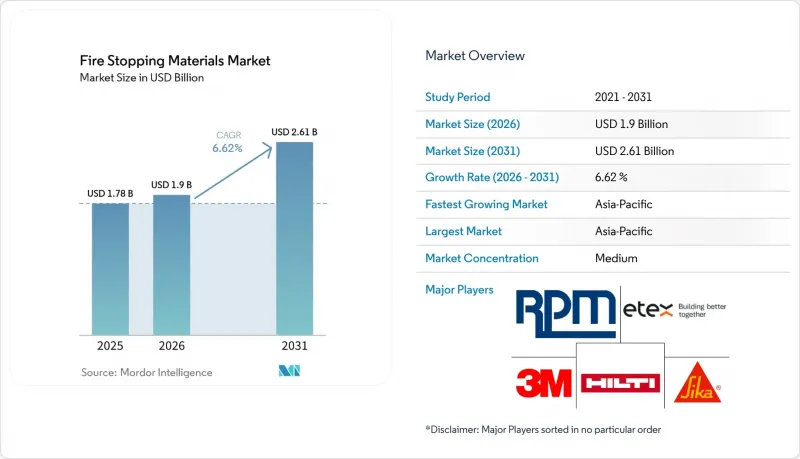
에 따르면 방화재 시장 규모는 2025년에 17억 8,000만 달러로 평가되며, 2026년 19억 달러에서 2031년까지 26억 1,000만 달러에 달할 것으로 추정되며, 예측 기간(2026-2031년) 동안 CAGR은 6.62%가 될 전망입니다.
세계 방화재 시장의 동향 및 인사이트
방화 규제의 엄격화와 집행 강화
2025년 4월, 언더라이터스 래버러토리즈(UL) 1479 제4판이 발간되어 관통부용 방화·방수 시스템의 성능 기준이 상향 조정되었습니다. 제조사는 해당 시스템에 대한 인증을 재취득해야 하며, 이에 따라 상업용 사양서에서 최신 시험 결과의 중요성이 더욱 커졌습니다. 또한, 국제 건축 기준(IBC) 요건에 따라 관련 프로젝트에서 지정된 조건 하에 방화·방수 시스템을 설치하고 검사해야 합니다. 이러한 요건으로 인해 프로젝트가 문서화된 검사 대상이 되는 경우, 시험을 거치지 않은 충전재를 사용할 수 있는 범위가 좁아지고 있습니다. 인도의 SP 7:2026에서는 데이터센터 전용 용도 구분이 도입되고, 방화 안전 규정이 갱신됨에 따라 신축 건물에서의 구획화 계획의 중요성이 더욱 높아졌습니다. 주요 건설 지역에서 ASTM, UL, EN의 시험 방법이 채택되고 있는 점도 공급업체에게 있어 폭넓은 인증 범위의 중요성을 높이고 있습니다. 이는 건축 기준의 시행과 프로젝트 문서화가 점차 체계화되고 있는 방화재 시장을 뒷받침하는 요소입니다.
고층 건축 및 인프라 건설
고층 빌딩에는 내화벽이나 내화 바닥을 관통하는 여러 서비스 라이저, 계단실 및 배전 경로가 존재합니다. 각 개구부에는 하부 구조, 관통물 및 조립체의 내화 등급에 부합하는, 시험을 거친 방화·방수 구성이 필요합니다. 지하철 시스템, 공항, 터널에도 밀집된 난방, 환기, 공조, 신호 및 전력 네트워크가 존재합니다. 따라서 이러한 프로젝트에서는 복잡성이 낮은 구조물에 비해 1제곱피트당 방화·방수 공사의 양이 많아집니다. 인도의 SP 7:2026에서는 일부 용도 구분에 대해 방화 기준이 조정되어, 공공 시설 건설에 있어 방화 계획의 중요성이 더욱 높아졌습니다. 고층 건축물에서는 표준적인 1시간 내화 성능을 가진 조립식 구조가 아닌, 2시간 또는 4시간 내화 성능을 갖춘 시스템이 필요한 경우가 많아지고 있습니다. 이에 따라 더 높은 성능 요건을 충족하고 시공 가치가 높은 제품에 대한 수요가 증가하고 있습니다.
인증 시스템과 시공 비용 부담
인증 시스템은 인증된 자재의 사용, 숙련된 시공, 그리고 프로젝트에 따라 제3자에 의한 검사가 필요하기 때문에 일반적인 건축용 충진재보다 비용이 높습니다. 시공 시에는 개구부와 관통부의 조합에 대해 시험을 거친 구성에 따라야 합니다. 건축 기준의 시행이 일관되지 않은 경우, 저비용이면서 내화 성능 인증을 받지 않은 발포재나 매스틱 제품이 사용될 여지가 생깁니다. 이로 인해 신축 건물에서 관통부의 총 수에 비해 인증 제품의 수요가 완전히 일치하지 않을 위험이 발생합니다. 또한, UL 1479의 2025년 개정판에서는 시스템 재인증이 의무화되어, 이에 따라 시험소에서 진행하는 시험 및 문서화에 드는 비용이 증가했습니다. 대형 공급업체는 이러한 비용을 광범위한 제품 포트폴리오에 분산시킬 수 있지만, 중소기업에게는 더 큰 부담이 될 가능성이 있습니다. 이러한 제약은 신흥 건설 지역의 가격에 민감한 주택 및 소규모 상업 프로젝트에서 가장 두드러지게 나타나고 있습니다.
부문 분석
실란트는 케이블 번들, 배관, 덕트, 건축 이음매 등 폭넓게 사용할 수 있어 2025년 방화 밀봉재 시장 점유율의 31.24%를 차지했습니다. 다양한 기질에 대응할 수 있는 유연성 덕분에 상업 시설, 산업 시설, 주거 시설에서 폭넓게 활용되고 있습니다. 팽창성 실란트는 열에 의해 팽창하여, 가연성 배관이나 케이블 재료가 연화될 때 발생하는 개구부를 막는 데 도움이 됩니다. 2025년 UL 1479 규격의 개정에 따라, 인증된 관통부 방화 시스템에서 시험을 거친 배합의 중요성이 높아졌습니다. 저휘발성 유기화합물(VOC) 및 할로겐 프리 제품은 의료, 교육, 공공 건물에서 중요하게 여겨지고 있습니다. 이러한 구매자들은 환경 친화적인 조달 요건을 방화 안전 사양과 조화시키는 경향을 보입니다. 모르타르는 압축 강도와 치수 안정성이 중요한 고하중 기계 설비나 배관의 관통부에서 여전히 중요한 역할을 하고 있습니다.
보드 시장은 2031년까지 연평균 성장률(CAGR) 7.07%로 확대될 것으로 예측됩니다. 데이터센터나 대규모 상업 시설에서는 초기 설치 후 케이블 경로가 변경될 가능성이 있는 구간에 보드가 사용되고 있습니다. 재밀봉이 가능한 형태라면, 영구적인 밀봉 부위 전체를 제거하고 재시공하지 않고도 변경이 가능합니다. 또한, 콘크리트 타설 전에 설치할 수 있기 때문에 새로운 상업 시설이나 데이터센터 프로젝트에서 매립형 장치의 사용도 증가하고 있습니다. 컬러는 금속 배관이 플라스틱 배수관으로 대체되고 있는 아시아태평양의 주거용 고층 빌딩에서 중요한 역할을 하고 있습니다. 랩, 스트립, 퍼티, 퍼티 패드는 특수 케이블 트레이나 외장 케이블 용도로 사용되고 있습니다.
지역별 분석
아시아태평양은 2025년에 방화재 시장의 44.58%를 차지했으며, 2031년까지 연평균 성장률(CAGR) 7.16%로 확대될 것으로 전망됩니다. 중국, 인도, 한국, 일본 및 동남아시아 국가연합(ASEAN) 국가들에서는 도시 건설 및 건축 기준의 변경으로 인해 수요가 뒷받침되고 있습니다. 인도의 SP 7:2026에서는 데이터센터 전용 용도 구분 및 추가 구획화 규정이 도입되었습니다. 중국의 고층 주택 및 상업 건축은, 특히 플라스틱 배수관이 사용되는 경우, 컬러 및 실란트의 사용을 지속적으로 뒷받침하고 있습니다. 베트남, 인도네시아, 필리핀에서는 고밀도 이용 구조물에서 발생한 사고를 계기로 건축 방화 규정이 강화되고 있습니다. 일본과 한국에서는 내진 및 방화 안전 요건의 결합으로 인해 높은 수준의 사양에 대한 수요가 뒷받침되고 있습니다. 이러한 상황은 상업 및 공공 시설 프로젝트에서 더 높은 내화 성능을 갖춘 관통부 시스템에 대한 수요를 촉진하고 있습니다.
북미는 방화재 시장에서 성숙한 지역으로, 건축 기준에 기반한 사양과 문서화된 시공 워크플로가 널리 채택되고 있습니다. 프로젝트 초기 단계부터 설비 개구부를 조정하기 위해 빌딩 정보 모델링(BIM)이 널리 활용되고 있습니다. 관련 고층 건축물 및 위험 범주에 해당하는 프로젝트에 대한 국제 건축 기준(IBC)의 검사 요건으로 인해, 문서화된 인증 시스템의 필요성이 더욱 높아지고 있습니다. 데이터센터 건설의 경우, 시설 내에 대규모 전력 및 데이터 배선이 필요하기 때문에 전기 관통부에 대한 수요가 뒷받침되고 있습니다. 캐나다에서는 CAN/ULC-S115를 통해 미국의 요건과 밀접하게 부합하고 있으며, 지역 전체에서 유사한 제품 요건이 요구되고 있습니다. 멕시코에서는 급속히 성장하는 도시에서 상업용 건축 수요가 증가하고 있지만, 규제 시행 상황은 일관되지 않습니다. 데이터센터와 공공 시설이 혼재되어 있는 점이 고품질의 방화·방수 솔루션에 대한 수요를 뒷받침하고 있습니다.
유럽에서는 건설 제품 규정 요건 및 관통·접합 시스템에 관한 EN 1366 시험 시리즈가 기준으로 적용되고 있습니다. 영국에서는 국내 규격인 BS 476의 분류 체계에서 ‘승인 문서 B(Approved Document B)’에 기반한 EN 13501 시리즈의 분류 체계로 전환되고 있으며, 이에 따라 기존 제품 선정에 대한 재검토가 촉진될 것으로 예상됩니다. 독일, 프랑스 및 북유럽 국가에서는 규정 준수 체계가 견고하며, 공공 조달 분야에서 저휘발성 유기화합물(VOC) 함유 제품에 대한 수요가 증가하고 있습니다. 남미 시장은 여전히 규모는 작지만, 브라질과 아르헨티나의 상업 건축 확대에 따라 성장을 이어가고 있습니다. Sika AG는 2026년 2월, 아르헨티나와 콜롬비아에 제조 시설을 개설하여 해당 지역의 생산 체제를 강화했습니다. 중동 및 아프리카 시장은 데이터센터, 병원, 복합 용도 타워 등을 포함하는 사우디아라비아의 ‘비전 2030’ 프로젝트에 힘입어 성장하고 있습니다. 지역별 인증 획득과 기술 지원을 결합한 공급업체는 이러한 발전 중인 유통 시장에서 비즈니스 기회를 얻을 수 있습니다.
기타 혜택:
- 엑셀 형식의 시장 예측(ME) 시트
- 3개월간의 애널리스트 지원
자주 묻는 질문
목차
제1장 소개
- 조사 가정과 시장 정의
- 조사 범위
제2장 조사 방법
제3장 주요 요약
제4장 시장 구도
- 시장 개요
- 시장 성장 촉진요인
- 시장 성장 억제요인
- 밸류체인 분석
- Porter's Five Forces 분석
제5장 시장 규모와 성장 예측
- 유형별
- 용도별
- 최종 이용 산업별
- 지역별
- 아시아태평양
- 중국
- 인도
- 일본
- 한국
- ASEAN 국가
- 기타 아시아태평양 국가
- 북미
- 미국
- 캐나다
- 멕시코
- 유럽
- 독일
- 영국
- 프랑스
- 이탈리아
- 북유럽 국가
- 기타 유럽 국가
- 남미
- 브라질
- 아르헨티나
- 기타 남미 국가
- 중동 및 아프리카
- 사우디아라비아
- 남아프리카공화국
- 기타 중동 및 아프리카 국가
- 아시아태평양
제6장 경쟁 구도
- 시장 집중도
- 전략적 동향
- 시장 점유율·순위 분석
- 기업 개요
- 3M
- BASF
- Etex Group
- Hilti Corporation
- Knauf Insulation
- Morgan Advanced Materials plc
- Quelfire
- RectorSeal
- ROCKWOOL A/S
- RPM International Inc.
- Sika AG
- Specified Technologies Inc.
- TENMAT Ltd.
제7장 시장 기회와 향후 전망
KSM 26.10.30According to Mordor Intelligence, the fire stopping materials market size was valued at USD 1.78 billion in 2025 and is estimated to grow from USD 1.90 billion in 2026 to reach USD 2.61 billion by 2031, at a CAGR of 6.62% during the forecast period (2026-2031).
Global Fire Stopping Materials Market Trends and Insights
Tightening Fire-Safety Codes and Enforcement
Underwriters Laboratories (UL) 1479 Edition 4 was released in April 2025 and raised the performance benchmarks for through-penetration firestop systems. Manufacturers had to requalify affected system listings, which increased the importance of current test evidence in commercial specifications. International Building Code requirements also call for firestop systems to be installed and inspected under specified conditions in relevant projects. These requirements reduce the scope for using untested fillers when a project is subject to documented inspection. India's SP 7:2026 introduced a dedicated data-center occupancy class and updated fire-safety provisions, extending the relevance of compartmentation planning in new buildings. The use of ASTM, UL, and EN test approaches across major construction regions also makes broad certification coverage more important for suppliers. This supports the fire stopping materials market where code enforcement and project documentation are becoming more formal.
High-Rise and Infrastructure Construction
High-rise buildings contain multiple service risers, staircase enclosures, and electrical distribution routes that pass-through fire-rated walls and floors. Each opening requires a tested firestop configuration that matches the substrate, penetrant, and rating of the assembly. Metro systems, airports, and tunnels also contain dense heating, ventilation, air conditioning, signaling, and power networks. These projects therefore require more firestop work per square foot than less complex structures. India's SP 7:2026 adjusted fire-safety thresholds for several occupancy types, broadening the relevance of fire protection planning in institutional construction. Taller structures often require 2-hour or 4-hour rated systems rather than standard 1-hour assemblies. This shifts demand toward products that meet higher performance requirements and carry higher installation value.
Certified System and Installation Cost Burden
Certified systems cost more than general construction fillers because they require listed materials, trained installation, and, on some projects, third-party inspection. The installation must follow the tested configuration for the opening and penetrant combination. Inconsistently enforced codes can leave room for lower-cost, non-rated foam or mastic products. This creates a risk that certified-product demand does not fully match the total number of penetrations in new construction. The 2025 revision of UL 1479 also required system requalification, which added laboratory testing and documentation costs. Large suppliers can spread these costs across wider portfolios, while smaller companies may face a higher burden. The constraint is most visible in price-sensitive residential and small commercial projects in emerging construction regions.
Other drivers and restraints analyzed in the detailed report include:
- Increasing MEP Penetration Density
- Data-Center, Modular-Construction, and Prefabricated-MEP Expansion
- Skilled-Applicator Shortages and Installation Complexity
For complete list of drivers and restraints, kindly check the Table Of Contents.
Segment Analysis
Sealants held 31.24% of the fire stopping materials market share in 2025 because they can be used across cable bundles, pipes, ducts, and construction joints. Their flexibility across different substrates supports broad use in commercial, industrial, and residential installations. Intumescent sealants expand under heat and help close openings created when combustible pipes or cable materials soften. The 2025 update to UL 1479 increased the importance of tested formulations in listed through-penetration systems. Low-volatile-organic-compound and halogen-free products have relevance in healthcare, education, and public buildings. These buyers often align environmental purchasing requirements with fire-safety specifications. Mortar remains relevant in high-load mechanical and plumbing penetrations where compressive strength and dimensional stability are important.
Boards are projected to advance at a 7.07% CAGR through 2031. Data centers and large commercial facilities use boards where cable routes are likely to change after the initial installation. Re-enterable formats allow changes without removing and rebuilding an entire permanent seal. Cast-in devices are also gaining use in new commercial and data-center projects because they can be placed before concrete is poured. Collars have a strong role in Asia-Pacific residential towers where plastic drainage pipes are replacing metal pipework. Wraps, strips, putty, and putty pads serve specialized cable-tray and armored-cable applications.
Complete Report Scope:
- By Type
- Sealant
- Mortar
- Cast-in Devices
- Boards
- Putty and Putty Pads
- Collars
- Wraps/Strips
- Other Types
- By Application
- Electrical
- Mechanical
- Plumbing
- Other Applications
- By End-Use Industry
- Commercial
- Industrial
- Residential
- Other End-Use Industries
- By Geography
- Asia-Pacific
- China
- India
- Japan
- South Korea
- ASEAN Countries
- Rest of Asia-Pacific
- North America
- United States
- Canada
- Mexico
- Europe
- Germany
- United Kingdom
- France
- Italy
- NORDIC Countries
- Rest of Europe
- South America
- Brazil
- Argentina
- Rest of South America
- Middle East and Africa
- Saudi Arabia
- South Africa
- Rest of Middle East and Africa
- Asia-Pacific
Geography Analysis
Asia-Pacific held 44.58% of the fire stopping materials market share in 2025 and is projected to advance at a 7.16% CAGR through 2031. China, India, South Korea, Japan, and Association of Southeast Asian Nations countries support demand through urban construction and changing building requirements. India's SP 7:2026 introduced a dedicated data-center occupancy class and additional compartmentation provisions. High-rise residential and commercial construction in China continues to support collar and sealant use, particularly where plastic drainage pipes are used. Vietnam, Indonesia, and the Philippines are tightening building-fire provisions after incidents in high-occupancy structures. Japan and South Korea support premium specification demand through combined seismic and fire-safety requirements. These conditions support demand for higher-rated penetration systems in commercial and institutional projects.
North America is a mature area for the fire stopping materials market, with strong use of code-based specifications and documented installation workflows. Building Information Modeling is widely used to coordinate service openings earlier in the project process. International Building Code inspection requirements for relevant high-rise and risk-category projects strengthen the need for documented listed systems. Data-center construction supports electrical penetration demand because facilities require extensive power and data routing. Canada aligns closely with United States requirements through CAN/ULC-S115, supporting similar product expectations across the region. Mexico offers added commercial construction demand in growing cities, although enforcement is not uniform. The mix of data centers and institutional facilities supports demand for premium firestop applications.
Europe is shaped by Construction Products Regulation requirements and the EN 1366 test series for penetration and joint systems. The United Kingdom is moving from national BS 476 classifications toward EN 13501-series classifications under Approved Document B, which is expected to prompt review of existing product choices. Germany, France, and Nordic countries have strong compliance practices and demand for low-volatile-organic-compound formulations in public procurement. South America remains smaller but is expanding through commercial construction in Brazil and Argentina. Sika AG opened manufacturing facilities in Argentina and Colombia in February 2026, improving its regional production footprint. The Middle East and Africa are supported by Saudi Arabia's Vision 2030 projects, including data centers, hospitals, and mixed-use towers. Suppliers that combine regional certification coverage with technical support have an opportunity in these developing distribution markets.
- 3M
- BASF
- Etex Group
- Hilti Corporation
- Knauf Insulation
- Morgan Advanced Materials plc
- Quelfire
- RectorSeal
- ROCKWOOL A/S
- RPM International Inc.
- Sika AG
- Specified Technologies Inc.
- TENMAT Ltd.
Additional Benefits:
- The market estimate (ME) sheet in Excel format
- 3 months of analyst support
TABLE OF CONTENTS
1 Introduction
- 1.1 Study Assumptions and Market Definition
- 1.2 Scope of the Study
2 Research Methodology
3 Executive Summary
4 Market Landscape
- 4.1 Market Overview
- 4.2 Market Drivers
- 4.2.1 Tightening Fire-Safety Codes and Enforcement
- 4.2.2 High-Rise and Infrastructure Construction
- 4.2.3 Increasing MEP Penetration Density
- 4.2.4 Aging-Building Retrofit and Firestop Remediation
- 4.2.5 Data-Center, Modular-Construction, and Prefabricated-MEP Expansion
- 4.3 Market Restraints
- 4.3.1 Certified System and Installation Cost Burden
- 4.3.2 Skilled-Applicator Shortages and Installation Complexity
- 4.3.3 Re-Penetration, Movement, and Assembly-Compatibility Risk
- 4.4 Value Chain Analysis
- 4.5 Porter's Five Forces Analysis
- 4.5.1 Threat of New Entrants
- 4.5.2 Bargaining Power of Suppliers
- 4.5.3 Bargaining Power of Buyers
- 4.5.4 Threat of Substitutes
- 4.5.5 Competitive Rivalry
5 Market Size and Growth Forecasts (Value)
- 5.1 By Type
- 5.1.1 Sealant
- 5.1.2 Mortar
- 5.1.3 Cast-in Devices
- 5.1.4 Boards
- 5.1.5 Putty and Putty Pads
- 5.1.6 Collars
- 5.1.7 Wraps/Strips
- 5.1.8 Other Types
- 5.2 By Application
- 5.2.1 Electrical
- 5.2.2 Mechanical
- 5.2.3 Plumbing
- 5.2.4 Other Applications
- 5.3 By End-Use Industry
- 5.3.1 Commercial
- 5.3.2 Industrial
- 5.3.3 Residential
- 5.3.4 Other End-Use Industries
- 5.4 By Geography
- 5.4.1 Asia-Pacific
- 5.4.1.1 China
- 5.4.1.2 India
- 5.4.1.3 Japan
- 5.4.1.4 South Korea
- 5.4.1.5 ASEAN Countries
- 5.4.1.6 Rest of Asia-Pacific
- 5.4.2 North America
- 5.4.2.1 United States
- 5.4.2.2 Canada
- 5.4.2.3 Mexico
- 5.4.3 Europe
- 5.4.3.1 Germany
- 5.4.3.2 United Kingdom
- 5.4.3.3 France
- 5.4.3.4 Italy
- 5.4.3.5 NORDIC Countries
- 5.4.3.6 Rest of Europe
- 5.4.4 South America
- 5.4.4.1 Brazil
- 5.4.4.2 Argentina
- 5.4.4.3 Rest of South America
- 5.4.5 Middle East and Africa
- 5.4.5.1 Saudi Arabia
- 5.4.5.2 South Africa
- 5.4.5.3 Rest of Middle East and Africa
- 5.4.1 Asia-Pacific
6 Competitive Landscape
- 6.1 Market Concentration
- 6.2 Strategic Moves
- 6.3 Market Share (%)/Ranking Analysis
- 6.4 Company Profiles (includes Global Overview, Market Overview, Core Segments, Financials as available, Strategic Information, Products and Services, and Recent Developments)
- 6.4.1 3M
- 6.4.2 BASF
- 6.4.3 Etex Group
- 6.4.4 Hilti Corporation
- 6.4.5 Knauf Insulation
- 6.4.6 Morgan Advanced Materials plc
- 6.4.7 Quelfire
- 6.4.8 RectorSeal
- 6.4.9 ROCKWOOL A/S
- 6.4.10 RPM International Inc.
- 6.4.11 Sika AG
- 6.4.12 Specified Technologies Inc.
- 6.4.13 TENMAT Ltd.
7 Market Opportunities and Future Outlook
- 7.1 White-Space and Unmet-Need Assessment


