

|
시장보고서
상품코드
2155620
태양광발전용 코팅 : 시장 점유율 분석, 업계 동향과 통계, 성장 예측(2026-2031년)Photovoltaic Coating - Market Share Analysis, Industry Trends & Statistics, Growth Forecasts (2026 - 2031) |
||||||
 Mordor Intelligence
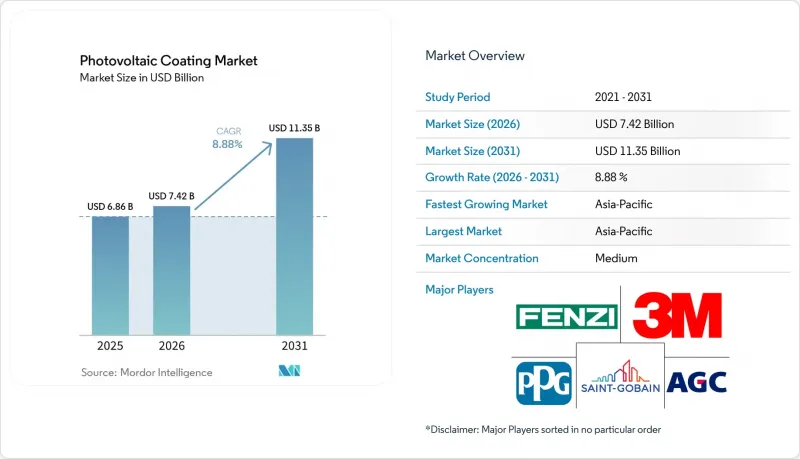
에 따르면 태양광발전용 코팅 시장 규모는 2025년에 68억 6,000만 달러로 평가되며, 2026년 74억 2,000만 달러에서 2031년까지 113억 5,000만 달러로 확대되어, 예측 기간(2026-2031년) 동안 CAGR은 8.88%에 달할 것으로 추정됩니다.
세계 태양광발전용 코팅 시장의 동향 및 인사이트
태양광발전 설비 용량의 확대와 모듈 제조의 성장
2025년 태양광발전의 신규 설치량은 698 GW에 달했으며, 전 세계 누적 발전 용량은 3 TW를 넘어섰습니다. 이러한 설치 기반을 바탕으로, 태양광발전용 코팅 시장에는 기능성 표면 처리가 필요한 모듈용 유리가 대량으로 공급되고 있으며, 그 공급량은 증가 추세를 보이고 있습니다. 코팅이 적용된 모듈 1장당 유리 면적이 넓기 때문에 신규 설치 시 코팅 채택이 소폭 증가하는 것만으로도 상당한 수요를 창출할 수 있습니다. 중국에서는 2025년에 415 GW의 설비 용량이 도입되어, 국내 수요가 공급업체의 공급량 및 조달 관행의 중심이 되고 있습니다. 인도에서는 2025년에 55.9 GW가 추가될 예정이며, 먼지가 많은 운영 환경으로 인해 오염 방지 처리의 사용 사례가 확대되고 있습니다. 국제에너지기구(IEA)는 태양광발전의 신규 도입량이 2030년대 중반까지 연간 600 GW를 초과할 것으로 예측하고 있으며, 이는 본 보고서의 대상 기간을 넘어 지속적인 수요를 뒷받침하는 요인이 될 것입니다.
반사 방지 및 다기능 코팅을 통한 효율 향상
반사 방지 제품은 커버 유리로 인해 손실된 빛을 다운스트림 단계의 셀 개량만으로는 회복할 수 없기 때문에 태양광발전용 코팅 시장에서 여전히 중요한 위치를 차지하고 있습니다. 2026년 동료 심사를 거친 연구에서는 유전체 코팅의 최적화된 조합을 태양광의 스펙트럼 특성에 맞춰 조정할 수 있음이 밝혀졌습니다. 이러한 결과로 인해 제조업체가 모듈의 설치 면적을 변경하지 않고 높은 수율을 추구할 때 코팅 선정이 더욱 중요해집니다. 다기능 층은 반사 방지 기능과 열 관리 기능을 결합할 수도 있어, 모듈 온도 상승으로 인해 발전량이 감소하는 상황에서 유용합니다. 따라서 조달 팀은 코팅을 단순한 외관상의 요소로 취급하지 않고, 예상 에너지 수율, 세척 빈도 감소, 그리고 운영 조건과 대조하여 코팅 비용을 평가할 수 있습니다.
모듈 가격 하락에 따른 프리미엄 코팅 비용
국제 태양광발전 기술 로드맵(ITRPV)에 따르면, 모듈 현물 가격은 2024년 대부분 기간 동안 0.07-0.08달러/W였으나, 2025년에는 가중 평균으로 0.09달러/W까지 회복되었습니다. 와트당 0.005-0.010달러의 비용 증가를 초래하는 프리미엄 코팅은 프로젝트의 초기 비용을 중시하는 개발자들로부터 엄격한 심사를 받고 있습니다. 이러한 제약은 구매 결정 시 수명주기 성능보다 설비 투자액이 우선시되는 경향이 있는 신흥 시장에서 더욱 두드러지게 나타납니다. 반면, 유럽 및 북미의 개발업체들은 독립 기관에 의해 검증된 발전량과 운전 데이터를 더 중요하게 여깁니다. 또한 은 가격의 급등으로 인해 2025년에는 모듈 제조사가 추가적인 재료비를 흡수할 수 있는 여지가 줄어들었습니다. 이러한 가격 압박으로 인해 제품의 기술적 가치가 분명함에도 불구하고 태양광발전용 코팅 시장의 확산은 주춤하고 있습니다.
부문 분석
2025년, 반사 방지 코팅은 태양광발전용 코팅 시장 점유율의 42.67%를 차지했습니다. 이러한 위상은 OEM(주문자 상표 생산) 및 개조 용도 모두에서 모듈 유리가 광범위하게 사용되고 있음을 반영합니다. 이러한 코팅은 외부 표면에서의 반사 손실을 줄여, 가동 조건 하에서의 발전량을 뒷받침합니다. 반사 방지 구조에 대한 지속적인 연구를 통해 태양광 스펙트럼에 맞춰 유전체 층을 최적화하는 능력은 지속적으로 향상되고 있습니다. 태양광발전용 코팅 업계에서 이러한 성능상의 역할 덕분에, 반사 방지층은 주로 세척이나 외관을 목적으로 선택되는 처리 방식과는 확연히 차별화됩니다. 표준 결정질 실리콘 모듈에 대한 폭넓은 적용성이 그 위상을 뒷받침하고 있습니다.
자가 세정 코팅 시장은 2031년까지 연평균 성장률(CAGR) 9.35%로 성장할 것으로 예측됩니다. 이러한 유형의 코팅을 포함한 태양광발전용 코팅 시장의 규모는 먼지 축적으로 인해 연간 발전량이 현저히 감소할 우려가 있는 건조 지역의 전력 사업 프로젝트에 의해 뒷받침되고 있습니다. 친수성 및 소수성 코팅은 수작업 세척의 빈도와 수고를 줄이는 것을 목적으로 하지만, 그 성능은 현지의 기상 조건과 먼지의 특성에 따라 달라집니다. 중국의 T/CADZ 0077-2026 규격에서는 태양광발전용 유리에 적용되는 자가 세정형 나노코팅에 관한 기술 요건, 시험 방법, 검사 기준 및 분류가 정의되어 있습니다. 전도성 코팅의 역할은 비교적 작지만, 헤테로접합 기술(HJT) 및 박막 모듈 설계에서 투명 전극층으로서 여전히 중요한 위치를 차지하고 있습니다. 그 밖에도 소수성, 김서림 방지, 자외선 차단 코팅 등의 제품은 외관이나 내구성이 선정의 결정적 요인이 되는 특정 주거용 및 민생용 전자기기 용도로 사용되고 있습니다.
지역별 분석
아시아태평양은 2025년에 41.34%의 점유율로 태양광발전용 코팅 시장을 주도할 것이며, 2031년까지 연평균 성장률(CAGR) 9.67%로 확대될 것으로 예측됩니다. IEA-PVPS에 따르면, 중국은 2025년에 415 GW의 신규 태양광발전 설비를 도입하여 누적 설비 용량이 1,463 GW에 달했습니다. 이러한 도입 규모로 인해 중국은 태양광발전용 코팅 시장 전체에서 수요, 규격 및 공급업체 인증 측면에서 중심적인 역할을 하고 있습니다. 인도는 2025년에 55.9 GW를 추가로 도입했으며, 이 나라에서는 먼지 노출이 높기 때문에 오염 방지 제품에 대한 수요가 뒷받침되고 있습니다. 중국의 규격인 ‘T/CERS 0144-2025’ 및 ‘T/CADZ 0077-2026’에서는 발전소 및 태양광발전용 유리에 대한 자가 세정형 나노코팅 요건이 공식적으로 규정되었습니다. 일본은 누적 용량이 102.7 GW에 달하며, 높은 습도와 해안 지역의 오염 조건에 적합한 코팅을 위한 성숙한 시장으로 자리 잡고 있습니다.
북미 및 유럽에서는 고성능·고사양 코팅에 대한 수요가 견조합니다. 독일은 2025년에 17 GW를 추가하여 누적 용량이 117.3 GW에 달했으나, 계획 중인 도입 프로젝트로 인해 공장 출하 시 코팅 및 개보수용 솔루션에 대한 수요가 뒷받침되고 있습니다. 스페인은 2025년에 14 GW를 도입함에 따라, 남유럽은 반건조 운전 조건 하의 방오 용도에서 중요한 시장이 되었습니다. 유럽의 PFAS 규제는 기존의 불소수지 화학에 의존하는 공급업체에 압박을 가하고 있으며, 성능과 규정 준수 요건을 모두 충족하는 대체재의 길을 열어주고 있습니다. 북미에서는 ‘인플레이션 억제법’에 따른 국내 조달 인센티브로 인해, 현지 제조 또는 조달 요건을 충족하는 공급업체의 입지가 강화될 가능성이 있습니다.
중동 및 아프리카, 남미에서는 세척 및 물 관리가 중요한 고려 사항이 되는 운영 환경을 볼 수 있습니다. 사우디아라비아에서는 국영 전력 회사의 프로그램을 바탕으로 2025년에 약 7GW의 태양광발전 용량이 추가되었습니다. 사막 환경에서는 먼지가 쌓이고 세척이 지연될 경우 발전량이 크게 감소할 가능성이 있습니다. 브라질에서는 2025년에 13.8GW가 도입되었으며, 그 반건조 내륙 지역은 다른 건조한 태양광발전 지역과 일부 운영 특성을 공유하고 있습니다. 남아프리카에서는 2025년에 태양광발전 설비가 3GW를 넘어섰으며, 체계적인 운영 및 유지보수 체제의 필요성이 부각되었습니다. 이러한 지역에서는 자가 세정 코팅을 도입함으로써 세정 빈도와 물 사용량을 줄일 수 있습니다.
기타 이점:
- 엑셀 형식의 시장 예측(ME) 시트
- 3개월간의 애널리스트 지원
자주 묻는 질문
목차
제1장 소개
- 조사 가정과 시장 정의
- 조사 범위
제2장 조사 방법
제3장 주요 요약
제4장 시장 구도
- 시장 개요
- 시장 성장 촉진요인
- 시장 성장 억제요인
- 밸류체인 분석
- Porter's Five Forces 분석
제5장 시장 규모와 성장 예측
- 코팅 유형별
- 용도별
- 지역별
- 아시아태평양
- 중국
- 인도
- 일본
- 한국
- ASEAN 국가
- 기타 아시아태평양 국가
- 북미
- 미국
- 캐나다
- 멕시코
- 유럽
- 독일
- 영국
- 프랑스
- 이탈리아
- 북유럽 국가
- 기타 유럽 국가
- 남미
- 브라질
- 아르헨티나
- 기타 남미 국가
- 중동 및 아프리카
- 사우디아라비아
- 남아프리카공화국
- 기타 중동 및 아프리카 국가
- 아시아태평양
제6장 경쟁 구도
- 시장 집중도
- 전략적 동향
- 시장 점유율·순위 분석
- 기업 개요
- 3M
- AGC Inc.
- Akzo Nobel N.V.
- Arkema
- BASF
- Covestro AG
- DuPont
- Eastman Chemical Company
- FENZI S.p.A.
- Guardian Glass
- Koninklijke DSM NV
- nanopool GmbH
- Pellucere
- PPG Industries, Inc.
- Saint-Gobain
제7장 시장 기회와 향후 전망
KSM 26.10.30According to Mordor Intelligence, the photovoltaic coating market size was valued at USD 6.86 billion in 2025 and is estimated to grow from USD 7.42 billion in 2026 to USD 11.35 billion by 2031, at a CAGR of 8.88% during the forecast period (2026-2031).
Global Photovoltaic Coating Market Trends and Insights
Solar PV Capacity Expansion and Module Manufacturing Growth
Solar photovoltaic additions reached 698 GW in 2025, bringing cumulative global capacity beyond 3 TW. This deployment base provides the photovoltaic coating market with a large and growing quantity of module glass requiring functional surface treatment. Even a limited increase in coating adoption in new installations can create substantial demand, as each coated module has a large glass area. China installed 415 GW of capacity in 2025, making domestic demand central to suppliers' quantities and procurement practices. India added 55.9 GW in 2025, and its dusty operating conditions strengthen the use case for anti-soiling treatments. The International Energy Agency expects solar additions to remain above 600 GW annually through the mid-2030s, which supports sustained demand beyond the report period.
Efficiency Gains from Anti-Reflective and Multifunctional Coatings
Anti-reflective products remain important to the photovoltaic coating market because light lost at the cover glass cannot be recovered by downstream cell improvements. A 2026 peer-reviewed study also showed how optimized combinations of dielectric coatings can be tuned for solar spectral performance. These results make coating selection more relevant when manufacturers seek higher yield without changing the module footprint. Multifunctional layers can also combine anti-reflection with thermal management, which is useful where high module temperatures reduce electrical output. Procurement teams can therefore assess coating costs against expected energy yield, cleaning reduction, and operating conditions, rather than treating the coating as a purely cosmetic input.
Premium Coating Cost Relative to Declining Module Prices
Module spot prices were USD 0.07-0.08/W for much of 2024 before recovering to a weighted-average of USD 0.09/W in 2025, according to the International Technology Roadmap for Photovoltaic (ITRPV). Premium coatings that add USD 0.005 to USD 0.010/W per watt face close scrutiny from developers focused on upfront project costs. This constraint is more visible in emerging markets, where capital expenditure often outweighs lifecycle performance in purchasing decisions. Developers in Europe and North America place greater emphasis on independently verified yield and operating data. Rising silver costs also reduced the margin available for module makers to absorb additional material costs in 2025. This pricing pressure slows uptake in the photovoltaic coating market, even when the technical value of a product is clear.
Other drivers and restraints analyzed in the detailed report include:
- Water Scarcity and Rising Solar-Panel Cleaning Costs
- Growth of Bifacial, TOPCon, HJT, and Perovskite Modules
- Long-Duration Durability Validation and Warranty Risk
For complete list of drivers and restraints, kindly check the Table Of Contents.
Segment Analysis
Anti-reflective coatings held 42.67% of the photovoltaic coating market share in 2025. Their position reflects widespread use of module glass across large areas in both original equipment manufacturing and retrofit applications. These coatings reduce reflection losses at the outer surface, supporting energy yield under operating conditions. Ongoing research on anti-reflective architectures continues to improve the ability to tailor dielectric layers for the solar spectrum. Within the photovoltaic coating industry, this performance role distinguishes anti-reflective layers from treatments selected primarily for cleaning or appearance. Their broad applicability across standard crystalline-silicon modules sustains their position.
Self-cleaning coatings are forecast to grow at a CAGR of 9.35% through 2031. The photovoltaic coating market size for this coating type is supported by utility projects in dry regions where dust accumulation can materially reduce annual generation. Hydrophilic and hydrophobic coatings aim to reduce the frequency or intensity of manual cleaning, although their performance depends on local weather and dust characteristics. China's T/CADZ 0077-2026 defined technical requirements, test methods, inspection criteria, and classifications for self-cleaning nanocoatings on photovoltaic glass. Conductive coatings serve a smaller role but remain important as transparent electrode layers in Heterojunction Technology (HJT) and thin-film module designs. Other products, including hydrophobic, anti-fogging, and ultraviolet-protective coatings, serve selected residential and consumer electronics applications where appearance and durability influence selection.
Complete Report Scope:
- By Coating Type
- Anti-Reflective Coatings
- Self-Cleaning Coatings
- Conductive Coatings
- Others
- By Application
- Solar Panels
- Automotive
- Consumer Electronics
- Textile
- Others
- By Geography
- Asia-Pacific
- China
- India
- Japan
- South Korea
- ASEAN Countries
- Rest of Asia-Pacific
- North America
- United States
- Canada
- Mexico
- Europe
- Germany
- United Kingdom
- France
- Italy
- NORDIC Countries
- Rest of Europe
- South America
- Brazil
- Argentina
- Rest of South America
- Middle East and Africa
- Saudi Arabia
- South Africa
- Rest of Middle East and Africa
- Asia-Pacific
Geography Analysis
Asia-Pacific led the photovoltaic coating market with a 41.34% share in 2025 and is forecast to expand at a 9.67% CAGR through 2031. China installed 415 GW of new photovoltaic capacity in 2025, bringing cumulative capacity to 1,463 GW, according to IEA-PVPS. This installation scale gives China a central role in demand, standards, and supplier qualification across the photovoltaic coating market. India added 55.9 GW in 2025, where high dust exposure supports demand for anti-soiling products. China's T/CERS 0144-2025 and T/CADZ 0077-2026 standards formalized requirements for self-cleaning nano coatings in power plants and on photovoltaic glass. Japan has 102.7 GW of cumulative capacity and is a mature market for coatings suited to high-humidity coastal soiling conditions.
North America and Europe have a strong demand for high-performance, premium-specification coatings. Germany added 17 GW in 2025 and held 117.3 GW of cumulative capacity, while its planned deployment pipeline supports demand for factory-applied and retrofit solutions. Spain installed 14 GW in 2025, making southern Europe relevant for anti-soiling applications in semi-arid operating conditions. European PFAS restrictions are placing pressure on suppliers that depend on legacy fluoropolymer chemistry, creating a pathway for alternatives that can meet both performance and compliance requirements. In North America, domestic-content incentives under the Inflation Reduction Act can strengthen the position of suppliers that qualify for local manufacturing or sourcing.
The Middle East, Africa, and South America present operating conditions where cleaning and water management are major considerations. Saudi Arabia added nearly 7 GW of solar capacity in 2025, supported by state utility programs. Desert environments can experience high output losses when dust accumulates and cleaning is delayed. Brazil installed 13.8 GW in 2025, and its semi-arid interior shares some operating characteristics with dry solar regions elsewhere. South Africa exceeded 3 GW of solar photovoltaic installations in 2025, underscoring the need for systematic operations and maintenance practices. In these regions, self-cleaning coatings can reduce cleaning frequency and water use where both are constrained.
- 3M
- AGC Inc.
- Akzo Nobel N.V.
- Arkema
- BASF
- Covestro AG
- DuPont
- Eastman Chemical Company
- FENZI S.p.A.
- Guardian Glass
- Koninklijke DSM NV
- nanopool GmbH
- Pellucere
- PPG Industries, Inc.
- Saint-Gobain
Additional Benefits:
- The market estimate (ME) sheet in Excel format
- 3 months of analyst support
TABLE OF CONTENTS
1 Introduction
- 1.1 Study Assumptions and Market Definition
- 1.2 Scope of the Study
2 Research Methodology
3 Executive Summary
4 Market Landscape
- 4.1 Market Overview
- 4.2 Market Drivers
- 4.2.1 Solar PV Capacity Expansion and Module Manufacturing Growth
- 4.2.2 Efficiency Gains from Anti-Reflective and Multifunctional Coatings
- 4.2.3 Water Scarcity and Rising Solar-Panel Cleaning Costs
- 4.2.4 Growth of Bifacial, TOPCon, HJT and Perovskite Modules
- 4.2.5 Coating Qualification as a Bankability Differentiator for New Module Technologies
- 4.3 Market Restraints
- 4.3.1 Premium Coating Cost Relative to Declining Module Prices
- 4.3.2 Long-Duration Durability Validation and Warranty Risk
- 4.3.3 Retrofit-Line Integration and Coating-Application Uniformity Constraints
- 4.4 Value Chain Analysis
- 4.5 Porter's Five Forces Analysis
- 4.5.1 Bargaining Power of Suppliers
- 4.5.2 Bargaining Power of Buyers
- 4.5.3 Threat of New Entrants
- 4.5.4 Threat of Substitutes
- 4.5.5 Competitive Rivalry
5 Market Size and Growth Forecasts (Value)
- 5.1 By Coating Type
- 5.1.1 Anti-Reflective Coatings
- 5.1.2 Self-Cleaning Coatings
- 5.1.3 Conductive Coatings
- 5.1.4 Others
- 5.2 By Application
- 5.2.1 Solar Panels
- 5.2.2 Automotive
- 5.2.3 Consumer Electronics
- 5.2.4 Textile
- 5.2.5 Others
- 5.3 By Geography
- 5.3.1 Asia-Pacific
- 5.3.1.1 China
- 5.3.1.2 India
- 5.3.1.3 Japan
- 5.3.1.4 South Korea
- 5.3.1.5 ASEAN Countries
- 5.3.1.6 Rest of Asia-Pacific
- 5.3.2 North America
- 5.3.2.1 United States
- 5.3.2.2 Canada
- 5.3.2.3 Mexico
- 5.3.3 Europe
- 5.3.3.1 Germany
- 5.3.3.2 United Kingdom
- 5.3.3.3 France
- 5.3.3.4 Italy
- 5.3.3.5 NORDIC Countries
- 5.3.3.6 Rest of Europe
- 5.3.4 South America
- 5.3.4.1 Brazil
- 5.3.4.2 Argentina
- 5.3.4.3 Rest of South America
- 5.3.5 Middle East and Africa
- 5.3.5.1 Saudi Arabia
- 5.3.5.2 South Africa
- 5.3.5.3 Rest of Middle East and Africa
- 5.3.1 Asia-Pacific
6 Competitive Landscape
- 6.1 Market Concentration
- 6.2 Strategic Moves
- 6.3 Market Share (%)/Ranking Analysis
- 6.4 Company Profiles (includes Global Overview, Market Overview, Core Segments, Financials as available, Strategic Information, Products and Services, and Recent Developments)
- 6.4.1 3M
- 6.4.2 AGC Inc.
- 6.4.3 Akzo Nobel N.V.
- 6.4.4 Arkema
- 6.4.5 BASF
- 6.4.6 Covestro AG
- 6.4.7 DuPont
- 6.4.8 Eastman Chemical Company
- 6.4.9 FENZI S.p.A.
- 6.4.10 Guardian Glass
- 6.4.11 Koninklijke DSM NV
- 6.4.12 nanopool GmbH
- 6.4.13 Pellucere
- 6.4.14 PPG Industries, Inc.
- 6.4.15 Saint-Gobain
7 Market Opportunities and Future Outlook
- 7.1 White-Space and Unmet-Need Assessment


