

|
시장보고서
상품코드
2155647
일회용 핀셋 : 시장 점유율 분석, 업계 동향과 통계, 성장 예측(2026-2031년)Disposable Tweezers - Market Share Analysis, Industry Trends & Statistics, Growth Forecasts (2026 - 2031) |
||||||
 Mordor Intelligence
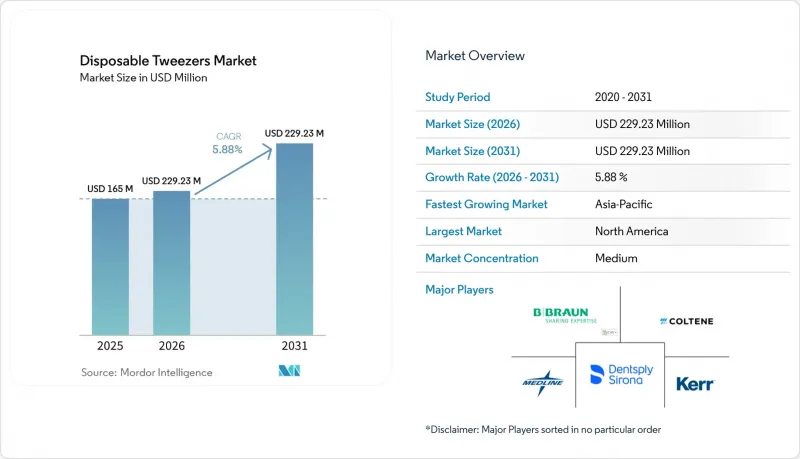
에 따르면 일회용 핀셋 시장 규모는 2025년 1억 6,500만 달러에서 2026년에는 2억 2,923만 달러로 확대되어, 2026년부터 2031년까지 CAGR 5.88%를 기록하며 2031년에는 2억 2,923만 달러에 달할 것으로 예측됩니다.
세계 일회용 핀셋 시장의 동향 및 인사이트
감염 예방 및 교차 오염 억제
의료 관련 감염은 병원 및 진료소에서 신뢰할 수 있는 감염 예방에 대한 직접적인 수요를 지속적으로 창출하고 있습니다. 일회용 핀셋 시장은 이러한 수요로부터 혜택을 받고 있습니다. 일회용 기구는 재사용에 따른 오염 위험을 피할 수 있기 때문입니다. 재처리에는 세척, 소독, 멸균 및 검사가 필요하며, 각 공정에는 검증된 절차가 요구됩니다. 미국 질병통제예방센터(CDC)는 재사용이나 세척의 신뢰성이 불확실한 경우 일회용 기구의 사용이 적절하다고 지적하고 있습니다. 검증된 재처리 능력을 갖추지 못한 시설에서는 일관된 임상 관행을 뒷받침하기 위해 미리 포장된 멸균 제품을 사용할 수 있습니다. 이로 인해 환자 유입이 빈번하고 기구 처리 자원이 제한된 환경에서 수요가 가장 견조하게 유지되고 있습니다.
치과, 외과 및 임상 시술의 증가
시술 건수의 증가에 따라 조직 취급, 상처 처치, 검체 처리에 사용되는 기구의 소비량도 증가합니다. 국제미용성형외과학회(ISAPS)의 2024년 세계 조사에 따르면, 미용 시술 건수는 약 3,800만 건에 달했으며, 그중 210만 건 이상이 안검 수술이었습니다. 임상 프로토콜에서 일회용 제품 사용이 의무화되어 있는 경우, 시술마다 새로운 기구 세트가 필요할 수 있습니다. 치과 진료에서도 세척이 어렵거나 열멸균이 불가능한 경우에는 일회용 기구가 사용됩니다. 외래 진료 및 최소침습 치료의 증가에 따라 기본적인 소모품의 빈번한 보충이 필요해지고 있습니다. 따라서 일회용 핀셋 시장은 시술 건수뿐만 아니라 요구되는 기구 관리 수준에도 영향을 받습니다.
의료 폐기물의 처리 및 처분 비용
일회용 제품은 임상 사용 후 폐기물 처리에 수고가 따르기 때문에 사용량이 적은 환경에서는 비용 면에서의 우위가 약화될 가능성이 있습니다. 미국 환경보호청(EPA)은 유해 폐기물 발생자에 대한 요건을 정하고 있으며, 의료 시설은 적용되는 규정의 범위 내에서 규제 대상 폐기물을 관리해야 합니다. 수집, 처리 및 처분 비용이 높아지면 일회용 제품의 총비용에 영향을 미칩니다. 시설에서 개별 포장된 멸균 기구를 대량으로 사용하는 경우, 그 영향은 더욱 두드러질 수 있습니다. 콤팩트한 포장이나 재료 효율이 높은 형태를 채택함으로써 단위당 폐기물 부담을 줄일 수 있습니다. 시설이 조달 비용과 폐기물 처리 비용을 종합적으로 평가할 경우, 일회용 핀셋 시장은 더 큰 압박에 직면하게 될 것입니다.
부문 분석
2025년 기준, 일회용 핀셋 시장에서 플라스틱 소재의 점유율은 72.21%를 차지했습니다. 폴리프로필렌은 비용 효율적인 생산, 색상 구분, 그리고 감마선 조사에 대한 적합성을 가능하게 합니다. 또한, 경량이기 때문에 상처 관리나 일상적인 임상 업무에서 기구를 빈번하게 교체해야 하는 상황에도 대응할 수 있습니다. 이 소재는 병원의 대량 구매에서 여전히 일반적인 선택지로 자리 잡고 있습니다. 스테인리스강은 끝부분의 정밀도가 더 요구되는 경우나 고급 티타늄 제품이 필요하지 않은 용도에 적합합니다. 치과 시술 및 일반 외과에서의 상처 봉합은 일회용 스테인리스강 제품의 주요 용도로 계속 남아 있습니다.
티타늄 시장은 2026년부터 2031년까지 연평균 성장률(CAGR) 6.8%로 성장할 것으로 예측됩니다. 내식성과 비자성이라는 특성 덕분에 뇌신경외과, 안과 및 첨단 진단 업무에서의 사용이 확대되고 있습니다. AROSurgical사는 2025년 10월, FDA 승인을 받은 일회용 티타늄 스프링식 미세혈관 클램프를 출시했습니다. 이 제품은 15-120g의 교정된 힘 범위와 X선 불투과성으로 인한 가시성을 갖추고 있습니다. ISO 13402:2025는 외과용 및 치과용 수기 기구의 오토클레이브 처리, 부식 및 열 노출에 대한 내성 시험 방법을 규정하고 있습니다. 범용 플라스틱 제품 라인은 대량 주문 시 더 치열한 경쟁에 직면할 가능성이 있습니다. 반면, 티타늄 및 특수 폴리머 제품 라인은 사용자가 검증된 정밀도나 재료 성능을 요구할 경우 더 높은 가격 책정이 가능합니다.
2025년, 스트레이트 팁 핀셋은 일회용 핀셋 시장 점유율의 39.2%를 차지했습니다. 범용적인 설계 덕분에 상처 관리, 치과용 솜 배치 및 일상적인 검체 처리에 사용됩니다. 사용자는 이러한 용도에서 확실한 집게력과 일관된 기본 성능을 중요시합니다. 구부러진 끝부분은 이비인후과 및 안과 수술에서 깊숙한 부위에 접근할 수 있게 해줍니다. 비스듬한 끝부분 디자인은 정밀한 실험실 작업이나 임상 외의 주변 용도에 유용합니다. 따라서 스트레이트 팁 제품은 일상적인 임상 현장에서 폭넓은 구매 수요를 유지하고 있습니다.
끝이 가늘어지는 형태의 핀셋은 2026년부터 2031년까지 연평균 성장률(CAGR) 6.3%로 성장할 것으로 예측됩니다. 이 형태는 검사실에서의 진단, 조직학 및 법의학적 검체 처리 시 정밀한 취급을 가능하게 합니다. 또한, 끝이 가느다란 기구는 최소침습 수술 시 조직 취급이나 검체 채취에도 유용합니다. 제품 개발자들은 비대칭 끝단 디자인, 질감이 가공된 그립, 잠금 장치 등을 독자적인 형태에 접목하고 있습니다. 이러한 기능 덕분에 뾰족한 끝부분을 가진 제품은 단순한 범용 디자인의 범주를 뛰어넘습니다. 일회용 핀셋 시장은 제한된 작업 영역 내에서 매우 작은 물체를 일관되게 다뤄야 하는 사용자에게 가치를 높여줄 수 있습니다.
지역별 분석
2025년, 북미는 일회용 핀셋 시장 점유율의 34.1%를 차지했습니다. 미국에는 병원, 외래 수술 센터, 치과 진료소가 밀집된 네트워크를 형성하고 있으며, 이러한 시설에서는 대량의 임상용 소모품이 사용되고 있습니다. CDC(미국 질병통제예방센터)의 감염 관리 지침은 일회용 의료기기의 적절한 사용을 권장하고 있습니다. 헨리 샤인(Henry Schein)사는 2025년에 132억 달러의 매출을 기록했으며, 이 중 순매출의 69%는 미국 사업에서 창출되었습니다. MedPAC 보고서에 따르면, ASC(외래 수술 센터)의 처리량은 지속적으로 증가하고 있으며, 이는 멸균 처리되고 정밀성을 중시하는 제품 형태에 대한 수요를 뒷받침하고 있습니다. 캐나다와 멕시코에서는 병원 투자 및 민간 의료 활동의 확장으로 인해 처리량이 서서히 증가하고 있습니다.
유럽은 여전히 중요한 지역 거점이며, 독일, 영국, 프랑스가 주요 시장을 형성하고 있습니다. 의료 폐기물, 포장 및 일회용 플라스틱 사용에 대한 우려로 인해 지역 내 수요는 억제되고 있습니다. 규정(EU) 2025/40은 의료 제품 포장에 영향을 미치는 포장 및 포장 폐기물 요건을 규정하고 있으며, 의료 분야에 특화된 규정이 적용되는 경우도 있습니다. 또한, EU 의료기기 규정 제17조에 따라 일회용 의료기기의 재처리에 관한 국가별 조건이 정해져 있습니다. 이러한 차이점 때문에 공급업체 입장에서는 국가별 규제 계획을 수립하는 것이 중요합니다. 이 지역에서는 안정적인 시술 수요가 예상되지만, 제품 설계 시에는 환경 요건과 구매 동향에 대응해야 합니다.
아시아태평양은 2026년부터 2031년까지 연평균 성장률(CAGR) 6.7%로 성장할 것으로 예측됩니다. 중국, 인도 및 동남아시아 국가에서는 병원 및 외래 진료 수용 능력이 확대되고 있으며, 이에 따라 일회용 의료용품의 고객 기반이 넓어지고 있습니다. 일본의 의료기기 규제 체계에는 코드 35079001에 해당하는 일회용 핀셋의 등록 구분이 포함되어 있습니다. 인도의 3차 의료기관 확충과 동남아시아의 외래 진료 시설 확충이 해당 지역의 수요를 더욱 끌어올리고 있습니다. 중동 및 아프리카 및 남미는 현대화 프로그램과 민간 병원의 확장에 힘입고 있지만, 여전히 시장 규모는 작은 상황입니다. 이러한 지역에서는 장거리 물류로 인해 멸균 제품의 유통기한 관리가 더욱 어려워질 가능성이 있습니다.
기타 혜택:
- 엑셀 형식의 시장 예측(ME) 시트
- 3개월간의 애널리스트 지원
자주 묻는 질문
목차
제1장 소개
- 조사 가정과 시장 정의
- 조사 범위
제2장 조사 방법
제3장 주요 요약
제4장 시장 구도
- 시장 개요
- 시장 성장 촉진요인
- 시장 성장 억제요인
- 가치 및 공급망 분석
- 규제 상황
- 기술 전망
- Porter's Five Forces 분석
제5장 시장 규모와 성장 예측
- 소재별
- 칩 형상별
- 무균 상태별
- 용도별
- 최종사용자별
- 지역별
- 북미
- 미국
- 캐나다
- 멕시코
- 유럽
- 독일
- 영국
- 프랑스
- 이탈리아
- 스페인
- 기타 유럽 국가
- 아시아태평양
- 중국
- 일본
- 인도
- 한국
- 호주
- 기타 아시아태평양 국가
- 중동 및 아프리카
- GCC
- 남아프리카공화국
- 기타 중동 및 아프리카 국가
- 남미
- 브라질
- 아르헨티나
- 기타 남미 국가
- 북미
제6장 경쟁 구도
- 시장 집중도
- 시장 점유율 분석
- 기업 개요
- Rubis
- Dumont Tweezers
- Excelta Corporation
- Ideal-tek SA
- Robert Burkle GmbH
- Sampling Systems Ltd
- TIGA-MED Deutschland GmbH
- MECO Instruments Pvt. Ltd
- Arrowhead Forensics
- AmScope
- Avantor Inc.
- Heathrow Scientific LLC
- Henry Schein, Inc.
- LABOAO
- Medline Industries, LP
- Misumi Group Inc.
- B. Braun Melsungen AG
- Hu-Friedy Mfg. Co., LLC
- Ultradent Products, Inc.
- Dentsply Sirona Inc.
- Patterson Companies, Inc.
- Kerr Corporation
- COLTENE Group
- GC Corporation
- Young Innovations
제7장 시장 기회와 향후 전망
KSM 26.10.30According to Mordor Intelligence, the disposable tweezers market size is expected to grow from USD 165 million in 2025 to USD 229.23 million in 2026 and is forecast to reach USD 229.23 million by 2031 at 5.88% CAGR over 2026-2031.
Global Disposable Tweezers Market Trends and Insights
Infection Prevention and Cross-Contamination Control
Healthcare-associated infections continue to create a direct need for reliable infection prevention in hospitals and clinics. The disposable tweezers market gains from this need because a single-use instrument avoids reuse-related contamination risk. Reprocessing requires cleaning, disinfection, sterilization, and inspection, and each step requires validated procedures. The Centers for Disease Control and Prevention identifies single-use devices as appropriate where reuse and cleaning reliability are uncertain. Facilities without validated reprocessing capacity can use prepackaged sterile products to support consistent clinical practice. This keeps demand strongest in settings with rapid patient turnover and limited instrument-processing resources.
Growth in Dental, Surgical, and Clinical Procedures
A higher number of procedures increases the consumption of instruments used for tissue handling, dressing, and specimen work. The International Society of Aesthetic Plastic Surgery reported nearly 38 million aesthetic procedures in its 2024 global survey, including more than 2.1 million eyelid surgeries. Each procedure can require a fresh set of instruments when clinical protocols require single-use products. Dental practices also use single-use devices where cleaning is difficult or where they cannot be heat sterilized. Growth in outpatient and minimally invasive care supports frequent replenishment of basic consumables. The disposable tweezers market, therefore, depends on procedure volumes as well as the required level of instrument control.
Medical-Waste Treatment and Disposal Costs
Disposables add waste handling requirements after clinical use, which can weaken their cost advantage in lower-volume settings. The U.S. Environmental Protection Agency sets requirements for hazardous waste generators, and healthcare facilities must manage regulated waste within applicable rules. Higher collection, treatment, and disposal charges affect the full cost of a single-use product. The effect can be more pronounced when facilities use high volumes of individually packaged sterile instruments. Compact packaging and material-efficient formats can reduce the waste burden associated with each unit. The disposable tweezers market faces greater pressure where facilities evaluate procurement and waste expenses together.
Other drivers and restraints analyzed in the detailed report include:
- Expansion of Laboratory Automation and High-Throughput Testing
- Growth of Online and Direct Procurement Channels
- Price Premium Versus Reusable Tweezers in Low-Volume Settings
For complete list of drivers and restraints, kindly check the Table Of Contents.
Segment Analysis
Plastic held 72.21% of disposable tweezers market share in 2025. Polypropylene supports cost-efficient production, color coding, and compatibility with gamma irradiation. Its light weight can also support repeated instrument exchanges during wound care and routine clinical work. The material remains the common choice for high-volume hospital purchasing. Stainless steel serves applications that need greater tip precision but do not require a premium titanium product. Dental procedures and general surgical wound closure remain relevant uses for disposable stainless-steel designs.
Titanium is forecast to grow at a 6.8% CAGR from 2026 to 2031. Its corrosion resistance and nonmagnetic properties support use in neurosurgery, ophthalmology, and advanced diagnostic work. AROSurgical introduced FDA-cleared disposable titanium spring microvascular clamps in October 2025 with a calibrated 15-120 g force range and radiopaque visibility. ISO 13402:2025 sets test methods for resistance to autoclaving, corrosion, and thermal exposure in surgical and dental hand instruments. Commodity plastic lines are likely to face stronger price competition in bulk tenders. Titanium and specialty-polymer lines can support higher pricing when users require demonstrated precision and material performance.
Straight-tip tweezers held 39.2% of the disposable tweezers market share in 2025. Their general-purpose design supports wound care, dental cotton placement, and routine specimen handling. Users value a firm grasp and consistent basic performance in these applications. Curved tips support access to recessed anatomy during ENT and ophthalmic procedures. Slanted designs can assist fine laboratory work and peripheral nonclinical uses. Straight-tip products therefore retain broad purchasing relevance across routine clinical settings.
Pointed-tip tweezers are forecast to grow at a 6.3% CAGR from 2026 to 2031. This geometry supports precise handling in laboratory diagnostics, histology, and forensic sample work. Fine-tipped instruments can also support tissue handling and specimen retrieval in minimally invasive procedures. Product developers are adding asymmetric tip designs, textured grips, and locking mechanisms to differentiated formats. These features move pointed-tip products beyond a basic commodity design. The disposable tweezers market can gain value where users require consistent handling of very small objects in confined work areas.
Complete Report Scope:
- By Material
- Plastic
- Stainless Steel
- Titanium
- By Tip Geometry
- Straight Tip
- Pointed Tip
- Curved Tip
- Slanted Tip
- By Sterility Status
- Sterile
- Non-Sterile
- By Application
- Surgical Procedures
- Wound Care & Dressing
- Diagnostic Procedures
- Dental Procedures
- Laboratory & Clinical Diagnostics
- By End User
- Hospitals
- Ambulatory Surgery Centers
- Specialty Clinics
- Others (Clinical Laboratories, Academic & Research Institutions)
- By Geography
- North America
- United States
- Canada
- Mexico
- Europe
- Germany
- United Kingdom
- France
- Italy
- Spain
- Rest of Europe
- Asia-Pacific
- China
- Japan
- India
- South Korea
- Australia
- Rest of Asia-Pacific
- Middle East and Africa
- GCC
- South Africa
- Rest of Middle East and Africa
- South America
- Brazil
- Argentina
- Rest of South America
- North America
Geography Analysis
North America held 34.1% of the disposable tweezers market share in 2025. The United States has a dense network of hospitals, ambulatory surgery centers, and dental practices that use high volumes of clinical consumables. Infection-control guidance from the CDC supports the appropriate use of single-use devices. Henry Schein reported USD 13.2 billion in 2025 revenue, with 69% of net sales generated through U.S. operations. MedPAC reported continued ASC volume growth, which supports demand for sterile and precision-oriented formats. Canada and Mexico add incremental volume through hospital investment and expanding private care activity.
Europe remains a significant regional base, with Germany, the United Kingdom, and France as major volume markets. Regional demand is moderated by concerns about medical waste, packaging, and the use of single-use plastics. Regulation (EU) 2025/40 establishes packaging and packaging waste requirements that will affect medical product packaging, while specific healthcare provisions may apply. Article 17 of the EU Medical Device Regulation also creates different national conditions for reprocessing single-use devices. This variation makes country-level regulatory planning important for suppliers. The region offers stable procedure demand, but product designs must respond to environmental requirements and purchasing preferences.
Asia-Pacific is forecast to grow at a 6.7% CAGR from 2026 to 2031. China, India, and Southeast Asian countries are expanding hospital and outpatient capacity, which broadens the customer base for disposable supplies. Japan's medical device framework includes a registration category for disposable tweezers under code 35079001. India's tertiary hospital development and Southeast Asia's outpatient facilities add to regional demand. Middle East and Africa and South America remain smaller opportunities, supported by modernization programs and private hospital expansion. Long-distance distribution can make sterile shelf-life management more difficult in these regions.
- Rubis
- Dumont Tweezers
- Excelta Corporation
- Ideal-tek SA
- Robert Burkle GmbH
- Sampling Systems Ltd
- TIGA-MED Deutschland GmbH
- MECO Instruments Pvt. Ltd
- Arrowhead Forensics
- AmScope
- Avantor Inc.
- Heathrow Scientific LLC
- Henry Schein
- LABOAO
- Medline Industries
- Misumi Group Inc.
- B. Braun
- Hu-Friedy Mfg
- Ultradent Products, Inc.
- Dentsply Sirona
- Patterson Companies
- Kerr
- COLTENE Group
- GC Corporation
- Young Innovations
Additional Benefits:
- The market estimate (ME) sheet in Excel format
- 3 months of analyst support
TABLE OF CONTENTS
1 INTRODUCTION
- 1.1 Study Assumptions and Market Definition
- 1.2 Scope of the Study
2 RESEARCH METHODOLOGY
3 EXECUTIVE SUMMARY
4 MARKET LANDSCAPE
- 4.1 Market Overview
- 4.2 Market Drivers
- 4.2.1 Infection Prevention and Cross-Contamination Control
- 4.2.2 Growth in Dental, Surgical and Clinical Procedures
- 4.2.3 Expansion of Laboratory Automation and High-Throughput Testing
- 4.2.4 Growth of Online and Direct Procurement Channels
- 4.2.5 Demand for Cleanroom-Compatible, Ready-to-Use Instruments
- 4.2.6 Material Innovation Enabling Lower-Impact Disposable Designs
- 4.3 Market Restraints
- 4.3.1 Medical-Waste Treatment and Disposal Costs
- 4.3.2 Price Premium Versus Reusable Tweezers in Low-Volume Settings
- 4.3.3 Sterility-Shelf-Life Risk in Long-Distance Distribution
- 4.3.4 Plastic Restrictions and Procurement Preference for Reusable Instruments
- 4.4 Value and Supply-Chain Analysis
- 4.5 Regulatory Landscape
- 4.6 Technological Outlook
- 4.7 Porters Five Forces Analysis
- 4.7.1 Bargaining Power of Suppliers
- 4.7.2 Bargaining Power of Buyers
- 4.7.3 Threat of New Entrants
- 4.7.4 Threat of Substitutes
- 4.7.5 Competitive Rivalry
5 MARKET SIZE AND GROWTH FORECASTS
- 5.1 By Material
- 5.1.1 Plastic
- 5.1.2 Stainless Steel
- 5.1.3 Titanium
- 5.2 By Tip Geometry
- 5.2.1 Straight Tip
- 5.2.2 Pointed Tip
- 5.2.3 Curved Tip
- 5.2.4 Slanted Tip
- 5.3 By Sterility Status
- 5.3.1 Sterile
- 5.3.2 Non-Sterile
- 5.4 By Application
- 5.4.1 Surgical Procedures
- 5.4.2 Wound Care & Dressing
- 5.4.3 Diagnostic Procedures
- 5.4.4 Dental Procedures
- 5.4.5 Laboratory & Clinical Diagnostics
- 5.5 By End User
- 5.5.1 Hospitals
- 5.5.2 Ambulatory Surgery Centers
- 5.5.3 Specialty Clinics
- 5.5.4 Others (Clinical Laboratories, Academic & Research Institutions)
- 5.6 By Geography
- 5.6.1 North America
- 5.6.1.1 United States
- 5.6.1.2 Canada
- 5.6.1.3 Mexico
- 5.6.2 Europe
- 5.6.2.1 Germany
- 5.6.2.2 United Kingdom
- 5.6.2.3 France
- 5.6.2.4 Italy
- 5.6.2.5 Spain
- 5.6.2.6 Rest of Europe
- 5.6.3 Asia-Pacific
- 5.6.3.1 China
- 5.6.3.2 Japan
- 5.6.3.3 India
- 5.6.3.4 South Korea
- 5.6.3.5 Australia
- 5.6.3.6 Rest of Asia-Pacific
- 5.6.4 Middle East and Africa
- 5.6.4.1 GCC
- 5.6.4.2 South Africa
- 5.6.4.3 Rest of Middle East and Africa
- 5.6.5 South America
- 5.6.5.1 Brazil
- 5.6.5.2 Argentina
- 5.6.5.3 Rest of South America
- 5.6.1 North America
6 COMPETITIVE LANDSCAPE
- 6.1 Market Concentration
- 6.2 Market Share Analysis
- 6.3 Company Profiles (includes Global Level Overview, Market Level Overview, Core Segments, Financials as available, Strategic Information, Market Rank/Share, Products and Services, Recent Developments)
- 6.3.1 Rubis
- 6.3.2 Dumont Tweezers
- 6.3.3 Excelta Corporation
- 6.3.4 Ideal-tek SA
- 6.3.5 Robert Burkle GmbH
- 6.3.6 Sampling Systems Ltd
- 6.3.7 TIGA-MED Deutschland GmbH
- 6.3.8 MECO Instruments Pvt. Ltd
- 6.3.9 Arrowhead Forensics
- 6.3.10 AmScope
- 6.3.11 Avantor Inc.
- 6.3.12 Heathrow Scientific LLC
- 6.3.13 Henry Schein, Inc.
- 6.3.14 LABOAO
- 6.3.15 Medline Industries, LP
- 6.3.16 Misumi Group Inc.
- 6.3.17 B. Braun Melsungen AG
- 6.3.18 Hu-Friedy Mfg. Co., LLC
- 6.3.19 Ultradent Products, Inc.
- 6.3.20 Dentsply Sirona Inc.
- 6.3.21 Patterson Companies, Inc.
- 6.3.22 Kerr Corporation
- 6.3.23 COLTENE Group
- 6.3.24 GC Corporation
- 6.3.25 Young Innovations


