

|
시장보고서
상품코드
2155681
남미의 국내 CEP : 시장 점유율 분석, 업계 동향과 통계, 성장 예측(2026-2031년)South America Domestic CEP - Market Share Analysis, Industry Trends & Statistics, Growth Forecasts (2026 - 2031) |
||||||
 Mordor Intelligence
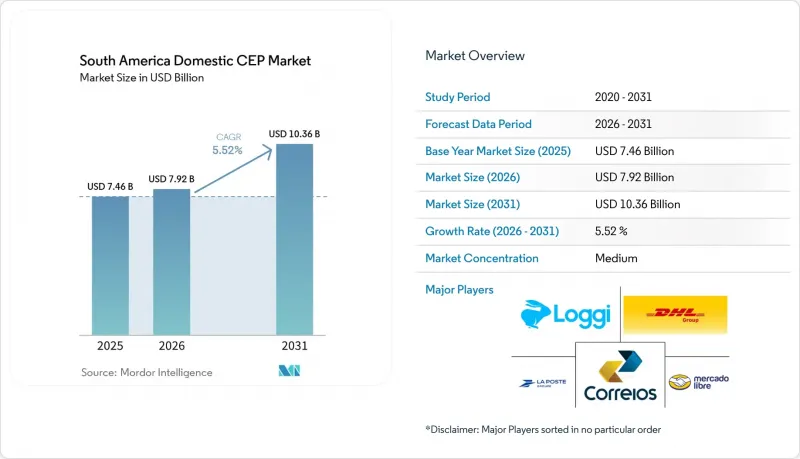
에 따르면 남미 국내 CEP 시장 규모는 2025년에 74억 6,000만 달러로 평가되며, 2026년 79억 2,000만 달러에서 2031년까지 103억 6,000만 달러에 달할 것으로 예측되며, 예측 기간(2026-2031년) 동안 CAGR은 5.52%가 될 전망입니다.
남미 국내 CEP 시장의 동향 및 인사이트
E-Commerce 소포 밀도 및 마켓플레이스를 통한 주문 처리 확대
남미 국내 CEP 시장에서 E-Commerce는 계속해서 국내 소포 수요의 주요 원천으로 자리 잡고 있습니다. MercadoLibre는 2025년 4분기에 초당 95건의 주문을 처리하고, 풀필먼트 센터를 27곳으로 확대한 결과, 브라질 내 주문의 75%를 48시간 이내에 배송했습니다. 이 회사는 2026년까지 42곳의 물류센터를 구축하겠다는 투자 계획을 발표하며, 마켓플레이스의 주문 처리 능력을 지속적으로 확대해 나갈 것임을 시사했습니다. Shopee는 2026년에 3곳의 풀필먼트 센터를 개설했으며, 해당사의 풀필먼트 네트워크를 통한 주문량은 지난 12개월 동안 15배 증가했습니다. Loggi의 보고서에 따르면, 2026년 상반기 브라질 중소기업의 PUDO 거점 이용은 전년 동기 대비 53% 증가했습니다. 플랫폼에 대한 투자로 인해 네트워크 용량에 대한 책임은 운송업체에서 마켓플레이스로 더욱 크게 이전되었으며, 운송업체가 대량의 화물을 처리하기 위해서는 디지털 및 운영상의 통합이 더욱 중요해졌습니다.
즉시결제의 보급이 주문의 신속한 발송을 가능하게 했습니다.
브라질의 Pix 시스템은 2025년에 약 800억 건의 거래를 처리하여 2024년 대비 25.7% 증가했습니다. 그중 소비자가 기업에 지불한 금액이 전체 거래의 43%를 차지했습니다. 즉시 확인 기능 덕분에, 그동안 발송 전에 주문을 보류하게 만들었던 대조 작업의 지연이 해소되었습니다. DHL 익스프레스 브라질은 2026년 2월 dLocal과 Pix 처리를 통합했으며, 통합 후 Pix를 통한 결제 처리량은 400% 증가했습니다. 또한 DHL은 온라인 결제 비율이 31% 상승하고 소포 발송 시간이 단축되었다고 보고했습니다. Ebanx는 2025년 42%에 비해 2026년 말까지 브라질 온라인 판매의 45%를 Pix가 차지할 것으로 예측하고 있습니다. 콜롬비아와 칠레의 결제 시스템도 유사한 개선을 가져올 가능성이 있지만, 이들 국가에서의 보급 속도는 브라질보다 더뎌질 것으로 예상됩니다.
유류 가격, 세금, 환율 변동
2026년 초 공급 차질로 인해 석유 비용이 상승하면서 브라질의 디젤 가격은 20% 이상 급등했습니다. 브라질의 ANTT는 도로 화물 운송료의 최소 인상률을 4.8%에서 7%로 정했지만, 디젤 비용은 장거리 운송업체들에게 여전히 큰 비용 요인으로 남아 있습니다. 칠레에서도 연료 가격 안정화 제도가 단계적으로 폐지된 후 연료 가격이 급등했습니다. 순이익률이 3%에서 7%인 사업자들에게 이러한 변동을 흡수할 여지는 제한적이었습니다. 아르헨티나에서는 환율 변동으로 인해 현지 통화로 수익을 올리는 사업자들에게 수입 자재 비용이 상승했습니다. 계약에 연료 가격이나 인플레이션에 대한 보호 조항이 포함되어 있지 않은 경우, 중소 운송업체들은 더 큰 업계 재편 압력에 직면했습니다.
부문별 분석
2025년, 남미의 국내 CEP 시장에서 비특급 서비스가 77.40%의 점유율을 차지했습니다. 이코노미 배송은 비용에 민감한 소비자나 속도보다 총 운송비를 중시하는 공급망에 적합했습니다. 이러한 수익 기반을 통해 운송업체들은 노선 밀도를 높이고 광범위한 네트워크 커버리지를 유지할 수 있었습니다. 또한, 이러한 물류 물량의 규모는 주요 노선에서 고속 서비스의 수익성을 뒷받침하는 요인이기도 했습니다. 이를 통해 사업자들은 폭넓은 발송 기반을 활용하여 더 빠른 서비스를 개발할 수 있게 되었습니다.
특급 배송은 2026년부터 2031년까지 연평균 성장률(CAGR) 6.44%로 성장할 것으로 예측되었습니다. 빠른 배송에 대한 수요는 브라질의 주요 도시에서 지방 도시 및 인접 국가로 점차 확대되고 있었습니다. 2025년 MercadoLibre의 48시간 배송 실적은 플랫폼 운영사가 설정한 서비스 기준을 여실히 보여주었습니다. 특급 서비스의 보급은 배송량이 요구되는 비용 기반을 감당할 수 있는 인구 밀집 도시 지역에서 계속해서 가장 견고할 것으로 전망되었습니다. 반면, 소규모 도시에서는 비특급 서비스에 대한 의존도가 높아질 것으로 예상되었습니다. 이러한 차이로 인해 사업자는 동일한 네트워크 내에서 서로 다른 서비스 모델을 관리해야 했습니다.
2025년, 남미의 국내 CEP 시장 규모 중 B2C가 53.17%를 차지했습니다. 또한 B2C는 가장 빠르게 성장하는 비즈니스 모델이기도 하여, 2031년까지의 예측 연평균 성장률(CAGR)은 6.61%였습니다. 소비자 대상 E-Commerce는 증가하는 소규모 온라인 판매업체를 기반으로 안정적인 소포 수요를 창출했습니다. Pix는 결제 시 발생하는 마찰을 줄이고, 결제가 완료된 주문을 배송 네트워크로 이관하는 데 걸리는 시간을 단축했습니다. 또한 판매자와 운송업체 간의 신뢰할 수 있는 실시간 데이터 교환의 중요성을 높였습니다.
B2B 부문은 부품 보충, 산업용 물류, 서류 운송을 지속적으로 뒷받침했습니다. 그러나 디지털 조달 및 마켓플레이스를 통한 주문 처리(fulfillment)가 기존 도매 흐름의 일부를 대체함에 따라, 그 상대적 기여도는 압박을 받았습니다. C2C 서비스는 재판매 플랫폼과 긱형 배송 앱에 의해 뒷받침되었으나, 규모는 여전히 작았고 소포 1개당 수익도 낮은 수준을 유지했습니다. 소비자의 반품에 대해서는 브라질의 ‘소비자 보호법’에 따라 새로운 운영 요건이 발생했습니다. 물류 업체들은 B2C 사업의 수익성을 유지하기 위해 반품 운송 요금을 정확하게 책정해야 했습니다. 이러한 운영상의 필요성으로 인해 소비자 대상 채널은 단순한 출하량만으로는 예상할 수 없는 수준의 엄격한 요건을 부과받게 되었습니다.
기타 혜택:
- 엑셀 형식의 시장 예측(ME) 시트
- 3개월간의 애널리스트 지원
자주 묻는 질문
목차
제1장 소개
- 조사 가정과 시장 정의
- 조사 범위
제2장 조사 방법
제3장 주요 요약
제4장 시장 구도
- 시장 개요
- 주요 거시경제 지표(GDP, 인플레이션율 등)와 시장에 대한 영향
- 시장 성장 촉진요인
- 시장 성장 억제요인
- 밸류체인 및 유통 채널 분석
- 규제 프레임워크
- 기술 전망
- E-Commerce 업계 실적과 개요
- Porter's Five Forces 분석
- 지정학적 사건이 시장에 미치는 영향
제5장 시장 규모와 성장 예측
- 배송 속도별
- 비즈니스 모델별
- 출하 중량별
- 운송 수단별
- 최종 이용 산업별
- 국가별
- 아르헨티나
- 브라질
- 칠레
- 콜롬비아
- 페루
- 기타 남미 국가
제6장 경쟁 구도
- 시장 집중도
- 주요 전략적 동향
- 시장 점유율 분석
- 기업 개요
- Empresa Brasileira de Correios e Telegrafos
- MercadoLibre, Inc.
- Loggi Tecnologia Ltda.
- Total Express
- La Poste Group(Including DPD Group)
- DHL Group
- FedEx
- United Parcel Service of America, Inc.(UPS)
- Azul Linhas Aereas Brasileiras S.A.
- GOL Linhas Aereas S.A.
- Braspress Transportes Urgentes Ltda.
- Jamef Transportes Ltda.
- Rodonaves Transportes e Encomendas Ltda.
- Sequoia Logistica e Transportes S.A.
- Grupo Logistico Andreani
- Correo Argentino
- Chilexpress S.A.
- Correos de Chile
- Patrus Transportes
- DSV A/S
- Alfa Transportes
제7장 시장 기회와 향후 전망
KSM 26.10.30According to Mordor Intelligence, the South America domestic CEP market size was valued at USD 7.46 billion in 2025 and is estimated to grow from USD 7.92 billion in 2026 to reach USD 10.36 billion by 2031, at a CAGR of 5.52% during the forecast period (2026-2031).
South America Domestic CEP Market Trends and Insights
E-Commerce Parcel Density and Marketplace Fulfillment Expansion
E-commerce remained the primary source of domestic parcel demand across the South America domestic CEP market. MercadoLibre processed 95 orders per second in the fourth quarter of 2025 and delivered 75% of Brazilian orders within 48 hours after expanding to 27 fulfillment centers. The company announced an investment plan for 2026 targeting 42 distribution centers, and indicating continued expansion of marketplace fulfillment capacity. Shopee opened 3 fulfillment centers in 2026, and its fulfillment-network order volume increased 15 times over the preceding 12 months. Loggi reported that PUDO point use among Brazilian small and medium-sized businesses increased 53% year over year in the first half of 2026. Platform investment shifted more responsibility for network capacity from carriers to marketplaces, making carrier access to volume more dependent on digital and operational integration.
Instant-Payment Adoption Enabling Faster Order Release
Brazil's Pix system processed nearly 80 billion transactions in 2025, up 25.7% from 2024, while consumer-to-business payments represented 43% of its transactions. Immediate confirmation removed reconciliation delays that had previously held orders before dispatch. DHL Express Brazil integrated Pix processing with dLocal in February 2026, and its Pix payment volume increased 400% after the integration. DHL also reported a 31% rise in its online payment rate and shorter parcel release times. Ebanx plans Pix to account for 45% of Brazil's online sales by the end of 2026, compared with 42% in 2025. Payment systems in Colombia and Chile could support comparable improvements, although their adoption curves were expected to follow Brazil's later.
Fuel-Price, Tax, and Currency Volatility
A supply disruption in early 2026 raised oil costs and lifted diesel prices in Brazil by more than 20%. Brazil's ANTT required minimum road freight rate increases of 4.8% to 7%, but diesel remained a major cost for long-haul carriers. Chile also faced sharp fuel-price increases after its fuel-stabilization scheme was wound down. Operators with net margins of 3% to 7% had limited capacity to absorb these changes. Currency movements in Argentina raised the cost of imported inputs for providers earning local-currency revenue. Smaller carriers faced greater consolidation pressure where contracts lacked fuel or inflation protection.
Other drivers and restraints analyzed in the detailed report include:
- Same-Day and Next-Day Delivery Expectations in Major Urban Corridors
- Dark-Store and Micro-Fulfillment Expansion
- Road Quality, Congestion, and Remote-Area Delivery Constraints
For complete list of drivers and restraints, kindly check the Table Of Contents.
Segment Analysis
Non-express services held 77.40% of the South America domestic CEP market share in 2025. Economy shipping suited cost-sensitive consumers and supply chains that placed greater weight on total freight expense than speed. This revenue base helped carriers build route density and retain broad network coverage. The scale of these flows also supported the economics of faster services on common routes. It gave providers a broad shipment base from which to develop higher-speed products.
Express delivery was forecast to grow at a 6.44% CAGR from 2026 to 2031. Demand for shorter delivery windows was spreading from the largest Brazilian cities toward secondary cities and neighboring countries. MercadoLibre's 48-hour performance in 2025 illustrated the service standard that platform operations were setting. Express adoption was likely to remain strongest in dense urban areas where delivery volumes could support the required cost base. Smaller cities were expected to retain a greater reliance on non-express services. This difference required providers to manage separate service models within the same network.
B2C accounted for 53.17% of the South America domestic CEP market size in 2025. It was also the fastest-growing business model, with a forecast CAGR of 6.61% through 2031. Consumer e-commerce created steady parcel demand across a growing base of small online sellers. Pix reduced checkout friction and shortened the time needed to release paid orders to the delivery network. It also increased the importance of dependable real-time data exchange between sellers and carriers.
B2B continued to support parts replenishment, industrial distribution, and document transport. Its relative contribution was under pressure as digital procurement and marketplace fulfillment replaced some traditional wholesale flows. C2C services were supported by resale platforms and gig-delivery applications, although they remained smaller and had lower revenue per parcel. Consumer returns created an additional operating requirement under Brazil's Consumer Defense Code. Carriers needed to price return movements accurately to protect B2C profitability. These operational needs made consumer channels more demanding than simple outbound delivery volumes suggested.
Complete Report Scope:
- By Speed of Delivery
- Express
- Non-Express
- By Business Model
- Business-to-Business (B2B)
- Business-to-Consumer (B2C)
- Consumer-to-Consumer (C2C)
- By Shipment Weight
- Light-Weight Shipments
- Medium-Weight Shipments
- Heavy-Weight Shipments
- By Mode of Transport
- Air
- Road
- Others
- By End-User Industry
- E-Commerce
- Financial Services (BFSI)
- Healthcare
- Manufacturing
- Primary Industry
- Wholesale and Retail Trade (Offline)
- Others
- By Country
- Argentina
- Brazil
- Chile
- Colombia
- Peru
- Rest of South America
List of Companies Covered in this Report:
- Empresa Brasileira de Correios e Telegrafos
- MercadoLibre, Inc.
- Loggi Tecnologia Ltda.
- Total Express
- La Poste Group (Including DPD Group)
- DHL Group
- FedEx
- United Parcel Service of America, Inc. (UPS)
- Azul Linhas Aereas Brasileiras S.A.
- GOL Linhas Aereas S.A.
- Braspress Transportes Urgentes Ltda.
- Jamef Transportes Ltda.
- Rodonaves Transportes e Encomendas Ltda.
- Sequoia Logistica e Transportes S.A.
- Grupo Logistico Andreani
- Correo Argentino
- Chilexpress S.A.
- Correos de Chile
- Patrus Transportes
- DSV A/S
- Alfa Transportes
Additional Benefits:
- The market estimate (ME) sheet in Excel format
- 3 months of analyst support
TABLE OF CONTENTS
1 INTRODUCTION
- 1.1 Study Assumptions and Market Definition
- 1.2 Scope of the Study
2 RESEARCH METHODOLOGY
3 EXECUTIVE SUMMARY
4 MARKET LANDSCAPE
- 4.1 Market Overview
- 4.2 Key Macroeconomic Factors (GDP, Inflation, etc.) and their Impact on the Market
- 4.3 Market Drivers
- 4.3.1 E-Commerce Parcel Density and Marketplace Fulfillment Expansion
- 4.3.2 Instant-Payment Adoption Enabling Faster Order Release
- 4.3.3 Same-Day and Next-Day Delivery Expectations in Major Urban Corridors
- 4.3.4 Transport-Corridor and Multimodal Infrastructure Investment
- 4.3.5 Dark-Store and Micro-Fulfillment Expansion
- 4.3.6 Healthcare, Perishables and Temperature-Controlled Parcel Demand
- 4.4 Market Restraints
- 4.4.1 Fuel-Price, Tax and Currency Volatility
- 4.4.2 Road Quality, Congestion and Remote-Area Delivery Constraints
- 4.4.3 Parcel-Theft, Fraud and Security Costs
- 4.4.4 Battery-Cell Availability and Electrification Readiness
- 4.5 Value Chain and Distribution Channel Analysis
- 4.6 Regulatory Framework
- 4.7 Technological Outlook
- 4.8 E-commerce Industry Performance and Profile
- 4.9 Porter's Five Forces Analysis
- 4.9.1 Threat of New Entrants
- 4.9.2 Bargaining Power of Suppliers
- 4.9.3 Bargaining Power of Buyers
- 4.9.4 Threat of Substitutes
- 4.9.5 Competitive Rivalry
- 4.10 Impact of Geopolitical Events on the Market
5 MARKET SIZE AND GROWTH FORECASTS (Value, USD)
- 5.1 By Speed of Delivery
- 5.1.1 Express
- 5.1.2 Non-Express
- 5.2 By Business Model
- 5.2.1 Business-to-Business (B2B)
- 5.2.2 Business-to-Consumer (B2C)
- 5.2.3 Consumer-to-Consumer (C2C)
- 5.3 By Shipment Weight
- 5.3.1 Light-Weight Shipments
- 5.3.2 Medium-Weight Shipments
- 5.3.3 Heavy-Weight Shipments
- 5.4 By Mode of Transport
- 5.4.1 Air
- 5.4.2 Road
- 5.4.3 Others
- 5.5 By End-User Industry
- 5.5.1 E-Commerce
- 5.5.2 Financial Services (BFSI)
- 5.5.3 Healthcare
- 5.5.4 Manufacturing
- 5.5.5 Primary Industry
- 5.5.6 Wholesale and Retail Trade (Offline)
- 5.5.7 Others
- 5.6 By Country
- 5.6.1 Argentina
- 5.6.2 Brazil
- 5.6.3 Chile
- 5.6.4 Colombia
- 5.6.5 Peru
- 5.6.6 Rest of South America
6 COMPETITIVE LANDSCAPE
- 6.1 Market Concentration
- 6.2 Key Strategic Moves
- 6.3 Market Share Analysis
- 6.4 Company Profiles (Includes Global Level Overview, Market Level Overview, Core Segments, Financials as Available, Strategic Information, Geographic Coverage, Products and Services, Recent Developments)
- 6.4.1 Empresa Brasileira de Correios e Telegrafos
- 6.4.2 MercadoLibre, Inc.
- 6.4.3 Loggi Tecnologia Ltda.
- 6.4.4 Total Express
- 6.4.5 La Poste Group (Including DPD Group)
- 6.4.6 DHL Group
- 6.4.7 FedEx
- 6.4.8 United Parcel Service of America, Inc. (UPS)
- 6.4.9 Azul Linhas Aereas Brasileiras S.A.
- 6.4.10 GOL Linhas Aereas S.A.
- 6.4.11 Braspress Transportes Urgentes Ltda.
- 6.4.12 Jamef Transportes Ltda.
- 6.4.13 Rodonaves Transportes e Encomendas Ltda.
- 6.4.14 Sequoia Logistica e Transportes S.A.
- 6.4.15 Grupo Logistico Andreani
- 6.4.16 Correo Argentino
- 6.4.17 Chilexpress S.A.
- 6.4.18 Correos de Chile
- 6.4.19 Patrus Transportes
- 6.4.20 DSV A/S
- 6.4.21 Alfa Transportes
7 MARKET OPPORTUNITIES AND FUTURE OUTLOOK
- 7.1 White-Space and Unmet-Need Assessment


