

|
시장보고서
상품코드
2155685
골수섬유증 치료 : 시장 점유율 분석, 업계 동향과 통계, 성장 예측(2026-2031년)Myelofibrosis Treatment - Market Share Analysis, Industry Trends & Statistics, Growth Forecasts (2026 - 2031) |
||||||
 Mordor Intelligence
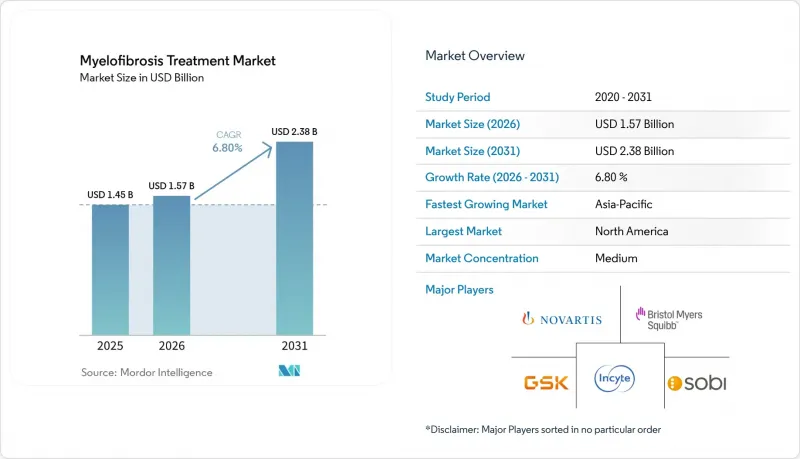
에 따르면 골수섬유증 치료 시장 규모는 2025년 14억 5,000만 달러에서 2026년에는 15억 7,000만 달러로 확대되어, 2026년부터 2031년까지 CAGR 8.68%를 기록하며 2031년에는 23억 8,000만 달러에 달할 것으로 예측됩니다.
세계 골수섬유증 치료 시장의 동향 및 인사이트
표현형 특이적 JAK 억제제 치료법의 채택 확대
골수섬유증 치료 시장에서 치료법 선택은 표현형에 기반한 접근 방식으로 전환되고 있습니다. 빈혈의 중증도, 혈소판 수, 그리고 치료 이력이 치료법 선택에 있어 점점 더 중요한 지침이 되고 있습니다. 모메로티닙은 JAK1, JAK2 및 ACVR1을 억제하여 헵시딘 농도를 낮추고, 적혈구 생성을 촉진하며, 비장 비대 개선에 기여합니다. 발표된 치료 지침에서는 혈소판 수가 50×109/L 미만인 환자에게는 파크리티닙을, 수혈 의존성 환자에게는 모메로티닙을 권장하고 있어, 승인된 JAK 억제제의 임상적 역할이 더욱 명확해지고 있습니다.
질환 수정 요법 및 병용요법의 파이프라인 확대
병용요법 프로그램은 골수섬유증 치료 시장에서 선택의 폭을 넓히고 있습니다. 2025년 MANIFEST-2 임상시험에서, 페라브레시브와 룩솔리티닙의 병용요법을 통해 JAK 억제제 미치료 환자의 65.9%가 SVR35를 달성한 반면, 룩솔리티닙 단독 요법에서는 35.2%에 그쳤습니다. 셀리넥솔과 룩솔리티닙의 병용요법에서는 36주 시점에서 환자의 47%가 SVR35를 달성한 반면, 대조군에서는 23%에 그쳤습니다. 카리오팜(Kariofarm)은 2026년 8월, 이 병용요법에 대한 신약 승인 신청 보충 자료를 제출하고 신속 승인을 신청했습니다. ASCO 2026에서 발표된 업데이트된 사후 매칭 분석에 따르면, 이메텔스타트는 최상의 기존 치료법과 비교하여 전체 생존 기간의 중앙값이 30.7개월 대 15.4개월을 나타냈습니다. 이러한 프로그램은 1차 및 그 이후 치료에서 BET 억제, XPO1 차단, MDM2 활성화, 텔로머라제 억제 및 II형 JAK2 선택성을 포괄하고 있습니다.
치료를 제한하는 빈혈, 혈소판 감소증 및 골수 억제
골수 억제는 JAK 억제제 치료에서 계속해서 주요한 안전성 문제로 남아 있으며, 보다 집중적인 치료가 필요한 환자의 용량 증량을 제한할 가능성이 있습니다. MANIFEST-2 임상시험에서, 페라브레시브와 룩솔리티닙을 병용한 환자의 52.8%에서 혈소판 감소증이, 44.8%에서 어느 정도의 빈혈이 관찰되었습니다. SENTRY 임상시험에서는 셀리넥솔과 룩솔리티닙을 병용한 군의 59%에서 혈소판 감소증이 나타난 반면, 룩솔리티닙과 위약을 병용한 군에서는 43%였습니다. 혈액학적 독성을 관리하기 위한 용량 감량은 JAK 억제제의 효능을 저하시킬 가능성이 있어, 특정 병용요법의 더 광범위한 도입을 제한하는 요인이 되고 있습니다.
부문 분석
2025년 기준, 질환 유형별 골수섬유증 치료 시장 점유율 중 원발성 골수섬유증이 55.67%를 차지했습니다. 이는 본태성 혈소판증가증 및 진성 적혈구증가증에 비해 원발성 골수섬유증의 발병률이 높기 때문입니다. 또한, 원발성 골수섬유증은 진단 및 초기 치료에서 계속해서 확고한 중점 분야로 남아 있습니다. 이차성 골수섬유증은 본태성 혈소판증가증 및 진성 적혈구증가증 환자의 생존 기간이 연장되고, 전이 위험이 있는 환자 수가 증가하고 있기 때문에 2031년까지 연평균 성장률(CAGR) 9.22%로 성장할 것으로 예측됩니다. 하이드록시우레아 및 페그화 인터페론은 장기적인 질환 관리를 뒷받침하고 있으며, 전이 모니터링의 필요성이 높아지고 있습니다.
분자진단 및 위험 분류의 발전이 이차성 골수섬유증 부문을 뒷받침하고 있습니다. 2026년 인도 3차 의료 기관 코호트를 대상으로 한 연구에 따르면, 초기 단계에서 69개 유전자 차세대 염기서열 분석을 통해 골수증식성 종양 환자의 16.4%가 예후 위험이 더 높은 범주로 재분류된 것으로 나타났습니다. MYSEC-PM 점수는 골수증식성 종양 후 이차성 골수섬유증에서 위험도에 기반한 치료 선택을 지원하는 것으로, 유럽의 치료 알고리즘에 채택되어 있을 뿐만 아니라 아시아태평양의 전문 의료 센터에서도 채택이 확대되고 있습니다. 이러한 도구는 의뢰, 분자 검사 및 적시 치료 재검토를 개선합니다.
2025년에는 표적 치료제가 약물 분류별 매출의 58.66%를 차지할 것으로 예상되며, 여기에는 JAK 억제제 및 기타 분자 표적 치료제가 포함됩니다. 4개의 승인된 JAK 억제제가 이 부문을 뒷받침하고 있으며, 룩솔리티닙은 1차 증상 관리 및 비장 관리에서 여전히 중심적인 역할을 하고 있습니다. 이 부문은 빈혈 및 혈소판 프로파일에 맞춘 치료에 대한 관심이 높아지고 있음을 반영합니다. 새롭게 등장하고 있는 표적 치료제의 병용요법은 일반적으로 루크솔리티닙의 대체제로서가 아니라, 병행 요법으로 평가되고 있습니다.
화학요법은 2031년까지 연평균 성장률(CAGR) 8.80%로 성장할 것으로 예측되며, 이는 약물 분류 중 가장 높은 수치입니다. 이 요법의 사용은 세포 감소 치료, 특히 아시아태평양이나 남미 등 보험 급여가 제한된 지역의 저위험 환자를 대상으로 한 하이드록시우레아와 관련이 있습니다. 페그화 인터페론과 룩솔리티닙의 병용요법은 이전 JAK 억제제 치료에 내약성이 없었던 환자에서 골수 세포 수 및 섬유화를 개선했습니다. ‘기타’ 범주에는 승인을 기다리고 있는 텔로머라제 억제제 및 MDM2 억제제가 포함되어 있으며, 3상 임상시험 결과가 보고됨에 따라 이 범주가 확대될 가능성이 있습니다.
지역별 분석
2025년, 북미는 골수섬유증 치료 시장의 42.80%를 차지했습니다. 이는 미국 내 추정 환자 수 2만 명과 FDA 승인을 받은 4가지 JAK 억제제 모두에 대한 접근성이 보장된 데 기인합니다. 선별된 전문 약국이 치료제 공급 및 모니터링을 지원하고 있습니다. 유럽은 두 번째로 큰 지역 시장이며, 루크솔리티닙, 모메로티닙, 페드라티닙이 유럽의약품청(EMA)의 집중 승인 절차를 통해 승인되었습니다. 독일, 영국, 프랑스는 지정된 골수증식성 종양 전문 센터를 통해 해당 지역 내 처방량을 주도하고 있으나, 국가별 보험 급여 승인에는 대개 임상적 및 의료경제적 근거가 요구됩니다.
아시아태평양은 2031년까지 연평균 성장률(CAGR) 8.95%로 성장할 것으로 예측됩니다. 중국 국가의약품감독관리국은 2026년 2월 28일, 원발성 및 이차성 골수섬유증을 앓고 있는 적격 성인 환자를 대상으로 한 JAK/ROCK 이중 억제제 ‘TQ05105’(상품명 : Anxu)를 승인했습니다. 등록 데이터에 따르면, 환자의 58.33%에서 SVR35가, 77.78%에서 TSS50이 확인되었습니다. 중국의 골수섬유증 환자 수는 2025년에 6만 7,000명을 넘어섰으며, 진단 능력, 고령화, 그리고 3차 의료 수준의 혈액학 인프라 구축을 배경으로 2030년까지 30만 명에 육박할 것으로 예측됩니다. 일본에서는 JAK 억제제의 꾸준한 사용이 권장되고 있는 반면, 인도에서 2026년에 실시된 69개 유전자 염기서열 분석 연구에 따르면, 환자의 16.4%가 예후 위험이 더 높은 그룹으로 재분류되어, 조기 전문의 치료의 중요성이 입증되었습니다.
중동 및 아프리카에서는 JAK 억제제 치료가 여전히 상용화의 초기 단계에 있으며, 치료는 GCC 국가, 남아프리카공화국 및 기타 주요 도시 지역의 3차 종양 센터에 집중되어 있습니다. 보험 환급 제도가 제한적이기 때문에 많은 환자들이 병원의 약제 목록이나 제약 회사의 지원 프로그램에 의존할 수밖에 없습니다. 남미에서는 브라질과 아르헨티나가 주도적인 역할을 하고 있지만, 비용 및 접근성과 관련된 제약은 여전히 남아 있습니다. 한편, 브라질의 공적 의료 제도에서는 학술 기관 이외의 곳에서도 인지도가 높아짐에 따라 치료 경로가 도입되기 시작했습니다. 진단 대상의 확대, 국제 임상시험 참여, 그리고 전문의 소개 네트워크의 강화가 두 지역에서 치료법의 점진적인 보급을 뒷받침하고 있습니다.
기타 혜택:
- 엑셀 형식의 시장 예측(ME) 시트
- 3개월간의 애널리스트 지원
자주 묻는 질문
목차
제1장 소개
- 조사 가정과 시장 정의
- 조사 범위
제2장 조사 방법
제3장 주요 요약
제4장 시장 구도
- 시장 개요
- 시장 성장 촉진요인
- 시장 성장 억제요인
- 가치 및 공급망 분석
- 규제 상황
- 기술 전망
- Porter's Five Forces 분석
제5장 시장 규모와 성장 예측
- 질환 유형별
- 약물 계열별
- 투여 경로별
- 최종사용자별
- 지역별
- 북미
- 미국
- 캐나다
- 멕시코
- 유럽
- 독일
- 영국
- 프랑스
- 이탈리아
- 스페인
- 기타 유럽 국가
- 아시아태평양
- 중국
- 인도
- 일본
- 호주
- 한국
- 기타 아시아태평양 국가
- 중동 및 아프리카
- GCC
- 남아프리카공화국
- 기타 중동 및 아프리카 국가
- 남미
- 브라질
- 아르헨티나
- 기타 남미 국가
- 북미
제6장 경쟁 구도
- 시장 집중도
- 시장 점유율 분석
- 기업 개요
- AbbVie Inc.
- Bristol-Myers Squibb Company
- Geron Corporation
- GSK plc
- Incyte Corporation
- Kartos Therapeutics, Inc.
- Karyopharm Therapeutics Inc.
- MorphoSys AG
- Novartis AG
- PharmaEssentia Corporation
- Swedish Orphan Biovitrum AB(publ)
- Takeda Pharmaceutical Company Limited
제7장 시장 기회와 향후 전망
KSM 26.10.30According to Mordor Intelligence, the myelofibrosis treatment market size is expected to grow from USD 1.45 billion in 2025 to USD 1.57 billion in 2026 and is forecast to reach USD 2.38 billion by 2031 at 8.68% CAGR over 2026-2031.
Global Myelofibrosis Treatment Market Trends and Insights
Increasing Adoption of Phenotype-Specific JAK Inhibitor Therapy
Treatment selection in the myelofibrosis treatment market is shifting toward a phenotype-based approach. Anemia severity, platelet count, and treatment history increasingly guide therapy selection. Momelotinib inhibits JAK1, JAK2, and ACVR1, lowering hepcidin levels, supporting erythropoiesis, and addressing splenomegaly. Published treatment guidance positions pacritinib for patients with platelet counts below 50 X 109/L and momelotinib for transfusion-dependent patients, creating clearer clinical roles for approved JAK inhibitors.
Pipeline Expansion of Disease-Modifying and Combination Therapies
Combination therapy programs are expanding options in the myelofibrosis treatment market. In the 2025 MANIFEST-2 trial, pelabresib plus ruxolitinib achieved SVR35 in 65.9% of JAK inhibitor-naive patients, compared with 35.2% for ruxolitinib alone. Selinexor plus ruxolitinib achieved SVR35 in 47% of patients at week 36, compared with 23% in the comparator group. Karyopharm submitted a supplemental New Drug Application for the combination in August 2026 and sought accelerated approval. Imetelstat showed a median overall survival of 30.7 months versus 15.4 months with best-available therapy in an updated post-hoc matched analysis presented at ASCO 2026. These programs cover BET inhibition, XPO1 blockade, MDM2 activation, telomerase inhibition, and Type II JAK2 selectivity for frontline and later-line care.
Treatment-Limiting Anemia, Thrombocytopenia, and Myelosuppression
Myelosuppression remains a key safety challenge in JAK inhibitor treatment and can limit dose escalation for patients requiring more intensive therapy. In MANIFEST-2, 52.8% of patients receiving pelabresib plus ruxolitinib experienced thrombocytopenia, while 44.8% experienced anemia of any grade. In the SENTRY trial, thrombocytopenia occurred in 59% of the selinexor plus ruxolitinib group, compared with 43% of the ruxolitinib plus placebo group. Dose reductions to manage hematologic toxicity can reduce JAK inhibitor effectiveness, limiting broader adoption of certain combination therapies.
Other drivers and restraints analyzed in the detailed report include:
- Expansion of Anemia-Directed Treatment Options
- Growing Demand for Post-JAK Inhibitor Treatment
- High Treatment Cost and Unequal Reimbursement Access
For complete list of drivers and restraints, kindly check the Table Of Contents.
Segment Analysis
Primary myelofibrosis held 55.67% of the myelofibrosis treatment market share by disease type in 2025, driven by higher de novo incidence than post-essential thrombocythemia and post-polycythemia vera forms. It also remains the established focus of diagnosis and initial treatment. Secondary myelofibrosis is forecast to grow at a 9.22% CAGR through 2031 as longer survival among patients with essential thrombocythemia and polycythemia vera increases the population at risk of transformation. Hydroxyurea and pegylated interferon support long-term disease management, increasing the need for transformation monitoring.
Advances in molecular diagnosis and risk classification support the secondary myelofibrosis segment. A 2026 study from an Indian tertiary referral cohort found that upfront 69-gene next-generation sequencing reclassified 16.4% of patients with myeloproliferative neoplasms into higher prognostic risk categories. The MYSEC-PM score supports risk-based therapy selection for post-myeloproliferative neoplasm secondary myelofibrosis and is used in European treatment algorithms, with increasing adoption across Asia-Pacific specialty centers. These tools improve referral, molecular testing, and timely therapeutic review.
Targeted drug therapy held 58.66% of drug-class revenue in 2025 and includes JAK inhibitors and other molecularly targeted agents. Four approved JAK inhibitors supported the category, while ruxolitinib remained central to front-line symptom and spleen management. The segment reflects a growing focus on matching treatment with anemia and platelet profiles. Emerging targeted combinations are generally being evaluated alongside, rather than in place of, ruxolitinib.
Chemotherapy is forecast to grow at an 8.80% CAGR through 2031, the highest among drug classes. Its use is linked to cytoreductive treatment, particularly hydroxyurea for lower-risk patients in reimbursement-constrained areas of the Asia-Pacific and South America. Pegylated interferon plus ruxolitinib improved marrow cellularity and fibrosis in patients intolerant of prior JAK inhibitor therapy. The Others category includes telomerase inhibitors and MDM2 inhibitors awaiting approval, which could expand the category as Phase 3 programs report results.
Complete Report Scope:
- By Disease Type
- Primary Myelofibrosis
- Secondary Myelofibrosis
- By Drug Class
- Targeted Drug Therapy
- JAK Inhibitors
- Other Targeted Therapy
- Chemotherapy
- Immunomodulatory Agents
- Others
- Targeted Drug Therapy
- By Route of Administration
- Oral
- Intravenous
- Subcutaneous
- Other Routes of Administration
- By End User
- Hospitals
- Specialty Hematology and Oncology Clinics
- Ambulatory Infusion Centers
- Academic Medical Centers
- Others
- By Geography
- North America
- United States
- Canada
- Mexico
- Europe
- Germany
- United Kingdom
- France
- Italy
- Spain
- Rest of Europe
- Asia-Pacific
- China
- India
- Japan
- Australia
- South Korea
- Rest of Asia-Pacific
- Middle East and Africa
- GCC
- South Africa
- Rest of Middle East and Africa
- South America
- Brazil
- Argentina
- Rest of South America
- North America
Geography Analysis
North America held 42.80% of the myelofibrosis treatment market share in 2025, supported by an estimated 20,000 patients in the United States and access to all four FDA-approved JAK inhibitors. Restricted specialty pharmacies support treatment distribution and monitoring. Europe is the second-largest regional market, with ruxolitinib, momelotinib, and fedratinib authorized through the European Medicines Agency's centralized route. Germany, the United Kingdom, and France lead regional volumes through designated myeloproliferative neoplasm expert centers, while country-specific reimbursement often requires clinical and health economic evidence.
Asia-Pacific is forecast to grow at an 8.95% CAGR through 2031. China's National Medical Products Administration approved TQ05105, branded Anxu, on February 28, 2026, as a dual JAK/ROCK inhibitor for eligible adults with primary and secondary myelofibrosis; registration data showed SVR35 in 58.33% of patients and TSS50 in 77.78% of patients. China's myelofibrosis patient population exceeded 67,000 in 2025 and is projected to approach 300,000 by 2030, supported by diagnostic capacity, aging demographics, and tertiary hematology infrastructure. Japan supports steady JAK inhibitor use, while India's 2026 69-gene sequencing study reclassified 16.4% of patients into higher prognostic risk groups, supporting earlier specialist care.
The Middle East and Africa remain at an early commercial stage for JAK inhibitor therapy, with treatment concentrated in tertiary oncology centers across GCC countries, South Africa, and other major urban locations. Limited reimbursement infrastructure requires many patients to rely on hospital formularies or manufacturer support programs. Brazil and Argentina lead South American activity, although cost and access constraints persist, while Brazil's public health system is beginning to incorporate treatment pathways as awareness expands beyond academic centers. Diagnostic expansion, international trial participation, and stronger specialist referral networks support gradual adoption across both regions.
- Abbvie
- Bristol-Myers Squibb
- Geron Corporation
- GlaxoSmithKline
- Incyte
- Kartos Therapeutics, Inc.
- Karyopharm Therapeutics
- MorphoSys AG
- Novartis
- PharmaEssentia Corporation
- Swedish Orphan Biovitrum AB (publ)
- Takeda Pharmaceuticals
Additional Benefits:
- The market estimate (ME) sheet in Excel format
- 3 months of analyst support
TABLE OF CONTENTS
1 INTRODUCTION
- 1.1 Study Assumptions and Market Definition
- 1.2 Scope of the Study
2 RESEARCH METHODOLOGY
3 EXECUTIVE SUMMARY
4 MARKET LANDSCAPE
- 4.1 Market Overview
- 4.2 Market Drivers
- 4.2.1 Increasing Adoption of Phenotype-Specific JAK Inhibitor Therapy
- 4.2.2 Expansion of Anemia-Directed Treatment Options
- 4.2.3 Rising Diagnosis Through Molecular Testing and Specialist Referral
- 4.2.4 Growing Demand for Post-JAK Inhibitor Treatment
- 4.2.5 Pipeline Expansion of Disease-Modifying and Combination Therapies
- 4.2.6 Increasing Use of Real-World Evidence in Rare Hematological Cancers
- 4.3 Market Restraints
- 4.3.1 Treatment-Limiting Anemia, Thrombocytopenia, and Myelosuppression
- 4.3.2 Limited Evidence of Durable Disease Modification
- 4.3.3 High Treatment Cost and Unequal Reimbursement Access
- 4.3.4 Small, Heterogeneous, and Difficult-to-Diagnose Patient Population
- 4.4 Value/Supply-Chain Analysis
- 4.5 Regulatory Landscape
- 4.6 Technological Outlook
- 4.7 Porter's Five Forces Analysis
- 4.7.1 Bargaining Power of Suppliers
- 4.7.2 Bargaining Power of Buyers
- 4.7.3 Threat of New Entrants
- 4.7.4 Threat of Substitutes
- 4.7.5 Competitive Rivalry
5 MARKET SIZE AND GROWTH FORECASTS (VALUE, USD)
- 5.1 By Disease Type
- 5.1.1 Primary Myelofibrosis
- 5.1.2 Secondary Myelofibrosis
- 5.2 By Drug Class
- 5.2.1 Targeted Drug Therapy
- 5.2.1.1 JAK Inhibitors
- 5.2.1.2 Other Targeted Therapy
- 5.2.2 Chemotherapy
- 5.2.3 Immunomodulatory Agents
- 5.2.4 Others
- 5.2.1 Targeted Drug Therapy
- 5.3 By Route of Administration
- 5.3.1 Oral
- 5.3.2 Intravenous
- 5.3.3 Subcutaneous
- 5.3.4 Other Routes of Administration
- 5.4 By End User
- 5.4.1 Hospitals
- 5.4.2 Specialty Hematology and Oncology Clinics
- 5.4.3 Ambulatory Infusion Centers
- 5.4.4 Academic Medical Centers
- 5.4.5 Others
- 5.5 By Geography
- 5.5.1 North America
- 5.5.1.1 United States
- 5.5.1.2 Canada
- 5.5.1.3 Mexico
- 5.5.2 Europe
- 5.5.2.1 Germany
- 5.5.2.2 United Kingdom
- 5.5.2.3 France
- 5.5.2.4 Italy
- 5.5.2.5 Spain
- 5.5.2.6 Rest of Europe
- 5.5.3 Asia-Pacific
- 5.5.3.1 China
- 5.5.3.2 India
- 5.5.3.3 Japan
- 5.5.3.4 Australia
- 5.5.3.5 South Korea
- 5.5.3.6 Rest of Asia-Pacific
- 5.5.4 Middle East and Africa
- 5.5.4.1 GCC
- 5.5.4.2 South Africa
- 5.5.4.3 Rest of Middle East and Africa
- 5.5.5 South America
- 5.5.5.1 Brazil
- 5.5.5.2 Argentina
- 5.5.5.3 Rest of South America
- 5.5.1 North America
6 COMPETITIVE LANDSCAPE
- 6.1 Market Concentration
- 6.2 Market Share Analysis
- 6.3 Company Profiles (includes Global Level Overview, Market Level Overview, Core Segments, Financials as available, Strategic Information, Market Rank/Share, Products and Services, Recent Developments)
- 6.3.1 AbbVie Inc.
- 6.3.2 Bristol-Myers Squibb Company
- 6.3.3 Geron Corporation
- 6.3.4 GSK plc
- 6.3.5 Incyte Corporation
- 6.3.6 Kartos Therapeutics, Inc.
- 6.3.7 Karyopharm Therapeutics Inc.
- 6.3.8 MorphoSys AG
- 6.3.9 Novartis AG
- 6.3.10 PharmaEssentia Corporation
- 6.3.11 Swedish Orphan Biovitrum AB (publ)
- 6.3.12 Takeda Pharmaceutical Company Limited
7 MARKET OPPORTUNITIES AND FUTURE OUTLOOK
- 7.1 White-Space and Unmet-Need Assessment


