

|
시장보고서
상품코드
2156895
군용 항공우주 코팅 : 시장 점유율 분석, 업계 동향과 통계, 성장 예측(2026-2031년)Military Aerospace Coatings - Market Share Analysis, Industry Trends & Statistics, Growth Forecasts (2026 - 2031) |
||||||
 Mordor Intelligence
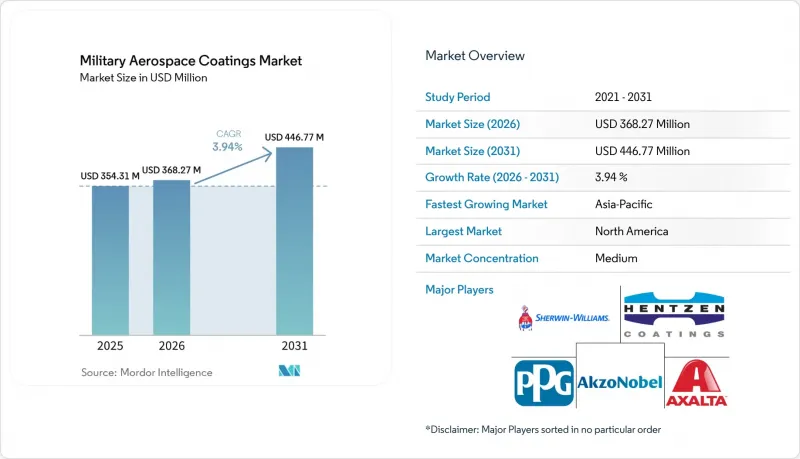
에 따르면 군용 항공우주 코팅 시장 규모는 2025년에 3억 5,431만 달러로 평가되며, 2026년 3억 6,827만 달러에서 2031년까지 4억 4,677만 달러에 달할 것으로 예측되고 있으며, 예측 기간(2026-2031년)에 CAGR은 3.94%에 달할 전망입니다.
전 세계 군사·항공우주용 코팅 시장의 동향 및 인사이트
방위 함대의 현대화 및 수명 연장
방위 조달 분야에서는 신형 항공기 프로그램이나 구형 항공기의 운용 지속을 위한 작업을 통해 수요가 창출됩니다. 새로운 플랫폼에는 기체 전체에 걸쳐 프라이머, 탑코트 및 특수 기능층이 필요합니다. 또한 수명 연장 프로그램에서는 구조 보수 후 도장 박리 및 전면 재도장이 필요합니다. 북대서양조약기구(NATO)는 2025년 6월, 2035년까지 국방비 직접 분담액을 국내총생산(GDP)의 3.5%로 끌어올리겠다고 약속했습니다. 이 약속은 군용 항공 프로그램의 장기적인 계획 수립을 지원하는 것입니다. 또한 구형 항공기가 재취역할 때에는 현재의 크롬 프리 또는 저VOC(휘발성 유기 화합물) 시스템이 필요할 수 있으며, 이로 인해 공식적인 단계적 폐지 기한 이전에 조성이 변경된 도료가 사용되게 됩니다.
반복되는 부식 방지 및 재도장 수요
부식 방지는 군용기에게 여전히 필수적인 정비 요건입니다. 2025년 'Engineering Failure Analysis' 저널에 게재된 연구에 따르면 대체재에 대한 신뢰할 수 있는 가속 시험 방법이 부족하여 항공기 구조용 코팅에서 6가 크롬을 제거하는 데 제약이 있는 것으로 밝혀졌습니다. 따라서 대체 시스템은 인증을 받기 전에 더 장기간에 걸친 현장 검증이 필요합니다. 2025년에 발표된 조사에서는 재료의 열화 및 부식이 미국 해군 항공 부대의 즉각적인 대응 능력에 미치는 영향에 대해서도 검증되었습니다. 부식이 항공기의 운용 가능 상태에 부정적인 영향을 미치는 경우, 보호용 프라이머와 보수용 탑코트는 여전히 필수적입니다. 군사 항공우주용 코팅 시장에서 이러한 요건으로 인해 수요는 국방 예산의 단기적인 주기보다는 재량적인 장비 구매에 더 크게 의존하는 경향이 강해지고 있습니다.
장기적인 군사 인증 및 승인 주기
군사용 코팅의 승인에는 기판이나 필요한 시험 범위에 따라 3년 7년이 소요될 수 있습니다. 이 과정은 미국의 군사 성능(MIL-PRF) 사양 요건, 영국의 국방 표준(Defence Standard) 프레임워크, 그리고 북대서양 조약 기구(NATO)의 기준 등의 사양에 따라 진행됩니다. 2026년 2월, 크롬산염을 함유한 항공우주용 프라이머의 승인 신청과 관련하여 영국 보건안전집행청(HSE)이 내린 결정에서는 공급망 전반에 걸쳐 크롬이 포함되지 않은 대체재를 검증하고 도입하는 데 어려움이 있다는 점이 지적되었습니다. 대체 코팅의 경우 플랫폼 전체에 대한 승인이 필요할 수 있으므로, 제조업체들은 종종 사전 인증된 시스템을 사용합니다. 군사 항공우주용 코팅 시장에서는 신제품 채택 속도가 완만하지만, 확립된 승인 포트폴리오를 보유한 공급업체들은 우위를 유지하고 있습니다. 미국 육군 연구소 및 해군 해상 시스템 사령부의 기술 매뉴얼을 통해 관리되는 군사 성능 사양(MIL-PRF) 요건 또한 플랫폼별 승인에 관한 진입 기준을 규정하고 있습니다.
부문 분석
폴리우레탄은 2025년에 군사 항공우주용 코팅 시장 점유율의 42.36%를 차지할 것으로 예상되며, 2031년까지 연평균 성장률(CAGR) 5.35%로 확대될 것으로 전망됩니다. 이러한 위상은 광택 유지력, 자외선 안정성, 내화학성 및 극한 온도 하에서의 유연성에 관한 MIL-PRF-85285의 요건을 충족하고 있음을 반영합니다. 이러한 특성 덕분에 항공기 외장 표면에 사용될 수 있습니다. 이 수지는 화학 물질, 햇빛 및 변동하는 사용 온도에 노출되는 기체에도 사용할 수 있습니다. 또한 그 성능 특성 덕분에 정기적인 유지보수 작업 후에도 일관된 외관을 유지할 수 있습니다. 에폭시 수지는 탄소섬유 복합재의 기판에 대한 접착력이 뛰어나기 때문에 여전히 중요한 프라이머 재료로 자리 잡고 있습니다. 아크릴 수지는 레돔용 투명 코팅이나 내장재 용도 등 보다 전문적인 역할을 담당하고 있습니다. 이러한 용도에서는 외장재의 내구성보다 빠른 경화성이나 유전 특성이 더 중요할 수 있습니다.
SOCOMORE사는 2026년 4월부터 ‘AeroGlaze’, ‘Chemglaze’ 폴리우레탄 코팅 및 ‘PreKote’ 표면 처리제에 대해 Blend Supply사를 북미 지역의 정식 마스터 유통업체로 지정했습니다. 이 판매 계약을 통해 정비·수리·오버홀(MRO) 고객들이 군사 용도에서 파생된 폴리우레탄 코팅 제품을 이용할 수 있게 되었습니다. Indestructible Paint Ltd.는 염수 분무 시험에서 1,000시간 이상의 내성을 보이는 알루미늄 합금용 크롬 프리 방식 프라이머에 대해 Institute of Materials Finishing으로부터 인증을 받았습니다. Akzo Nobel N.V.는 2026년에 에어버스 디펜스 앤 스페이스(Airbus Defence and Space)를 대상으로 새로운 크롬 프리 프라이머의 인증을 획득했습니다. 이러한 진전은 외장 보호와 환경 부담 저감을 양립시키기 위한 지속적인 노력을 보여줍니다. 또한 승인 진행 상황이 수지 대체 시기에 영향을 미칠 가능성도 시사하고 있습니다. 기타 수지 범주에 속하는 불소 수지계 도료 시스템은 제안된 PFAS 규제의 압박에 직면해 있습니다. 수성 및 고고형분 유형의 사용은 2031년까지 확대될 것으로 예상되지만, 인증 진행 속도가 여전히 제약 요인으로 작용하고 있습니다.
2025년 시점에 용제형 도료는 군사 항공우주용 코팅 시장 점유율의 57.34%를 차지했습니다. 이러한 확고한 입지는 오랜 기간에 걸친 MIL-PRF 인증 데이터와, 내공성(耐空性)에 필수적인 자산에서 입증된 성능이 요구되기 때문입니다. 수성 도료는 2031년까지 연평균 성장률(CAGR) 5.67%로 확대될 것으로 예측됩니다. 군사 시설에서의 배출 규제 강화가 그 개발을 지원하고 있습니다. 수성 시스템은 기존 코팅 시스템과 동등한 성능 요건을 충족해야 합니다. 그 이용 확대는 각 시설의 인증 결과 및 시공 능력에 달려 있습니다. 리프헬 에어로스페이스(Leupold Aerospace)는 2026년 1분기에 상하이를 포함한 아시아태평양 서비스 센터에서 화학물질 등록, 평가, 허가 및 제한(REACH) 규정을 준수하는 3가 크롬 시스템 공정을 도입했습니다. 이 프로그램은 군용 항공우주 코팅 시장이 저배출 코팅 공정을 위해 서비스 네트워크를 어떻게 구축하고 있는지를 보여줍니다.
군용 항공기 분야에서는 분체 도장이나 방사선 경화형 코팅의 채택이 여전히 제한적입니다. 크고 복잡한 기체 구조는 일반적으로 분체 도장 방식에 적합하지 않습니다. PPG 인더스트리즈는 2026년 6월, 전착을 통해 균일한 도막 두께를 실현할 수 있는 크롬 프리 기술로 AEROCRON 전착 프라이머를 발표했습니다. 이 방법은 스프레이 도장에 비해 휘발성 유기 화합물(VOC) 배출량을 줄일 수 있습니다. 또한 관련 부품 전체에 프라이머를 도포하기 위한 새로운 기법도 제공합니다. 군용 규격 인증을 획득하게 되면, 프라이머 도포에 있으며, 기술 구성이 바뀔 가능성이 있습니다. 그때까지는 용제계 제품이 실적이 확립되어 있으므로, 운용상의 우위를 유지하게 될 것입니다.
지역별 분석
2025년, 북미는 매출 점유율의 40.13%를 차지했습니다. 미국 공군, 해군, 해병대의 각 프로그램이 신규 생산 및 유지 활동 전반에 걸친 수요를 지원하고 있습니다. 의회가 승인한 2026 회계연도 국방비는 사상 처음으로 1조 달러를 넘어섰습니다. 이 예산에는 F-47 차세대 공중 우세(Next Generation Air Dominance) 기체의 조달과 F-35, B-52, 그리고 공중급유기 편대의 개조 비용이 포함되어 있습니다. 이러한 항공기 프로그램에서는 제조 및 정비 과정에서 인증된 코팅의 도포가 필요합니다. 또한 이 지역의 공급업체 기반에는 MIL-PRF 인증 제품군이 집중되어 있습니다. PPG 인더스트리즈는 2025년 10월, 노스캐롤라이나주 셸비에 3억 8,000만 달러를 투자해 항공우주용 코팅 및 실란트 제조 시설 건설을 시작했습니다. 198,000제곱피트 규모의 이 시설은 2027년 상반기에 완공될 예정입니다.
유럽의 방위용 코팅 수요는 2025년에 증가했으며, 2026년에도 장비 조달 및 지역 방위 태세 강화 조치에 힘입어 성장세를 이어가고 있습니다. 유럽연합(EU) 회원국들의 장비 조달 규모는 2025년에 1,150억 유로(약 1,336억 5,000만 달러)에 달해, 2024년 대비 실질 26% 증가했습니다. 스톡홀름 국제평화연구소(SIPRI)에 따르면 2025년 독일의 군사 지출은 1,140억 달러에 달해 24% 증가했습니다. 지역적인 조달 활동은 항공기 확보 및 유지 관리에 필요한 요건을 모두 지원할 수 있습니다. 악소노벨(AkzoNobel)은 2026년 7월, 프랑스 파미에에 위치한 항공우주용 코팅 공장 확장 사업에서 중요한 이정표를 달성했습니다. 이러한 진전은 항공우주 프로그램을 위한 지역적인 코팅 공급을 지원하는 것입니다.
아시아태평양은 2031년까지 연평균 성장률(CAGR) 5.45%로 확대될 것으로 예측됩니다. 이 군용 항공우주 코팅 시장은 각국의 조달 계획과 국내 항공우주 제조 능력 확대의 혜택을 받고 있습니다. 2025년, 인도의 군사비는 921억 달러, 일본은 622억 달러였습니다. KF-21의 취역과 인도내 C295의 현지 조립은 국내 항공기 제조로의 전환을 보여줍니다. 이러한 프로그램들로 인해 현지에서 지원되는 코팅 사양 및 기술 서비스에 대한 수요가 발생하고 있습니다. 악소노벨(AkzoNobel)은 2026년 9월 태국 촌부리에 색상 혼합 및 유통 시설을 개설했습니다. 남미, 중동 및 아프리카는 여전히 규모가 작은 지역이지만, 항공기 기단의 확장으로 인해 여전히 수입에 의존하고 있는 공급망에서 인증된 코팅에 대한 수요가 발생할 가능성이 있습니다.
기타 혜택:
- 엑셀 형식의 시장 예측(ME) 시트
- 3개월간의 애널리스트 지원
자주 묻는 질문
목차
제1장 서론
- 조사 전제조건과 시장 정의
- 조사 범위
제2장 조사 방법
제3장 개요
제4장 시장 구도
- 시장 개요
- 시장 성장 촉진요인
- 시장 성장 억제요인
- 밸류체인 분석
- Porter's Five Forces 분석
제5장 시장 규모와 성장 예측
- 수지 유형별
- 기술별
- 사용자 유형별
- 항공기 유형별
- 지역별
- 아시아태평양
- 중국
- 인도
- 일본
- 한국
- ASEAN 국가
- 기타 아시아태평양 국가
- 북미
- 미국
- 캐나다
- 멕시코
- 유럽
- 독일
- 영국
- 프랑스
- 이탈리아
- 북유럽 국가
- 러시아
- 기타 유럽 국가
- 남미
- 브라질
- 아르헨티나
- 기타 남미 국가
- 중동 및 아프리카
- 사우디아라비아
- 남아프리카공화국
- 기타 중동 및 아프리카 국가
- 아시아태평양
제6장 경쟁 구도
- 시장 집중도
- 전략적 동향
- 시장 점유율·순위 분석
- 기업 개요
- 3Chem
- Akzo Nobel N.V.
- Axalta Coating Systems, LLC
- BryCoat Inc.
- Creative Coatings Co.
- Hentzen Coatings, Inc.
- Indestructible Paint Ltd.
- Ionbond
- Mankiewicz Gebr. & Co.
- Mapaero
- PPG Industries, Inc.
- SOCOMORE
- The Sherwin-Williams Company
제7장 시장 기회와 향후 전망
KSA 26.10.29According to Mordor Intelligence, the military aerospace coatings market size was valued at USD 354.31 million in 2025 and is estimated to grow from USD 368.27 million in 2026 to reach USD 446.77 million by 2031, at a CAGR of 3.94% during the forecast period (2026-2031).
Global Military Aerospace Coatings Market Trends and Insights
Defense Fleet Modernization and Service-Life Extension
Defense procurement creates demand through new aircraft programs and through work that keeps older aircraft in service. New platforms need primer, topcoat, and specialty functional layers across the airframe. Service-life extension programs also require stripping and full recoating after structural repair. The North Atlantic Treaty Organization committed in June 2025 to increasing direct defense contributions to 3.5% of gross domestic product by 2035. This commitment supports a longer planning horizon for military aviation programs. Older aircraft can also require current chrome-free or low-VOC systems when they are returned to service, which brings reformulated coatings into use before a formal phaseout deadline.
Recurring Corrosion-Control and Recoating Demand
Corrosion control remains an essential maintenance requirement for military aircraft. A 2025 study in Engineering Failure Analysis found that the lack of reliable, accelerated test methods for alternatives limits the removal of hexavalent chromium from structural aircraft coatings. Alternative systems, therefore, need extended field validation before they can be qualified. Research published in 2025 also examined the effect of materials deterioration and corrosion on the readiness of the United States naval aviation. Protective primers and repair topcoats remain necessary when corrosion affects aircraft availability. Within the military aerospace coatings market, this requirement makes demand less dependent on short defense-budget cycles than on discretionary equipment purchases.
Lengthy Military Qualification and Certification Cycles
Military coating approvals can take 3 to 7 years, depending on the substrate and the range of testing required. The process is governed by specifications such as Military Performance (MIL-PRF) specification requirements in the United States, Defence Standard frameworks in the United Kingdom, and North Atlantic Treaty Organization standards. A February 2026 United Kingdom Health and Safety Executive decision on an authorization application for chromate-containing aerospace primers noted the difficulty of validating and implementing chrome-free alternatives across the full supply chain. Manufacturers often use pre-qualified systems because a replacement coating can require full platform approval. The military aerospace coatings market sees slower adoption of new products, while suppliers with established approval portfolios retain protection. Military Performance Specification requirements administered through the United States Army Research Laboratory and Naval Sea Systems Command technical manuals also set entry criteria for platform-specific approvals.
Other drivers and restraints analyzed in the detailed report include:
- Stealth and Multispectral Signature Management
- Indigenous Defense Manufacturing and Regional MRO Expansion
- Environmental Compliance and Reformulation Costs
For complete list of drivers and restraints, kindly check the Table Of Contents.
Segment Analysis
Polyurethane held 42.36% of the military aerospace coatings market share in 2025 and is projected to advance at a 5.35% CAGR through 2031. Its position reflects compliance with MIL-PRF-85285 requirements for gloss retention, ultraviolet stability, chemical resistance, and flexibility at temperature extremes. These properties support its use on aircraft exterior surfaces. The resin can serve airframes exposed to chemical fluids, sunlight, and changing operating temperatures. Its performance profile also supports a consistent appearance after routine maintenance work. Epoxy resins remain important primer chemistries because they adhere well to carbon-fiber composite substrates. Acrylic resins serve more specialized roles, including radome-transparent coatings and interior applications. In these uses, fast curing and dielectric performance can be more important than exterior durability.
SOCOMORE appointed Blend Supply as its Authorized Master Distributor for North America, effective April 2026, for AeroGlaze, Chemglaze polyurethane coatings, and PreKote surface treatments. The distribution arrangement supports access to military-origin polyurethane coating products for maintenance, repair and overhaul customers. Indestructible Paint Ltd. received recognition from the Institute of Materials Finishing for chromium-free anticorrosive primers for aluminum alloys with salt-spray resistance above 1,000 hours. Akzo Nobel N.V. qualified a new chrome-free primer for Airbus Defence and Space in 2026. These developments show continuing work to combine exterior protection with reduced environmental impact. They also show that approval progress can influence the timing of resin substitution. Fluoropolymer systems in the other resin category face pressure from the proposed PFAS restriction. Water-borne and high-solids variants are expected to gain use through 2031, although qualification pace remains a limiting factor.
Solvent-borne held 57.34% of the military aerospace coatings market share in 2025. Its installed position reflects long-standing MIL-PRF qualification data and the need for proven performance on airworthiness-critical assets. Water-borne is projected to advance at a 5.67% CAGR through 2031. Tighter emission permits at military depots support their development. Water-borne systems need to meet the same performance expectations as existing coating systems. Their wider use depends on qualification results and application capability at each facility. Liebherr-Aerospace implemented Registration, Evaluation, Authorisation and Restriction of Chemicals (REACH)-compliant Trivalent Chromium System processes at service centers in Asia-Pacific, including Shanghai, during the first quarter of 2026. The program shows how the military aerospace coatings market is preparing service networks for lower-emission coating processes.
Powder and radiation-cured coatings remain limited in military aircraft work. Large and complex airframes do not generally suit powder-coating methods. PPG Industries, Inc. presented its AEROCRON electrocoat primer in June 2026 as a chrome-free technology that can provide uniform film thickness through electrodeposition. The method can reduce volatile organic compound output compared with spray application. It also provides a different method for applying primer across relevant components. A military qualification could change the technology mix in primer applications. Until then, solvent-borne products retain an operational advantage because their performance history is established.
Complete Report Scope:
- By Resin Type
- Polyurethane
- Epoxy
- Acrylic
- Others
- By Technology
- Solvent-Borne
- Water-Borne
- Others
- By User Type
- Original Equipment Manufacturer
- Maintenance, Repair and Overhaul
- By Aircraft Type
- Fixed-Wing Aircraft
- Rotary-Wing Aircraft
- Others
- By Geography
- Asia-Pacific
- China
- India
- Japan
- South Korea
- ASEAN Countries
- Rest of Asia-Pacific
- North America
- United States
- Canada
- Mexico
- Europe
- Germany
- United Kingdom
- France
- Italy
- NORDIC Countries
- Russia
- Rest of Europe
- South America
- Brazil
- Argentina
- Rest of South America
- Middle East and Africa
- Saudi Arabia
- South Africa
- Rest of Middle East and Africa
- Asia-Pacific
Geography Analysis
North America held 40.13% revenue share in 2025. United States Air Force, Navy, and Marine Corps programs support demand across new production and sustainment activities. Congress-approved Fiscal Year 2026 defense spending exceeded USD 1 trillion for the first time. The funding included procurement for the F-47 Next Generation Air Dominance aircraft and modifications to F-35, B-52, and tanker fleets. These aircraft programs need qualified coating applications during production and maintenance. The regional supplier base also has a concentration of MIL-PRF-approved portfolios. PPG Industries, Inc. began construction in October 2025 on a USD 380 million aerospace coatings and sealants facility in Shelby, North Carolina. The 198,000-square-foot facility is expected to be completed in the first half of 2027.
Europe's defense coating demand rose in 2025 and remains supported in 2026 by equipment procurement and regional readiness initiatives. European Union member-state equipment procurement reached EUR 115 billion (approximately USD 133.65 billion) in 2025, representing a 26% real increase from 2024. Germany's military spending reached USD 114 billion in 2025, a 24% increase, according to the Stockholm International Peace Research Institute (SIPRI). Regional procurement can support both aircraft acquisition and sustainment requirements. Akzo Nobel N.V. reached a milestone in July 2026 in the expansion of its Pamiers, France, aerospace coatings site. These developments support regional coating supply for aerospace programs.
Asia-Pacific is projected to advance at a 5.45% CAGR through 2031. This military aerospace coatings market benefits from national procurement plans and the expansion of domestic aerospace manufacturing capacity. India spent USD 92.1 billion on its military in 2025, while Japan spent USD 62.2 billion in 2025. The KF-21 rollout and India's local C295 assembly mark a shift toward domestic aircraft manufacturing. These programs create requirements for locally supported coating specifications and technical service. Akzo Nobel N.V. opened a color blending and distribution facility in Chonburi, Thailand, in September 2026. South America and the Middle East and Africa remain smaller areas, but fleet expansion can create demand for qualified coatings from supply chains that still depend on imports.
- 3Chem
- Akzo Nobel N.V.
- Axalta Coating Systems, LLC
- BryCoat Inc.
- Creative Coatings Co.
- Hentzen Coatings, Inc.
- Indestructible Paint Ltd.
- Ionbond
- Mankiewicz Gebr. & Co.
- Mapaero
- PPG Industries, Inc.
- SOCOMORE
- The Sherwin-Williams Company
Additional Benefits:
- The market estimate (ME) sheet in Excel format
- 3 months of analyst support
TABLE OF CONTENTS
1 Introduction
- 1.1 Study Assumptions and Market Definition
- 1.2 Scope of the Study
2 Research Methodology
3 Executive Summary
4 Market Landscape
- 4.1 Market Overview
- 4.2 Market Drivers
- 4.2.1 Defense Fleet Modernization and Service-Life Extension
- 4.2.2 Recurring Corrosion-Control and Recoating Demand
- 4.2.3 Stealth and Multispectral Signature Management
- 4.2.4 Indigenous Defense Manufacturing and Regional MRO Expansion
- 4.2.5 Qualification of Low-VOC, Chrome-Free and PFAS-Reduced Systems
- 4.3 Market Restraints
- 4.3.1 Lengthy Military Qualification and Certification Cycles
- 4.3.2 Environmental Compliance and Reformulation Costs
- 4.3.3 Specialized Application Infrastructure and Skilled-Labor Constraints
- 4.4 Value Chain Analysis
- 4.5 Porter's Five Forces Analysis
- 4.5.1 Threat of New Entrants
- 4.5.2 Bargaining Power of Suppliers
- 4.5.3 Bargaining Power of Buyers
- 4.5.4 Threat of Substitutes
- 4.5.5 Competitive Rivalry
5 Market Size and Growth Forecasts (Value)
- 5.1 By Resin Type
- 5.1.1 Polyurethane
- 5.1.2 Epoxy
- 5.1.3 Acrylic
- 5.1.4 Others
- 5.2 By Technology
- 5.2.1 Solvent-Borne
- 5.2.2 Water-Borne
- 5.2.3 Others
- 5.3 By User Type
- 5.3.1 Original Equipment Manufacturer
- 5.3.2 Maintenance, Repair and Overhaul
- 5.4 By Aircraft Type
- 5.4.1 Fixed-Wing Aircraft
- 5.4.2 Rotary-Wing Aircraft
- 5.4.3 Others
- 5.5 By Geography
- 5.5.1 Asia-Pacific
- 5.5.1.1 China
- 5.5.1.2 India
- 5.5.1.3 Japan
- 5.5.1.4 South Korea
- 5.5.1.5 ASEAN Countries
- 5.5.1.6 Rest of Asia-Pacific
- 5.5.2 North America
- 5.5.2.1 United States
- 5.5.2.2 Canada
- 5.5.2.3 Mexico
- 5.5.3 Europe
- 5.5.3.1 Germany
- 5.5.3.2 United Kingdom
- 5.5.3.3 France
- 5.5.3.4 Italy
- 5.5.3.5 NORDIC Countries
- 5.5.3.6 Russia
- 5.5.3.7 Rest of Europe
- 5.5.4 South America
- 5.5.4.1 Brazil
- 5.5.4.2 Argentina
- 5.5.4.3 Rest of South America
- 5.5.5 Middle East and Africa
- 5.5.5.1 Saudi Arabia
- 5.5.5.2 South Africa
- 5.5.5.3 Rest of Middle East and Africa
- 5.5.1 Asia-Pacific
6 Competitive Landscape
- 6.1 Market Concentration
- 6.2 Strategic Moves
- 6.3 Market Share (%)/Ranking Analysis
- 6.4 Company Profiles (includes Global Overview, Market Overview, Core Segments, Financials as available, Strategic Information, Products and Services, and Recent Developments)
- 6.4.1 3Chem
- 6.4.2 Akzo Nobel N.V.
- 6.4.3 Axalta Coating Systems, LLC
- 6.4.4 BryCoat Inc.
- 6.4.5 Creative Coatings Co.
- 6.4.6 Hentzen Coatings, Inc.
- 6.4.7 Indestructible Paint Ltd.
- 6.4.8 Ionbond
- 6.4.9 Mankiewicz Gebr. & Co.
- 6.4.10 Mapaero
- 6.4.11 PPG Industries, Inc.
- 6.4.12 SOCOMORE
- 6.4.13 The Sherwin-Williams Company
7 Market Opportunities and Future Outlook
- 7.1 White-Space and Unmet-Need Assessment


