

|
시장보고서
상품코드
2156896
나노 탄산칼슘 : 시장 점유율 분석, 업계 동향과 통계, 성장 예측(2026-2031년)Nano Calcium Carbonate - Market Share Analysis, Industry Trends & Statistics, Growth Forecasts (2026 - 2031) |
||||||
 Mordor Intelligence
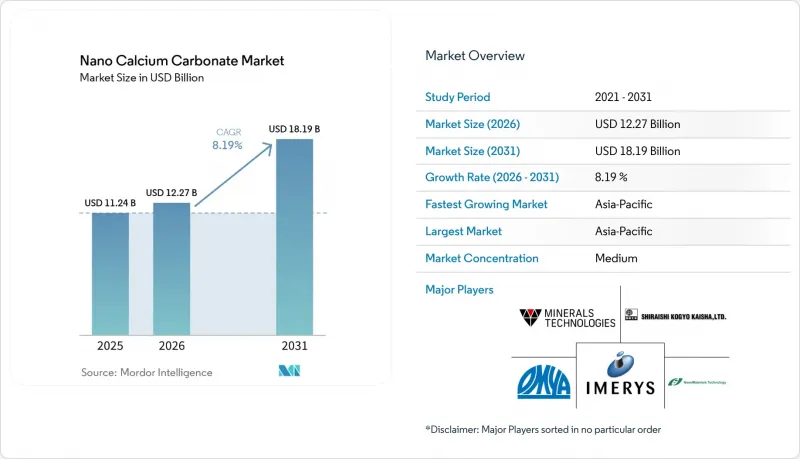
에 따르면 나노 탄산칼슘 시장 규모는 2025년에 112억 4,000만 달러로 평가되어 예측 기간(2026-2031년)에 CAGR 8.19%로 확대하며, 2026년 122억 7,000만 달러에서 2031년에는 181억 9,000만 달러에 달할 것으로 추정되고 있습니다.
전 세계 나노 탄산칼슘 시장의 동향 및 인사이트
플라스틱 경량화 및 충전재 최적화
표면 개질된 나노 CaCO3는 플라스틱에서 중요한 기능성 충전제로, 자동차 및 소비자 가전 제품 분야에서 엔지니어들이 금속이나 유리섬유로 만든 부품을 대체함에 따라 그 역할이 확대되고 있습니다. 나노 등급 제품을 사용하면 재료의 가공성을 유지하면서 마이크로 등급 대체재에 비해 중량 대비 30-50% 더 높은 충전률을 실현할 수 있습니다. 2025년 연구에 따르면 4.0 wt%의 나노입자상 CaCO3를 첨가함으로써 폴리프로필렌의 열변형 온도가 순수 폴리머에 비해 12°C 상승하는 것으로 밝혀졌습니다. 또한 같은 연구에서 0.48 wt%를 배합함으로써 나노복합재의 산소 투과율이 52% 감소하는 것으로 밝혀졌습니다.
표면 개질 나노 등급의 확대
스테아르산, 실란 커플링제, 티탄산염 에스테르 등을 사용함으로써 특정 폴리머나 코팅 배합에 맞춰 나노 CaCO3의 표면을 개질할 수 있습니다. 이러한 개질 등급은 미개질 소재에 비해 40-60% 비싸지만, 자동차용 도료, 의약품 첨가제, 전자기기 용도에서 요구되는 분산 요건을 충족합니다. 2026년 연구에 따르면 표적화된 표면 개질을 통해 미개질 나노 CaCO3로는 달성할 수 없었던 아크릴로니트릴-부타디엔-스티렌(ABS) 공중합체에 대한 고비율 충진이 가능해졌음이 밝혀졌습니다. 이러한 차이는 분산의 균일성이 최종 제품의 품질에 직접적인 영향을 미치는 까다로운 가공 조건 하에서 충전재 등급을 선정하는 제조업체에게 중요한 의미를 지닙니다.
기존의 탄산칼슘에 비해 높은 제조 비용
나노 CaCO₃의 제조에는 제어된 탄산화, 표면 개질, 그리고 에너지 집약적인 건조 또는 제트 밀링이 포함됩니다. 이러한 공정으로 인해 동등한 생산량 기준에서 기존의 침전법 탄산칼슘에 비해 제조 비용이 40%-60% 상승합니다. 전자기기용 및 의약품용 등급은 철 함량을 5ppm 이하, 입자 변동계수(CV)를 3% 이하로 하는 등 엄격한 순도 요건이 요구되므로 비용이 5-8배 높아질 수 있습니다. 2025-2026년에 저·중가대 나노 CaCO3의 가격은 4.80% 하락하여 톤당 612달러가 되었지만, 특수 등급의 가격은 여전히 상당히 높은 수준을 유지했습니다. 이러한 가격 차이로 인해 비용에 민감한 포장 및 고무 용도에서의 대체재 도입은 제한되고 있습니다. 이는 특수 등급 제조업체들이 고부가가치 등급을 통해 이익률을 유지하고 있기 때문입니다.
부문 분석
2025년 시점에 제품 유형별로 보면 침전법 나노 탄산칼슘이 나노 탄산칼슘 시장 점유율의 60.43%를 차지했습니다. 이러한 위상은 입자 크기 제어, 설계된 결정 형태, 그리고 균일한 표면적을 반영한 것입니다. 제어된 CO₂ 유량 및 온도 하에서 수산화칼슘의 탄산화를 통해 제조업체는 특정 유변학적 및 기계적 요건을 충족하기 위해 사방정계, 침상 및 방해석 형태의 입자를 생성할 수 있습니다. 이 제조 방법은 분쇄법을 통해 비슷한 비용으로 동등한 품질을 달성하기 어렵습니다. 미네랄 테크놀러지스(Minerals Technologies)는 2026년 1월, 2025년에 아시아에 3개의 새로운 위성형 침전법 탄산칼슘(PCC) 공장(중국 2곳, 인도 1곳)을 가동하고, 인도에 위치한 기존 위성 공장의 생산 능력을 두 배로 늘렸다고 발표했습니다.
분쇄법을 통한 나노 탄산칼슘은 2031년까지 제품 유형별 가장 높은 연평균 성장률(CAGR) 8.72%를 기록할 것으로 예측됩니다. 공정 개선을 통해 특히 고객이 신뢰성 높은 입자 분포를 필요로 하되 의약품이나 전자 분야에서의 최고 수준 사양까지는 요구하지 않는 경우, 침전법으로 제조된 재료와의 형태적 차이가 점차 줄어들고 있습니다. 오미야사는 2026년 6월, 나노급 침전 탄산칼슘을 제조하기 위한 건식 샌드밀 공정에 대해 미국 특허 제12668499호를 취득했습니다. 이는 건식 처리 기술과 침전 기술이 성능 목표 측면에서 융합되기 시작했음을 보여줍니다. 분쇄 등급은 기존 석회석 채석장의 인프라와 확립된 원자재 물류망을 활용할 수 있으므로, 건설용 컴파운드, 고무 제품 및 표준 포장 용도에서 경쟁력 있는 가격 책정이 가능합니다. 물류 부담이 적다는 점은 재료비가 구매 결정의 핵심이 되고, 정밀도 요건이 그리 엄격하지 않은 경우에 특히 중요합니다. 콜로이드 분산액, 수성 슬러리, 사전 분산 마스터배치와 같은 다른 형태는 필름 및 섬유 제품 분야에서 활용이 확대되고 있습니다. 이는 무분진 취급과 사전 분산된 공급을 통해 분말 제품에 수반되는 응집 문제를 완화할 수 있기 때문입니다.
지역별 분석
아시아태평양은 2025년 나노 탄산칼슘 시장 점유율의 45.07%를 차지하고 있으며, 2031년까지 연평균 성장률(CAGR) 9.25%로 성장할 것으로 예측됩니다. 중국은 2026년에 전 세계 생산 능력의 62% 이상을 차지하고 98만 6,000톤 이상을 소비할 것으로 예상되며, 이는 전 세계 소비량의 41.2%에 해당합니다. 인도에서는 도시화가 진행되고 특수 화학 제품 제조업체들이 고객과 일체화된 공급 계약을 채택하고 있으며, 실란트 및 건설 자재에 대한 수요가 증가하고 있습니다. 한국과 일본은 비교적 소규모 시장이지만, 전자 및 자동차 분야의 사양과 가격 기준에 영향을 미치고 있습니다.
북미 시장은 의약품 등급, 식품 접촉 인증 및 고성능 폴리머 소재에 대한 수요에 힘입어 성장하고 있습니다. 2025년 11월에 발효된 중국산 나노 CaCO3에 대한 미국의 12% 추가 관세로 인해 조달처가 인도, 동남아시아 및 유럽의 공급업체로 전환되었으며, 현재도 해당 지역의 조달 결정에 계속 영향을 미치고 있습니다. 오미야(Omiya)와 돔타(Domtar)는 2024년 9월 위스콘신주 네코사(Necosa)에서 연간 생산 능력 27,500 드라이톤 규모의 PCC 위성 공장을 가동했습니다. 이 공장을 통해 공급 중단 위험이 줄어들고 장거리 운송의 필요성이 사라졌으며, 이전 공장 폐쇄로 인한 지역적 공급 부족이 해소되었습니다. 유럽에서는 자동차용 도료, 건설용 실란트, 특수 용지가 주를 이루고 있으며, EU의 REACH 규정에 명시된 나노 물질 관련 조항이 사실상 진입 장벽으로 작용하고 있습니다. 이러한 요건으로 인해 입자 형태 데이터, 비표면적 측정값, 흡입 독성 정보를 포함한 완전한 등록 서류를 제출할 수 있는 공급업체가 우대받습니다.
남미는 브라질, 아르헨티나, 칠레의 건설 활동을 배경으로 도료·실란트용 나노 CaCO3의 수요가 여전히 확대되고 있는 신흥 시장입니다. 이메리스는 2026년 7월, 브라질의 초미세 탄산칼슘 제조업체인 SB Mineracao의 인수를 완료했으며, 해당 사업은 2025년에 3,000만 달러의 매출을 기록했습니다. 중동 및 아프리카에서는 주로 건설용 도료, 폴리머 배관, 인프라용 실란트에 이 소재가 사용되고 있으며, 해당 지역의 나노 등급 제품 수요 대부분은 수입으로 충당되고 있습니다. 이 지역에서는 나노 등급 제품보다 일반적인 CaCO3의 총 소비량이 여전히 더 많은 상황이지만, 도시화와 산업 투자로 인해 장기적으로는 더 높은 사양의 등급 채택이 확대될 것으로 예상됩니다.
기타 혜택:
- 엑셀 형식의 시장 예측(ME) 시트
- 3개월간의 애널리스트 지원
자주 묻는 질문
목차
제1장 서론
- 조사 전제조건과 시장 정의
- 조사 범위
제2장 조사 방법
제3장 개요
제4장 시장 구도
- 시장 개요
- 시장 성장 촉진요인
- 시장 성장 억제요인
- 밸류체인 분석
- Porter's Five Forces 분석
제5장 시장 규모와 성장 예측
- 제품 유형별
- 용도별
- 지역별
- 아시아태평양
- 중국
- 인도
- 일본
- 한국
- ASEAN 국가
- 기타 아시아태평양 국가
- 북미
- 미국
- 캐나다
- 멕시코
- 유럽
- 독일
- 영국
- 프랑스
- 이탈리아
- 북유럽 국가
- 기타 유럽 국가
- 남미
- 브라질
- 아르헨티나
- 기타 남미 국가
- 중동 및 아프리카
- 사우디아라비아
- 남아프리카공화국
- 기타 중동 및 아프리카 국가
- 아시아태평양
제6장 경쟁 구도
- 시장 집중도
- 전략적 동향
- 시장 점유율·순위 분석
- 기업 개요
- Fimatec Ltd.
- Fujian Sanmu Nano Calcium Carbonate Co., Ltd.
- Guangdong Qiangda New Materials Technology Co., Ltd.
- Gulshan Polyols Limited
- Huber Engineered Materials
- Imerys S.A.
- MARUO CALCIUM CO.,LTD.
- Minerals Technologies Inc.
- NanoMaterials Technology Co., Ltd.
- Nordkalk Corporation
- Okutama Kogyo Co., Ltd.
- Omya International AG
- SCHAEFER KALK GmbH & Co. KG
- Shanghai YaoHua Nano-Tech Co., Ltd.
- SHIRAISHI KOGYO KAISHA, LTD.
제7장 시장 기회와 향후 전망
KSA 26.10.29According to Mordor Intelligence, the nano calcium carbonate market size was valued at USD 11.24 billion in 2025 and is estimated to grow from USD 12.27 billion in 2026 to USD 18.19 billion by 2031, at a CAGR of 8.19% during the forecast period (2026-2031).
Global Nano Calcium Carbonate Market Trends and Insights
Plastics Lightweighting and Filler Optimization
Surface-modified nano CaCO3 is a key functional filler in plastics, and its role is expanding as engineers replace metal and glass-fiber parts in automotive and consumer electronics products. Nano grades can enable filler loading that is 30-50% higher by weight than micro-grade alternatives while keeping the material processable. A 2025 study found that adding 4.0 wt% nanoparticulate CaCO3 increased the polypropylene heat deflection temperature by 12°C relative to the neat polymer. The same study found that a 0.48 wt% loading reduced oxygen transmission by 52% in a nanocomposite.
Expansion of Surface-Modified Nano Grades
Stearic acid, silane coupling agents, and titanate esters can modify the surfaces of nano CaCO3 for specific polymer and coating formulations. These modified grades cost 40-60% more than unmodified material, but they meet dispersion requirements in automotive coatings, pharmaceutical excipients, and electronics applications. A 2026 study showed that targeted surface modification allowed high-proportion filling of Acrylonitrile Butadiene Styrene (ABS) copolymer that unmodified nano CaCO3 could not achieve. This distinction is relevant for manufacturers selecting filler grades for demanding processing conditions, where dispersion consistency directly affects end-product quality.
Higher Production Costs Versus Conventional Calcium Carbonate
Nano CaCO3 production involves controlled carbonation, surface modification, and energy-intensive drying or jet milling. These steps raise production costs by 40%-60% above conventional precipitated calcium carbonate at equivalent output levels. Electronics and pharmaceutical grades can cost 5-8 times more due to strict purity requirements, including iron content at 5 ppm or less and particle Coefficient of Variation (CV) of 3% or less. Low- and mid-range nano CaCO3 prices fell 4.80% to USD 612 per ton in 2025-2026, while specialty-grade prices remained materially higher. This price difference limits substitution in cost-sensitive packaging and rubber applications, as specialty producers maintain margins through higher-value grades.
Other drivers and restraints analyzed in the detailed report include:
- High-Performance Packaging and Film Down-Gauging
- Construction Sealant and Composite Performance Requirements
- Nanomaterial Safety and Regulatory Compliance Burden
For complete list of drivers and restraints, kindly check the Table Of Contents.
Segment Analysis
Precipitated nano calcium carbonate held 60.43% of the nano calcium carbonate market share by product type in 2025. Its position reflects controlled particle size, engineered crystal morphology, and uniform surface area. Carbonation of calcium hydroxide under controlled CO2 flow and temperature allows producers to create scalenohedral, acicular, and calcitic forms to meet specific rheological and mechanical requirements. This production route is difficult to match through ground methods at a similar cost. Minerals Technologies announced in January 2026 that it had launched three new satellite Precipitated Calcium Carbonate (PCC) plants in Asia during 2025, including two in China and one in India, and doubled the capacity at an existing satellite in India.
Ground nano calcium carbonate is forecast to register the fastest product-type CAGR of 8.72% through 2031. Process improvements are narrowing the morphology gap with precipitated material, particularly where customers need reliable particle distribution but do not require the highest pharmaceutical or electronics specifications. Omya received U.S. Patent 12668499 in June 2026 for a dry sandmill process to produce nano precipitated calcium carbonate, illustrating how dry processing and precipitation technologies are beginning to converge in their performance objectives. Ground grades can use existing limestone quarry infrastructure and established raw-material logistics, which support competitive pricing for construction compounds, rubber products, and standard packaging applications. The lower logistics burden is most relevant where material cost is central to purchasing decisions and precision requirements are less demanding. Other formats, including colloidal dispersions, aqueous slurries, and pre-dispersed masterbatches, are gaining use in films and textiles because dust-free handling and pre-dispersed delivery can reduce the agglomeration challenges associated with powder products.
Complete Report Scope:
- By Product Type
- Precipitated
- Ground
- Others
- By Application
- Plastics
- Rubber
- Building and Construction
- Paper and Board
- Paints and Coatings
- Adhesives and Sealants
- Other Applications
- By Geography
- Asia-Pacific
- China
- India
- Japan
- South Korea
- ASEAN Countries
- Rest of Asia-Pacific
- North America
- United States
- Canada
- Mexico
- Europe
- Germany
- United Kingdom
- France
- Italy
- NORDIC Countries
- Rest of Europe
- South America
- Brazil
- Argentina
- Rest of South America
- Middle East and Africa
- Saudi Arabia
- South Africa
- Rest of Middle East and Africa
- Asia-Pacific
Geography Analysis
Asia-Pacific accounted for 45.07% of the nano calcium carbonate market share in 2025 and is forecast to grow at a 9.25% CAGR through 2031. China held more than 62% of global production capacity and consumed more than 986,000 tons in 2026, equal to 41.2% of global consumption. India is seeing rising demand for sealants and construction-grade materials as urbanization advances and specialty chemical producers adopt client-integrated supply agreements. South Korea and Japan represent smaller markets but influence electronics and automotive specifications and pricing benchmarks.
North America is driven by demand for pharmaceutical-grade, food-contact-certified, and high-performance polymer materials. The additional 12% U.S. tariff on China-origin nano CaCO3, effective November 2025, shifted procurement toward Indian, Southeast Asian, and European suppliers and continues to influence regional sourcing decisions. Omya and Domtar commissioned a PCC satellite plant in Nekoosa, Wisconsin, in September 2024, with an annual capacity of 27,500 dry tons. The plant reduced the risk of supply disruption, eliminated the need for long-haul transport, and addressed a regional supply gap following an earlier plant closure. Europe is centered on automotive coatings, construction sealants, and specialty paper, where EU REACH nanomaterial provisions act as a practical entry filter. These requirements favor suppliers that can provide complete registration dossiers, including particle morphology data, specific surface area measurements, and inhalation toxicology information.
South America remains an emerging demand area for coatings- and sealants-grade nano CaCO3, supported by construction activity in Brazil, Argentina, and Chile. Imerys completed the acquisition of Brazilian ground calcium carbonate producer SB Mineracao in July 2026, and the business generated USD 30 million in 2025 revenue. The Middle East and Africa primarily consume the material in construction coatings, polymer piping, and infrastructure sealants, with imports supplying much of the region's nano-grade demand. These regions continue to consume more total CaCO3 than nano-specific products, but urbanization and industrial investment are expected to support longer-term adoption of higher-specification grades.
- Fimatec Ltd.
- Fujian Sanmu Nano Calcium Carbonate Co., Ltd.
- Guangdong Qiangda New Materials Technology Co., Ltd.
- Gulshan Polyols Limited
- Huber Engineered Materials
- Imerys S.A.
- MARUO CALCIUM CO.,LTD.
- Minerals Technologies Inc.
- NanoMaterials Technology Co., Ltd.
- Nordkalk Corporation
- Okutama Kogyo Co., Ltd.
- Omya International AG
- SCHAEFER KALK GmbH & Co. KG
- Shanghai YaoHua Nano-Tech Co., Ltd.
- SHIRAISHI KOGYO KAISHA, LTD.
Additional Benefits:
- The market estimate (ME) sheet in Excel format
- 3 months of analyst support
TABLE OF CONTENTS
1 Introduction
- 1.1 Study Assumptions and Market Definition
- 1.2 Scope of the Study
2 Research Methodology
3 Executive Summary
4 Market Landscape
- 4.1 Market Overview
- 4.2 Market Drivers
- 4.2.1 Plastics Lightweighting and Filler Optimization
- 4.2.2 Construction Sealant and Composite Performance Requirements
- 4.2.3 High-Performance Packaging and Film Down-Gauging
- 4.2.4 Expansion of Surface-Modified Nano Grades
- 4.2.5 On-Site and Just-in-Time PCC Supply Models
- 4.3 Market Restraints
- 4.3.1 Higher Production Costs Versus Conventional Calcium Carbonate
- 4.3.2 Nanomaterial Safety and Regulatory Compliance Burden
- 4.3.3 Batch-to-Batch Dispersion and Morphology Variability
- 4.4 Value Chain Analysis
- 4.5 Porter's Five Forces Analysis
- 4.5.1 Threat of New Entrants
- 4.5.2 Bargaining Power of Suppliers
- 4.5.3 Bargaining Power of Buyers
- 4.5.4 Threat of Substitutes
- 4.5.5 Competitive Rivalry
5 Market Size and Growth Forecasts (Value)
- 5.1 By Product Type
- 5.1.1 Precipitated
- 5.1.2 Ground
- 5.1.3 Others
- 5.2 By Application
- 5.2.1 Plastics
- 5.2.2 Rubber
- 5.2.3 Building and Construction
- 5.2.4 Paper and Board
- 5.2.5 Paints and Coatings
- 5.2.6 Adhesives and Sealants
- 5.2.7 Other Applications
- 5.3 By Geography
- 5.3.1 Asia-Pacific
- 5.3.1.1 China
- 5.3.1.2 India
- 5.3.1.3 Japan
- 5.3.1.4 South Korea
- 5.3.1.5 ASEAN Countries
- 5.3.1.6 Rest of Asia-Pacific
- 5.3.2 North America
- 5.3.2.1 United States
- 5.3.2.2 Canada
- 5.3.2.3 Mexico
- 5.3.3 Europe
- 5.3.3.1 Germany
- 5.3.3.2 United Kingdom
- 5.3.3.3 France
- 5.3.3.4 Italy
- 5.3.3.5 NORDIC Countries
- 5.3.3.6 Rest of Europe
- 5.3.4 South America
- 5.3.4.1 Brazil
- 5.3.4.2 Argentina
- 5.3.4.3 Rest of South America
- 5.3.5 Middle East and Africa
- 5.3.5.1 Saudi Arabia
- 5.3.5.2 South Africa
- 5.3.5.3 Rest of Middle East and Africa
- 5.3.1 Asia-Pacific
6 Competitive Landscape
- 6.1 Market Concentration
- 6.2 Strategic Moves
- 6.3 Market Share (%)/Ranking Analysis
- 6.4 Company Profiles (includes Global Overview, Market Overview, Core Segments, Financials as available, Strategic Information, Products and Services, and Recent Developments)
- 6.4.1 Fimatec Ltd.
- 6.4.2 Fujian Sanmu Nano Calcium Carbonate Co., Ltd.
- 6.4.3 Guangdong Qiangda New Materials Technology Co., Ltd.
- 6.4.4 Gulshan Polyols Limited
- 6.4.5 Huber Engineered Materials
- 6.4.6 Imerys S.A.
- 6.4.7 MARUO CALCIUM CO.,LTD.
- 6.4.8 Minerals Technologies Inc.
- 6.4.9 NanoMaterials Technology Co., Ltd.
- 6.4.10 Nordkalk Corporation
- 6.4.11 Okutama Kogyo Co., Ltd.
- 6.4.12 Omya International AG
- 6.4.13 SCHAEFER KALK GmbH & Co. KG
- 6.4.14 Shanghai YaoHua Nano-Tech Co., Ltd.
- 6.4.15 SHIRAISHI KOGYO KAISHA, LTD.
7 Market Opportunities and Future Outlook
- 7.1 White-Space and Unmet-Need Assessment


