

|
시장보고서
상품코드
2156909
마이크로채널 열교환기 : 시장 점유율 분석, 업계 동향과 통계, 성장 예측(2026-2031년)Microchannel Heat Exchanger - Market Share Analysis, Industry Trends & Statistics, Growth Forecasts (2026 - 2031) |
||||||
 Mordor Intelligence
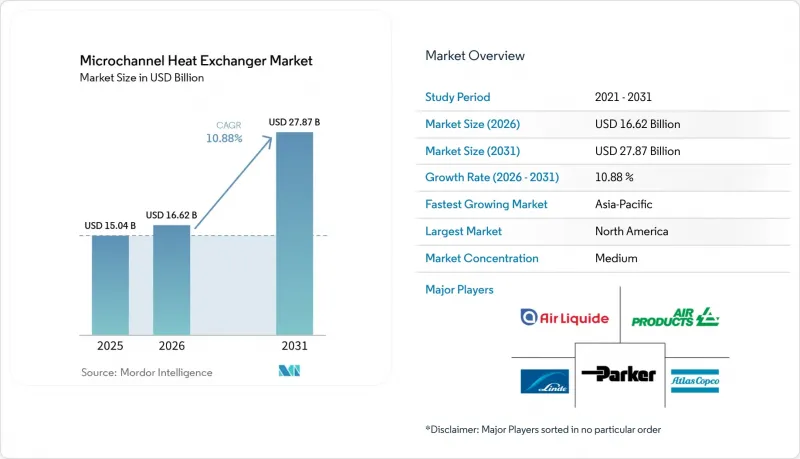
에 따르면 마이크로채널 열교환기 시장 규모는 2025년 150억 4,000만 달러에서 2026년에는 166억 2,000만 달러로 확대하며, 2026-2031년에 CAGR 10.88%로 추이하며, 2031년까지 278억 7,000만 달러에 달할 것으로 예상되고 있습니다.
글로벌 마이크로채널 열교환기 시장의 동향 및 인사이트
HVACR의 교체 및 히트펌프 도입
히트펌프의 보급으로 인해 마이크로채널 열교환기 시장에서 지속적인 교체 주기가 형성되고 있습니다. 국제에너지기구(IEA)는 특정 정책 시나리오 하에서 2035년까지 전 세계 히트펌프 판매 대수가 2배 이상 증가할 것으로 예측하고 있습니다. 2026년에는 미국 가구의 20% 이상이 주요 난방 설비로 히트펌프를 사용했습니다. 일본의 산업용 히트펌프 용량은 2024년에 650MW에 달했습니다. 이는 10년 전의 290MW에 비해 대폭 증가한 수치입니다. 히트펌프 코일은 응축기 및 증발기 역할을 해야 하므로, 결빙 및 제상 주기를 거치는 동안 안정적인 배수가 제품의 기본 요건으로 자리 잡고 있습니다. Kaltra사는 이러한 작동 조건에 대응하기 위해 2025년 10월 가역형 마이크로채널 증발기 코일을 출시했습니다.
자동차의 전동화와 열부하 증가
자동차의 전동화로 인해 마이크로채널 열교환기 시장이 처리하는 열 부하가 증가하고 있습니다. 일반적인 전기자동차(EV) 플랫폼에서는 배터리, 인버터, 차량내 공조 시스템에 걸쳐 3-5개의 마이크로채널 부품이 사용되고 있습니다. 2025년 조사에 따르면 최적화된 매니폴드형 마이크로채널 방열판은 기존 마이크로채널 설계에 비해 열저항을 2.8%, 펌프 출력을 27.3% 감소시키는 것으로 밝혀졌습니다. Hanon Systems사는 2026년 3월, BMW의 전기자동차 ‘iX3’를 위해 무게 16kg의 ‘고도로 통합된 냉각 유닛(Highly Integrated Cooling Entity)’ 모듈을 공급했습니다. 이 어셈블리에는 e-컴프레서, 수랭식 콘덴서, 내장형 열교환기, 칠러, 배관, 밸브, 센서가 통합되어 있습니다. 이러한 통합 시스템으로의 전환을 통해 브레이징, 누설 시험 및 시스템 엔지니어링 요건을 충족할 수 있는 공급업체로부터의 조달이 일원화되었습니다.
정밀 제조 및 특수 브레이징 비용
기체 제어 브레이징은 마이크로 채널 열교환기 시장 진입에 있으며, 여전히 실질적인 장벽으로 남아 있습니다. 이 공정에는 용광로내 조건 제어가 필요하며, 미세한 온도 편차만으로도 접합부의 피로 강도가 저하될 우려가 있습니다. 대량 생산용 기체 제어 브레이징 라인에는 수백만 달러 규모의 투자와 장비가 준비되기까지 긴 리드타임이 필요합니다. 멀티포트 튜브의 압출 성형에도 인근 열교환기 제조업체 대부분이 갖추지 못한 정밀한 공차가 요구됩니다. 북미와 유럽에서는 인건비, 설비비, 자재비가 특히 높습니다. 핀 적층 및 튜브 삽입 공정의 자동화를 통해 비용을 절감할 수는 있지만, 자동화에 대한 투자 역시 이용 가능한 자본에 의해 제한을 받습니다.
부문 분석
2025년, 콘덴서는 마이크로채널 열교환기 시장 점유율의 46.4%를 차지했습니다. 이러한 선도적인 위상은 스플릿 시스템, 루프탑 장비 및 경공업용 냉동 장치에서 공기 측 열 방출의 주요 구성 요소로서의 역할을 반영합니다. 기존 설비의 존재로 인해 콘덴서 공급업체는 신축 수요가 둔화될 때에도 수요를 지탱할 수 있는 교체 주기를 확보하고 있습니다. 증발기는 두 번째로 큰 부품 그룹을 형성합니다. 이들은 히트펌프의 실내 코일, 전기자동차의 실내 공조 시스템, 그리고 상업용 냉동 뱅크에 사용됩니다. 그 밖의 부품으로는 보조 방열 회로 및 서브쿨러 회로 등이 포함됩니다.
수랭식 코일은 2026-2031년까지 연평균 성장률(CAGR) 11.6%로 성장할 것으로 예상되며, 마이크로채널 열교환기 시장에서 가장 견고한 전망을 보이고 있습니다. 이러한 성장은 데이터센터내 수랭식 시스템의 확대와 히트펌프에 대한 액체 회로 통합에 기인합니다. 수요는 주택 착공 건수나 계절적 건설 주기보다는 하이퍼스케일에 대한 자본 투자와 밀접한 관련이 있습니다. Kaltra사는 2026년 5월, 두꺼운 벽면의 멀티포트 튜브, 희생 아연층, 나노 스케일 코팅 및 일체형 헤더를 채택하여 워터 코일 제품 라인업을 확충했습니다. 이 제품은 미국의 데이터센터, 공조기 및 프리 쿨링 시스템을 대상으로 합니다. 프리쿨링 설계를 통해 기계식 칠러의 가동 시간을 줄일 수 있으므로, 신뢰성 높은 수측 성능의 중요성이 더욱 커지고 있습니다.
2025년, HVAC는 마이크로 채널 열교환기 시장 규모의 41.2%를 차지했습니다. 이 용도는 고효율 장비에서 기존의 핀 앤 튜브식 코일을 지속적으로 대체하는 데 따른 혜택을 받고 있습니다. 화석 연료 기반 난방 시스템을 대체하는 히트펌프의 설치도 수요를 지원하고 있습니다. 냉동은 두 번째로 큰 용도 범주로 콜드 체인 물류, 슈퍼마켓, 공정 냉각 등이 포함됩니다. 많은 냉동 설비에서 냉매 충전량 감축이 중요하게 여겨지고 있습니다. 산업용 공정 냉각 및 데이터센터 냉각은 ‘기타 용도’ 범주로 분류됩니다.
마이크로채널 열교환기 시장에서 자동차 용도는 2031년까지 연평균 성장률(CAGR) 10.9%로 확대될 것으로 예측됩니다. 배터리 열 관리, 인버터 냉각 및 멀티 서킷 방식의 차량 실내 공조 시스템은 통합 시스템에 대한 수요를 창출하고 있습니다. 덴소는 2024년과 2025년에 전기자동차용 열교환기 설계 및 알루미늄 냉각 회로의 부식 관리와 관련된 특허 활동을 지속했습니다. 항저우에 위치한 산화(Sanhua)와 댄포스(Danfoss)의 합작 회사는 주거용 및 상업용 공조 기기 제조업체에 마이크로 채널식 응축기 및 증발기 제품을 공급하고 있습니다. 자동차용 설계에는 많은 HVAC 용도에 비해 더 높은 압력 사이클 내구성, 경량화, 폭넓은 유체 호환성, 그리고 더 복잡한 통합이 요구됩니다. 이러한 요구 사항으로 인해 HVAC 고객에게만 서비스를 제공하는 공급업체의 경우 시장 진입이 더욱 어려워지고 있습니다.
지역별 분석
2025년, 북미는 마이크로채널 열교환기 시장 점유율의 31.2%를 차지했습니다. 미국의 상업용 패키지형 에어컨 및 히트펌프에 대한 에너지 효율 기준은 지속적인 장비 교체 주기를 지원하고 있습니다. 2026년에는 미국 가구의 20% 이상이 주요 난방 설비로 히트펌프를 사용했습니다. 데이터센터 냉각은 주택 건설 동향과 밀접하게 연동되지 않는 또 다른 수요 채널이 되고 있습니다. 모다인(Modine)은 1억 달러 규모의 생산 능력 확대 투자의 일환으로 2025년 위스콘신주에 155,000제곱피트 규모의 시설을 개장했습니다. 캐나다에서는 주거용 전기 난방 수요가 증가하고 있으며, 멕시코에서는 소규모 상업용 및 산업용 HVAC 수요가 기여하고 있습니다.
유럽은 냉매 관련 규제가 엄격하므로 마이크로채널 열교환기 시장에 있으며, 여전히 기술적으로 요구 사항이 까다로운 지역입니다. 2025년에는 프랑스, 독일, 이탈리아가 유럽의 히트펌프 판매 대수를 주도했습니다. 국제에너지기구(IEA) 보고서에 따르면 2024년의 위축을 겪은 후 2026년에는 유럽의 히트펌프 시장이 회복되어, 특히 독일과 스웨덴에서 강력한 성장이 나타났습니다. 독일의 난방 규제로 인해 히트펌프 호환 기기에 대한 수요가 높아지고 있습니다. DunAn사의 MPHX 제품은 저충전량 R290 시스템을 위해 스웨덴을 비롯한 유럽 각지에서 도입되고 있습니다. 2027년에 시행될 특정 신형 모노블록형 히트펌프에 대한 지구온난화지수(GWP)가 높은 냉매 사용 제한으로 인해 규제를 준수하는 제품의 인증이 가속화되고 있습니다.
아시아태평양은 2026-2031년까지 연평균 성장률(CAGR) 12.2%로 확대될 것으로 예측되며, 마이크로채널 열교환기 시장에서 지역별 가장 높은 성장률을 기록할 전망입니다. 중국은 세계 최대 히트펌프 시장이며, 인도, 베트남, 인도네시아, 태국의 도시화가 상업용 HVAC 설치를 촉진하고 있습니다. 중국의 2026년 기준은 전체 공급업체 기반에서 제품의 일관성을 높이고 인증 절차를 단축할 가능성이 있습니다. 일본의 산업용 히트펌프 설비 용량은 650MW에 달하며, 특수한 산업 수요를 지원하고 있습니다. DunAn사는 2026년 1월, 태국에 자동차용 열 관리 및 열교환기 제조 시설을 개설했습니다. 남미에서는 특정 분야를 위한 냉동 및 주거용 공조 수요가 예상됩니다. 한편, 중동 및 아프리카에서는 지역 냉방 및 해안 지역의 기후에 대응하기 위해 내식성을 갖춘 설계가 요구되고 있습니다.
기타 혜택:
- 엑셀 형식의 시장 예측(ME) 시트
- 3개월간의 애널리스트 지원
자주 묻는 질문
목차
제1장 서론
- 조사 전제조건과 시장 정의
- 조사 범위
제2장 조사 방법
제3장 개요
제4장 시장 구도
- 시장 개요
- 시장 성장 촉진요인
- 시장 성장 억제요인
- 공급망 분석
- Porter's Five Forces 분석
- 기술 동향
- 규제 상황
- 투자 분석
제5장 시장 규모와 성장 예측
- 컴포넌트별
- 용도별
- 제품 유형별
- 소재별
- 지역별
- 북미
- 미국
- 캐나다
- 멕시코
- 유럽
- 독일
- 프랑스
- 이탈리아
- 스페인
- 영국
- 폴란드
- 러시아
- 기타 유럽 국가
- 아시아태평양
- 중국
- 인도
- 일본
- 한국
- 호주
- 인도네시아
- 베트남
- 태국
- 기타 아시아태평양 국가
- 남미
- 브라질
- 아르헨티나
- 칠레
- 기타 남미 국가
- 중동 및 아프리카
- 사우디아라비아
- 아랍에미리트
- 이집트
- 남아프리카공화국
- 모로코
- 기타 중동 및 아프리카 국가
- 북미
제6장 경쟁 구도
- 시장 집중도
- 전략적 동향
- 시장 점유율 분석
- 기업 개요
- Alfa Laval AB
- API Heat Transfer Inc.
- Brazeway Inc.
- Carrier Global Corporation
- Climetal S.L.
- Daikin Industries Ltd.
- Danfoss A/S
- DENSO Corporation
- Evapco Inc.
- Goldstone HVACR Inc.
- Hanon Systems
- Johnson Controls International plc
- Kaltra Innovativtechnik GmbH
- Kelvion Holding GmbH
- Kobelco(Kobe Steel, Ltd.)
- MAHLE GmbH
- Mitsubishi Heavy Industries, Ltd.
- Modine Manufacturing Company
- Sanhua Holding Group Co. Ltd.
- Zhejiang DUNAN Artificial Environment Co. Ltd.
제7장 시장 기회와 향후 전망
KSA 26.10.29According to Mordor Intelligence, the microchannel heat exchanger market size is expected to increase from USD 15.04 billion in 2025 to USD 16.62 billion in 2026 and reach USD 27.87 billion by 2031, at a CAGR of 10.88% over 2026-2031.
Global Microchannel Heat Exchanger Market Trends and Insights
HVACR Replacement and Heat Pump Deployment
Heat pump adoption is creating a durable replacement cycle for the microchannel heat exchanger market. The International Energy Agency projects that global heat pump sales will more than double by 2035 under stated policy scenarios. More than 20% of U.S. households used heat pumps as their primary heating equipment in 2026. Japan's industrial heat pump capacity reached 650 MW in 2024, compared with 290 MW a decade earlier. Heat pump coils must work as condensers and evaporators, so stable drainage through frosting and defrosting cycles is becoming a basic product requirement. Kaltra introduced a reversible microchannel evaporator coil in October 2025 to address this operating condition.
Automotive Electrification and Higher Thermal Loads
Vehicle electrification is increasing the thermal duties handled by the microchannel heat exchanger market. A typical electric vehicle platform uses 3-5 microchannel components across battery, inverter, and cabin-conditioning systems. A 2025 study found that optimized manifold microchannel heat sinks reduced thermal resistance by 2.8% and pumping power by 27.3% compared with conventional microchannel designs. Hanon Systems supplied a 16 kg Highly Integrated Cooling Entity module for BMW's electric iX3 in March 2026. The assembly combines an eCompressor, water-cooled condenser, internal heat exchanger, chiller, lines, valves, and sensors. This move toward integrated systems concentrates procurement among suppliers that can meet brazing, leak-testing, and system engineering requirements.
Precision Manufacturing and Specialized Brazing Cost
Controlled-atmosphere brazing remains a practical barrier to entry in the microchannel heat exchanger market. The process requires controlled furnace conditions, and narrow temperature deviations can weaken joint fatigue performance. A high-volume controlled-atmosphere brazing line requires multi-million-dollar investment and lengthy equipment lead times. Multiport tube extrusion also requires precise tolerances that many adjacent heat exchanger manufacturers do not have. Labor, equipment, and material costs are particularly high in North America and Europe. Automation can lower costs through fin stacking and tube insertion, but investment in automation is also limited by available capital.
Other drivers and restraints analyzed in the detailed report include:
- Energy Efficiency Regulations and Refrigerant Reduction Requirements
- AI Data Center Cooling and Rising Rack Power Density
- Durability, Fouling, and Corrosion Risk
For complete list of drivers and restraints, kindly check the Table Of Contents.
Segment Analysis
Condensers held 46.4% of the microchannel heat exchanger market share in 2025. Their leading position reflects their role as the main air-side heat rejection component in split systems, rooftop equipment, and light-industrial refrigeration. The installed base gives condenser suppliers a replacement cycle that can support demand when new construction slows. Evaporators form the second-largest component group. They are used in heat pump indoor coils, electric vehicle cabin conditioning, and commercial refrigeration banks. Other components include auxiliary heat-rejection and subcooler circuits.
Water coils are forecast to grow at 11.6% CAGR from 2026 to 2031, the strongest component outlook in the microchannel heat exchanger market. Growth follows hydronic cooling expansion in data centers and liquid-circuit integration in heat pumps. Demand is linked to hyperscale capital commitments more than to housing starts or seasonal construction cycles. Kaltra expanded its water coil portfolio in May 2026 with thicker-wall multiport tubes, sacrificial zinc layers, nano-scale coatings, and one-piece headers. The product targets U.S. data centers, air handling units, and free-cooling systems. Free-cooling designs can reduce mechanical chiller operation and raise the importance of reliable water-side performance.
HVAC held 41.2% of the microchannel heat exchanger market size in 2025. The application benefits from ongoing substitution of conventional fin-and-tube coils in efficient equipment. Heat pump installations replacing fossil-fuel heating systems also support demand. Refrigeration is the second application category and includes cold chain logistics, supermarkets, and process cooling. Lower refrigerant charge is important in many refrigeration installations. Industrial process cooling and data center cooling sit within the other applications category.
Automotive applications are projected to advance at a 10.9% CAGR through 2031 in the microchannel heat exchanger market. Battery thermal management, inverter cooling, and multi-circuit cabin conditioning create demand for integrated systems. DENSO maintained patent activity covering electric vehicle heat-exchanger designs and corrosion management for aluminum cooling circuits in 2024 and 2025. The Sanhua and Danfoss joint venture in Hangzhou serves residential and commercial air-conditioning equipment makers with microchannel condenser and evaporator products. Automotive designs require stronger pressure-cycle durability, lower weight, broader fluid compatibility, and more complex integration than many HVAC applications. These requirements make entry more difficult for suppliers that only serve HVAC customers.
Complete Report Scope:
- By Component
- Evaporator
- Condenser
- Water Coil
- Other Components
- By Application
- HVAC
- Automotive
- Refrigeration
- Others
- By Product Type
- Air Handling Units
- Heat Pumps
- Fan Coil Units
- Chillers
- Other Product Types
- By Material
- Metal-Based
- Ceramic-Based
- By Geography
- North America
- United States
- Canada
- Mexico
- Europe
- Germany
- France
- Italy
- Spain
- United Kingdom
- Poland
- Russia
- Rest of Europe
- Asia-Pacific
- China
- India
- Japan
- South Korea
- Australia
- Indonesia
- Vietnam
- Thailand
- Rest of Asia-Pacific
- South America
- Brazil
- Argentina
- Chile
- Rest of South America
- Middle East and Africa
- Saudi Arabia
- United Arab Emirates
- Egypt
- South Africa
- Morocco
- Rest of Middle East and Africa
- North America
Geography Analysis
North America held 31.2% of the microchannel heat exchanger market share in 2025. U.S. energy conservation standards for commercial package air conditioners and heat pumps support a continuing equipment replacement cycle. More than 20% of U.S. households used heat pumps as their primary heating equipment in 2026. Data center cooling adds another demand channel that does not closely follow residential construction. Modine opened a 155,000-square-foot facility in Wisconsin during 2025 as part of a USD 100 million capacity investment. Canada adds residential electrified-heating demand, while Mexico contributes light-commercial and industrial HVAC volume.
Europe remains a technically demanding region for the microchannel heat exchanger market because its refrigerant policy is stringent. France, Germany, and Italy led European heat pump unit sales in 2025. The IEA reported a recovery in European heat pump markets during 2026 after contraction in 2024, with strong growth in Germany and Sweden. Germany's heating rules reinforce demand for heat-pump-ready equipment. DunAn's MPHX product has been deployed in Sweden and other European locations for low-charge R290 systems. The 2027 restriction on higher-global-warming-potential refrigerants in certain new monoblock heat pumps is accelerating compliant product qualification.
Asia-Pacific is forecast to expand at 12.2% CAGR from 2026 to 2031, the fastest regional rate in the microchannel heat exchanger market. China is the world's largest heat pump market, and urbanization in India, Vietnam, Indonesia, and Thailand supports commercial HVAC installation. China's 2026 standard can raise product consistency and shorten qualification processes across its supplier base. Japan's industrial heat pump capacity of 650 MW supports specialized industrial demand. DunAn opened vehicle thermal management and heat exchanger facilities in Thailand in January 2026. South America offers targeted refrigeration and residential air-conditioning demand, while the Middle East and Africa require corrosion-protected designs for district cooling and coastal climates.
- Alfa Laval AB
- API Heat Transfer Inc.
- Brazeway Inc.
- Carrier Global Corporation
- Climetal S.L.
- Daikin Industries Ltd.
- Danfoss A/S
- DENSO Corporation
- Evapco Inc.
- Goldstone HVACR Inc.
- Hanon Systems
- Johnson Controls International plc
- Kaltra Innovativtechnik GmbH
- Kelvion Holding GmbH
- Kobelco (Kobe Steel, Ltd.)
- MAHLE GmbH
- Mitsubishi Heavy Industries, Ltd.
- Modine Manufacturing Company
- Sanhua Holding Group Co. Ltd.
- Zhejiang DUNAN Artificial Environment Co. Ltd.
Additional Benefits:
- The market estimate (ME) sheet in Excel format
- 3 months of analyst support
TABLE OF CONTENTS
1 INTRODUCTION
- 1.1 Study Assumptions and Market Definition
- 1.2 Scope of the Study
2 RESEARCH METHODOLOGY
3 EXECUTIVE SUMMARY
4 MARKET LANDSCAPE
- 4.1 Market Overview
- 4.2 Market Drivers
- 4.2.1 Energy-Efficiency Regulations and Refrigerant-Reduction Requirements
- 4.2.2 HVACR Replacement and Heat-Pump Deployment
- 4.2.3 Automotive Electrification and Higher Thermal Loads
- 4.2.4 AI Data-Center Cooling and Rising Rack Power Density
- 4.2.5 Retrofit-Ready Corrosion-Resistant Coils for Harsh Climates
- 4.2.6 Additive and Automated Manufacturing for Application-Specific Geometries
- 4.3 Market Restraints
- 4.3.1 Precision Manufacturing and Specialized Brazing Cost
- 4.3.2 Durability, Fouling, and Corrosion Risk
- 4.3.3 Pressure-Drop and Pumping-Power Trade-Offs in High-Density Channels
- 4.3.4 Qualification Gaps for Flammable and Ultra-Low-GWP Refrigerants
- 4.4 Supply-Chain Analysis
- 4.5 Porter's Five Forces Analysis
- 4.5.1 Bargaining Power of Suppliers
- 4.5.2 Bargaining Power of Buyers
- 4.5.3 Threat of New Entrants
- 4.5.4 Threat of Substitutes
- 4.5.5 Competitive Rivalry
- 4.6 Technology Outlook
- 4.7 Regulatory Landscape
- 4.8 Investment Analysis
5 MARKET SIZE AND GROWTH FORECASTS
- 5.1 By Component
- 5.1.1 Evaporator
- 5.1.2 Condenser
- 5.1.3 Water Coil
- 5.1.4 Other Components
- 5.2 By Application
- 5.2.1 HVAC
- 5.2.2 Automotive
- 5.2.3 Refrigeration
- 5.2.4 Others
- 5.3 By Product Type
- 5.3.1 Air Handling Units
- 5.3.2 Heat Pumps
- 5.3.3 Fan Coil Units
- 5.3.4 Chillers
- 5.3.5 Other Product Types
- 5.4 By Material
- 5.4.1 Metal-Based
- 5.4.2 Ceramic-Based
- 5.5 By Geography
- 5.5.1 North America
- 5.5.1.1 United States
- 5.5.1.2 Canada
- 5.5.1.3 Mexico
- 5.5.2 Europe
- 5.5.2.1 Germany
- 5.5.2.2 France
- 5.5.2.3 Italy
- 5.5.2.4 Spain
- 5.5.2.5 United Kingdom
- 5.5.2.6 Poland
- 5.5.2.7 Russia
- 5.5.2.8 Rest of Europe
- 5.5.3 Asia-Pacific
- 5.5.3.1 China
- 5.5.3.2 India
- 5.5.3.3 Japan
- 5.5.3.4 South Korea
- 5.5.3.5 Australia
- 5.5.3.6 Indonesia
- 5.5.3.7 Vietnam
- 5.5.3.8 Thailand
- 5.5.3.9 Rest of Asia-Pacific
- 5.5.4 South America
- 5.5.4.1 Brazil
- 5.5.4.2 Argentina
- 5.5.4.3 Chile
- 5.5.4.4 Rest of South America
- 5.5.5 Middle East and Africa
- 5.5.5.1 Saudi Arabia
- 5.5.5.2 United Arab Emirates
- 5.5.5.3 Egypt
- 5.5.5.4 South Africa
- 5.5.5.5 Morocco
- 5.5.5.6 Rest of Middle East and Africa
- 5.5.1 North America
6 COMPETITIVE LANDSCAPE
- 6.1 Market Concentration
- 6.2 Strategic Moves
- 6.3 Market Share Analysis
- 6.4 Company Profiles (includes Global Level Overview, Market Level Overview, Core Segments, Financials as available, Strategic Information, Products and Services, Recent Developments)
- 6.4.1 Alfa Laval AB
- 6.4.2 API Heat Transfer Inc.
- 6.4.3 Brazeway Inc.
- 6.4.4 Carrier Global Corporation
- 6.4.5 Climetal S.L.
- 6.4.6 Daikin Industries Ltd.
- 6.4.7 Danfoss A/S
- 6.4.8 DENSO Corporation
- 6.4.9 Evapco Inc.
- 6.4.10 Goldstone HVACR Inc.
- 6.4.11 Hanon Systems
- 6.4.12 Johnson Controls International plc
- 6.4.13 Kaltra Innovativtechnik GmbH
- 6.4.14 Kelvion Holding GmbH
- 6.4.15 Kobelco (Kobe Steel, Ltd.)
- 6.4.16 MAHLE GmbH
- 6.4.17 Mitsubishi Heavy Industries, Ltd.
- 6.4.18 Modine Manufacturing Company
- 6.4.19 Sanhua Holding Group Co. Ltd.
- 6.4.20 Zhejiang DUNAN Artificial Environment Co. Ltd.
7 MARKET OPPORTUNITIES AND FUTURE OUTLOOK
- 7.1 White-Space and Unmet-Need Assessment


