

|
시장보고서
상품코드
2156912
산업 검사용 밀리미터파 이미징 : 시장 점유율 분석, 업계 동향과 통계, 성장 예측(2026-2031년)Millimeter-Wave Imaging For Industrial Inspection - Market Share Analysis, Industry Trends & Statistics, Growth Forecasts (2026 - 2031) |
||||||
 Mordor Intelligence
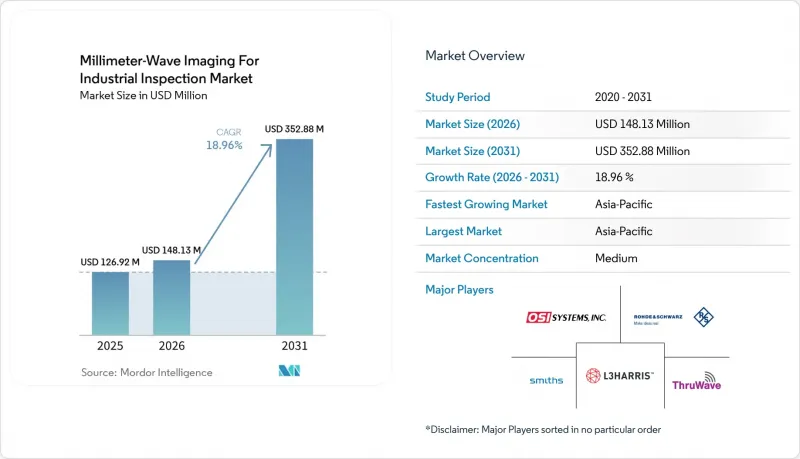
에 따르면 산업용 검사용 밀리미터파 이미징 시장 규모는 2025년 1억 2,692만 달러, 2026년 1억 4,813만 달러에서 2031년까지 3억 5,288만 달러로 확대될 것으로 예측되고 있으며, 2026-2031년까지 연평균 성장률(CAGR)은 18.96%에 달할 전망입니다.
산업용 검사용 밀리파 이미징의 글로벌 동향 및 인사이트
비파괴 인라인 품질관리의 도입 확대
배치 샘플링으로는 ‘결함 제로’라는 기대에 부응할 수 없는 경우, 인라인 비파괴 검사의 중요성이 높아지고 있습니다. 밀리파 시스템은 비접촉식이며 비이온화 방식이고, 컨베이어 속도에 맞춰 작동할 수 있으며, 100% 인라인 검사를 실현합니다. 따라서 산업용 검사 시장에서 밀리파 이미징은 재료의 흐름을 멈추지 않고 검사 범위를 커버해야 하는 공장에 있으며, 중요한 역할을 수행하고 있습니다. 로데 슈바르츠(Rohde & Schwarz)는 2026년 7월, 기존 생산 관리 소프트웨어로 연결하기 위한 표준 인터페이스를 갖춘 ‘R&S IMAGER’를 발표했습니다. 이 시스템을 통해 엔지니어는 광범위한 제조 환경을 재설계하지 않고도 체적 검사 범위를 확대할 수 있습니다. 2025년 IEEE Access 저널에 실린 연구에서는 항공우주 및 자동차 부품 분야에서 자동화된 근거리 합성개구레이더(SAR)를 이용한 결함 위치 파악 사례가 보고되었으며, 이 용도에 있으며, 생산에 초점을 맞춘 참고 사례를 제시하고 있습니다.
이미지 저장 기능은 인라인 검사에 실용적인 기록 관리상 이점을 제공합니다. 각 밀리파 이미지는 검사 대상품의 추적성을 보장하는 형태로 저장할 수 있습니다. 이 기록은 품질 검토 및 전자 문서화 의무를 지원합니다. 이러한 접근 방식은 즉각적인 합격/불합격 판정을 위해 2D 투영만 생성하는 검사 기법과는 다릅니다. 페르디난트 브라운 연구소는 2024년, 80개의 모노리식 집적형 검출기를 탑재하고 판독 속도가 초당 최대 15,000 이미지에 달하는 110 GHz 라인 스캐너를 발표했습니다. 이를 통해 산업용 검사 시장의 밀리파 이미징 인라인 응용 분야 중 일부에서는 이미징 처리량이 반드시 주요 제약 조건이 아니라는 점이 입증되었습니다.
제품을 개봉하지 않고 밀봉된 패키지를 검사해야 할 필요성이 높아지고 있습니다.
식품, 의약품, 물류 분야의 각 사업자는 포장을 개봉하지 않고 내용물을 확인해야 합니다. 기존의 카메라나 중량 측정 툴로는 밀봉된 물품의 내부 상태를 일관되게 평가할 수 없습니다. 밀리파 신호는 일반적인 포장에 사용되는 골판지, 플라스틱, 라미네이트 필름, 유리를 투과할 수 있습니다. 이를 통해 직접 접촉하지 않고도 제품의 유무, 밀봉 불량, 부품 누락 등을 확인할 수 있습니다. ThruWave사에 따르면 자사의 플랫폼은 분당 600피트, 초당 4개의 속도로 밀봉된 상자를 검사할 수 있다고 합니다. 이 사용 사례는 포장 검증 분야의 산업용 검사 시장에서 밀리파 이미징의 역할을 강화하는 것입니다.
2025년 ACM이 실시한 연구에서는 밀리파 합성개구레이더 이미징을 이용한 포장 투과형 액체 누출 감지가 검토되었습니다. 이 연구에서는 누출 감지 및 액체 식별에서 93%를 넘는 정확도가 보고되었으며, 이는 평가 대상이된 기준 기법보다 14.70% 높은 수치였습니다. 이러한 유형의 검사는 시각 시스템으로는 포장재를 투과하여 내부를 확인할 수 없다는 과제를 해결해 줍니다. 또한 로데 슈바르츠(Rohde & Schwarz)사는 밀폐된 유리병의 진공 누출도 자사 시스템으로 감지 가능한 결함 중 하나로 특정했습니다. X선 검사로는 이러한 유형의 결함을 확실하게 식별할 수 없습니다. 이 기능 덕분에 밀리파 이미징의 용도는 이물질 검사에 그치지 않고, 포장의 물리적 검증으로까지 확대되고 있습니다.
높은 시스템 및 통합 비용
완전히 구성된 검사 셀에는 다중 채널 트랜시버 어레이, 신호 처리, AI 분석 소프트웨어 및 생산 라인과의 기계적 통합이 필요합니다. 이러한 설비 투자 요건은 중소규모 제조업체의 경우 정당화하기 어려울 수 있습니다. 95GHz에서 300 GHz 주파수 대역에서 작동하는 시스템은 특수한 화합물 반도체 공정과 고정밀 도파관 부품에 의존합니다. 해당 부품 비용은 범용화된 CMOS 센서를 기반으로 한 광학 카메라 시스템에 비해 구조적으로 높습니다. 또한 산업용 검사 시장을 위한 밀리파 이미징에서는 스캐너의 출력을 제조 실행 시스템이나 생산 관리 소프트웨어로 연결하기 위한 통합 작업도 필요합니다. 이 작업에는 검사 셀의 재검증이 필요할 수 있습니다.
ThruWave사는 2025년 8월, Maple Systems사의 cMT3000 시리즈 HMI(Human-Machine Interface)와의 통합을 완료했습니다. 이번 도입에서는 멀티 PLC 통신과 설정 가능한 인터페이스가 지원되어, 다양한 생산 환경에서 실제로 필요한 조치들이 제시되었습니다. 따라서 가격에 민감한 환경에서는 기존 X선 시스템이 여전히 우위를 점하고 있습니다. Qorvo사와 Sivers Semiconductors사의 칩 레벨 통합으로 인해 비용 차이의 일부는 점차 줄어들고 있습니다. 그러나 하드웨어 비용 절감만으로는 소프트웨어 통합, 라인 설치 및 공정 검증에 드는 비용을 상쇄할 수 없습니다. 이러한 고려 사항으로 인해 검사 기능이 기술적으로 적합하더라도 도입이 지연될 가능성이 있습니다.
부문 분석
2025년, 산업용 검사 시장의 밀리미터파 이미징 중 능동형 밀리미터파 이미징 시스템이 82.47%의 점유율을 차지했습니다. 이 시스템에 내장된 조명 광원은 생산 현장에서 일관된 이미지 콘트라스트를 제공합니다. 이는 생산 공정 중 주변 온도 조건이 변동하는 상황에서 유용합니다. 제약, 식품, 전자기기 제조업체들은 가동 속도에서도 예측 가능한 화질을 얻기 위해 능동 방식을 채택하고 있습니다. 일관된 이미지는 AI 분류 전 수동 재보정의 필요성을 줄일 수도 있습니다. R&S IMAGER는 독자적인 밀리파 소스를 사용하여 포장재를 투과시키고, 센서 어레이를 통해 표면 아래의 이미지를 재구성합니다. 이 ISAR 기반 체적 재구성 기술은 출력에 사용되는 디지털 트윈 형식을 지원합니다. 이 능동형 아키텍처는 일관된 커버리지가 중요한, 통제된 생산 현장 환경에 적합합니다.
패시브형 밀리파 이미징 시스템은 2031년까지 연평균 성장률(CAGR) 19.23%로 확대될 것으로 예측됩니다. 물류 사업자는 주변의 열적 대비가 이상 감지에 충분한 정보를 제공하는 상황에서 이를 활용할 수 있습니다. 패시브형 시스템은 능동형 광원이 필요하지 않아 저비용이 요구되는 상황에 적합합니다. 이 시스템의 화질은 검사 대상 제품과 그 주변의 열적 대비에 더 직접적으로 좌우됩니다. 따라서 환경이 명확한 대비를 제공하지 않는 상황에서는 사용이 제한됩니다. TeraSense사는 감지와 신호 처리를 하나의 칩에 통합하는 실리콘 기반 서브테라헤르츠 감지기 제조를 위한 계획을 설명하고 있습니다. 이러한 접근 방식을 통해 능동형 시스템과의 화질 격차를 줄이면서 하드웨어 비용을 절감할 수 있습니다. 이를 통해 산업용 검사 시장의 밀리파 이미징 분야에서 보다 광범위하고 저비용의 검사 도입이 가능해집니다.
2025년, 산업용 검사 분야의 밀리파 이미징 시장 점유율 중 38.73%를 통합형 인라인 검사 시스템이 차지했습니다. 식품, 의약품, 전자기기 OEM(Original Equipment Manufacturer)들은 이러한 시스템을 컨베이어식 라인에 직접 설치하고 있습니다. 이 방식은 공정 흐름이 안정적인 경우 100% 처리량 검사를 실현합니다. 이는 포장된 제품이나 표준화된 부품을 지속적으로 검사해야 하는 공장에 적합합니다. 이러한 통합을 통해 이미지를 생산 관리 시스템이나 후속 처리 결정에 연동할 수 있습니다. 또한 추후 품질 검토를 위해 이미지 기록을 저장하는 것도 가능합니다. 이러한 결합으로 인해 설치시 전문적인 엔지니어링이 필요한 경우도 있지만, 인라인 시스템은 가장 널리 사용되는 형식이 되었습니다. 제품의 형상이나 처리량이 컨베이어 이송에 적합한 산업용 검사 시장에서 이 형식은 계속해서 중심적인 역할을 수행하고 있습니다.
핸드헬드형 및 휴대용 검사 시스템은 2031년까지 연평균 성장률(CAGR) 19.44%로 확대될 것으로 예측됩니다. 건설, 인프라, 물류 분야의 사용 사례는 대개 고정된 생산 라인 밖에서 발생합니다. 엔지니어는 콘크리트 구조물, 복합 패널, 건물 외벽의 검사에 휴대용 스캐너를 사용할 수 있습니다. 2026년 연구에서는 제조 단계에서 섬유 기반 패널의 비파괴 품질 분석에 밀리파를 적용한 사례가 평가되었습니다. 이는 현장 도입에 대한 기술적 근거를 지원하는 것입니다. 컨베이어에 적합하지 않은 항공우주 및 자동차 부품의 경우, 독립형 시스템이 여전히 중요한 역할을 하고 있습니다. 2024년 11월, FieldFox 핸드헬드 분석기 시리즈가 170 GHz까지 확장됨에 따라 현장 사용자를 위한 휴대용 서브테라헤르츠 대역의 측정 범위가 확대되었습니다. 따라서 뛰어난 휴대성 덕분에 부품의 크기와 접근 조건이 다양한 현장에서도 검사가 가능해졌습니다.
지역별 분석
아시아태평양은 2025년 산업용 검사용 밀리파 이미징 시장에서 35.71%의 점유율을 차지하고 있으며, 2031년까지 연평균 성장률(CAGR) 19.74%로 확대될 것으로 예측됩니다. 중국의 전자기기 조립, 식품 가공 및 의약품 수탁제조 거점이 이 지역의 수요를 지원하고 있습니다. 또한 정부의 품질 인프라에 대한 투자도 육안 샘플링을 대체하는 자동화된 처리량 검사를 촉진하고 있습니다. 일본의 자동차 공급망은 IATF 16949를 준수하는 ‘무결점’ 요건 하에 운영되고 있습니다. 이러한 요건은 전기자동차(EV)용 배터리 부품 및 파워 일렉트로닉스 검사를 촉진하고 있습니다. 한국의 DRAM 및 NAND 플래시 생산 능력 확대에 따라 기판 결함 스크리닝 수요가 증가하고 있습니다. X선 컴퓨터 단층촬영(CT)에 막대한 계산 자원이 필요한 경우, 밀리파 프로브를 이용한 비파괴 검사는 실용적인 대안이 될 수 있습니다.
북미는 산업용 검사 시장의 밀리파 이미징 분야에서 2위 규모를 자랑하는 지역입니다. 제약, 물류, 항공우주 분야의 용도가 지역 전체의 수요를 지원하고 있습니다. ThruWave사는 시애틀에 본사를 두고 있으며, 이온화 방사선을 사용하지 않고 소포, 편지, 봉투 등의 우편물에 포함된 불법 물품을 자동으로 탐지하는 서비스를 제공하고 있습니다. 복합재료 구조 검사에 관한 FAA(연방항공청)의 지침과 미국 국방부의 비파괴 평가 기준은 미국 제조 클러스터내 항공우주 관련 활동을 지원하고 있습니다. 캐나다의 자동차 산업 회랑도 추가적인 활용 사례를 제공하고 있습니다. 멕시코의 전자기기 조립 거점 또한 해당 지역의 수요에 기여하고 있습니다. 이러한 용도들은 북미 전역에서 제품의 무결성, 포장물 검사 및 복합재료 검사를 하나로 연결하고 있습니다.
유럽은 강력한 산업 계측 역량과 고품질 기준이 밀집되어 있는 것이 특징입니다. 독일은 로데 슈바르츠(Rohde & Schwarz)사의 존재와 대규모 자동차 및 자본재 제조 거점의 혜택을 받고 있습니다. 프랑스에서는 Teratonics SAS, Optikan SAS, MC2 Technologies SAS 등이 발전 중인 검사 클러스터를 형성하고 있습니다. 영국은 파란 테크놀러지(Farran Technology)사의 도파관 부품에 관한 노하우를 제공하고 있습니다. 남미의 단기 수요는 브라질의 식품 가공 및 제약 부문에 집중되어 있으며, 수출 규정 준수가 검증된 인라인 검사에 대한 관심을 촉진하고 있습니다. 중동 및 아프리카는 여전히 초기 단계에 있지만, 아랍에미리트의 산업 다각화와 사우디아라비아의 ‘비전 2030’은 장기적인 기회를 제공하고 있습니다. 아프리카에서의 활동은 연구 기관 및 시험소에 집중되어 있습니다.
기타 혜택:
- 엑셀 형식의 시장 예측(ME) 시트
- 3개월간의 애널리스트 지원
자주 묻는 질문
목차
제1장 서론
- 조사 전제조건과 시장 정의
- 조사 범위
제2장 조사 방법
제3장 개요
제4장 시장 구도
- 시장 개요
- 시장 성장 촉진요인
- 시장 성장 억제요인
- 거시경제 요인이 시장에 미치는 영향
- 업계의 공급망 분석
- 기술 동향
- 규제 상황
- Porter's Five Forces 분석
제5장 시장 규모와 성장 예측
- 제품 유형별
- 시스템 형식별
- 주파수대별
- 최종사용자 산업별
- 지역별
- 북미
- 미국
- 캐나다
- 멕시코
- 남미
- 브라질
- 아르헨티나
- 기타 남미 국가
- 유럽
- 독일
- 영국
- 프랑스
- 이탈리아
- 스페인
- 기타 유럽 국가
- 아시아태평양
- 중국
- 일본
- 인도
- 한국
- ASEAN
- 기타 아시아태평양 국가
- 중동 및 아프리카
- 중동
- 사우디아라비아
- 아랍에미리트
- 튀르키예
- 기타 중동 국가
- 아프리카
- 남아프리카공화국
- 나이지리아
- 기타 아프리카 국가
- 중동
- 북미
제6장 경쟁 구도
- 시장 집중도
- 전략적 동향
- 시장 점유율 분석
- 기업 개요
- Rohde & Schwarz GmbH & Co. KG
- ThruWave, Inc.
- Optikan SAS
- HUBNER GmbH & Co. KG
- TeraSense Group, Inc.
- Malcam Ltd.
- Teratonics SAS
- Lytid AS
- Heliotis AG
- Millimeter Wave Products, Inc.
- Farran Technology Limited
- Eravant, Inc.
- SAGE Millimeter, Inc.
- QuinStar Technology, Inc.
- Virginia Diodes, Inc.
- Sivers Semiconductors AB
- Vayyar Imaging Ltd.
- Qorvo, Inc.
- ACST GmbH
- RPG Radiometer Physics GmbH
- MC2 Technologies SAS
제7장 시장 기회와 향후 전망
KSA 26.10.29According to Mordor Intelligence, the millimeter-wave imaging for industrial inspection market size is projected to expand from USD 126.92 million in 2025 and USD 148.13 million in 2026 to USD 352.88 million by 2031, registering a CAGR of 18.96% between 2026 and 2031.
Global Millimeter-Wave Imaging For Industrial Inspection Market Trends and Insights
Increasing Adoption of Non-Destructive Inline Quality Control
Inline non-destructive testing has become more important where batch sampling cannot meet zero-defect expectations. Millimeter-wave systems support 100% inline inspection because they are contactless, non-ionizing, and can operate at conveyor speeds. This makes the millimeter-wave imaging for the industrial inspection market relevant to factories that need coverage without stopping material flow. Rohde and Schwarz introduced the R&S IMAGER in July 2026 with standard interfaces for connection to existing production-control software. The system allows engineers to extend volumetric inspection coverage without redesigning the wider manufacturing environment. A 2025 IEEE Access study reported automated near-field synthetic aperture radar defect localization across aerospace and automotive components, providing a production-focused reference point for this use.
Image retention adds a practical record-keeping benefit to inline inspection. Each millimeter-wave image can be retained as a traceable representation of the inspected item. That record can support quality reviews and electronic documentation obligations. The approach differs from inspection methods that only produce a 2D projection for an immediate pass-or-fail decision. The Ferdinand-Braun-Institut presented a 110 GHz line scanner in 2024 with 80 monolithically integrated detectors and readout speeds of up to 15,000 images per second. This demonstrated that imaging throughput need not be the main constraint for some inline applications in the millimeter-wave imaging for industrial inspection market.
Rising Need to Inspect Sealed Packages Without Product Opening
Food, pharmaceutical, and logistics operators need to verify packaged goods without opening them. Conventional cameras and weight-based tools cannot consistently assess the internal condition of a sealed item. Millimeter-wave signals can pass through cardboard, plastics, laminated films, and glass used in common packaging. They can support checks for product presence, seal defects, and missing components without direct contact. ThruWave states that its platform inspects sealed boxes at up to 600 feet per minute and 4 items per second. The operating case is strengthening the role of the millimeter-wave imaging for the industrial inspection market in package verification.
A 2025 ACM study examined through-package liquid leakage detection using millimeter-wave synthetic aperture radar imaging. The study reported accuracy above 93% for leakage detection and liquid identification, which was 14.70% higher than the baseline methods it evaluated. This type of inspection addresses a gap where visual systems cannot see through packaging materials. Rohde and Schwarz also identified vacuum loss in sealed glass bottles as a condition that its system can detect. X-ray inspection cannot reliably identify this type of failure. The capability extends the use of millimeter-wave imaging beyond foreign-body screening and toward package-physics verification.
High System and Integration Costs
A fully configured inspection cell requires multichannel transceiver arrays, signal processing, AI analytics software, and mechanical integration with the production line. This capital requirement can be difficult for small and mid-size manufacturers to justify. Systems operating from 95 GHz to 300 GHz rely on specialized compound semiconductor processes and precision waveguide components. Their component costs are structurally higher than those of optical camera systems based on commoditized CMOS sensors. The millimeter-wave imaging for the industrial inspection market also requires integration work to connect scanner outputs with manufacturing execution and production-control software. This work can require inspection-cell revalidation.
ThruWave completed an integration of Maple Systems' cMT3000 series human-machine interfaces in August 2025. The deployment supported multi-PLC communication and configurable interfaces, showing the practical effort needed in varied production environments. Existing X-ray systems, therefore, retain an advantage in price-sensitive environments. Chip-level integration from Qorvo and Sivers Semiconductors is narrowing part of the cost difference. However, hardware savings do not eliminate the costs of software integration, line installation, and process validation. These considerations can delay adoption even where the inspection capability is technically suitable.
Other drivers and restraints analyzed in the detailed report include:
- Tightening Zero-Defect and Product-Safety Requirements
- Integration of AI-Based Defect Recognition With Millimeter-Wave Images
- Limited Penetration Through Water-Rich and Highly Conductive Materials
For complete list of drivers and restraints, kindly check the Table Of Contents.
Segment Analysis
Active millimeter-wave imaging systems held 82.47% of the millimeter-wave imaging for industrial inspection market share in 2025. Their built-in illumination source provides consistent image contrast on production floors. This is useful where ambient thermal conditions vary during a production run. Pharmaceutical, food, and electronics manufacturers use active designs for predictable image quality at operating speed. Consistent images can also reduce the need for manual recalibration before AI classification. The R&S IMAGER uses its own millimeter-wave source to transmit through packaging and reconstruct subsurface images through a sensor array. Its ISAR-based volumetric reconstruction supports the digital-twin format used in its output. This active architecture fits controlled production-floor environments where consistent coverage is important.
Passive millimeter-wave imaging systems are projected to expand at a CAGR of 19.23% through 2031. Logistics operators can use them where ambient thermal contrast provides enough information for anomaly detection. Passive systems avoid an active source and can suit situations with lower cost expectations. Their image quality depends more directly on the thermal contrast of the inspected product and its surroundings. This limits use where the environment does not provide clear contrast. TeraSense has described a move toward silicon-based sub-terahertz detector fabrication that would combine detection and signal processing on one chip. That approach can narrow the image-quality gap with active systems while reducing hardware cost. It supports a broader range of lower-cost inspection deployments in the millimeter-wave imaging for industrial inspection market.
Integrated inline inspection systems accounted for 38.73% of the millimeter-wave imaging market share for industrial inspection in 2025. Food, pharmaceutical, and electronics original equipment manufacturers install these systems directly on conveyor-based lines. The format supports 100% throughput inspection when the process flow is stable. It is suited to factories that need continuous coverage of packaged goods or standardized components. The integration can connect images to production control systems and downstream handling decisions. It can also retain image records for later quality review. This combination makes inline systems the largest format, even though installation can require specialized engineering. The format remains central to the millimeter-wave imaging for the industrial inspection market, where product geometry and throughput suit conveyance.
Handheld and portable inspection systems are projected to expand at a CAGR of 19.44% through 2031. Construction, infrastructure, and logistics use cases often occur outside a fixed production line. Engineers can use portable scanners for concrete structures, composite panels, and building facades. A 2026 study assessed millimeter waves for non-destructive quality analysis of fiber-based panels during production stages. This supports the technical basis for field deployment. Standalone systems retain a role for aerospace and automotive components that do not fit a conveyor. The November 2024 expansion of the FieldFox handheld analyzer series to 170 GHz increased portable sub-terahertz coverage for field users. Portability therefore extends inspection to sites with varying part sizes and access conditions.
Complete Report Scope:
- By Product Type
- Active Millimeter-Wave Imaging Systems
- Passive Millimeter-Wave Imaging Systems
- By System Format
- Benchtop/Laboratory Inspection Systems
- Handheld and Portable Inspection Systems
- Standalone Inspection Systems
- Integrated Inline Inspection Systems
- By Frequency Band
- 30 to less than 57 GHz
- 57 to less than 95 GHz
- 95 to 300 GHz
- By End-User Industry
- Food and Beverage
- Pharmaceutical
- Logistics, Postal and E-Commerce
- Aerospace and Defense
- Automotive and Transportation
- Electronics and Semiconductor
- Construction and Building Materials
- General Manufacturing and Consumer Goods
- Research Institutes and Testing Laboratories
- Other End-User Industries
- By Geography
- North America
- United States
- Canada
- Mexico
- South America
- Brazil
- Argentina
- Rest of South America
- Europe
- Germany
- United Kingdom
- France
- Italy
- Spain
- Rest of Europe
- Asia-Pacific
- China
- Japan
- India
- South Korea
- ASEAN
- Rest of Asia-Pacific
- Middle East and Africa
- Middle East
- Saudi Arabia
- United Arab Emirates
- Turkey
- Rest of the Middle East
- Africa
- South Africa
- Nigeria
- Rest of Africa
- Middle East
- North America
Geography Analysis
Asia-Pacific held 35.71% of the millimeter-wave imaging for industrial inspection market share in 2025 and is projected to expand at a CAGR of 19.74% through 2031. China's electronics assembly, food processing, and pharmaceutical contract manufacturing base supports regional demand. Government quality-infrastructure investment is also encouraging automated throughput inspection in place of visual sampling. Japan's automotive supply chains operate under zero-defect requirements linked to IATF 16949. These requirements support inspection of EV battery components and power electronics. South Korea's DRAM and NAND flash capacity expansion is increasing the need for substrate-defect screening. Millimeter-wave probe-based non-destructive testing can offer a practical alternative when X-ray computed tomography requires substantial computational resources.
North America is the second-largest regional area in the millimeter-wave imaging for industrial inspection market. Pharmaceutical, logistics, and aerospace applications support demand across the region. ThruWave operates from Seattle and provides automated mail contraband detection for parcels, flats, and envelopes without ionizing radiation. FAA guidance on composite structure inspection and US Department of Defense non-destructive evaluation standards support aerospace activity in US manufacturing clusters. Canada's automotive corridor provides additional use cases. Mexico's electronics assembly base also contributes to regional demand. These applications link product integrity, package screening, and composite inspection across North America.
Europe has strong industrial metrology capability and a high density of quality standards. Germany benefits from the presence of Rohde and Schwarz and a large automotive and capital-goods manufacturing base. France includes Teratonics SAS, Optikan SAS, and MC2 Technologies SAS in its developing inspection cluster. The United Kingdom contributes Farran Technology's waveguide component experience. South America's near-term demand centers on Brazil's food processing and pharmaceutical sectors, where export compliance supports interest in validated inline inspection. Middle East and Africa remains at an earlier stage, although industrial diversification in the United Arab Emirates and Saudi Arabia's Vision 2030 present longer-term opportunities. African activity is concentrated in research institutes and testing laboratories.
- Rohde & Schwarz GmbH & Co. KG
- ThruWave, Inc.
- Optikan SAS
- HUBNER GmbH & Co. KG
- TeraSense Group, Inc.
- Malcam Ltd.
- Teratonics SAS
- Lytid AS
- Heliotis AG
- Millimeter Wave Products, Inc.
- Farran Technology Limited
- Eravant, Inc.
- SAGE Millimeter, Inc.
- QuinStar Technology, Inc.
- Virginia Diodes, Inc.
- Sivers Semiconductors AB
- Vayyar Imaging Ltd.
- Qorvo, Inc.
- ACST GmbH
- RPG Radiometer Physics GmbH
- MC2 Technologies SAS
Additional Benefits:
- The market estimate (ME) sheet in Excel format
- 3 months of analyst support
TABLE OF CONTENTS
1 INTRODUCTION
- 1.1 Study Assumptions and Market Definition
- 1.2 Scope of the Study
2 RESEARCH METHODOLOGY
3 EXECUTIVE SUMMARY
4 MARKET LANDSCAPE
- 4.1 Market Overview
- 4.2 Market Drivers
- 4.2.1 Increasing Adoption of Non-Destructive Inline Quality Control
- 4.2.2 Rising Need to Inspect Sealed Packages Without Product Opening
- 4.2.3 Tightening Zero-Defect and Product-Safety Requirements
- 4.2.4 Integration of AI-Based Defect Recognition With mmWave Images
- 4.2.5 Growth of High-Throughput Automated Manufacturing Lines
- 4.2.6 Expansion of Multimodal Inspection for Composite and Dielectric Materials
- 4.3 Market Restraints
- 4.3.1 High System and Integration Costs
- 4.3.2 Limited Penetration Through Water-Rich and Highly Conductive Materials
- 4.3.3 Calibration Complexity and Application-Specific Model Training
- 4.3.4 Fragmented Standards for mmWave Industrial Inspection Validation
- 4.4 Impact of Macroeconomic Factors on the Market
- 4.5 Industry Supply-Chain Analysis
- 4.6 Technology Outlook
- 4.7 Regulatory Landscape
- 4.8 Porter's Five Forces Analysis
- 4.8.1 Threat of New Entrants
- 4.8.2 Bargaining Power of Suppliers
- 4.8.3 Bargaining Power of Buyers
- 4.8.4 Threat of Substitutes
- 4.8.5 Intensity of Competitive Rivalry
5 MARKET SIZE AND GROWTH FORECASTS (VALUE)
- 5.1 By Product Type
- 5.1.1 Active Millimeter-Wave Imaging Systems
- 5.1.2 Passive Millimeter-Wave Imaging Systems
- 5.2 By System Format
- 5.2.1 Benchtop/Laboratory Inspection Systems
- 5.2.2 Handheld and Portable Inspection Systems
- 5.2.3 Standalone Inspection Systems
- 5.2.4 Integrated Inline Inspection Systems
- 5.3 By Frequency Band
- 5.3.1 30 to less than 57 GHz
- 5.3.2 57 to less than 95 GHz
- 5.3.3 95 to 300 GHz
- 5.4 By End-User Industry
- 5.4.1 Food and Beverage
- 5.4.2 Pharmaceutical
- 5.4.3 Logistics, Postal and E-Commerce
- 5.4.4 Aerospace and Defense
- 5.4.5 Automotive and Transportation
- 5.4.6 Electronics and Semiconductor
- 5.4.7 Construction and Building Materials
- 5.4.8 General Manufacturing and Consumer Goods
- 5.4.9 Research Institutes and Testing Laboratories
- 5.4.10 Other End-User Industries
- 5.5 By Geography
- 5.5.1 North America
- 5.5.1.1 United States
- 5.5.1.2 Canada
- 5.5.1.3 Mexico
- 5.5.2 South America
- 5.5.2.1 Brazil
- 5.5.2.2 Argentina
- 5.5.2.3 Rest of South America
- 5.5.3 Europe
- 5.5.3.1 Germany
- 5.5.3.2 United Kingdom
- 5.5.3.3 France
- 5.5.3.4 Italy
- 5.5.3.5 Spain
- 5.5.3.6 Rest of Europe
- 5.5.4 Asia-Pacific
- 5.5.4.1 China
- 5.5.4.2 Japan
- 5.5.4.3 India
- 5.5.4.4 South Korea
- 5.5.4.5 ASEAN
- 5.5.4.6 Rest of Asia-Pacific
- 5.5.5 Middle East and Africa
- 5.5.5.1 Middle East
- 5.5.5.1.1 Saudi Arabia
- 5.5.5.1.2 United Arab Emirates
- 5.5.5.1.3 Turkey
- 5.5.5.1.4 Rest of the Middle East
- 5.5.5.2 Africa
- 5.5.5.2.1 South Africa
- 5.5.5.2.2 Nigeria
- 5.5.5.2.3 Rest of Africa
- 5.5.5.1 Middle East
- 5.5.1 North America
6 COMPETITIVE LANDSCAPE
- 6.1 Market Concentration
- 6.2 Strategic Moves
- 6.3 Market Share Analysis
- 6.4 Company Profiles (includes Global Level Overview, Market Level Overview, Core Segments, Financials as available, Strategic Information, Market Rank/Share, Products and Services, Recent Developments)
- 6.4.1 Rohde & Schwarz GmbH & Co. KG
- 6.4.2 ThruWave, Inc.
- 6.4.3 Optikan SAS
- 6.4.4 HUBNER GmbH & Co. KG
- 6.4.5 TeraSense Group, Inc.
- 6.4.6 Malcam Ltd.
- 6.4.7 Teratonics SAS
- 6.4.8 Lytid AS
- 6.4.9 Heliotis AG
- 6.4.10 Millimeter Wave Products, Inc.
- 6.4.11 Farran Technology Limited
- 6.4.12 Eravant, Inc.
- 6.4.13 SAGE Millimeter, Inc.
- 6.4.14 QuinStar Technology, Inc.
- 6.4.15 Virginia Diodes, Inc.
- 6.4.16 Sivers Semiconductors AB
- 6.4.17 Vayyar Imaging Ltd.
- 6.4.18 Qorvo, Inc.
- 6.4.19 ACST GmbH
- 6.4.20 RPG Radiometer Physics GmbH
- 6.4.21 MC2 Technologies SAS
7 MARKET OPPORTUNITIES AND FUTURE OUTLOOK
- 7.1 White-Space and Unmet-Need Assessment


