

|
시장보고서
상품코드
2156918
신장병 치료제 : 시장 점유율 분석, 업계 동향과 통계, 성장 예측(2026-2031년)Nephrology Drugs - Market Share Analysis, Industry Trends & Statistics, Growth Forecasts (2026 - 2031) |
||||||
 Mordor Intelligence
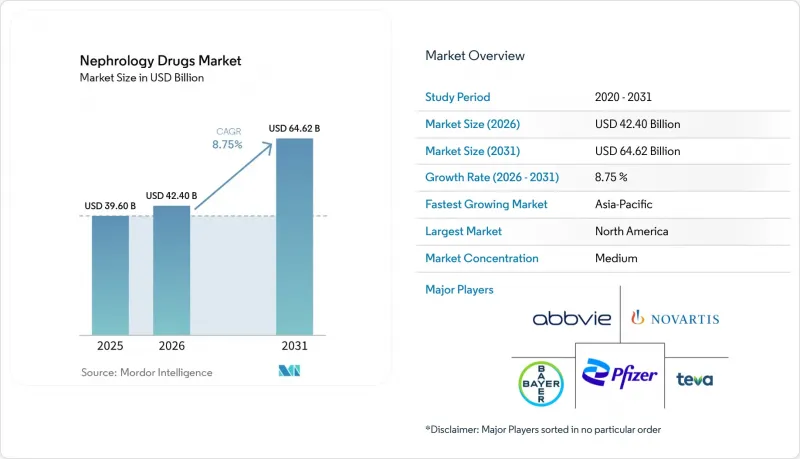
에 따르면 신장병 치료제 시장 규모는 2025년 396억 달러에서 2026년에는 424억 달러로 확대하며, 2031년까지 646억 2,000만 달러에 달할 것으로 예상되고 있으며, 2026-2031년에 CAGR 8.75%로 성장할 것으로 전망되고 있습니다.
세계 신장 질환 치료제 시장의 동향 및 분석
만성 신장 질환 및 말기 신부전의 부담 증가
2023년 기준, 전 세계에서 7억 8,800만 명의 성인이 만성 신장 질환을 앓고 있으며, 이는 1990년의 3억 7,800만 명에 비해 크게 증가한 수치입니다. 중국에서는 1억 5,200만 명, 인도에서는 1억 3,800만 명의 환자가 확인되어, 두 나라가 가장 많은 환자 수를 기록하고 있습니다. 2023년 기준으로, 환자의 약 30%는 임상 기록상 확정 진단을 받지 않은 상태였습니다. 따라서 검진 보급을 통해 질환 발생률이 증가하지 않더라도 치료 수요를 높일 수 있습니다. 2023년에는 만성 신장 질환(CKD)으로 인한 사망자 수가 148만 명에 달해 세계 9위의 사망 원인이 되었습니다. 또한 신장 기능 장애는 심혈관 질환으로 인한 사망의 11.5%를 차지하고 있으며, 관련 질환에 대한 의약품 개발을 촉진하고 있습니다.
당뇨병 이외의 분야에서 신장 보호 작용을 가진 SGLT2 억제제의 사용 확대
KDIGO는 eGFR 기준을 충족하는 성인 CKD 환자에게 SGLT2 억제제에 대해 1A등급 권고를 내렸습니다. 이 권고는 당뇨병 유무와 관계없이 적용되므로, 처방 대상 환자층이 확대되고 있습니다. 당뇨병이 없는 환자에 대한 사용은 여전히 가이드라인의 권고 범위 밖에 머물러 있습니다. 이러한 격차는 일차 진료, 순환기내과, 신장내과 진료 현장에서 이 지침을 채택함에 따라 처방 건수가 증가할 여지를 남기고 있습니다. CONFIDENCE 임상시험에서는 피네레논과 엠파글리플로진의 병용 요법이 어느 한 약물의 단독 투여에 비해 소변 알부민/크레아티닌 비율을 29% 더 낮추는 것으로 밝혀졌습니다. 이 병용 요법으로 인해 신장 질환 치료제 시장에서 상호 보완적인 약물의 사용이 증가할 가능성이 있습니다.
신장 치료 분야의 높은 비용과 보험 급여 관련 과제
메디케어의 말기 신부전(ESRD) 예상 지급 제도에서는 투석 관련 의약품의 대부분이 1일당 정액 지급으로 통합되어 있습니다. 의료 기관이 새로운 치료법을 도입할 경우, 이 정액 지급액을 초과하는 비용이 발생할 가능성이 있습니다. ‘과도기 의약품 추가 지급 조정(Transitional Drug Add-on Payment Adjustment)’을 통해 지급액이 정액 수준으로 돌아올 때까지 2년간 지원이 제공됩니다. 이러한 변경으로 인해 환자의 필요성이 입증되었음에도 불구하고 의료 제공자가 처방을 내리기 어려워질 수 있습니다. 2025년 분석에 따르면 비용 문제로 인해 새로운 생물제제나 표적 치료법을 활용한 신장 치료제는 주로 고소득 국가로 한정되어 있는 것으로 밝혀졌습니다. 이러한 접근성 격차는 만성 신장 질환(CKD)의 부담이 큰 지역에서 신장 질환 치료제 시장의 확장을 저해하고 있습니다.
부문 분석
2025년 기준, RAS 억제제는 신장 질환 치료제 시장 점유율의 31.8%를 차지했습니다. 이러한 위상은 고혈압 및 당뇨병성 신증에 대한 오랜 기간의 지침에 기반한 사용과 제네릭 의약품의 광범위한 접근성을 반영한 것입니다. SGLT2 억제제는 2026-2031년까지 연평균 성장률(CAGR) 10.8%로 성장할 것으로 예측됩니다. KDIGO의 1A 등급 권고에 따라 당뇨병 유무와 관계없이 적격한 성인 CKD 환자에 대한 사용이 권장되고 있습니다. 당뇨병이 없는 환자에서의 도입 지연은 치료 사용률을 높일 수 있는 분명한 여지를 남기고 있습니다. 따라서 신장 질환 치료제 업계는 RAS 치료에만 초점을 맞추던 상황에서 벗어나고 있습니다.
CONFIDENCE 임상시험에서는 피넬레논과 엠파글리플로진의 병용 요법이 어느 한 약제의 단독 요법과 비교했을 때 단백뇨 감소율이 29% 더 높은 것으로 나타났습니다. 이 결과는 다제 병용 프로토콜을 지원하며, 치료를 받는 환자 1인당 약물 사용량을 증가시키는 요인입니다. 빈혈 치료제에는 적혈구 조혈 자극제 및 HIF-프로릴 하이드록실라제 억제제가 포함됩니다. 바프세오는 2024년 3월 FDA 승인을 받은 후, 2025년 1월 미국에서 시판이 시작되었습니다. 인 결합제, 칼륨 결합제, 면역억제제 및 보체 억제제는 다른 신장 질환에서도 여전히 중요한 역할을 하고 있습니다. 희귀 신장 질환을 대상으로 하는 표적 생물제제도 제한적 유통 프로그램의 대상이 되고 있습니다.
2025년, 만성 신장 질환(CKD)은 신장 질환 치료제 시장 규모의 38.5%를 차지하며 가장 큰 적응증이 되었습니다. 당뇨병성 신장 질환은 2026-2031년까지 연평균 성장률(CAGR) 10.6%로 성장할 것으로 예측됩니다. 2023년에는 공복 혈장 포도당 수치가 CKD의 장애 조정 생존 연수(DALY)의 31.9%를 차지했습니다. 이러한 질병 부담이 당뇨병성 신장 질환에 대한 개발이 중점적으로 이루어지고 있는 이유를 설명해 줍니다. 노보노르디스크는 이 치료 분야에서 세마글루티드의 적응증을 신장 결과 관련 적응증으로 확대하고 있습니다.
CKD에는 확립된 치료 대상 환자군이 존재하며, 여러 임상 지침에서 명확한 약물 치료 접근법이 규정되어 있습니다. 따라서 이러한 환자 기반을 바탕으로, 약물의 시장 침투율이 소폭 향상되더라도 판매량이 대폭 증가할 것으로 예상됩니다. 사구체성 및 자가면역성 질환에는 IgAN, FSGS, 원발성 막성 신증, 루푸스 신염 등이 포함됩니다. 치료는 광범위한 면역억제 요법에서 표적화된 생물제제나 BTK 억제제를 이용한 접근 방식으로 전환되고 있습니다. IgAN의 경우, FDA가 승인한 대체 평가 지표인 단백뇨가 스퍼센탄 및 탈페요의 승인을 지원했습니다. 급성 신장 손상의 치료는 여전히 지지요법이 중심이지만, 바이오마커에 기반한 조기 개입 방법이 개발되고 있습니다. 말기 신부전(ESRD) 및 만성 신장 질환(CKD)의 합병증은 투석 프로그램을 통한 빈혈 및 미네랄 대사 관리와 밀접한 관련이 있습니다.
지역별 분석
2025년, 북미는 신장 질환 치료제 시장 점유율의 41.3%를 차지했습니다. 이 지역은 확립된 신장 전문의의 존재, 메디케어(Medicare)를 통한 ESRD 보험 적용, 그리고 권장 치료법의 조기 도입이라는 이점을 가지고 있습니다. 미국은 의료제도상 승인 후 사용이 급속히 확대될 가능성이 있으며, 여전히 최대 국내 시장으로 자리 잡고 있습니다. 케렌디아는 2025년 전 세계 매출 8억 2,900만 유로(9억 3,600만 달러 상당)를 기록했습니다. 캐나다에서도 유사한 처방 경향이 관찰되었으나, 멕시코에서는 도시 지역의 비만 및 당뇨병 증가에 따라 시장이 확대되고 있습니다. 메디케어의 ESRD(말기 신부전)에 대한 포괄적인 지급 구조는 여전히 새로운 투석 치료제에 있으며, 중요한 제약 요인으로 작용하고 있습니다.
유럽은 북미에 이어 두 번째로 큰 시장 규모를 자랑하며, 독일, 영국, 프랑스의 통합적인 신장 치료 경로가 이를 지원하고 있습니다. 지침의 채택에 따라 CKD 및 심부전 치료 전반에 걸쳐 SGLT2 억제제의 사용이 촉진되고 있습니다. 아시아태평양은 2026-2031년까지 연평균 성장률(CAGR) 10.9%로 성장할 것으로 예측됩니다. 2023년 데이터에 따르면 중국과 인도의 만성 신장 질환(CKD) 환자 수는 각각 1억 5,200만 명, 1억 3,800만 명이었습니다. 일본은 확립된 투석 시스템을 갖추고 있으며, 신성 빈혈 치료를 위한 HIF-PH 억제제를 조기에 도입했습니다.
일본에서는 250만 명의 만성 신장 질환(CKD) 환자가 진단되었으며, 한국과 호주에서는 선별 검사 활동이 확대되고 있습니다. 아시아태평양 전체에서 비당뇨성 만성 신장 질환(CKD)에 대한 SGLT2 억제제 사용은 더욱 발전할 여지가 있습니다. IgA 신증의 유병률은 서구 국가들보다 높기 때문에 이 질환에 대한 의약품 개발도 이 지역에 있으며, 중요한 의미를 지닙니다. 중동 및 아프리카 및 남미는 경제적 부담과 전문의 접근성 제한이 걸림돌이 되어 여전히 시장 침투율이 낮은 지역입니다. 라틴아메리카에서는 2023년 연령 조정 CKD 유병률이 15.4%를 기록했습니다. 독점 판매권 만료가 다가옴에 따라 저비용 SGLT2 제네릭 의약품이 판매량 주도형 시장 확대를 견인할 가능성이 있습니다.
기타 혜택:
- 엑셀 형식의 시장 예측(ME) 시트
- 3개월간의 애널리스트 지원
자주 묻는 질문
목차
제1장 서론
- 조사 전제조건과 시장 정의
- 조사 범위
제2장 조사 방법
제3장 개요
제4장 시장 구도
- 시장 개요
- 시장 성장 촉진요인
- 시장 성장 억제요인
- 공급망 분석
- 규제 상황
- 기술 전망
- Porter's Five Forces 분석
제5장 시장 규모와 성장 예측
- 약제 클래스별
- 적응증별
- 투여 경로별
- 유통 채널별
- 지역별
- 북미
- 미국
- 캐나다
- 멕시코
- 유럽
- 독일
- 영국
- 프랑스
- 이탈리아
- 스페인
- 기타 유럽 국가
- 아시아태평양
- 중국
- 일본
- 인도
- 한국
- 호주
- 기타 아시아태평양 국가
- 중동 및 아프리카
- GCC
- 남아프리카공화국
- 기타 중동 및 아프리카 국가
- 남미
- 브라질
- 아르헨티나
- 기타 남미 국가
- 북미
제6장 경쟁 구도
- 시장 집중도
- 시장 점유율 분석
- 기업 개요
- AstraZeneca
- Boehringer Ingelheim International GmbH
- Eli Lilly and Company
- Bayer AG
- Amgen Inc.
- Novartis AG
- Novo Nordisk A/S
- Pfizer Inc.
- F. Hoffmann-La Roche Ltd
- AbbVie Inc.
- Johnson & Johnson
- CSL Vifor
- Akebia Therapeutics, Inc.
- Ardelyx, Inc.
- Travere Therapeutics, Inc.
- Calliditas Therapeutics AB
- Otsuka Pharmaceutical Co., Ltd.
- Takeda Pharmaceutical Company Limited
- Kyowa Kirin Co., Ltd.
- Alnylam Pharmaceuticals, Inc.
제7장 시장 기회와 향후 전망
KSA 26.10.29According to Mordor Intelligence, the nephrology drugs market size is expected to increase from USD 39.60 billion in 2025 to USD 42.40 billion in 2026 and reach USD 64.62 billion by 2031, growing at a CAGR of 8.75% over 2026-2031.
Global Nephrology Drugs Market Trends and Insights
Rising Chronic Kidney Disease and End-Stage Renal Disease Burden
Chronic kidney disease affected 788 million adults globally in 2023, compared with 378 million adults in 1990. China had 152 million cases and India had 138 million cases, creating the largest national patient pools. Around 30% of affected people lacked a confirmed diagnosis in clinical records during 2023. Broader detection can therefore increase treatment demand without requiring a rise in disease incidence. CKD caused 1.48 million deaths in 2023 and ranked as the ninth leading global cause of death. Impaired kidney function also contributed to 11.5% of cardiovascular mortality, supporting drug development across related conditions.
Expansion of Renal-Protective SGLT2 Inhibitor Use Beyond Diabetes
KDIGO gave SGLT2 inhibitors a Grade 1A recommendation for adults with CKD who meet its eGFR criteria. The recommendation applies regardless of diabetes status, expanding the relevant prescribing population. Use among people without diabetes has remained beyond the scope of the guideline recommendation. This gap leaves room for prescription growth as primary care, cardiology, and nephrology practices adopt the guidance. The CONFIDENCE trial found that finerenone plus empagliflozin reduced urinary albumin-to-creatinine ratios 29% more than either medicine alone. Combination treatment can raise use of complementary medicines within the nephrology drugs market.
High Cost and Reimbursement Friction for Novel Renal Therapies
Medicare's ESRD Prospective Payment System bundles most dialysis-related medicines into a fixed daily payment. Facilities can face costs above the bundled payment when they use newer treatments. The Transitional Drug Add-on Payment Adjustment provides support for 2 years before payment returns to bundled levels. This change can make prescribing difficult for providers despite an established patient need. A 2025 analysis found that costs restrict novel biological and targeted renal medicines largely to high-income countries. The access gap limits the nephrology drugs market in regions with substantial CKD burdens.
Other drivers and restraints analyzed in the detailed report include:
- Earlier Detection Through eGFR and Albuminuria Screening
- Aging, Diabetes, Hypertension and Obesity Comorbidity Load
- Long and Complex Kidney-Outcome Trial Requirements
For complete list of drivers and restraints, kindly check the Table Of Contents.
Segment Analysis
RAS inhibitors held 31.8% of the nephrology drugs market share in 2025. Their position reflected long-standing guideline use and broad generic availability in hypertensive and diabetic nephropathy. SGLT2 inhibitors are projected to grow at a 10.8% CAGR from 2026 to 2031. KDIGO's Grade 1A recommendation supports their use in eligible adults with CKD, regardless of diabetes status. Slower adoption among patients without diabetes leaves a clear route for higher treatment use. The nephrology drugs industry is therefore moving beyond a landscape centered on RAS therapy alone.
The CONFIDENCE trial showed a 29% greater reduction in proteinuria from finerenone and empagliflozin together than from either therapy alone. The result supports multi-class protocols and increases medicine use per treated patient. Anemia therapies include erythropoiesis-stimulating agents and HIF-prolyl hydroxylase inhibitors. Vafseo became commercially available in the United States in January 2025 after FDA approval in March 2024. Phosphate binders, potassium binders, immunosuppressants, and complement inhibitors remain important in other renal conditions. Targeted biologics for rare kidney diseases are also entering restricted distribution programs.
CKD accounted for 38.5% of the nephrology drugs market size in 2025, making it the largest indication. Diabetic kidney disease is forecast to grow at a 10.6% CAGR from 2026 to 2031. High fasting plasma glucose contributed 31.9% of CKD disability-adjusted life years in 2023. This disease burden explains the strong development focus on diabetic kidney disease. Novo Nordisk is extending semaglutide into renal outcome indications within this therapeutic area.
CKD has an established treatment population and well-defined pharmacotherapy approaches across several clinical guidelines. Modest gains in drug penetration can therefore create substantial volume because of this patient base. Glomerular and autoimmune diseases include IgAN, FSGS, primary membranous nephropathy, and lupus nephritis. Treatment is moving from broad immunosuppression toward targeted biologics and BTK-inhibitor approaches. Proteinuria as an FDA-accepted surrogate endpoint in IgAN supported approvals for sparsentan and Tarpeyo. Acute kidney injury remains centered on supportive care, although biomarker-guided early intervention is under development. ESRD and CKD complications remain linked to anemia and mineral-metabolism management through dialysis programs.
Complete Report Scope:
- By Drug Class
- Renin-Angiotensin System (RAS) Inhibitors (ACE Inhibitors, ARBs)
- SGLT2 Inhibitors
- Mineralocorticoid Receptor Antagonists & Endothelin Receptor Antagonists
- Anemia Management Therapies (ESAs, HIF-PH Inhibitors)
- Other Nephrology Drugs (Phosphate Binders, Potassium Binders, Immunosuppressants, Complement Inhibitors, Others)
- By Indication
- Chronic Kidney Disease (CKD)
- Diabetic Kidney Disease (DKD)
- Glomerular & Autoimmune Kidney Diseases
- Acute Kidney Injury (AKI)
- CKD-Associated Complications & End-Stage Renal Disease (ESRD)
- By Route of Administration
- Oral
- Injectable/Parenteral
- Intravenous
- Subcutaneous
- Other Routes
- By Distribution Channel
- Hospital Pharmacies
- Retail Pharmacies
- Online Pharmacies
- Specialty Pharmacies
- Other Distribution Channels
- By Geography
- North America
- United States
- Canada
- Mexico
- Europe
- Germany
- United Kingdom
- France
- Italy
- Spain
- Rest of Europe
- Asia-Pacific
- China
- Japan
- India
- South Korea
- Australia
- Rest of Asia-Pacific
- Middle East and africa
- GCC
- South Africa
- Rest of Middle East and Africa
- South America
- Brazil
- Argentina
- Rest of South America
- North America
Geography Analysis
North America held 41.3% of the nephrology drugs market share in 2025. The region benefits from established renal specialists, Medicare ESRD coverage, and early uptake of recommended therapies. The United States remains the largest national market because post-approval use can develop quickly within its health care system. Kerendia generated EUR 829 million, equivalent to USD 936 million, in global sales during 2025. Canada showed similar prescribing patterns, while Mexico is growing with urban obesity and diabetes. Medicare's bundled ESRD payment structure remains an important constraint on novel dialysis medicines.
Europe follows North America, supported by integrated renal care pathways in Germany, the United Kingdom, and France. Guideline adoption has supported SGLT2 inhibitor use across CKD and heart failure care. Asia-Pacific is projected to grow at a 10.9% CAGR from 2026 to 2031. China and India had 152 million and 138 million CKD cases, respectively, in the 2023 dataset. Japan has an established dialysis system and was an early adopter of HIF-PH inhibitors for renal anemia treatment.
Japan recorded 2.5 million diagnosed CKD patients, while South Korea and Australia are expanding screening initiatives. SGLT2 use in non-diabetic CKD has further room to develop across Asia-Pacific. IgA nephropathy drug development also has regional relevance because prevalence is higher than in Western populations. Middle East and Africa, and South America, remain lower-penetration areas constrained by affordability and specialist access. Latin America recorded an age-standardized CKD prevalence of 15.4% in 2023. Lower-cost SGLT2 generics may support a volume-led pathway as exclusivities expire.
- AstraZeneca
- Boehringer Ingelheim
- Eli Lilly and Company
- Bayer
- Amgen
- Novartis
- Novo Nordisk
- Pfizer
- Roche
- Abbvie
- Johnson & Johnson
- CSL Vifor
- Akebia Therapeutics
- Ardelyx, Inc.
- Travere Therapeutics, Inc.
- Calliditas Therapeutics AB
- Otsuka
- Takeda Pharmaceuticals
- Kyowa Kirin
- Alnylam Pharmaceuticals
Additional Benefits:
- The market estimate (ME) sheet in Excel format
- 3 months of analyst support
TABLE OF CONTENTS
1 INTRODUCTION
- 1.1 Study Assumptions and Market Definition
- 1.2 Scope of the Study
2 RESEARCH METHODOLOGY
3 EXECUTIVE SUMMARY
4 MARKET LANDSCAPE
- 4.1 Market Overview
- 4.2 Market Drivers
- 4.2.1 Rising Chronic Kidney Disease and End-Stage Renal Disease Burden
- 4.2.2 Expansion of Renal-Protective SGLT2 Inhibitor Use Beyond Diabetes
- 4.2.3 Earlier Detection Through eGFR and Albuminuria Screening
- 4.2.4 Aging, Diabetes, Hypertension and Obesity Comorbidity Load
- 4.2.5 Increasing Investment in Precision Nephrology and Rare Kidney Disease Therapies
- 4.2.6 Digitally Enabled Home and Outpatient Medication Management
- 4.3 Market Restraints
- 4.3.1 High Cost and Reimbursement Friction for Novel Renal Therapies
- 4.3.2 Long and Complex Kidney-Outcome Trial Requirements
- 4.3.3 Renal-Dose Errors and Medication-Management Complexity
- 4.3.4 Late Diagnosis, Low Awareness and Uneven Specialist Access
- 4.4 Supply-Chain Analysis
- 4.5 Regulatory Landscape
- 4.6 Technological Outlook
- 4.7 Porters Five Forces Analysis
- 4.7.1 Threat of New Entrants
- 4.7.2 Bargaining Power of Suppliers
- 4.7.3 Bargaining Power of Buyers
- 4.7.4 Threat of Substitutes
- 4.7.5 Competitive Rivalry
5 MARKET SIZE AND GROWTH FORECASTS
- 5.1 By Drug Class
- 5.1.1 Renin-Angiotensin System (RAS) Inhibitors (ACE Inhibitors, ARBs)
- 5.1.2 SGLT2 Inhibitors
- 5.1.3 Mineralocorticoid Receptor Antagonists & Endothelin Receptor Antagonists
- 5.1.4 Anemia Management Therapies (ESAs, HIF-PH Inhibitors)
- 5.1.5 Other Nephrology Drugs (Phosphate Binders, Potassium Binders, Immunosuppressants, Complement Inhibitors, Others)
- 5.2 By Indication
- 5.2.1 Chronic Kidney Disease (CKD)
- 5.2.2 Diabetic Kidney Disease (DKD)
- 5.2.3 Glomerular & Autoimmune Kidney Diseases
- 5.2.4 Acute Kidney Injury (AKI)
- 5.2.5 CKD-Associated Complications & End-Stage Renal Disease (ESRD)
- 5.3 By Route of Administration
- 5.3.1 Oral
- 5.3.2 Injectable/Parenteral
- 5.3.3 Intravenous
- 5.3.4 Subcutaneous
- 5.3.5 Other Routes
- 5.4 By Distribution Channel
- 5.4.1 Hospital Pharmacies
- 5.4.2 Retail Pharmacies
- 5.4.3 Online Pharmacies
- 5.4.4 Specialty Pharmacies
- 5.4.5 Other Distribution Channels
- 5.5 By Geography
- 5.5.1 North America
- 5.5.1.1 United States
- 5.5.1.2 Canada
- 5.5.1.3 Mexico
- 5.5.2 Europe
- 5.5.2.1 Germany
- 5.5.2.2 United Kingdom
- 5.5.2.3 France
- 5.5.2.4 Italy
- 5.5.2.5 Spain
- 5.5.2.6 Rest of Europe
- 5.5.3 Asia-Pacific
- 5.5.3.1 China
- 5.5.3.2 Japan
- 5.5.3.3 India
- 5.5.3.4 South Korea
- 5.5.3.5 Australia
- 5.5.3.6 Rest of Asia-Pacific
- 5.5.4 Middle East and africa
- 5.5.4.1 GCC
- 5.5.4.2 South Africa
- 5.5.4.3 Rest of Middle East and Africa
- 5.5.5 South America
- 5.5.5.1 Brazil
- 5.5.5.2 Argentina
- 5.5.5.3 Rest of South America
- 5.5.1 North America
6 COMPETITIVE LANDSCAPE
- 6.1 Market Concentration
- 6.2 Market Share Analysis
- 6.3 Company Profiles (includes Global Level Overview, Market Level Overview, Core Segments, Financials as available, Strategic Information, Market Rank/Share, Products and Services, Recent Developments)
- 6.3.1 AstraZeneca
- 6.3.2 Boehringer Ingelheim International GmbH
- 6.3.3 Eli Lilly and Company
- 6.3.4 Bayer AG
- 6.3.5 Amgen Inc.
- 6.3.6 Novartis AG
- 6.3.7 Novo Nordisk A/S
- 6.3.8 Pfizer Inc.
- 6.3.9 F. Hoffmann-La Roche Ltd
- 6.3.10 AbbVie Inc.
- 6.3.11 Johnson & Johnson
- 6.3.12 CSL Vifor
- 6.3.13 Akebia Therapeutics, Inc.
- 6.3.14 Ardelyx, Inc.
- 6.3.15 Travere Therapeutics, Inc.
- 6.3.16 Calliditas Therapeutics AB
- 6.3.17 Otsuka Pharmaceutical Co., Ltd.
- 6.3.18 Takeda Pharmaceutical Company Limited
- 6.3.19 Kyowa Kirin Co., Ltd.
- 6.3.20 Alnylam Pharmaceuticals, Inc.
7 MARKET OPPORTUNITIES AND FUTURE OUTLOOK
- 7.1 White-Space and Unmet-Need Assessment


