

|
시장보고서
상품코드
2156940
납땜 장비 : 시장 점유율 분석, 업계 동향과 통계, 성장 예측(2026-2031년)Soldering Equipment - Market Share Analysis, Industry Trends & Statistics, Growth Forecasts (2026 - 2031) |
||||||
 Mordor Intelligence
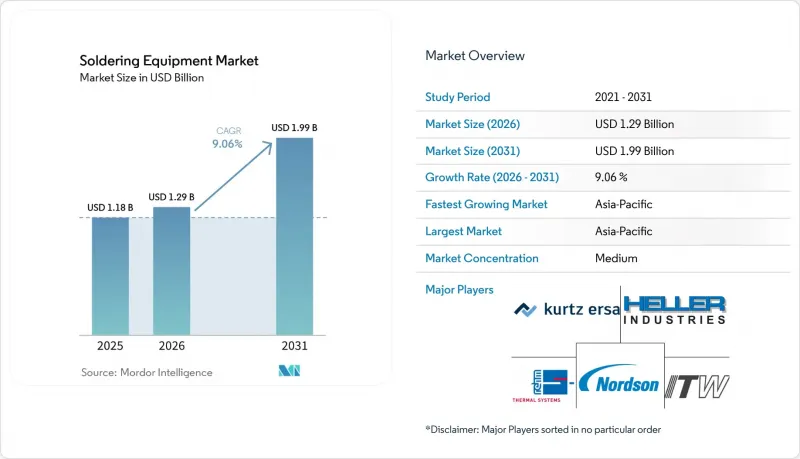
에 따르면 납땜 장비 시장 규모는 2025년에 11억 8,000만 달러로 평가되며, 2026년 12억 9,000만 달러에서 2031년까지 19억 9,000만 달러에 달할 것으로 예측되고 있으며, 예측 기간(2026-2031년)에 CAGR은 9.06%에 달할 전망입니다.
세계 납땜 장비 시장의 동향 및 인사이트
전자 제품의 소형화 및 고밀도 PCB 조립의 가속화
고밀도 상호 연결(HDI) 조립의 경우, 복잡한 기판 전체에 걸쳐 납땜량 및 온도의 허용 변동 범위가 더욱 엄격해지고 있습니다. 01005 크기의 수동 부품이나 0.3mm 피치의 볼 그리드 어레이(BGA)에 사용되는 시스템은 40층을 초과하는 기판 전체에서 온도 차이를 ±5°C 이내로 유지해야 합니다. 구형 부품 형식에 맞춰 설계된 장비로는 100µm 미만의 피치를 가진 조립에 필요한 수율을 일관되게 확보할 수 없습니다. 5G, 사물인터넷(IoT), 첨단 운전자 보조 시스템(ADAS)용 고밀도 상호 연결 기판은 인증된 납땜 플랫폼의 교체 수요를 지원하고 있습니다. 항공우주, 의료, 자동차 생산 분야의 높은 신뢰성 요건을 충족하기 위해 전자기기 제조 서비스 제공업체들이 설비를 갱신함에 따라 납땜 장비 시장은 그 혜택을 보고 있습니다. 새로운 생산 계약을 목표로 하는 공급업체에게 있으며, 국제전기기술위원회(IEC) 및 전자산업연결협회(IPC)의 요구 사항을 준수하는 문서화는 필수 요소가 되고 있습니다.
전기자동차(EV), 배터리 관리, 전력 전자 제품 생산의 확대
전기자동차(EV)의 경우, 모터 인버터, 차량용 충전기, 배터리 관리 시스템에 납땜된 어셈블리가 필요합니다. 800V 차량 아키텍처로의 전환에 따라 절연 전자 부품에 가해지는 전기적 스트레스가 증가함에 따라 더욱 엄격한 보이드 제어 성능이 요구되고 있습니다. SEHO Systems GmbH는 productronica 2025에서 e-모빌리티, 배터리 관리 및 컨버터 기술 용도를 위한 ‘PowerSelective-HD’ 시스템을 발표했습니다. 보쉬는 미국 상무부와 2억 2,500만 달러 규모의 직접 자금 지원 계약을 체결한 후, 2026년에 캘리포니아주 로즈빌에 위치한 실리콘 카바이드 반도체 제조 시설에서 시범 생산을 시작했습니다. 이러한 요구 사항으로 인해 자동차 등급 파워 모듈에 대응 가능한 진공 리플로우 및 선택적 납땜 시스템이 선호되고 있습니다. 따라서 차량 플랫폼이 고전압 설계로 전환됨에 따라 납땜 장비 시장의 설비 교체 주기는 장기화되고 있습니다.
자동 납땜 및 선택적 납땜 시스템에 대한 높은 설비 투자 요건
첨단 패키징 및 자동차 생산에 사용되는 선택적 납땜 및 레이저 납땜 플랫폼은 대당 50만 달러를 초과할 수 있습니다. 소규모 전자기기 제조 서비스 제공업체들도 질소 공급, 진동 제어, 열 관리를 위한 시설 비용에 직면해 있습니다. 이러한 변화로 인해 초기 설비 비용이 20%에서 40%까지 증가할 가능성이 있습니다. 그로 인해 발생하는 총 비용 때문에 중규모 조립 업체들은 종종 구형 웨이브 납땜 라인을 계속 사용하는 경우가 많습니다. 리스나 성과 기반 지불 모델은 이러한 장벽을 완화할 수 있지만, 설비 자금 조달이 제한된 시장에서는 여전히 이용이 제한적입니다. 남미와 중동 및 아프리카에서는 현지 조립 능력이 확대되고 있음에도 불구하고 자금 조달 제약이 가장 심각합니다.
부문 분석
2025년, 리플로우 공정은 대량 생산되는 표면 실장 기술(SMT) 조립에 힘입어 납땜 장비 시장 점유율의 38.65%를 차지했습니다. 이는 소비자 가전, 네트워크 기판, 자동차용 전자제어 장치(ECU)에 널리 사용되고 있습니다. 고밀도 상호 연결 기판의 경우, 소형 부품이나 마이크로 볼 그리드 어레이(MBGA)의 실장에 다중 구역 열 프로파일이 필요합니다. 에너지 소비량, 질소 사용량 및 유지보수 주기 단축으로 인해 고처리량 리플로우 라인의 운영 비용이 상승할 가능성이 있습니다. Rehm Thermal Systems GmbH는 EFX 2026에서 ‘VisionXP+’ 세대를 발표하며, 전자 정류 모터, 지능형 팬 제어 및 질소 셔터를 통해 대기시 에너지 소비를 최대 60%까지 절감할 수 있다고 보고했습니다. 유도식 및 핫바식 리플로우 시스템은 웨어러블 기기나 OLED 디스플레이용 플렉서블 회로의 본딩 등 국소적인 열원이 바람직한 상황에서 여전히 중요한 역할을 하고 있습니다.
레이저 납땜은 2031년까지 연평균 성장률(CAGR) 9.75%로 확대될 것으로 예측되며, 납땜 장비 시장에서 가장 높은 성장률을 보이고 있습니다. 이 기술은 카메라 모듈, 마이크로 전자 기계 시스템(MEMS) 장치, 플렉서블 인쇄회로기판 커넥터 및 자동차용 센서 어셈블리에 비접촉 가열을 제공합니다. Han's Laser사는 2026년, 카메라 모듈, 완전 무선 스테레오 이어폰, 플렉서블 인쇄회로기판 커넥터를 아우르는 3C 전자제품 제조용 전용 레이저 납땜 시스템을 발표했습니다. 인공지능(AI) 가속기 패키지의 경우에도 미세한 패드 피치에서의 정렬 제어가 요구됩니다. 레이저 시스템은 리플로우 시스템에 비해 도입 비용이 높지만, 첨단 패키지에서 불량품이 발생할 경우의 비용을 고려하면 그 투자는 정당화될 것입니다. 기계식 및 알루미늄 재질의 납땜 플랫폼은 산업, 방위, 전력 인프라 조립 분야에서 스루홀 및 중량 부품 처리에 계속해서 활용되고 있습니다.
지역별 분석
아시아태평양은 2025년 납땜 장비 시장 점유율의 45.87%를 차지하고 있으며, 2031년까지 연평균 성장률(CAGR) 10.07%로 확대될 것으로 예측됩니다. 중국의 표면 실장 기술(SMT) 기반, 일본의 정밀 기기 기술력, 한국의 반도체 및 디스플레이 산업 클러스터, 그리고 인도의 확대되는 전자기기 제조 서비스 역량이 이러한 위상을 지원하고 있습니다. 인도의 전자제품 생산액은 2025-26 회계연도에 전년 대비 15.8% 증가한 13.11 락 크롤(약 1,560억 달러)에 달했습니다. 이 지역의 납땜 장비 시장 규모는 인도의 생산 연계형 인센티브 프로그램과 반도체 투자 계획에 힘입어 성장하고 있습니다. SEHO Systems GmbH는 2026년 8월 NMTronics India Pvt. Ltd.와의 제휴를 발표했으며, Heller Industries, Inc.의 인도 공장에서 웨이브 납땜 시스템을 현지 생산할 계획입니다.
북미에서는 반도체의 리쇼어링과 첨단 패키징에 대한 투자로 인해 장비 수요가 증가하고 있습니다. TSMC가 애리조나주에 2,650억 달러를 투자할 계획은 리플로우, 플립칩 본딩 및 기타 첨단 패키징 워크플로우를 지원하기 위한 것입니다. 멕시코 역시 자동차 관련 전자기기 제조 분야에서 니어쇼어링 추세를 반영하고 있습니다. 노드슨 코퍼레이션은 2026년 3월, 어셈블리 프로덕츠(Assembly Products)사와의 판매 제휴를 확대하여 미국 및 캐나다 전역에서 MARCH 플라즈마 시스템과 SELECT 선택적 납땜 제품을 취급하게 되었습니다. 이러한 상업적 움직임은 지역별 전자기기 생산 능력 확충과 현지 서비스망 구축을 향한 더 광범위한 흐름에 부합하는 것입니다.
유럽의 납땜 장비 시장은 자동차용 전자기기 생산, 정밀 제조 및 무연 규제의 준수 요건에 의해 형성되고 있습니다. 2025년 11월에 공표된 유럽연합(EU)의 개정안에 따라 기존 솔더내 납 함유에 관한 적용 예외 범위가 축소되었으며, 제조업체는 적용 기한까지 갱신된 기술 문서를 준비해야 할 의무가 부과되었습니다. Rehm Thermal Systems GmbH는 IPC APEX EXPO 2026에서 질소 분위기 처리 및 에너지 관리를 실현하는 ‘VisionXC Nitro’ 리플로우 플랫폼을 발표했습니다. 남미, 중동 및 아프리카는 여전히 수요 규모가 작지만, 전자기기 제조 서비스의 생산 능력 확대에 따라 성장을 이어가고 있습니다. 브라질과 아르헨티나는 소비자 가전 및 자동차 부품 생산을 통해 남미의 수요를 지원하고 있는 반면, 사우디아라비아와 남아프리카공화국에서는 장기적인 유통 및 서비스 기회가 기대되고 있습니다.
기타 혜택:
- 엑셀 형식의 시장 예측(ME) 시트
- 3개월간의 애널리스트 지원
자주 묻는 질문
목차
제1장 서론
- 조사 전제조건과 시장 정의
- 조사 범위
제2장 조사 방법
제3장 개요
제4장 시장 구도
- 시장 개요
- 시장 성장 촉진요인
- 시장 성장 억제요인
- 밸류체인 분석
- Porter's Five Forces 분석
제5장 시장 규모와 성장 예측
- 유형별
- 용도별
- 지역별
- 아시아태평양
- 중국
- 인도
- 일본
- 한국
- ASEAN 국가
- 기타 아시아태평양 국가
- 북미
- 미국
- 캐나다
- 멕시코
- 유럽
- 독일
- 영국
- 프랑스
- 이탈리아
- 북유럽 국가
- 기타 유럽 국가
- 남미
- 브라질
- 아르헨티나
- 기타 남미 국가
- 중동 및 아프리카
- 사우디아라비아
- 남아프리카공화국
- 기타 중동 및 아프리카 국가
- 아시아태평양
제6장 경쟁 구도
- 시장 집중도
- 전략적 동향
- 시장 점유율·순위 분석
- 기업 개요
- Apollo Seiko Ltd.
- BTU-An Amtech Company
- HAKKO Corporation
- Heller Industries, Inc.
- Illinois Tool Works Inc.
- JAPAN UNIX CO., LTD.
- JBC Soldering S.L.
- JUKI Automation Systems GmbH
- Kurtz Ersa
- Metcal, an OK International Company
- Nordson Corporation
- Pillarhouse International Ltd
- Rehm Thermal Systems GmbH
- SEHO Systems GmbH
- Weller
제7장 시장 기회와 향후 전망
KSA 26.10.29According to Mordor Intelligence, the soldering equipment market size was valued at USD 1.18 billion in 2025 and is estimated to grow from USD 1.29 billion in 2026 to reach USD 1.99 billion by 2031, at a CAGR of 9.06% during the forecast period (2026-2031).
Global Soldering Equipment Market Trends and Insights
Accelerating Electronics Miniaturization and High-Density PCB Assembly
High-density interconnect assembly has tightened allowable variation in solder volume and temperature across complex boards. Systems used for 01005 passive components and 0.3 mm-pitch ball grid arrays must maintain a temperature difference within +-5 °C across boards with more than 40 layers. Equipment designed for older component formats cannot consistently deliver the yield needed for sub-100 µm pitch assemblies. High-density interconnect boards for 5G, Internet of Things, and advanced driver-assistance systems are supporting replacement demand for qualified soldering platforms. The soldering equipment market benefits when electronics manufacturing services providers renew equipment to meet high-reliability requirements in aerospace, medical, and automotive production. Documentation aligned with International Electrotechnical Commission and Association Connecting Electronics Industries (IPC) requirements is becoming necessary for suppliers seeking new production contracts.
Rising EV, Battery-Management and Power-Electronics Production
Electric vehicles require soldered assemblies in motor inverters, onboard chargers, and battery management systems. The move to 800 V vehicle architectures increases electrical stress on isolation electronics and requires tighter void-control performance. SEHO Systems GmbH introduced its PowerSelective-HD system for e-mobility, battery management, and converter technology applications at productronica 2025. Bosch began sample production at its silicon carbide semiconductor facility in Roseville, California, in 2026 after a USD 225 million direct funding agreement with the U.S. Department of Commerce. These requirements favor vacuum reflow and selective systems that can support automotive-grade power modules. The soldering equipment market, therefore, has a longer equipment upgrade cycle as vehicle platforms shift toward higher-voltage designs.
High Capital Requirements for Automated and Selective Soldering Systems
Selective and laser soldering platforms used for advanced packaging or automotive production can cost more than USD 500,000 per unit. Smaller electronics manufacturing services providers also face facility costs for nitrogen supply, vibration control, and thermal management. These changes can add 20% to 40% to the initial equipment cost. The resulting total cost often leads mid-sized assemblers to continue using older wave-soldering lines. Leasing and pay-per-yield models can reduce this barrier, but they remain limited in markets with restricted equipment financing. Capital constraints are most acute in South America and Middle East and Africa, even as local assembly capacity grows.
Other drivers and restraints analyzed in the detailed report include:
- Expansion of Semiconductor Packaging and Advanced Interconnects
- Automation, Robotics and Industry 4.0 Adoption in Electronics Manufacturing
- Tight Process Windows for Lead-Free Soldering
For complete list of drivers and restraints, kindly check the Table Of Contents.
Segment Analysis
Reflow soldering held 38.65% of the soldering equipment market share in 2025, supported by high-volume surface-mount technology assembly. It is widely used for consumer electronics, networking boards, and automotive electronic control units. High-density interconnect boards need multi-zone thermal profiles for small components and micro ball grid array placements. Energy consumption, nitrogen use, and shorter maintenance intervals can raise the operating cost of high-throughput reflow lines. Rehm Thermal Systems GmbH presented its VisionXP+ generation at EFX 2026 with reported idle-period energy savings of up to 60% through electronically commutated motors, intelligent fan control, and a nitrogen shutter. Induction and hot-bar reflow systems remain relevant where a localized heat source is preferable, including flexible circuit bonding for wearables and organic light-emitting diode displays.
Laser soldering is projected to advance at a 9.75% CAGR through 2031, the fastest type growth rate in the soldering equipment market size. It provides noncontact heating for camera modules, microelectromechanical systems devices, flexible printed-circuit connectors, and automotive sensor assemblies. Han's Laser introduced dedicated laser soldering systems for 3C electronics manufacturing in 2026, covering camera modules, true wireless stereo earbuds, and flexible printed-circuit connectors. Artificial intelligence accelerator packages also require alignment control at small pad pitches. Laser systems carry a higher acquisition cost than reflow systems, but the cost of a rejected advanced package can justify the investment. Mechanical and aluminum soldering platforms continue to serve through-hole and heavy-component work in industrial, defense, and power-infrastructure assembly.
Complete Report Scope:
- By Type
- Reflow Soldering
- Induction Soldering
- Hot-Bar Reflow
- Laser Soldering
- Mechanical Soldering
- Aluminum Soldering
- By Application
- Consumer Electronics
- Networking and Communication
- Automotive
- Aerospace and Defense
- Other Applications
- By Geography
- Asia-Pacific
- China
- India
- Japan
- South Korea
- ASEAN Countries
- Rest of Asia-Pacific
- North America
- United States
- Canada
- Mexico
- Europe
- Germany
- United Kingdom
- France
- Italy
- NORDIC Countries
- Rest of Europe
- South America
- Brazil
- Argentina
- Rest of South America
- Middle East and Africa
- Saudi Arabia
- South Africa
- Rest of Middle East and Africa
- Asia-Pacific
Geography Analysis
Asia-Pacific held 45.87% of the soldering equipment market share in 2025 and is projected to advance at a 10.07% CAGR through 2031. China's surface-mount technology base, Japan's precision-equipment capabilities, South Korea's semiconductor and display clusters, and India's growing electronics manufacturing services capacity support this position. India's electronics output rose 15.8% year over year to INR 13.11 lakh crore (approximately USD 156 billion) in fiscal year 2025-26. The soldering equipment market size in the region is also supported by India's production-linked incentive programs and semiconductor investment plans. SEHO Systems GmbH announced an August 2026 partnership with NMTronics India Pvt. Ltd. and plans to manufacture wave soldering systems locally at Heller Industries, Inc.'s Indian facility.
North America is gaining equipment demand through semiconductor reshoring and advanced packaging investment. TSMC's USD 265 billion Arizona commitment supports reflow, flip-chip bonding, and other advanced packaging workflows. Mexico is also absorbing nearshoring activity in automotive-related electronics manufacturing. Nordson Corporation expanded its distribution partnership with Assembly Products Inc. in March 2026 to include MARCH plasma systems and SELECT selective soldering products across the United States and Canada. This commercial move aligns with a broader shift toward regional electronics capacity and local service coverage.
Europe's soldering equipment market is shaped by automotive electronics production, precision manufacturing, and lead-free compliance requirements. European Union amendments published in November 2025 narrowed legacy lead-in-solder exemptions and required manufacturers to prepare updated technical files before applicable deadlines. Rehm Thermal Systems GmbH presented the VisionXC Nitro reflow platform at IPC APEX EXPO 2026 for nitrogen-atmosphere processing and energy management. South America and Middle East and Africa remain smaller demand areas that are expanding with electronics manufacturing services capacity. Brazil and Argentina support South American demand through consumer electronics and automotive component production, while Saudi Arabia and South Africa offer longer-term distribution and service opportunities.
- Apollo Seiko Ltd.
- BTU - An Amtech Company
- HAKKO Corporation
- Heller Industries, Inc.
- Illinois Tool Works Inc.
- JAPAN UNIX CO., LTD.
- JBC Soldering S.L.
- JUKI Automation Systems GmbH
- Kurtz Ersa
- Metcal, an OK International Company
- Nordson Corporation
- Pillarhouse International Ltd
- Rehm Thermal Systems GmbH
- SEHO Systems GmbH
- Weller
Additional Benefits:
- The market estimate (ME) sheet in Excel format
- 3 months of analyst support
TABLE OF CONTENTS
1 Introduction
- 1.1 Study Assumptions and Market Definition
- 1.2 Scope of the Study
2 Research Methodology
3 Executive Summary
4 Market Landscape
- 4.1 Market Overview
- 4.2 Market Drivers
- 4.2.1 Accelerating Electronics Miniaturization and High-Density PCB Assembly
- 4.2.2 Rising EV, Battery-Management and Power-Electronics Production
- 4.2.3 Expansion of Semiconductor Packaging and Advanced Interconnects
- 4.2.4 Automation, Robotics and Industry 4.0 Adoption in Electronics Manufacturing
- 4.2.5 Regionalization of Electronics Manufacturing and EMS Capacity
- 4.3 Market Restraints
- 4.3.1 High Capital Requirements for Automated and Selective Soldering Systems
- 4.3.2 Tight Process Windows for Lead-Free Soldering
- 4.3.3 Shortage of Skilled Operators and Process-Validation Specialists
- 4.4 Value Chain Analysis
- 4.5 Porter's Five Forces Analysis
- 4.5.1 Threat of New Entrants
- 4.5.2 Bargaining Power of Suppliers
- 4.5.3 Bargaining Power of Buyers
- 4.5.4 Threat of Substitutes
- 4.5.5 Competitive Rivalry
5 Market Size and Growth Forecasts (Value)
- 5.1 By Type
- 5.1.1 Reflow Soldering
- 5.1.2 Induction Soldering
- 5.1.3 Hot-Bar Reflow
- 5.1.4 Laser Soldering
- 5.1.5 Mechanical Soldering
- 5.1.6 Aluminum Soldering
- 5.2 By Application
- 5.2.1 Consumer Electronics
- 5.2.2 Networking and Communication
- 5.2.3 Automotive
- 5.2.4 Aerospace and Defense
- 5.2.5 Other Applications
- 5.3 By Geography
- 5.3.1 Asia-Pacific
- 5.3.1.1 China
- 5.3.1.2 India
- 5.3.1.3 Japan
- 5.3.1.4 South Korea
- 5.3.1.5 ASEAN Countries
- 5.3.1.6 Rest of Asia-Pacific
- 5.3.2 North America
- 5.3.2.1 United States
- 5.3.2.2 Canada
- 5.3.2.3 Mexico
- 5.3.3 Europe
- 5.3.3.1 Germany
- 5.3.3.2 United Kingdom
- 5.3.3.3 France
- 5.3.3.4 Italy
- 5.3.3.5 NORDIC Countries
- 5.3.3.6 Rest of Europe
- 5.3.4 South America
- 5.3.4.1 Brazil
- 5.3.4.2 Argentina
- 5.3.4.3 Rest of South America
- 5.3.5 Middle East and Africa
- 5.3.5.1 Saudi Arabia
- 5.3.5.2 South Africa
- 5.3.5.3 Rest of Middle East and Africa
- 5.3.1 Asia-Pacific
6 Competitive Landscape
- 6.1 Market Concentration
- 6.2 Strategic Moves
- 6.3 Market Share (%)/Ranking Analysis
- 6.4 Company Profiles (includes Global Overview, Market Overview, Core Segments, Financials as available, Strategic Information, Products and Services, and Recent Developments)
- 6.4.1 Apollo Seiko Ltd.
- 6.4.2 BTU - An Amtech Company
- 6.4.3 HAKKO Corporation
- 6.4.4 Heller Industries, Inc.
- 6.4.5 Illinois Tool Works Inc.
- 6.4.6 JAPAN UNIX CO., LTD.
- 6.4.7 JBC Soldering S.L.
- 6.4.8 JUKI Automation Systems GmbH
- 6.4.9 Kurtz Ersa
- 6.4.10 Metcal, an OK International Company
- 6.4.11 Nordson Corporation
- 6.4.12 Pillarhouse International Ltd
- 6.4.13 Rehm Thermal Systems GmbH
- 6.4.14 SEHO Systems GmbH
- 6.4.15 Weller
7 Market Opportunities and Future Outlook
- 7.1 White-Space and Unmet-Need Assessment


