

|
시장보고서
상품코드
2156964
윤활유 포장 : 시장 점유율 분석, 업계 동향과 통계, 성장 예측(2026-2031년)Lubricant Packaging - Market Share Analysis, Industry Trends & Statistics, Growth Forecasts (2026 - 2031) |
||||||
 Mordor Intelligence
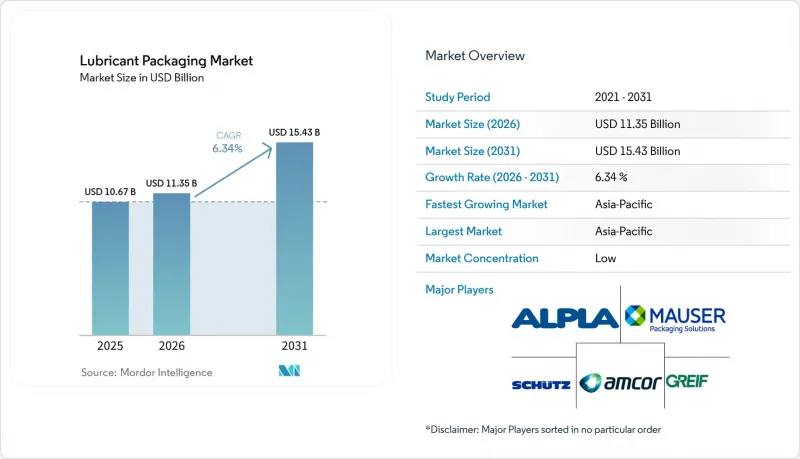
에 따르면 윤활유 포장 시장 규모는 2025년에 106억 7,000만 달러로 평가되며, 2026년 113억 5,000만 달러에서 2031년까지 154억 3,000만 달러에 달할 것으로 예측되고 있으며, 예측 기간(2026-2031년)에 CAGR은 6.34%에 달할 전망입니다.
전 세계 윤활유 포장 시장의 동향 및 인사이트
자동차 보유 대수의 증가와 자동차 애프터마켓
윤활유 포장 시장은 14억 대를 넘어선 전 세계 운행 차량 대수로부터 혜택을 받고 있습니다. 각 차량은 윤활유 및 정비·소매 판매에 사용되는 용기에 대한 지속적인 수요를 창출하고 있습니다. 인도는 2025년에 2,820만 대의 차량 등록을 기록했으며, 2025-26 회계연도의 자동차 생산 대수는 3,470만 대에 달했습니다. 2025-26 회계연도의 이륜차 생산 대수는 2,660만 대 이상을 차지하여 소형 윤활유 팩의 빈번한 사용이 필요하게 되었습니다. 2025년 인도의 자동차 소매 판매 대수는 7.71% 증가했으며, 승용차 소매 판매 대수는 9.70% 증가했습니다. 동남아시아 및 중동의 정식 애프터서비스 네트워크에서는 판매 형태가 무브랜드 디스펜싱에서 라벨이 부착되고 위조 방지 기능이 있는 패키지로 전환되고 있으며, 윤활유 판매 단위당 용기 사용량이 증가하고 있습니다. 이러한 전환을 통해 윤활유 브랜드는 판매 시점에 대한 상품 전시 방식, 진위 확인 및 제품 정보 관리를 보다 엄격하게 수행할 수 있게 됩니다. 자동차 보유 대수가 증가하는 가운데, 편의성을 중시하여 설계된 포장은 더 광범위한 정비 공장 및 판매 대리점 네트워크에서 정비 주기 준수와 소매점에서의 보충을 지원할 수 있습니다.
산업화 및 제조, 건설, 광업, 에너지 분야의 확대
윤활유 포장 시장은 건설 기계, 광산 기계, 에너지 자산을 운영하는 산업용 사용자들에게도 서비스를 제공하고 있습니다. 이러한 사용자들은 대용량 충전, 안전한 취급 및 제어된 분배를 지원하는 드럼통이나 IBC가 필요합니다. 사우디아라비아의 건설 프로젝트, 인도의 인프라 투자, 인도네시아의 광업 활동으로 인해 산업용 용기의 수요 기반이 확대되고 있습니다. 1,000리터 용량의 IBC는 200리터 드럼통에 비해 취급 공정 및 디스펜싱 비용을 절감할 수 있습니다. 재활용 네트워크를 통해 대규모 산업 거점에서의 이러한 용기 재사용이 촉진되고 있습니다. 해상 풍력발전 유지보수를 포함한 에너지 분야 용도에서는 유엔 인증 용기에 담긴 합성유도 필요하며, 이로 인해 보다 전문적인 형태의 용기에 대한 수요가 지원되고 있습니다. 산업용 고객들은 또한 보관 중 액체를 보호하고 작업 현장에서 안전하고 안정적인 이송을 가능하게 하는 포장을 중요하게 여깁니다. 그들의 사양에서는 빈번한 이동, 장기 보관, 가혹한 작동 조건에서도 신뢰성을 유지할 수 있는 견고한 형태가 선호되는 경향이 있습니다.
석유화학용 수지 및 금속 가격의 변동
석유화학 수지 가격 변동은 윤활유 포장 시장의 공급업체에게 직접적인 비용상 과제가 되고 있습니다. 고밀도 폴리에틸렌은 병, 캔, 드럼통에 널리 사용되고 있으므로 가공업체는 원료 공급 상황의 변화에 영향을 받기 쉽습니다. 호르무즈 해협의 무역 루트가 차단됨에 따라 2026년 1분기에는 폴리에틸렌 및 폴리프로필렌 가격이 전년 동기 대비 25%-30% 상승했습니다. 양철과 알루미늄 가격은 원자재 시장 동향에 연동되므로 금속캔과 드럼통도 유사한 압박에 직면해 있습니다. 장기 수지 공급 계약이나 안정적인 원료 확보가 없는 공급업체는 이익률 압박 위험이 높아집니다. 이러한 불확실성으로 인해 윤활유 용기에 대한 수요가 견고하더라도 생산 능력에 대한 투자가 제한될 가능성이 있습니다. 또한 이로 인해 포장 공급업체와 윤활유 블렌딩 업체 모두에게 계약 가격 설정, 원자재 조달, 재고 계획의 중요성이 더욱 커집니다. 이러한 영향은 폴리머 수지나 금속을 대량으로 사용하고, 고객과의 고정 계약에 따라 공급되는 제품 형태에서 특히 두드러집니다.
부문별 분석
2025년, 병은 윤활유 포장 시장 규모의 29.46%를 차지했습니다. 이러한 위상은 진열대에서의 가시성, 포장 크기, 따르기 용이성이 중요한 자동차 애프터마켓 소매 채널의 중요성을 반영합니다. 병의 디자인은 인몰드 라벨링, 재활용 소재 사용, 인체공학적 취급 편의성, 그리고 위조 방지 캡에 의해 형성됩니다. 이러한 특징들은 DIY나 정비소와 같은 상황에서 윤활유 브랜드가 제품을 차별화하는 데 도움이 됩니다. 소형 포맷은 엔진오일 및 기타 차량용 유체의 교체 주기에 적합합니다. 병 부문은 자동차 소매 네트워크의 규모와 체계화와 밀접하게 연결되어 있습니다. 이 부문의 지속적인 중요성은 공급업체가 소형 포맷에서 합리적인 가격, 안전한 취급, 그리고 독보적인 브랜드 이미지를 얼마나 효과적으로 결합할 수 있는지에 달려 있습니다. 또한 제조사는 소매점, 정비소, 서비스 체인에 공급되는 다양한 크기의 용기에 대해 일관된 품질을 유지해야 합니다.
윤활유 포장 시장에서 IBC(중간 벌크 컨테이너)는 2026-2031년까지 연평균 성장률(CAGR) 6.84%로 성장할 것으로 예측됩니다. 산업용 구매자들은 200리터 드럼통에 비해 취급 공정을 줄이고 비용을 절감하기 위해 1,000리터 재사용 가능한 유닛을 사용하고 있습니다. Schutz GmbH & Co. KGaA는 interpack 2026에서 6층 구조로 퍼플루오로알킬 및 폴리플루오로알킬 물질을 포함하지 않는 에틸렌-비닐 알코올 배리어 구조를 채택한 ‘SC2’ 제리칸 시리즈를 발표했습니다. 이 시리즈에는 재생 수지를 최대 30% 함유한 ‘그린 레이어’ 변형 제품이 포함되어 있습니다. 드럼통은 고급 소매 시장 및 소량 충진 산업 용도로 계속해서 사용되고 있습니다. 워크숍에서는 파우치나 사셰의 사용이 증가하는 반면, IBC(중간 벌크 컨테이너) 수준의 용량이 필요하지 않은 산업용 사용자들에게는 드럼통이나 배럴이 여전히 중요한 역할을 하고 있습니다. 통 및 관련 용기는 정확한 충진과 확실한 밀봉이 요구되는 항공 업계나 윤활유 공급 등의 특수 용도로 사용되고 있습니다.
지역별 분석
아시아태평양은 2025년 윤활유 포장 시장의 36.20% 점유율을 차지하고 있으며, 2031년까지 연평균 성장률(CAGR) 7.06%로 성장할 것으로 예측됩니다. 인도에서는 2025-26 회계연도에 3,470만 대의 차량이 생산되었으며, 그중 2,660만 대 이상이 이륜차였습니다. 이러한 차량들은 소형 윤활유 용기의 빈번한 사용을 지원하고 있습니다. 중국에서는 자동차 보유 대수가 증가함에 따라 소매용 포장 엔진오일에 대한 대규모 교체 수요가 발생하고 있습니다. 태국, 베트남, 인도네시아에서는 자동변속기가 장착된 승용차로의 전환이 진행되고 있으며, 이는 자동변속기 오일 병 및 IBC(중간 벌크 컨테이너)에 대한 수요를 지원하고 있습니다. 일본과 한국에서도 첨단 진위 확인 기능과 재생 소재 함유 기능을 갖춘 패키지 형태의 프리미엄 합성 윤활유가 인기를 얻고 있습니다. 이러한 시장에서는 기술적인 보호 기능과 소비자를 위한 명확한 제품 식별 기능을 겸비한 패키지 형태의 가치가 높아지고 있습니다. 또한 체계화된 소매 환경 덕분에 브랜드 제조사는 패키지를 통해 재활용 및 진위 확인의 특징을 소비자에게 전달하기가 더 쉬워졌습니다.
북미에서는 운행 중인 차량 대수가 많고 프리미엄 합성 윤활유에 대한 수요가 시장을 촉진하고 있습니다. 오리건주는 2025년 7월, 포장재에 관한 확대 생산자 책임(EPR) 프로그램에 따라 첫 번째 생산자 청구서를 발행했으며, 콜로라도주는 2026년 1월부터 과금을 시작했고, 캘리포니아주의 SB 54 규정은 2026년 5월에 시행되었습니다. 유럽에서는 자동차의 노후화와 애프터마켓에서의 지속적인 윤활유 수요가 시장 성장을 지원하고 있습니다. 유럽연합(EU)의 ‘포장 및 포장 폐기물 규정’은 재활용 가능한 포장의 재설계와 재료에 대한 투명한 보고를 요구하는 압력을 강화하고 있습니다. 이러한 상황에서 제품의 안전성, 재생 소재 함유율, 국경을 초월한 규정 준수를 적절히 관리할 수 있는 공급업체가 우위를 점하게 됩니다. 또한 용기 재설계 및 수명 주기 성능 문서화에 대한 조기 투자에 대한 보다 명확한 비즈니스적 근거도 생겨나고 있습니다. 공급업체는 여러 국가 및 지역 시장을 대상으로 제품 라인업을 계획할 때 이러한 요건을 고려해야 합니다.
남미에서는 브라질과 아르헨티나가 상용차 및 농업기계의 주요 수요 거점으로 자리 잡고 있습니다. 그라이프(Gleif)사는 2024년 브라질 윤활유 포장 고객을 대상으로 실시한 설문조사에서 순추천지수(NPS)가 +87을 기록했다고 보고했습니다. 중동 및 아프리카에서는 산업용 포장의 지역 생산 능력이 더욱 확대되고 있습니다. 슈츠(Schutz GmbH &Co. KGaA)는 2025년 1월, 사우디아라비아의 내셔널 플라스틱 팩토리 컴퍼니(National Plastic Factory Company)와 ECOBULK IBC 생산에 관한 라이선스 계약을 체결했습니다. 광업, 에너지, 인프라 관련 활동이 해당 지역 전체의 드럼통 및 IBC 수요를 지원하고 있습니다. 또한 아르헨티나, 남아프리카공화국, 아랍에미리트(UAE)에서 소매업이 정상화됨에 따라 윤활유 판매도 브랜드화되고 라벨이 부착된 용기로 전환되고 있습니다.
기타 혜택:
- 엑셀 형식의 시장 예측(ME) 시트
- 3개월간의 애널리스트 지원
자주 묻는 질문
목차
제1장 서론
- 조사 전제조건과 시장 정의
- 조사 범위
제2장 조사 방법
제3장 개요
제4장 시장 구도
- 시장 개요
- 시장 성장 촉진요인
- 시장 성장 억제요인
- 밸류체인 분석
- Porter's Five Forces 분석
제5장 시장 규모와 성장 예측
- 포장 유형별
- 소재별
- 윤활유 유형별
- 지역별
- 아시아태평양
- 중국
- 인도
- 일본
- 한국
- ASEAN 국가
- 기타 아시아태평양 국가
- 북미
- 미국
- 캐나다
- 멕시코
- 유럽
- 독일
- 영국
- 프랑스
- 이탈리아
- 북유럽 국가
- 기타 유럽 국가
- 남미
- 브라질
- 아르헨티나
- 기타 남미 국가
- 중동 및 아프리카
- 사우디아라비아
- 남아프리카공화국
- 기타 중동 및 아프리카 국가
- 아시아태평양
제6장 경쟁 구도
- 시장 집중도
- 전략적 동향
- 시장 점유율·순위 분석
- 기업 개요
- ALPLA
- Amcor plc
- CCL Industries
- Crown Holdings, Inc.
- Graham Packaging
- Greif
- Mauser Packaging Solutions
- Mold-Tek Packaging Ltd.
- Mondi
- Plastipak Holdings, Inc.
- Schutz GmbH & Co. KGaA
- Silgan Holdings Inc.
- Sonoco
- Time Technoplast Ltd.
제7장 시장 기회와 향후 전망
KSA 26.10.29According to Mordor Intelligence, the lubricant packaging market size was valued at USD 10.67 billion in 2025 and is estimated to grow from USD 11.35 billion in 2026 to reach USD 15.43 billion by 2031, at a CAGR of 6.34% during the forecast period (2026-2031).
Global Lubricant Packaging Market Trends and Insights
Growth in Vehicle Ownership and Automotive After-Sales
The lubricant packaging market benefits from a global in-use vehicle fleet that has exceeded 1.4 billion units. Each vehicle generates recurring demand for lubricants and the containers used for service and retail sales. India recorded 28.2 million vehicle registrations in 2025, while automotive production reached 34.7 million units in fiscal year 2025-26. Two-wheelers accounted for more than 26.6 million units of production in fiscal year 2025-26 and require frequent use of smaller lubricant packs. India's vehicle retail volume grew 7.71% in calendar year 2025, while passenger vehicle retail sales increased 9.70%. In formal after-sales networks in Southeast Asia and the Middle East, sales are moving from unbranded dispensing toward labeled and tamper-evident packs, increasing container use per unit of lubricant sold. The transition also gives lubricant brands more control over presentation, authentication, and product information at the point of sale. As vehicle ownership rises, packs designed for convenient use can support service intervals and retail replenishment across a broader network of workshops and distributors.
Industrialization and Expansion of Manufacturing, Construction, Mining, and Energy
The lubricant packaging market also serves industrial users who operate construction equipment, mining machinery, and energy assets. These users need drums and IBCs that support larger fills, safe handling, and controlled dispensing. Construction programs in Saudi Arabia, infrastructure spending in India, and mining activity in Indonesia are widening the demand base for industrial containers. IBCs with 1,000-liter capacity can reduce handling steps and dispensing costs compared with 200-liter drums. Reconditioning networks improve the reuse case for these units in large industrial centers. Energy applications, including offshore wind servicing, also require synthetic oils in United Nations-certified containers, which supports demand for more specialized formats. Industrial customers also value packages that protect fluids during storage and allow safe, consistent transfer at operating sites. Their specifications can favor robust formats that remain reliable during frequent movement, extended storage, and demanding operating conditions.
Volatility in Petrochemical Resin and Metal Prices
Petrochemical resin price volatility is a direct cost challenge for lubricant packaging market suppliers. High-density polyethylene is widely used in bottles, cans, and drums, leaving converters exposed to changes in feedstock availability. Polyethylene and polypropylene prices increased 25%-30% year over year in the first quarter of 2026 following the disruption to the Strait of Hormuz trade routes. Metal cans and drums face similar pressure because tin-plated steel and aluminum prices follow commodity markets. Suppliers without long-term resin agreements or secured feedstock face a greater risk of margin pressure. This uncertainty can limit capacity investment even when demand for lubricant containers remains strong. It also makes contract pricing, material sourcing, and inventory planning more important for both pack suppliers and lubricant blenders. The effect is especially material for formats that use large volumes of polymer resin or metal and are supplied under fixed customer agreements.
Other drivers and restraints analyzed in the detailed report include:
- Shift Toward Lightweight, Recyclable, and Convenient Packaging
- Growth in Specialty Lubricants and Performance-Specific Formulations
- Rising Compliance Costs for EPR, Hazardous-Product Handling, and Transport
For complete list of drivers and restraints, kindly check the Table Of Contents.
Segment Analysis
Bottles accounted for 29.46% of the lubricant packaging market size in 2025. Their position reflects the importance of retail automotive after-sales channels, where shelf visibility, pack size, and ease of pouring matter. Bottle design is shaped by in-mold labeling, recycled content, ergonomic handling, and tamper-evident closures. These features help lubricant brands differentiate products in do-it-yourself and workshop settings. Small formats also suit the replacement cycle for engine oils and other vehicle fluids. The bottle segment remains closely tied to the scale and formalization of automotive retail networks. Its continued relevance depends on how effectively suppliers combine affordability, safe handling, and distinctive brand presentation in compact formats. Manufacturers also need to maintain consistent container quality across the varied sizes supplied to retail stores, workshops, and service chains.
IBCs are projected to grow at a 6.84% CAGR from 2026 to 2031 within the lubricant packaging market. Industrial buyers use 1,000-liter reusable units to reduce handling steps and lower costs relative to 200-liter drums. Schutz GmbH & Co. KGaA introduced its SC2 jerrycan series at interpack 2026 with 6-layer, perfluoroalkyl and polyfluoroalkyl substances-free ethylene vinyl alcohol barrier structures. The range includes Green Layer variants with up to 30% regranulate content. Cans continue to serve premium retail and lower-volume industrial fills. Pouches and sachets are gaining use in workshops, while drums and barrels remain important for industrial users that do not require IBC capacity. Kegs and related formats serve specialized aviation and lubricant supply applications that need precise fills and secure closures.
Complete Report Scope:
- By Packaging Type
- Bottles
- Cans
- Pouches and Sachets
- Drums and Barrels
- Intermediate Bulk Containers (IBCs)
- Kegs
- Others
- By Material
- Plastic
- Metal
- Others
- By Lubricant Type
- Engine Oils
- Transmission and Hydraulic Fluids
- Others
- By Geography
- Asia-Pacific
- China
- India
- Japan
- South Korea
- ASEAN Countries
- Rest of Asia-Pacific
- North America
- United States
- Canada
- Mexico
- Europe
- Germany
- United Kingdom
- France
- Italy
- NORDIC Countries
- Rest of Europe
- South America
- Brazil
- Argentina
- Rest of South America
- Middle East and Africa
- Saudi Arabia
- South Africa
- Rest of Middle East and Africa
- Asia-Pacific
Geography Analysis
Asia-Pacific held 36.20% of the lubricant packaging market share in 2025 and is projected to grow at a 7.06% CAGR through 2031. India produced 34.7 million vehicles in fiscal year 2025-26, including more than 26.6 million two-wheelers. These vehicles support frequent use of smaller lubricant containers. China's expanding vehicle fleet is creating a large replacement demand for engine oils in retail packs. Thailand, Vietnam, and Indonesia are seeing a move toward passenger vehicles with automatic transmissions, which supports demand for automatic transmission fluid bottles and IBCs. Japan and South Korea also support premium synthetic lubricants in packs with advanced authentication and recycled-content features. These markets reinforce the value of formats that combine technical protection with clear consumer-facing product identification. Organized retail environments also make it easier for branded suppliers to communicate recycling and authentication features through the pack.
North America drives demand through a large in-service vehicle fleet and demand for premium synthetic lubricants. Oregon issued its first producer invoices under its packaging Extended Producer Responsibility program in July 2025, Colorado began charging in January 2026, and California's SB 54 regulations took effect in May 2026. Europe is supported by an aging car base and recurring aftermarket lubricant demand. The European Union Packaging and Packaging Waste Regulation adds pressure for recyclable format redesigns and transparent material reporting. These conditions reward suppliers that can manage product safety, recycled content, and cross-border compliance. They also create a clearer commercial case for early investment in redesigned containers and documented lifecycle performance. Suppliers must account for these requirements when they plan product ranges intended for multiple national and regional markets.
South America relies on Brazil and Argentina as important demand centers for commercial fleets and agricultural machinery. Greif reported a Net Promoter Score of +87 among its Brazilian lubricant packaging customers in 2024. The Middle East and Africa is developing more regional production capacity for industrial packs. Schutz GmbH & Co. KGaA signed a license agreement with National Plastic Factory Company in Saudi Arabia in January 2025 for ECOBULK IBC production. Mining, energy, and infrastructure activity support demand for drums and IBCs across the region. Retail formalization in Argentina, South Africa, and the United Arab Emirates also shifts lubricant sales into branded and labeled containers.
- ALPLA
- Amcor plc
- CCL Industries
- Crown Holdings, Inc.
- Graham Packaging
- Greif
- Mauser Packaging Solutions
- Mold-Tek Packaging Ltd.
- Mondi
- Plastipak Holdings, Inc.
- Schutz GmbH & Co. KGaA
- Silgan Holdings Inc.
- Sonoco
- Time Technoplast Ltd.
Additional Benefits:
- The market estimate (ME) sheet in Excel format
- 3 months of analyst support
TABLE OF CONTENTS
1 Introduction
- 1.1 Study Assumptions and Market Definition
- 1.2 Scope of the Study
2 Research Methodology
3 Executive Summary
4 Market Landscape
- 4.1 Market Overview
- 4.2 Market Drivers
- 4.2.1 Growth in Vehicle Ownership and Automotive After-Sales
- 4.2.2 Industrialization and Expansion of Manufacturing, Construction, Mining, and Energy
- 4.2.3 Shift Toward Lightweight, Recyclable, and Convenient Packaging
- 4.2.4 Growth in Specialty Lubricants and Performance-Specific Formulations
- 4.2.5 Packaging-Level Traceability for Counterfeit Control and Recall Readiness
- 4.3 Market Restraints
- 4.3.1 Volatility in Petrochemical Resin and Metal Prices
- 4.3.2 Rising Compliance Costs for EPR, Hazardous-Product Handling, and Transport
- 4.3.3 Residual-Lubricant Contamination Weakening Recycling Economics
- 4.4 Value Chain Analysis
- 4.5 Porter's Five Forces Analysis
- 4.5.1 Threat of New Entrants
- 4.5.2 Bargaining Power of Suppliers
- 4.5.3 Bargaining Power of Buyers
- 4.5.4 Threat of Substitutes
- 4.5.5 Competitive Rivalry
5 Market Size and Growth Forecasts (Value)
- 5.1 By Packaging Type
- 5.1.1 Bottles
- 5.1.2 Cans
- 5.1.3 Pouches and Sachets
- 5.1.4 Drums and Barrels
- 5.1.5 Intermediate Bulk Containers (IBCs)
- 5.1.6 Kegs
- 5.1.7 Others
- 5.2 By Material
- 5.2.1 Plastic
- 5.2.2 Metal
- 5.2.3 Others
- 5.3 By Lubricant Type
- 5.3.1 Engine Oils
- 5.3.2 Transmission and Hydraulic Fluids
- 5.3.3 Others
- 5.4 By Geography
- 5.4.1 Asia-Pacific
- 5.4.1.1 China
- 5.4.1.2 India
- 5.4.1.3 Japan
- 5.4.1.4 South Korea
- 5.4.1.5 ASEAN Countries
- 5.4.1.6 Rest of Asia-Pacific
- 5.4.2 North America
- 5.4.2.1 United States
- 5.4.2.2 Canada
- 5.4.2.3 Mexico
- 5.4.3 Europe
- 5.4.3.1 Germany
- 5.4.3.2 United Kingdom
- 5.4.3.3 France
- 5.4.3.4 Italy
- 5.4.3.5 NORDIC Countries
- 5.4.3.6 Rest of Europe
- 5.4.4 South America
- 5.4.4.1 Brazil
- 5.4.4.2 Argentina
- 5.4.4.3 Rest of South America
- 5.4.5 Middle East and Africa
- 5.4.5.1 Saudi Arabia
- 5.4.5.2 South Africa
- 5.4.5.3 Rest of Middle East and Africa
- 5.4.1 Asia-Pacific
6 Competitive Landscape
- 6.1 Market Concentration
- 6.2 Strategic Moves
- 6.3 Market Share (%)/Ranking Analysis
- 6.4 Company Profiles (includes Global Overview, Market Overview, Core Segments, Financials as available, Strategic Information, Products and Services, and Recent Developments)
- 6.4.1 ALPLA
- 6.4.2 Amcor plc
- 6.4.3 CCL Industries
- 6.4.4 Crown Holdings, Inc.
- 6.4.5 Graham Packaging
- 6.4.6 Greif
- 6.4.7 Mauser Packaging Solutions
- 6.4.8 Mold-Tek Packaging Ltd.
- 6.4.9 Mondi
- 6.4.10 Plastipak Holdings, Inc.
- 6.4.11 Schutz GmbH & Co. KGaA
- 6.4.12 Silgan Holdings Inc.
- 6.4.13 Sonoco
- 6.4.14 Time Technoplast Ltd.
7 Market Opportunities and Future Outlook
- 7.1 White-Space and Unmet-Need Assessment


