

|
시장보고서
상품코드
2156970
폴리카보네이트 디올 : 시장 점유율 분석, 업계 동향과 통계, 성장 예측(2026-2031년)Polycarbonate Diols - Market Share Analysis, Industry Trends & Statistics, Growth Forecasts (2026 - 2031) |
||||||
 Mordor Intelligence
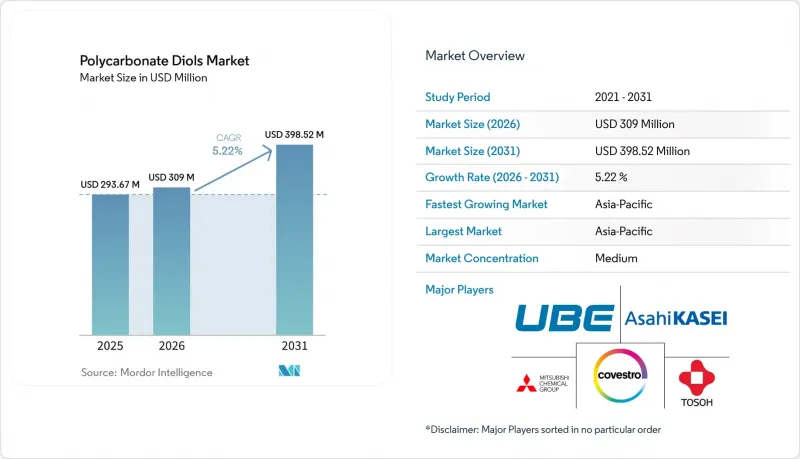
에 따르면 폴리카보네이트 디올 시장 규모는 2025년에 2억 9,367만 달러로 평가되며, 2026년 3억 900만 달러에서 2031년까지 3억 9,852만 달러에 달할 것으로 추정되고 있으며, 예측 기간(2026-2031년)에 CAGR은 5.22%에 달할 전망입니다.
글로벌 폴리카보네이트 디올 시장의 동향 및 인사이트
자동차용 합성 가죽 분야의 고성능 폴리우레탄 수요
각 자동차 OEM 업체들은 배터리식 전기자동차(BEV)용 시트, 도어 패널, 헤드라이너의 사양을 업데이트하고 있습니다. 밀폐된 차내에서는 습도가 높아질 가능성이 있으며, 이로 인해 폴리에스터계 폴리우레탄 소재의 열화가 가속화될 우려가 있습니다. 2025년 연구에 따르면 폴리카보네이트 디올계 폴리우레탄은 70℃에서 28일간 침지한 후에도 초기 인장 강도의 90% 이상을 유지하는 것으로 나타났습니다. 반면, 폴리에스터계 폴리우레탄의 대체재는 동일한 노출 조건에서 강도의 40%에서 70%를 상실했습니다. 이러한 성능 차이로 인해 중국과 한국의 1차 내장 부품 공급업체들은 더 장기적인 보증 프로그램을 실현하기 위해 합성 가죽 습식 가공 라인에서 폴리카보네이트 디올의 도입을 추진하고 있습니다. 내장 부품 공급업체들이 내습성을 ‘선택적 업그레이드’가 아닌 ‘필수 자격 요건’으로 취급하게 된다면, 폴리카보네이트 디올 시장의 수요는 더욱 높아질 것입니다.
수성 폴리우레탄 분산액의 확대
수성 폴리우레탄 분산액의 보급에 따라 가죽, 목재, 섬유의 마감 가공 분야에서 내구성이 뛰어난 소프트 부문 소재에 대한 수요가 증가하고 있습니다. 수성 시스템에서는 분산액을 조제하는 과정에서 에스테르 결합이 습기에 노출되므로 도포 전에 소재의 성능이 저하될 가능성이 있습니다. 분산 입자의 안정성이나 피막 특성이 중요한 경우, 폴리카보네이트 디올은 보다 안정적인 대체 소재가 됩니다. UBE사는 디지털 텍스타일 인쇄용 바인더나 내구성이 뛰어난 가죽 마감에 사용되는 수성 폴리우레탄 분산액용 ‘ETERNACOLL’ 폴리카보네이트 디올을 상품화했습니다. BASF는 2025년 10월 터키에 새로운 분산액 생산 라인을 가동했는데, 이는 수성 폴리우레탄 생산 능력에 대한 지속적인 투자를 보여주는 것입니다. 따라서 주요 코팅 제조업체들이 수성 생산 설비를 위해 신뢰할 수 있는 고순도 소재를 필요로 할 경우, 폴리카보네이트 디올 시장은 그 혜택을 누리게 될 것입니다.
폴리에스터 및 폴리에테르 디올에 비해 높은 제조 비용
생산 경제성 문제로 인해 비용 효율을 중시하는 용도에서의 폴리카보네이트 디올 사용은 제한되고 있습니다. 포스겐이 없는 에스테르 교환 반응에는 다단식 반응기 시스템, 온도 관리, 진공 증류 및 철저한 품질관리가 필요합니다. 이러한 공정은 고성능 폴리우레탄 용도에서 요구되는 분자량의 일관성을 확보하기 위해 필수적입니다. 1톤당 비용은 표준 폴리에스테르 폴리올에 비해 여전히 3배에서 5배 더 높으며, 폴리에테르계 대체품보다도 높습니다. 이러한 비용 차이가 가장 큰 제약 요인이 되는 분야는 일반 산업용 접착제, 표준 신발, 그리고 내구성의 부가가치를 그다지 중요하게 여기지 않는 저급 코팅 분야입니다. 그 결과, 폴리카보네이트 디올 시장은 내가수분해성이나 수명에 따라 추가적인 재료 비용이 정당화되는 용도에 계속해서 초점을 맞추고 있습니다.
부문 분석
2025년에는 1,000 g/mol에서 2,000 g/mol 미만의 범위가 시장 매출의 42.67%를 차지했습니다. 이 범위는 분자량 등급별 폴리카보네이트 디올 시장 규모에서 가장 큰 비중을 차지했습니다. 복합재 제조업체들이 이러한 등급을 채택하는 이유는 점도, 이소시아네이트 반응성 및 소프트 부문 길이의 균형이 잘 잡혀 있기 때문입니다. 이러한 균형 덕분에 일부 고분자량 소재에 필요한 가열 장치 없이도 용액 가공 및 분산 가공이 가능합니다. 또한 일관된 취급 조건이 필요한 기존 폴리우레탄 생산 라인에도 적합합니다.
1,000 g/mol에서 2,000 g/mol 미만의 범위는 2031년까지 연평균 성장률(CAGR) 5.78%로 확대될 것으로 예측됩니다. 자동차용 합성 가죽이나 고성능 코팅의 경우, 내구성이 높은 폴리우레탄 층이 요구되는 상황에서 이러한 등급이 사용되고 있습니다. 폴리카보네이트 디올 시장의 프리미엄 접착제 프로그램에서는 가공 균형과 가수분해 저항성이 중요한 범위의 등급이 채택되고 있습니다. 1,000 g/mol 미만의 등급은 높은 하드 부문 함량과 가교 밀도가 필요한 UV 경화형 탑코트나 고광택 가구용 라미네이트 소재에 사용됩니다. 2,000 g/mol 이상의 등급은 유연성과 저온 성능이 요구되는 엘라스토머, 열가소성 폴리우레탄 및 장쇄계 접착제 시스템에 사용됩니다.
지역별 분석
아시아태평양은 2025년에 시장 매출의 48.86%를 차지할 것으로 예상되며, 2031년까지 연평균 성장률(CAGR) 6.05%로 확대될 것으로 전망됩니다. 이 지역은 중국, 일본, 한국 및 동남아시아 국가 연합(ASEAN) 국가들에 합성 가죽, 신발, 산업용 코팅의 주요 공급망이 존재하므로 폴리카보네이트 디올 시장 규모가 가장 큽니다. 중국은 이 지역에서 가장 큰 국가별 수요 거점입니다. 생산과 소비는 양쯔강 삼각주, 주강 삼각주, 보하이 연안의 산업 회랑에 집중되어 있습니다. 중국 동부의 수요는 장쑤성, 저장성, 산둥성의 생산자들에 의해 지원되고 있습니다.
우베코산, 아사히카세이, 쿠라레, 도소, 다이셀 등 일본의 생산 기업은 수출 지향형 공급 체제와 특수 소재 개발을 지원해 왔습니다. 일본은 저비용의 중국 표준 등급에 대한 차별화된 입지를 유지하기 위해 폴리카보네이트 디올 시장의 초점을 바이오 기반 및 이산화탄소 유래 등급으로 전환하고 있습니다. 한국은 전기자동차(EV) 플랫폼 프로그램을 포함한 자동차 및 신발 제조 분야의 수요를 지원하고 있습니다. 인도 및 동남아시아국가연합(ASEAN) 국가들은 정밀 화학 제품 생산 및 코팅 가공 능력 확대를 통해 수요를 늘리고 있습니다. 중국의 제품별 휘발성 유기 화합물(VOC) 기준은 가구용 코팅 및 자동차 재도장 분야에서 수성 폴리우레탄의 사용을 촉진하고 있습니다.
북미와 유럽은 고성능 코팅, 엘라스토머, 접착제의 주요 수요 기반을 형성하고 있습니다. 2025년 미국의 규제 조치로 인해 자동차 및 산업용 코팅 프로그램의 배합 재검토가 진행되고 있으나, 캐나다와 멕시코는 미국의 OEM(주문자 상표 제조) 제조사와 연계된 공급망을 통해 수요에 기여하고 있습니다. 독일과 이탈리아는 자동차, 산업용 코팅, 합성 가죽 제조를 통해 유럽의 수요를 지원하고 있습니다. 남미, 중동 및 아프리카는 여전히 수요 규모가 작은 지역으로, 수입 및 물류 비용이 보급을 저해하는 한편, 고온 다습한 기후가 내구성이 뛰어난 폴리우레탄의 수요를 지원하고 있습니다.
기타 혜택:
- 엑셀 형식의 시장 예측(ME) 시트
- 3개월간의 애널리스트 지원
자주 묻는 질문
목차
제1장 서론
- 조사 전제조건과 시장 정의
- 조사 범위
제2장 조사 방법
제3장 개요
제4장 시장 구도
- 시장 개요
- 시장 성장 촉진요인
- 시장 성장 억제요인
- 밸류체인 분석
- Porter's Five Forces 분석
제5장 시장 규모와 성장 예측
- 분자량별
- 폼별
- 용도별
- 지역별
- 아시아태평양
- 중국
- 인도
- 일본
- 한국
- ASEAN 국가
- 기타 아시아태평양 국가
- 북미
- 미국
- 캐나다
- 멕시코
- 유럽
- 독일
- 영국
- 프랑스
- 이탈리아
- 북유럽 국가
- 기타 유럽 국가
- 남미
- 브라질
- 아르헨티나
- 기타 남미 국가
- 중동 및 아프리카
- 사우디아라비아
- 남아프리카공화국
- 기타 중동 및 아프리카 국가
- 아시아태평양
제6장 경쟁 구도
- 시장 집중도
- 전략적 동향
- 시장 점유율·순위 분석
- 기업 개요
- Asahi Kasei Corporation
- BASF
- Caffaro Industrie
- Covestro AG
- Cromogenia-Units
- Daicel Corporation
- GRR Fine Chem Pvt. Ltd.
- Jiangsu Chemical Research Institute Co., Ltd.
- KURARAY CO., LTD.
- Mitsubishi Chemical Corporation
- Perstorp
- Tosoh Corporation
- UBE Corporation
- Wanhua
- YuanLi Chemical Group CO.,LTD.
제7장 시장 기회와 향후 전망
KSA 26.10.29According to Mordor Intelligence, the polycarbonate diols market size was valued at USD 293.67 million in 2025 and is estimated to grow from USD 309.00 million in 2026 to reach USD 398.52 million by 2031, at a CAGR of 5.22% during the forecast period (2026-2031).
Global Polycarbonate Diols Market Trends and Insights
High-Performance Polyurethane Demand in Automotive Synthetic Leather
Automotive original equipment manufacturers are updating seat, door-panel, and headliner specifications for battery electric vehicles. Enclosed cabins can experience higher humidity, which can accelerate degradation in polyester-based polyurethane materials. A 2025 study found that polycarbonate diol-based polyurethanes retained more than 90% of the original tensile strength after 28 days of immersion at 70 °C. Polyester polyurethane alternatives lost 40% to 70% of their strength under the same exposure conditions. This performance gap is encouraging Tier 1 interior suppliers in China and South Korea to use polycarbonate diols in synthetic leather wet-processing lines for longer warranty programs. The polycarbonate diols market gains demand when interior suppliers treat moisture durability as a required qualification feature rather than an optional upgrade.
Expansion of Waterborne Polyurethane Dispersions
The expansion of waterborne polyurethane dispersions is increasing demand for durable soft-segment materials in leather, wood, and textile finishing. Waterborne systems expose ester linkages to moisture during dispersion preparation, which can reduce material performance before application. Polycarbonate diols can provide a more stable alternative where dispersion particle stability and film properties are important. UBE has commercialized ETERNACOLL polycarbonate diols for waterborne polyurethane dispersions used in digital textile printing binders and durable leather finishing. BASF commissioned a new dispersion production line in Turkiye in October 2025, which illustrates continued investment in waterborne polyurethane capacity. The polycarbonate diols market, therefore, benefits when large coating producers need reliable, high-purity materials for waterborne production assets.
High Production Cost Relative to Polyester and Polyether Polyols
Production economics limit the use of polycarbonate diols in cost-sensitive applications. Non-phosgene transesterification requires multi-stage reactor systems, controlled temperature and vacuum distillation, and detailed quality control. These steps are needed to achieve the molecular weight consistency required in high-performance polyurethane applications. Per-metric-ton costs remain 3x to 5x higher than standard polyester polyols and exceed polyether alternatives. The cost difference is most restrictive in general industrial adhesives, standard footwear, and lower-grade coatings, where customers place less value on added durability. The polycarbonate diols market consequently remains focused on applications where hydrolysis resistance and service life justify the additional material cost.
Other drivers and restraints analyzed in the detailed report include:
- Stringent Volatile Organic Compound Regulations
- Demand for Hydrolysis-Resistant Coatings and Elastomers
- Complex Processing and High-Purity Feedstock Requirements
For complete list of drivers and restraints, kindly check the Table Of Contents.
Segment Analysis
The 1,000 g/mol to below 2,000 g/mol range accounted for 42.67% of the market revenue in 2025. This range represented the largest part of the polycarbonate diols market size for molecular weight grades. Formulators use these grades because they balance viscosity, isocyanate reactivity, and soft-segment length. This balance supports solution processing and dispersion processing without the heated equipment required for some higher-molecular-weight materials. It also makes the range suitable for established polyurethane production lines that need consistent handling conditions.
The 1,000 g/mol to below 2,000 g/mol range is projected to advance at a 5.78% CAGR through 2031. Automotive synthetic leather and high-performance coatings use these grades where durable polyurethane layers are required. Premium adhesive programs in the polycarbonate diols market use a range where processing balance and hydrolysis resistance are important. Below 1,000 g/mol grades serve UV-curable topcoats and high-gloss furniture laminates that need high hard-segment content and crosslink density. Grades of 2,000 g/mol and above serve elastomers, thermoplastic polyurethane, and long-chain adhesive systems needing flexibility and low-temperature performance.
Complete Report Scope:
- By Molecular Weight
- Below 1,000 g/mol
- 1,000 g/mol to Below 2,000 g/mol
- 2,000 g/mol and Above
- By Form
- Solid
- Liquid
- By Application
- Synthetic Leather
- Paints and Coatings
- Adhesives and Sealants
- Elastomers
- Other Applications
- By Geography
- Asia-Pacific
- China
- India
- Japan
- South Korea
- ASEAN Countries
- Rest of Asia-Pacific
- North America
- United States
- Canada
- Mexico
- Europe
- Germany
- United Kingdom
- France
- Italy
- NORDIC Countries
- Rest of Europe
- South America
- Brazil
- Argentina
- Rest of South America
- Middle East and Africa
- Saudi Arabia
- South Africa
- Rest of Middle East and Africa
- Asia-Pacific
Geography Analysis
Asia-Pacific held 48.86% of the market revenue in 2025 and is projected to advance at a 6.05% CAGR through 2031. The region has the largest polycarbonate diols market size because China, Japan, South Korea, and the Association of Southeast Asian Nations countries have major synthetic leather, footwear, and industrial coatings supply chains. China is the largest national demand center in the region. Production and consumption are concentrated in the Yangtze Delta, Pearl River Delta, and Bohai Rim industrial corridors. East China's demand is supported by producers in Jiangsu, Zhejiang, and Shandong.
Japanese producers, including UBE Corporation, Asahi Kasei Corporation, KURARAY CO., LTD., Tosoh Corporation, and Daicel Corporation, have supported export-oriented supply and specialty material development. Japan is shifting its polycarbonate diols market focus toward bio-based and carbon dioxide-derived grades to sustain differentiated positions against lower-cost Chinese standard grades. South Korea supports demand from automotive and footwear manufacturing, including electric vehicle platform programs. India and the Association of Southeast Asian Nations countries add demand through fine chemicals production and expanding coatings conversion capacity. China's product-specific volatile organic compound standards encourage waterborne polyurethane use in furniture coatings and automotive refinishing.
North America and Europe form a major demand base for high-performance coatings, elastomers, and adhesives. United States regulatory actions in 2025 were driving reformulation in automotive and industrial coating programs, while Canada and Mexico contribute through supply chains linked to United States original equipment manufacturers. Germany and Italy support European demand through automotive, industrial coating, and synthetic leather manufacturing. South America, the Middle East and Africa remain smaller demand pools, where imports and logistics costs can constrain adoption, while hot and humid conditions support durable polyurethane demand.
- Asahi Kasei Corporation
- BASF
- Caffaro Industrie
- Covestro AG
- Cromogenia-Units
- Daicel Corporation
- GRR Fine Chem Pvt. Ltd.
- Jiangsu Chemical Research Institute Co., Ltd.
- KURARAY CO., LTD.
- Mitsubishi Chemical Corporation
- Perstorp
- Tosoh Corporation
- UBE Corporation
- Wanhua
- YuanLi Chemical Group CO.,LTD.
Additional Benefits:
- The market estimate (ME) sheet in Excel format
- 3 months of analyst support
TABLE OF CONTENTS
1 Introduction
- 1.1 Study Assumptions and Market Definition
- 1.2 Scope of the Study
2 Research Methodology
3 Executive Summary
4 Market Landscape
- 4.1 Market Overview
- 4.2 Market Drivers
- 4.2.1 High-Performance Polyurethane Demand in Automotive Synthetic Leather
- 4.2.2 Expansion of Waterborne Polyurethane Dispersions
- 4.2.3 Stringent Volatile Organic Compound Regulations
- 4.2.4 Demand for Hydrolysis-Resistant Coatings and Elastomers
- 4.2.5 Bio-Based and Carbon-Derived Polycarbonate Diol Development
- 4.3 Market Restraints
- 4.3.1 High Production Cost Relative to Polyester and Polyether Polyols
- 4.3.2 Complex Processing and High-Purity Feedstock Requirements
- 4.3.3 Qualification Cycles for Automotive and Industrial Formulations
- 4.4 Value Chain Analysis
- 4.5 Porter's Five Forces Analysis
- 4.5.1 Threat of New Entrants
- 4.5.2 Bargaining Power of Suppliers
- 4.5.3 Bargaining Power of Buyers
- 4.5.4 Threat of Substitutes
- 4.5.5 Competitive Rivalry
5 Market Size and Growth Forecasts (Value)
- 5.1 By Molecular Weight
- 5.1.1 Below 1,000 g/mol
- 5.1.2 1,000 g/mol to Below 2,000 g/mol
- 5.1.3 2,000 g/mol and Above
- 5.2 By Form
- 5.2.1 Solid
- 5.2.2 Liquid
- 5.3 By Application
- 5.3.1 Synthetic Leather
- 5.3.2 Paints and Coatings
- 5.3.3 Adhesives and Sealants
- 5.3.4 Elastomers
- 5.3.5 Other Applications
- 5.4 By Geography
- 5.4.1 Asia-Pacific
- 5.4.1.1 China
- 5.4.1.2 India
- 5.4.1.3 Japan
- 5.4.1.4 South Korea
- 5.4.1.5 ASEAN Countries
- 5.4.1.6 Rest of Asia-Pacific
- 5.4.2 North America
- 5.4.2.1 United States
- 5.4.2.2 Canada
- 5.4.2.3 Mexico
- 5.4.3 Europe
- 5.4.3.1 Germany
- 5.4.3.2 United Kingdom
- 5.4.3.3 France
- 5.4.3.4 Italy
- 5.4.3.5 NORDIC Countries
- 5.4.3.6 Rest of Europe
- 5.4.4 South America
- 5.4.4.1 Brazil
- 5.4.4.2 Argentina
- 5.4.4.3 Rest of South America
- 5.4.5 Middle East and Africa
- 5.4.5.1 Saudi Arabia
- 5.4.5.2 South Africa
- 5.4.5.3 Rest of Middle East and Africa
- 5.4.1 Asia-Pacific
6 Competitive Landscape
- 6.1 Market Concentration
- 6.2 Strategic Moves
- 6.3 Market Share (%)/Ranking Analysis
- 6.4 Company Profiles (includes Global Overview, Market Overview, Core Segments, Financials as available, Strategic Information, Products and Services, and Recent Developments)
- 6.4.1 Asahi Kasei Corporation
- 6.4.2 BASF
- 6.4.3 Caffaro Industrie
- 6.4.4 Covestro AG
- 6.4.5 Cromogenia-Units
- 6.4.6 Daicel Corporation
- 6.4.7 GRR Fine Chem Pvt. Ltd.
- 6.4.8 Jiangsu Chemical Research Institute Co., Ltd.
- 6.4.9 KURARAY CO., LTD.
- 6.4.10 Mitsubishi Chemical Corporation
- 6.4.11 Perstorp
- 6.4.12 Tosoh Corporation
- 6.4.13 UBE Corporation
- 6.4.14 Wanhua
- 6.4.15 YuanLi Chemical Group CO.,LTD.
7 Market Opportunities and Future Outlook
- 7.1 White-Space and Unmet-Need Assessment


