

|
시장보고서
상품코드
2156974
구강암 신속 검사 키트 : 시장 점유율 분석, 업계 동향과 통계, 성장 예측(2026-2031년)Oral Cancer Rapid Test Kit - Market Share Analysis, Industry Trends & Statistics, Growth Forecasts (2026 - 2031) |
||||||
 Mordor Intelligence
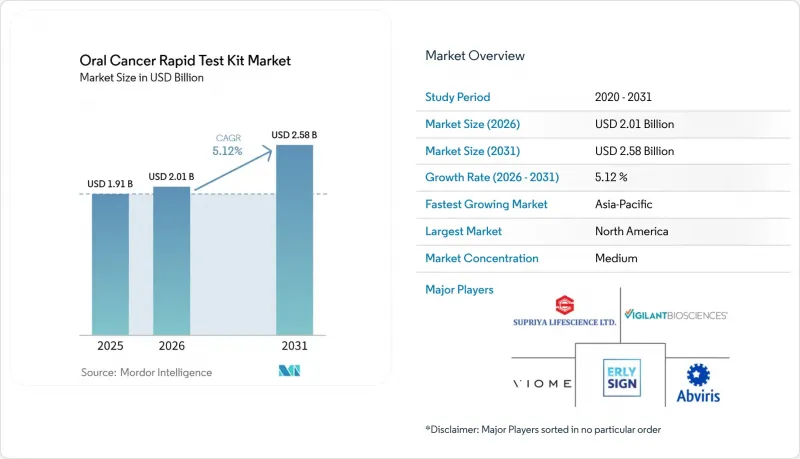
에 따르면 구강암 신속 검사 키트 시장 규모는 2025년에 19억 1,000만 달러로 평가되며, 2026년 20억 1,000만 달러에서 2031년까지 25억 8,000만 달러에 달할 것으로 추정되고 있으며, 예측 기간(2026-2031년)에 CAGR은 5.12%에 달할 전망입니다.
전 세계 구강암 신속 검사 키트 시장의 동향 및 인사이트
구강암 발병률 증가 및 고위험 요인에 대한 노출
담배 사용, 베텔넛 씹기, HPV 감염으로 인해 일부 지역에서 구강암 조기 검진의 필요성이 높아지고 있습니다. 남아시아는 인구 10만 명당 9.8이라는 가장 높은 연령 조정 발병률을 보이고 있으며, 이 지역은 전 세계 입술 및 구강암 사망자의 18.7%를 차지하고 있습니다. 또한 유럽, 북미, 남미, 호주, 뉴질랜드 등 44개국에서 남성의 HPV 관련 구강·인두암도 증가하고 있습니다. 이로 인해 담배나 베텔넛 노출률이 높은 저소득 지역과 HPV 관련 위험이 높은 고소득 지역 모두에서 수요가 발생하고 있습니다. 구강암 신속 검사 키트 시장에서는 남아시아의 1차 진료 현장을 위해 저비용 타액 검사 키트가 요구되는 반면, 유럽과 미국의 치과 진료소에서는 더 높은 민감도를 가진 분자 진단법이 요구되고 있습니다. 이러한 환자층의 차이로 인해 단일 제품 형태를 모든 환경에서 범용적으로 활용하기는 어렵습니다.
조기 및 비침습적 검출에 대한 수요 증가
조직 생검과 조직 병리학적 검사는 여전히 진단의 표준 방법이지만, 침습적이며 광범위한 집단 선별 검사에는 활용하기 어렵습니다. 2025년에 실시된 4,112명의 환자를 대상으로 한 25건의 연구에 대한 메타분석에 따르면 타액 바이오마커를 이용한 액체생검의 통합 민감도는 89%, 특이도는 91%, AUC는 0.93인 것으로 밝혀졌습니다. 동 분석에서 마이크로RNA 패널은 90%의 민감도와 92%의 특이도를 보였습니다. 2025년에 실시된 1,527개의 검체를 사용한 다중 모드 모델에서는 진단 정확도 93.2%, AUC 0.96을 달성함과 동시에, 기존의 조직 병리학과 비교하여 위음성률을 43% 감소시켰습니다. 구강암 신속 검사 키트 시장에서 체어사이드 검사는 침습적 검사로 진행해야 할 환자를 식별함으로써 트리아지를 지원할 수 있습니다. 증거가 그 사용을 지원할 경우, 임상적 권고 사항은 치과에서 장비를 조달할 때 더 명확한 근거가 될 것입니다.
제한적인 임상 검증 및 규제상의 불확실성
구강암 신속 검사 키트 시장은 규제 당국의 승인 및 일상적인 임상 사용에 필요한 증거 수준에 의해 여전히 제약을 받고 있습니다. 2026년 현재, FDA 승인을 받은 타액을 이용한 단독형 구강암 검사는 존재하지 않습니다. PMC의 ‘획기적 의료기기(Breakthrough Device) 지정’은 심사를 가속화할 가능성이 있지만, 이는 판매 승인을 의미하지는 않습니다. 또한 개발자는 검사가 하류 결과를 개선한다는 것을 입증해야 하며, 이 기준을 충족하기 위해서는 장기간에 걸친 임상 데이터가 필요할 수 있습니다. 2025년 11월 FDA가 제안한 핵산 기반 암 동반 진단제의 분류 하향 조정안은 구강암 모듈로 확장 가능한 플랫폼에 불확실성을 가중시키고 있습니다. 유럽에서는 IVDR(체외진단용 의료기기 규정) 요건에 따라 기존 체계에 비해 임상적 증거에 대한 기준이 높아졌으며, 국제적인 사업 확장을 위해서는 규제 대응 계획이 매우 중요해졌습니다.
부문 분석
OncAlert Oral Cancer LAB은 2025년 제품 유형별 구강암 신속 검사 키트 시장에서 35.31%의 점유율을 차지했습니다. 이러한 위상은 확립된 횡류 면역 분석법의 임상 개발이 앞서 진행되고 있다는 점과 진료 현장에서의 실용성을 반영한 것입니다. 2026년 OncAlert RAPID 연구에서는 타액내 용해성 CD44 및 총 단백질을 평가하여, 검사의 지속 여부 또는 초기 생검 시행에 관한 의사결정을 지원합니다. 랩-온-칩 플랫폼은 2031년까지 연평균 성장률(CAGR) 6.65%로 성장할 것으로 예측됩니다. 미세유체 기술과 핵산 증폭 기술을 통해 실험실 수준의 분석 기능을 소형 카트리지에 통합할 수 있게 되었습니다. 2026년 리뷰에서는 미세유체식 랩-온-칩 형식을 활용한 현장 분자 진단이 중개 종양학 분야에서 갖는 가치가 확인되었습니다.
Insilixa Test 및 Prevo-Check는 조기 도입형 임상 검사실에서 여전히 확고한 입지를 유지하고 있습니다. 이러한 검사 기관이 단일 워크플로우 내에서 여러 생물학적 신호를 비교할 수 있다면, 구강암 신속 검사 키트 시장은 그 혜택을 누릴 것입니다. 여러 유전자 마커와 단백질 마커를 평가할 수 있다는 점은 단일 마커의 래터럴 플로우 방식과는 차별화되는 특징입니다. 그 밖의 제품 유형으로는 OraLiva사의 ‘Onc In-Cyt’와 같은 AI 기반 브러시 생검 사이토믹스 플랫폼이 있으며, 이들은 FDA 승인을 목표로 하는 한편 CLIA 인증 실험실 개발 검사(LDT)로 운영되고 있습니다. 구강암 신속 검사 키트 업계에서는 보다 강력한 임상 검증 증거를 제시할 수 있는 플랫폼이 지지를 받는 경향이 있는 것으로 보입니다. 치과 의료 지침에서 조기 발견에 대한 증거에 대한 기대가 더욱 명확해짐에 따라 이러한 요구는 더욱 중요해지고 있습니다. 측류 및 미세유체 기술의 개발자 모두에게 기관 차원의 대규모 도입을 지원할 근거가 필요합니다.
2025년, 검출 원리별 부문에서 면역 분석법에 의한 검사는 41.24%의 점유율을 차지했습니다. 성숙한 래터럴 플로우 제조 기술, IL-8 및 CD44와 같은 바이오마커를 위해 확립된 항체 쌍, 그리고 치과 진료실 워크플로우와의 호환성이 이러한 위상을 지원하고 있습니다. 항체에 의한 인식은 분석 대상 물질에 대한 특이성을 제공하며, 이것이 임상적 수용을 지원해 왔습니다. 그러나 암 검출에서 다중 분자 데이터세트의 중요성이 높아짐에 따라 단일 분석 대상 형식으로는 민감도의 한계에 직면할 가능성이 있습니다. 센서 기반 검사는 2031년까지 연평균 성장률(CAGR) 7.42%로 성장할 것으로 예측됩니다. 전기화학적 및 광자식 바이오센서는 소형 형태로 구강 편평상피암과 관련된 마이크로RNA, 단백질 및 엑소좀 마커를 검출할 수 있습니다.
2026년 연구에서는 항체로 기능화된 야누스 입자를 이용하여 구강암 세포주 내의 CD63 및 CD44 엑소좀을 고감도로 검출할 수 있음이 입증되었습니다. 이 연구 결과는 학술적인 바이오센싱 연구에서 임상용 기기로의 개발 경로를 지원하는 것입니다. 장비가 제한적이고 육안으로 결과를 확인해야 하는 발병률이 높은 지역에서는 비색법에 의한 검사가 여전히 유용합니다. 구강암 신속 검사 키트 시장에서도 제한된 지원 장비로 운용 가능한 형태가 요구되고 있습니다. 확립된 면역측정법 외에도 분자진단법이나 전기화학법과 같은 방식도 부상하고 있습니다. ISO 15189 인증은 임상 사용시 새로운 검출 원리에 대한 검증 요건에 영향을 미칩니다. 국제적인 확장을 목표로 하는 개발자는 FDA 및 IVDR의 규정 준수 요건을 모두 충족해야 합니다.
지역별 분석
2025년, 북미는 구강암 신속 검사 키트 시장 점유율의 41.41%를 차지했습니다. 밀집된 치과 네트워크, 진단 센터의 유통 경로, 그리고 FDA의 개발 프로세스가 이 지역의 위상을 지원하고 있습니다. 미국에는 연구개발 및 병원 기반 진단을 위한 탄탄한 기관 기반이 마련되어 있습니다. 캐나다와 멕시코에는 성장 잠재력이 있습니다. 그러나 이들 국가의 보험 급여 제도와 진단 인프라는 미국과 다릅니다. 구강암 신속 검사 키트 시장에서는 이들 국가에서 현지 지불 체계 및 유통 채널에 맞춘 전략이 요구됩니다. 따라서 미국의 비즈니스 모델을 그대로 신속하게 도입하는 것은 어렵습니다. 북미의 구강암 신속 검사 키트 시장은 임상 검증 결과가 보험사의 승인으로 이어지는 속도에 따라 앞으로도 그 동향이 좌우될 것입니다.
2025년, 유럽은 지역별 기준으로 2위의 규모를 차지했습니다. IVDR(체외진단 의료기기 규정) 준수는 엄격한 규정 준수 요건이 될 가능성이 있지만, 국제 시장 진출을 지원하는 요인이 될 수도 있습니다. 비질런트 바이오사이언시스(Vigilant Biosciences)는 2025년, 자사의 ‘BeVigilant OraFusion System’의 국제 시장 진출을 위해 IVDR 승인을 획득했습니다. 독일, 영국, 프랑스는 이 지역내 최대 국내 시장입니다. 잘 정비된 의료제도와 조기 발견 프로그램은 구강 검진 툴 도입을 위한 제도적 기반을 제공하고 있습니다. 구매자가 확립된 문서를 선호하는 경우, 규정 준수 증명은 상업적 우위가 될 수 있습니다.
아시아태평양은 2031년까지 연평균 성장률(CAGR) 6.25%로 성장할 것으로 예측됩니다. 인도는 담배 및 베텔넛 씹기가 구강암의 주요 부담 요인으로 작용하고 있으며, 특히 전문의에 대한 접근성이 제한된 농촌 지역 인구에서 거대한 시장 기회를 내포하고 있습니다. 한국과 호주에서는 고소득층의 수요가 예상되는 반면, 베텔넛 노출률이 높은 동남아시아 인구층에 대해서는 여전히 충분한 의료 서비스가 제공되지 않고 있습니다. 중동 및 아프리카는 GCC(걸프협력회의) 국가들의 의료 인프라 투자와 연계된, 아직 초기 단계의 시장입니다. 브라질은 구강암의 부담이 크고 진단 센터 네트워크가 확대되고 있으며, 남미 지역에서 가장 유력한 시장으로 부상하고 있습니다.
기타 혜택:
- 엑셀 형식의 시장 예측(ME) 시트
- 3개월간의 애널리스트 지원
자주 묻는 질문
목차
제1장 서론
- 조사 전제조건과 시장 정의
- 조사 범위
제2장 조사 방법
제3장 개요
제4장 시장 구도
- 시장 개요
- 시장 성장 촉진요인
- 시장 성장 억제요인
- 공급망 분석
- 규제 상황
- 기술 전망
- Porter's Five Forces 분석
제5장 시장 규모와 성장 예측
- 제품 유형별
- 검출 원리별
- 샘플 유형별
- 소요 시간별
- 최종사용자별
- 지역별
- 북미
- 미국
- 캐나다
- 멕시코
- 유럽
- 독일
- 영국
- 프랑스
- 이탈리아
- 스페인
- 기타 유럽 국가
- 아시아태평양
- 중국
- 일본
- 인도
- 호주
- 한국
- 기타 아시아태평양 국가
- 중동 및 아프리카
- GCC
- 남아프리카공화국
- 기타 중동 및 아프리카 국가
- 남미
- 브라질
- 아르헨티나
- 기타 남미 국가
- 북미
제6장 경쟁 구도
- 시장 집중도
- 시장 점유율 분석
- 기업 개요
- Abviris Deutschland GmbH
- ErlySign
- Genefitletics
- Kalinga Institute of Industrial Technology
- OraLiva
- OrisDX
- Supriya Lifescience Ltd.
- Vigilant Biosciences, Inc.
- Viome Life Sciences, Inc.
제7장 시장 기회와 향후 전망
KSA 26.10.29According to Mordor Intelligence, the oral cancer rapid test kit market size was valued at USD 1.91 billion in 2025 and is estimated to grow from USD 2.01 billion in 2026 to reach USD 2.58 billion by 2031, at a CAGR of 5.12% during the forecast period (2026-2031).
Global Oral Cancer Rapid Test Kit Market Trends and Insights
Rising Oral Cancer Incidence and High-Risk Exposure
Tobacco use, betel-quid chewing, and HPV infection are increasing the need for earlier oral cancer screening across several regions. South Asia has the highest age-standardized incidence rate at 9.8 per 100,000 population, and the region accounts for 18.7% of global lip and oral cavity cancer deaths. HPV-associated oropharyngeal cancers among men have also increased across 44 countries in Europe, North America, South America, Australia, and New Zealand. This creates demand in both lower-income settings with high exposure to tobacco and betel quid and higher-income settings with HPV-related risk. The oral cancer rapid test kit market needs lower-cost saliva formats for primary care in South Asia and more sensitive molecular approaches for Western dental offices. These distinct patient groups limit the usefulness of a single product format across every setting.
Growing Demand for Earlier and Non-Invasive Detection
Tissue biopsy with histopathological analysis remains the diagnostic reference method, but it is invasive and difficult to use for broad population screening. A 2025 meta-analysis of 25 studies involving 4,112 patients found a pooled sensitivity of 89%, a specificity of 91%, and an AUC of 0.93 for salivary biomarker liquid biopsy. MicroRNA panels in that analysis showed 90% sensitivity and 92% specificity. A 2025 multimodal model using 1,527 samples reached 93.2% diagnostic accuracy and an AUC of 0.96, while reducing false negatives by 43% against conventional histopathology. In the oral cancer rapid test kit market, a chairside test can support triage by identifying patients who should proceed to invasive workup. Clinical recommendations can give dental practices a clearer basis for procurement when evidence supports their use.
Limited Clinical Validation and Regulatory Uncertainty
The oral cancer rapid test kit market remains constrained by the level of evidence required for regulatory clearance and routine clinical use. As of 2026, no FDA-approved saliva-based standalone oral cancer test exists. PMC Breakthrough Device Designation can accelerate review, but it does not constitute marketing approval. Developers must also show that a test improves downstream outcomes, a standard that can require long-duration clinical data. The FDA's November 2025 proposal on downclassifying nucleic acid-based cancer companion diagnostics adds uncertainty for platforms that could expand into oral cancer modules. In Europe, IVDR requirements raise the clinical evidence threshold compared with the earlier framework, making regulatory planning central to international expansion.
Other drivers and restraints analyzed in the detailed report include:
- Decentralized Screening and Home-Use Testing
- Salivaomics and Multimarker Interpretation
- Absence of Uniform Screening and Reimbursement Pathways
For complete list of drivers and restraints, kindly check the Table Of Contents.
Segment Analysis
OncAlert Oral Cancer LAB held 35.31% of the oral cancer rapid test kit market share by product type in 2025. Its position reflects the earlier clinical development and chairside feasibility of established lateral flow immunoassay formats. A 2026 OncAlert RAPID study evaluates soluble CD44 and total protein in saliva to support decisions on evaluation or initial biopsy. Lab-on-Chip Platforms are forecast to grow at a 6.65% CAGR through 2031. Microfluidics and nucleic acid amplification can place laboratory-style analytical functions in compact cartridges. A 2026 review identified translational oncology value for point-of-care molecular diagnostics using microfluidic lab-on-chip formats.
The Insilixa Test and Prevo-Check retain positions in early-adopter clinical laboratory settings. The oral cancer rapid test kit market benefits when these laboratories can compare several biological signals in a single workflow. Their ability to assess multiple genetic and protein markers differentiates them from single-marker lateral flow formats. Other product types include AI-enabled brush-biopsy cytomics platforms such as OraLiva's Onc In-Cyt, which operate as CLIA-certified laboratory-developed tests while FDA clearance is pursued. The oral cancer rapid test kit industry is likely to favor platforms that can present stronger clinical validation evidence. This need becomes more important as dental guidance sets clearer expectations for early-detection evidence. Lateral flow and microfluidic developers both need evidence that supports institutional adoption at scale.
Immunoassay Tests held 41.24% of the detection-principle segment in 2025. Mature lateral flow manufacturing, established antibody pairs for biomarkers such as IL-8 and CD44, and compatibility with chairside workflows support this position. Antibody recognition provides analyte specificity, which has supported clinical acceptance. However, single-analyte formats can face sensitivity limits as multiplex molecular data sets become more important in cancer detection. Sensor-Based Tests are forecast to grow at a 7.42% CAGR through 2031. Electrochemical and photonic biosensors can detect oral squamous cell carcinoma-related microRNAs, proteins, and exosomal markers in compact formats.
A 2026 study demonstrated sensitive detection of CD63 and CD44 exosomes in oral cancer cell lines using antibody-functionalized Janus particles. This work supports the development path from academic biosensing research toward clinical devices. Colorimetric tests remain relevant in high-incidence areas where instruments are limited and visual results are necessary. The oral cancer rapid test kit market also needs formats that can operate with limited supporting equipment. Molecular diagnostic and electrochemical formats are emerging alongside established immunoassays. ISO 15189 accreditation affects validation expectations for new detection principles in clinical use. Developers seeking international scale must address both FDA and IVDR compliance requirements.
Complete Report Scope:
- By Product Type
- OncAlert Oral Cancer LAB
- Lab on Chip
- Insilixa Test
- Prevo-Check
- Other Product Types
- By Detection Principle
- Sensor-Based Tests
- Colorimetric Tests
- Immunoassay Tests
- Molecular Diagnostic Tests
- Electrochemical Tests
- Other Detection Principles
- By Sample Type
- Saliva
- Oral Swab
- Blood
- Other Sample Types
- By Turnaround Time
- Under 15 Minutes
- 15-60 Minutes
- More Than 60 Minutes
- By End User
- Hospitals and Clinics
- Diagnostic Centers
- Ambulatory Care Centers
- Consumer and Home-Use Settings
- Other End Users
- By Geography
- North America
- United States
- Canada
- Mexico
- Europe
- Germany
- United Kingdom
- France
- Italy
- Spain
- Rest of Europe
- Asia-Pacific
- China
- Japan
- India
- Australia
- South Korea
- Rest of Asia-Pacific
- Middle East and Africa
- GCC
- South Africa
- Rest of Middle East and Africa
- South America
- Brazil
- Argentina
- Rest of South America
- North America
Geography Analysis
North America held 41.41% of the oral cancer rapid test kit market share in 2025. Dense dental networks, diagnostic-center channels, and FDA development pathways support the region's position. The United States has a substantial institutional base for research and hospital-based diagnostics. Canada and Mexico offer growth potential, but their reimbursement frameworks and diagnostic infrastructure differ from those in the United States. The oral cancer rapid test kit market requires localized payment and channel strategies in these countries. This makes the rapid transfer of a United States commercial model difficult. The oral cancer rapid test kit market in North America will remain shaped by the pace at which clinical validation reaches payer acceptance.
Europe held the second-largest regional position in 2025. IVDR conformity can be a demanding compliance requirement, but it can also support access to international markets. Vigilant Biosciences received IVDR approval for international expansion of its BeVigilant OraFusion System in 2025. Germany, the United Kingdom, and France are the largest national markets in the region. Structured health systems and early-detection programs provide an institutional setting for oral screening tools. Compliance evidence can become a commercial advantage where purchasers prefer established documentation.
Asia-Pacific is forecast to grow at a 6.25% CAGR through 2031. India is a high-volume opportunity because tobacco and betel-quid chewing contribute to a large oral cancer burden, especially in rural populations with limited specialist access. South Korea and Australia add higher-income demand, while Southeast Asian populations with high betel-nut exposure remain underserved. The Middle East and Africa are early-stage markets linked to GCC health infrastructure investment. Brazil has the strongest South American position because of its oral cancer burden and expanding diagnostic center network.
- Abviris Deutschland GmbH
- ErlySign
- Genefitletics
- Kalinga Institute of Industrial Technology
- OraLiva
- OrisDX
- Supriya Lifescience Ltd.
- Vigilant Biosciences, Inc.
- Viome Life Sciences, Inc.
Additional Benefits:
- The market estimate (ME) sheet in Excel format
- 3 months of analyst support
TABLE OF CONTENTS
1 Introduction
- 1.1 Study Assumptions and Market Definition
- 1.2 Scope of the Study
2 Research Methodology
3 Executive Summary
4 Market Landscape
- 4.1 Market Overview
- 4.2 Market Drivers
- 4.2.1 Rising Oral Cancer Incidence and High-Risk Exposure
- 4.2.2 Growing Demand for Earlier and Non-Invasive Detection
- 4.2.3 Decentralized Screening and Home-Use Testing
- 4.2.4 Expansion of Dental and Diagnostic-Center Screening
- 4.2.5 Salivaomics and AI-Based Multimarker Interpretation
- 4.2.6 Increasing Adoption of Portable Lab-on-Chip Platforms
- 4.3 Market Restraints
- 4.3.1 Limited Clinical Validation and Regulatory Uncertainty
- 4.3.2 Absence of Uniform Screening and Reimbursement Pathways
- 4.3.3 Saliva Collection, Storage and Biomarker-Stability Variability
- 4.3.4 False-Positive Risk and Confirmatory-Biopsy Dependence
- 4.4 Supply-Chain Analysis
- 4.5 Regulatory Landscape
- 4.6 Technological Outlook
- 4.7 Porter's Five Forces Analysis
- 4.7.1 Bargaining Power of Suppliers
- 4.7.2 Bargaining Power of Buyers
- 4.7.3 Threat of New Entrants
- 4.7.4 Threat of Substitutes
- 4.7.5 Intensity of Competitive Rivalry
5 Market Size & Growth Forecasts (Value, USD)
- 5.1 By Product Type
- 5.1.1 OncAlert Oral Cancer LAB
- 5.1.2 Lab on Chip
- 5.1.3 Insilixa Test
- 5.1.4 Prevo-Check
- 5.1.5 Other Product Types
- 5.2 By Detection Principle
- 5.2.1 Sensor-Based Tests
- 5.2.2 Colorimetric Tests
- 5.2.3 Immunoassay Tests
- 5.2.4 Molecular Diagnostic Tests
- 5.2.5 Electrochemical Tests
- 5.2.6 Other Detection Principles
- 5.3 By Sample Type
- 5.3.1 Saliva
- 5.3.2 Oral Swab
- 5.3.3 Blood
- 5.3.4 Other Sample Types
- 5.4 By Turnaround Time
- 5.4.1 Under 15 Minutes
- 5.4.2 15-60 Minutes
- 5.4.3 More Than 60 Minutes
- 5.5 By End User
- 5.5.1 Hospitals and Clinics
- 5.5.2 Diagnostic Centers
- 5.5.3 Ambulatory Care Centers
- 5.5.4 Consumer and Home-Use Settings
- 5.5.5 Other End Users
- 5.6 By Geography
- 5.6.1 North America
- 5.6.1.1 United States
- 5.6.1.2 Canada
- 5.6.1.3 Mexico
- 5.6.2 Europe
- 5.6.2.1 Germany
- 5.6.2.2 United Kingdom
- 5.6.2.3 France
- 5.6.2.4 Italy
- 5.6.2.5 Spain
- 5.6.2.6 Rest of Europe
- 5.6.3 Asia-Pacific
- 5.6.3.1 China
- 5.6.3.2 Japan
- 5.6.3.3 India
- 5.6.3.4 Australia
- 5.6.3.5 South Korea
- 5.6.3.6 Rest of Asia-Pacific
- 5.6.4 Middle East and Africa
- 5.6.4.1 GCC
- 5.6.4.2 South Africa
- 5.6.4.3 Rest of Middle East and Africa
- 5.6.5 South America
- 5.6.5.1 Brazil
- 5.6.5.2 Argentina
- 5.6.5.3 Rest of South America
- 5.6.1 North America
6 Competitive Landscape
- 6.1 Market Concentration
- 6.2 Market Share Analysis
- 6.3 Company Profiles (includes Global Level Overview, Market Level Overview, Core Segments, Financials as available, Strategic Information, Market Rank/Share, Products and Services, Recent Developments)
- 6.3.1 Abviris Deutschland GmbH
- 6.3.2 ErlySign
- 6.3.3 Genefitletics
- 6.3.4 Kalinga Institute of Industrial Technology
- 6.3.5 OraLiva
- 6.3.6 OrisDX
- 6.3.7 Supriya Lifescience Ltd.
- 6.3.8 Vigilant Biosciences, Inc.
- 6.3.9 Viome Life Sciences, Inc.
7 Market Opportunities and Future Outlook
- 7.1 White-Space and Unmet-Need Assessment


