

|
시장보고서
상품코드
2156975
유전성 난청 : 시장 점유율 분석, 업계 동향과 통계, 성장 예측(2026-2031년)Hereditary Deafness - Market Share Analysis, Industry Trends & Statistics, Growth Forecasts (2026 - 2031) |
||||||
 Mordor Intelligence
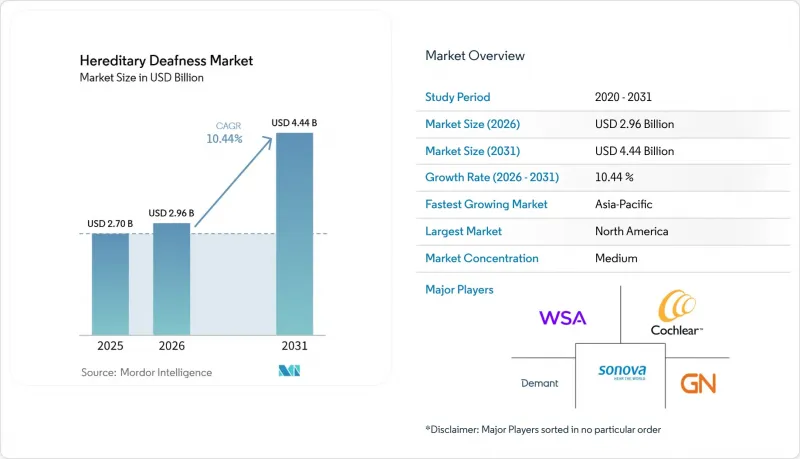
에 따르면 유전성 난청 시장 규모는 2025년에 27억 달러로 평가되며, 2026년 29억 6,000만 달러에서 2031년까지 44억 4,000만 달러에 달할 것으로 추정되고 있으며, 예측 기간(2026-2031년)에 CAGR은 10.44%에 달할 전망입니다.
전 세계 유전성 난청 시장의 동향 및 인사이트
신생아 및 소아 유전성 청력 선별 검사 확대
신생아 유전자 선별검사는 생리학적 청력 검사에 그치지 않고, 증상이 나타나기 전에 위험 요인을 파악할 수 있는 다유전자 프로그램으로 확대되고 있습니다. 온타리오주에서는 청력 검사와 유전자 선별 검사를 결합한 프로그램을 시행하고 있으며, 3년간의 검증 결과에 따르면 이 프로그램을 통해 표준 청력 검사를 통과한 신생아에서도 GJB2 및 SLC26A4와 관련된 난청이 확인되었습니다. 2026년 전향적 코호트 연구에 따르면 70달러의 비용이 드는 12개 유전자 검사 전략을 통해 생리학적 선별 검사만 실시한 경우에 비해 71% 더 많은 사례가 확인된 반면, 청각학적 평가가 필요한 영아는 고작 0.4%에 그쳤습니다. 초기 선별 검사를 통과한 GJB2 c.109G>A 동형접합 변이를 가진 영아는 위험이 나중에 나타날 가능성이 있으므로 정기적인 청각학적 모니터링 대상이 됩니다. 이로 인해 유전성 난청 시장 전체에서 진단 검사 기관 및 청각 클리닉에 대한 향후 수요가 확대될 것입니다. 또한 선별 검사 프로그램이 이후의 치료 수요를 형성하는 데 있으며, 보다 직접적인 역할을 하게 될 것입니다. 미국 ‘신생아 및 소아 유전성 질환 자문위원회’의 권고 사항과 유럽 각국의 관련 프로그램이 이 기법의 보다 광범위한 도입 속도에 영향을 미칠 것으로 보입니다.
다유전자 NGS 패널의 비용 감소 및 적용 범위 확대
시퀀싱 비용의 하락으로 인해 포괄적인 청각 관련 유전자 패널이 전문 의료 현장에서 일상적으로 활용되는 단계에 점점 가까워지고 있습니다. 아이오와 대학교는 2025년 4월, OtoSCOPE v9 패널을 업데이트하여 200개의 유전자를 스크리닝하는 제품을 정가 2,050달러에 제공하고 있습니다. Blueprint Genetics사는 비코딩 변이 평가를 포함한 288개의 유전자로 구성된 난청 패널을 제공하고 있으며, 검사 범위가 지속적으로 확대되고 있음을 알 수 있습니다. 한 과학적 메타분석에 따르면 타겟 패널의 진단 양성률은 45%, 전체 엑솜 시퀀싱에서는 42%라는 결과가 나왔으며, 이는 패널 규모를 확대하는 것만으로는 모든 사례를 해결할 수 없음을 보여줍니다. 따라서 유전성 난청 시장은 시퀀싱 커버리지 확대와 더불어 더욱 강력한 변이 해석에 의존하게 될 것입니다. 이러한 균형은 검사실 투자와 더 광범위한 패널의 임상적 가치 모두에 영향을 미칩니다. 초기 검사에서 원인을 특정할 수 없는 경우, 전체 엑솜 및 전체 게놈 검사의 활용이 점점 늘어나고 있지만, CAP, CLIA 및 ISO 15189 요건은 검사실에 있으며, 여전히 필수적인 기준으로 남아 있습니다.
유전자 검사 및 첨단 치료에 대한 보험 급여의 불균형
주요 보험 제도에서 유전성 난청 검사의 보험 적용은 여전히 조건부로 이루어지고 있습니다. 미국 보험사의 정책에 따르면 CPT 81430 또는 CPT 81431에 기반한 다유전자 검사를 승인하기 전에, 난청 소견이 문서화되어 있고 비유전적 요인이 배제되었음을 일반적으로 요구하고 있습니다. 보험 정책에 따라 검사를 환자의 평생 1회로 제한하거나, GJB2, STRC, SLC26A4, TECTA, MYO15A, MYO7A 등의 유전자를 초기 후보로 지정하는 경우가 있습니다. 오탈메니 요법 및 후속 유전자 치료에 대해서는 급여 범주에 관한 결정이 필요하지만, 많은 공적 및 민간 보험사에서는 아직 그 기준이 확립되지 않았습니다. 이 때문에 임상적 근거에 따라 치료가 권장되는 경우에도 치료의 보급이 제한될 가능성이 있습니다. 이러한 제한은 남미와 중동에서 더욱 심각하며, 이 지역에서는 유전성 청각 장애 검사에 대한 보험 급여 체계가 여전히 제한적이거나 아직 정비 중인 상태이기 때문입니다. 아시아태평양의 농촌 지역 및 이러한 지역에서는 유전학·청각학 전문의의 수가 제한적이기 때문에 전문의 의뢰나 치료 접근성이 더욱 지연되고 있습니다.
부문 분석
2025년, 신생아 청력 선별검사는 진단·검사 부문의 32.1%를 차지하며, 신생아 관리에서 청력 손실 발견의 첫 단계로서의 역할을 반영하고 있습니다. 8,261명의 신생아를 대상으로 한 연구에 따르면 유전적 진단을 받은 164명 중 126명이 생리학적 선별 검사를 통과한 것으로 밝혀졌으며, 이는 기존의 검사 방법으로는 향후 감각신경성 난청 위험이 있는 영아를 놓칠 가능성이 있음을 시사합니다. 이러한 격차로 인해 초기 선별 검사 후 결과를 확인하거나 가족을 평가하기 위한 표적 검사 및 NGS 패널에 대한 수요가 증가하고 있습니다. 신생아 청각 선별 검사 프로그램은 아동의 청각 상태를 파악할 수 있지만, 반드시 그 원인이나 진행 위험을 나타내는 것은 아닙니다. 청각 관리 경로에 유전자 선별 검사가 통합됨에 따라 검사 기관은 후속 검사에서 더 큰 역할을 담당하게 될 것입니다. 선별 검사를 통해 즉시 보청기가 필요한 것이 아니라 경과 관찰이 필요한 아동을 식별할 수 있다면, 유전성 난청 시장의 향후 서비스 기반은 더욱 확대될 것입니다.
전체 엑솜/전체 게놈 시퀀싱은 2031년까지 연평균 성장률(CAGR) 14.5%로 확대될 것으로 예측되며, 이 부문에서 가장 높은 성장률을 보이고 있습니다. 비용이 낮아짐에 따라 그리고 검사 기관이 표적형 접근법으로는 탐지할 수 없는 잠재적인 인트론 변이, 복제 수 변이, 미토콘드리아 DNA 변화를 파악하려고 함에 따라 그 이용은 확대되고 있습니다. 시퀀싱은 모든 1차 검사 방법을 대체하기보다는 표적형 검사에서 원인을 특정할 수 없었던 사례에 대해 수행되는 것이 일반적입니다. 복제수 및 미토콘드리아 검사 시장 규모는 여전히 작지만, 전체 게놈 플랫폼에서는 이러한 분석을 동일한 워크플로우의 일부로 통합하는 경향이 강해지고 있습니다. 이러한 통합으로 인해 향후 독립적인 복제수 분석의 필요성은 줄어들 가능성이 있습니다. 유전성 난청 분야에서는 초기 선별 검사, 확인용 패널, 그리고 필요에 따라 고심도 시퀀싱을 결합한 검사 과정으로 전환되고 있습니다.
2025년, GJB2/GJB6 관련 난청은 유전성 난청 부문의 28.4%를 차지하며 가장 큰 비중을 차지했습니다. 이는 코넥신 26의 변이가 무증상 난청의 일반적인 상염색체 열성 유전 원인 때문인 것입니다. 24개국, 18,968명의 환자를 대상으로 한 2024년 메타분석에 따르면 무증상 청각 장애에서 GJB2 돌연변이의 유병률은 25.9%인 것으로 밝혀졌습니다. 보고된 유병률이 가장 높았던 것은 중동 집단으로 38.5%였으나, c.35delG는 유럽 집단에서 c.235delC는 동아시아 집단에서 더 많이 관찰되었습니다. 이러한 지역적 차이는 1차 검사 패널에 어떤 변이가 포함될지에 영향을 미칩니다. Sensorion사의 GJB2-GT 프로그램은 소아 선천성 난청 및 조기 발병성 노화성 난청을 대상으로 하며, 현재의 OTOF에 초점을 맞춘 치료 프로그램보다 더 광범위한 환자층을 대상으로 합니다. GJB2/GJB6 검사는 다양한 집단에서 진단을 지원하는 데 기여할 것이므로, 유전성 난청 시장에서 계속해서 핵심적인 역할을 수행할 것입니다.
OTOF 관련 난청은 2031년까지 연평균 성장률(CAGR) 16%로 성장할 것으로 예측되며, 유전성 원인 부문에서 가장 높은 성장률을 보이고 있습니다. OTOF 관련 사례는 무증상 난청 사례의 2%에서 8%를 차지하지만, 오탈메니의 승인으로 적격성이 확인된 환자에 대한 명확한 치료 경로가 확립되었습니다. 일라이 릴리(Eli Lilly)의 Akouos 프로그램과 센서리온(Sensorion)의 SENS-501도 이 질환에 대한 임상 개발을 진행하고 있습니다. 승인된 치료법과 활발한 임상 개발이 맞물리면서 정밀한 OTOF 검사에 대한 수요가 증가하고 있습니다. SLC26A4 관련 난청은 펜드레드 증후군이나 전정수관 확장과의 연관성으로 인해 여전히 중요하지만, 치료는 여전히 인공와우나 보청기에 의존하고 있습니다. 이러한 병인에는 서로 다른 치료 계획이 필요하므로 검사 패널의 설계와 임상적 해석의 중요성은 변함이 없습니다.
지역별 분석
2025년, 북미는 전 세계 매출의 41.3%를 차지하며 유전성 난청 시장에서 가장 큰 기여를 한 지역이 되었습니다. 신생아 청력 선별 검사의 보편적 의무화, 인공 와우에 대한 공적 및 민간 보험의 광범위한 적용, 그리고 첨단 유전자 치료에 관한 규제가 이러한 위상을 지원하고 있습니다. 2026년 4월 오타르메니(Otarmeni)의 FDA 승인으로, 미국은 유전자 치료를 통한 난청 치료제가 최초로 상업적으로 출시된 시장이 되었습니다. 2025년 버지니아주 법에 따라 해당 주의 신생아 선별 검사 의무가 ‘권장 통합 선별 패널(RUSP)’에 부합하게 되어 진단 수요의 지속이 지원되었습니다. 2025년 미국 보건복지부의 조직 개편에 따라 ACHDNC 위원회가 해산된 것은 RUSP의 추가 확대를 둔화시킬 가능성이 있습니다. 이로 인해 전국적인 선별 검사 표준화의 속도에 불확실성이 발생하고 있습니다.
2025년, 유럽은 독일, 영국, 프랑스, 이탈리아, 스페인의 견인 덕분에 지역별 점유율에서 2위를 차지했습니다. 이들 국가에서는 병원을 거점으로 한 통합 청각학 네트워크가 검사 및 보청기 관리에 대한 접근성을 지원하고 있습니다. 의료기기 규정(MDR) 및 체외진단용 의료기기 규정(IVDR)의 요건은 유럽 전역에서의 접근을 추구하는 검사 기관들에게, 특히 새로운 차세대 염기서열 분석(NGS) 패널 구성에 있으며, 큰 장벽이 되고 있습니다. 유럽의약품청(EMA)이 AK-OTOF의 희귀질환 치료제 지정에 대해 긍정적인 견해를 표명한 것은 이 지역에서 유전성 난청 치료법에 대한 규제적 길이 열리고 있음을 시사합니다. 독일과 영국은 학술 및 임상 인프라와 중앙 집중식 조달 체계가 잘 갖춰져 있으며, 조기 상용화가 예상됩니다. 반면, 남유럽 및 동유럽 국가에서는 자금 조달 상황과 시장 준비 상태의 차이를 반영하여 도입이 지연될 가능성이 높습니다.
아시아태평양은 2031년까지 연평균 성장률(CAGR) 12.5%로 성장할 것으로 예측되며, 이는 지역별로는 가장 높은 성장률입니다. 중국, 일본, 인도, 한국, 호주가 이러한 성장의 주요 견인차 역할을 하고 있습니다. 중국에서 실시된 대규모 신생아 선별 검사 결과, GJB2 c.235delC 및 SLC26A4의 보균율이 각각 2.53%와 2.05%로 밝혀졌으며, 이는 정부 자금을 통한 3단계 예방 네트워크의 유효성을 입증하고 있습니다. 코클리어(Cochlear)는 2026년 6월, 일본에 ‘Nucleus Nexa 시스템’을 도입하여 일본의 인공 와우 치료 경로에 펌웨어 업데이트 기능을 도입했습니다. 인도에서 2,159명의 신생아를 대상으로 한 연구에서는 GJB2의 보균 빈도가 3.01%인 것으로 보고되어, 신생아 선별 검사 계획 수립과 관련된 인구 규모에 대한 증거가 추가되었습니다. 남미, 중동 및 아프리카는 인프라, 전문의 확보, 보험 환급 제도의 미비로 인해 여전히 시장 규모가 작은 편이지만, 브라질과 걸프협력회의(GCC) 회원국에는 더 큰 상업적 잠재력이 있습니다. 이러한 접근성 격차로 인해 유전성 난청 시장의 지역별 발전은 불균형한 상태가 지속될 것입니다.
기타 혜택:
- 엑셀 형식의 시장 예측(ME) 시트
- 3개월간의 애널리스트 지원
자주 묻는 질문
목차
제1장 유전성 난청 시장
제2장 서론
- 조사 전제조건과 시장 정의
- 조사 범위
제3장 조사 방법
제4장 개요
제5장 시장 구도
- 시장 개요
- 시장 성장 촉진요인
- 시장 성장 억제요인
- 공급망 분석
- 규제 상황
- 기술 전망
- Porter's Five Forces 분석
제6장 시장 규모와 성장 예측
- 진단·검사별
- 신생아 청각 스크리닝
- 타겟 유전자 검사
- NGS 패널
- 전엑솜/전게놈 시퀀싱(WES/WGS)
- 카피수 검사 및 미토콘드리아 검사
- 유전적 병인별
- GJB2/GJB6 관련성 난청
- SLC26A4 관련 난청
- OTOF 관련 난청
- 기타 유전성 난청
- 임상 유형별
- 비증후군성 난청
- 증후군성 난청
- 청각신경 장애 스펙트럼 장애(ANSD)
- 계승 패턴별
- 상염색체 열성 유전
- 상염색체 우성
- X연쇄성 및 미토콘드리아성
- 치료별
- 보청기
- 인공와우
- 골전도 디바이스
- 신규 유전자 치료
- 유전 카운셀링 및 재활
- 최종사용자별
- 병원 및 청각 클리닉
- 진단 검사실
- 유전 카운셀링 센터
- 연구·학술기관
- 지역별
- 북미
- 미국
- 캐나다
- 멕시코
- 유럽
- 독일
- 영국
- 프랑스
- 이탈리아
- 스페인
- 기타 유럽 국가
- 아시아태평양
- 중국
- 일본
- 인도
- 한국
- 호주
- 기타 아시아태평양 국가
- 중동 및 아프리카
- GCC
- 남아프리카공화국
- 기타 중동 및 아프리카 국가
- 남미
- 브라질
- 아르헨티나
- 기타 남미 국가
- 북미
제7장 경쟁 구도
- 시장 집중도
- 시장 점유율 분석
- 기업 개요
- Cochlear Limited
- Sonova Holding AG
- MED-EL
- Advanced Bionics AG
- Demant A/S
- GN Store Nord A/S
- WS Audiology A/S
- Starkey Hearing Technologies
- Envoy Medical Corporation
- Zhejiang Nurotron Biotechnology Co., Ltd.
- Oticon Medical A/S
- Medtronic plc
- RION Co., Ltd.
- Audina Hearing Instruments, Inc.
- Decibel Therapeutics, Inc.
- Regeneron Pharmaceuticals, Inc.
- Eli Lilly and Company
- Sensorion
- Frequency Therapeutics, Inc.
- Pipeline Therapeutics, Inc.
- Illumina, Inc.
- Thermo Fisher Scientific Inc.
- Laboratory Corporation of America Holdings
- Blueprint Genetics Oy
- Ambry Genetics Corporation
제8장 시장 기회와 향후 전망
- 화이트 스페이스 및 미충족 수요 평가
According to Mordor Intelligence, the hereditary deafness market size was valued at USD 2.70 billion in 2025 and is estimated to grow from USD 2.96 billion in 2026 to reach USD 4.44 billion by 2031, at a CAGR of 10.44% during the forecast period (2026-2031).
Global Hereditary Deafness Market Trends and Insights
Expansion of Newborn and Pediatric Genetic Hearing Screening
Newborn genetic screening is expanding beyond physiologic hearing checks into multigene programs that can identify risk before symptoms appear. Ontario combined hearing and genetic screening, and its 3-year review showed that the program identified GJB2- and SLC26A4-related hearing loss in newborns who passed standard audiological screening. A 2026 prospective cohort found that a 12-gene strategy costing USD 70 identified 71% more cases than physiologic screening alone, while only 0.4% of infants needed audiological assessment. Infants with GJB2 c.109G>A homozygous variants who pass initial screening can enter regular audiological monitoring because their risk may emerge later. This expands future demand for diagnostic laboratories and audiology clinics across the hereditary deafness market. It also gives screening programs a more direct role in shaping later care demand. U.S. recommendations from the Advisory Committee on Heritable Disorders in Newborns and Children, together with related programs in European countries, will influence the pace of wider adoption.
Falling Cost and Wider Coverage of Multigene NGS Panels
Lower sequencing costs are moving comprehensive hearing-gene panels closer to routine use in specialist care. The University of Iowa updated its OtoSCOPE v9 panel in April 2025 to screen 200 genes at a list price of USD 2,050. Blueprint Genetics offers a 288-gene hearing loss panel that includes non-coding variant assessment, showing how testing breadth continues to increase. A scientific meta-analysis found pooled diagnostic yields of 45% for targeted panels and 42% for whole-exome sequencing, which indicates that larger panels alone do not resolve every case. The hereditary deafness market will therefore depend on stronger variant interpretation as well as wider sequencing coverage. This balance affects both laboratory investment and the clinical value of a broader panel. Whole-exome and whole-genome testing is increasingly used after initial testing does not identify a cause, while CAP, CLIA, and ISO 15189 requirements remain necessary standards for laboratories.
Uneven Reimbursement for Genetic Testing and Advanced Interventions
Coverage for hereditary hearing-loss testing remains conditional across major insurance systems. U.S. payer policies commonly require documented hearing loss and exclusion of non-hereditary causes before approving multigene testing under CPT 81430 or CPT 81431. Policies may limit testing to once in a patient's lifetime and identify genes such as GJB2, STRC, SLC26A4, TECTA, MYO15A, and MYO7A as early candidates. Otarmeni and later gene therapies require benefit-category decisions that many public and private payers have not yet established. This can limit uptake even where clinical evidence supports treatment. The restriction is more severe in South America and the Middle East, where reimbursement pathways for hereditary hearing disorder testing remain limited or are still developing. Limited genetics-audiology specialist capacity in rural Asia Pacific and these regions further slows referral and treatment access.
Other drivers and restraints analyzed in the detailed report include:
- First Commercial Gene Therapy Approval for OTOF-Related Deafness
- Earlier Cochlear Implant Referral Enabled by Molecular Diagnosis
- Variant Interpretation Gaps and Persistent Unresolved Diagnoses
For complete list of drivers and restraints, kindly check the Table Of Contents.
Segment Analysis
Newborn Hearing Screening held 32.1% of the diagnosis and testing segment in 2025, reflecting its role as the first point of hearing-loss detection in neonatal care. A study of 8,261 newborns found that 126 of 164 children with a genetic diagnosis had passed physiologic screening, showing that conventional testing can miss infants at risk of later sensorineural hearing impairment. This gap supports demand for targeted testing and NGS panels that confirm results or assess families after an initial screen. Newborn programs can identify a child's hearing status, but they do not always show the cause or the risk of progression. As genetic screening is added to hearing pathways, laboratories gain a larger role in follow-up testing. The hereditary deafness market has a larger future service base when screening identifies children who need surveillance rather than an immediate device.
Whole Exome/Genome Sequencing is forecast to expand at a 14.5% CAGR through 2031, the highest rate within this segmentation. Its use grows as costs fall and laboratories seek cryptic intronic variants, copy number variants, and mitochondrial DNA changes that targeted approaches may not find. Sequencing is commonly positioned after targeted tests have not resolved a case, rather than replacing all first-line tests. Copy Number and Mitochondrial Testing remains smaller, but whole-genome platforms increasingly include these analyses as part of the same workflow. That bundling may reduce the need for stand-alone copy-number assays over time. The hereditary deafness industry is shifting toward testing pathways that combine initial screening, confirmatory panels, and higher-depth sequencing where needed.
GJB2/GJB6-Related Deafness accounted for 28.4% of the genetic etiology segment in 2025, the largest share because connexin 26 mutations are a common autosomal recessive cause of nonsyndromic hearing loss. A 2024 meta-analysis covering 18,968 patients from 24 countries found a GJB2 mutation prevalence of 25.9% in nonsyndromic hearing impairment. The highest reported prevalence was 38.5% in Middle Eastern populations, while c.35delG was more common in European populations and c.235delC in East Asian populations. This geographic variation affects which variants are included in first-line panels. Sensorion's GJB2-GT program targets pediatric congenital deafness and early-onset presbycusis, a broader population than current OTOF-focused therapy programs. GJB2/GJB6 testing will remain central to the hereditary deafness market because it supports diagnosis across many populations.
OTOF-Related Deafness is forecast to grow at a 16% CAGR through 2031, the fastest genetic etiology segment. OTOF-related cases represent 2% to 8% of nonsyndromic cases, yet Otarmeni's approval created a defined treatment route for patients with confirmed eligibility. Eli Lilly's Akouos program and Sensorion's SENS-501 are also advancing clinical programs for this condition. The combination of approved treatment and active clinical development expands the need for precise OTOF testing. SLC26A4-related deafness remains important because of its link to Pendred syndrome and enlarged vestibular aqueduct, though treatment is still based on cochlear implants and hearing aids. These etiologies require different care plans, which keeps panel design and clinical interpretation important.
Complete Report Scope:
- By Diagnosis & Testing
- Newborn Hearing Screening
- Targeted Genetic Testing
- NGS Panels
- Whole Exome/Genome Sequencing (WES/WGS)
- Copy Number & Mitochondrial Testing
- By Genetic Etiology
- GJB2/GJB6-Related Deafness
- SLC26A4-Related Deafness
- OTOF-Related Deafness
- Other Genetic Deafness
- By Clinical Type
- Nonsyndromic Deafness
- Syndromic Deafness
- Auditory Neuropathy Spectrum Disorder (ANSD)
- By Inheritance Pattern
- Autosomal Recessive
- Autosomal Dominant
- X-Linked & Mitochondrial
- By Treatment
- Hearing Aids
- Cochlear Implants
- Bone-Conduction Devices
- Emerging Genetic Therapies
- Genetic Counseling & Rehabilitation
- By End User
- Hospitals & Audiology Clinics
- Diagnostic Laboratories
- Genetic Counseling Centers
- Research & Academic Institutes
- By Geography
- North America
- United States
- Canada
- Mexico
- Europe
- Germany
- United Kingdom
- France
- Italy
- Spain
- Rest of Europe
- Asia-Pacific
- China
- Japan
- India
- South Korea
- Australia
- Rest of Asia-Pacific
- Middle East and Africa
- GCC
- South Africa
- Rest of Middle East and Africa
- South America
- Brazil
- Argentina
- Rest of South America
- North America
Geography Analysis
North America held 41.3% of global revenue in 2025, making it the largest regional contributor to the hereditary deafness market. Universal newborn hearing screening mandates, broad public and private coverage for cochlear implants, and advanced gene therapy regulation support this position. The FDA approval of Otarmeni in April 2026 establishes the United States as the first commercial launch setting for a genetic hearing treatment. Virginia legislation in 2025 aligned the state's newborn screening obligations with the Recommended Uniform Screening Panel, supporting continued diagnostic demand. The 2025 dissolution of the ACHDNC committee during the U.S. Department of Health and Human Services restructuring could slow further RUSP expansion. This creates some uncertainty around the pace of national screening standardization.
Europe held the second-largest regional share in 2025, supported by Germany, the United Kingdom, France, Italy, and Spain. Integrated hospital-based audiology networks support access to testing and device care in these countries. Medical Device Regulation and In Vitro Diagnostic Regulation requirements create meaningful barriers for laboratories seeking broad European access, especially for newer NGS panel configurations. The European Medicines Agency's positive opinion on orphan drug designation for AK-OTOF indicates that genetic hearing therapies have a regulatory route in the region. Germany and the United Kingdom are positioned for earlier commercialization because of their academic and clinical infrastructure and centralized procurement. Southern and eastern European countries are likely to adopt later, reflecting differences in funding and market readiness.
Asia Pacific is forecast to grow at a 12.5% CAGR through 2031, the highest regional rate. China, Japan, India, South Korea, and Australia are the main contributors to this expansion. A large Chinese newborn analysis found GJB2 c.235delC and SLC26A4 carrier rates of 2.53% and 2.05%, supporting a government-funded three-tier prevention network. Cochlear introduced the Nucleus Nexa System in Japan in June 2026, bringing firmware-update capability to the country's cochlear implant care pathway. An Indian study of 2,159 newborns reported a GJB2 carrier frequency of 3.01%, adding population-scale evidence relevant to newborn screening planning. South America and the Middle East and Africa remain smaller because of gaps in infrastructure, specialist capacity, and reimbursement, although Brazil and the Gulf Cooperation Council countries have stronger commercial potential. These access differences will keep regional development uneven across the hereditary deafness market.
- Cochlear
- Sonova
- MED-EL
- Advanced Bionics
- Demant
- GN Store Nord
- WS Audiology A/S
- Starkey Hearing Technologies
- Envoy Medical
- Zhejiang Nurotron Biotechnology Co., Ltd.
- Oticon Medical A/S
- Medtronic
- RION
- Audina Hearing Instruments
- Decibel Therapeutics, Inc.
- Regeneron Pharmaceuticals
- Eli Lilly and Company
- Sensorion
- Frequency Therapeutics, Inc.
- Pipeline Therapeutics, Inc.
- Illumina
- Thermo Fisher Scientific
- LabCorp
- Blueprint Genetics
- Ambry Genetics
Additional Benefits:
- The market estimate (ME) sheet in Excel format
- 3 months of analyst support
TABLE OF CONTENTS
1 HEREDITARY DEAFNESS MARKET
2 INTRODUCTION
- 2.1 Study Assumptions and Market Definition
- 2.2 Scope of the Study
3 RESEARCH METHODOLOGY
4 EXECUTIVE SUMMARY
5 MARKET LANDSCAPE
- 5.1 Market Overview
- 5.2 Market Drivers
- 5.2.1 Expansion of Newborn and Pediatric Genetic Hearing Screening
- 5.2.2 Falling Cost and Wider Coverage of Multigene NGS Panels
- 5.2.3 First Commercial Gene Therapy Approval for OTOF-Related Deafness
- 5.2.4 Earlier Cochlear Implant Referral Enabled by Molecular Diagnosis
- 5.2.5 Population-Specific Variant Knowledge Improving Diagnostic Yield
- 5.2.6 Genetic Selection for Hearing-Preservation and Ototoxicity Avoidance
- 5.3 Market Restraints
- 5.3.1 Uneven Reimbursement for Genetic Testing and Advanced Interventions
- 5.3.2 Variant Interpretation Gaps and Persistent Unresolved Diagnoses
- 5.3.3 Anti-AAV Immunity and Cochlear Delivery Constraints
- 5.3.4 Limited Specialist Capacity for Integrated Genetics and Audiology Care
- 5.4 Supply-Chain Analysis
- 5.5 Regulatory Landscape
- 5.6 Technological Outlook
- 5.7 Porters Five Forces Analysis
- 5.7.1 Bargaining Power of Suppliers
- 5.7.2 Bargaining Power of Buyers
- 5.7.3 Threat of New Entrants
- 5.7.4 Threat of Substitutes
- 5.7.5 Competitive Rivalry
6 MARKET SIZE AND GROWTH FORECASTS
- 6.1 By Diagnosis & Testing
- 6.1.1 Newborn Hearing Screening
- 6.1.2 Targeted Genetic Testing
- 6.1.3 NGS Panels
- 6.1.4 Whole Exome/Genome Sequencing (WES/WGS)
- 6.1.5 Copy Number & Mitochondrial Testing
- 6.2 By Genetic Etiology
- 6.2.1 GJB2/GJB6-Related Deafness
- 6.2.2 SLC26A4-Related Deafness
- 6.2.3 OTOF-Related Deafness
- 6.2.4 Other Genetic Deafness
- 6.3 By Clinical Type
- 6.3.1 Nonsyndromic Deafness
- 6.3.2 Syndromic Deafness
- 6.3.3 Auditory Neuropathy Spectrum Disorder (ANSD)
- 6.4 By Inheritance Pattern
- 6.4.1 Autosomal Recessive
- 6.4.2 Autosomal Dominant
- 6.4.3 X-Linked & Mitochondrial
- 6.5 By Treatment
- 6.5.1 Hearing Aids
- 6.5.2 Cochlear Implants
- 6.5.3 Bone-Conduction Devices
- 6.5.4 Emerging Genetic Therapies
- 6.5.5 Genetic Counseling & Rehabilitation
- 6.6 By End User
- 6.6.1 Hospitals & Audiology Clinics
- 6.6.2 Diagnostic Laboratories
- 6.6.3 Genetic Counseling Centers
- 6.6.4 Research & Academic Institutes
- 6.7 By Geography
- 6.7.1 North America
- 6.7.1.1 United States
- 6.7.1.2 Canada
- 6.7.1.3 Mexico
- 6.7.2 Europe
- 6.7.2.1 Germany
- 6.7.2.2 United Kingdom
- 6.7.2.3 France
- 6.7.2.4 Italy
- 6.7.2.5 Spain
- 6.7.2.6 Rest of Europe
- 6.7.3 Asia-Pacific
- 6.7.3.1 China
- 6.7.3.2 Japan
- 6.7.3.3 India
- 6.7.3.4 South Korea
- 6.7.3.5 Australia
- 6.7.3.6 Rest of Asia-Pacific
- 6.7.4 Middle East and Africa
- 6.7.4.1 GCC
- 6.7.4.2 South Africa
- 6.7.4.3 Rest of Middle East and Africa
- 6.7.5 South America
- 6.7.5.1 Brazil
- 6.7.5.2 Argentina
- 6.7.5.3 Rest of South America
- 6.7.1 North America
7 COMPETITIVE LANDSCAPE
- 7.1 Market Concentration
- 7.2 Market Share Analysis
- 7.3 Company Profiles (includes Global Level Overview, Market Level Overview, Core Segments, Financials as available, Strategic Information, Market Rank/Share, Products and Services, Recent Developments)
- 7.3.1 Cochlear Limited
- 7.3.2 Sonova Holding AG
- 7.3.3 MED-EL
- 7.3.4 Advanced Bionics AG
- 7.3.5 Demant A/S
- 7.3.6 GN Store Nord A/S
- 7.3.7 WS Audiology A/S
- 7.3.8 Starkey Hearing Technologies
- 7.3.9 Envoy Medical Corporation
- 7.3.10 Zhejiang Nurotron Biotechnology Co., Ltd.
- 7.3.11 Oticon Medical A/S
- 7.3.12 Medtronic plc
- 7.3.13 RION Co., Ltd.
- 7.3.14 Audina Hearing Instruments, Inc.
- 7.3.15 Decibel Therapeutics, Inc.
- 7.3.16 Regeneron Pharmaceuticals, Inc.
- 7.3.17 Eli Lilly and Company
- 7.3.18 Sensorion
- 7.3.19 Frequency Therapeutics, Inc.
- 7.3.20 Pipeline Therapeutics, Inc.
- 7.3.21 Illumina, Inc.
- 7.3.22 Thermo Fisher Scientific Inc.
- 7.3.23 Laboratory Corporation of America Holdings
- 7.3.24 Blueprint Genetics Oy
- 7.3.25 Ambry Genetics Corporation
8 MARKET OPPORTUNITIES AND FUTURE OUTLOOK
- 8.1 White-Space and Unmet-Need Assessment


