

|
시장보고서
상품코드
2157003
3D 스마트 카메라 : 시장 점유율 분석, 업계 동향과 통계, 성장 예측(2026-2031년)3D Smart Camera - Market Share Analysis, Industry Trends & Statistics, Growth Forecasts (2026 - 2031) |
||||||
 Mordor Intelligence
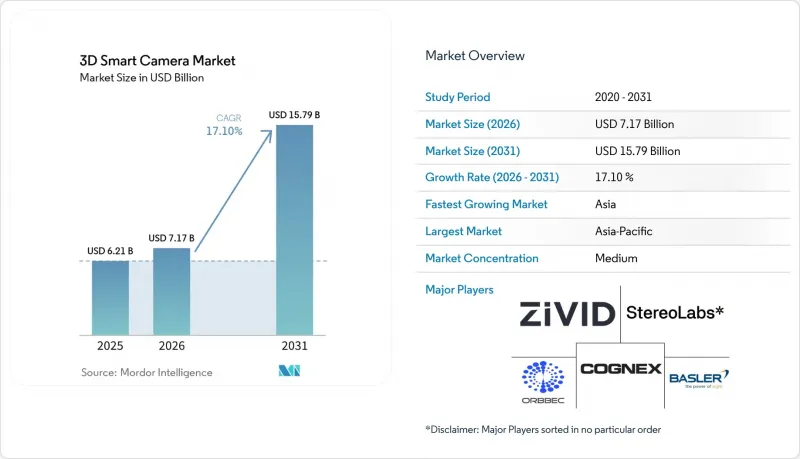
에 따르면 3D 스마트 카메라 시장 규모는 2025년에 62억 1,000만 달러로 평가되며, 2026년 71억 7,000만 달러에서 확대하며, 2031년까지 157억 9,000만 달러에 달할 것으로 예측됩니다.
예측 기간(2026-2031년) 동안 연평균 성장률(CAGR)은 17.10%에 달할 것으로 전망됩니다.
전 세계 3D 스마트 카메라 시장의 동향 및 인사이트
산업 자동화 및 로봇 비전의 확대
국제로봇연맹(IFR)의 기록에 따르면 2024년 전 세계 산업용 로봇 도입 대수는 54만 2,000대를 기록하여 4년 연속 50만 대를 넘어섰습니다. 그중 아시아가 74%를 차지했으며, 중국만 해도 29만 5,000대를 차지했습니다. 동 연맹은 설치 대수가 2025년에는 57만 5,000대에 달하고, 2028년까지 70만 대를 넘어설 것으로 예측하고 있습니다. 각 로봇 암, 협업 작업 공간, 빈 피킹 스테이션은 변화하는 물체나 레이아웃 속에서도 작동하기 위해 신뢰성 높은 깊이 인식을 필요로 합니다. 또한 이처럼 확대되는 도입 기반은 구형 비전 시스템이 임베디드 AI 카메라로 업그레이드됨에 따른 교체 수요도 지원하고 있습니다. 따라서 3D 스마트 카메라 시장은 신규 자동화 프로젝트와 기존 라인의 현대화 모두로부터 혜택을 받고 있습니다.
ADAS 및 차량내 모니터링 시스템의 성장
3D 스마트 카메라 시장과 관련하여, 유럽연합(EU)의 일반 안전 규정(GSR)에 따라 2024년 7월 이후 신차에 ‘운전자 졸음 및 주의 산만 경고 시스템’의 탑재가 의무화됩니다. 또한 2026년 7월부터는 모든 신차 모델에 카메라 기반의 ‘고급 운전자 주의 산만 경고 시스템’ 탑재가 의무화됩니다. 이러한 요건으로 인해 주의 산만이나 졸음을 감지할 수 있는 차량용 이미징 모듈에 대한 수요가 증가하고 있습니다. 2026년 3월, Mobileye사는 미국 자동차 제조사와 운전자 및 탑승자 모니터링에 단일 EyeQ6L 칩을 사용하는 운전자 모니터링 양산 프로그램을 수주했으며, 2027년 생산을 시작할 예정입니다. 자동차 제조사들은 단일 기능의 경고 시스템에서 운전자의 상태, 승객의 위치, 어린이용 카시트 장착 여부를 평가하는 시스템으로 전환하고 있습니다. 이러한 변화로 인해 차량당 카메라 탑재 수가 증가함에 따라 주요 자동차 프로그램에 참여하는 공급업체들에게 비즈니스 기회가 확대되고 있습니다.
카메라, 소프트웨어 및 시스템 통합에 드는 높은 비용
3D 스마트 카메라 시장에서 완전한 도입에는 센서 하드웨어, 엣지 AI 소프트웨어, 보정 툴 및 시스템 통합에 드는 인건비가 포함됩니다. 이러한 총 비용은 비용에 민감한 지역에 위치한 중소 제조업체의 자본 예산을 초과할 가능성이 있습니다. 또한 소프트웨어 구독은 하드웨어 구매를 중심으로 한 조달 프로세스에 지속적인 운영 비용을 초래합니다. 설치, 배선, 인건비, 소프트웨어를 포함한 전체 구성의 경우, 스테이션당 일반적으로 20,000-5만 달러의 비용이 소요됩니다. IEC 62443의 사이버 보안 요구사항이나 ISO 13849의 기계 안전 요구사항으로 인해 통합 작업 및 전문 서비스 비용이 증가할 가능성이 있습니다. 따라서 의료, 항공우주, 방위 분야 사용자는 규정 준수가 예상되는 투자 회수 기간에 영향을 미치기 때문에 프로젝트 승인에 시간이 걸릴 수 있습니다.
부문 분석
2025년 3D 스마트 카메라 시장에서 ToF(Time-of-Flight) 기술이 34.71%의 점유율을 차지했습니다. 이 기술의 전 시야 깊이 캡처 기능과 주변광 변동에 대한 내성은 산업 자동화, 접근 제어 및 차량내 감시를 지원합니다. LIPS Corporation의 ‘LIPSedge T235’는 삼성의 ISOCELL VIZION 63D 간접 ToF 센서를 채택하고 있습니다. 이 플랫폼은 깊이 정확도를 1% 미만으로 유지하면서 측정 범위를 10미터 이상으로 확장합니다. 이러한 성능을 통해 기존에는 더 고가의 LiDAR 시스템이 필요했던 대규모 물류 구역이나 광범위한 감시 용도에 대응할 수 있습니다.
하이브리드 멀티 센서 시스템은 2031년까지 연평균 성장률(CAGR) 20.87%로 확대될 것으로 예측됩니다. 이러한 시스템은 2가지 이상의 깊이 감지 방식을 결합하여 근거리 조작 및 중거리 장애물 감지를 지원합니다. 구조화된 광은 전자기기나 자동차 차체 부품의 상세한 계측에서 여전히 중요한 역할을 하고 있습니다. 스테레오 비전은 창고내 내비게이션이나 빈 피킹에 널리 활용되고 있습니다. SICK사의 ‘Visionary AI-Assist’는 스테레오 3D 카메라와 온센서 AI를 결합하여 자율주행 로봇의 충돌 회피를 실현합니다. 3D 스마트 카메라 시장에서는 단일 모달리티가 아닌, 센서 퓨전 및 적응형 센싱을 통해 차별화가 진행될 것으로 전망됩니다.
2025년 시점에 8 MP 대역은 3D 스마트 카메라 시장 점유율의 52.63%를 차지했습니다. 로봇 유도, 물류 분야의 치수 측정, 빈 피킹 및 접근 제어에서는 대부분의 경우 이보다 더 높은 화소 수는 필요하지 않습니다. 이러한 용도에서는 프레임 속도, 깊이 정확도 및 엣지 컴퓨팅의 처리량이 더 중요하게 여겨집니다. 고속 글로벌 셔터도 표준 산업용 사용 사례에 적합합니다. 8-16 MP 부문은 중간 수준의 검사 작업에 대응하며, 제조 사양이 엄격해짐에 따라 수요를 흡수할 수 있습니다.
16 MP를 초과하는 부문은 2031년까지 연평균 성장률(CAGR) 20.69%로 확대될 것으로 예측됩니다. 반도체 웨이퍼 검사, 전기자동차(EV) 배터리 분석 및 전자기기 조립에서는 정밀한 결함 탐지가 요구됩니다. 이러한 환경에서는 공간 분해능이 마이크론 단위의 이상을 식별하는 능력에 직접적인 영향을 미칩니다. LMI사의 ‘Gocator 6300’은 2.1 마이크론 미만의 X 프로파일 간격을 실현하는 반면, ‘Gocator 2600’의 변형 모델은 광범위한 시야에서 프로파일당 4,200포인트를 측정합니다. 또한 배터리 제조업체들은 셀 검사부터 물류 및 포장 라인에 이르기까지 고해상도 요구 사항을 확대하고 있습니다. 이에 따라 수요는 전문적인 품질관리 스테이션의 범위를 넘어 확장되고 있습니다.
지역별 분석
아시아태평양은 2025년 3D 스마트 카메라 시장 점유율의 38.57%를 차지하고 있으며, 2031년까지 연평균 성장률(CAGR) 21.47%로 확대될 것으로 예측됩니다. 중국에서는 2024년에 29만 5,000대의 산업용 로봇이 도입되었으며, 이는 전 세계 도입 대수의 54%에 해당합니다. 이는 단일 국가로서의 연간 도입 대수로는 사상 최고치를 기록했습니다. 중국은 제조 및 물류용 카메라 수요가 가장 집중된 지역입니다. Hikrobot사와 Vzense Technology사도 중국 국내에 그치지 않고 아세안(ASEAN)의 공급망으로 사업을 확장하고 있습니다.
일본에서는 3D 스마트 카메라 시장이 자동차 및 정밀 전자기기 분야의 구조화된 광(Structured Light) 및 ToF(Time-of-Flight) 시스템 도입에 힘입어 성장하고 있습니다. 한국의 반도체 및 디스플레이 제조 공장에서는 서브미크론 단위의 측정이 가능한 프로파일링 센서가 요구되고 있습니다. 인도의 전자 및 자동차 제조 회랑은 생산 연계형 인센티브 프로그램의 지원을 받아 급속히 발전하는 국내 성장 기회로 부상하고 있습니다. 북미는 지역별 점유율에서 2위를 차지하고 있으며, 수요는 자동차 제조, 반도체 제조, 물류 자동화 및 방위 분야에 집중되어 있습니다. 미국은 여전히 이 지역의 수요 중심지이며, 미시간주, 테네시주, 텍사스주, 애리조나주에서 활발한 움직임이 관찰되고 있습니다.
Mobileye사의 2026년 3월 시작 예정인 미국 생산 계획은 예측 기간 중 차량내 센싱 기술의 채택이 더욱 확대될 것임을 시사합니다. 캐나다의 AI 및 컴퓨터 비전 관련 기관들은 온타리오주의 조기 도입 기업을 지원하고 있는 반면, 멕시코의 1차 공급업체들은 북미 자동차 프로그램에 부합하는 시스템을 채택하고 있습니다. 유럽은 3위 지역 시장이며, 독일, 영국, 프랑스, 이탈리아, 스페인이 주도적인 역할을 하고 있습니다. 유럽의 안전 규제로 인해 운전자 모니터링은 규정 준수의 최소 요건이 되었으며, SICK사와 Basler사는 여전히 정평이 나 있는 산업용 비전 공급업체로서의 입지를 공고히 하고 있습니다. 남미, 중동 및 아프리카는 신흥 시장이며, 자동차 조립, 식품 가공, 스마트 시티 프로젝트, 보안 인프라가 이 지역들의 수요를 주도하고 있습니다.
기타 혜택:
- 엑셀 형식의 시장 예측(ME) 시트
- 3개월간의 애널리스트 지원
자주 묻는 질문
목차
제1장 서론
- 조사 전제조건과 시장 정의
- 조사 범위
제2장 조사 방법
제3장 개요
제4장 시장 구도
- 시장 개요
- 시장 성장 촉진요인
- 시장 성장 억제요인
- 거시경제 요인이 시장에 미치는 영향
- 업계의 공급망 분석
- 기술 동향
- 규제 상황
- Porter's Five Forces 분석
제5장 시장 규모와 성장 예측
- 기술별
- 해상도별
- 배포별
- 용도별
- 최종사용자 산업별
- 지역별
- 북미
- 미국
- 캐나다
- 멕시코
- 남미
- 브라질
- 아르헨티나
- 기타 남미 국가
- 유럽
- 독일
- 영국
- 프랑스
- 이탈리아
- 스페인
- 기타 유럽 국가
- 아시아태평양
- 중국
- 일본
- 인도
- 한국
- 기타 아시아태평양 국가
- 중동 및 아프리카
- 중동
- 사우디아라비아
- 아랍에미리트
- 튀르키예
- 기타 중동 국가
- 아프리카
- 남아프리카공화국
- 나이지리아
- 기타 아프리카 국가
- 중동
- 북미
제6장 경쟁 구도
- 시장 집중도
- 전략적 동향
- 시장 점유율 분석
- 기업 개요
- AT-Automation Technology GmbH
- Basler AG
- Chromasens GmbH
- Cognex Corporation
- FARO Technologies, Inc.
- Giraffe360 Limited
- Hikrobot Co., Ltd.
- LMI Technologies Inc.
- LuminWave Technology Co., Ltd.
- Luxonis Holding Corporation
- Matterport, Inc.
- Nerian Vision GmbH
- Orbbec Inc.
- photonicSENS, Inc.
- Photoneo s.r.o.
- Roboception GmbH
- SICK AG
- Stereolabs Inc.
- Vision Components GmbH
- Vzense Technology(Shenzhen) Co., Ltd.
- Zivid AS
제7장 시장 기회와 향후 전망
KSA 26.10.29According to Mordor Intelligence, the 3D smart camera market size was valued at USD 6.21 billion in 2025 and estimated to expand from USD 7.17 billion in 2026 to reach USD 15.79 billion by 2031, at a CAGR of 17.10% during the forecast period (2026-2031).
Global 3D Smart Camera Market Trends and Insights
Expansion of Industrial Automation and Robotic Vision
The International Federation of Robotics recorded 542,000 industrial robot installations worldwide in 2024, the fourth consecutive year above 500,000 units. Asia accounted for 74% of those installations, with China accounting for 295,000 units. The federation expects installations to reach 575,000 in 2025 and exceed 700,000 by 2028. Each robot arm, collaborative workspace, and bin-picking station needs reliable depth perception to operate in the presence of changing objects and layouts. This expanding installed base also supports replacement demand as older vision systems are upgraded with embedded AI cameras. The 3D Smart Camera Market, therefore, benefits from both new automation projects and modernization of existing lines.
Growth of ADAS and In-Cabin Monitoring Systems
For the 3D Smart Camera Market, the European Union General Safety Regulation requires Driver Drowsiness and Attention Warning systems on new vehicles from July 2024. Camera-based Advanced Driver Distraction Warning is required across new vehicles from July 2026. These requirements increase demand for in-cabin imaging modules capable of detecting distraction and drowsiness. In March 2026, Mobileye secured a driver-monitoring production program with a U.S. automaker, using a single EyeQ6L chip for driver and occupant monitoring, with production planned for 2027. Vehicle makers are moving from single-purpose warnings toward systems that assess driver status, passenger position, and child-seat presence. This shift raises camera content per vehicle and broadens opportunities for suppliers serving major vehicle programs.
High Camera, Software, and System Integration Costs
In the 3D Smart Camera Market, a full deployment includes sensor hardware, edge-AI software, calibration tools, and systems-integration labor. These combined costs can exceed the capital budgets of smaller manufacturers in cost-sensitive locations. Software subscriptions also introduce recurring operating costs to procurement processes built around hardware purchases. Full configurations with mounting, wiring, labor, and software commonly cost USD 20,000 to USD 50,000 per station. IEC 62443 cybersecurity requirements and ISO 13849 machine-safety requirements can increase integration work and professional-service fees. Healthcare, aerospace, and defense users may therefore take longer to approve projects because compliance work affects the expected payback period.
Other drivers and restraints analyzed in the detailed report include:
- Edge AI Enables Real-Time Autonomous Perception
- Increasing Demand for 3D Inspection and Quality Assurance
- Limited Availability of Skilled 3D Vision Engineers
For complete list of drivers and restraints, kindly check the Table Of Contents.
Segment Analysis
Time-of-Flight held 34.71% of the 3D Smart Camera Market share in 2025. Its full-field depth capture and tolerance for ambient-light variation support industrial automation, access control, and in-cabin monitoring. LIPS Corporation's LIPSedge T235 uses Samsung's ISOCELL VIZION 63D indirect ToF sensor. The platform extends measurement range beyond 10 meters while maintaining sub-1% depth accuracy. This performance supports large logistics areas and wide-field surveillance uses that previously required more costly LiDAR systems.
Hybrid Multi-Sensor systems are projected to expand at a 20.87% CAGR through 2031. They combine 2 or more depth-sensing methods to support near-field manipulation and mid-range obstacle detection. Structured light remains important for detailed metrology in electronics and automotive body parts. Stereo vision is widely used in warehouse navigation and bin picking. SICK's Visionary AI-Assist combines a stereoscopic 3D camera with on-sensor AI for autonomous mobile robot collision avoidance. The 3D Smart Camera Market is likely to see differentiation through sensor fusion and adaptive sensing rather than a single modality.
The 8 MP band held 52.63% of the 3D Smart Camera Market share in 2025. Robotic guidance, logistics dimensioning, bin picking, and access control often do not need higher pixel counts. These uses place more value on frame rate, depth accuracy, and edge-compute throughput. Fast global shutters also fit standard industrial use cases. The 8-16 MP tier addresses intermediate inspection work and can absorb demand as manufacturing specifications become stricter.
The above 16 MP segment is projected to expand at a 20.69% CAGR through 2031. Semiconductor wafer inspection, EV battery analysis, and electronics assembly require detailed defect detection. In these settings, spatial resolution directly affects the ability to identify micron-scale anomalies. LMI's Gocator 6300 offers X-profile intervals below 2.1 microns, while a Gocator 2600 variant provides 4,200 points per profile across wide fields. Battery manufacturers are also extending high-resolution requirements from cell inspection into logistics packaging lines. This broadens demand beyond specialized quality-control stations.
Complete Report Scope:
- By Technology
- Time-of-Flight
- Stereo Vision
- Structured Light
- Hybrid Multi-Sensor
- By Resolution
- Less Than 8 MP
- 8-16 MP
- Above 16 MP
- By Deployment
- Embedded Smart Camera
- PC-Based Camera System
- Cloud-Connected Camera System
- By Application
- 3D Scanning and Modeling
- Robotics and Automation
- Quality Inspection and Metrology
- Augmented Reality and Virtual Reality
- Driver and Occupant Monitoring
- Access Control and Surveillance
- Medical and Diagnostic Imaging
- 3D Printing and Additive Manufacturing
- Other Applications
- By End-User Industry
- Consumer Electronics
- Automotive
- Industrial Manufacturing
- Logistics and Warehousing
- Healthcare and Life Sciences
- Security and Surveillance
- Construction and Real Estate
- Agriculture
- Other End-User Industries
- By Geography
- North America
- United States
- Canada
- Mexico
- South America
- Brazil
- Argentina
- Rest of South America
- Europe
- Germany
- United Kingdom
- France
- Italy
- Spain
- Rest of Europe
- Asia-Pacific
- China
- Japan
- India
- South Korea
- Rest of Asia-Pacific
- Middle East and Africa
- Middle East
- Saudi Arabia
- United Arab Emirates
- Turkey
- Rest of the Middle East
- Africa
- South Africa
- Nigeria
- Rest of Africa
- Middle East
- North America
Geography Analysis
Asia-Pacific held 38.57% of the 3D Smart Camera Market share in 2025 and is projected to expand at a 21.47% CAGR through 2031. China installed 295,000 industrial robots in 2024, equal to 54% of global installations. This was the highest annual deployment total for a single country. China is the largest concentration of demand for manufacturing and logistics cameras. Hikrobot and Vzense Technology are also expanding beyond China into ASEAN supplier networks.
In Japan, the 3D Smart Camera Market is supported by automotive and precision-electronics purchases of structured-light and ToF systems. South Korean semiconductor and display fabs require profiling sensors capable of sub-micron measurement. India's electronics and automotive manufacturing corridor is emerging as a fast-developing national opportunity, supported by production-linked incentive programs. North America holds the second-largest regional share, with demand concentrated in automotive manufacturing, semiconductor fabrication, logistics automation, and defense. The United States remains the central regional demand hub, with activity in Michigan, Tennessee, Texas, and Arizona.
Mobileye's March 2026 U.S. production program points to broader adoption of in-cabin sensing through the forecast period. Canada's AI and computer-vision institutions support early adopters in Ontario, while Mexico's Tier 1 suppliers are adopting systems aligned with North American vehicle programs. Europe is the third-largest regional market, led by Germany, the United Kingdom, France, Italy, and Spain. European safety rules make driver monitoring a baseline compliance requirement, while SICK and Basler remain established industrial vision suppliers. South America, the Middle East, and Africa are emerging markets where automotive assembly, food processing, smart-city projects, and security infrastructure drive targeted demand.
- AT - Automation Technology GmbH
- Basler AG
- Chromasens GmbH
- Cognex Corporation
- FARO Technologies, Inc.
- Giraffe360 Limited
- Hikrobot Co., Ltd.
- LMI Technologies Inc.
- LuminWave Technology Co., Ltd.
- Luxonis Holding Corporation
- Matterport, Inc.
- Nerian Vision GmbH
- Orbbec Inc.
- photonicSENS, Inc.
- Photoneo s.r.o.
- Roboception GmbH
- SICK AG
- Stereolabs Inc.
- Vision Components GmbH
- Vzense Technology (Shenzhen) Co., Ltd.
- Zivid AS
Additional Benefits:
- The market estimate (ME) sheet in Excel format
- 3 months of analyst support
TABLE OF CONTENTS
1 INTRODUCTION
- 1.1 Study Assumptions and Market Definition
- 1.2 Scope of the Study
2 RESEARCH METHODOLOGY
3 EXECUTIVE SUMMARY
4 MARKET LANDSCAPE
- 4.1 Market Overview
- 4.2 Market Drivers
- 4.2.1 Expansion of Industrial Automation and Robotic Vision
- 4.2.2 Integration of Depth Sensing in Smartphones and Tablets
- 4.2.3 Growth of ADAS and In-Cabin Monitoring Systems
- 4.2.4 Increasing Demand for 3D Inspection and Quality Assurance
- 4.2.5 Edge AI Enables Real-Time Autonomous Perception
- 4.2.6 Standardized 3D Vision Interfaces Accelerate Retrofit Adoption
- 4.3 Market Restraints
- 4.3.1 High Camera, Software, and System Integration Costs
- 4.3.2 Limited Availability of Skilled 3D Vision Engineers
- 4.3.3 Calibration Drift in High-Throughput Industrial Environments
- 4.3.4 Fragmented Point-Cloud Data and AI Model Standards
- 4.4 Impact of Macroeconomic Factors on the Market
- 4.5 Industry Supply-Chain Analysis
- 4.6 Technology Outlook
- 4.7 Regulatory Landscape
- 4.8 Porter's Five Forces Analysis
- 4.8.1 Threat of New Entrants
- 4.8.2 Bargaining Power of Suppliers
- 4.8.3 Bargaining Power of Buyers
- 4.8.4 Threat of Substitutes
- 4.8.5 Intensity of Competitive Rivalry
5 MARKET SIZE AND GROWTH FORECASTS (VALUE)
- 5.1 By Technology
- 5.1.1 Time-of-Flight
- 5.1.2 Stereo Vision
- 5.1.3 Structured Light
- 5.1.4 Hybrid Multi-Sensor
- 5.2 By Resolution
- 5.2.1 Less Than 8 MP
- 5.2.2 8-16 MP
- 5.2.3 Above 16 MP
- 5.3 By Deployment
- 5.3.1 Embedded Smart Camera
- 5.3.2 PC-Based Camera System
- 5.3.3 Cloud-Connected Camera System
- 5.4 By Application
- 5.4.1 3D Scanning and Modeling
- 5.4.2 Robotics and Automation
- 5.4.3 Quality Inspection and Metrology
- 5.4.4 Augmented Reality and Virtual Reality
- 5.4.5 Driver and Occupant Monitoring
- 5.4.6 Access Control and Surveillance
- 5.4.7 Medical and Diagnostic Imaging
- 5.4.8 3D Printing and Additive Manufacturing
- 5.4.9 Other Applications
- 5.5 By End-User Industry
- 5.5.1 Consumer Electronics
- 5.5.2 Automotive
- 5.5.3 Industrial Manufacturing
- 5.5.4 Logistics and Warehousing
- 5.5.5 Healthcare and Life Sciences
- 5.5.6 Security and Surveillance
- 5.5.7 Construction and Real Estate
- 5.5.8 Agriculture
- 5.5.9 Other End-User Industries
- 5.6 By Geography
- 5.6.1 North America
- 5.6.1.1 United States
- 5.6.1.2 Canada
- 5.6.1.3 Mexico
- 5.6.2 South America
- 5.6.2.1 Brazil
- 5.6.2.2 Argentina
- 5.6.2.3 Rest of South America
- 5.6.3 Europe
- 5.6.3.1 Germany
- 5.6.3.2 United Kingdom
- 5.6.3.3 France
- 5.6.3.4 Italy
- 5.6.3.5 Spain
- 5.6.3.6 Rest of Europe
- 5.6.4 Asia-Pacific
- 5.6.4.1 China
- 5.6.4.2 Japan
- 5.6.4.3 India
- 5.6.4.4 South Korea
- 5.6.4.5 Rest of Asia-Pacific
- 5.6.5 Middle East and Africa
- 5.6.5.1 Middle East
- 5.6.5.1.1 Saudi Arabia
- 5.6.5.1.2 United Arab Emirates
- 5.6.5.1.3 Turkey
- 5.6.5.1.4 Rest of the Middle East
- 5.6.5.2 Africa
- 5.6.5.2.1 South Africa
- 5.6.5.2.2 Nigeria
- 5.6.5.2.3 Rest of Africa
- 5.6.5.1 Middle East
- 5.6.1 North America
6 COMPETITIVE LANDSCAPE
- 6.1 Market Concentration
- 6.2 Strategic Moves
- 6.3 Market Share Analysis
- 6.4 Company Profiles (includes Global Level Overview, Market Level Overview, Core Segments, Financials as available, Strategic Information, Market Rank/Share, Products and Services, Recent Developments)
- 6.4.1 AT - Automation Technology GmbH
- 6.4.2 Basler AG
- 6.4.3 Chromasens GmbH
- 6.4.4 Cognex Corporation
- 6.4.5 FARO Technologies, Inc.
- 6.4.6 Giraffe360 Limited
- 6.4.7 Hikrobot Co., Ltd.
- 6.4.8 LMI Technologies Inc.
- 6.4.9 LuminWave Technology Co., Ltd.
- 6.4.10 Luxonis Holding Corporation
- 6.4.11 Matterport, Inc.
- 6.4.12 Nerian Vision GmbH
- 6.4.13 Orbbec Inc.
- 6.4.14 photonicSENS, Inc.
- 6.4.15 Photoneo s.r.o.
- 6.4.16 Roboception GmbH
- 6.4.17 SICK AG
- 6.4.18 Stereolabs Inc.
- 6.4.19 Vision Components GmbH
- 6.4.20 Vzense Technology (Shenzhen) Co., Ltd.
- 6.4.21 Zivid AS
7 MARKET OPPORTUNITIES AND FUTURE OUTLOOK
- 7.1 White-Space and Unmet-Need Assessment


