

|
시장보고서
상품코드
2157008
SaaS 데이터 보호 : 시장 점유율 분석, 업계 동향과 통계, 성장 예측(2026-2031년)SaaS Data Protection - Market Share Analysis, Industry Trends & Statistics, Growth Forecasts (2026 - 2031) |
||||||
 Mordor Intelligence
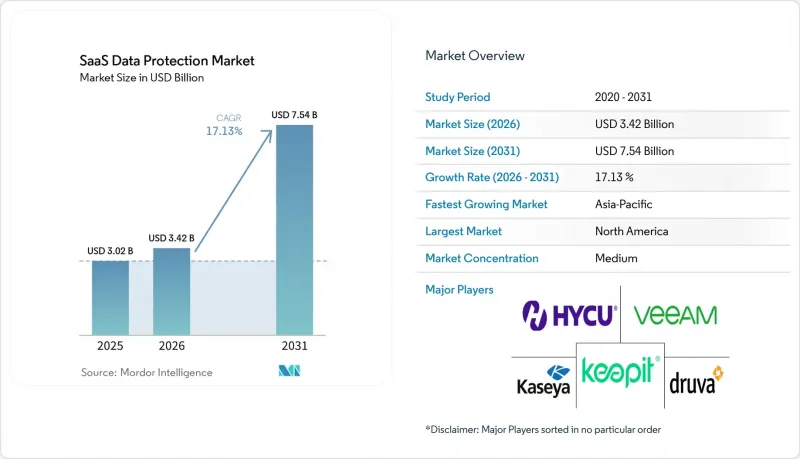
에 따르면 SaaS 데이터 보호 시장 규모는 2025년 30억 2,000만 달러에서 2026년에는 34억 2,000만 달러로 확대하며, 2031년까지 75억 4,000만 달러에 달할 것으로 예측되고 있으며, 2026-2031년까지 연평균 성장률(CAGR)은 17.13%에 달할 전망입니다.
글로벌 SaaS 데이터 보호 시장의 동향 및 인사이트
랜섬웨어 및 실수로 인한 삭제 위험
랜섬웨어는 공격자가 운영 시스템보다 먼저 백업 저장소를 표적으로 삼는 경우가 많아 수요를 창출하고 있습니다. 복구 가능한 깨끗한 사본을 보유하고 있는 조직이라면 몸값을 지불할 필요성은 낮아집니다. IBM의 기록에 따르면 2025년에는 109개의 활성 랜섬웨어 및 협박 그룹이 확인되었으며, 이는 2024년의 73개에서 증가한 수치입니다. 이러한 상황에서 SaaS 데이터 보호 시장에서 격리된 백업 사본의 중요성은 더욱 커지고 있습니다. 공격시 프로덕션 시스템, 사용자 계정 또는 주요 관리 환경이 침해되더라도 보호된 사본은 계속 사용할 수 있어야 하기 때문입니다. Spanning사의 보고서에 따르면 정보 기술 및 보안 전문가의 87%가 지난 12개월 동안 SaaS 데이터 손실을 경험한 것으로 나타났습니다. 해당 보고서에 따르면 보고된 사고의 50% 이상에서 악의적인 삭제가 확인되었으며, 이는 자동 복구 서비스에 대한 수요를 지원하는 것입니다.
비즈니스에 필수적인 워크로드에서의 SaaS 도입 가속화
비즈니스에 필수적인 업무는 많은 조직이 보호 정책을 강화하는 속도를 앞지르는 속도로 클라우드 애플리케이션으로 이전되고 있습니다. Spanning에 따르면 2025년에는 퍼블릭 클라우드 환경에서 운영되는 워크로드 및 애플리케이션의 50% 이상이 클라우드로 이전될 전망입니다. 따라서 SaaS 데이터 보호 시장에서는 생산성 향상 툴, CRM, ID 관리, 개발자용 툴을 지원하는 더 광범위한 커넥터가 요구되고 있습니다. Keepit은 2028년까지 수백 개의 SaaS 애플리케이션을 지원할 계획이라고 밝혔습니다. AvePoint는 2026년에 ServiceNow, AWS S3, Azure Kubernetes 및 Entra External ID에 대한 보호 대상을 추가했습니다. Salesforce, Jira Cloud, Confluence Cloud에 대한 보호 범위가 비교적 좁다는 점은 벤더들에게 기존 Microsoft 365와의 관계를 다른 애플리케이션으로 확대할 여지를 남겨줍니다. 벤더들은 익숙한 정책 제어 및 파트너 관계를 활용하여, 구매자가 아직 공식 백업 프로그램의 대상으로 포함하지 않은 워크로드까지 지원할 수 있게 될 것입니다.
타사 클라우드의 데이터 관리 및 개인정보 보호에 대한 우려
기밀성이 높은 SaaS 정보를 보호하는 조직은 데이터의 저장 위치, 접근 권한 및 법적 관할권에 대해 여전히 우려를 가지고 있습니다. GDPR에 따른 데이터 처리자의 설명 책임은 백업 제공업체가 추가 처리 업체를 이용할 경우 감독의 강도를 높일 가능성이 있습니다. 이러한 우려로 인해 금융 서비스 및 의료 분야에서는 구매 주기가 장기화될 우려가 있습니다. 이러한 분야에서는 의사결정자가 보호된 데이터를 타사 서비스로 전송하는 것을 승인하기 전에 보안, 법무, 규정 준수, 기술, 조달 및 사업 연속성 팀을 모두 참여시킬 가능성이 있기 때문입니다. 또한 SaaS 데이터 보호 시장에서 스토리지 설계, 계약상 관리, 명확한 복구 프로세스의 중요성이 높아지고 있습니다. 스토리지 아키텍처를 직접 관리하는 공급자는 특히 보호된 사본의 저장 위치를 설명하고, 접근 권한을 명시하며, 추가 처리 주체를 제한하고, 서비스 약관을 고객의 내부 개인정보 보호 요건에 부합시킬 수 있는 경우, 구매자의 우려 사항 중 일부를 해소할 수 있습니다. 이 문제는 신중한 조직의 도입을 저해하는 한편, 주권을 중시하는 서비스에 대한 수요를 촉진할 가능성이 있습니다.
부문 분석
2025년, 솔루션은 SaaS 데이터 보호 시장 점유율의 71.63%를 차지했습니다. 이러한 상황은 IT 팀이 사내에서 관리하는 소프트웨어 주도형 도입을 반영한 것입니다. SaaS 데이터 보호 시장에서 이 부문에는 일반적인 클라우드 애플리케이션 전반에 걸친 백업 설정, 사본 보존 및 복구 활동 조정을 위한 플랫폼이 포함됩니다. 이 솔루션은 사내 기술 환경 전반에 걸친 정책 설계, 일상적인 운영, 애플리케이션 우선순위, 보존 규칙, 접근 권한, 복구 활동의 시기를 직접 관리하고자 하는 대규모 조직에게 여전히 중요한 선택지입니다. 클라우드를 통해 제공되는 제품은 팀이 공급자가 관리하는 용량을 활용하면서도 자사의 애플리케이션 환경 및 문서화된 복구 요건에 부합하는 정책을 유지할 수 있게 해주므로, 기존 백업 환경에 수반되는 인프라 부담을 경감시킵니다. SaaS형 백업 및 복구 업계에서는 애플리케이션 전반을 보호하는 기반으로서 이러한 제품들이 계속해서 활용되고 있습니다. DORA 및 SOC 2 Type II 요건으로 인해 문서화된 복구 절차의 필요성이 높아지고 있습니다. 또한 이러한 요건은 구매자가 솔루션이 재현 가능한 테스트, 명확한 증거 수집, 접근 제어, 보존 기간 관리, 그리고 감사 및 내부 복원력 평가시 확인할 수 있는 기록을 어떻게 지원하는지 검토하도록 유도하고 있습니다. 주요 공급업체들은 시장내 입지를 유지하기 위해 자동화 기능과 더 광범위한 워크로드 지원을 추가하고 있습니다.
서비스 시장은 2026-2031년까지 연평균 성장률(CAGR) 23.58%를 기록할 것으로 예측됩니다. 이러한 성장은 ‘Backup as a Service(BaaS)’, 관리형 백업 및 외부 운영을 통한 복구 기능의 보급을 반영한 것입니다. 이러한 서비스는 자사 팀이 경보, 정책, 테스트, 복구 워크플로를 지속적으로 관리할 수 없는 경우, 고객에게 명확한 운영 모델을 제공할 수 있습니다. Veeam은 2025년 10월, 파트너가 서비스를 제공하는 고객을 대상으로 SaaS 데이터의 복원력을 확장하기 위해 ‘Data Cloud for Managed Service Providers’를 출시했습니다. 관리형 서비스 제공업체는 중소기업 고객을 위한 SaaS 데이터 보호의 더 광범위한 경로가 되고 있습니다. AvePoint는 파트너 및 관리형 서비스 기반 접근 방식을 바탕으로 2026년 2분기 매출이 전년 동기 대비 22% 증가한 1억 2,450만 달러를 기록했다고 보고했습니다. 이 서비스는 복구 관련 전문 지식이 부족한 소규모 구매자나 지속적인 검증이 필요한 규제 대상 조직을 지원할 수 있습니다. 이는 제공업체가 표준 정책을 적용하고, 보호된 환경을 모니터링하며, 테스트를 지원하고, 구독 기간 중 고객을 위해 수행한 활동을 문서화할 수 있기 때문입니다. 솔루션이 매출의 대부분을 차지할 것으로 예상되지만, 서비스의 채택률은 이를 상회할 가능성이 높습니다. 이러한 변화는 일회성 소프트웨어 도입이 아닌 지속적인 지원에 대한 수요를 반영하고 있습니다.
2025년, Microsoft 365는 보호 대상 워크로드 매출의 34.78%를 차지했습니다. 이러한 우위는 이메일, 협업 및 생산성 애플리케이션이 기업에서 널리 사용되고 있음을 반영합니다. Spanning사의 추정에 따르면 2025년 Microsoft 365 사용자의 70%가 백업 전략을 수립했습니다. 그럼에도 불구하고 악의적인 삭제는 여전히 SaaS 데이터 손실의 주요 원인 중 하나였습니다. 따라서 Microsoft 365 보호는 SaaS 데이터 보호 시장에서 확고한 진입점이 되고 있습니다. 이는 조직이 애플리케이션 수준에서 사고가 발생한 후 복원할 수 있어야 하는 널리 사용되는 이메일, 파일, 협업 기록 및 사용자 컨텐츠를 다루기 때문입니다. Google Workspace는 광범위한 협업 범위를 원하는 벤더에게 또 다른 주요 워크로드로 자리 잡고 있습니다. 기타 SaaS 애플리케이션으로는 ID 플랫폼, 개발자용 툴, 인사 시스템 등이 있으며, 여기에는 팀이 정상적인 업무 활동을 유지하는 데 필요한 사용자 인증 정보, 원본 자료, 관리 설정, 프로젝트 기록, 운영 정보 등이 포함될 수 있습니다. Jira Cloud 및 Confluence Cloud의 백업 대상 범위가 낮았다는 점은 워크로드 확대의 여지가 여전히 있음을 시사합니다. 각 벤더는 다양한 애플리케이션 포트폴리오를 보유한 고객을 확보하기 위해 광범위한 커넥터를 활용하여 경쟁을 펼치고 있습니다.
Salesforce는 2026-2031년까지 연평균 성장률(CAGR) 24.63%로 성장할 것으로 예측됩니다. Arcserve의 조사에 따르면 Salesforce의 백업 도입률은 20.5%인 반면, Microsoft 365는 63.1%였습니다. 이 차이는 중요한 의미를 지닙니다. 왜냐하면 Salesforce에는 영업 파이프라인, 고객 계약, 서비스 기록, 계정 정보, 영업 활동 및 관련 설정 데이터가 포함되어 있으며, 이러한 정보는 상업 운영 및 고객 지원 기능에 중요하기 때문입니다. Salesforce는 2024년 말, 19억 달러에 Own Company 인수를 완료했습니다. 이 거래를 통해 해당 회사의 플랫폼에 네이티브 백업 및 복구 기능이 추가되었습니다. 여러 프로덕션 환경을 운영하는 규제 대상 조직, 특히 내부 정책에 따라 독립적인 복구용 사본이 요구되어 팀이 원래 애플리케이션 환경 외부에서 정보를 복원해야 하는 경우, 여전히 독립적인 보호 조치가 필요할 수 있습니다. 이러한 고객은 메타데이터, 구성 및 전체 관련성을 아우르는 복구가 필요할 수 있습니다. 따라서 SaaS 데이터 보호 시장은 가장 성숙한 생산성 워크로드의 범위를 벗어나 남아 있는 커버리지 격차를 해결할 수 있습니다. 이미 Microsoft 365를 보호하고 있는 벤더는 이 격차를 활용하여 고객과의 관계를 확대할 수 있습니다.
지역별 분석
2025년에는 북미가 매출의 36.43%를 차지했습니다. 이 지역은 SaaS 보급률이 높고 사이버 보안 투자가 성숙한 데다, 규제 대상인 금융, 의료, 국방 관련 기관이 존재한다는 점이 강점으로 작용하고 있습니다. 이러한 기관의 기술 팀은 대개 복원력 프로그램을 구축해 놓았으며, 여러 백업 방식을 평가하는 데 필요한 예산, 기술, 거버넌스 체계를 갖추고 있습니다. HIPAA, 서번스-옥슬리법, 그리고 미국 증권거래위원회(SEC)의 2024년 사이버 보안 공시 규정은 지속적인 데이터 보호 투자를 촉진하고 있습니다. 또한 이 지역에는 Druva, Rubrik, Commvault, Cohesity, AvePoint와 같은 기업이 거점을 두고 있습니다. 이러한 집적 덕분에 벤더는 초기 도입 기업을 고객으로 확보하고 정기적인 제품 피드백을 얻을 수 있습니다. 이를 통해 공급업체는 복잡한 운영 요구 사항에 대응하여 워크로드 커넥터, 복구 프로세스, 관리 인터페이스, 파트너 서비스 및 규정 준수 기능을 정교화할 수 있습니다. 따라서 북미의 SaaS 데이터 보호 시장은 수요의 성숙도와 견고한 공급업체 기반 모두에 의해 지원되고 있으며, 구매자는 익숙한 규제 환경 속에서 생산성, CRM, 클라우드 인프라, ID 관리 및 보다 광범위한 기업 복구 요구 사항을 충족하는 검증된 솔루션을 비교 검토할 수 있습니다.
아시아태평양은 2026-2031년까지 연평균 성장률(CAGR) 24.71%로 확대될 것으로 예측됩니다. 조직들이 일상 업무에 클라우드 애플리케이션을 도입하고, 대규모 사내 인프라를 구축하지 않고도 구매, 도입, 관리, 확장이 가능한 보호 수단을 모색하는 가운데, 디지털 인프라에 대한 투자, 현지 데이터 규제, 그리고 다수의 중소기업 존재가 이러한 성장 속도를 지원하고 있습니다. 중국에서는 2026년 1분기에 정보 전송, 소프트웨어 및 정보 기술 서비스 분야에서 전년 동기 대비 10.6%의 성장이 보고되었습니다. 알리바바 클라우드와 화웨이 클라우드는 각자의 플랫폼 내에 기업용 백업 기능을 추가하고 있습니다. 또한 인도의 ‘디지털 개인 데이터 보호법’ 역시 기밀성이 높은 워크로드에 대해서는 인도 국내에 위치한 백업 스토리지를 우선적으로 사용하는 경향을 지원하고 있습니다. SaaS 데이터 보호 시장은 이 지역에서 ‘Backup as a Service(BaaS)’의 보급 확대에 힘입어 성장하고 있습니다. 이는 각 제공업체와 파트너사들이 클라우드 시스템 도입 속도가 서로 다른 고객 및 데이터 저장 장소에 대한 요건이 국가마다 다른 상황에서 사업을 운영하는 고객에게 적합한 구독 모델을 통해 데이터 보호 솔루션을 제공하고 있기 때문입니다.
유럽은 SaaS 데이터 보호 시장에서 두 번째로 큰 지역이며, DORA가 2025년 1월부터 적용됨에 따라 금융 기관의 백업 조달이 확대되었습니다. GDPR에 따라 금융 및 공공 부문의 입찰에서 주권을 고려한 스토리지 및 처리자 관리가 중요해졌으며, 구매자는 데이터가 어디에 보관되어 있는지, 누가 처리하고 있는지, 접근 권한이 어떻게 관리되고 있는지, 그리고 백업 약정이 계약상 및 규제상의 책임을 충족하는지 여부를 면밀히 검토하고 있습니다. 독일, 영국, 프랑스, 이탈리아 및 베네룩스 국가들이 이러한 수요의 중심이 되고 있습니다. 남미에서도 브라질의 ‘Lei Geral de Protecao de Dados(일반 데이터 보호법)’가 규정 준수를 고려한 클라우드 백업 도입을 촉진하고 있으며, 진전이 나타나고 있습니다. 중동 및 아프리카에서는 걸프협력회의(GCC)의 디지털 정부 프로그램을 통해 그 기세가 더욱 거세지고 있습니다. 아랍에미리트(UAE)와 사우디아라비아는 ‘비전 2030’ 및 주권 클라우드 프로그램을 통해 현지에서 호스팅되는 백업 옵션을 우선시하고 있으며, 클라우드 현대화를기밀 데이터에 대한 현지 관리를 가능하게 하고, 사업 연속성 계획을 지원하며, 공공 부문의 기대에 부응하는 인프라 및 서비스 체계의 선정과 연계하고 있습니다.
기타 혜택:
- 엑셀 형식의 시장 예측(ME) 시트
- 3개월간의 애널리스트 지원
자주 묻는 질문
목차
제1장 서론
- 조사 전제조건과 시장 정의
- 조사 범위
제2장 조사 방법
제3장 개요
제4장 시장 구도
- 시장 개요
- 시장 성장 촉진요인
- 시장 성장 억제요인
- 거시경제 요인의 영향
- 업계 밸류체인 분석
- 규제 상황
- 기술 전망
- Porter's Five Forces 분석
제5장 시장 규모와 성장 예측
- 컴포넌트별
- 보호 대상 워크로드별
- 배포 모델별
- 조직 규모별
- 산업 분야별
- 지역별
- 북미
- 미국
- 캐나다
- 멕시코
- 남미
- 브라질
- 아르헨티나
- 기타 남미 국가
- 유럽
- 독일
- 영국
- 프랑스
- 이탈리아
- 베네룩스
- 기타 유럽 국가
- 아시아태평양
- 중국
- 일본
- 인도
- 한국
- 호주
- 기타 아시아태평양 국가
- 중동 및 아프리카
- 중동
- 아랍에미리트
- 사우디아라비아
- 기타 중동 국가
- 아프리카
- 남아프리카공화국
- 나이지리아
- 이집트
- 기타 아프리카 국가
- 중동
- 북미
제6장 경쟁 구도
- 시장 집중도
- 전략적 동향
- 시장 점유율 분석
- 기업 개요
- Druva Inc.
- Veeam Software Group GmbH
- Keepit A/S
- HYCU, Inc.
- Kaseya US LLC, Spanning
- AvePoint, Inc.
- Commvault Systems, Inc.
- Rubrik, Inc.
- Cohesity, Inc.
- Acronis International GmbH
- Barracuda Networks, Inc.
- Asigra Inc.
- Own Company, Inc.
- Spin Technology, Inc.
- CloudAlly Ltd.
- SysCloud, Inc.
- Odaseva, Inc.
- Rewind Software Inc.
- Backupify, Inc.
- Datto, Inc.
- Veritas Technologies LLC
- Open Text Corporation
- N-able Technologies Ltd.
- CrashPlan Group LLC
- Zadara Storage, Inc.
제7장 시장 기회와 향후 전망
KSA 26.10.29According to Mordor Intelligence, the SaaS data protection market size is projected to expand from USD 3.02 billion in 2025 to USD 3.42 billion in 2026, and to USD 7.54 billion by 2031, registering a CAGR of 17.13% between 2026 and 2031.
Global SaaS Data Protection Market Trends and Insights
Ransomware and Accidental Deletion Exposure
Ransomware creates demand because attackers often target backup repositories before production systems. An organization with a clean recoverable copy has less reason to pay a ransom. IBM recorded 109 active ransomware and extortion groups in 2025, up from 73 in 2024. This setting makes isolated backup copies more important for the SaaS data protection market, because a protected copy must remain usable when production systems, user accounts, or the primary administrative environment have been compromised during an attack. Spanning reported that 87% of information technology and security professionals experienced SaaS data loss during the prior 12 months. Its report also identified malicious deletion in more than 50% of reported incidents, which supports the demand for automated recovery services.
Accelerating SaaS Adoption for Business-Critical Workloads
Business-critical work is moving into cloud applications faster than many organizations are expanding their protection policies. More than 50% of workloads and applications operated in public cloud environments in 2025, according to Spanning. The SaaS data protection market, therefore, needs broader connectors for productivity, CRM, identity, and developer tools. Keepit has stated that it plans to support hundreds of SaaS applications by 2028. AvePoint added protection sources for ServiceNow, AWS S3, Azure Kubernetes, and Entra External ID in 2026. Lower protection coverage for Salesforce, Jira Cloud, and Confluence Cloud leaves vendors room to extend established Microsoft 365 relationships into other applications, using familiar policy controls and partner relationships to address workloads that buyers may not yet have placed under a formal backup program.
Data Control and Privacy Concerns in Third-Party Clouds
Organizations protecting sensitive SaaS information remain concerned about data location, access, and legal jurisdiction. GDPR data-processor accountability can increase scrutiny when a backup provider uses additional processors. This concern can lengthen buying cycles in financial services and healthcare, where decision-makers may involve security, legal, compliance, technology, procurement, and business continuity teams before approving the transfer of protected data to a third-party service. It also increases the importance of storage design, contractual controls, and clear recovery processes in the SaaS data protection market. Providers that maintain direct control of their storage architecture can address some buyer concerns, especially when they can explain the location of protected copies, identify access roles, limit additional processing parties, and align their service terms with the customer's internal privacy requirements. The issue may reduce adoption by cautious organizations while directing demand toward sovereignty-focused offerings.
Other drivers and restraints analyzed in the detailed report include:
- Regulatory and Data-Sovereignty Requirements
- Demand for Automated Recovery and Business Continuity
- Vendor Lock-In and Proprietary Backup Formats
For complete list of drivers and restraints, kindly check the Table Of Contents.
Segment Analysis
Solutions accounted for 71.63% of the SaaS data protection market share in 2025. This position reflected software-led deployments managed internally by information technology teams. Within the SaaS data protection market, the segment includes platforms for configuring backups, retaining copies, and coordinating restoration activities across common cloud applications. Solutions remain relevant for large organizations that want direct control over policy design, day-to-day operations, application priorities, retention rules, access permissions, and the timing of recovery activities across their internal technology environments. Cloud-delivered products also reduce the infrastructure burden associated with older backup environments, as teams can use provider-managed capacity while retaining policies aligned with their application estate and documented recovery requirements. The SaaS backup and recovery industry continues to rely on these products as the base layer for protection across applications. DORA and SOC 2 Type II requirements increase the need for documented recovery procedures. Those requirements also encourage buyers to consider how solutions support repeatable testing, clear evidence collection, access control, retention management, and records that can be reviewed during an audit or an internal resilience assessment. The largest providers are adding automation and broader workload support to retain their positions.
Services are projected to record a 23.58% CAGR from 2026 to 2031. Growth reflects the wider adoption of Backup as a Service, managed backup, and externally operated recovery functions, which can provide customers with a defined operating model when their own teams cannot continuously manage alerts, policies, tests, and restoration workflows. Veeam launched Data Cloud for Managed Service Providers in October 2025 to extend SaaS data resilience to partner-served accounts. Managed service providers are also becoming a wider route to SaaS data protection for small and mid-market customers. AvePoint reported Q2 2026 revenue of USD 124.5 million, up 22% year over year, supported by its partner and managed service approach. Services can help smaller buyers that lack recovery expertise and regulated organizations that need ongoing validation, since providers can apply standard policies, monitor the protected environment, assist with tests, and document activities for customers over the subscription period. Solutions are expected to retain the majority of revenue, but service adoption is likely to outpace them. The shift reflects demand for recurring support rather than a one-time software installation.
Microsoft 365 held 34.78% of protected-workload revenue in 2025. Its lead reflected broad enterprise use of email, collaboration, and productivity applications. Spanning estimated that 70% of Microsoft 365 users had a backup strategy in place in 2025. Even so, malicious deletion remained a leading cause of SaaS data loss. Microsoft 365 protection is therefore an established entry point in the SaaS data protection market because it addresses widely used email, files, collaboration records, and user content that organizations must be able to restore after an application-level incident. Google Workspace represents another core workload for vendors seeking broad collaboration coverage. Other SaaS applications include identity platforms, developer tools, and human resources systems, which can hold user credentials, source materials, administrative settings, project records, and operational information that teams need to maintain normal business activity. Jira Cloud and Confluence Cloud had lower backup coverage, indicating continued scope for workload expansion. Vendors are using a breadth of connectors to compete for accounts with diverse application portfolios.
Salesforce is projected to grow at 24.63% CAGR from 2026 to 2031. An Arcserve survey reported 20.5% backup adoption for Salesforce, compared with 63.1% for Microsoft 365. The difference matters because Salesforce may contain revenue pipelines, customer contracts, service records, account information, sales activity, and related configuration data that are important to commercial operations and customer support functions. Salesforce completed its acquisition of Own Company in late 2024 for USD 1.9 billion. The transaction added native Backup and Recover capabilities to its platform. Independent protection may still be needed by regulated organizations operating multiple production environments, particularly where internal policy requires a separate recovery copy and teams need to restore information outside the original application environment. These buyers can require recovery across metadata, configuration, and relationships. The SaaS data protection market can therefore address a coverage gap that remains outside the most mature productivity workloads. Vendors that already protect Microsoft 365 can use this gap to extend their customer relationships.
Complete Report Scope:
- By Component
- Solutions
- Services
- By Protected Workload
- Microsoft 365
- Google Workspace
- Salesforce
- Other SaaS Applications
- By Deployment Model
- Public Cloud
- Private Cloud
- Hybrid Cloud
- By Organization Size
- Large Enterprises
- Small and Medium-sized Enterprises
- By Industry Vertical
- Government and Public Administration
- Retail and E-Commerce
- Transportation and Logistics
- IT and Telecommunication
- Media and Entertainment
- Healthcare and Life Sciences
- Banking, Financial Services, and Insurance (BFSI)
- Other Industry Verticals
- By Geography
- North America
- United States
- Canada
- Mexico
- South America
- Brazil
- Argentina
- Rest of South America
- Europe
- Germany
- United Kingdom
- France
- Italy
- BENELUX
- Rest of Europe
- Asia-Pacific
- China
- Japan
- India
- South Korea
- Australia
- Rest of Asia-Pacific
- Middle East and Africa
- Middle East
- United Arab Emirates
- Saudi Arabia
- Rest of Middle East
- Africa
- South Africa
- Nigeria
- Egypt
- Rest of Africa
- Middle East
- North America
Geography Analysis
North America accounted for 36.43% of revenue in 2025. The region benefits from deep SaaS use, mature cybersecurity spending, and regulated financial, healthcare, and defense organizations, where technology teams often have established resilience programs and the budget, skills, and governance structures needed to evaluate several backup approaches. HIPAA, the Sarbanes-Oxley Act, and the U.S. Securities and Exchange Commission's 2024 cybersecurity disclosure rules support ongoing data protection investments. The region also hosts Druva, Rubrik, Commvault, Cohesity, and AvePoint. This concentration provides vendors with early-adopter enterprise customers and regular product feedback, allowing suppliers to refine workload connectors, recovery processes, management interfaces, partner services, and compliance features in response to complex operational needs. The SaaS data protection market in North America is therefore supported by both demand maturity and a strong supplier base, with buyers able to compare established offerings that address common productivity, CRM, cloud infrastructure, identity, and broader enterprise recovery requirements within a familiar regulatory setting.
Asia-Pacific is projected to expand to a 24.71% CAGR from 2026 to 2031. Digital infrastructure investment, local data rules, and a large base of small and medium-sized businesses support this pace, as organizations adopt cloud applications for everyday operations and seek protection that can be purchased, deployed, managed, and expanded without extensive internal infrastructure. China reported 10.6% year-over-year growth in information transmission, software, and information technology services in the first quarter of 2026. Alibaba Cloud and Huawei Cloud are adding enterprise backup capabilities within their platforms. India's Digital Personal Data Protection Act also supports a preference for India-resident backup storage for sensitive workloads. The SaaS data protection market is benefiting from the wider adoption of Backup as a Service in the region, as providers and partners make protection available through subscription models that suit customers adopting cloud systems at different speeds and operating across countries with varying data-location expectations.
Europe is the second-largest geographic area in the SaaS data protection market, and DORA's January 2025 application date increased backup procurement by financial institutions. GDPR has made sovereignty-aware storage and processor controls important in financial and public-sector tenders, with buyers examining where data is held, who processes it, how access is controlled, and whether backup arrangements meet contractual and regulatory responsibilities. Germany, the United Kingdom, France, Italy, and the BENELUX countries are central to this demand. South America is advancing, as Brazil's Lei Geral de Protecao de Dados supports the adoption of compliance-aware cloud backup. The Middle East and Africa are gaining momentum through digital-government programs in the Gulf Cooperation Council. The UAE and Saudi Arabia are prioritizing locally hosted backup options through Vision 2030 and sovereign cloud programs, linking cloud modernization to a preference for infrastructure and service arrangements that offer local control over sensitive data, support continuity planning, and meet public-sector expectations.
- Druva Inc.
- Veeam Software Group GmbH
- Keepit A/S
- HYCU, Inc.
- Kaseya US LLC, Spanning
- AvePoint, Inc.
- Commvault Systems, Inc.
- Rubrik, Inc.
- Cohesity, Inc.
- Acronis International GmbH
- Barracuda Networks, Inc.
- Asigra Inc.
- Own Company, Inc.
- Spin Technology, Inc.
- CloudAlly Ltd.
- SysCloud, Inc.
- Odaseva, Inc.
- Rewind Software Inc.
- Backupify, Inc.
- Datto, Inc.
- Veritas Technologies LLC
- Open Text Corporation
- N-able Technologies Ltd.
- CrashPlan Group LLC
- Zadara Storage, Inc.
Additional Benefits:
- The market estimate (ME) sheet in Excel format
- 3 months of analyst support
TABLE OF CONTENTS
1 INTRODUCTION
- 1.1 Study Assumptions and Market Definition
- 1.2 Scope of the Study
2 RESEARCH METHODOLOGY
3 EXECUTIVE SUMMARY
4 MARKET LANDSCAPE
- 4.1 Market Overview
- 4.2 Market Drivers
- 4.2.1 Ransomware and Accidental Deletion Exposure
- 4.2.2 Accelerating SaaS Adoption for Business-Critical Workloads
- 4.2.3 Regulatory and Data-Sovereignty Requirements
- 4.2.4 Demand for Automated Recovery and Business Continuity
- 4.2.5 Application-Programming-Interface Dependency Mapping
- 4.2.6 Recovery Validation for Artificial Intelligence Workloads
- 4.3 Market Restraints
- 4.3.1 Data Control and Privacy Concerns in Third-Party Clouds
- 4.3.2 Vendor Lock-In and Proprietary Backup Formats
- 4.3.3 SaaS Application Programming Interface Rate Limits
- 4.3.4 Incomplete Recovery of Configuration, Metadata, and Relationships
- 4.4 Impact of Macroeconomic Factors
- 4.5 Industry Value-Chain Analysis
- 4.6 Regulatory Landscape
- 4.7 Technological Outlook
- 4.8 Porter's Five Forces Analysis
- 4.8.1 Bargaining Power of Suppliers
- 4.8.2 Bargaining Power of Buyers
- 4.8.3 Threat of New Entrants
- 4.8.4 Threat of Substitutes
- 4.8.5 Competitive Rivalry
5 MARKET SIZE AND GROWTH FORECASTS (VALUE)
- 5.1 By Component
- 5.1.1 Solutions
- 5.1.2 Services
- 5.2 By Protected Workload
- 5.2.1 Microsoft 365
- 5.2.2 Google Workspace
- 5.2.3 Salesforce
- 5.2.4 Other SaaS Applications
- 5.3 By Deployment Model
- 5.3.1 Public Cloud
- 5.3.2 Private Cloud
- 5.3.3 Hybrid Cloud
- 5.4 By Organization Size
- 5.4.1 Large Enterprises
- 5.4.2 Small and Medium-sized Enterprises
- 5.5 By Industry Vertical
- 5.5.1 Government and Public Administration
- 5.5.2 Retail and E-Commerce
- 5.5.3 Transportation and Logistics
- 5.5.4 IT and Telecommunication
- 5.5.5 Media and Entertainment
- 5.5.6 Healthcare and Life Sciences
- 5.5.7 Banking, Financial Services, and Insurance (BFSI)
- 5.5.8 Other Industry Verticals
- 5.6 By Geography
- 5.6.1 North America
- 5.6.1.1 United States
- 5.6.1.2 Canada
- 5.6.1.3 Mexico
- 5.6.2 South America
- 5.6.2.1 Brazil
- 5.6.2.2 Argentina
- 5.6.2.3 Rest of South America
- 5.6.3 Europe
- 5.6.3.1 Germany
- 5.6.3.2 United Kingdom
- 5.6.3.3 France
- 5.6.3.4 Italy
- 5.6.3.5 BENELUX
- 5.6.3.6 Rest of Europe
- 5.6.4 Asia-Pacific
- 5.6.4.1 China
- 5.6.4.2 Japan
- 5.6.4.3 India
- 5.6.4.4 South Korea
- 5.6.4.5 Australia
- 5.6.4.6 Rest of Asia-Pacific
- 5.6.5 Middle East and Africa
- 5.6.5.1 Middle East
- 5.6.5.1.1 United Arab Emirates
- 5.6.5.1.2 Saudi Arabia
- 5.6.5.1.3 Rest of Middle East
- 5.6.5.2 Africa
- 5.6.5.2.1 South Africa
- 5.6.5.2.2 Nigeria
- 5.6.5.2.3 Egypt
- 5.6.5.2.4 Rest of Africa
- 5.6.5.1 Middle East
- 5.6.1 North America
6 COMPETITIVE LANDSCAPE
- 6.1 Market Concentration
- 6.2 Strategic Moves
- 6.3 Market Share Analysis
- 6.4 Company Profiles (includes Global Level Overview, Market Level Overview, Core Segments, Financials as available, Strategic Information, Market Rank/Share, Products and Services, Recent Developments)
- 6.4.1 Druva Inc.
- 6.4.2 Veeam Software Group GmbH
- 6.4.3 Keepit A/S
- 6.4.4 HYCU, Inc.
- 6.4.5 Kaseya US LLC, Spanning
- 6.4.6 AvePoint, Inc.
- 6.4.7 Commvault Systems, Inc.
- 6.4.8 Rubrik, Inc.
- 6.4.9 Cohesity, Inc.
- 6.4.10 Acronis International GmbH
- 6.4.11 Barracuda Networks, Inc.
- 6.4.12 Asigra Inc.
- 6.4.13 Own Company, Inc.
- 6.4.14 Spin Technology, Inc.
- 6.4.15 CloudAlly Ltd.
- 6.4.16 SysCloud, Inc.
- 6.4.17 Odaseva, Inc.
- 6.4.18 Rewind Software Inc.
- 6.4.19 Backupify, Inc.
- 6.4.20 Datto, Inc.
- 6.4.21 Veritas Technologies LLC
- 6.4.22 Open Text Corporation
- 6.4.23 N-able Technologies Ltd.
- 6.4.24 CrashPlan Group LLC
- 6.4.25 Zadara Storage, Inc.
7 MARKET OPPORTUNITIES AND FUTURE OUTLOOK
- 7.1 White-space and Unmet-need Assessment


