

|
시장보고서
상품코드
2157013
디이소프로필벤젠 : 시장 점유율 분석, 업계 동향과 통계, 성장 예측(2026-2031년)Diisopropylbenzene - Market Share Analysis, Industry Trends & Statistics, Growth Forecasts (2026 - 2031) |
||||||
 Mordor Intelligence
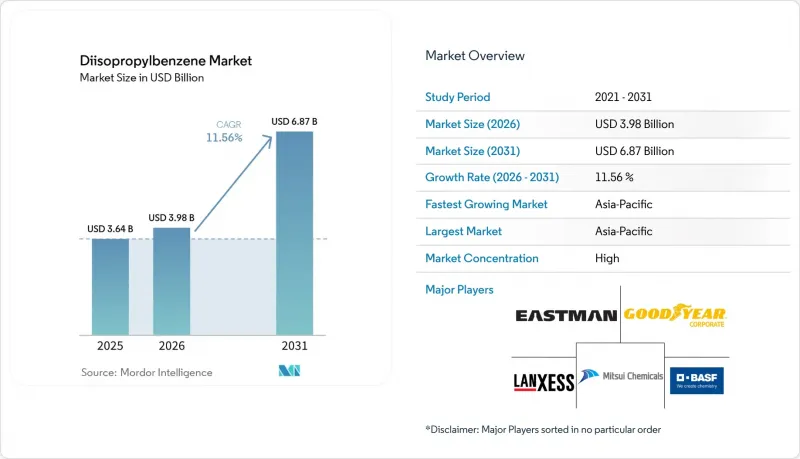
에 따르면 디이소프로필벤젠 시장 규모는 2025년에 36억 4,000만 달러로 평가되며, 2026년 39억 8,000만 달러에서 2031년까지 68억 7,000만 달러로 확대하며, 예측 기간(2026-2031년)에 CAGR은 11.56%에 달할 것으로 추정되고 있습니다.
글로벌 디이소프로필벤젠 시장의 동향 및 인사이트
하이드로퍼옥사이드 및 폴리머 개시제의 수요 확대
p-디이소프로필벤젠은 스티렌-부타디엔 고무의 저온 에멀전 중합용 개시제인 디이소프로필벤젠 디하이드로퍼옥사이드의 제조에 사용됩니다. 이 화합물은 기존의 과산화물 계열이 충분한 효과를 발휘하지 못하는 온도 범위에서도 자유 라디칼을 생성하므로 제어된 엘라스토머 생산에서 중요한 역할을 합니다. 이러한 관계로 인해 디이소프로필벤젠 시장은 합성 고무 생산, 타이어 제조 활동, 그리고 타이어 제조업체가 정한 품질 요건과 밀접하게 연결되어 있습니다. 이와 유사한 화학적 특성은 과산화물에 의한 가교 및 산화 방지제 용도로도 활용되므로, 그 중요성은 단순한 타이어 생산의 한 공정에 그치지 않습니다. 전기자동차용 타이어에는 일관된 폴리머 사슬의 특성과 낮은 구름 저항이 요구되며, 이로 인해 고무 가공에 사용되는 과산화물 중간체의 순도 요건이 높아지고 있습니다. 하류 사용자는 이성질체 조성의 편차를 쉽게 수용할 수 없기 때문에 이러한 요건은 디이소프로필벤젠 시장 전체에서 고순도 p-디이소프로필벤젠에 대한 수요를 증가시킬 가능성이 있습니다. LANXESS는 EU의 REACH 등록을 완료한 후, 2026년 9월에 6PPD의 대체품으로 ‘Vulkanox 4060’을 출시했습니다. 이에 따라 규제를 준수하는 타이어 첨가제 시스템의 지속적인 개발과 규제 대상 타이어 시장에서 대체품 도입의 기회가 촉진되고 있습니다.
고성능 폴리머 및 안정제 용도의 확대
디이소프로필벤젠 디하이드로퍼옥사이드(DIBP)는 케이블 절연체, 온수 배관 및 열경화성 발포체용 가교 폴리에틸렌에서 가교 개시제로 기능합니다. 이러한 용도는 건설, 전기 인프라, 특수 폴리머 가공 분야의 수요를 연결할 뿐만 아니라, 열이나 기계적 스트레스 하에서도 확실한 성능을 발휘하는 소재에 대한 수요로도 이어지고 있습니다. 또한 각 컴파운더 업체들은 자동차 및 산업용 전자기기의 성능 및 수명 연장 요건에 부응하기 위해 더욱 엄격한 산화 방지제 사양을 적용하고 있습니다. 전선, 케이블, 배관 제품의 제조 공정 요건에 따라 재료의 수명 기간 중 안정적인 배합 성능이 중요합니다. 이러한 사양에서는 실험실에서의 적합성 평가 시뿐만 아니라, 반복적인 생산 공정 전반에 걸쳐 일관된 품질 및 순도 요건을 충족할 수 있는 중간체가 요구됩니다. SI Group은 K 2025 및 India Rubber Expo 2026에서 NAUGARD BIO-XL 및 NaugaShield와 같은 바이오 기반 고성능 수지를 발표했습니다. 이는 성능, 환경적 우려가 적은 화학 조성, 그리고 지속가능성을 겸비한 첨가제 시스템에 대한 고객의 관심을 반영한 것입니다. 중간체 공급업체가 진화하는 순도, 기능적 성능 및 지속가능성에 대한 기대에 부응하지 못할 경우, 디이소프로필벤젠 시장은 프리미엄 용도 분야에서 점차 압박에 직면할 가능성이 있습니다.
벤젠 및 프로필렌의 가격 변동
벤젠과 프로필렌은 디이소프로필벤젠 생산의 주요 원료이며, 그 가격은 생산자의 원가와 예측 가능한 이익률을 유지하는 능력에 직접적인 영향을 미칩니다. 하류 스티렌 수요의 부진으로 인해 2025년 5월까지 12개월 동안 아시아의 벤젠 가격이 하락하여 방향족 화합물 체인 전체의 경제성이 변화했습니다. 이러한 하락으로 인해 방향족 화합물의 수익성이 저하되었으며, 하류 수요가 비교적 견고했던 지역에서도 비통합형 공급업체의 가동률이 제한되었습니다. 가격 하락은 가격 상승과 마찬가지로 큰 혼란을 초래할 가능성이 있습니다. 이는 재고 가치, 계약 조건, 고객에 대한 가격 책정 변경이 반드시 동시에 발생하지는 않기 때문입니다. 디이소프로필벤젠 시장은 원료 가격이 하류 제품의 계약 가격보다 급격하게 변동하거나, 공급업체 간 조달 조건에 차이가 있는 경우 위험에 노출됩니다. 벤젠, 프로필렌 또는 알킬화 사업을 통합한 생산자는 현물 시장에서 원료를 구매하는 위탁 가공업체보다 비용 면에서 유리한 입장에 있습니다. 이러한 차이로 인해 2층 구조의 공급 체제가 형성되며, 현물 가격의 영향을 받는 공급업체는 이익률, 설비 가동률, 고객에 대한 가격 책정 및 재고 관리 결정에 있으며, 더 큰 압박에 직면하게 됩니다.
부문 분석
p-디이소프로필벤젠은 2025년에 디이소프로필벤젠 시장 점유율의 72.67%를 차지할 것으로 예상되며, 2031년까지 연평균 성장률(CAGR) 13.06%로 성장할 것으로 전망됩니다. 이 시장의 입지는 디하이드로퍼옥시드 경로를 통한 하이드로퀴논 제조 용도에 의해 지원되고 있으며, 이 공정에서는 원료의 순도가 공정 성능에 직접적인 영향을 미칩니다. 또한 과산화물 개시형 엘라스토머의 가교화 및 일관된 재료 거동이 요구되는 관련 특수 화학 제품 용도로도 사용되고 있습니다. 고순도의 파라 이성질체 원료는 반응 조건의 제어와 배치 간 안정적인 수율이 요구되는 산화 공정을 지원합니다. 다른 이성질체에서 유래한 불순물은 산화 성능이나 하이드로퀴논의 품질에 영향을 미칠 가능성이 있으므로, 분리 및 정제 공정의 중요성이 높아지고 있습니다. 따라서 p-디이소프로필벤젠은 요구 수준이 낮은 용도에 사용되는 저사양 방향족 제품과는 본질적으로 다르며, 상업적 규모에서 일관되게 고순도 등급을 공급할 수 있는 분리 공정의 가치를 높이고 있습니다. 중국의 휘발성 유기 화합물(VOC)에 관한 기준 강화로 인해 기존의 하이드로퀴논 제조 공정에 대한 압박이 커지고 있으며, 이는 p-디이소프로필벤젠 경로의 중요성을 지원하고 있습니다. 이러한 요인들로 인해 p-이성체는 디이소프로필벤젠 시장 전체의 수요와 적용되는 기술 기준 모두에 있으며, 중요한 위치를 차지하고 있습니다.
p-디이소프로필벤젠의 밸류체인을 지원하는 것은 제조 및 정제 과정에서 이성질체의 함량을 제어할 수 있는 생산자입니다. 일본의 미쓰이 화학(Mitsui Chemicals)과 미국의 이스트만 케미컬(Eastman Chemical)은 관련 고부가가치 화학 경로에서 상업적 입지를 확립하고 있습니다. 이스트먼사는 1,4-디이소프로필벤젠을 상용 제품 중 하나로 꼽고 있으며, 이는 특수 방향족 중간체로서의 지속적인 공급이 가능함을 보여줍니다. m-디이소프로필벤젠은 타이어 코드와 고무 접착에 사용되는 레졸시놀의 전구체로 기능하며, 제한적이긴 하지만 상업적으로 중요한 하류 용도를 담당하고 있습니다. o-디이소프로필벤젠은 다른 이성체와 함께 생산되지만, 고부가가치의 최종 용도가 적어 그 관리가 운영상 과제가 되고 있습니다. 이 물질이 축적되면, 특히 분리 장치가 재료를 효율적으로 재활용하도록 설계되지 않은 경우, 디이소프로필벤젠 업계에 재고 및 폐기물 처리 문제가 발생할 수 있습니다. m- 및 o-이성체를 알킬화 루프로 재활용함으로써 p-이성체의 수율을 향상시키고 폐기물을 줄일 수 있습니다. 이러한 재활용 경로를 채택하는 생산자는 일관된 품질과 안정적인 공급이 요구되는 계약에서 자사의 입지를 강화할 수 있습니다. p-디이소프로필벤젠 시장은 순도, 수율, 확실한 규격 준수 및 추적 가능한 공급을 우선시하는 용도에 의해 주도되고 있습니다.
지역별 분석
아시아태평양은 2025년에 디이소프로필벤젠 시장 점유율의 42.38%를 차지할 것으로 예상되며, 2031년까지 연평균 성장률(CAGR) 14.25%로 성장할 것으로 전망됩니다. 이 지역은 중국의 거대한 합성고무 생산 기반과 일본의 고순도 화학물질 제조 능력을 모두 갖추고 있으며, 대규모 폴리머 가공 및 특수 화학물질 용도 모두에서 수요를 창출하고 있습니다. 한국은 관련 방향족 원료를 사용하여 기술 소재의 요구 사항을 지원하는 페놀, 비스페놀 A, 에폭시 수지의 통합 공급망을 제공하고 있습니다. 인도는 특수 화학품 및 하이드로퀴논 관련 밸류체인에서의 역할을 확대하고 있으며, p-디이소프로필벤젠 유도체의 새로운 수요 거점으로 부상하고 있습니다. 이러한 다양한 수요 거점들이 범용 등급과 고순도 등급 모두를 지원하고 있으며, 아시아태평양은 다양한 기술적 위치에 있는 생산자들에게 중요한 시장이 되고 있습니다.
BASF가 2026년 3월 잔장(湛江)에 투자한 것은 이 지역의 새로운 통합 화학 플랜트 규모를 여실히 보여주며, 70종 이상의 제품과 재생 가능 전력을 이용해 가동되는 연간 100만 메트릭톤 규모의 에틸렌 크래커를 포함하고 있습니다. 따라서 아시아태평양은 디이소프로필벤젠 시장에서 소비 거점이자 생산 거점으로서 중요한 위치를 차지하고 있으며, 특히 현지 원료에 대한 접근성과 서비스 체계를 필요로 하는 공급업체에게는 더욱 중요합니다. 중국의 환경 규제와 생산 능력 합리화는 소규모 공장의 가동 요건을 높임으로써 지역 공급 환경을 형성하고 있습니다. 이러한 생산자들은 운영 비용 상승에 더해 공정 효율, 분리 성능 및 제품 사양 관리를 개선해야 한다는 압박에 직면해 있습니다. 이러한 추세로 인해 더 대규모이며 우수한 공정 기술을 보유하고 안정적인 품질을 요구하는 고객을 충족시킬 수 있는 공급업체에 실질적인 생산이 집중되는 경향이 있습니다.
일본의 전자 재료 산업은 신뢰할 수 있는 순도와 문서화된 생산 품질이 필수적인 특수 방향족 중간체의 수요를 지원하고 있습니다. 한국에서는 국내 페놀 및 비스페놀 A의 가격 스프레드가 계속해서 압박을 받고 있으며, 생산자들은 국내 시장 외의 기회를 모색하고 있으며, 수출 및 고부가가치 제품의 중요성이 높아지고 있습니다. 북미에서는 테네시주 킹스포트에 위치한 이스트먼(Eastman)사의 상업 생산이 국내외 고객에게 공급함으로써 디이소프로필벤젠 시장을 지원하고 있습니다. 또한 미국의 반도체 제조 업계에서도 고순도 화학물질의 안정적인 공급에 대한 관심이 높아지고 있습니다. 이는 전문적인 하류 사용자에게 있으며, 소재의 인증 및 예측 가능한 납품이 중요하기 때문입니다. 유럽은 특수 폴리머 첨가제 및 산업용 윤활유 분야에서 여전히 성숙하고 품질을 중시하는 시장으로 남아 있습니다. 반면, 남미, 중동 및 아프리카는 폴리머 및 고무 가공의 향후 성장과 연계된 장기적인 기회를 내포하고 있습니다.
기타 혜택:
- 엑셀 형식의 시장 예측(ME) 시트
- 3개월간의 애널리스트 지원
자주 묻는 질문
목차
제1장 서론
- 조사 전제조건과 시장 정의
- 조사 범위
제2장 조사 방법
제3장 개요
제4장 시장 구도
- 시장 개요
- 시장 성장 촉진요인
- 시장 성장 억제요인
- 밸류체인 분석
- Porter's Five Forces 분석
제5장 시장 규모와 성장 예측
- Isomer별
- 용도별
- 지역별
- 아시아태평양
- 중국
- 인도
- 일본
- 한국
- ASEAN 국가
- 기타 아시아태평양 국가
- 북미
- 미국
- 캐나다
- 멕시코
- 유럽
- 독일
- 영국
- 프랑스
- 이탈리아
- 북유럽 국가
- 기타 유럽 국가
- 남미
- 브라질
- 아르헨티나
- 기타 남미 국가
- 중동 및 아프리카
- 사우디아라비아
- 남아프리카공화국
- 기타 중동 및 아프리카 국가
- 아시아태평양
제6장 경쟁 구도
- 시장 집중도
- 전략적 동향
- 시장 점유율·순위 분석
- 기업 개요
- Arkema
- BASF
- Chevron Phillips Chemical Company LLC
- Eastman Chemical Company
- Evonik Industries AG
- INEOS
- KUMHO P&B CHEMICALS.,INC.
- LANXESS
- LyondellBasell Industries Holdings N.V.
- Merck KGaA
- Mitsubishi Chemical Corporation
- Mitsui Chemicals, Inc.
- SI Group, Inc.
- The Goodyear Tire & Rubber Company
- Tokyo Chemical Industry Co., Ltd.
제7장 시장 기회와 향후 전망
KSA 26.10.29According to Mordor Intelligence, the diisopropylbenzene market size was valued at USD 3.64 billion in 2025 and is estimated to grow from USD 3.98 billion in 2026 to USD 6.87 billion by 2031, at a CAGR of 11.56% during the forecast period (2026-2031).
Global Diisopropylbenzene Market Trends and Insights
Growth in Hydroperoxide and Polymer-Initiator Demand
p-Diisopropylbenzene is used to produce diisopropylbenzene dihydroperoxide, an initiator for low-temperature emulsion polymerization of styrene-butadiene rubber. The compound generates free radicals at temperatures where conventional peroxide systems are less effective, making it relevant to controlled elastomer production. This relationship links the diisopropylbenzene market to synthetic rubber production, tire manufacturing activity, and the quality requirements set by tire producers. The same chemistry supports peroxide crosslinking and antioxidant applications, so its relevance extends beyond a single tire production step. Electric vehicle tires require consistent polymer chain properties and lower rolling resistance, which raises purity requirements for peroxide intermediates used in rubber processing. These requirements can increase demand for high-purity p-diisopropylbenzene across the diisopropylbenzene market, as downstream users cannot readily accept variable isomer composition. LANXESS launched Vulkanox 4060 in September 2026 as an alternative to 6PPD after completing EU REACH registration, supporting continued development of compliant tire additive systems and replacement opportunities in regulated tire markets.
Expansion of High-Performance Polymer and Stabilizer Applications
Diisopropylbenzene dihydroperoxide serves as a crosslinking initiator in cross-linked polyethylene for cable insulation, hot-water pipes, and thermosetting foams. This use connects demand with construction, electrical infrastructure, and specialized polymer processing, as well as the need for materials that perform reliably under heat and mechanical stress. Compounders are also applying tighter antioxidant specifications to address electronics performance and longer service-life requirements in automotive and industrial applications. The process requirements of wire, cable, and piping products make stable formulation performance important throughout the material's useful life. Such specifications favor intermediates that can meet consistent quality and purity requirements across repeat production runs, not only during laboratory qualification. SI Group presented NAUGARD BIO-XL and NaugaShield bio-based performance resins at K 2025 and India Rubber Expo 2026, reflecting customer interest in additive systems that combine performance, lower-concern chemistry, and sustainability. The diisopropylbenzene market may face gradual pressure in premium applications if intermediate suppliers do not meet evolving purity, functional performance, and sustainability expectations.
Benzene and Propylene Price Volatility
Benzene and propylene are key raw materials in diisopropylbenzene production, and their prices directly affect producer costs and the ability to maintain predictable margins. Weak downstream styrene demand reduced Asian benzene prices during the 12 months ending May 2025, altering the economics of the broader aromatics chain. This decline reduced aromatics' profitability and limited operating rates for non-integrated suppliers, even where downstream demand remained comparatively resilient. Price declines can be as disruptive as price increases because changes in inventory value, contract terms, and customer pricing may not occur simultaneously. The diisopropylbenzene market is exposed when feedstock prices move faster than contract prices for downstream products, or when purchasing conditions differ among suppliers. Producers with integrated benzene, propylene, or alkylation operations hold a stronger cost position than toll converters that buy feedstocks on the spot market. This difference creates a two-tier supply structure in which spot-exposed suppliers face greater pressure on margins, capacity utilization, customer pricing, and inventory decisions.
Other drivers and restraints analyzed in the detailed report include:
- Increasing Demand for High-Purity Intermediates in Electronics and Advanced Materials
- Asia-Pacific Specialty-Chemical and Petrochemical Capacity Expansion
- Environmental, Health, Safety, and Chemical-Registration Compliance Costs
For complete list of drivers and restraints, kindly check the Table Of Contents.
Segment Analysis
p-Diisopropylbenzene held 72.67% of the diisopropylbenzene market share in 2025 and is forecast to grow at a CAGR of 13.06% through 2031. Its market position is driven by its use in hydroquinone production via the dihydroperoxide route, in which feedstock purity directly affects process performance. It is also used in peroxide-initiated elastomer crosslinking and related specialty chemical applications that require consistent material behavior. High-purity para-isomer feedstock supports oxidation processes that require controlled reaction conditions and reliable product yields across batches. Impurities from other isomers can affect oxidation performance and hydroquinone quality, increasing the importance of separation and purification. This makes p-diisopropylbenzene materially different from lower-specification aromatic products used in less demanding applications and raises the value of separation processes that can consistently deliver high-purity grades at commercial scale. China's volatile organic compound standards have increased pressure on older hydroquinone processes, which supports the relevance of the p-diisopropylbenzene route. These factors make the p-isomer important to both demand and the technical standards applied across the diisopropylbenzene market.
The p-diisopropylbenzene value chain is served by producers who can control isomer content during production and purification. Mitsui Chemicals in Japan and Eastman Chemical in the United States have commercial positions in related high-value chemical pathways. Eastman lists 1,4-diisopropylbenzene among its commercial products, demonstrating its continued availability as a specialty aromatic intermediate. m-Diisopropylbenzene serves as a precursor to resorcinol, used in tire cord-to-rubber bonding, giving it a focused but commercially relevant downstream role. o-Diisopropylbenzene is produced alongside the other isomers and has fewer high-value end uses, making its management an operational concern. Its accumulation can create inventory and disposal challenges for the diisopropylbenzene industry, particularly where separation units are not designed to recycle material efficiently. Recycling m- and o-isomers into the alkylation loop can improve p-isomer yields and reduce waste. Producers using such recycling routes can strengthen their position in contracts requiring consistent quality and reliable availability. The diisopropylbenzene market for p-diisopropylbenzene is driven by applications that prioritize purity, yield, reliable qualification, and traceable supply.
Complete Report Scope:
- By Isomer
- o-Diisopropylbenzene
- m-Diisopropylbenzene
- p-Diisopropylbenzene
- By Application
- Chemical Intermediates
- Stabilizers
- Polymers
- Synthetic Lubricants
- Hydroperoxides
- Others
- By Geography
- Asia-Pacific
- China
- India
- Japan
- South Korea
- ASEAN Countries
- Rest of Asia-Pacific
- North America
- United States
- Canada
- Mexico
- Europe
- Germany
- United Kingdom
- France
- Italy
- NORDIC Countries
- Rest of Europe
- South America
- Brazil
- Argentina
- Rest of South America
- Middle East and Africa
- Saudi Arabia
- South Africa
- Rest of Middle East and Africa
- Asia-Pacific
Geography Analysis
Asia-Pacific held 42.38% of the diisopropylbenzene market share in 2025 and is forecast to grow at a CAGR of 14.25% through 2031. The region combines China's large synthetic rubber base with Japan's high-purity chemical capabilities, generating demand from both large-scale polymer processing and specialized chemical applications. South Korea contributes integrated phenol, bisphenol A, and epoxy supply chains that use related aromatic feedstocks and support technical material requirements. India is expanding its role in specialty chemicals and hydroquinone-linked value chains, adding another demand center for p-diisopropylbenzene derivatives. These varied demand centers support both commodity and higher-purity grades, making the Asia-Pacific region relevant to producers across different technical positions.
BASF's March 2026 Zhanjiang investment illustrates the scale of new integrated chemical capacity in the region, encompassing more than 70 products and a 1-million-metric-ton-per-year ethylene cracker powered by renewable electricity. Asia-Pacific is therefore significant as both a consumption center and a production base for the diisopropylbenzene market, particularly for suppliers that require local access to feedstocks and service capabilities. China's environmental controls and capacity rationalization are shaping the regional supply environment by raising operating requirements for smaller plants. These producers face higher operating costs and increased pressure to improve process efficiency, separation performance, and control over product specifications. This dynamic tends to concentrate effective production among suppliers with greater scale, stronger process technology, and the ability to serve customers requiring consistent quality.
Japan's electronic materials activity supports demand for specialty aromatic intermediates for which reliable purity and documented production quality are essential. South Korea's producers are seeking opportunities outside domestic markets as local phenol and bisphenol A spreads remain compressed, increasing the importance of exports and higher-value products. In North America, the diisopropylbenzene market is supported by Eastman's commercial production in Kingsport, Tennessee, which serves both domestic and international customers. U.S. semiconductor construction is also increasing interest in the continuity of high-purity chemical supply, as material qualification and predictable deliveries are important for specialized downstream users. Europe remains a mature, quality-focused market for specialty polymer additives and industrial lubricants, while South America, the Middle East, and Africa represent longer-term opportunities tied to future growth in polymer and rubber processing.
- Arkema
- BASF
- Chevron Phillips Chemical Company LLC
- Eastman Chemical Company
- Evonik Industries AG
- INEOS
- KUMHO P&B CHEMICALS.,INC.
- LANXESS
- LyondellBasell Industries Holdings N.V.
- Merck KGaA
- Mitsubishi Chemical Corporation
- Mitsui Chemicals, Inc.
- SI Group, Inc.
- The Goodyear Tire & Rubber Company
- Tokyo Chemical Industry Co., Ltd.
Additional Benefits:
- The market estimate (ME) sheet in Excel format
- 3 months of analyst support
TABLE OF CONTENTS
1 Introduction
- 1.1 Study Assumptions and Market Definition
- 1.2 Scope of the Study
2 Research Methodology
3 Executive Summary
4 Market Landscape
- 4.1 Market Overview
- 4.2 Market Drivers
- 4.2.1 Growth in Hydroperoxide and Polymer-Initiator Demand
- 4.2.2 Expansion of High-Performance Polymer and Stabilizer Applications
- 4.2.3 Increasing Demand for High-Purity Intermediates in Electronics and Advanced Materials
- 4.2.4 Asia-Pacific Specialty-Chemical and Petrochemical Capacity Expansion
- 4.2.5 Isomer-Selective Oxidation and Dihydroperoxide Process Improvements
- 4.3 Market Restraints
- 4.3.1 Benzene and Propylene Price Volatility
- 4.3.2 Environmental, Health, Safety, and Chemical-Registration Compliance Costs
- 4.3.3 Isomer-Separation Constraints and o-Diisopropylbenzene Accumulation
- 4.4 Value Chain Analysis
- 4.5 Porter's Five Forces Analysis
- 4.5.1 Bargaining Power of Suppliers
- 4.5.2 Bargaining Power of Buyers
- 4.5.3 Threat of New Entrants
- 4.5.4 Threat of Substitutes
- 4.5.5 Competitive Rivalry
5 Market Size And Growth Forecasts (Value)
- 5.1 By Isomer
- 5.1.1 o-Diisopropylbenzene
- 5.1.2 m-Diisopropylbenzene
- 5.1.3 p-Diisopropylbenzene
- 5.2 By Application
- 5.2.1 Chemical Intermediates
- 5.2.2 Stabilizers
- 5.2.3 Polymers
- 5.2.4 Synthetic Lubricants
- 5.2.5 Hydroperoxides
- 5.2.6 Others
- 5.3 By Geography
- 5.3.1 Asia-Pacific
- 5.3.1.1 China
- 5.3.1.2 India
- 5.3.1.3 Japan
- 5.3.1.4 South Korea
- 5.3.1.5 ASEAN Countries
- 5.3.1.6 Rest of Asia-Pacific
- 5.3.2 North America
- 5.3.2.1 United States
- 5.3.2.2 Canada
- 5.3.2.3 Mexico
- 5.3.3 Europe
- 5.3.3.1 Germany
- 5.3.3.2 United Kingdom
- 5.3.3.3 France
- 5.3.3.4 Italy
- 5.3.3.5 NORDIC Countries
- 5.3.3.6 Rest of Europe
- 5.3.4 South America
- 5.3.4.1 Brazil
- 5.3.4.2 Argentina
- 5.3.4.3 Rest of South America
- 5.3.5 Middle East and Africa
- 5.3.5.1 Saudi Arabia
- 5.3.5.2 South Africa
- 5.3.5.3 Rest of Middle East and Africa
- 5.3.1 Asia-Pacific
6 Competitive Landscape
- 6.1 Market Concentration
- 6.2 Strategic Moves
- 6.3 Market Share (%)/Ranking Analysis
- 6.4 Company Profiles (includes Global Overview, Market Overview, Core Segments, Financials as available, Strategic Information, Products and Services, and Recent Developments)
- 6.4.1 Arkema
- 6.4.2 BASF
- 6.4.3 Chevron Phillips Chemical Company LLC
- 6.4.4 Eastman Chemical Company
- 6.4.5 Evonik Industries AG
- 6.4.6 INEOS
- 6.4.7 KUMHO P&B CHEMICALS.,INC.
- 6.4.8 LANXESS
- 6.4.9 LyondellBasell Industries Holdings N.V.
- 6.4.10 Merck KGaA
- 6.4.11 Mitsubishi Chemical Corporation
- 6.4.12 Mitsui Chemicals, Inc.
- 6.4.13 SI Group, Inc.
- 6.4.14 The Goodyear Tire & Rubber Company
- 6.4.15 Tokyo Chemical Industry Co., Ltd.
7 Market Opportunities and Future Outlook
- 7.1 White-Space and Unmet-Need Assessment


