

|
시장보고서
상품코드
2157016
폴리페닐렌 에테르(PPE) : 시장 점유율 분석, 업계 동향과 통계, 성장 예측(2026-2031년)Polyphenylene Ether (PPE) - Market Share Analysis, Industry Trends & Statistics, Growth Forecasts (2026 - 2031) |
||||||
 Mordor Intelligence
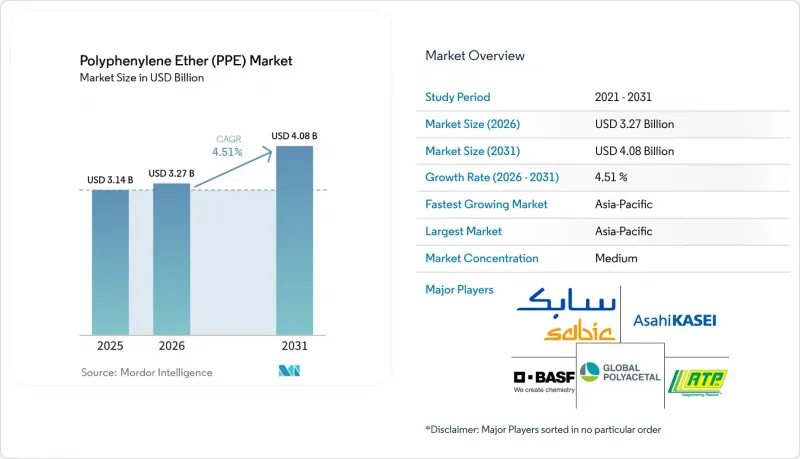
에 따르면 세계의 폴리페닐렌 에테르(PPE) 시장 규모는 2025년 31억 4,000만 달러, 2026년 32억 7,000만 달러에서 2031년까지 40억 8,000만 달러로 확대될 것으로 예측되고 있으며, 2026-2031년까지 연평균 성장률(CAGR)은 4.51%에 달할 전망입니다.
전 세계 폴리페닐렌 에테르(PPE) 시장의 동향 및 인사이트
자동차 경량화 및 전기자동차(EV) 배터리의 안전 요건
전기자동차 안전 요건으로 인해 PPE 계열 소재를 사용할 수 있는 부품의 범위가 확대되고 있습니다. 배터리 셀 홀더, 부스바 절연체, 모듈 커버, 충전 포트 하우징 등이 내연기관 차량에서는 필요하지 않았던 새로운 용도로 추가되고 있습니다. PPE 복합 소재는 알루미늄 제품에 비해 배터리 모듈 하우징의 질량을 최대 35%까지 줄일 수 있을 뿐만 아니라, 할로겐계 첨가제를 사용하지 않고도 UL 94 V-0 등급의 난연 성능을 실현합니다. 이러한 조합을 통해 차량 경량화를 지원하는 동시에 배터리 주변의 안전 요건도 충족할 수 있습니다. 차량 프로그램에서 전기 절연성, 치수 안정성 및 난연 성능을 모두 갖춘 소재가 지정될 경우, 폴리페닐렌 에테르(PPE) 시장은 혜택을 볼 것입니다. 다만, 차량 생산을 위해 각 등급에 대한 검증이 필요하므로 보다 광범위한 채택에는 여전히 지연이 발생할 가능성이 있습니다.
SABIC사는 2025년 2월, 전기자동차(EV)의 서비스 플랩 및 기타 인라인 도장되는 외장 부품용으로 ‘Noryl GTX LMX310’을 출시했습니다. 이 전도성 PPE/폴리아미드 블렌드는 기존 폴리아미드 등급에 비해 평형 흡습률이 85% 낮아졌습니다. 또한 SABIC사는 이 소재의 뒤틀림 위험이 최대 90% 감소했다고 보고했습니다. 이러한 특성은 흡습이나 마감 품질이 부품의 성능에 영향을 미치는 외장 부품에 적합합니다. 서비스 플랩, 카메라 하우징, 도어 핸들에 대한 검증 활동을 통해 기존 구조용 용도를 넘어 PPE/폴리아미드의 역할이 더욱 확대될 가능성이 시사되고 있습니다. 따라서 폴리페닐렌 에테르(PPE) 시장은 외장 마감과 엔지니어링 성능을 모두 필요로 하는 부품에 대한 수요가 점차 확대되고 있습니다.
전자 기기의 소형화 및 고주파 연결
고주파 연결 기술의 발전에 따라 안정적인 유전 특성을 갖춘 소재에 대한 수요가 증가하고 있습니다. 제공된 기술 자료에 따르면 PPE의 유전율은 2.55-2.65, 10 GHz에서의 유전 탄젠트는 0.0008-0.002입니다. 이러한 특성 덕분에 고주파용 구리 박판 적층 기판, 안테나, 레이더 하우징 및 관련 전기 부품에 사용할 수 있습니다. 폴리페닐렌 에테르(PPE) 시장은 스몰 셀, 안테나 소자, 분산형 네트워크 노드의 증가와 밀접한 관련이 있습니다. 이러한 시스템은 모두 정밀 성형된 부품과 신뢰성 높은 신호 성능을 필요로 합니다. 전기적 사양은 지속적으로 발전하고 있으므로, 표준 인증 절차는 여전히 중요합니다.
2024년에 발표된 연구에 따르면 비스마레이미드 가교 PPE 배합재는 85°C, 상대 습도 85%의 시험 후에도 100 GHz 이상에서 낮은 유전 특성을 유지하는 것으로 밝혀졌습니다. 이 연구 결과는 향후 초고주파 기판 용도에 대한 기술적 근거를 지원합니다. 아사히카세이는 5G 안테나 기판 및 유전체 위상 변환기용으로 ‘XYRON’ 및 ‘SunForce’ 발포 PPE 제품을 출시하고 있습니다. 발포 처리를 통해 소재의 유효 유전율을 더욱 낮출 수 있습니다. 이러한 개발을 통해 폴리페닐렌 에테르(PPE) 시장은 적층 기판의 제조 방법을 대폭 변경하지 않으면서도 저손실 성능이 요구되는 설계에서 중요한 역할을 수행하게 될 것입니다. 제품 선정은 유전율 목표치, 부품 형상 및 제조 요건의 균형에 따라 결정됩니다.
2,6-크실레놀 및 페놀의 원료 농도
PPE는 2,6-크실레놀로도 알려진 2,6-디메틸페놀로부터 제조됩니다. 페놀과 메탄올은 이 소재 공급망에서 주요 상류 원료입니다. 생산에는 특수한 알킬화 및 이성질체 분리 기술이 필수적이기 때문에 공급업체의 수는 제한적입니다. 제공된 자료에 따르면 2025년 PPE 총 생산 비용 중 원자재가 60-65%를 차지했습니다. 이러한 비용 구조로 인해 원자재 가격이 상승했을 때 대응할 수 있는 여지는 제한적입니다. 폴리페닐렌에테르(PPE) 시장은 원유 및 천연가스와 연동되는 투입 원자재의 가격 변동 영향을 지속적으로 받고 있습니다.
또한 이 보고서에서는 크레졸산의 공급 경로에서 발생하는 에너지 비용 및 물류와 관련된 유럽내 과거 원료 공급 제약에 대해서도 해설하고 있습니다. 이러한 상황으로 인해 리드타임이 장기화되고 품질 사양이 엄격해졌습니다. 듀얼 소싱, 지역별 안전 재고, 위탁 정제를 활용함으로써 사업상의 리스크를 경감할 수 있습니다. 4-6주 분량의 안전 재고를 확보하는 것은 운전 자금 수요를 증가시키는 요인이 되기도 합니다. 소규모 컴파운더의 경우, 이러한 조치를 감당하는 것이 통합형 공급업체에 비해 어려울 수 있습니다. PPE 부문은 공급 안정성과 비용 및 재고 관리의 엄격함 사이에서 균형을 맞춰야 합니다.
부문 분석
2025년 기준, PPE/폴리스티렌은 유형별 폴리페닐렌 에테르(PPE) 시장 규모의 45.23%를 차지했습니다. 그 확립된 용도에는 자동차 대시보드, 스피커 그릴, 급배수용 이음쇠, 그리고 소비자용 전자기기 케이스 등이 포함됩니다. 이 블렌드는 저밀도, 치수 안정성 및 유전 특성을 겸비하고 있으며, 오랜 기간에 걸친 인증 실적을 지원해 왔습니다. 또한 이 배합은 열경화성 구리 박판 적층판 시스템에 사용되는 저분자량·이관능성 올리고머 등급의 기반이 되고 있습니다. SABIC은 2025년, AI 서버용 다층 적층판 제조업체를 지원하기 위해 NORYL SA9000 올리고머의 생산 능력을 확대했습니다. 이러한 노력은 전자기기 분야의 PPE/폴리스티렌 제품에 대한 지속적인 수요와 기존 성형 부품에 대한 수요를 지원하고 있습니다.
PPE/폴리아미드는 2031년까지 연평균 성장률(CAGR) 5.87%로 성장할 것으로 예측되며, 이는 각 유형 부문 중 가장 높은 성장률입니다. 이 등급은 낮은 흡습성, 인라인 도장성, 그리고 EV 부품용 UL 94 V-0 적합성을 갖추고 있습니다. SABIC의 ‘Noryl GTX LMX310’ 제품은 외장 마감이 필요한 서비스 플랩, 카메라 하우징, 도어 핸들에 사용됩니다. PPE/폴리프로필렌은 저밀도와 내화학성이 요구되는 수처리, 배관 인프라 및 태양광발전용 하우징 용도에 사용됩니다. 기타 PPE 합금으로는 비스마레이미드, 벤조옥사진 또는 반응성 난연 시스템을 사용한 열경화성 올리고머 배합물이 있습니다. 비스마레이미드 가교 PPE는 100 GHz 이상에서도 안정적인 유전 특성을 보여, 향후 고주파 기판으로서의 기술적 타당성을 입증하고 있습니다.
지역별 분석
아시아태평양은 2025년에 전 세계 PPE 수요의 40.48%를 차지할 것으로 예상되며, 2031년까지 연평균 성장률(CAGR) 5.43%로 성장할 것으로 전망됩니다. 중국은 신에너지차 생산과 전자기기 제조를 통해 주요 수요 거점으로 자리 잡고 있습니다. 본 조사에 따르면 중국은 2025년에 1,280만 대의 신에너지차를 생산했습니다. 전기자동차(EV)는 배터리 및 전기 부품을 탑재하고 있으며, 내연기관 차량에 비해 대당 PPE 합금 사용량이 많습니다. 한국은 PCB 기판, OLED 모듈 하우징, 고밀도 커넥터 어셈블리용 전자기기 공급망을 통해 수요를 지원하고 있습니다. 일본은 소재 개발 및 특수 컴파운드 생산 분야에서 여전히 중요한 역할을 수행하고 있습니다.
북미는 제공된 자료에 따르면 2위 지역 시장입니다. 미시간주, 오하이오주, 테네시주의 자동차 프로젝트 외에도 버지니아주, 텍사스주 및 태평양 연안 북서부 지역의 데이터센터 인프라가 수요를 지원하고 있습니다. 누에보 레온주, 치와와주, 바하 캘리포니아주에서의 컴파운드 제조에 대한 투자는 자동차 조립 공장을 위한 니어쇼어 공급을 지원하고 있습니다. SABIC의 올리고머 및 전기자동차용 ‘Noryl GTX LMX’ 등급에 대한 투자는 북미 및 유럽의 프로젝트를 지원하고 있습니다. 유럽에서는 자동차 부품 공급업체와 ADAS용 레이더 하우징, 배터리 구조 부품, 도장 가능한 외장 부품에 대한 수요가 시장을 지원하고 있습니다. 또한 RoHS 및 REACH 요건도 유럽내 용도를 위한 할로겐 프리 등급의 인증을 촉진하고 있습니다.
남미는 브라질의 자동차 조립 거점을 중심으로 한 비교적 소규모의 폴리페닐렌 에테르(PPE) 시장입니다. 상파울루주 및 미나스제라이스주의 자동차 제조사들은 계기판, 수처리 부품, 전자기기 하우징에 컴파운드를 사용하고 있습니다. 아르헨티나의 경제 상황으로 인해 제조 투자는 억제되고 있지만, 화학 및 자동차 분야의 사용자들로부터의 수요는 여전히 유지되고 있습니다. 중동 및 아프리카에서는 PPE 소비가 여전히 발전의 초기 단계에 있습니다. 남아프리카의 자동차 부품 클러스터가 해당 지역 사용량의 대부분을 차지하고 있습니다. 사우디아라비아에서는 산업 다각화가 엔지니어링 플라스틱 생산을 지원하고 있으며, 현지 석유화학 인프라를 통해 원료 측면에서 우위를 점할 것으로 전망됩니다. 두 지역 모두 여전히 주로 수입에 의존하고 있으며, 컴파운드 생산 능력은 점차 확대될 것으로 예상됩니다.
기타 혜택:
- 엑셀 형식의 시장 예측(ME) 시트
- 3개월간의 애널리스트 지원
자주 묻는 질문
목차
제1장 서론
- 조사 전제조건과 시장 정의
- 조사 범위
제2장 조사 방법
제3장 개요
제4장 시장 구도
- 시장 개요
- 시장 성장 촉진요인
- 시장 성장 억제요인
- 밸류체인 분석
- Porter's Five Forces 분석
제5장 시장 규모와 성장 예측
- 유형별
- 용도별
- 지역별
- 아시아태평양
- 중국
- 인도
- 일본
- 한국
- ASEAN 국가
- 기타 아시아태평양 국가
- 북미
- 미국
- 캐나다
- 멕시코
- 유럽
- 독일
- 영국
- 프랑스
- 이탈리아
- 북유럽 국가
- 기타 유럽 국가
- 남미
- 브라질
- 아르헨티나
- 기타 남미 국가
- 중동 및 아프리카
- 사우디아라비아
- 남아프리카공화국
- 기타 중동 및 아프리카 국가
- 아시아태평양
제6장 경쟁 구도
- 시장 집중도
- 전략적 동향
- 시장 점유율·순위 분석
- 기업 개요
- Asahi Kasei Corporation
- BASF
- Celanese Corporation
- Covestro AG
- Ensinger
- EnTech Plastics
- Evonik Industries AG
- Global Polyacetal Co., Ltd.
- Kingfa Sci.& Tech. Co.,Ltd.
- Kraton Corporation
- LG Chem
- LyondellBasell Industries N.V.
- ROMIRA GmbH
- RTP Company
- SABIC
- Sumitomo Chemical Co., Ltd.
제7장 시장 기회와 향후 전망
KSA 26.10.29According to Mordor Intelligence, the global Polyphenylene Ether (PPE) market size is projected to expand from USD 3.14 billion in 2025 and USD 3.27 billion in 2026 to USD 4.08 billion by 2031, at a CAGR of 4.51% between 2026 and 2031.
Global Polyphenylene Ether (PPE) Market Trends and Insights
Automotive Lightweighting and EV Battery Safety Requirements
Electric vehicle safety requirements are expanding the set of parts that can use PPE-based materials. Battery cell holders, busbar insulators, module covers, and charge-port housings add applications that internal-combustion vehicles did not require. PPE composites can reduce battery module housing mass by up to 35% against aluminum equivalents while providing UL 94 V-0 flame performance without halogen additives. This combination supports vehicle weight reduction while addressing battery-proximal safety needs. The Polyphenylene Ether (PPE) market benefits when vehicle programs specify materials that combine electrical insulation, dimensional stability, and flame performance. The need to validate each grade for vehicle production can still delay broader adoption.
SABIC launched Noryl GTX LMX310 in February 2025 for EV service flaps and other inline-painted exterior parts. The conductive PPE/Polyamide blend showed 85% lower equilibrium moisture absorption than incumbent polyamide grades. SABIC also reported up to 90% lower warpage risk for the material. These properties address exterior components where moisture uptake and finishing quality affect part performance. Validation activity for service flaps, camera housings, and door handles points to a wider role for PPE/Polyamide beyond conventional structural uses. The Polyphenylene Ether (PPE) market is therefore gaining demand from parts that need both an exterior finish and engineering performance.
Electronics Miniaturization and High-Frequency Connectivity
High-frequency connectivity is increasing demand for materials with stable dielectric properties. PPE has a dielectric constant of 2.55-2.65 and a dissipation factor of 0.0008-0.002 at 10 GHz in the supplied technical evidence. These properties support use in high-frequency copper-clad laminates, antennas, radar housings, and related electrical parts. The Polyphenylene Ether (PPE) market is linked to the growing number of small cells, antenna elements, and distributed network nodes. Each of these systems requires precisely molded parts and reliable signal performance. Standard qualification processes remain important because electrical specifications continue to evolve.
Research published in 2024 found that bismaleimide-crosslinked PPE formulations retained low dielectric properties above 100 GHz after 85°C and 85% relative-humidity testing. The findings support the technical basis for future ultra-high-frequency substrate applications. Asahi Kasei positions its XYRON and SunForce foamed PPE products for 5G antenna substrates and dielectric phase shifters. Foaming can further reduce the effective dielectric constant of the material. These developments give the Polyphenylene Ether (PPE) market a role in designs that require low-loss performance without a major change in laminate production methods. Product selection will depend on the balance between dielectric targets, part geometry, and manufacturing requirements.
2,6-Xylenol and Phenol Feedstock Concentration
PPE is produced from 2,6-dimethylphenol, also known as 2,6-xylenol. Phenol and methanol are key upstream inputs for this material chain. The supplier base is narrow because production relies on specialized alkylation and isomer-separation technologies. Raw materials accounted for 60-65% of total PPE production costs in 2025 in the supplied content. This cost structure limits the buffer available when feedstock prices rise. The Polyphenylene Ether (PPE) market remains exposed to price movements in crude oil and natural gas-linked inputs.
The supplied content also describes prior European feedstock constraints related to energy costs and logistics for cresylic acid streams. These conditions extended lead times and tightened quality specifications. Dual sourcing, regional safety stocks, and toll purification can reduce operational exposure. Holding 4-6 weeks of safety stock can also increase working-capital requirements. Smaller compounders may find these measures harder to absorb than integrated suppliers. The PPE sector must balance supply security against cost and inventory discipline.
Other drivers and restraints analyzed in the detailed report include:
- Data-Center Power and Thermal-Management Build-Out
- Halogen-Free Flame-Retardant and Low-Dielectric Grade Adoption
- High Qualification Costs and 18-24 Month Design-In Cycles
For complete list of drivers and restraints, kindly check the Table Of Contents.
Segment Analysis
PPE/Polystyrene held 45.23% of the Polyphenylene Ether (PPE) market size by type in 2025. Its established uses include automotive dashboards, speaker grilles, water-handling fittings, and consumer electronics enclosures. The blend combines low density, dimensional stability, and dielectric properties that have supported long qualification histories. It is also the basis for low-molecular-weight, bifunctional oligomer grades used in thermoset copper-clad laminate systems. SABIC expanded NORYL SA9000 oligomer capacity in 2025 to support AI-server multilayer laminate manufacturers. This activity supports continued demand for PPE/Polystyrene formats in electronics as well as established molded parts.
PPE/Polyamide is forecast to grow at a 5.87% CAGR through 2031, the fastest rate among type segments. The grade provides low moisture absorption, inline paintability, and UL 94 V-0 capability for EV components. SABIC's Noryl GTX LMX310 product addresses service flaps, camera housings, and door handles that need an exterior finish. PPE/Polypropylene serves water treatment, plumbing infrastructure, and photovoltaic housing uses where lower density and chemical resistance are relevant. Other PPE alloys include thermoset oligomeric formulations that use bismaleimide, benzoxazine, or reactive flame-retardant systems. Bismaleimide-crosslinked PPE has shown stable dielectric properties above 100 GHz, supporting the technical case for future high-frequency substrates.
Complete Report Scope:
- By Type
- Polyphenylene Ether/Polystyrene
- Polyphenylene Ether/Polyamide
- Polyphenylene Ether/Polypropylene
- Other Polyphenylene Ether Alloys
- By Application
- Automotive
- Electrical and Electronics
- Healthcare
- Aerospace
- Others
- By Geography
- Asia-Pacific
- China
- India
- Japan
- South Korea
- ASEAN Countries
- Rest of Asia-Pacific
- North America
- United States
- Canada
- Mexico
- Europe
- Germany
- United Kingdom
- France
- Italy
- NORDIC Countries
- Rest of Europe
- South America
- Brazil
- Argentina
- Rest of South America
- Middle East and Africa
- Saudi Arabia
- South Africa
- Rest of Middle East and Africa
- Asia-Pacific
Geography Analysis
Asia Pacific held 40.48% of global PPE demand in 2025 and is projected to grow at a 5.43% CAGR through 2031. China is a major demand center because of new-energy vehicle production and electronics manufacturing. The supplied research states that China produced 12.8 million new-energy vehicles in 2025. Each EV can use more PPE alloy content than an internal-combustion vehicle because of battery and electrical components. South Korea supports demand through electronics supply chains serving PCB substrates, OLED module housings, and high-density connector assemblies. Japan remains important for material development and specialized compound production.
North America is the second-largest regional market in the supplied content. Automotive programs in Michigan, Ohio, and Tennessee support demand, along with data-center infrastructure in Virginia, Texas, and the Pacific Northwest. Compounding investment in Nuevo Leon, Chihuahua, and Baja California supports nearshore supply for automotive assembly plants. SABIC's investments in oligomers and EV-focused Noryl GTX LMX grades address North American and European programs. Europe is supported by automotive suppliers and demand for ADAS radar housings, battery structures, and paintable exterior components. RoHS and REACH requirements also support qualification of halogen-free grades in European applications.
South America is a smaller Polyphenylene Ether (PPE) market centered on Brazil's automotive assembly base. Vehicle producers in Sao Paulo and Minas Gerais use compounds in instrument panels, water-handling parts, and electronic housings. Argentina's economic conditions have constrained manufacturing investment but have not removed demand from chemical and automotive users. The Middle East and Africa remain at an early stage of development for PPE consumption. South Africa's automotive component clusters account for much of the regional use. Saudi Arabia has a potential feedstock advantage through local petrochemical infrastructure as industrial diversification supports engineering plastics production. Both regions still rely primarily on imports and are expected to build compounding capacity gradually.
- Asahi Kasei Corporation
- BASF
- Celanese Corporation
- Covestro AG
- Ensinger
- EnTech Plastics
- Evonik Industries AG
- Global Polyacetal Co., Ltd.
- Kingfa Sci.&Tech. Co.,Ltd.
- Kraton Corporation
- LG Chem
- LyondellBasell Industries N.V.
- ROMIRA GmbH
- RTP Company
- SABIC
- Sumitomo Chemical Co., Ltd.
Additional Benefits:
- The market estimate (ME) sheet in Excel format
- 3 months of analyst support
TABLE OF CONTENTS
1 INTRODUCTION
- 1.1 Study Assumptions and Market Definition
- 1.2 Scope of the Study
2 RESEARCH METHODOLOGY
3 EXECUTIVE SUMMARY
4 MARKET LANDSCAPE
- 4.1 Market Overview
- 4.2 Market Drivers
- 4.2.1 Automotive Lightweighting and EV Battery Safety Requirements
- 4.2.2 Electronics Miniaturization and High-Frequency Connectivity
- 4.2.3 Data-Center Power and Thermal-Management Build-Out
- 4.2.4 Halogen-Free Flame-Retardant and Low-Dielectric Grade Adoption
- 4.2.5 Qualification-Ready Local Compounding in Asia-Pacific and Mexico
- 4.3 Market Restraints
- 4.3.1 2,6-Xylenol and Phenol Feedstock Concentration
- 4.3.2 High Qualification Costs and 18-24 Month Design-In Cycles
- 4.3.3 Substitution by PEI, PEEK, LCP, PPS, PC/ABS and Advanced Polyamides
- 4.4 Value Chain Analysis
- 4.5 Porter's Five Forces Analysis
- 4.5.1 Threat of New Entrants
- 4.5.2 Bargaining Power of Suppliers
- 4.5.3 Bargaining Power of Buyers
- 4.5.4 Threat of Substitutes
- 4.5.5 Competitive Rivalry
5 MARKET SIZE AND GROWTH FORECASTS (VALUE)
- 5.1 By Type
- 5.1.1 Polyphenylene Ether/Polystyrene
- 5.1.2 Polyphenylene Ether/Polyamide
- 5.1.3 Polyphenylene Ether/Polypropylene
- 5.1.4 Other Polyphenylene Ether Alloys
- 5.2 By Application
- 5.2.1 Automotive
- 5.2.2 Electrical and Electronics
- 5.2.3 Healthcare
- 5.2.4 Aerospace
- 5.2.5 Others
- 5.3 By Geography
- 5.3.1 Asia-Pacific
- 5.3.1.1 China
- 5.3.1.2 India
- 5.3.1.3 Japan
- 5.3.1.4 South Korea
- 5.3.1.5 ASEAN Countries
- 5.3.1.6 Rest of Asia-Pacific
- 5.3.2 North America
- 5.3.2.1 United States
- 5.3.2.2 Canada
- 5.3.2.3 Mexico
- 5.3.3 Europe
- 5.3.3.1 Germany
- 5.3.3.2 United Kingdom
- 5.3.3.3 France
- 5.3.3.4 Italy
- 5.3.3.5 NORDIC Countries
- 5.3.3.6 Rest of Europe
- 5.3.4 South America
- 5.3.4.1 Brazil
- 5.3.4.2 Argentina
- 5.3.4.3 Rest of South America
- 5.3.5 Middle East and Africa
- 5.3.5.1 Saudi Arabia
- 5.3.5.2 South Africa
- 5.3.5.3 Rest of Middle East and Africa
- 5.3.1 Asia-Pacific
6 COMPETITIVE LANDSCAPE
- 6.1 Market Concentration
- 6.2 Strategic Moves
- 6.3 Market Share (%)/Ranking Analysis
- 6.4 Company Profiles (includes Global Level Overview, Market Level Overview, Core Segments, Financials as available, Strategic Information, Products and Services, Recent Developments)
- 6.4.1 Asahi Kasei Corporation
- 6.4.2 BASF
- 6.4.3 Celanese Corporation
- 6.4.4 Covestro AG
- 6.4.5 Ensinger
- 6.4.6 EnTech Plastics
- 6.4.7 Evonik Industries AG
- 6.4.8 Global Polyacetal Co., Ltd.
- 6.4.9 Kingfa Sci.&Tech. Co.,Ltd.
- 6.4.10 Kraton Corporation
- 6.4.11 LG Chem
- 6.4.12 LyondellBasell Industries N.V.
- 6.4.13 ROMIRA GmbH
- 6.4.14 RTP Company
- 6.4.15 SABIC
- 6.4.16 Sumitomo Chemical Co., Ltd.
7 MARKET OPPORTUNITIES AND FUTURE OUTLOOK
- 7.1 White-Space and Unmet-Need Assessment


