

|
시장보고서
상품코드
2157059
민간 항공기 기내 엔터테인먼트 및 접속 시스템 : 시장 점유율 분석, 업계 동향과 통계, 성장 예측(2026-2031년)Commercial Aircraft Inflight Entertainment and Connectivity Systems - Market Share Analysis, Industry Trends & Statistics, Growth Forecasts (2026 - 2031) |
||||||
 Mordor Intelligence
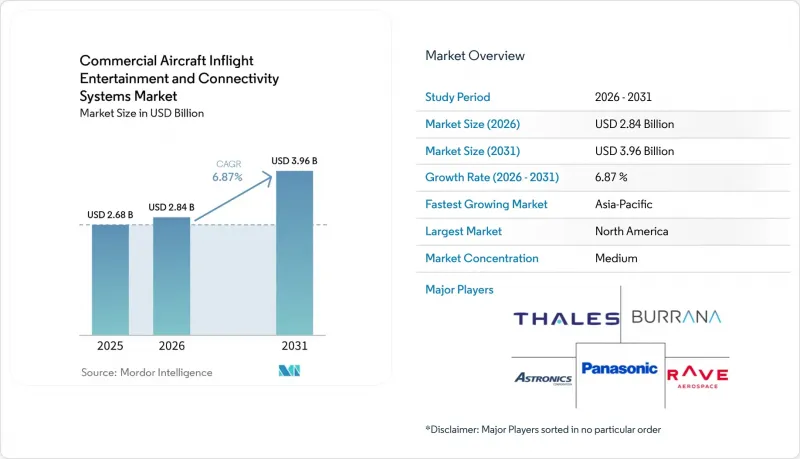
에 따르면 민간 항공기 기내 엔터테인먼트 및 커넥티비티 시스템 시장은 2025년에 26억 8,000만 달러 규모에 달하며, 2026년 28억 4,000만 달러에서 2031년까지 39억 6,000만 달러에 달할 것으로 예측되고 있으며, 예측 기간(2026-2031년)에 CAGR은 6.87%에 달할 전망입니다.
전 세계 민간 항공기용 기내 엔터테인먼트 및 커넥티비티 시스템 시장의 동향과 인사이트
승객 경험을 중시한 기내 서비스의 차별화
민간 항공사들은 기내 승객 경험을 차별화하기 위해 기내 엔터테인먼트 및 커넥티비티 시스템을 점점 더 많이 활용하고 있습니다. 각 항공사는 와이드바디 기종과 나로우바디 기종 모두에 4K 디스플레이, 블루투스 오디오, 공간 오디오, 고출력 USB-C 충전을 도입하고 있습니다. 파나소닉 아비오닉스의 ‘Astrova’ 시스템은 2024년 12월 아이슬란드 항공이 A321LR에 최초로 도입한 것으로, 4K OLED HDR10+ 디스플레이, 블루투스 지원 공간 오디오, 그리고 67W USB-C 충전 기능을 갖추고 있습니다. 마찬가지로 SWISS Senses도 A350-900 기종에 4K 엔터테인먼트 디스플레이, 블루투스 연결, 첨단 객실 조명, 그리고 강화된 프리미엄 좌석 제어 기능을 결합하고 있습니다. 캐세이퍼시픽항공도 A321neo 전 기종에 4K 좌석 등받이 디스플레이와 블루투스 오디오를 도입하고 있으며, 이는 항공사의 기내 차별화에서 첨단 기내 엔터테인먼트 및 연결 시스템의 역할이 점점 더 중요해지고 있음을 반영하고 있습니다.
아시아태평양의 항공기 수와 승객 수의 급증
아시아태평양의 여객 수 증가와 항공기 대수 확충은 기내 엔터테인먼트 및 연결성에 대한 수요를 지속적으로 지원하고 있습니다. 2026년 상반기, 아시아태평양 항공사의 국제선 여객 수요는 전년 동기 대비 5.3% 증가했으며, 2026년 7월의 여객 킬로미터(RPK)는 2025년 7월 수준을 1.1% 상회했습니다. 에어버스(Airbus)는 2044년까지 아시아태평양에서 19,560대의 신형 여객기가 필요할 것으로 예측하고 있으며, 이는 전 세계 수요의 46%를 차지합니다. 또한 이 지역의 디지털 및 연결 서비스 시장은 2025년 29억 달러에서 2044년까지 112억 달러로 성장할 것으로 전망됩니다. LCC(저비용 항공사)에서의 도입도 확대되고 있으며, 비엣젯 태국은 보유 중인 18대의 에어버스제 협동체기 전 기종에 블루박스 어비에이션(Blue Box Aviation)사의 ‘블루뷰(BlueView)’ 플랫폼을 도입했으며, 향후 도입 예정인 B737 MAX 기종으로의 확대도 계획하고 있습니다. 이러한 동향은 FSC(풀서비스 항공사)와 LCC 모두에서 기내 엔터테인먼트 및 연결성 시스템의 보급을 촉진하고 있습니다.
좌석 등받이형 시스템에 대한 설비 투자(CAPEX) 및 중량 증가
기존의 좌석 등받이형 IFE 시스템에는 디스플레이, 전원, 배선, 좌석 내장 및 지원용 하드웨어가 필요하며, 이로 인해 무선형 엔터테인먼트 대안과 비교했을 때 항공기 개조 비용과 탑재 중량이 증가합니다. 중량은 여전히 중요한 설계 고려 사항입니다. 탈레스의 ‘Optiq 4K’ 디스플레이는 이전 세대 제품에 비해 약 30% 가벼워졌을 뿐만 아니라 총 소유 비용(TCO)도 절감하고 있습니다. 비용 압박 또한 개조를 중점으로 한 솔루션을 지원하고 있습니다. 2026년 4월, 파나소닉 아비오닉스는 기존 X 시리즈 모니터를 대체할 비용 효율적인 드롭인형 교체 제품으로 ‘eXNeo’를 발표했습니다. 이를 통해 항공사는 좌석을 교체하거나 객실을 전면 개조하지 않고도 기존 IFE를 업그레이드할 수 있게 되었습니다. 이러한 동향은 프리미엄 좌석 등받이 경험과 탑재 시스템의 비용, 무게, 복잡성 사이에서 여전히 상충 관계가 존재함을 여실히 보여주고 있습니다.
부문 분석
2025년에는 좌석 등받이형 기기가 시장의 52.88%를 차지했습니다. 이는 프리미엄 클래스 및 장거리 노선에서의 지속적인 이용에 더해, 협동체기(narrow-body) 기종에서의 채택이 증가하고 있는 것이 배경입니다. 파나소닉 아비오닉스의 ‘Astrova’는 2025년 12월까지 100개의 항공사 프로그램에 걸쳐 30개 이상의 항공사로부터 채택되었습니다. 한편, 에어 캐나다는 86대를 대상으로 한 도입 계획의 일환으로 2026년 4월 A321에서 해당 시스템의 운용을 시작했습니다. 또한 모듈식 설계 덕분에 업그레이드의 복잡성도 완화되었습니다. 2026년 4월에 도입된 파나소닉의 ‘eXNeo’는 기존 하네스와 기계적 인터페이스를 활용하고 있으며, 기존 좌석 등받이 시스템 업그레이드시 인증 획득 부담과 항공기 가동 중단 시간을 최소화하도록 설계되었습니다.
각 항공사가 무선 엔터테인먼트, 클라우드 기반 컨텐츠 관리 및 기내 연결형 애플리케이션을 확대함에 따라 기내 커넥티비티 서버 시장은 2031년까지 연평균 성장률(CAGR) 7.25%로 성장할 것으로 예측됩니다. 파나소닉의 ‘Converix’ 플랫폼은 모듈형 서버 아키텍처 내에서 기내 엔터테인먼트 및 연결 시스템 통합, 기내 컴퓨팅, 확장 가능한 스토리지, OTT 스트리밍, 동적 컨텐츠 캐시를 통합하고 있습니다. 서버 기반 연결성은 무선 객실 전체에서도 확대되고 있습니다. Viasat의 2026년 인증 실적에는 차세대 모바일 애플리케이션 서버와 객실용 무선 액세스 포인트가 포함되어 있는 반면, 파나소닉의 ‘eXW’ 무선 IFE는 에어 아라비아의 172대 항공기에 채택되어 있습니다. 이러한 동향은 좌석 등받이 서비스와 승객의 기기를 위한 서비스를 모두 지원할 수 있는 유연한 기내 서버에 대한 수요가 증가하고 있음을 지원합니다.
2025년, 협동체기(narrow-body)는 대규모 도입 실적과 지속적인 기단 확장에 힘입어 민간 항공기 기내 엔터테인먼트 및 커넥티비티 시스템 시장의 49.35%를 차지했습니다. 에어버스의 2026년 전망에 따르면 2045년까지 필요한 42,060대의 신형 항공기 중 단일 통로 항공기가 81%를 차지할 것으로 예측되어, 기내 엔터테인먼트 및 연결 시스템 도입에 대한 장기적인 기회가 더욱 강화되고 있습니다. 또한 첨단 시스템도 협동체기 기단에 더욱 확산되고 있습니다. 에어 캐나다는 23대의 신형 A220-300 및 30대의 A321XLR에 파나소닉의 ‘아스트로바’를 출고시 기본 사양으로 장착하는 한편, 별도의 19대의 A321 기종에 대해서는 4K OLED 디스플레이, 블루투스 오디오, 그리고 업그레이드된 승객용 인터페이스를 사후 장착하고 있습니다. 이를 통해 단일 통로 항공기와 기존 장거리 노선의 객실 간 기술 격차가 점차 좁혀지고 있습니다.
지역 제트기는 기단 갱신, 지방 도시로의 연결성 향상, 그리고 경량 무선 기내 엔터테인먼트·통신 시스템의 보급 확대에 힘입어 2031년까지 연평균 성장률(CAGR) 7.80%로 성장할 것으로 예측됩니다. 엠브라에르의 2026년 전망에 따르면 2045년까지 150석 미만의 제트기에 대한 수요가 8,500대, 총액 6,500억 달러에 달할 것으로 예측됩니다. 통신 기능도 향상되어, 엠브라에르는 E-Jets E2에 최대 275 Mbps 속도를 지원하는 인텔샛(Intelsat)의 다궤도 고속 통신 시스템을 공장 출하시 옵션으로 제공하고 있습니다. 버진 호주 리저널 항공(Virgin Australia Regional Airlines)의 E190-E2 역시 고대역폭 Wi-Fi와 승객의 개인 단말기로 직접 스트리밍되는 엔터테인먼트 기능을 갖추고 있으며, 소형 항공기에서 기내 엔터테인먼트 및 통신 시스템의 도입이 확대되고 있음을 보여줍니다.
지역별 분석
2025년, 북미는 민간 항공기 기내 엔터테인먼트 및 통신 시스템 시장의 30.88%를 차지했습니다. 이는 대규모의 연결된 기단과 기내 고속 통신에 대한 지속적인 투자가 지원된 결과입니다. 2026년 2분기까지 유나이티드 항공은 450대의 항공기에 스타링크를 도입할 예정이며, 연말까지 약 1,000대로 확대될 것으로 예상되며, 2027년까지 전체 기단에 도입하는 것을 목표로 하고 있습니다. 델타항공의 무료 Wi-Fi 서비스 ‘Delta Sync’는 2026년 5월 기준 1,200대 이상의 항공기에 도입되었으며, 서비스 개시 이후 1억 6,000만 회 이상의 고객 이용을 기록했습니다. 하와이안 항공도 A330 및 A321neo 전 기종에서 무료 스타링크를 제공하고 있습니다. 연결 환경이 이미 널리 보급됨에 따라 업계의 수요는 기체 업그레이드, 더 빠른 위성 시스템, 그리고 통합된 디지털 승객 서비스로 점점 더 이동하고 있습니다.
아시아태평양은 급속한 기단 확충과 여객 수 증가에 힘입어 2031년까지 연평균 성장률(CAGR) 7.95%로 성장할 것으로 전망됩니다. 에어버스는 이 지역에서 2044년까지 19,560대의 신형 여객기가 필요할 것으로 전망하며, 이는 전 세계 수요의 46%를 차지하고, 승객 수는 연평균 4.4% 증가할 것으로 예상하고 있습니다. 캐세이퍼시픽항공은 2025년 8월부터 전 기종에서 좌석 등받이형 기내 엔터테인먼트(IFE) 및 고속 Wi-Fi 이용을 가능하게 했습니다. 한편, 비엣젯 태국은 18대의 에어버스 기종에 블루박스(Bluebox)사의 ‘Blueview’ 무선 IFE 플랫폼을 도입했으며, 향후 도입 예정인 B737 MAX 기종으로도 확대할 계획입니다. 이러한 투자를 통해 프리미엄 항공사와 LCC(저비용 항공사) 모두에서 기내 엔터테인먼트 및 연결 시스템의 도입이 확대되고 있습니다.
유럽, 중동 및 아프리카에서는 프리미엄 좌석 등받이형 및 무선형 기내 엔터테인먼트·통신 시스템의 도입 현황에 차이가 보입니다. 스위스 항공은 2025년에 ‘SWISS Senses’ 사양의 A350 객실을 도입할 예정이며, TUI는 엔터테인먼트, 메시징, 목적지 예약을 지원하기 위해 59대의 B737에 Immfly의 디지털 플랫폼을 도입했습니다. 중동에서는 사우디아(Saudia)가 2026년 6월 A321XLR에 파나소닉의 ‘Astrova’를 도입하고, 추가로 46대의 A321, A330, B777 기종에도 해당 플랫폼을 사후 도입하기로 결정하여, 협동체기 및 광폭기 양쪽 기단에서 기내 엔터테인먼트 및 연결 시스템의 추가적인 현대화를 추진하고 있습니다.
기타 혜택:
- 엑셀 형식의 시장 예측(ME) 시트
- 3개월간의 애널리스트 지원
자주 묻는 질문
목차
제1장 서론
- 조사 전제조건과 시장 정의
- 조사 범위
제2장 조사 방법
제3장 개요
제4장 시장 구도
- 시장 개요
- 시장 성장 촉진요인
- 시장 성장 억제요인
- 밸류체인 분석
- 규제 상황
- 기술 전망
- Porter's Five Forces 분석
제5장 시장 규모와 성장 예측
- 시스템 유형별
- 항공기 유형별
- 피트 유형별
- 객실 클래스별
- 지역별
- 북미
- 미국
- 캐나다
- 멕시코
- 유럽
- 영국
- 프랑스
- 독일
- 스페인
- 이탈리아
- 러시아
- 기타 유럽 국가
- 아시아태평양
- 중국
- 인도
- 일본
- 한국
- 호주
- 기타 아시아태평양 국가
- 남미
- 브라질
- 기타 남미 국가
- 중동 및 아프리카
- 중동
- 아랍에미리트
- 사우디아라비아
- 튀르키예
- 기타 중동 국가
- 아프리카
- 남아프리카공화국
- 기타 아프리카 국가
- 중동
- 북미
제6장 경쟁 구도
- 시장 집중도
- 전략적 동향
- 시장 점유율 분석
- 기업 개요
- Panasonic Holdings Corporation
- Thales Group
- RAVE Aerospace, LLC
- RTX Corporation
- Burrana Pty Ltd.
- Astronics Corporation
- Viasat Inc.
- SES S.A.(Intelsat)
- Lufthansa Systems GmbH & Co. KG(DEUTSCHE LUFTHANSA AG)
- Shenzhen Donica Avionics Co., Ltd.
- Imagik Corp.
- LATECOERE S.A.
- Anuvu Operations LLC
- FTS Systems LLC
제7장 시장 기회와 향후 전망
KSA 26.10.30According to Mordor Intelligence, the commercial aircraft inflight entertainment and connectivity systems market was valued at USD 2.68 billion in 2025 and is estimated to grow from USD 2.84 billion in 2026 to reach USD 3.96 billion by 2031, at a CAGR of 6.87% during the forecast period (2026-2031).
Global Commercial Aircraft Inflight Entertainment and Connectivity Systems Market Trends and Insights
Passenger-Experience Driven Cabin Differentiation
Commercial airlines are increasingly using inflight entertainment and connectivity systems to differentiate the onboard passenger experience. Carriers are adopting 4K displays, Bluetooth audio, spatial audio, and high-power USB-C charging across both widebody and narrowbody fleets. Panasonic Avionics' Astrova system, first deployed by Icelandair on its A321LR in December 2024, offers 4K OLED HDR10+ displays, Bluetooth-enabled spatial audio, and 67W USB-C charging. SWISS Senses similarly combines 4K entertainment displays, Bluetooth connectivity, advanced cabin lighting, and enhanced premium-seat controls on the A350-900. Cathay Pacific has also introduced 4K seatback displays and Bluetooth audio across its A321neo cabins, reflecting the growing role of advanced inflight entertainment and connectivity systems in airline cabin differentiation.
Asia-Pacific Fleet and Passenger Boom
Asia-Pacific passenger growth and fleet expansion continue to support demand for inflight entertainment and connectivity. International passenger demand among Asia-Pacific airlines increased 5.3% year on year in H1 2026, while July 2026 revenue passenger kilometers (RPKs) remained 1.1% above July 2025 levels. Airbus expects Asia-Pacific to require 19,560 new passenger aircraft through 2044, representing 46% of global demand, while regional digital and connectivity services are projected to grow from USD 2.9 billion in 2025 to USD 11.2 billion by 2044. LCC adoption is also expanding, with Vietjet Thailand selecting Bluebox Aviation's Blueview platform across its 18-aircraft Airbus narrowbody fleet, with planned expansion to incoming B737 MAX aircraft. These developments support broader inflight entertainment and connectivity systems penetration across both FSCs and LCCs.
CAPEX and Weight Penalty of Seat-Back Systems
Traditional seat-back IFE systems require displays, power, wiring, seat integration, and supporting hardware, which increases aircraft modification costs and installed weight compared with wireless entertainment alternatives. Weight remains an important design consideration: Thales' Optiq 4K displays are around 30% lighter than the previous generation while also reducing total cost of ownership. Cost pressure is also driving retrofit-focused solutions. In April 2026, Panasonic Avionics introduced eXNeo as a cost-effective drop-in replacement for legacy X Series monitors, allowing airlines to upgrade existing IFE without replacing seats or completing a full cabin overhaul. These developments highlight the ongoing trade-off between premium seat-back experiences and the cost, weight, and complexity of installed systems.
Other drivers and restraints analyzed in the detailed report include:
- High-Speed Satcom Enabling Streaming-Grade Bandwidth
- Bring Your Own Device (BYOD) retrofit cost advantage
- Certification Hurdles for EMI/EMC
For complete list of drivers and restraints, kindly check the Table Of Contents.
Segment Analysis
Seat-back devices accounted for 52.88% of the market in 2025, supported by their continued use across premium and long-haul cabins and increasing adoption on narrowbody aircraft. Panasonic Avionics' Astrova had been selected by more than 30 airlines across 100 airline programs by December 2025, while Air Canada began operating the system on its A321 in April 2026 as part of an 86-aircraft deployment. Modular designs are also reducing upgrade complexity. Panasonic's eXNeo, introduced in April 2026, uses existing harnesses and mechanical interfaces and is designed to minimize certification effort and aircraft downtime during upgrades of legacy seat-back systems.
Cabin connectivity servers are projected to grow at a 7.25% CAGR through 2031 as airlines expand wireless entertainment, cloud-based content management, and connected onboard applications. Panasonic's Converix platform combines inflight entertainment and connectivity systems integration, onboard computing, scalable storage, OTT streaming, and dynamic content caching within a modular server architecture. Server-based connectivity is also expanding across wireless cabins; Viasat's 2026 certification records include its next-generation mobile application server and cabin wireless access points, while Panasonic's eXW wireless IFE has been selected across 172 Air Arabia aircraft. These developments support increasing demand for flexible onboard servers capable of supporting both seat-back and passenger-device services.
Narrowbody aircraft accounted for 49.35% of the commercial aircraft inflight entertainment and connectivity systems market in 2025, supported by their large installed base and continued fleet expansion. Airbus' 2026 outlook expects single-aisle aircraft to account for 81% of the 42,060 new aircraft required through 2045, reinforcing the long-term opportunity for installing inflight entertainment and connectivity systems. Advanced systems are also moving deeper into narrowbody fleets. Air Canada is line-fitting Panasonic Astrova on 23 new A220-300s and 30 A321XLRs, while retrofitting another 19 A321 aircraft with 4K OLED displays, Bluetooth audio, and upgraded passenger interfaces. This is narrowing the technology gap between single-aisle and traditional long-haul cabins.
Regional jets are projected to grow at a 7.80% CAGR through 2031, supported by fleet renewal, secondary-city connectivity, and increasing availability of lightweight wireless inflight entertainment and connectivity systems. Embraer's 2026 outlook forecasts demand for 8,500 sub-150-seat jets through 2045, valued at USD 650 billion. Connectivity capability is also improving, with Embraer offering Intelsat's multi-orbit high-speed connectivity system as a factory-installed option on E-Jets E2, supporting speeds of up to 275 Mbps. Virgin Australia Regional Airlines' E190-E2s also feature high-bandwidth Wi-Fi and entertainment streamed directly to passengers' personal devices, demonstrating growing inflight entertainment and connectivity systems adoption on smaller aircraft.
Complete Report Scope:
- By System Type
- Seat-back IFEC
- Wireless and BYOD IFE
- In-seat Power and Peripherals
- By Aircraft Type
- Narrowbody Aircraft
- Widebody Aircraft
- Regional Jets
- By Fit Type
- Original Equipment Manufacturer (OEM)
- Aftermarket
- By Cabin Class
- First Class
- Business Class
- Premium Economy Class
- Economy Class
- By Geography
- North America
- United States
- Canada
- Mexico
- Europe
- United Kingdom
- France
- Germany
- Spain
- Italy
- Russia
- Rest of Europe
- Asia-Pacific
- China
- India
- Japan
- South Korea
- Australia
- Rest of Asia-Pacific
- South America
- Brazil
- Rest of South America
- Middle East and Africa
- Middle East
- United Arab Emirates
- Saudi Arabia
- Turkey
- Rest of Middle East
- Africa
- South Africa
- Rest of Africa
- Middle East
- North America
Geography Analysis
North America accounted for 30.88% of the commercial aircraft inflight entertainment and connectivity systems market in 2025, supported by large connected fleets and continued investment in high-speed onboard connectivity. By Q2 2026, United Airlines had installed Starlink on 450 aircraft, with nearly 1,000 expected by year-end and fleetwide coverage targeted by 2027. Delta's free Delta Sync Wi-Fi covered more than 1,200 aircraft by May 2026 and had recorded over 160 million customer sessions since launch. Hawaiian Airlines also provides free Starlink across its A330 and A321neo fleet. With connectivity already widespread, regional demand is increasingly shifting toward fleet upgrades, faster satellite systems, and integrated digital passenger services.
Asia-Pacific is projected to grow at a 7.95% CAGR through 2031, supported by rapid fleet expansion and passenger traffic growth. Airbus expects the region to require 19,560 new passenger aircraft through 2044, accounting for 46% of global demand, with passenger traffic growing at 4.4% annually. Cathay Pacific achieved seatback IFE and high-speed Wi-Fi availability across its entire fleet from August 2025, while Vietjet Thailand selected Bluebox's Blueview wireless IFE platform for 18 Airbus aircraft, with expansion planned to include incoming B737 MAX aircraft. These investments are expanding the adoption of in-flight entertainment and connectivity systems across both premium and LCCs.
Europe, the Middle East, and Africa continue to show a mix of adoption of premium seatback and wireless inflight entertainment and connectivity systems. SWISS introduced its SWISS Senses A350 cabin in 2025, while TUI deployed Immfly's digital platform across 59 B737 aircraft to support entertainment, messaging, and destination bookings. In the Middle East, Saudia introduced Panasonic Astrova on its A321XLR in June 2026 and has committed to retrofitting the platform across another 46 A321, A330, and B777 aircraft, supporting further inflight entertainment and connectivity systems modernization across both narrowbody and widebody fleets.
- Panasonic Holdings Corporation
- Thales Group
- RAVE Aerospace, LLC
- RTX Corporation
- Burrana Pty Ltd.
- Astronics Corporation
- Viasat Inc.
- SES S.A. (Intelsat)
- Lufthansa Systems GmbH & Co. KG (DEUTSCHE LUFTHANSA AG)
- Shenzhen Donica Avionics Co., Ltd.
- Imagik Corp.
- LATECOERE S.A.
- Anuvu Operations LLC
- FTS Systems LLC
Additional Benefits:
- The market estimate (ME) sheet in Excel format
- 3 months of analyst support
TABLE OF CONTENTS
1 INTRODUCTION
- 1.1 Study Assumptions and Market Definition
- 1.2 Scope of the Study
2 RESEARCH METHODOLOGY
3 EXECUTIVE SUMMARY
4 MARKET LANDSCAPE
- 4.1 Market Overview
- 4.2 Market Drivers
- 4.2.1 Passenger-experience driven cabin differentiation
- 4.2.2 Asia-Pacific fleet and passenger boom
- 4.2.3 High-speed satcom enabling streaming-grade bandwidth
- 4.2.4 Bring Your Own Device (BYOD) retrofit cost advantage
- 4.2.5 Low Earth Orbit (LEO) satellite bandwidth cost collapse
- 4.2.6 IFE-enabled onboard e-commerce revenue
- 4.3 Market Restraints
- 4.3.1 Capex and weight penalty of seat-back systems
- 4.3.2 Certification hurdles for EMI/EMC
- 4.3.3 Cross-border content licensing complexity
- 4.3.4 Cyber-security risks in open Wi-Fi architectures
- 4.4 Value Chain Analysis
- 4.5 Regulatory Landscape
- 4.6 Technological Outlook
- 4.7 Porter's Five Forces Analysis
- 4.7.1 Bargaining Power of Suppliers
- 4.7.2 Bargaining Power of Buyers
- 4.7.3 Threat of New Entrants
- 4.7.4 Threat of Substitutes
- 4.7.5 Intensity of Competitive Rivalry
5 MARKET SIZE AND GROWTH FORECASTS (VALUE)
- 5.1 By System Type
- 5.1.1 Seat-back IFEC
- 5.1.2 Wireless and BYOD IFE
- 5.1.3 In-seat Power and Peripherals
- 5.2 By Aircraft Type
- 5.2.1 Narrowbody Aircraft
- 5.2.2 Widebody Aircraft
- 5.2.3 Regional Jets
- 5.3 By Fit Type
- 5.3.1 Original Equipment Manufacturer (OEM)
- 5.3.2 Aftermarket
- 5.4 By Cabin Class
- 5.4.1 First Class
- 5.4.2 Business Class
- 5.4.3 Premium Economy Class
- 5.4.4 Economy Class
- 5.5 By Geography
- 5.5.1 North America
- 5.5.1.1 United States
- 5.5.1.2 Canada
- 5.5.1.3 Mexico
- 5.5.2 Europe
- 5.5.2.1 United Kingdom
- 5.5.2.2 France
- 5.5.2.3 Germany
- 5.5.2.4 Spain
- 5.5.2.5 Italy
- 5.5.2.6 Russia
- 5.5.2.7 Rest of Europe
- 5.5.3 Asia-Pacific
- 5.5.3.1 China
- 5.5.3.2 India
- 5.5.3.3 Japan
- 5.5.3.4 South Korea
- 5.5.3.5 Australia
- 5.5.3.6 Rest of Asia-Pacific
- 5.5.4 South America
- 5.5.4.1 Brazil
- 5.5.4.2 Rest of South America
- 5.5.5 Middle East and Africa
- 5.5.5.1 Middle East
- 5.5.5.1.1 United Arab Emirates
- 5.5.5.1.2 Saudi Arabia
- 5.5.5.1.3 Turkey
- 5.5.5.1.4 Rest of Middle East
- 5.5.5.2 Africa
- 5.5.5.2.1 South Africa
- 5.5.5.2.2 Rest of Africa
- 5.5.5.1 Middle East
- 5.5.1 North America
6 COMPETITIVE LANDSCAPE
- 6.1 Market Concentration
- 6.2 Strategic Moves
- 6.3 Market Share Analysis
- 6.4 Company Profiles (includes Global level Overview, Market level overview, Core Segments, Financials as available, Strategic Information, Market Rank/Share for key companies, Products and Services, and Recent Developments)
- 6.4.1 Panasonic Holdings Corporation
- 6.4.2 Thales Group
- 6.4.3 RAVE Aerospace, LLC
- 6.4.4 RTX Corporation
- 6.4.5 Burrana Pty Ltd.
- 6.4.6 Astronics Corporation
- 6.4.7 Viasat Inc.
- 6.4.8 SES S.A. (Intelsat)
- 6.4.9 Lufthansa Systems GmbH & Co. KG (DEUTSCHE LUFTHANSA AG)
- 6.4.10 Shenzhen Donica Avionics Co., Ltd.
- 6.4.11 Imagik Corp.
- 6.4.12 LATECOERE S.A.
- 6.4.13 Anuvu Operations LLC
- 6.4.14 FTS Systems LLC
7 MARKET OPPORTUNITIES AND FUTURE OUTLOOK
- 7.1 White-space and Unmet-Need Assessment


