

|
시장보고서
상품코드
2157109
유럽, 중동 및 아프리카(EMEA)의 바이오 농약 종자 처리 : 시장 점유율 분석, 업계 동향과 통계, 성장 예측(2026-2031년)Europe, Middle East, and Africa (EMEA) Biopesticides Seed Treatment - Market Share Analysis, Industry Trends & Statistics, Growth Forecasts (2026 - 2031) |
||||||
 Mordor Intelligence
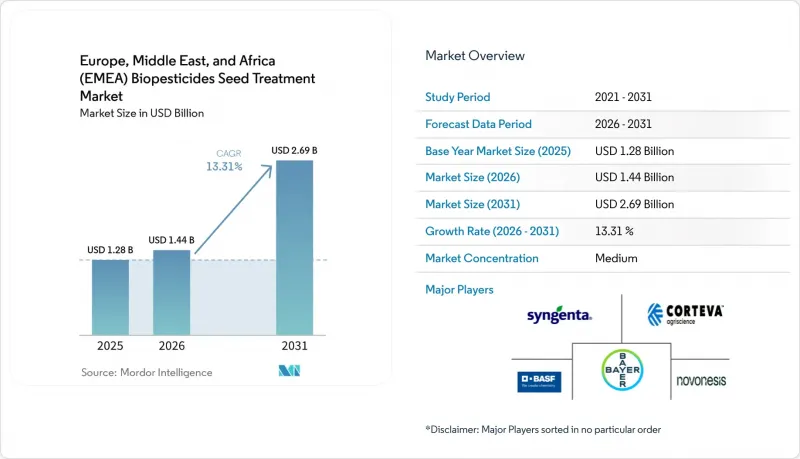
에 따르면 유럽, 중동 및 아프리카(EMEA) 지역의 바이오 농약에 의한 종자 처리 시장 규모는 2025년에 12억 8,000만 달러로 평가되며, 2026년에는 14억 4,000만 달러, 2031년까지 26억 9,000만 달러에 달할 것으로 예측되고 있으며, 2026-2031년에 CAGR 13.31%로 성장할 것으로 전망되고 있습니다.
유럽·중동 및 아프리카(EMEA) 지역의 바이오 농약을 이용한 종자 처리 시장 동향 및 인사이트
저잔류 농약에 대한 수요 증가
수출 지향형 농업 시스템이 EMEA 지역의 바이오 농약을 이용한 종자 처리 시장에서 투입 자재 선정에 새로운 변화를 가져오고 있습니다. 유럽 식품 공급망에 제품을 공급하는 구매자들은 엄격한 잔류 기준 준수를 여전히 최우선 과제로 삼고 있으며, 이는 파종 전 종자 처리 결정에 점점 더 큰 영향을 미치고 있습니다. 이러한 추세는 생산자가 생육 후기 화학 농약 사용을 줄이고, 더 깨끗하고 지속가능한 작물 보호 프로그램으로 시즌을 시작하려는 재배 시스템에서 특히 두드러집니다. 정책 방향 또한 이러한 전환을 지속적으로 지원하고 있으며, 규제 전략은 기존 화학 농약에 대한 의존도를 줄이고 더 안전한 대안을 장려하는 데 중점을 두고 있습니다. 이러한 전환 과정에서 ‘농장에서 식탁까지(Farm-to-Fork) 전략’은 여전히 중심적인 역할을 수행하고 있으며, 유럽연합(EU)에서는 2030년까지 화학 농약 사용량과 위험을 50% 감축하는 것을 목표로 하고 있습니다. 또한 최근 정책 동향은 생물학적 작물 보호 제품에 대해 더 유리한 규제 경로를 마련함으로써 생물학적 방제 솔루션의 보다 신속한 도입을 지원하고 있습니다. 시장에서는 이러한 동향이 농법과 잔류물 규제를 모두 고려한 무역 요건을 충족하는 미생물 및 생물학적 종자 처리제의 상업적 타당성을 높이고 있습니다. 또한 이러한 제품의 채택이 인증 유기농 재배의 범위를 넘어 주류 상업 농업으로 확대됨에 따라 전반적인 잠재 수요 기반도 확대되고 있습니다.
종자 코팅 공정에서의 생물제제 확대
EMEA 지역의 생물농약을 이용한 종자 처리 시장은 생물활성 물질이 틈새 시장 수준의 시험 프로그램에 국한되지 않고 표준 종자 코팅 공정에 점점 더 통합됨에 따라 탄력을 받고 있습니다. 종자 회사가 생물학적 처리를 일상적인 코팅 공정에 통합하면, 그 도입은 더욱 일관성 있게 이루어지며, 농장 차원의 취급에 대한 의존도도 낮아집니다. 이러한 전환은 확장성과 업무 효율성을 향상시킴으로써 생물농약의 상업적 타당성을 높이고 있습니다. BASF SE에 따르면 Bacillus amyloliquefaciens MBI600을 기반으로 한 ‘Integral Pro’는 유럽에서 수백만 헥타르의 유채를 보호해 왔다고 합니다. 이 회사는 2025년 11월 프랑스에서 해바라기용 첫 등록을 획득했으며, 2026년 파종 시즌에는 유럽연합(EU) 전역에서 판매를 시작할 예정입니다. 동시에, 첨단 코팅 시스템으로의 전환에 따라 제제의 적합성과 공정 통합의 중요성이 높아지고 있습니다. 그 결과, 시장은 단순히 유효 성분의 입수 가능성보다는 제형에 대한 전문 지식 및 코팅 성능과 더욱 밀접하게 연결되고 있습니다. 이러한 추세는 생물학적 효능을 산업적 종자 가공의 물리적 및 운영상 요건과 조화시킬 수 있는 공급업체에게 유리하게 작용하고 있습니다.
토양 및 기후 조건에 따른 포장별 효능의 편차
토양 및 기후 조건에 따른 효능의 편차는 여전히 시장의 큰 제약 요인으로 남아 있습니다. 파종부터 작물 정착까지의 짧은 기간 중의 생물학적 활성은 토양 온도, 수분, pH 및 현지 미생물 군집에 크게 좌우됩니다. 이러한 조건은 EMEA 지역 내, 특히 온대 유럽과 고온·건조한 생산 지역 간에 상당히 다릅니다. 2026년 'Plants'지에 게재된 연구에서는 사우디아라비아의 조건 하에서 올리브 진드기 해충에 대한 세균성 생물 방제제가 평가되었으며, 기후나 해충에 특화된 용도에서 현지에서 시험된 생물학적 솔루션의 중요성이 부각되었습니다. EMEA 지역의 생물농약을 이용한 종자 처리 시장에서는 생산자가 새로운 처리 기법을 채택할 때 동종 업계의 실적을 참고하는 경우가 많기 때문에 단 한 건의 불충분한 포장 시험 결과만으로도 과도한 영향을 미칠 가능성이 있습니다. 이 때문에 다른 지역에서 제기된 유효성 주장보다 현지에서 얻은 시험 데이터가 더 중요하게 여겨집니다. 공급업체가 고온이나 수분 스트레스가 가해지는 재배 시스템에서 보다 광범위한 검증을 실시하게 될 때까지 기후로 인한 성능의 편차가 도입의 걸림돌로 남아 있을 것입니다.
부문 분석
2025년, EMEA 지역의 바이오 농약 종자 처리 시장에서 살충제는 시장 점유율의 44.0%를 차지하며, 현재 제품 구성 중 가장 큰 제품 유형이 되고 있습니다. 이러한 주도적인 위상은 서유럽 및 중부 유럽 전역의 곡물, 옥수수, 사탕무, 지방종자 재배 시스템에서 생육 초기 해충 방제에 대한 지속적인 수요를 반영합니다. 특정 합성 종자 처리제의 입수 가능성이 점차 낮아짐에 따라 이러한 재배 체계에서 생물학적 해충 방제 대안의 중요성이 커지고 있습니다. 그 결과, 시장은 대규모 줄 재배 작물에 대한 적용의 주요 진입점으로 해충 방제에 계속 의존하고 있습니다.
살균제는 2위 부문으로, 종자 단계 방제 프로그램에서 미생물 기반 병해 방제 제품의 확고한 사용에 힘입고 있습니다. Koppert B.V.사의 ‘Cerall’ 및 ‘Cedomon’과 같은 제품은 보리, 귀리 및 관련 작물의 종자 전염성 병해에 대한 생물학적 방제 도입을 지속적으로 지원하고 있으며, 살균용 생물 제제는 통합 병해충 관리(IPM)의 실천과 계속해서 긴밀히 연계되고 있습니다. 기타 농약 부문의 경우, 공급업체들이 생화학적 선충 구제제, 생물학적 기피제 및 식물 방어 활성화제로의 확장을 추진함에 따라 2026-2031년까지 연평균 성장률(CAGR) 14.8%를 기록할 것으로 예측됩니다. 이러한 성장은 저위험 작물 보호 부문에 대해 점점 더 우호적으로 변하고 있는 규제 환경에 힘입은 것입니다. 업계 내에서는 해충 방제가 주도적인 위치를 유지하는 한편, 제품 구성의 다각화가 앞으로도 지속될 것으로 보입니다.
2025년, EMEA 지역의 바이오 농약 종자 처리 시장에서 상업 부문은 58.0%를 차지하고 있으며, 이는 전문적인 종자 처리 인프라에 대한 강한 의존도를 반영합니다. 주요 종자 회사 및 종자 처리 시설에서는 농장 수준의 작업에 비해 투여 정확도, 코팅 균일성 및 취급 신뢰성 면에서 우수한 생물 유래 제품을 적용하고 있습니다. 생물 유래 종자 처리제는 기존 제품보다 살포 품질에 민감하므로 이러한 운영상의 우위는 중요합니다. 따라서 시장 규모를 확대하는 데 있으며, 상업 채널은 여전히 가장 효과적인 경로로 남아 있습니다.
또한 상업 부문은 2026-2031년까지 13.9%의 성장이 예상되며, 공급업체들이 워크플로우 관리가 가장 철저한 환경을 우선시함에 따라 최종사용자층 중에서 가장 빠르게 성장할 부문이 될 전망입니다. Incotec B.V.(Croda International plc)의 미세 플라스틱이 포함되지 않은 코팅 개발은 상업용 처리 환경에서 보다 정교하고 규제를 준수하는 가공 시스템으로의 광범위한 전환을 반영하고 있습니다. Novonesis A/S 역시 2026년에 바이오 솔루션의 판매 범위를 확대하여 주요 열작물 및 특수 작물의 종자 처리 용도를 포괄함으로써, 생물학적 제품의 공식적인 상업 채널의 장기적인 발전을 지원했습니다. 중앙 집중식 처리 인프라가 충분히 구축되지 않은 아프리카 일부 지역에서는 농장 차원의 처리가 여전히 중요하지만, 상업적 가공업체가 주요 채널로 남아 있습니다. 시장 내에서 이러한 추세는 유효 성분뿐만 아니라 시용시 신뢰성까지 제공할 수 있는 기업에 유리하게 작용합니다.
기타 혜택:
- 엑셀 형식의 시장 예측(ME) 시트
- 3개월간의 애널리스트 지원
자주 묻는 질문
목차
제1장 서론
- 조사 전제조건과 시장 정의
- 조사 범위
제2장 조사 방법
제3장 개요
제4장 시장 구도
- 시장 개요
- 시장 성장 촉진요인
- 시장 성장 억제요인
- 규제 상황
- 기술 전망
- Porter's Five Forces 분석
제5장 시장 규모와 성장 예측
- 제품 유형별
- 최종사용자별
- 적용 기술별
- 작물 유형별
- 지역별
- 유럽
- 영국
- 독일
- 러시아
- 스페인
- 이탈리아
- 프랑스
- 기타 유럽 국가
- 중동
- 사우디아라비아
- 아랍에미리트
- 오만
- 기타 중동 국가
- 아프리카
- 이집트
- 에티오피아
- 남아프리카공화국
- 기타 아프리카 국가
- 유럽
제6장 경쟁 구도
- 시장 집중도
- 전략적 동향
- 시장 점유율 분석
- 기업 개요
- Bayer AG
- Syngenta AG
- BASF SE
- Corteva Agriscience
- Novonesis A/S
- Koppert Biological Systems B.V.
- Certis Biologicals(Mitsui and Co., Ltd.)
- Valent BioSciences LLC(Sumitomo Chemical Company, Limited)
- Lallemand Inc.
- Bioceres Crop Solutions Corp.
- BioWorks, Inc.
- Andermatt Biocontrol AG
- Plant Health Care plc
- Incotec B.V.(Croda International plc)
- Seipasa S.A.
제7장 시장 기회와 향후 전망
KSA 26.10.30According to Mordor Intelligence, the Europe, Middle East, and Africa (EMEA) biopesticides seed treatment market size was valued at USD 1.28 billion in 2025 and is projected to reach USD 1.44 billion in 2026 and USD 2.69 billion by 2031, growing at a CAGR of 13.31% from 2026 to 2031.
Europe, Middle East, and Africa (EMEA) Biopesticides Seed Treatment Market Trends and Insights
Rising Demand for Low-Residue Crop Protection
Export-oriented farm systems are reshaping input decisions across the EMEA biopesticides seed treatment market. Buyers supplying European food chains continue to prioritize strict residue compliance, increasingly influencing seed treatment decisions before planting begins. This trend is particularly relevant in crop systems where growers seek to reduce later-stage chemical applications and start the season with cleaner, more sustainable crop protection programs. Policy direction continues to reinforce this transition, with regulatory strategies focusing on reducing reliance on conventional chemical pesticides and promoting safer alternatives. The Farm to Fork Strategy remains central to this shift, targeting a 50% reduction in chemical pesticide use and risk by 2030 in the European Union. Recent policy developments also support the faster adoption of biocontrol solutions by creating a more favorable regulatory pathway for biological crop protection products. In the market, these developments strengthen the commercial case for microbial and biological seed treatments that align agronomic practices with residue-sensitive trade requirements. They also expand the overall addressable demand base, as adoption increasingly extends beyond certified organic production into mainstream commercial agriculture.
Expansion of Biologicals in Seed Coating Workflows
The EMEA biopesticides seed treatment market is gaining momentum as biological actives are increasingly incorporated into standard seed-coating workflows rather than remaining limited to niche trial programs. Once a seed company integrates a biological treatment into its routine coating process, adoption becomes more consistent and less dependent on farm-level handling. This transition is strengthening the commercial case for biologicals by improving scalability and operational efficiency. BASF SE states that Integral Pro, which is based on Bacillus amyloliquefaciens MBI600, has protected millions of hectares of oilseed rape in Europe. The company received its first sunflower registration in France in November 2025, with European Union (EU)-wide availability planned for the 2026 sowing season. At the same time, the shift toward advanced coating systems is increasing the importance of formulation compatibility and process integration. As a result, the market is becoming more closely linked to formulation expertise and coating performance rather than the simple availability of active ingredients. This dynamic favors suppliers that can align biological efficacy with the physical and operational requirements of industrial seed processing.
Variable Field Efficacy Across Soil And Climate Conditions
Variable performance across soil and climate conditions remains a major constraint on the market. Biological activity during the short window between sowing and crop establishment depends heavily on soil temperature, moisture, pH, and the local microbial community. These conditions vary considerably across EMEA, particularly between temperate Europe and hot, arid production zones. A 2026 study in Plants evaluated bacterial biocontrol agents against olive mite pests under Saudi Arabian conditions, highlighting the importance of locally tested biological solutions for climate- and pest-specific applications. In the EMEA biopesticides seed treatment market, a single poor field result can have an outsized effect, as growers often rely on peer observation before adopting a new treatment approach. This makes locally generated trial data more important than efficacy claims from other geographies. Until suppliers build broader validation across hot and moisture-stressed cropping systems, climate-linked performance variability will continue to restrain adoption.
Other drivers and restraints analyzed in the detailed report include:
- Grower Adoption of Preventive, Early-Season Crop Protection
- Regulatory Pressure on Synthetic Seed Treatments
- Limited Shelf Life And Storage Sensitivity Of Biologicals
For complete list of drivers and restraints, kindly check the Table Of Contents.
Segment Analysis
Insecticides accounted for 44.0% of the EMEA biopesticides seed treatment market share in 2025, making them the largest product type in the current mix. This leadership reflects the continued need for early-season pest protection in cereals, maize, sugar beet, and oilseed systems across Western and Central Europe. The gradual reduction in availability of certain synthetic seed treatment options has increased the relevance of biological insect control alternatives in these crop systems. As a result, the market continues to rely on insect control as a primary entry point into large-scale row-crop applications.
Fungicide is the second-largest segment, supported by the established use of microbial disease-control products in seed-stage protection programs. Products such as Koppert B.V.'s Cerall and Cedomon continue to support the adoption of biological control for seed-borne diseases in barley, oats, and related crops, keeping fungicidal biologicals closely aligned with integrated pest management practices. The other pesticides segment is forecast to register a 14.8% CAGR from 2026 through 2031 as suppliers expand into biochemical nematicides, biorepellents, and plant defense activators. This growth is supported by a regulatory environment increasingly favorable to lower-risk crop protection categories. Within the industry, this suggests the product mix will continue to diversify, even as insect control maintains its leading position.
The Commercial segment accounted for 58.0% of the EMEA biopesticides seed treatment market in 2025, reflecting strong reliance on professional seed treatment infrastructure. Large seed companies and conditioning facilities apply biological products with greater dosing accuracy, coating consistency, and handling reliability compared to farm-level operations. This operational advantage is important because biological seed treatments are more sensitive to application quality than conventional products. For this reason, commercial channels remain the most effective route for market scaling.
The Commercial segment is also forecast to grow at 13.9%, from 2026 through 2031, making it the fastest end-user profile, as suppliers prioritize environments with the strongest workflow control. Incotec B.V. (Croda International plc) work on microplastic-free coatings reflects a broader shift toward more advanced, regulation-ready processing systems in commercial treatment environments. Novonesis A/S also expanded its biosolutions distribution reach in 2026, covering seed treatment applications across major row and specialty crops, supporting the long-term development of formal commercial channels for biological products. Farm-level treatment remains relevant in parts of Africa where centralized treating infrastructure is less developed, but commercial processors remain the primary channel. Within the market, this pattern favors companies that can offer not only active ingredients, but also application reliability.
Complete Report Scope:
- By Product Type
- Insecticide
- Fungicide
- Other Pesticides
- By End User
- Commercial
- Farm Level
- By Application Technique
- Seed Coating
- Seed Pelleting
- Seed Dressing
- Other Application Techniques
- By Crop Type
- Grains and Cereals
- Pulses and Oilseeds
- Fruits and Vegetables
- Other Crop Types
- By Geography
- Europe
- United Kingdom
- Germany
- Russia
- Spain
- Italy
- France
- Rest of Europe
- Middle East
- Saudi Arabia
- United Arab Emirates
- Oman
- Rest of Middle East
- Africa
- Egypt
- Ethiopia
- South Africa
- Rest of Africa
- Europe
List of Companies Covered in this Report:
- Bayer AG
- Syngenta AG
- BASF SE
- Corteva Agriscience
- Novonesis A/S
- Koppert Biological Systems B.V.
- Certis Biologicals (Mitsui and Co., Ltd.)
- Valent BioSciences LLC (Sumitomo Chemical Company, Limited)
- Lallemand Inc.
- Bioceres Crop Solutions Corp.
- BioWorks, Inc.
- Andermatt Biocontrol AG
- Plant Health Care plc
- Incotec B.V. (Croda International plc)
- Seipasa S.A.
Additional Benefits:
- The market estimate (ME) sheet in Excel format
- 3 months of analyst support
TABLE OF CONTENTS
1 INTRODUCTION
- 1.1 Study Assumptions and Market Definition
- 1.2 Scope of the Study
2 RESEARCH METHODOLOGY
3 EXECUTIVE SUMMARY
4 MARKET LANDSCAPE
- 4.1 Market Overview
- 4.2 Market Drivers
- 4.2.1 Rising Demand for Low-Residue Crop Protection
- 4.2.2 Expansion of Biologicals in Seed Coating Workflows
- 4.2.3 Grower Adoption of Preventive, Early-Season Crop Protection
- 4.2.4 Regulatory Pressure on Synthetic Seed Treatments
- 4.2.5 Precision Seed Delivery and Micro-Dosing Compatibility
- 4.2.6 Strain Stability and Seed-Handling Innovation
- 4.3 Market Restraints
- 4.3.1 Variable Field Efficacy Across Soil and Climate Conditions
- 4.3.2 Limited Shelf Life and Storage Sensitivity of Biologicals
- 4.3.3 Higher Cost-to-Performance Perception Versus Conventional Chemicals
- 4.3.4 Fragmented Registration and Seed Treatment Approval Complexity
- 4.4 Regulatory Landscape
- 4.5 Technological Outlook
- 4.6 Porter's Five Forces Analysis
- 4.6.1 Bargaining Power of Suppliers
- 4.6.2 Bargaining Power of Buyers
- 4.6.3 Threat of New Entrants
- 4.6.4 Threat of Substitutes
- 4.6.5 Intensity of Competitive Rivalry
5 MARKET SIZE AND GROWTH FORECASTS (VALUE)
- 5.1 By Product Type
- 5.1.1 Insecticide
- 5.1.2 Fungicide
- 5.1.3 Other Pesticides
- 5.2 By End User
- 5.2.1 Commercial
- 5.2.2 Farm Level
- 5.3 By Application Technique
- 5.3.1 Seed Coating
- 5.3.2 Seed Pelleting
- 5.3.3 Seed Dressing
- 5.3.4 Other Application Techniques
- 5.4 By Crop Type
- 5.4.1 Grains and Cereals
- 5.4.2 Pulses and Oilseeds
- 5.4.3 Fruits and Vegetables
- 5.4.4 Other Crop Types
- 5.5 By Geography
- 5.5.1 Europe
- 5.5.1.1 United Kingdom
- 5.5.1.2 Germany
- 5.5.1.3 Russia
- 5.5.1.4 Spain
- 5.5.1.5 Italy
- 5.5.1.6 France
- 5.5.1.7 Rest of Europe
- 5.5.2 Middle East
- 5.5.2.1 Saudi Arabia
- 5.5.2.2 United Arab Emirates
- 5.5.2.3 Oman
- 5.5.2.4 Rest of Middle East
- 5.5.3 Africa
- 5.5.3.1 Egypt
- 5.5.3.2 Ethiopia
- 5.5.3.3 South Africa
- 5.5.3.4 Rest of Africa
- 5.5.1 Europe
6 COMPETITIVE LANDSCAPE
- 6.1 Market Concentration
- 6.2 Strategic Moves
- 6.3 Market Share Analysis
- 6.4 Company Profiles (Includes Global Level Overview, Market Level Overview, Core Segments, Financials as Available, Strategic Information, Market Rank/Share, Products and Services, Recent Developments)
- 6.4.1 Bayer AG
- 6.4.2 Syngenta AG
- 6.4.3 BASF SE
- 6.4.4 Corteva Agriscience
- 6.4.5 Novonesis A/S
- 6.4.6 Koppert Biological Systems B.V.
- 6.4.7 Certis Biologicals (Mitsui and Co., Ltd.)
- 6.4.8 Valent BioSciences LLC (Sumitomo Chemical Company, Limited)
- 6.4.9 Lallemand Inc.
- 6.4.10 Bioceres Crop Solutions Corp.
- 6.4.11 BioWorks, Inc.
- 6.4.12 Andermatt Biocontrol AG
- 6.4.13 Plant Health Care plc
- 6.4.14 Incotec B.V. (Croda International plc)
- 6.4.15 Seipasa S.A.


