

|
시장보고서
상품코드
2157130
폴리아크릴아미드 코폴리머 : 시장 점유율 분석, 업계 동향과 통계, 성장 예측(2026-2031년)Polyacrylamide Copolymer - Market Share Analysis, Industry Trends & Statistics, Growth Forecasts (2026 - 2031) |
||||||
 Mordor Intelligence
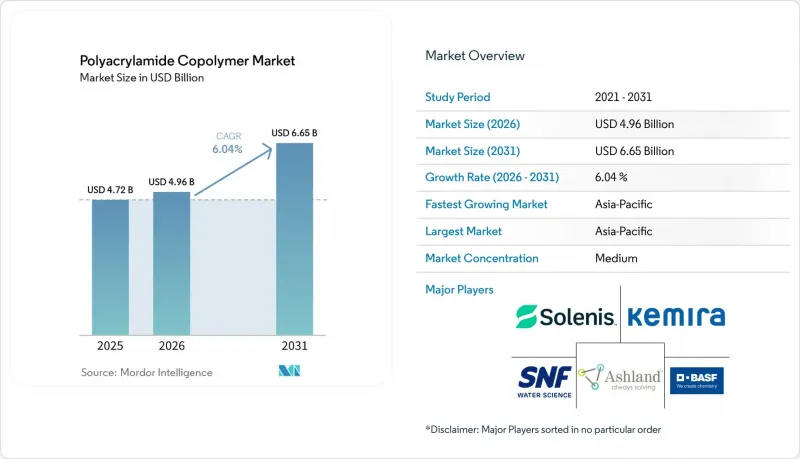
에 따르면 폴리아크릴아미드 공중합체 시장 규모는 2025년에 47억 2,000만 달러로 평가되어 예측 기간(2026-2031년)에 CAGR 6.04%로 확대하며, 2026년 49억 6,000만 달러에서 2031년에는 66억 5,000만 달러에 달할 것으로 추정되고 있습니다.
전 세계 폴리아크릴아미드 공중합체 시장의 동향 및 인사이트
더욱 엄격해진 폐수 배출 및 재이용 요건
개정된 유럽연합(EU)의 ‘도시 폐수 처리 지침’이 2025년 1월 1일에 발효되어, 대규모 시설에 대해 더욱 엄격한 처리 의무가 도입되었습니다. 인구 환산 1만 명 이상을 처리 대상으로 하는 시설은 2036년까지 질소 및 인에 관한 더 엄격한 기준을 충족해야 합니다. 또한 해당 지침에서는 지정된 대규모 시설에 대해 2045년까지 4차 처리를 도입할 것을 의무화하고 있으며, 이에 따라 처리 및 슬러지 관리 요건이 강화되었습니다. 처리 단계가 하나 늘어날 때마다 상수도 사업자가 전처리 및 탈수를 수행해야 하는 고형물의 양이 증가할 가능성이 있습니다. 이러한 요건으로 인해 저투여량으로 고액 분리를 개선하는 고분자량 공중합체에 대한 수요가 증가하고 있습니다. 미국에서는 음용수 규제로 인해 아크릴아마이드의 투여 조건이 제한되고 있으며, 지자체 조달에서 인증된 제품에 대한 수요가 증가하고 있습니다.
지자체 및 산업용 슬러지 탈수의 확대
지자체 및 산업용 처리 시설에서는 처리량을 줄이고 운영 효율을 높이기 위해 슬러지 탈수 처리가 필요합니다. 양이온성 등급은 식품 가공, 섬유 제조, 석탄 세척 및 지자체 처리 시설에서 배출되는 슬러지 등 음전하를 띤 고형분을 포함하는 슬러지에 적합합니다. 이러한 용도로 인해 폴리아크릴아미드 공중합체 시장은 단순히 신규 플랜트 건설뿐만 아니라 처리량과도 밀접하게 연관되어 있습니다. 더 복잡한 조성의 슬러지의 경우, 원하는 케이크 건조도를 달성하기 위해 더 높은 분자량이나 조정된 전하 밀도가 필요할 수 있습니다. 기존의 폴리머 골격과 바이오폴리머 성분을 결합한 하이브리드 제품은 유동성이 있는 미세 광미 처리시 투여량을 줄일 수 있음이 입증되었습니다. 이러한 장점 덕분에 구매 결정은 단가가 가장 저렴한 등급이 아닌, 총 처리 비용을 절감할 수 있는 등급으로 전환될 가능성이 있습니다.
잔류 아크릴아미드 단량체에 대한 규정 준수 비용
유럽연합(EU)은 화학물질의 등록, 평가, 허가 및 제한(REACH) 체계를 바탕으로 아크릴아마이드를 규제하고 있으며, 공급업체에 규정 준수 요건을 부과하고 있습니다. 이러한 요건은 공급망 전반에 걸친 제품의 배합, 시험, 인증 및 문서화에 영향을 미칩니다. 미국에서는 음용수 용도에서 잔류 아크릴아미드 노출을 제한하는 투여 조건 하에 운영되고 있습니다. 여러 지역에 제품을 공급하는 공급업체는 현지 규정을 준수하기 위해 지역별로 서로 다른 제품 등급이나 인증 절차가 필요할 수 있습니다. 이러한 요건은 확립된 품질관리 시스템과 낮은 모노머 생산 능력을 갖춘 대형 제조업체에 유리하게 작용할 수 있습니다. 또한 폴리아크릴아미드 공중합체 시장의 특수 용도 진입 장벽을 높이는 결과로 이어집니다.
부문 분석
2025년, 음이온성 폴리아크릴아미드는 폴리아크릴아미드 공중합체 시장 점유율의 44.83%를 차지했습니다. 이 제품은 고분자 구조가 전하를 띤 부유 입자를 가교 결합하므로 광업 폐석의 농축, 산업 폐수의 정화 및 제지 공정에서의 리텐션에 사용됩니다. 황철광을 포함한 광미에 대한 조사 결과, 음이온성 폴리아크릴아미드(PAM)가 흡착 및 응집 성능을 발휘하는 것으로 밝혀졌으며, 광물 구성이 결과에 영향을 미치는 것으로 나타났습니다. 이러한 연구 결과는 분자량 및 전하 밀도에 따라 조정된 등급에 대한 수요를 지원합니다. 비이온성 폴리아크릴아미드는 토양 침식 방지, 수압 파쇄용 스페이서 및 특정 섬유 가공 공정과 같은 특수 용도로 사용됩니다. 양성 및 기타 개질 제품에는 2-아크릴아미드-2-메틸프로판술폰산(ATBS)과 유전 환경용 NVP 삼원 공중합체 등이 포함됩니다.
양이온성 폴리아크릴아미드는 2026-2031년까지 연평균 성장률(CAGR) 6.23%로 성장할 것으로 예측됩니다. 이는 원심분리기나 벨트 프레스를 통한 탈수 전에 슬러지에 양이온성 처리가 필요한 상황에서 사용됩니다. 도시 하수 처리, 식품 가공 및 산업용 처리가 이러한 제품의 주요 수요원입니다. 점점 더 복잡해지는 슬러지를 처리하는 시스템이 폴리아크릴아미드 공중합체 시장에서 양이온성 제품에 대한 수요를 지원하고 있습니다. 고이온성 양이온성 등급은 일반적으로 범용 음이온성 제품보다 판매 가격이 높습니다. 그 결과, 시장 점유율 증가 속도를 상회하는 속도로 매출 기여도가 높아질 가능성이 있습니다.
지역별 분석
아시아태평양은 2025년 폴리아크릴아미드 공중합체 시장 점유율의 45.07%를 차지하며, 2031년까지 연평균 성장률(CAGR) 6.34%로 성장할 것으로 예측됩니다. 이 지역에서는 도시 하수 처리 수요, 광업 활동 및 유전에서의 수요가 예상됩니다. 중국은 표준 폴리아크릴아미드 등급의 생산 거점이며, 전체 수출 시장의 가격 형성에 영향을 미치고 있습니다. 인도의 처리 인프라 확충은 하수 처리 및 슬러지 관리에 사용되는 응집제의 수요를 지원하고 있습니다. 또한 인도네시아, 말레이시아, 태국, 베트남에서의 제조 및 배터리 공급망에 대한 투자도 폐수 처리 수요를 증가시키고 있습니다.
북미는 폴리아크릴아미드 공중합체 시장에서 성숙한 부문입니다. 비전통적 석유 생산, 생산수 관리, 그리고 도시 공공사업의 설비 갱신이 수요를 지원하고 있습니다. 미국에서는 아크릴아미드를 함유한 수처리 제품의 품질 기준에 영향을 미치는 연방 음용수 기준이 유지되고 있습니다. 유럽에서는 개정된 ‘도시 폐수 처리 지침’의 시행 일정이 시장 수요에 영향을 미치고 있습니다. 독일의 산업 및 지자체 사용자들은 배출 기준을 충족하기 위해 더 고성능의 등급을 필요로 하고 있습니다. 북유럽 국가들의 조달 활동 또한 바이오하이브리드 응집제 솔루션에 대한 평가를 촉진하고 있습니다.
남미, 중동 및 아프리카에서는 폴리아크릴아미드 공중합체 시장에서 각각 고유한 수요 패턴이 나타나고 있습니다. 칠레, 페루, 브라질에서는 구리, 리튬, 철광석 처리 과정에서 폴리머를 이용한 광미 탈수가 이루어지고 있습니다. 수자원이 부족한 광업 지역에서는 침강 효율 향상과 물 회수가 음이온성 폴리머의 활용을 촉진하고 있습니다. 중동의 수요는 특히 고온·고염분 농도의 저류층에서 석유 증진 회수(EOR) 용도와 관련이 있습니다. 북아프리카 및 사하라 이남 아프리카에서는 수처리 인프라 확충을 통해 수요가 확대되고 있습니다. 또한 남아프리카의 광산 사업에서도 광미 관리 및 관련 규제 요건을 충족하기 위해 고분자량 음이온성 폴리머가 사용되고 있습니다.
기타 혜택:
- 엑셀 형식의 시장 예측(ME) 시트
- 3개월간의 애널리스트 지원
자주 묻는 질문
목차
제1장 서론
- 조사 전제조건과 시장 정의
- 조사 범위
제2장 조사 방법
제3장 개요
제4장 시장 구도
- 시장 개요
- 시장 성장 촉진요인
- 시장 성장 억제요인
- 밸류체인 분석
- Porter's Five Forces 분석
제5장 시장 규모와 성장 예측
- 제품 유형별
- 용도별
- 지역별
- 아시아태평양
- 중국
- 인도
- 일본
- 한국
- ASEAN 국가
- 기타 아시아태평양 국가
- 북미
- 미국
- 캐나다
- 멕시코
- 유럽
- 독일
- 영국
- 프랑스
- 이탈리아
- 북유럽 국가
- 기타 유럽 국가
- 남미
- 브라질
- 아르헨티나
- 기타 남미 국가
- 중동 및 아프리카
- 사우디아라비아
- 남아프리카공화국
- 기타 중동 및 아프리카 국가
- 아시아태평양
제6장 경쟁 구도
- 시장 집중도
- 전략적 동향
- 시장 점유율·순위 분석
- 기업 개요
- Anhui Jucheng Fine Chemicals Co., LTD
- Anhui Tianrun Chemical Industry Co., Ltd.
- Ashland
- BASF
- Beijing Hengju Chemical Group Co., Ltd.
- Black Rose Industries Ltd.
- CNPC
- Ecolab Inc.
- Kemira Oyj
- Mitsui Chemicals, Inc.
- PetroChina Company Limited
- SHANDONG POLYMER BIOCHEMICALS CO., LTD.
- SNF Group
- Solenis
- Syensqo
- XITAO POLYMER CO., LTD.
제7장 시장 기회와 향후 전망
KSA 26.10.30According to Mordor Intelligence, the polyacrylamide copolymer market size was valued at USD 4.72 billion in 2025 and is estimated to grow from USD 4.96 billion in 2026 to USD 6.65 billion by 2031, at a CAGR of 6.04% during the forecast period (2026-2031).
Global Polyacrylamide Copolymer Market Trends and Insights
Stricter Wastewater Discharge and Reuse Requirements
The revised European Union Urban Wastewater Treatment Directive entered into force on January 1, 2025, introducing stricter treatment obligations for larger facilities. Plants serving more than 10,000 population equivalents must meet tighter nitrogen and phosphorus standards by 2036. The directive also requires specified large facilities to implement quaternary treatment by 2045, increasing treatment and sludge management requirements. Each additional treatment stage can increase the quantity of solids that utilities must condition and dewater. These requirements drive demand for high-molecular-weight copolymers that improve solid-liquid separation at low dosages. In the United States, drinking water regulations limit acrylamide dosing conditions, supporting demand for certified products in municipal procurement.
Expansion of Municipal and Industrial Sludge Dewatering
Municipal and industrial treatment plants require sludge dewatering to reduce disposal quantities and improve operational efficiency. Cationic grades suit sludge containing negatively charged solids, including sludge from food processing, textile manufacturing, coal washing, and municipal treatment facilities. This application links the polyacrylamide copolymer market to treatment throughput rather than solely to new plant construction. More complex sludge compositions may require higher molecular weights or tailored charge densities to achieve the required cake dryness. Hybrid products that combine conventional polymer backbones with biopolymer components have demonstrated lower dosage requirements in fluid fine tailings applications. These gains can shift purchasing decisions toward grades that reduce total treatment costs rather than those with the lowest unit price.
Residual Acrylamide Monomer Compliance Costs
The European Union regulates acrylamide under the Registration, Evaluation, Authorization and Restriction of Chemicals (REACH) framework, creating compliance requirements for suppliers. These requirements affect product formulation, testing, certification, and documentation throughout the supply chain. In the United States, drinking water applications operate under dosing conditions that limit residual acrylamide exposure. Suppliers serving multiple regions may require separate product grades and certification processes to comply with local regulations. These requirements may benefit larger manufacturers with established quality systems and low-monomer production capabilities. They also increase barriers to entry for specialty applications in the polyacrylamide copolymer market.
Other drivers and restraints analyzed in the detailed report include:
- Polymer Flooding in Mature and High-Salinity Oilfields
- Critical-Mineral Tailings and Solid-Liquid Separation Demand
- Petrochemical Feedstock Price Volatility
For complete list of drivers and restraints, kindly check the Table Of Contents.
Segment Analysis
Anionic polyacrylamide held 44.83% of the polyacrylamide copolymer market share in 2025. It is used in mining tailings thickening, industrial effluent clarification, and paper retention because its polymer structure bridges charged suspended particles. Research on pyrite-containing tailings found that anionic polyacrylamide (PAM) provided adsorption and flocculation performance and showed that mineralogy affects results. These findings support the demand for grades tailored by molecular weight and charge density. Non-ionic polyacrylamide is used in specialized applications, including soil erosion control, hydraulic fracturing spacers, and selected textile processes. Amphoteric and other modified products include 2-acrylamido-2-methylpropane sulfonic acid (ATBS) and NVP terpolymers for oilfield conditions.
Cationic polyacrylamide is forecast to grow at a CAGR of 6.23% from 2026 to 2031. It is used where sludge requires cationic conditioning before centrifuge or belt press dewatering. Municipal wastewater treatment, food processing, and industrial treatment are key demand centers for these products. Treatment systems handling increasingly complex sludge support demand for cationic products in the polyacrylamide copolymer market. High-ionicity cationic grades generally have higher selling prices than commodity anionic products. As a result, their revenue contribution can increase faster than their market share.
Complete Report Scope:
- By Product Type
- Anionic
- Cationic
- Non-Ionic
- Others
- By Application
- Water Treatment Flocculants
- Enhanced Oil Recovery and Petroleum
- Paper Making and Pulp Processing
- Other Applications
- By Geography
- Asia-Pacific
- China
- India
- Japan
- South Korea
- ASEAN Countries
- Rest of Asia-Pacific
- North America
- United States
- Canada
- Mexico
- Europe
- Germany
- United Kingdom
- France
- Italy
- NORDIC Countries
- Rest of Europe
- South America
- Brazil
- Argentina
- Rest of South America
- Middle East and Africa
- Saudi Arabia
- South Africa
- Rest of Middle East and Africa
- Asia-Pacific
Geography Analysis
Asia-Pacific held 45.07% of the polyacrylamide copolymer market share in 2025 and is forecast to grow at a CAGR of 6.34% through 2031. The region has municipal water treatment requirements, mining activity, and oilfield demand. China is a production hub for standard polyacrylamide grades and influences pricing across export markets. India's expansion of treatment infrastructure supports demand for flocculants used in sewage treatment and sludge management. Manufacturing and battery supply chain investments in Indonesia, Malaysia, Thailand, and Vietnam also increase wastewater treatment requirements.
North America is a mature segment of the polyacrylamide copolymer market. Unconventional oil production, produced water management, and municipal utility upgrades support demand. The United States maintains federal drinking water requirements that influence quality standards for acrylamide-containing water treatment products. In Europe, the implementation timeline for the revised Urban Wastewater Treatment Directive influences market demand. Industrial and municipal users in Germany require higher-performance grades to meet effluent standards. Nordic procurement activity also supports the evaluation of bio-hybrid flocculant solutions.
South America, the Middle East, and Africa have distinct demand patterns within the polyacrylamide copolymer market. Chile, Peru, and Brazil use polymer-assisted tailings dewatering in the processing of copper, lithium, and iron ore. In water-scarce mining regions, improved settling efficiency and water recovery support the use of anionic polymers. Demand in the Middle East is linked to enhanced oil recovery applications, particularly in high-temperature, high-salinity reservoirs. North Africa and Sub-Saharan Africa contribute to demand through the development of water treatment infrastructure. South African mining operations also use high-molecular-weight anionic grades for tailings management and related compliance requirements.
- Anhui Jucheng Fine Chemicals Co., LTD
- Anhui Tianrun Chemical Industry Co., Ltd.
- Ashland
- BASF
- Beijing Hengju Chemical Group Co., Ltd.
- Black Rose Industries Ltd.
- CNPC
- Ecolab Inc.
- Kemira Oyj
- Mitsui Chemicals, Inc.
- PetroChina Company Limited
- SHANDONG POLYMER BIOCHEMICALS CO., LTD.
- SNF Group
- Solenis
- Syensqo
- XITAO POLYMER CO., LTD.
Additional Benefits:
- The market estimate (ME) sheet in Excel format
- 3 months of analyst support
TABLE OF CONTENTS
1 Introduction
- 1.1 Study Assumptions and Market Definition
- 1.2 Scope of the Study
2 Research Methodology
3 Executive Summary
4 Market Landscape
- 4.1 Market Overview
- 4.2 Market Drivers
- 4.2.1 Stricter Wastewater Discharge and Reuse Requirements
- 4.2.2 Expansion of Municipal and Industrial Sludge Dewatering
- 4.2.3 Polymer Flooding in Mature and High-Salinity Oilfields
- 4.2.4 Critical-Mineral Tailings and Solid-Liquid Separation Demand
- 4.2.5 High-Performance PAM for Unconventional and Offshore Production
- 4.3 Market Restraints
- 4.3.1 Residual Acrylamide Monomer Compliance Costs
- 4.3.2 Petrochemical Feedstock Price Volatility
- 4.3.3 Bio-Based and Natural Flocculant Substitution
- 4.4 Value Chain Analysis
- 4.5 Porter's Five Forces Analysis
- 4.5.1 Bargaining Power of Suppliers
- 4.5.2 Bargaining Power of Buyers
- 4.5.3 Threat of New Entrants
- 4.5.4 Threat of Substitutes
- 4.5.5 Competitive Rivalry
5 Market Size and Growth Forecasts (Value)
- 5.1 By Product Type
- 5.1.1 Anionic
- 5.1.2 Cationic
- 5.1.3 Non-Ionic
- 5.1.4 Others
- 5.2 By Application
- 5.2.1 Water Treatment Flocculants
- 5.2.2 Enhanced Oil Recovery and Petroleum
- 5.2.3 Paper Making and Pulp Processing
- 5.2.4 Other Applications
- 5.3 By Geography
- 5.3.1 Asia-Pacific
- 5.3.1.1 China
- 5.3.1.2 India
- 5.3.1.3 Japan
- 5.3.1.4 South Korea
- 5.3.1.5 ASEAN Countries
- 5.3.1.6 Rest of Asia-Pacific
- 5.3.2 North America
- 5.3.2.1 United States
- 5.3.2.2 Canada
- 5.3.2.3 Mexico
- 5.3.3 Europe
- 5.3.3.1 Germany
- 5.3.3.2 United Kingdom
- 5.3.3.3 France
- 5.3.3.4 Italy
- 5.3.3.5 NORDIC Countries
- 5.3.3.6 Rest of Europe
- 5.3.4 South America
- 5.3.4.1 Brazil
- 5.3.4.2 Argentina
- 5.3.4.3 Rest of South America
- 5.3.5 Middle East and Africa
- 5.3.5.1 Saudi Arabia
- 5.3.5.2 South Africa
- 5.3.5.3 Rest of Middle East and Africa
- 5.3.1 Asia-Pacific
6 Competitive Landscape
- 6.1 Market Concentration
- 6.2 Strategic Moves
- 6.3 Market Share (%)/Ranking Analysis
- 6.4 Company Profiles (includes Global Overview, Market Overview, Core Segments, Financials as available, Strategic Information, Products and Services, and Recent Developments)
- 6.4.1 Anhui Jucheng Fine Chemicals Co., LTD
- 6.4.2 Anhui Tianrun Chemical Industry Co., Ltd.
- 6.4.3 Ashland
- 6.4.4 BASF
- 6.4.5 Beijing Hengju Chemical Group Co., Ltd.
- 6.4.6 Black Rose Industries Ltd.
- 6.4.7 CNPC
- 6.4.8 Ecolab Inc.
- 6.4.9 Kemira Oyj
- 6.4.10 Mitsui Chemicals, Inc.
- 6.4.11 PetroChina Company Limited
- 6.4.12 SHANDONG POLYMER BIOCHEMICALS CO., LTD.
- 6.4.13 SNF Group
- 6.4.14 Solenis
- 6.4.15 Syensqo
- 6.4.16 XITAO POLYMER CO., LTD.
7 Market Opportunities and Future Outlook
- 7.1 White-Space and Unmet-Need Assessment


