

|
시장보고서
상품코드
2157133
건축용 금속 코팅 : 시장 점유율 분석, 업계 동향과 통계, 성장 예측(2026-2031년)Architectural Metal Coatings - Market Share Analysis, Industry Trends & Statistics, Growth Forecasts (2026 - 2031) |
||||||
 Mordor Intelligence
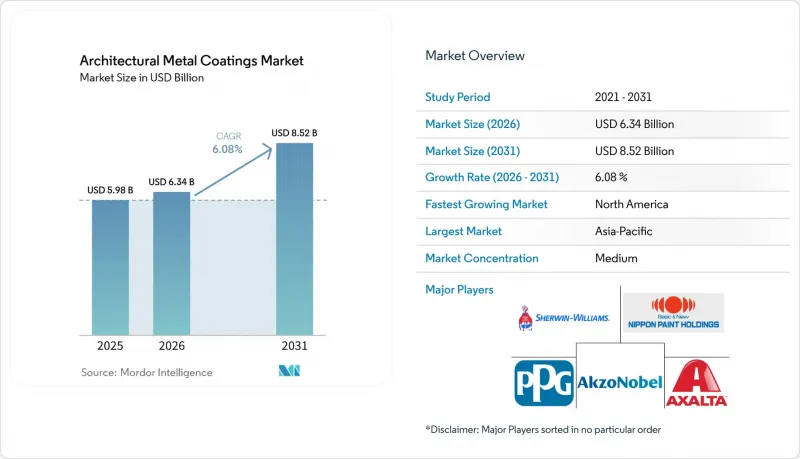
에 따르면 건축용 금속 코팅 시장 규모는 2025년에 59억 8,000만 달러로 평가되며, 2026년 63억 4,000만 달러에서 2031년까지 85억 2,000만 달러에 달할 것으로 예측되고 있으며, 예측 기간(2026-2031년)에 CAGR은 6.08%에 달할 전망입니다.
전 세계 건축용 금속 코팅 시장의 동향 및 인사이트
도시화와 금속 건축 외장재의 확대
건축용 금속 코팅 시장은 신축 건물에서 강철 및 알루미늄 외장이 선호되는 설계 옵션으로 자리 잡음에 따라 혜택을 받고 있습니다. 금속 시스템은 창고, 물류 단지, 데이터센터, 기술 캠퍼스 등에서 프로젝트의 공사 기간, 구조 중량, 수명 주기 예산 요건을 충족시킬 수 있습니다. 중국의 도시 재생 프로그램은 커튼월 형상에 대한 코일 도장 및 압출 성형 도장 마감에 대한 지속적인 수요를 지원하고 있습니다. 악조노벨(Akzo Nobel N.V.)은 동영 경제개발구의 상업 프로젝트에서 장기 시험을 실시한 후, 미국 건축 제조업체 협회(AAMA) 2605 인증을 획득한 ‘TRINAR SC 시리즈’를 도입했습니다. 쓰촨성은 강재 표면용 에너지 절약형 도료에 관한 DB51/T 3266-2025를 발표하여 지방 정부의 기술 요건 역할을 반영했습니다. 따라서 건축용 금속 도료 시장은 신축 공사가 부진하더라도 리모델링 주도의 수요 기반을 유지할 수 있습니다.
상업 건축 및 인프라 개보수의 확대
건축용 금속 도료 시장은 상업 건축 및 인프라 개보수 프로젝트로부터 지속적인 수요를 얻고 있습니다. 미국 토목공학회(ASCE)는 2025년 성적표에서 미국의 교량, 도로, 상수도 시스템에 대해 ‘C’ 이하의 평가를 내렸습니다. 이처럼 미뤄져 온 유지관리 부담이 노출된 금속 자산용 내구성이 뛰어난 에폭시 프라이머 및 폴리우레탄 탑코트에 대한 수요를 지원하고 있습니다. 인도의 ‘스마트 시티 미션’에서는 2025년 5월 기준으로 총액 1.51락 크롤(약 178억 달러)에 달하는 8,067건의 프로젝트 중 94%가 완료되었습니다. 이러한 계약에서는 색상이 일치하는 현장 보수 시스템도 요구되고 있으며, 이를 통해 초기 도료 공급에 더해 추가 매출이 예상됩니다. 디지털을 통한 색상 조화는 여러 건물로 구성된 포트폴리오 전체에서 반복 작업을 가능하게 하여, 공급업체 변경을 어렵게 할 가능성이 있습니다.
규제의 복잡성과 인증 비용
건축용 금속 코팅 시장에서는 규격 및 제품 요구 사항의 변경에 따라 규정 준수 절차가 장기화되는 경향이 있습니다. 개정된 AAMA 2603, AAMA 2604 및 AAMA 2605의 각 버전에서는 시공업체에 전처리 및 프라이머의 화학적 특성에 대한 재평가를 요구하고 있습니다. 이러한 작업으로 인해 공급업체가 고액 프로젝트의 사양 리스트에 다시 등재되려면 재인증이 필요할 수 있습니다. 또한 미국 코팅 협회(American Coatings Association)는 퍼플루오로알킬 및 폴리플루오로알킬 물질(PFAS) 규제가 코팅 기술에 미칠 잠재적인 영향에 대해서도 지적하고 있습니다. 이와 관련된 개발 작업에는 막대한 비용이 소요될 가능성이 있으며, 즉시 수익으로 이어지지는 않습니다. 또한 복잡한 규제는 이미 시험, 규제 대응, 문서화를 위한 자원을 보유하고 있는 대형 배합 제조업체에 유리하게 작용할 가능성이 있습니다.
부문 분석
2025년, 건축용 금속 코팅 시장 규모의 47.32%를 불소 수지가 차지했습니다. 이는 상업용 파사드, 커튼월, 지붕 자재에서 장기적인 내후성 보증이 요구되는 경우가 많기 때문입니다. 이러한 시스템은 장기간의 내구 기간 중 색상 유지력과 광택 유지력이 중요시되는 경우에 지정됩니다. 폴리에스터계 도료는 초기 비용의 저렴함이 자재 선정에 영향을 미치는 지붕 및 외장 공사에 사용됩니다. 폴리우레탄계 도료는 리모델링 공사가 수성 2액형 시스템으로 전환됨에 따라 2031년까지 연평균 성장률(CAGR) 6.74%로 확대될 것으로 예측됩니다. 건축용 금속 도료 업계에서는 프로젝트에서 VOC 배출량 저감과 내구성 있는 보호가 요구되는 경우, 이러한 시스템이 채택됩니다. 에폭시계 도료는 해안 환경의 아연 도금 강판이나 갈바륨 강판을 위한 방식 프라이머로서 여전히 중요한 역할을 하고 있습니다.
PVDF의 공급 상황은 불소 수지 시스템에서 중요한 사양상의 고려 사항이 되고 있습니다. 2026년 초, 중국 북부 지역의 R142b 생산 조정으로 인해 조달 결정은 공급 안정성을 중시하는 방향으로 전환되었습니다. 이는 고급 도료 라인용 건축용 등급 수지의 입수 가능성 및 가격에 영향을 미칠 가능성이 있습니다. 아르케마(Arkema)사의 칼버트 시티 공장 확장 프로젝트는 2026년 6월에 가동을 시작하여 북미의 배합 제조업체를 위한 생산 능력을 증강했습니다. 또한 이 회사는 중국 창수(常熟)에서 ‘카이나(Kynar)’ PVDF의 생산 능력을 20% 확대하여 2028년에 가동을 시작할 것이라고 발표했습니다. 이러한 투자는 코팅, 리튬이온 배터리, 반도체 용도의 수요에 대응하기 위한 것입니다. 리모델링 프로젝트에서 폴리우레탄계 도료의 채택이 확대됨에 따라 건축용 금속 코팅 업계에서는 수지 배합의 단계적 조정이 이루어질 가능성이 있습니다.
지역별 분석
2025년, 아시아태평양은 시장 매출의 41.05%를 차지했습니다. 이는 중국, 인도, 일본, 한국, 베트남, 인도네시아, 말레이시아의 수요를 반영한 것으로, 이들 지역에서는 도시 재생 및 신축 공사의 활성화로 인해 건축용 금속 도료 시장이 혜택을 보고 있습니다. 중국에서는 고성능 가공제를 활용한 도시 재생 프로젝트가 추진되고 있습니다. 악소노벨 N.V.의 ‘TRINAR SC 시리즈’는 동영 경제개발구에서 실시된 장기 시험에서 자가 세정 성능을 입증했습니다. 인도의 ‘스마트 시티 미션’에서는 2025년 5월 기준으로 8,067건의 프로젝트 중 94%가 완료되었습니다. 이 사업에는 금속 외장 및 코팅된 부재를 사용하는 공공 건축물, 교통 인프라, 시설 등이 포함됩니다. 일본과 한국에서는 건물의 노출면에 대해 기술적으로 첨단 불소수지 사양이 유지되고 있습니다.
동남아시아 국가들에서는 산업용 건물, 물류 시설, 상업 공간이 증가하고 있습니다. 요툰(Yotun)사는 2024년 두바이 시설 완공에 이어, 2026년 말레이시아에 본디드 메탈릭스(Bonded Metallics) 제조 시설을 개설할 것이라고 발표했습니다. 베커스 그룹은 2026년 5월, 합작 회사인 베르거 베커 코팅스를 통해 나그푸르에 재생 가능 폴리에스테르 수지 공장을 개설했습니다. 이 공장은 2026년 3분기에 상업 생산을 시작하며, 초기 연간 생산 능력은 9,000메트릭톤입니다. 재활용 폴리에틸렌 테레프탈레이트(PET) 및 바이오 기반 원료를 사용하고 있습니다. 현지 생산을 통해 지역 배합 제조업체 및 고객에 대한 공급 접근성이 개선됩니다. 그 결과, 현지 생산과 지역내 건축 물량의 지속적인 증가가 모두 건축용 금속 도료 시장을 지원하고 있습니다.
북미 시장은 상업용 건축물 및 도장된 금속 지붕의 교체 주기에 힘입어 2031년까지 연평균 성장률(CAGR) 7.03%로 확대될 것으로 전망됩니다. 선벨트 지역의 대도시권에서는 내구성이 뛰어난 지붕·벽 시스템을 채택한 신규 상업 프로젝트가 진행되고 있으며, 이는 건축용 금속 도료 시장을 강화하고 있습니다. PPG 인더스트리즈는 2026년 6월, Kynar Aquatec PVDF 수지를 채택한 ‘BUILDING RENEWAL NEVERFADE’ 외장용 코팅제를 출시했습니다. 이 시스템은 15년 보증이 제공되며, 재료 보호·성능 협회(AMPP) 및 SSPC(부식 방지 도장 협회)의 Paint 47 요건을 충족합니다. 유럽에서는 독일, 프랑스, 베네룩스 지역에서 노후화된 상업용 파사드 개보수에 계속해서 주력하고 있습니다. 유럽연합(EU)의 에코라벨은 해당 지역 전체의 제품 인증 기준을 재편하고 있습니다. 남미에서는 상업용 건축물 및 물류 인프라에 대한 수요가 증가하고 있으며, 중동 및 아프리카에서는 걸프 연안 국가들의 상업 및 인프라 프로젝트가 계속해서 수요를 지원하고 있습니다.
기타 혜택:
- 엑셀 형식의 시장 예측(ME) 시트
- 3개월간의 애널리스트 지원
자주 묻는 질문
목차
제1장 서론
- 조사 전제조건과 시장 정의
- 조사 범위
제2장 조사 방법
제3장 개요
제4장 시장 구도
- 시장 개요
- 시장 성장 촉진요인
- 시장 성장 억제요인
- 밸류체인 분석
- Porter's Five Forces 분석
제5장 시장 규모와 성장 예측
- 수지 유형별
- 용도별
- 최종사용자별
- 지역별
- 아시아태평양
- 중국
- 인도
- 일본
- 한국
- ASEAN 국가
- 기타 아시아태평양 국가
- 북미
- 미국
- 캐나다
- 멕시코
- 유럽
- 독일
- 영국
- 프랑스
- 이탈리아
- 북유럽 국가
- 러시아
- 기타 유럽 국가
- 남미
- 브라질
- 아르헨티나
- 기타 남미 국가
- 중동 및 아프리카
- 사우디아라비아
- 남아프리카공화국
- 기타 중동 및 아프리카 국가
- 아시아태평양
제6장 경쟁 구도
- 시장 집중도
- 전략적 동향
- 시장 점유율·순위 분석
- 기업 개요
- Akzo Nobel N.V.
- Alcea S.p.A.
- Axalta Coating Systems LLC
- Beckers Group
- Hempel A/S
- Jotun
- Kansai Paint Co., Ltd.
- KCC Corporation
- Nippon Paint Holdings Co., Ltd.
- NOROO Paint & Coatings Co., Ltd.
- PPG Industries, Inc.
- RPM International Inc.
- The Sherwin-Williams Company
- TIGER Coatings GmbH & Co. KG
- Tnemec
제7장 시장 기회와 향후 전망
KSA 26.10.30According to Mordor Intelligence, the architectural metal coatings market size was valued at USD 5.98 billion in 2025 and is estimated to grow from USD 6.34 billion in 2026 to reach USD 8.52 billion by 2031, at a CAGR of 6.08% during the forecast period (2026-2031).
Global Architectural Metal Coatings Market Trends and Insights
Urbanization and Metal-Building-Envelope Expansion
The architectural metal coatings market benefits when steel and aluminum envelopes become a preferred design choice for new buildings. Metal systems can meet project timing, structural weight, and lifecycle budget requirements across warehouses, logistics parks, data centers, and technology campuses. China's urban renewal program supports recurring demand for coil-applied and extrusion-applied finishes on curtain-wall geometries. Akzo Nobel N.V. deployed its American Architectural Manufacturers Association (AAMA) 2605-certified TRINAR SC Series after long-term testing at a commercial project in Dongying Economic Development Zone. Sichuan Province issued DB51/T 3266-2025 for energy-saving coatings on steel surfaces, reflecting the role of subnational technical requirements. The architectural metal coatings market can therefore retain a renovation-led demand base when new construction activity weakens.
Expansion of Commercial Construction and Infrastructure Renovation
The architectural metal coatings market receives recurring demand from commercial construction and infrastructure renovation projects. The American Society of Civil Engineers gave U.S. bridges, roads, and water systems grades of C or below in its 2025 report card. That deferred maintenance burden supports demand for durable epoxy primers and polyurethane topcoats on exposed metal assets. India's Smart Cities Mission had completed 94% of 8,067 projects worth INR 1.51 lakh crore (approximately USD 17.8 billion) as of May 2025. Such contracts also require color-matched field repair systems, which can add sales beyond the initial coating supply. Digital color matching supports repeat work across multi-building portfolios and can make supplier changes more difficult.
Regulatory Complexity and Certification Costs
The architectural metal coatings market faces longer compliance processes as standards and product requirements change. Updated AAMA 2603, AAMA 2604, and AAMA 2605 editions require applicators to reassess pretreatment and primer chemistry. This work can require requalification before a supplier returns to specification lists for high-value projects. The American Coatings Association has also identified potential effects from perfluoroalkyl and polyfluoroalkyl substances (PFAS) regulation on coating technologies. The associated development work can be costly and may not create immediate revenue. Complex rules can also favor large formulators that already maintain testing, regulatory, and documentation resources.
Other drivers and restraints analyzed in the detailed report include:
- Sustainable and Energy-Efficient Construction Standards
- Low-Energy, Low-VOC and Bio-Based Coating Adoption
- High Formulation and Application Costs for Advanced Systems
For complete list of drivers and restraints, kindly check the Table Of Contents.
Segment Analysis
Fluoropolymer held 47.32% of the architectural metal coatings market size in 2025 because commercial facades, curtain walls, and roofing often require long weatherability warranties. These systems are specified where color retention and gloss retention remain important throughout extended service periods. Polyester coatings serve roofing and cladding projects where lower initial costs influence material selection. Polyurethane is projected to advance at a 6.74% CAGR through 2031 as renovation work shifts toward waterborne 2-component systems. The architectural metal coatings industry uses these systems when a project requires lower VOC emissions and durable protection. Epoxy coatings remain important as corrosion-inhibiting primers for galvanized and Galvalume steel in coastal environments.
PVDF supply availability is becoming an important specification consideration for fluoropolymer systems. R142b output adjustments in northern China during early 2026 shifted procurement decisions toward supply security. This may affect the availability and pricing of architectural-grade resin for premium coating lines. Arkema's Calvert City expansion began operating in June 2026 and has added capacity for North American formulators. The company also announced a 20% Kynar PVDF capacity expansion at Changshu, China, for commissioning in 2028. These investments address demand from coatings, lithium-ion batteries, and semiconductor applications. The architectural metal coatings industry may see a gradual resin mix adjustment as polyurethane systems gain acceptance in renovation projects.
Complete Report Scope:
- By Resin Type
- Fluoropolymer
- Polyester
- Polyurethane
- Epoxy
- Other Resin Types
- By Application
- Roofing and Cladding
- Wall Panels and Facades
- Curtain Walls and Storefronts
- Window Frames and Doors
- Other Applications
- By End-User
- Commercial
- Residential
- Other End-Users
- By Geography
- Asia-Pacific
- China
- India
- Japan
- South Korea
- ASEAN Countries
- Rest of Asia-Pacific
- North America
- United States
- Canada
- Mexico
- Europe
- Germany
- United Kingdom
- France
- Italy
- NORDIC Countries
- Russia
- Rest of Europe
- South America
- Brazil
- Argentina
- Rest of South America
- Middle East and Africa
- Saudi Arabia
- South Africa
- Rest of Middle East and Africa
- Asia-Pacific
Geography Analysis
Asia-Pacific held 41.05% of the market revenue in 2025, reflecting demand across China, India, Japan, South Korea, Vietnam, Indonesia, and Malaysia, where the architectural metal coatings market benefits from urban renewal and new building activity. China supports urban renewal projects using high-performance finishes. Akzo Nobel N.V.'s TRINAR SC Series delivered self-cleaning performance in long-term testing at Dongying Economic Development Zone. India's Smart Cities Mission had completed 94% of 8,067 projects by May 2025. This work includes public buildings, transit assets, and facilities that use metal cladding and coated components. Japan and South Korea maintain technically demanding fluoropolymer specifications for exposed building surfaces.
Southeast Asian economies are adding industrial buildings, logistics facilities, and commercial space. Jotun announced a bonded metallics facility in Malaysia for opening in 2026, following the completion of its Dubai facility in 2024. Beckers Group inaugurated a renewable polyester resin plant in Nagpur through its Berger-Becker Coatings joint venture in May 2026. The plant began commercial production in the 3rd quarter of 2026 with an initial 9,000 metric tons of annual capacity. It uses recycled polyethylene terephthalate (PET) and bio-based feedstocks. Local manufacturing can improve supply access for regional formulators and customers. Both local production and continuing additions to the regional building stock consequently support the architectural metal coatings market.
North America is projected to advance at a 7.03% CAGR through 2031, supported by commercial construction and a replacement cycle for pre-painted metal roofing. Sun Belt metropolitan areas support new commercial projects that use durable roof and wall systems, which strengthen the architectural metal coatings market. PPG Industries, Inc. introduced BUILDING RENEWAL NEVERFADE Exterior Coatings with Kynar Aquatec PVDF resin in June 2026. The system carries a 15-year warranty and meets Association for Materials Protection and Performance (AMPP) SSPC (The Society for Protective Coatings) Paint 47 requirements. Europe remains focused on the renovation of aging commercial facades in Germany, France, and the Benelux region. The European Union Ecolabel is reshaping product qualification across the region. South America gains demand from commercial construction and logistics infrastructure, while the Middle East and Africa remain supported by Gulf commercial and infrastructure projects.
- Akzo Nobel N.V.
- Alcea S.p.A.
- Axalta Coating Systems LLC
- Beckers Group
- Hempel A/S
- Jotun
- Kansai Paint Co., Ltd.
- KCC Corporation
- Nippon Paint Holdings Co., Ltd.
- NOROO Paint & Coatings Co., Ltd.
- PPG Industries, Inc.
- RPM International Inc.
- The Sherwin-Williams Company
- TIGER Coatings GmbH & Co. KG
- Tnemec
Additional Benefits:
- The market estimate (ME) sheet in Excel format
- 3 months of analyst support
TABLE OF CONTENTS
1 Introduction
- 1.1 Study Assumptions and Market Definition
- 1.2 Scope of the Study
2 Research Methodology
3 Executive Summary
4 Market Landscape
- 4.1 Market Overview
- 4.2 Market Drivers
- 4.2.1 Urbanization and Metal-Building-Envelope Expansion
- 4.2.2 Sustainable and Energy-Efficient Construction Standards
- 4.2.3 Expansion of Commercial Construction and Infrastructure Renovation
- 4.2.4 Low-Energy, Low-VOC and Bio-Based Coating Adoption
- 4.2.5 Digital Color Matching and Field-Repair Economics
- 4.3 Market Restraints
- 4.3.1 Regulatory Complexity and Certification Costs
- 4.3.2 High Formulation and Application Costs for Advanced Systems
- 4.3.3 PVDF Raw-Material and Color-Matching Constraints in Renovation
- 4.4 Value Chain Analysis
- 4.5 Porter's Five Forces Analysis
- 4.5.1 Bargaining Power of Suppliers
- 4.5.2 Bargaining Power of Buyers
- 4.5.3 Threat of New Entrants
- 4.5.4 Threat of Substitutes
- 4.5.5 Competitive Rivalry
5 Market Size and Growth Forecasts (Value)
- 5.1 By Resin Type
- 5.1.1 Fluoropolymer
- 5.1.2 Polyester
- 5.1.3 Polyurethane
- 5.1.4 Epoxy
- 5.1.5 Other Resin Types
- 5.2 By Application
- 5.2.1 Roofing and Cladding
- 5.2.2 Wall Panels and Facades
- 5.2.3 Curtain Walls and Storefronts
- 5.2.4 Window Frames and Doors
- 5.2.5 Other Applications
- 5.3 By End-User
- 5.3.1 Commercial
- 5.3.2 Residential
- 5.3.3 Other End-Users
- 5.4 By Geography
- 5.4.1 Asia-Pacific
- 5.4.1.1 China
- 5.4.1.2 India
- 5.4.1.3 Japan
- 5.4.1.4 South Korea
- 5.4.1.5 ASEAN Countries
- 5.4.1.6 Rest of Asia-Pacific
- 5.4.2 North America
- 5.4.2.1 United States
- 5.4.2.2 Canada
- 5.4.2.3 Mexico
- 5.4.3 Europe
- 5.4.3.1 Germany
- 5.4.3.2 United Kingdom
- 5.4.3.3 France
- 5.4.3.4 Italy
- 5.4.3.5 NORDIC Countries
- 5.4.3.6 Russia
- 5.4.3.7 Rest of Europe
- 5.4.4 South America
- 5.4.4.1 Brazil
- 5.4.4.2 Argentina
- 5.4.4.3 Rest of South America
- 5.4.5 Middle East and Africa
- 5.4.5.1 Saudi Arabia
- 5.4.5.2 South Africa
- 5.4.5.3 Rest of Middle East and Africa
- 5.4.1 Asia-Pacific
6 Competitive Landscape
- 6.1 Market Concentration
- 6.2 Strategic Moves
- 6.3 Market Share (%)/Ranking Analysis
- 6.4 Company Profiles (includes Global Overview, Market Overview, Core Segments, Financials as available, Strategic Information, Products and Services, and Recent Developments)
- 6.4.1 Akzo Nobel N.V.
- 6.4.2 Alcea S.p.A.
- 6.4.3 Axalta Coating Systems LLC
- 6.4.4 Beckers Group
- 6.4.5 Hempel A/S
- 6.4.6 Jotun
- 6.4.7 Kansai Paint Co., Ltd.
- 6.4.8 KCC Corporation
- 6.4.9 Nippon Paint Holdings Co., Ltd.
- 6.4.10 NOROO Paint & Coatings Co., Ltd.
- 6.4.11 PPG Industries, Inc.
- 6.4.12 RPM International Inc.
- 6.4.13 The Sherwin-Williams Company
- 6.4.14 TIGER Coatings GmbH & Co. KG
- 6.4.15 Tnemec
7 Market Opportunities and Future Outlook
- 7.1 White-Space and Unmet-Need Assessment


