

|
시장보고서
상품코드
2157135
가변속 발전기 : 시장 점유율 분석, 업계 동향과 통계, 성장 예측(2026-2031년)Variable Speed Generator - Market Share Analysis, Industry Trends & Statistics, Growth Forecasts (2026 - 2031) |
||||||
 Mordor Intelligence
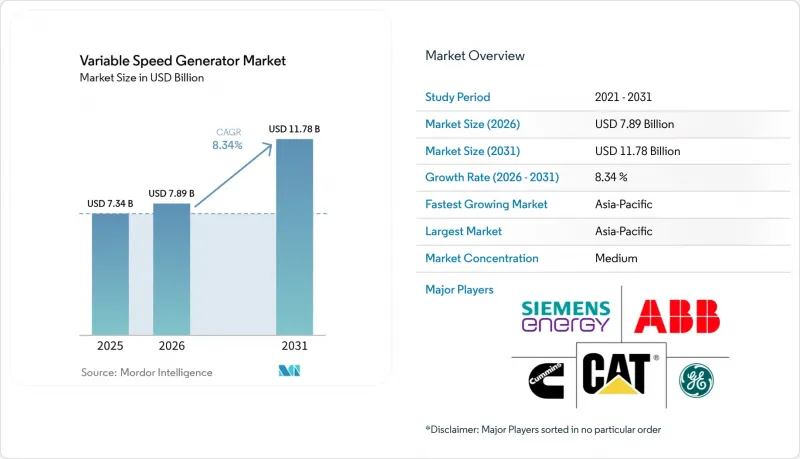
에 따르면 가변속 발전기 시장 규모는 2025년에 73억 4,000만 달러, 2026년에 78억 9,000만 달러에 달하며, 2031년까지 117억 8,000만 달러에 달할 것으로 예측되고 있으며, 2026-2031년까지 CAGR은 8.34%에 달할 전망입니다.
전 세계 가변속 발전기 시장의 동향 및 인사이트
재생에너지 통합 및 전력계통의 유연성
인버터 방식의 재생에너지 발전으로 인해 기존 송전망의 관성력이 저하됨에 따라 계통 운영 사업자들은 요건을 더욱 엄격하게 적용하고 있습니다. 2025년 전 세계 풍력발전 설비 용량은 40% 증가하여 165GW에 달했으며, 그중 아시아태평양이 131GW, 즉 증가분의 80%를 차지했습니다. 가변속 발전기는 유효 전력 제어와 무효 전력 지원을 제공할 수 있으므로, 주파수 안정성을 유지하면서 새로운 재생 가능 에너지 발전 설비를 계통로 연결할 수 있게 됩니다. 가변속 발전기 시장은 단순한 발전 용량 목표뿐만 아니라, 고장 시에도 운전을 지속할 수 있는 능력을 의무화하는 계통 규정에 의해 지원되고 있습니다. DFIG 시스템은 풀 스케일 컨버터 아키텍처보다 낮은 컨버터 요구 사항으로 이러한 요건을 충족할 수 있습니다. GWEC는 2026-2030년 사이에 969 GW의 신규 풍력발전 용량이 추가될 것으로 예측하고 있으며, DFIG 및 PMSG 장비에 대한 지속적인 프로젝트 파이프라인이 확보될 전망입니다.
연료 효율이 높고 배출량이 적은 발전에 대한 수요
해운, 석유 및 가스 및 분산형 발전 사업자들은 연료 소비량 감축과 배출량 저감을 추구하고 있습니다. 롤스로이스 파워 시스템즈는 2026년 8월, 650kWe에서 1,850kWe까지의 용도에 대응하는 ‘mtu 시리즈 2000’ 가변속 선박용 발전기를 발표했습니다. 이 회사에 따르면 엔진 회전수를 전력 수요에 맞춰 조정함으로써 고정 속도 세트에 비해 연료 소비량과 이산화탄소 배출량을 최대 15%까지 줄일 수 있다고 합니다. 또한 이 시리즈는 운전 소음을 6 dB 낮췄으며, 이는 항만이나 하이브리드 선박 운항에 있으며, 중요한 장점이 됩니다. 커민스사는 2025년, 완공 공사용 천연가스 가변속 기술을 검증하고, 그 활용 사례를 풍력발전이나 수력 발전의 범위를 넘어 확대했습니다. 그 결과, 가변속 발전기 시장에는 기존에 고정 속도로 가동되어 온 중장비 분야에서 새로운 비즈니스 기회가 생겨나고 있습니다.
부문 분석
2025년 시점에 더블 피디드 유도 발전기(DFIG)는 가변속 발전기 시장의 36.3%를 차지했습니다. 부분 스케일 컨버터 설계 덕분에 풀 컨버터 시스템에 비해 컨버터 요구 사항이 제한되어 비용 면에서의 우위를 점하고 있습니다. 또한 DFIG 장비는 15년 이상에 걸친 상용화를 통해 구축된 확립된 서비스 네트워크의 혜택도 누리고 있습니다. 이미 설치된 설비는 신규 설치 수가 변동하는 상황에서도 교체 및 리파워링 활동을 지원하고 있습니다. 가변속 자력식 유도 발전기는 2031년까지 연평균 성장률(CAGR)이 9.2%로 예측되며, 가장 빠르게 성장하고 있는 발전기 유형입니다. 외부 계통 기준 없이 전압과 주파수를 조정할 수 있으므로 분산형 시스템이나 마이크로그리드 시스템에 적합합니다.
PMSG 시스템은 12MW를 초과하는 해상 풍력발전 프로젝트에서 채택이 확대되고 있으며, 기어박스를 제거함으로써 점검 주기를 단축하고 유지보수 비용을 절감할 수 있습니다. 이 설계는 크레인으로 접근하기 어렵고 비용이 많이 드는 심해나 부유식 프로젝트에 적합합니다. WRIG 시스템은 기존의 재발전 프로젝트나 로터 자계의 정밀한 제어가 필요한 수력 발전 용도에서 계속해서 사용되고 있습니다. 그러나 컨버터 비용의 하락과 다이렉트 드라이브형 PMSG의 경제성 향상에 따라 그 입지가 위협받고 있습니다. 가와사키 중공업은 2026년 8월, iVSG(가상 동기 발전기) 제어 기술에 대한 첫 상용 라이선스 계약을 체결했습니다. 2027년에 예정된 인버터 도입은 그리드 포밍 제어 소프트웨어가 발전기 유형에 관계없이 차별화 요소로 자리 잡고 있음을 보여줍니다.
2025년 기준으로, 전력 전자 기반 시스템은 가변속 발전기 시장의 55.1%를 차지하고 있으며, 2031년까지 연평균 성장률(CAGR) 9.5%로 성장할 것으로 예상됩니다. 이러한 컨버터 시스템은 역률 보정, 신속한 주파수 응답 및 원격 모니터링을 가능하게 합니다. 이러한 기능을 통해 재생 가능 에너지 및 분산형 발전 프로젝트에서의 계통 지원 및 운영 모니터링이 향상됩니다. 2024년 IEEE Access 저널의 연구에 따르면 2MW급 DFIG(직접 급전형 유도 발전기)용 실리콘 카바이드(SiC) 부분 스케일 컨버터는 IGBT 솔루션에 비해 컨버터의 부피를 줄이고 효율을 높일 수 있는 것으로 보고되었습니다. 따라서 이 기술은 장비 선정에 점점 더 큰 영향을 미치는 운영 요건을 지원합니다. 가변 속도 발전기 시장에서는 운영자가 유연성과 성능을 중시하는 전자제어 방식이 계속해서 지지를 받고 있습니다.
기계식 가변속 발전기는 구매자가 보다 단순한 구동 시스템이나 낮은 설비 투자 비용을 우선시하는 경우 여전히 유용합니다. 소규모 유입식 수력 발전소나 기존 산업 설비의 개조 등은 이러한 경향이 지속되는 용도의 예입니다. IEC 60034-30-1의 효율 분류는 2024년 이후 유럽 시장의 회전 기계 조달 요건에 영향을 미쳐 왔습니다. 또한 중국의 국내 IGBT 제조업체들도 3,300V 및 1,500A 모듈의 양산에 성공하여 수입 부품과의 비용 격차가 줄어들고 있습니다. 이러한 변화로 인해 기계식 대체품의 역할을 훼손하지 않으면서도 전자 시스템의 경제성이 향상되고 있습니다. 따라서 전력 전자 기반 시스템은 예측 기간 중 우위를 유지할 것으로 보입니다.
지역별 분석
아시아태평양은 2025년 전 세계 가변속 발전기 시장의 36.7%를 차지하고 있으며, 2031년까지 지역별 가장 높은 연평균 성장률(CAGR) 9.4%를 기록할 것으로 예측됩니다. 중국은 2025년에 120.5GW의 풍력발전 용량을 늘려, 풍력발전 및 계통 연계용 장비 전반의 수요를 지원했습니다. 인도에서는 2025-26 회계연도에 6.05GW의 풍력발전 용량이 추가되었으며, 양수 발전 프로젝트에 대한 정책 지원으로 가변속 발전기 및 모터 시스템의 잠재 시장이 확대되었습니다. 도시바가 2026년 7월에 체결한 제3호기 관련 계약은 일본내 가변속 축전 시스템에 대한 수요가 지속되고 있음을 보여줍니다.
유럽과 북미는 각각 2위와 3위의 지역 시장을 차지하고 있습니다. 유럽에서는 해상 풍력발전 재건, 양수 발전소 개보수, 그리고 계통 연계 규정의 요건이 시장을 지원하고 있습니다. 2026년에 수주한 웨일스의 디놀위그 계약 및 프랑스의 부그랑 수주는 노후화된 수력 발전 설비의 현대화가 수행하는 역할을 보여줍니다. 북미의 수요는 풍력발전 OEM의 공급망, 데이터센터의 주 전원, 그리고 유전 서비스 분야의 천연가스 용도에 집중되어 있습니다. 발츠릴의 412 MW 오하이오주 프로젝트는 유연한 엔진 용량에 대한 데이터센터의 현재 수요를 여실히 보여주고 있습니다.
남미, 중동 및 아프리카에서는 2031년까지 새로운 기회가 창출되고 있습니다. 발츠라는 2026년, 브라질내 프로젝트를 위해 371 MW의 부하 조절용 엔진 용량을 공급하는 2건의 계약을 체결했습니다. 칠레에서는 2025년에 1.2GW의 풍력발전 용량이 추가되었으며, 사우디아라비아에서도 같은 해에 1.5GW의 풍력발전 용량이 도입되었습니다. 이러한 지역에서는 기존 송전망과의 통합으로 인해 프로젝트 비용이 증가할 가능성이 있습니다. 그럼에도 불구하고 연료비 절감, 배출 규제, 그리고 신뢰할 수 있는 분산형 전력의 필요성이 도입을 지속적으로 지원하고 있습니다.
기타 혜택:
- 엑셀 형식의 시장 예측(ME) 시트
- 3개월간의 애널리스트 지원
자주 묻는 질문
목차
제1장 서론
- 조사 전제조건과 시장 정의
- 조사 범위
제2장 조사 방법
제3장 개요
제4장 시장 구도
- 시장 개요
- 시장 성장 촉진요인
- 시장 성장 억제요인
- 공급망 분석
- Porter's Five Forces 분석
- 기술 동향
- 규제 상황
- 투자 분석
제5장 시장 규모와 성장 예측
- 발전기 유형별
- 기술별
- 출력 정격별
- 최종사용자별
- 지역별
- 북미
- 미국
- 캐나다
- 멕시코
- 유럽
- 독일
- 프랑스
- 이탈리아
- 스페인
- 영국
- 폴란드
- 러시아
- 기타 유럽 국가
- 아시아태평양
- 중국
- 인도
- 일본
- 한국
- 호주
- 인도네시아
- 베트남
- 태국
- 기타 아시아태평양 국가
- 남미
- 브라질
- 아르헨티나
- 칠레
- 기타 남미 국가
- 중동 및 아프리카
- 사우디아라비아
- 아랍에미리트
- 이집트
- 남아프리카공화국
- 모로코
- 기타 중동 및 아프리카 국가
- 북미
제6장 경쟁 구도
- 시장 집중도
- 전략적 동향
- 시장 점유율 분석
- 기업 개요
- Siemens Energy AG
- GE Vernova Inc.
- ABB Ltd.
- Cummins Inc.
- Caterpillar Inc.
- Mitsubishi Electric Corporation
- Mitsubishi Heavy Industries, Ltd.
- Wartsila Corporation
- Atlas Copco AB
- Generac Holdings Inc.
- Yanmar Holdings Co., Ltd.
- Kirloskar Oil Engines Limited
- Aksa Power Generation
- Innovus Power, Inc.
- Fischer Panda GmbH
- WhisperPower B.V.
- Ausonia S.r.l.
- Schneider Electric SE
- Danfoss A/S
- Himoinsa, S.L.
- Kohler Co.
제7장 시장 기회와 향후 전망
KSA 26.10.30According to Mordor Intelligence, the variable speed generator market size is projected to be USD 7.34 billion in 2025, USD 7.89 billion in 2026, and reach USD 11.78 billion by 2031, at a CAGR of 8.34% from 2026 to 2031.
Global Variable Speed Generator Market Trends and Insights
Renewable Energy Integration and Grid Flexibility
System operators are tightening requirements as inverter-based renewable generation reduces conventional grid inertia. Global wind installations increased 40% to 165 GW in 2025, with Asia-Pacific contributing 131 GW, or 80% of total additions. Variable-speed generators can provide active-power control and reactive support, allowing new renewable capacity to connect while maintaining frequency stability. The Variable Speed Generator Market is supported by grid rules that require fault-ride-through capability, rather than by capacity targets alone. DFIG systems can meet these requirements with lower converter requirements than full-scale converter architectures. GWEC expects 969 GW of new wind capacity to be added between 2026 and 2030, providing a sustained project pipeline for DFIG and PMSG equipment.
Demand for Fuel-Efficient and Low-Emission Generation
Marine, oil and gas, and distributed-power operators are seeking lower fuel use and lower emissions. Rolls-Royce Power Systems introduced its mtu Series 2000 variable-speed marine generator sets in August 2026 for applications from 650 kWe to 1,850 kWe. The company states that matching engine speed to power demand can reduce fuel consumption and carbon dioxide emissions by up to 15% against fixed-speed sets. The range also reduces operating noise by 6 dB, which is relevant in ports and hybrid-vessel operations. Cummins validated natural-gas variable-speed technology for completions services in 2025, extending the use case beyond wind and hydropower. The Variable Speed Generator Market consequently has opportunities in heavy-duty operations where equipment has historically operated at a fixed speed.
Other drivers and restraints analyzed in the detailed report include:
- Expansion of Distributed Energy Resources and Microgrids
- Variable-Speed Pumped-Storage Hydropower Modernization
- High Upfront Cost of Power-Electronics-Based Systems
- Specialized Maintenance and Regulatory Compliance Requirements
For complete list of drivers and restraints, kindly check the Table Of Contents.
Segment Analysis
Doubly Fed Induction Generators held 36.3% of the Variable Speed Generator Market in 2025. Their partial-scale converter design limits converter requirements relative to full-converter systems and supports their cost position. DFIG equipment also benefits from established service networks created through more than 15 years of commercial deployment. The installed base supports replacement and repowering activity when new installations fluctuate. Variable Speed Self-Excited Induction Generators represent the fastest-growing generator type, with a projected 9.2% CAGR through 2031. Their ability to regulate voltage and frequency without an external grid reference makes them suitable for distributed and microgrid systems.
PMSG systems are gaining use in offshore wind projects above 12 MW, where eliminating the gearbox can reduce service intervals and maintenance spending. This design is relevant for deepwater and floating projects where crane access is difficult and expensive. WRIG systems remain used in legacy repowering projects and hydropower applications that need precise rotor-excitation control. Their position is under pressure as converter costs decline and direct-drive PMSG economics improve. Kawasaki Heavy Industries executed its first commercial license for iVSG virtual synchronous generator control technology in August 2026. The planned 2027 inverter introduction indicates that grid-forming control software is becoming a differentiator across generator types.
Power electronics-based systems accounted for 55.1% of the Variable Speed Generator Market share in 2025 and are expected to grow at a 9.5% CAGR through 2031. Their converter systems enable power-factor correction, rapid frequency response, and remote monitoring. These functions can improve grid support and operational oversight in renewable and distributed-power projects. A 2024 IEEE Access study reported that a silicon-carbide partial-scale converter for a 2 MW DFIG could reduce converter volume and improve efficiency compared with an IGBT solution. The technology, therefore, supports the operating requirements that increasingly shape equipment selection. The Variable Speed Generator Market continues to favor electronic control, where operators value flexibility and performance.
Mechanical variable-speed generators remain relevant where buyers prioritize simpler drivetrains and lower capital costs. Small run-of-river hydropower sites and legacy industrial upgrades are among the applications that can retain this preference. IEC 60034-30-1 efficiency classifications have influenced procurement requirements for rotating machines in European markets since 2024. Domestic Chinese IGBT manufacturers have also reached batch production of 3,300 V and 1,500 A modules, reducing the cost gap with imported components. These changes improve the economics of electronic systems without removing the role of mechanical alternatives. Power electronics-based systems are therefore positioned to retain their lead over the forecast period.
Complete Report Scope:
- By Generator Type
- Variable Speed Self-Excited Induction Generator (SEIG)
- Doubly Fed Induction Generator (DFIG)
- Permanent Magnet Synchronous Generator (PMSG)
- Wound Rotor Induction Generator (WRIG)
- By Technology
- Power Electronics-Based Variable Speed Generators
- Mechanical Variable Speed Generators
- By Power Rating
- Up to 100 kVA
- 100 kVA to 1 MVA
- 1 MVA to 25 MVA
- Above 25 MVA
- By End User
- Renewable Power Generation
- Hydroelectric Power Generation
- Oil and Gas
- Mining
- Marine and Shipbuilding
- Industrial
- Other End Users
- By Geography
- North America
- United States
- Canada
- Mexico
- Europe
- Germany
- France
- Italy
- Spain
- United Kingdom
- Poland
- Russia
- Rest of Europe
- Asia-Pacific
- China
- India
- Japan
- South Korea
- Australia
- Indonesia
- Vietnam
- Thailand
- Rest of Asia-Pacific
- South America
- Brazil
- Argentina
- Chile
- Rest of South America
- Middle East and Africa
- Saudi Arabia
- United Arab Emirates
- Egypt
- South Africa
- Morocco
- Rest of Middle East and Africa
- North America
Geography Analysis
Asia-Pacific held 36.7% of the global Variable Speed Generator Market in 2025 and is forecast to record the fastest regional CAGR of 9.4% through 2031. China added 120.5 GW of wind capacity in 2025, supporting demand across wind generation and grid-balancing equipment. India added 6.05 GW of wind capacity in fiscal year 2025-26, while policy support for pumped-storage projects enlarged the addressable base for variable-speed generator-motor systems. Toshiba's July 2026 Unit 3 contract shows continuing demand for adjustable-speed storage in Japan.
Europe and North America are the 2nd and 3rd largest regional markets, respectively. Europe is supported by offshore wind repowering, pumped-storage rehabilitation, and grid-code requirements. The Dinorwig contract in Wales and the Vouglans order in France, both awarded in 2026, show the role of modernization at older hydropower assets. North American demand is concentrated in wind OEM supply chains, data-center prime power, and natural-gas applications in oil-field services. Wartsila's 412 MW Ohio project illustrates current data-center demand for flexible engine capacity.
South America, the Middle East, and Africa offer emerging opportunities through 2031. Wartsila signed 2 contracts in 2026 to supply 371 MW of balancing-engine capacity for projects in Brazil. Chile added 1.2 GW of wind capacity in 2025, while Saudi Arabia installed 1.5 GW of wind capacity during the same year. Legacy-grid integration can increase project costs in these regions. Fuel savings, emissions requirements, and the need for reliable distributed power nevertheless support continued adoption.
- Siemens Energy AG
- GE Vernova Inc.
- ABB Ltd.
- Cummins Inc.
- Caterpillar Inc.
- Mitsubishi Electric Corporation
- Mitsubishi Heavy Industries, Ltd.
- Wartsila Corporation
- Atlas Copco AB
- Generac Holdings Inc.
- Yanmar Holdings Co., Ltd.
- Kirloskar Oil Engines Limited
- Aksa Power Generation
- Innovus Power, Inc.
- Fischer Panda GmbH
- WhisperPower B.V.
- Ausonia S.r.l.
- Schneider Electric SE
- Danfoss A/S
- Himoinsa, S.L.
- Kohler Co.
Additional Benefits:
- The market estimate (ME) sheet in Excel format
- 3 months of analyst support
TABLE OF CONTENTS
1 INTRODUCTION
- 1.1 Study Assumptions and Market Definition
- 1.2 Scope of the Study
2 RESEARCH METHODOLOGY
3 EXECUTIVE SUMMARY
4 MARKET LANDSCAPE
- 4.1 Market Overview
- 4.2 Market Drivers
- 4.2.1 Renewable Energy Integration and Grid Flexibility
- 4.2.2 Demand for Fuel-Efficient and Low-Emission Generation
- 4.2.3 Expansion of Distributed Energy Resources and Microgrids
- 4.2.4 Growth of Off-Grid, Backup, and Critical-Power Applications
- 4.2.5 Variable-Speed Pumped-Storage Hydropower Modernization
- 4.2.6 Hybrid Battery-Generator Load Following for Remote and Marine Operations
- 4.3 Market Restraints
- 4.3.1 High Upfront Cost of Power-Electronics-Based Systems
- 4.3.2 Specialized Maintenance and Regulatory Compliance Requirements
- 4.3.3 Converter Semiconductor Thermal Stress and Technology Obsolescence
- 4.3.4 Interoperability Constraints in Legacy Generator and Grid Systems
- 4.4 Supply-Chain Analysis
- 4.5 Porter's Five Forces Analysis
- 4.5.1 Bargaining Power of Suppliers
- 4.5.2 Bargaining Power of Buyers
- 4.5.3 Threat of New Entrants
- 4.5.4 Threat of Substitutes
- 4.5.5 Competitive Rivalry
- 4.6 Technology Outlook
- 4.7 Regulatory Landscape
- 4.8 Investment Analysis
5 MARKET SIZE AND GROWTH FORECASTS
- 5.1 By Generator Type
- 5.1.1 Variable Speed Self-Excited Induction Generator (SEIG)
- 5.1.2 Doubly Fed Induction Generator (DFIG)
- 5.1.3 Permanent Magnet Synchronous Generator (PMSG)
- 5.1.4 Wound Rotor Induction Generator (WRIG)
- 5.2 By Technology
- 5.2.1 Power Electronics-Based Variable Speed Generators
- 5.2.2 Mechanical Variable Speed Generators
- 5.3 By Power Rating
- 5.3.1 Up to 100 kVA
- 5.3.2 100 kVA to 1 MVA
- 5.3.3 1 MVA to 25 MVA
- 5.3.4 Above 25 MVA
- 5.4 By End User
- 5.4.1 Renewable Power Generation
- 5.4.2 Hydroelectric Power Generation
- 5.4.3 Oil and Gas
- 5.4.4 Mining
- 5.4.5 Marine and Shipbuilding
- 5.4.6 Industrial
- 5.4.7 Other End Users
- 5.5 By Geography
- 5.5.1 North America
- 5.5.1.1 United States
- 5.5.1.2 Canada
- 5.5.1.3 Mexico
- 5.5.2 Europe
- 5.5.2.1 Germany
- 5.5.2.2 France
- 5.5.2.3 Italy
- 5.5.2.4 Spain
- 5.5.2.5 United Kingdom
- 5.5.2.6 Poland
- 5.5.2.7 Russia
- 5.5.2.8 Rest of Europe
- 5.5.3 Asia-Pacific
- 5.5.3.1 China
- 5.5.3.2 India
- 5.5.3.3 Japan
- 5.5.3.4 South Korea
- 5.5.3.5 Australia
- 5.5.3.6 Indonesia
- 5.5.3.7 Vietnam
- 5.5.3.8 Thailand
- 5.5.3.9 Rest of Asia-Pacific
- 5.5.4 South America
- 5.5.4.1 Brazil
- 5.5.4.2 Argentina
- 5.5.4.3 Chile
- 5.5.4.4 Rest of South America
- 5.5.5 Middle East and Africa
- 5.5.5.1 Saudi Arabia
- 5.5.5.2 United Arab Emirates
- 5.5.5.3 Egypt
- 5.5.5.4 South Africa
- 5.5.5.5 Morocco
- 5.5.5.6 Rest of Middle East and Africa
- 5.5.1 North America
6 COMPETITIVE LANDSCAPE
- 6.1 Market Concentration
- 6.2 Strategic Moves
- 6.3 Market Share Analysis
- 6.4 Company Profiles (includes Global Level Overview, Market Level Overview, Core Segments, Financials as available, Strategic Information, Products and Services, Recent Developments)
- 6.4.1 Siemens Energy AG
- 6.4.2 GE Vernova Inc.
- 6.4.3 ABB Ltd.
- 6.4.4 Cummins Inc.
- 6.4.5 Caterpillar Inc.
- 6.4.6 Mitsubishi Electric Corporation
- 6.4.7 Mitsubishi Heavy Industries, Ltd.
- 6.4.8 Wartsila Corporation
- 6.4.9 Atlas Copco AB
- 6.4.10 Generac Holdings Inc.
- 6.4.11 Yanmar Holdings Co., Ltd.
- 6.4.12 Kirloskar Oil Engines Limited
- 6.4.13 Aksa Power Generation
- 6.4.14 Innovus Power, Inc.
- 6.4.15 Fischer Panda GmbH
- 6.4.16 WhisperPower B.V.
- 6.4.17 Ausonia S.r.l.
- 6.4.18 Schneider Electric SE
- 6.4.19 Danfoss A/S
- 6.4.20 Himoinsa, S.L.
- 6.4.21 Kohler Co.
7 MARKET OPPORTUNITIES AND FUTURE OUTLOOK
- 7.1 White-Space and Unmet-Need Assessment


