|
시장보고서
상품코드
1483050
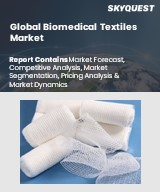
바이오메디컬 텍스타일 시장(2024-2031년)Global Biomedical Textiles Market 2024-2031 |
||||||

바이오메디컬 텍스타일 시장은 예측기간(2023-2030년)에 CAGR 6.2%로 성장할 것으로 예측됩니다. 이 시장의 성장 배경에는 세계의 기술 진보가 있습니다. 텍스타일 기술의 향상에 의해 항균 및 세정 기능이 향상한 텍스타일의 생산이 가능하게 되어, 시장 성장을 견인하고 있습니다. MDPI에 따르면 2023년 9월 폴리에스테르(PET)와 같은 섬유 제품에서 발생하는 마이크로플라스틱이 큰 우려 물질이 되고 있습니다. 연구에 따르면 섬유 그램 당 최대 72,000개의 마이크로플라스틱 섬유가 세탁 중에 방출될 수 있으며, 섬유 길이의 중앙값은 165-841μm입니다. 하루에 2만 개 이상의 섬유가 하천에 의해 하류로 운반되고, 평방 킬로미터당 21만 3200개의 섬유가 해수면에서 검출되고 있습니다. 플라스틱의 포이 버리는 것은 세계의 위기이며, 자연계에서 분해하는 소재로의 이행을 촉진하고 있습니다.
또한 섬유 산업에서는 바이오베이스와 생분해성 폴리머의 인기가 높아지고 있습니다. 향후 10년간 의류 산업이 이 시장 성장에 크게 기여할 것으로 예상됩니다. 생분해성 플라스틱은 제품이나 쓰레기가 자연적으로 의도하지 않고 폐기되는 경우에 이상적인 선택이며 호기성 또는 혐기성 소화 및 퇴비화가 가장 적합한 폐기 방법입니다.
부문별 전망
부직포 하위 부문이 세계 바이오메디컬 텍스타일 시장에서 상당한 점유율을 차지할 것으로 예측됨
패브릭 유형 중에서 부직포 하위 부문은 세계 바이오메디컬 텍스타일 시장에서 상당한 점유율을 차지할 것으로 예상됩니다. 부직포는 의료 및 수술 환경에서 2차 오염과 감염 전파를 방지함으로써 감염 예방과 질병 회피 등 본질적인 안전성을 제공합니다. 또한 부직포는 습윤 상처 치유 조건의 촉진, 피부 접착 최소화, 증기 투과의 제어 등의 기능을 갖춘 스마트 상처 치료 기구의 작성에 점점 사용되고 있습니다. 부직포는 수술용 드레싱재, 붕대, 임플란트 용도에 일반적으로 사용되며, 부직포는 시트, 튜브, 가운, 페이스 마스크, 스크럽 슈트, 신발 커버, 헤드 커버, 스펀지, 닦음, 플러그 등 다양한 생체 의료 섬유에 사용됩니다. 부직포 소재는 또한 직포보다 범용성이 높고, 비용 효율이 뛰어나고, 일회용 가능하고 효율적이기 때문에 헬스케어 용도로의 사용이 확대되고 있습니다.
지역별 전망
세계의 바이오메디컬 텍스타일 시장은 북미(미국, 캐나다), 유럽(영국, 이탈리아, 스페인, 독일, 프랑스, 기타 유럽), 아시아태평양(인도, 중국, 일본, 한국, 기타 아시아 지역), 세계의 기타 지역(중동 및 아프리카, 라틴아메리카)을 포함한 지역별로 더욱 세분화되어 있습니다. 그 중에서도 아시아태평양은 만성 상처 및 수술 증가로 세계 시장에서 돌출한 점유율을 차지할 것으로 예상되고 있습니다. 게다가 인도와 중국과 같은 신흥국 시장에서의 의료 재정 증가와 건강 관리 사업의 급성장은 시장 수익 성장을 가속하고 있습니다.
세계의 바이오메디컬 텍스타일 시장 성장 : 지역별(2023-2030년)
북미가 세계의 바이오메디컬 텍스타일 시장에서 대폭적인 CAGR을 나타낼 전망
모든 지역 중에서 북미는 예측 기간 동안 상당한 CAGR로 성장할 것으로 예상됩니다. 이 지역의 성장은 다양한 의료 용도가 증가하고 있기 때문입니다. 폴리에스테르 기반 소재는 광범위한 의료 용도에 적합하므로 점점 더 많이 사용되고 있습니다. 조직 공학용 발판, 치유를 촉진하는 상처 피복재, 생체 적합성의 외과용 임플란트, 혈관 재건 수술이나 안과 등의 치료에 이용할 수 있습니다. 미국 국립위생연구소(NIH)의 2022년 2월 발표에 따르면, 폴리에스테르계 재료는 경조직 및 연조직 공학, 상처 피복재, 수술용 임플란트, 혈관 재건 수술, 안과, 다제 내성 감염 예방 등 다양한 의료 용도에 사용됩니다. 의료 분야에서 폴리에스테르 소재의 사용률은 COVID-19의 팬데믹 이후 적어도 20.0% 증가하였으며, 의료용도 전체의 25.0%-50.0%가 폴리에스테르 소재를 사용하고, 나머지 비율은 다른 유형의 천연 폴리머나 합성 폴리머, 예를 들면 개인 보호구(PPE)에서는 25.0%의 폴리올레핀이 사용되고 있습니다.
목차
제1장 보고서 개요
- 업계의 현황 분석 및 성장 잠재력의 전망
- 조사방법 및 툴
- 시장 분석
- 부문별
- 지역별
제2장 시장 개요 및 인사이트
- 조사 범위
- 애널리스트의 인사이트 및 현재 시장 동향
- 주요 조사 결과
- 추천 사항
- 결론
제3장 경쟁 구도
- 주요 기업 분석
- B. Braun SE
- 개요
- 재무 분석
- SWOT 분석
- 최근 동향
- Bally Ribbon Mills
- 기업 개요
- 재무 분석
- SWOT 분석
- 최근 동향
- Biotechnology Center
- 개요
- 재무 분석
- SWOT 분석
- 최근 동향
- 주요 전략 분석
제4장 시장 세분화
- 세계의 바이오메디컬 텍스타일 시장 : 섬유 유형별
- 비생분해성
- 생분해성
- 세계의 바이오메디컬 텍스타일 시장 : 원단 유형별
- 부직포
- 직물
- 세계의 바이오메디컬 텍스타일 시장 : 용도별
- 이식 불가능
- 수술용 봉합사
제5장 지역 분석
- 북미
- 미국
- 캐나다
- 유럽
- 영국
- 독일
- 이탈리아
- 스페인
- 프랑스
- 기타 유럽
- 아시아태평양
- 중국
- 인도
- 일본
- 한국
- 기타 아시아태평양
- 세계 기타 지역
제6장 기업 프로파일
- Cardinal Health
- DSM
- Essity AB
- HARTMANN USA, Inc.
- Integra LifeSciences Corp.
- Johnson & Johnson Pvt. Ltd.
- Medline International BV
- MEISTER MASCHINEN Handels Service GmbH
- Poly-med
- Secant Group, LLC
- Swicofil AG
- Paul Hartmann AG
Biomedical Textiles Market Size, Share & Trends Analysis Report by Fiber Type (Non-Biodegradable and Biodegradable), by Fabric Type (Non-Woven and Woven), and by Application (Non-Implantable and Surgical Sutures) Forecast Period (2023-2030)
Biomedical textiles market is anticipated to grow at a CAGR of 6.2% during the forecast period (2023-2030). The market's growth is attributed to technological advancements across the globe. Textile technological improvements have enabled the production of textiles with improved antibacterial and cleaning capabilities, driving market growth. According to the MDPI, in September 2023, microplastics from textiles such as polyester (PET) pose a significant concern. Studies indicate that up to 72,000 microplastic fibers per gram of textile can be released during washing, with median fiber lengths ranging from 165 to 841 μm. Over 20,000 fibers per day are carried downstream by river and up to 213,200 fibers per square kilometer have been detected on the ocean's surface. Plastic littering is a global crisis, which is prompting a transition towards materials that degrade in nature.
Furthermore, Bio-based and biodegradable polymers are becoming increasingly popular in the textile industry. The clothing sector is expected to be the main contributor to the growth of this market in the next decade. Biodegradable plastics are the ideal choice when the product or litter is unintentionally disposed of in nature, where aerobic or anaerobic digestion and composting are the most suitable methods of disposal.
Segmental Outlook
The global biomedical textiles market is segmented on the fiber type, fabric type, and application. Based on the fiber type, the market is sub-segmented into non-biodegradable, and biodegradable. Based on the fabric type, the market is sub-segmented into non-woven, and woven. Furthermore, on the basis of application, the market is sub-segmented into non-implantable, and surgical sutures. The non-biodegradable subcategory is expected to capture a significant portion of the market share within the fiber type segment. This is attributed to the increased consumption in non-implantable applications. The growing awareness of the benefits of utilizing this fiber in the healthcare sector is projected to propel market growth.
The Non-Woven Sub-Segment is Anticipated to Hold a Considerable Share of the Global Biomedical Textiles Market
Among the fabric type, the non-woven sub-segment is expected to hold a considerable share of the global biomedical textiles market. Non-woven fabrics provide essential safety qualities such as infection prevention and disease avoidance by preventing cross-contamination and infection transmission in a medical or surgical environment. Furthermore, nonwovens have been used more and more in the creation of smart wound care devices, with features such as promoting moist wound healing conditions, minimizing skin adhesion, and controlling vapor transmission. Non-woven fabrics are commonly used in surgical dressings, bandages, and implant applications, and non-woven fabrics are utilized in a variety of biomedical textiles, including sheets, tubes, gowns, face masks, scrub suits, shoe covers, head covers, sponges, wipes, and plugs, among others. Nonwoven materials are additionally more versatile, cost-effective, disposable, and efficient than woven fabrics, leading to growing use of healthcare applications.
Regional Outlook
The global biomedical textiles market is further segmented based on geography including North America (the US, and Canada), Europe (UK, Italy, Spain, Germany, France, and the Rest of Europe), Asia-Pacific (India, China, Japan, South Korea, and Rest of Asia), and the Rest of the World (the Middle East & Africa, and Latin America). Among these, Asia-Pacific is anticipated to hold a prominent share of the market across the globe, owing to the rise in chronic wounds and surgical operations. Furthermore, increased healthcare financing and rapid growth of the healthcare business in developing nations such as India and China are boosting market revenue growth.
Global Biomedical Textiles Market Growth by Region 2023-2030
Source: OMR Analysis
The North America Region is Expected to Grow at a Significant CAGR in the Global Biomedical Textiles Market
Among all regions, the North American region is anticipated to grow at a considerable CAGR over the forecast period. Regional growth is attributed to the rising diverse medical applications. Polyester-based materials are increasingly being used, as they are compatible with a wide range of medical applications. They can be utilized to produce tissue engineering scaffolds, wound dressings that encourage healing, biocompatible surgical implants, and treatments such as vascular reconstructive surgery and ophthalmology. According to National Institute of Health (NIH), in February 2022, Polyester-based materials are used in a variety of medical applications, including hard and soft tissue engineering, wound dressings, surgical implants, vascular reconstructive surgery, ophthalmology, and prevention of multi-resistant infection. The usage of polyester materials in the medical field has increased by at least 20.0% since the start of the COVID-19 pandemic, with 25.0%-50.0% of all medical applications using polyester materials and the remaining percentage being provided by other types of natural or synthetic polymers, such as 25.0% polyolefins in personal protection equipment (PPE).
Market Players Outlook
The major companies serving the global biomedical textiles market include Cardinal Health, DSM, Essity AB, HARTMANN USA, Inc., and Integra LifeSciences Corp., among others. The market players are considerably contributing to the market growth by the adoption of various strategies including mergers and acquisitions, partnerships, collaborations, funding, and new product launches, to stay competitive in the market. For instance, in August 2019, Paul Hartmann AG acquired Safran Coating, the acquisition is designed to assist the expansion of new wound care solutions and improve patient quality of life.
The Report Covers:
- Market value data analysis of 2022 and forecast to 2030.
- Annualized market revenues ($ million) for each market segment.
- Country-wise analysis of major geographical regions.
- Key companies operating in the global biomedical textiles market. Based on the availability of data, information related to new product launches, and relevant news is also available in the report.
- Analysis of business strategies by identifying the key market segments positioned for strong growth in the future.
- Analysis of market-entry and market expansion strategies. Competitive strategies by identifying 'who-stands-where' in the market.
Table of Contents
1.Report Summary
- Current Industry Analysis and Growth Potential Outlook
- 1.1.Research Methods and Tools
- 1.2.Market Breakdown
- 1.2.1.By Segments
- 1.2.2.By Region
2.Market Overview and Insights
- 2.1.Scope of the Report
- 2.2.Analyst Insight & Current Market Trends
- 2.2.1.Key Findings
- 2.2.2.Recommendations
- 2.2.3.Conclusion
3.Competitive Landscape
- 3.1.Key Company Analysis
- 3.2.B. Braun SE
- 3.2.1.Overview
- 3.2.2.Financial Analysis
- 3.2.3.SWOT Analysis
- 3.2.4.Recent Developments
- 3.3.Bally Ribbon Mills
- 3.3.1.Overview
- 3.3.2.Financial Analysis
- 3.3.3.SWOT Analysis
- 3.3.4.Recent Developments
- 3.4.Biotechnology Center
- 3.4.1.Overview
- 3.4.2.Financial Analysis
- 3.4.3.SWOT Analysis
- 3.4.4.Recent Developments
- 3.5.Key Strategy Analysis
4.Market Segmentation
- 4.1.Global Biomedical Textiles Market by Fiber Type
- 4.1.1.Non-Biodegradable
- 4.1.2.Biodegradable
- 4.2.Global Biomedical Textiles Market by Fabric Type
- 4.2.1.Non-Woven
- 4.2.2.Woven
- 4.3.Global Biomedical Textiles Market by Application
- 4.3.1.Non-Implantable
- 4.3.2.Surgical Sutures
5.Regional Analysis
- 5.1.North America
- 5.1.1.United States
- 5.1.2.Canada
- 5.2.Europe
- 5.2.1.UK
- 5.2.2.Germany
- 5.2.3.Italy
- 5.2.4.Spain
- 5.2.5.France
- 5.2.6.Rest of Europe
- 5.3.Asia-Pacific
- 5.3.1.China
- 5.3.2.India
- 5.3.3.Japan
- 5.3.4.South Korea
- 5.3.5.Rest of Asia-Pacific
- 5.4.Rest of the World
6.Company Profiles
- 6.1.Cardinal Health
- 6.2.DSM
- 6.3.Essity AB
- 6.4.HARTMANN USA, Inc.
- 6.5.Integra LifeSciences Corp.
- 6.6.Johnson & Johnson Pvt. Ltd.
- 6.7.Medline International B.V.
- 6.8.MEISTER MASCHINEN Handels + Service GmbH
- 6.9.Poly-med
- 6.10.Secant Group, LLC
- 6.11.Swicofil AG
- 6.12.Paul Hartmann AG