
|
시장보고서
상품코드
2028471
지속가능 냉동 기술 시장 : 업계 동향과 예측(-2040년) - 기술 유형별, 설비 유형별, 용도별, 최종사용자별, 지역별Sustainable Refrigeration Technology Market: Industry Trends and Global Forecasts, Till 2040 - Distribution by Type of Technology, Type of Equipment, Application, End User and Geographical Regions |
||||||

지속가능한 냉동 기술 시장 - 개요
지속가능 냉동 기술 시장 규모는 2035년까지의 예측 기간에 CAGR 8.3%로 확대하며, 올해 694억 달러에서 2040년까지 2,115억 달러에 달할 것으로 추정되고 있습니다.
지속가능한 냉동 기술 시장 - 성장과 동향
냉동 기술은 식품 보존, 의료, 제약 분야의 중요한 용도를 지원하는 현대 인프라의 필수적인 요소로 자리 잡았습니다. 그러나 그 환경적 영향은 여전히 막대하며, 지속가능성은 점점 더 위협받고 있습니다. 수소불화탄소(HFC) 및 기타 합성 냉매에 크게 의존하는 기존 냉동 시스템은 온실 가스 배출과 오존층 파괴의 주요 원인이 되고 있습니다.
현재 냉동공조 분야는 전 세계 온실가스 배출량의 10% 이상을 차지하고 있으며, 2030년까지 그 양이 두 배로 증가할 것으로 예상됩니다. 동시에 냉동시스템은 전 세계 전력 소비량의 20%에 가까운 비중을 차지하고 있으며, 그 주요 요인은 에너지 효율이 낮은 기술과 기후변화를 악화시키는 HFC와 같은 지구온난화지수(GWP)가 높은 냉매의 지속적인 사용에 있습니다.
이러한 문제에 대응하기 위해 산업계는 환경에 미치는 영향을 최소화하기 위해 지속가능한 냉동 솔루션으로의 전환을 가속화하고 있습니다. 이러한 기술은 자연 냉매 및 대체 냉각 메커니즘을 활용하여 광범위한 응용 분야에서 보다 친환경적이고 에너지 효율적인 성능을 제공합니다.
이산화탄소(CO2), 암모니아(NH3), 프로판(R290) 등의 천연 냉매는 기존 합성 냉매에 비해 에너지 효율이 우수하고 GWP가 현저히 낮습니다. 특히 CO2와 같은 저탄소 냉매의 대규모 도입은 최대 48기가톤의 글로벌 배출량을 줄일 수 있으며, 이는 약 8,060억 그루의 나무가 흡수할 수 있는 이산화탄소량에 해당합니다.
이처럼 지속가능한 냉동 기술 시장은 저탄소 냉각 솔루션으로의 전환을 촉진하는 중요한 원동력으로 부상하고 있습니다. 또한 인공지능(AI), 사물인터넷(IoT) 등 첨단 기술의 통합으로 실시간 모니터링, 예지보전, 에너지 최적화를 통해 시스템 성능이 향상되고 있습니다.
또한 태양광발전 냉동 시스템 및 상변화 재료와 같은 혁신으로 인해 원격지 및 오프 그리드 지역에서 효율적인 냉각에 대한 접근성이 확대되고 있으며, 이는 새로운 시장 기회를 창출하고 있습니다. 콜드체인 물류의 급속한 성장과 Kigali 개정 및 유럽 F가스 규제를 포함한 엄격한 환경 규제의 시행과 함께 이러한 추세는 업계가 지속가능하고 규정을 준수하는 냉동 관행으로 전환하는 움직임을 가속화하고 있습니다.
성장의 원동력: 시장 확대의 전략적 촉진요인
지속가능한 냉동 기술 시장은 규제 요건, 환경적 우선순위, 진화하는 산업 요구사항이 강력하게 결합되어 상업, 산업, 주거 부문의 냉각 시스템 설계, 운영 및 도입을 포괄적으로 변화시키고 있습니다. 이러한 시장 확대의 중심에는 지구온난화지수(GWP)가 높은 냉매, 특히 하이드로플루오로카본(HFC)으로부터의 전환이 가속화되고 있다는 점이 있습니다. 이러한 전환은 몬트리올 의정서의 키갈리 개정, 유럽 그린딜, 개정된 F가스 규제, 그리고 미국의 AIM법 및 EPA의 SNAP 프로그램과 같은 국가 정책을 포함한 견고한 규제 프레임워크와 국제 협약에 의해 추진되고 있습니다.
이 프레임워크는 2025-2026년까지 유럽에서 특정 GWP 기준치를 초과하는 냉매의 사용을 금지하고, 미국에서 할당량을 40% 감축하는 등 HFC 감축을 위한 엄격한 기한을 설정하여 제조업체와 최종사용자에게 CO2(R-744), 암모니아(NH3/R-717), 탄화수소(예: 프로판/R-290)와 같은 천연 대체품으로 전환을 요구하고 있습니다. ), 탄화수소(예: 프로판/R-290)와 같은 천연 유래 대체품으로의 전환을 강요하고 있습니다. 이러한 규제 환경은 온실가스 배출을 크게 줄일 뿐만 아니라, 보다 광범위한 넷제로 목표와도 일치하며, 미래지향적인 비즈니스 운영을 추구하는 기업에게 규제 준수는 경쟁 우위를 가져다 줄 수 있습니다.
시장 과제: 발전을 가로막는 심각한 장벽들
앞서 언급한 장점에도 불구하고 지속가능한 냉동 기술 시장은 심각한 장벽에 직면해 있으며, 이는 전환 속도를 늦추고 광범위한 도입의 장벽이 될 수 있습니다. 그 중 가장 큰 것은 지속가능한 시스템에 필요한 높은 초기 투자 비용입니다. 예를 들어 CO2 시스템 도입은 기존 불소계 대체물질을 이용한 개보수 공사에 비해 초기 비용이 크게 높아 충분한 재정적 인센티브나 보조금이 없는 소규모 사업자나 비용에 민감한 지역 사업자에게는 도입의 걸림돌로 작용하고 있습니다. 기술적 복잡성도 또 다른 장벽이 되고 있습니다. 암모니아의 독성은 전문적인 안전 프로토콜과 취급에 대한 전문 지식이 필요하며, 탄화수소의 가연성은 부품의 재설계와 엄격한 인증이 필요합니다. 이 모든 것이 공급망에 부담을 주며, 이러한 첨단 장비를 설치, 유지보수 및 최적화할 수 있는 숙련된 기술자가 만성적으로 부족하다는 점을 강조하고 있습니다. 또한 지역 간 규제의 불일치로 인해 마찰이 더욱 심화되고 있습니다. 각 관할권마다 다른 컴플라이언스 기준은 전 세계 제조 및 도입을 복잡하게 만들고 있습니다. 또한 지정학적 긴장에서부터 부품 부족에 이르는 공급망 취약성은 에너지 가격 급등과 프로젝트 지연을 초래할 수 있습니다. 장기적인 수명주기 비용 절감(운영비용 절감, 배출규제 위반에 따른 벌칙 감소)에 대한 소비자 및 기업의 인식이 제한적이기 때문에 도입을 주저하는 경우가 있습니다. 또한 오프그리드나 개발도상국 시장과 같은 틈새시장에서는 애프터서비스망 미비, 환경적 측면의 트레이드오프가 여전히 남아있는 등 과제가 계속되고 있습니다. 이를 극복하기 위해서는 지속가능한 냉동 기술이 환경적으로 우수할 뿐만 아니라 대규모 도입 시에도 경제적, 운영적으로 원활하게 작동할 수 있도록 타겟팅된 인센티브, 인재 육성 프로그램, 그리고 지속적인 혁신이 필요합니다.
지속가능한 냉동 기술 시장 - 주요 인사이트
이 보고서는 지속가능한 냉동 기술 시장의 현황을 상세히 분석하고 업계내 잠재적인 성장 기회를 파악합니다. 보고서의 주요 조사 결과는 다음과 같습니다. :
- 지속가능한 냉동 기술 분야의 주요 기업(기존 기업 및 스타트업) 중 일부는 친환경 솔루션을 제공하는 데 필요한 역량을 보유하고 있다고 주장하고 있으며, 이들 기업의 대부분은 유럽에 기반을 두고 있습니다.
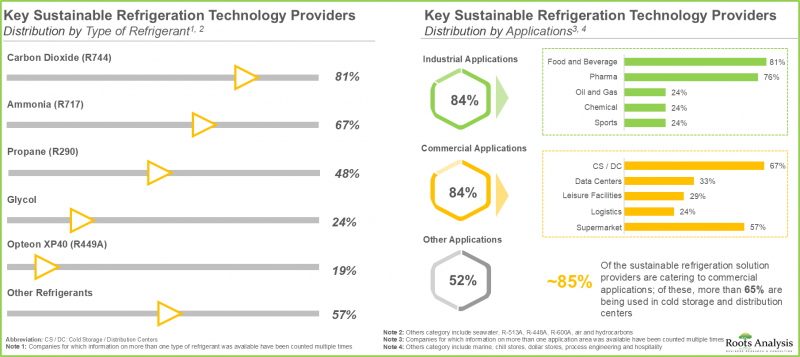
- 이산화탄소는 환경적 지속가능성, 에너지 효율성, 안전성, 운영의 다양성, 규제 준수 등 다양한 장점으로 인해 다양한 응용 분야에서 선호되는 냉매로 자리 잡았습니다.
- 조사를 통해 우리는 지속가능한 냉동 기술 시장을 형성하는 메가 트렌드에 대한 포괄적인 이해를 높이고, 현재 진행 상황과 미래 전망을 파악했습니다.
- 배출량 감축에 대한 규제 압력 증가, 소비자 인식 개선, 지속적인 기술 혁신에 힘입어 지속가능한 냉동 기술 분야는 괄목할 만한 성장을 달성하고 있습니다.
- 실제로 이 시장은 2040년까지 CAGR 8.3%로 성장할 것으로 예상되며, 유럽이 현재 시장 점유율의 40% 이상을 차지할 것으로 전망됩니다.
- 시장의 약 60%는 상업용 지속가능한 냉동 기술별 매출이 차지할 것으로 예상됩니다. 특히 냉각기 시장은 더 빠른 속도로 성장할 것으로 예상됩니다.
지속가능한 냉동 기술 시장
시장 규모 및 기회 분석은 다음 매개 변수를 기반으로 세분화됩니다. :
컴포넌트 유형
- 장비
- 서비스
기술 유형
- CO2 냉동 기술
- 암모니아 냉동 기술
- 프로판 냉동 기술
- 기타
설비 유형
- 쇼케이스
- 캐스케이드
- 응축 유닛
- 냉각기
- 기타
용도
- 상업용
- 산업 용도
- 기타
최종사용자
- 상업
- 산업
- 기타
지역별
- 북미
- 북미
- 아시아태평양
- 중동 및 북아프리카
- 라틴아메리카
지속가능한 냉동 기술 시장 - 주요 부문
CO2 냉동기술이 시장 확대 견인
현재 CO2 냉동기술의 하위 부문은 전체 시장의 56.3%를 차지하고 있습니다. 이러한 성장은 낮은 지구온난화지수(GWP), 무독성, 화학적 안정성, 규제 준수, 비용 효율성 등 CO2 냉동이 가진 수많은 장점에 힘입은 것입니다. 이러한 장점으로 인해 CO2 냉동은 상업용 및 산업용 냉동 응용 분야에서 가장 실용적이고 지속가능한 솔루션 중 하나가 되었습니다.
현재 많은 사업자들이 초임계 기술 및 캐스케이드 방식의 CO2 기반 시스템으로 전환하고 있다는 점을 염두에 두어야 합니다.
또한 기타 기술 시장 부문은 공기, 태양광, 자기냉동 기술의 개발 및 보급이 활발히 진행되면서 10.6%의 높은 CAGR로 확대될 것으로 예상됩니다.
가장 큰 점유율을 차지하는 것은 전시용 캐비닛입니다.
2026년 현재, 디스플레이 캐비닛은 지속가능한 냉동 기술 시장의 29%를 차지합니다. 소비자의 취향이 대형 슈퍼마켓에서 중소형 슈퍼마켓과 편의점으로 옮겨가고 있는 것이 디스플레이 캐비닛 수요 증가의 원동력이 되고 있습니다.
특히 디스플레이 캐비닛은 상품 가시성 향상, 식품 품질 유지, 에너지 효율 규제 대응에 필수적이기 때문에 전 세계 상업용 냉동냉장 장비 시장의 약 절반을 차지하는 주요 카테고리가 되었습니다.
9.3%의 비교적 높은 CAGR을 보이는 냉각기 하위 부문 시장은 에너지 효율 향상에 대한 수요 증가에 힘입어 성장하고 있습니다.
상업적 용도로 인한 시장 성장
현재 지속가능한 냉동 기술 시장은 상업용 응용 분야(59%)가 주도하고 있습니다. 이는 E-Commerce의 급속한 성장과 식품 소매, 호텔, 콜드체인 물류의 냉동 수요 증가가 주요 요인으로 작용하고 있습니다.
다양한 산업 분야에서 최첨단 친환경 및 에너지 효율이 높은 냉동 시스템이 빠르게 보급됨에 따라 산업 응용 분야는 8.8%의 높은 CAGR로 성장할 것으로 예상됩니다.
지속가능한 냉동 기술 시장은 식품 및 음료 분야가 주도하고 있습니다.
식품 및 음료 하위 부문은 2026년 시장 점유율의 대부분(48%)을 차지할 것으로 예상되며, 이러한 추세는 예측 기간 중 지속될 것으로 예상됩니다. 이는 주로 인구 증가에 따른 효과적이고 안전한 식품 보존 솔루션에 대한 수요 증가와 소매업 및 E-Commerce의 급속한 성장에 기인합니다.
또한 제약 및 생명공학 기업의 지속가능한 냉장 기술 시장은 9.2%의 더 높은 CAGR을 보일 것으로 예상됩니다. 이는 주로 백신, 바이오의약품 등 온도에 민감한 의약품의 운송 및 보관에 있으며, 엄격한 온도 관리에 대한 요구가 증가함에 따라 에너지 효율이 높은 첨단 냉장 시스템이 빠르게 도입되고 있기 때문입니다.
향후 수년간 아시아태평양이 지속가능한 냉동 기술 분야를 주도할 것으로 예상됩니다.
이 섹션에서는 북미, 유럽, 아시아태평양, 중동 및 북아프리카(MENA), 라틴아메리카 등 여러 지역의 시장 동향을 다룹니다. 당사의 예측에 따르면 올해 유럽은 지속가능한 냉동 기술 시장의 42%를 차지할 것으로 예상되며, 이러한 추세는 앞으로도 변함없이 유지될 것으로 예상됩니다. 이 지역에서 천연 냉매가 크게 활용되는 주요 요인은 F가스 규제 및 기타 엄격한 환경 규제에 있습니다. 예측 기간 중 아시아태평양 시장은 상대적으로 높은 CAGR(CAGR 9%)로 성장할 것으로 예상된다는 점에 유의하는 것이 중요합니다.
지속가능한 냉동 기술 시장의 주요 기업 사례
- Coastline International
- Ensera
- Forefront Medical Technologies
- Infus Medical
- M&M Qualtech
- Medical Murray
- Sanmina
- StarFish Medical
- Tessy Plastics
지속가능한 냉동 기술 시장 - 조사 범위
- 시장 규모 및 기회 분석: 이 보고서는 의료기기 수탁제조 시장에 대해 [A] 기술 유형, [B] 장비 유형, [C] 용도, [D] 최종사용자, [E] 지역 등 주요 시장 부문에 초점을 맞춘 상세한 분석을 담고 있습니다.
- 지속가능한 냉동 기술 시장 현황: 지속가능한 냉동 기술 시장 전체에 대한 상세한 평가와 함께 [A] 회사 개요, [B] 제공 서비스 유형, [C] 장비 유형, [D] 냉동 기술 유형, [E] 냉매 유형, [F] 용도 등 다양한 관련 매개변수에 대한 정보를 제공합니다.
- 기업 개요: [A] 설립연도, [B] 본사 소재지, [C] 제품 포트폴리오, [D] 최근 동향, [E] 정보에 입각한 미래 전망 등 여러 매개변수를 기반으로 지속가능한 냉동 기술 시장에 종사하는 주요 기업의 상세한 프로필을 제공합니다.
- 메가트렌드 분석: 천연 냉매 채택, 혁신적인 에너지 절약 시스템, 스마트 기술 통합, 오프그리드 냉각 솔루션 개발, 신흥 시장에서의 콜드체인 확장, 규제 준수 및 지속가능성 목표 등 지속가능한 냉동 기술 산업에서 진행 중인 다양한 메가트렌드에 대한 질적 평가. 평가입니다.
- 시장 영향 분석: 시장 성장에 영향을 미칠 수 있는 요인에 대한 상세한 분석입니다. 또한 이 분야의 주요 촉진요인, 잠재적 제약, 새로운 기회 및 기존 과제에 대한 식별 및 분석도 포함되어 있습니다.
목차
제1장 : 보고서의 개요
제1장 배경
제2장 조사 방법
제3장 시장 역학
제4장 거시경제 지표
제II부 : 정성적 인사이트
제5장 개요
제6장 서론
제III부 : 시장 개요
제7장 경쟁 구도 : 지속가능 냉동 기술 프로바이더
제IV부 : 기업 개요
제8장 기업 개요
제V부 : 시장 동향
제9장 지속가능 냉동 기술 시장 - 진행중 메가 트렌드의 개요
제VI부 : 시장 예측과 기회 분석
제10장 시장 영향 분석 : 촉진요인, 억제요인, 기회, 과제
제11장 세계의 지속가능 냉동 기술 시장
제12장 지속가능 냉동 기술 시장(부품 유형별)
제13장 지속가능 냉동 기술 시장(기술 유형별)
제14장 지속가능 냉동 기술 시장(설비 유형별)
제15장 지속가능 냉동 기술 시장(용도별)
제16장 지속가능 냉동 기술 시장(최종사용자별)
제17장 지속가능 냉동 기술 시장(지역별)
제VII부 시장 예측과 기회 분석
제18장 시장 기회 분석 : 북미
제19장 시장 기회 분석 : 유럽
제20장 시장 기회 분석 : 아시아태평양
제21장 시장 기회 분석 : 라틴아메리카
제22장 시장 기회 분석 : 중동 및 북아프리카
제VIII부 : 기타 독점적 인사이트
제23장 결론
제24장 1차 조사로부터의 인사이트
제IX부 : 부록
제25장 표형식 데이터
제26장 기업 및 조직 리스트
KSA 26.05.20Sustainable Refrigeration Technology Market: Overview
As per Roots Analysis, the sustainable refrigeration technology market is estimated to grow from USD 69.4 billion in the current year to USD 211.5 billion by 2040, at a CAGR of 8.3% during the forecast period, till 2035.
Sustainable Refrigeration Technology Market: Growth and Trends
Refrigeration has become an essential component of modern infrastructure, underpinning critical applications across food preservation, healthcare, and pharmaceuticals. However, its environmental impact remains substantial and increasingly unsustainable. Conventional refrigeration systems, which rely heavily on hydrofluorocarbons (HFCs) and other synthetic refrigerants, have been major contributors to greenhouse gas emissions and ozone layer depletion.
Currently, refrigeration and air conditioning account for over 10% of global greenhouse gas emissions, with projections suggesting a potential doubling by 2030. In parallel, refrigeration systems represent nearly 20% of global electricity consumption, driven largely by energy-inefficient technologies and the continued use of high global warming potential (GWP) refrigerants such as HFCs, which exacerbate climate change.
In response to these challenges, industries are increasingly transitioning toward sustainable refrigeration solutions aimed at minimizing environmental impact. These technologies leverage natural refrigerants or alternative cooling mechanisms, offering more eco-friendly and energy-efficient performance across a range of applications.
Natural refrigerants, including carbon dioxide (CO2), ammonia (NH3), and propane (R290), provide superior energy efficiency and significantly lower GWP compared to conventional synthetic options. Notably, the large-scale adoption of low-impact refrigerants such as CO2 has the potential to reduce global emissions by up to 48 gigatons equivalent to the carbon sequestration impact of approximately 806 billion trees.
The sustainable refrigeration technology market is thus emerging as a key enabler of the global transition toward low-carbon cooling solutions. Furthermore, the integration of advanced technologies such as artificial intelligence (AI) and the Internet of Things (IoT) is enhancing system performance through real-time monitoring, predictive maintenance, and energy optimization.
Additionally, innovations such as solar-powered refrigeration systems and phase-change materials are expanding access to efficient cooling in remote and off-grid regions, thereby unlocking new market opportunities. Coupled with the rapid expansion of cold chain logistics and the enforcement of stringent environmental regulations, including the Kigali Amendment and the European F-Gas Regulation, these developments are accelerating the industry's shift toward sustainable and compliant refrigeration practices.
Growth Drivers: Strategic Enablers of Market Expansion
The sustainable refrigeration technology market is being driven by a strong convergence of regulatory mandates, environmental priorities, and evolving industry requirements, collectively transforming the design, operation, and adoption of cooling systems across commercial, industrial, and residential sectors. Central to this market expansion is the accelerated global transition away from high global warming potential (GWP) refrigerants, particularly hydrofluorocarbons (HFCs). This shift is being driven by robust regulatory frameworks and international accords, including the Kigali Amendment to the Montreal Protocol, the European Green Deal, revised F-Gas regulations, and national policies such as the U.S. AIM Act and EPA SNAP program.
These frameworks impose strict timelines for HFC reductions such as bans on refrigerants above certain GWP thresholds starting in 2025-2026 in Europe and a 40% allocation cut in the US, compelling manufacturers and end-users to transition to natural alternatives like CO2 (R-744), ammonia (NH3/R-717), and hydrocarbons (e.g., propane/R-290). This regulatory environment not only slashes greenhouse gas emissions, but also aligns with broader net-zero targets, turning compliance into a competitive advantage for businesses seeking to future-proof their operations.
Market Challenges: Critical Barriers Impeding Progress
Despite the abovementioned advantages, the sustainable refrigeration technology market faces significant hurdles, that can slow the pace of transition and raise barriers for widespread implementation. Foremost among them is the elevated upfront capital investment required for sustainable systems CO2 installations, for example, often carry substantially higher initial costs than retrofits using legacy fluorinated alternatives, deterring smaller operators or those in cost-sensitive regions without sufficient financial incentives or subsidies. Technical complexities add another layer: ammonia's toxicity demands specialized safety protocols and handling expertise, while hydrocarbons' flammability necessitates redesigned components and rigorous certification, all of which strain supply chains and highlight a persistent shortage of skilled technicians capable of installation, maintenance, and optimization of these advanced setups. Further, regional inconsistencies in regulations create further friction, as varying compliance standards across jurisdictions complicate global manufacturing and deployment, while supply-chain vulnerabilities from geopolitical tensions to component shortages can spike energy prices and delay projects. Limited consumer and business awareness of long-term lifecycle savings (lower operating costs, reduced emissions penalties) sometimes leads to hesitation, and in niche areas like off-grid or developing markets, challenges such as inadequate after-sales service networks and lingering environmental trade-offs persist. Overcoming these will require targeted incentives, workforce training programs, and continued innovation to make sustainable refrigeration not just environmentally superior but also economically and operationally seamless at scale
Sustainable Refrigeration Technology Market: Key Insights
The report delves into the current state of the sustainable refrigeration technology market and identifies potential growth opportunities within industry. Some key findings from the report include:
- Several key companies (established as well as start ups) in the sustainable refrigeration technology domain claim to have the necessary capabilities to offer eco-friendly solutions; majority of these firms are based in Europe.
- Carbon dioxide is the preferred refrigerant for various applications due to its several advantages, including environmental sustainability, energy efficiency, safety, operational versatility, and regulatory compliance.
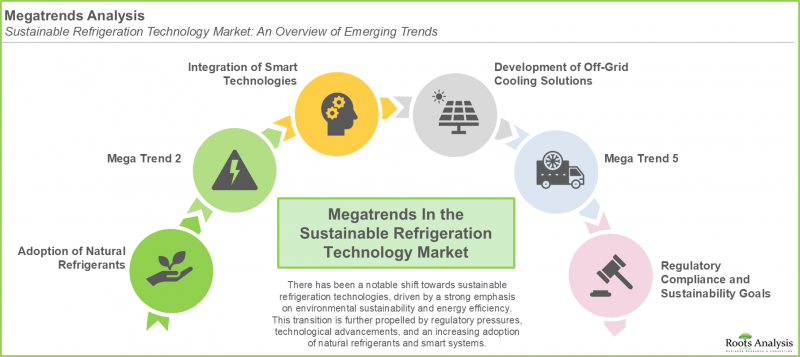
- During our research, we developed a comprehensive understanding of the megatrends shaping the sustainable refrigeration technology market, highlighting both current advancements and future prospects.
- The sustainable refrigeration technology domain is experiencing significant growth, driven by rising regulatory pressure to reduce emissions, rising consumer awareness and ongoing technological innovations.
- In fact, the market is likely to grow at an annualized rate (CAGR) of 8.3%, till 2040; >40% of the current market share is likely to be captured by Europe.
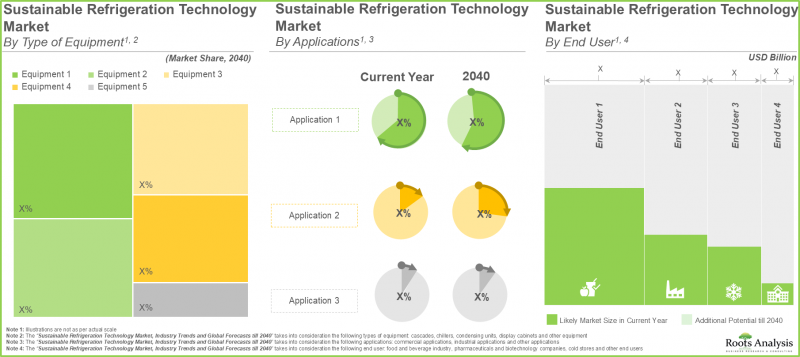
- Around 60% of the market is anticipated to be captured by revenues generated from sustainable refrigeration technologies for commercial applications; notably, the market for chillers is likely to grow at a faster pace.
Sustainable Refrigeration Technology Market
The market sizing and opportunity analysis has been segmented across the following parameters:
Type of Component
- Equipment
- Services
Type of Technology
- CO2 Refrigeration Technology
- Ammonia Refrigeration Technology
- Propane Refrigeration Technology
- Other Refrigeration Technologies
Type of Equipment
- Display Cabinets
- Cascades
- Condensing Units
- Chillers
- Other Equipment
Application
- Commercial Applications
- Industrial Applications
- Other Applications
End User
- Commercial Applications
- Industrial Applications
- Other Applications
By Geographical Regions
- North America
- Europe
- Asia-Pacific
- Middle East and North Africa
- Latin America
SUSTAINABLE REFRIGERATION TECHNOLOGY MARKET: Key Segments
CO2 Refrigeration Technology Fueling Market Expansion
At present, the CO2 refrigeration technology subsegment accounts for 56.3% of the overall market. This rise is fueled by a number of benefits of CO2 refrigeration, including as low GWP, non-toxicity, chemical stability, regulatory compliance, and cost-effectiveness. CO2 refrigeration is one of the most practical and sustainable solutions for commercial and industrial refrigeration applications because of these advantages.
It is important to note that a lot of business establishments are currently switching to transcritical technology or CO2-based systems in a cascade arrangement.
Additionally, the market for other technologies subsegment is anticipated to expand at a high compound annual growth rate (CAGR) of 10.6%, propelled by the growing development and uptake of air, solar, and magnetic refrigeration technologies.
The largest share is held by display cabinets
Display cabinets account for 29% of the market share for sustainable refrigeration technology in 2026. The movement in consumer preferences from large supermarkets to smaller supermarkets and convenience stores is the driving force behind the increasing need for display cabinets.
Notably, display cabinets are the leading category, making up about half of the global market for commercial refrigeration equipment, because they are essential for improving product visibility, preserving food quality, and satisfying energy efficiency regulations.
With a comparatively higher CAGR of 9.3%, the market for chillers sub-segment is being driven by the growing desire for greater energy efficiency.
Market Growth Driven by Commercial Applications
The market for sustainable refrigeration technology is currently dominated by the commercial applications subsegment (59%). The fast growth of e-commerce and the growing need for refrigeration in food retail, hotels, and cold chain logistics are the main causes of this.
Due to the quick uptake of cutting-edge, environmentally friendly, and energy-efficient refrigeration systems across a variety of industries, the industrial applications sub-segment is anticipated to develop at a higher CAGR of 8.8%.
The market for sustainable refrigeration technology is dominated by food and beverage
The food and beverage subsegment is expected to have the majority of the market share (48%) in 2026, and this trend is probably going to continue throughout the forecast period. This is mostly because of the growing population, which has raised the need for effective and safe food storage solutions, as well as the quick growth of retail and e-commerce.
Furthermore, a higher CAGR of 9.2% is anticipated for the pharmaceutical and biotechnology firms' sustainable refrigeration technology market. This is mostly because of the quick uptake of sophisticated, energy-efficient refrigeration systems to satisfy the growing need for strict temperature control in the shipping and storage of medications that are sensitive to temperature, such vaccines and biologics.
In the Coming Years, Asia-Pacific Will Lead the Sustainable Refrigeration Technology Sector
The market is distributed across several regions, including North America, Europe, Asia-Pacific, MENA, and Latin America, is highlighted in this section. Our forecasts indicate that Europe will likely account for 42% of the market share for sustainable refrigeration technology this year, and this trend is not expected to change. The F-gas Regulation and other strict environmental restrictions are largely to blame for the region's substantial use of natural refrigerants. It is important to note that throughout the projection period, the Asia-Pacific market is expected to rise at a comparatively higher CAGR (9%).
Example Players in Sustainable Refrigeration Technology Market
- Coastline International
- Ensera
- Forefront Medical Technologies
- Infus Medical
- M&M Qualtech
- Medical Murray
- Sanmina
- StarFish Medical
- Tessy Plastics
Sustainable Refrigeration Technology Market: Research Coverage
- Market Sizing and Opportunity Analysis: The report features an in-depth analysis of the medical device contract manufacturing market, focusing on key market segments, including [A] type of technology [B] type of equipment, [C] application, [D] end user, and [E] geographical regions.
- Sustainable Refrigeration Technology Market Landscape: A detailed assessment of the overall sustainable refrigeration technology market landscape, along with information on several relevant parameters, such as [A] company overview, [B] type of offering, [C] type of equipment, [D] type of refrigeration technology, [E] type of refrigerant and [F] applications.
- Company Profiles: In-depth profiles of leading players engaged in sustainable refrigeration technology market based on several parameters such as [A] year of establishment, [B] location of headquarters, [C] product portfolio, [D] recent developments and [E] an informed future outlook.
- Megatrends Analysis: A qualitative assessment of the various megatrends ongoing in the sustainable refrigeration technology industry, including the adoption of natural refrigerants, innovative energy-efficient systems, integration of smart technologies, development of off-grid cooling solutions, cold chain expansion in emerging markets, and the regulatory compliance and sustainability goals.
- Market Impact Analysis: An in-depth analysis of the factors that can impact the growth of the market. It also features identification and analysis of key drivers, potential restraints, emerging opportunities, and existing challenges in this domain.
Key Questions Answered in this Report
- Which are the leading companies in the sustainable refrigeration technology market?
- Which region dominates the sustainable refrigeration technology market?
- What are the key trends observed in the sustainable refrigeration technology market?
- What factors are likely to influence the evolution of this market?
- What are the primary challenges faced by sustainable refrigeration technology providers?
- What is the current and future market size?
- What is the CAGR of this market?
- How is the current and future market opportunity likely to be distributed across key market segments?
Reasons to Buy this Report
- The report provides a comprehensive market analysis, offering detailed revenue projections of the overall market and its specific sub-segments. This information is valuable to both established market leaders and emerging entrants.
- The report offers stakeholders a comprehensive overview of the market, including key drivers, barriers, opportunities, and challenges. This information empowers stakeholders to stay abreast of market trends and make data-driven decisions to capitalize on growth prospects.
- The report can aid businesses in identifying future opportunities in any sector. It also helps in understanding if those opportunities are worth pursuing.
- The report helps in identifying customer demand by understanding the needs, preferences, and behavior of the target audience in order to tailor products or services effectively.
- The report equips new entrants with requisite information regarding a particular market to help them build successful business strategies.
- The report allows for more effective communication with the audience and in building strong business relations.
Additional Benefits
- Complimentary Excel Data Packs for all Analytical Modules in the Report
- 15% Free Content Customization
- Detailed Report Walkthrough Session with Research Team
- Free Updated report if the report is 6-12 months old or older
TABLE OF CONTENTS
SECTION I: REPORT OVERVIEW
1. BACKGROUND
- 1.1. Context
- 1.2. Project Objectives
2. RESEARCH METHODOLOGY
- 2.1. Chapter Overview
- 2.2. Research Assumptions
- 2.2.1. Market Landscape and Market Trends
- 2.2.2. Market Forecast and Opportunity Analysis
- 2.2.3. Comparative Analysis
- 2.3. Database Building
- 2.3.1. Data Collection
- 2.3.2. Data Validation
- 2.3.3. Data Analysis
- 2.4. Project Methodology
- 2.4.1. Secondary Research
- 2.4.1.1. Annual Reports
- 2.4.1.2. Academic Research Papers
- 2.4.1.3. Company Websites
- 2.4.1.4. Investor Presentations
- 2.4.1.5. Regulatory Filings
- 2.4.1.6. White Papers
- 2.4.1.7. Industry Publications
- 2.4.1.8. Conferences and Seminars
- 2.4.1.9. Government Portals
- 2.4.1.10. Media and Press Releases
- 2.4.1.11. Newsletters
- 2.4.1.12. Industry Databases
- 2.4.1.13. Roots Proprietary Databases
- 2.4.1.14. Paid Databases and Sources
- 2.4.1.15. Social Media Portals
- 2.4.1.16. Other Secondary Sources
- 2.4.2. Primary Research
- 2.4.2.1. Types of Primary Research
- 2.4.2.1.1. Qualitative Research
- 2.4.2.1.2. Quantitative Research
- 2.4.2.1.3. Hybrid Approach
- 2.4.2.2. Advantages of Primary Research
- 2.4.2.3. Techniques for Primary Research
- 2.4.2.3.1. Interviews
- 2.4.2.3.2. Surveys
- 2.4.2.3.3. Focus Groups
- 2.4.2.3.4. Observational Research
- 2.4.2.3.5. Social Media Interactions
- 2.4.2.4. Key Opinion Leaders Considered in Primary Research
- 2.4.2.4.1. Company Executives (CXOs)
- 2.4.2.4.2. Board of Directors
- 2.4.2.4.3. Company Presidents and Vice Presidents
- 2.4.2.4.4. Research and Development Heads
- 2.4.2.4.5. Technical Experts
- 2.4.2.4.6. Subject Matter Experts
- 2.4.2.4.7. Scientists
- 2.4.2.4.8. Doctors and Other Healthcare Providers
- 2.4.2.5. Ethics and Integrity
- 2.4.2.5.1. Research Ethics
- 2.4.2.5.2. Data Integrity
- 2.4.2.1. Types of Primary Research
- 2.4.3. Analytical Tools and Databases
- 2.4.1. Secondary Research
- 2.5. Robust Quality Control
3. MARKET DYNAMICS
- 3.1. Chapter Overview
- 3.2. Forecast Methodology
- 3.2.1. Top-down Approach
- 3.2.2. Bottom-up Approach
- 3.2.3. Hybrid Approach
- 3.3. Market Assessment Framework
- 3.3.1. Total Addressable Market (TAM)
- 3.3.2. Serviceable Addressable Market (SAM)
- 3.3.3. Serviceable Obtainable Market (SOM)
- 3.3.4. Currently Acquired Market (CAM)
- 3.4. Forecasting Tools and Techniques
- 3.4.1. Qualitative Forecasting
- 3.4.2. Correlation
- 3.4.3. Regression
- 3.4.4. Extrapolation
- 3.4.5. Convergence
- 3.4.6. Sensitivity Analysis
- 3.4.7. Scenario Planning
- 3.4.8. Data Visualization
- 3.4.9. Time Series Analysis
- 3.4.10. Forecast Error Analysis
- 3.5. Key Considerations
- 3.5.1. Demographics
- 3.5.2. Government Regulations
- 3.5.3. Reimbursement Scenarios
- 3.5.4. Market Access
- 3.5.5. Supply Chain
- 3.5.6. Industry Consolidation
- 3.5.7. Pandemic / Unforeseen Disruptions Impact
- 3.6. Limitations
4. MACRO-ECONOMIC INDICATORS
- 4.1. Chapter Overview
- 4.2. Market Dynamics
- 4.2.1. Time Period
- 4.2.1.1. Historical Trends
- 4.2.1.2. Current and Forecasted Estimates
- 4.2.2. Currency Coverage
- 4.2.2.1. Major Currencies Affecting the Market
- 4.2.2.2. Factors Affecting Currency Fluctuations on the Industry
- 4.2.2.3. Impact of Currency Fluctuations on the Industry
- 4.2.3. Foreign Currency Exchange Rate
- 4.2.3.1. Impact of Foreign Exchange Rate Volatility on the Market
- 4.2.3.2. Strategies for Mitigating Foreign Exchange Risk
- 4.2.4. Recession
- 4.2.4.1. Assessment of Current Economic Conditions and Potential Impact on the Market
- 4.2.4.2. Historical Analysis of Past Recessions and Lessons Learnt
- 4.2.5. Inflation
- 4.2.5.1. Measurement and Analysis of Inflationary Pressures in the Economy
- 4.2.5.2. Potential Impact of Inflation on the Market Evolution
- 4.2.6. Interest Rates
- 4.2.6.1. Interest Rates and Their Impact on the Market
- 4.2.6.2. Strategies for Managing Interest Rate Risk
- 4.2.7. Commodity Flow Analysis
- 4.2.7.1. Type of Commodity
- 4.2.7.2. Origins and Destinations
- 4.2.7.3. Values and Weights
- 4.2.7.4. Modes of Transportation
- 4.2.8. Global Trade Dynamics
- 4.2.8.1. Import Scenario
- 4.2.8.2. Export Scenario
- 4.2.8.3. Trade Policies
- 4.2.8.4. Strategies for Mitigating the Risks Associated with Trade Barriers
- 4.2.8.5. Impact of Trade Barriers on the Market
- 4.2.9. War Impact Analysis
- 4.2.9.1. Russian-Ukraine War
- 4.2.9.2. Israel-Hamas War
- 4.2.10. COVID Impact / Related Factors
- 4.2.10.1. Global Economic Impact
- 4.2.10.2. Industry-specific Impact
- 4.2.10.3. Government Response and Stimulus Measures
- 4.2.10.4. Future Outlook and Adaptation Strategies
- 4.2.11. Other Indicators
- 4.2.11.1. Fiscal Policy
- 4.2.11.2. Consumer Spending
- 4.2.11.3. Gross Domestic Product
- 4.2.11.4. Employment
- 4.2.11.5. Taxes
- 4.2.11.6. Stock Market Performance
- 4.2.11.7. Cross Border Dynamics
- 4.2.1. Time Period
- 4.3. Conclusion
SECTION II: QUALITATIVE INSIGHTS
5. EXECUTIVE SUMMARY
6. INTRODUCTION
- 6.1. An Overview of Sustainable Refrigeration Technology
- 6.2. Working Mechanism of Sustainable Refrigeration Systems
- 6.3. Applications of Sustainable Refrigeration Technology
- 6.4. Types of Sustainable Refrigeration Technology / Systems
- 6.5. Advantages and Challenges in Sustainable Refrigeration Technology Industry
- 6.6. Recent Trends in Sustainable Refrigeration Technology Industry
SECTION III: MARKET OVERVIEW
7. COMPETITIVE LANDSCAPE: SUSTAINABLE REFRIGERATION TECHNOLOGY PROVIDERS
- 7.1. Methodology and Key Parameters
- 7.2. Sustainable Refrigeration Technology Providers: Overall Market Landscape
- 7.2.1. Analysis by Year of Establishment
- 7.2.2. Analysis by Company Size
- 7.2.3. Analysis by Location of Headquarters (Region and Country)
- 7.2.4. Analysis by Type of Offering
- 7.2.5. Analysis by Type of Equipment
- 7.2.6. Analysis by Type of Sustainable Refrigeration Technology
- 7.2.7. Analysis by Type of Refrigerant
- 7.2.8. Analysis by Applications
SECTION IV: COMPANY PROFILES
8. COMPANY PROFILES
- 8.1. Chapter Overview
- 8.2. Carrier Commercial Refrigeration
- 8.2.1. Company Overview
- 8.2.2. Company Mission
- 8.2.3. Company Footprint
- 8.2.4. Management Team
- 8.2.5. Contact Details
- 8.2.6. Operating Business Segments
- 8.2.7. Sustainable Refrigeration Technology Portfolio
- 8.2.8. Recent Developments and Future Outlook
- 8.3. Enerflex
- 8.3.1. Company Overview
- 8.3.2. Company Mission
- 8.3.3. Company Footprint
- 8.3.4. Management Team
- 8.3.5. Contact Details
- 8.3.6. Sustainable Refrigeration Technology Portfolio
- 8.3.7. Recent Developments and Future Outlook
- 8.4. GEA
- 8.4.1. Company Overview
- 8.4.2. Company Mission
- 8.4.3. Company Footprint
- 8.4.4. Management Team
- 8.4.5. Contact Details
- 8.4.6. Operating Business Segments
- 8.4.7. Sustainable Refrigeration Technology Portfolio
- 8.4.8. Recent Developments and Future Outlook
- 8.5. Greencold
- 8.5.1. Company Overview
- 8.5.2. Company Mission
- 8.5.3. Company Footprint
- 8.5.4. Management Team
- 8.5.5. Contact Details
- 8.5.6. Sustainable Refrigeration Technology Portfolio
- 8.5.7. Recent Developments and Future Outlook
- 8.6. Hussmann
- 8.6.1. Company Overview
- 8.6.2. Company Mission
- 8.6.3. Company Footprint
- 8.6.4. Management Team
- 8.6.5. Contact Details
- 8.6.6. Sustainable Refrigeration Technology Portfolio
- 8.6.7. Recent Developments and Future Outlook
- 8.7. INTARCON
- 8.7.1. Company Overview
- 8.7.2. Company Mission
- 8.7.3. Company Footprint
- 8.7.4. Management Team
- 8.7.5. Contact Details
- 8.7.6. Sustainable Refrigeration Technology Portfolio
- 8.7.7. Recent Developments and Future Outlook
- 8.8. MAGNOTHERM
- 8.8.1. Company Overview
- 8.8.2. Company Mission
- 8.8.3. Company Footprint
- 8.8.4. Management Team
- 8.8.5. Contact Details
- 8.8.6. Sustainable Refrigeration Technology Portfolio
- 8.8.7. Recent Developments and Future Outlook
- 8.9. SCM FRIGO
- 8.9.1. Company Overview
- 8.9.2. Company Mission
- 8.9.3. Company Footprint
- 8.9.4. Management Team
- 8.9.5. Contact Details
- 8.9.6. Sustainable Refrigeration Technology Portfolio
- 8.9.7. Recent Developments and Future Outlook
SECTION V: MARKET TRENDS
9. SUSTAINABLE REFRIGERATION TECHNOLOGY MARKET: OVERVIEW OF ONGOING MEGA TRENDS
- 9.1. Megatrends in the Sustainable Refrigeration Technology Market
- 9.1.1. Adoption of Natural Refrigerants
- 9.1.2. Launch of Innovative Energy-efficient Systems
- 9.1.3. Integration of Smart Technologies
- 9.1.4. Development of Off-grid Cooling Solutions
- 9.1.5. Expansion of Cold Chain Logistics in Emerging Markets
- 9.1.6. Regulatory Compliance and Sustainability Goals
SECTION VI: MARKET FORECAST AND OPPORTUNITY ANALYSIS
10. MARKET IMPACT ANALYSIS: DRIVERS, RESTRAINTS, OPPORTUNITIES AND CHALLENGES
- 10.1. Market Drivers
- 10.2. Market Restraints
- 10.3. Market Opportunities
- 10.4. Market Challenges
11. GLOBAL SUSTAINABLE REFRIGERATION TECHNOLOGY MARKET
- 11.1. Key Assumptions and Methodology
- 11.2. Global Sustainable Refrigeration Technology Market, Historical Trends (Since 2021) and Forecasted Estimates (Till 2040)
- 11.2.1. Multivariate Scenario Analysis
- 11.2.1.1. Conservative Scenario
- 11.2.1.2. Optimistic Scenario
- 11.2.1. Multivariate Scenario Analysis
- 11.3. Key Market Segmentations
12. SUSTAINABLE REFRIGERATION TECHNOLOGY MARKET, BY TYPE OF COMPONENT
- 12.1. Key Assumptions and Methodology
- 12.2. Sustainable Refrigeration Technology Market: Distribution by Type of Component
- 12.2.1. Equipment Market, Historical Trends (Since 2021) and Forecasted Estimates (Till 2040)
- 12.2.2. Services Market, Historical Trends (Since 2021) and Forecasted Estimates (Till 2040)
- 12.3. Data Triangulation and Validation
13. SUSTAINABLE REFRIGERATION TECHNOLOGY MARKET, BY TYPE OF TECHNOLOGY
- 13.1. Key Assumptions and Methodology
- 13.2. Sustainable Refrigeration Technology Market: Distribution by Type of Technology
- 13.2.1. CO2 Refrigeration Technology Market, Historical Trends (Since 2021) and Forecasted Estimates (Till 2040)
- 13.2.2. Ammonia Refrigeration Technology Market, Historical Trends (Since 2021) and Forecasted Estimates (Till 2040)
- 13.2.3. Propane Refrigeration Technology Market, Historical Trends (Since 2021) and Forecasted Estimates (Till 2040)
- 13.2.4. Other Refrigeration Technology Market, Historical Trends (Since 2021) and Forecasted Estimates (Till 2040)
- 13.3. Data Triangulation and Validation
14. SUSTAINABLE REFRIGERATION TECHNOLOGY MARKET, BY TYPE OF EQUIPMENT
- 14.1. Key Assumptions and Methodology
- 14.2. Sustainable Refrigeration Technology Market: Distribution by Type of Equipment
- 14.2.1. Sustainable Refrigeration Technology Market for Display Cabinets, Historical Trends (Since 2021) and Forecasted Estimates (Till 2040)
- 14.2.2. Sustainable Refrigeration Technology Market for Cascades, Historical Trends (Since 2021) and Forecasted Estimates (Till 2040)
- 14.2.3. Sustainable Refrigeration Technology Market for Condensing Units, Historical Trends (Since 2021) and Forecasted Estimates (Till 2040)
- 14.2.4. Sustainable Refrigeration Technology Market for Chillers, Historical Trends (Since 2021) and Forecasted Estimates (Till 2040)
- 14.2.5. Sustainable Refrigeration Technology Market for Other Equipment, Historical Trends (Since 2021) and Forecasted Estimates (Till 2040)
- 14.3. Data Triangulation and Validation
15. SUSTAINABLE REFRIGERATION TECHNOLOGY MARKET, BY APPLICATION
- 15.1. Key Assumptions and Methodology
- 15.2. Sustainable Refrigeration Technology Market: Distribution by Application
- 15.2.1. Sustainable Refrigeration Technology Market for Commercial Applications, Historical Trends (Since 2021) and Forecasted Estimates (Till 2040)
- 15.2.2. Sustainable Refrigeration Technology Market for Industrial Applications, Historical Trends (Since 2021) and Forecasted Estimates (Till 2040)
- 15.2.3. Sustainable Refrigeration Technology Market for Other Applications, Historical Trends (Since 2021) and Forecasted Estimates (Till 2040)
- 15.3. Data Triangulation and Validation
16. SUSTAINABLE REFRIGERATION TECHNOLOGY MARKET, BY END USER
- 16.1. Key Assumptions and Methodology
- 16.2. Sustainable Refrigeration Technology Market: Distribution by End User
- 16.2.1. Sustainable Refrigeration Technology Market for Food and Beverage Industries, Historical Trends (Since 2021) and Forecasted Estimates (Till 2040)
- 16.2.2. Sustainable Refrigeration Technology Market for Pharmaceutical and Biotechnology Companies, Historical Trends (Since 2021) and Forecasted Estimates (Till 2040)
- 16.2.3. Sustainable Refrigeration Technology Market for Cold Stores, Historical Trends (Since 2021) and Forecasted Estimates (Till 2040)
- 16.2.4. Sustainable Refrigeration Technology Market for Other End User, Historical Trends (Since 2021) and Forecasted Estimates (Till 2040)
- 16.3. Data Triangulation and Validation
17. SUSTAINABLE REFRIGERATION TECHNOLOGY MARKET, BY GEOGRAPHICAL REGIONS
- 17.1. Key Assumptions and Methodology
- 17.2. Sustainable Refrigeration Technology Market: Distribution by Geographical Regions
- 17.2.1. Sustainable Refrigeration Technology Market in North America, Historical Trends (Since 2021) and Forecasted Estimates (Till 2040)
- 17.2.1.1. Sustainable Refrigeration Technology Market in the US, Historical Trends (Since 2021) and Forecasted Estimates (Till 2040)
- 17.2.1.2. Sustainable Refrigeration Technology Market in Canada, Historical Trends (Since 2021) and Forecasted Estimates (Till 2040)
- 17.2.2. Sustainable Refrigeration Technology Market in Europe, Historical Trends (Since 2021) and Forecasted Estimates (Till 2040)
- 17.2.2.1. Sustainable Refrigeration Technology Market in Germany, Historical Trends (Since 2021) and Forecasted Estimates (Till 2040)
- 17.2.2.2. Sustainable Refrigeration Technology Market in the UK, Historical Trends (Since 2021) and Forecasted Estimates (Till 2040)
- 17.2.2.3. Sustainable Refrigeration Technology Market in France, Historical Trends (Since 2021) and Forecasted Estimates (Till 2040)
- 17.2.2.4. Sustainable Refrigeration Technology Market in Italy, Historical Trends (Since 2021) and Forecasted Estimates (Till 2040)
- 17.2.2.5. Sustainable Refrigeration Technology Market in the Netherlands, Historical Trends (Since 2021) and Forecasted Estimates (Till 2040)
- 17.2.2.6. Sustainable Refrigeration Technology Market in Rest of Europe, Historical Trends (Since 2021) and Forecasted Estimates (Till 2040)
- 17.2.3. Sustainable Refrigeration Technology Market in Asia-Pacific, Historical Trends (Since 2021) and Forecasted Estimates (Till 2040)
- 17.2.3.1. Sustainable Refrigeration Technology Market in China, Historical Trends (Since 2021) and Forecasted Estimates (Till 2040)
- 17.2.3.2. Sustainable Refrigeration Technology Market in India, Historical Trends (Since 2021) and Forecasted Estimates (Till 2040)
- 17.2.3.3. Sustainable Refrigeration Technology Market in Rest of Asia-Pacific, Historical Trends (Since 2021) and Forecasted Estimates (Till 2040)
- 17.2.4. Sustainable Refrigeration Technology Market in Latin America, Historical Trends (Since 2021) and Forecasted Estimates (Till 2040)
- 17.2.4.1. Sustainable Refrigeration Technology Market in Argentina, Historical Trends (Since 2021) and Forecasted Estimates (Till 2040)
- 17.2.4.2. Sustainable Refrigeration Technology Market in Brazil, Historical Trends (Since 2021) and Forecasted Estimates (Till 2040)
- 17.2.4.3. Sustainable Refrigeration Technology Market in Rest of Latin America, Historical Trends (Since 2021) and Forecasted Estimates (Till 2040)
- 17.2.5. Sustainable Refrigeration Technology Market in Middle East and North Africa, Historical Trends (Since 2021) and Forecasted Estimates (Till 2040)
- 17.2.5.1. Sustainable Refrigeration Technology Market in Egypt, Historical Trends (Since 2021) and Forecasted Estimates (Till 2040)
- 17.2.5.2. Sustainable Refrigeration Technology Market in Saudi Arabia, Historical Trends (Since 2021) and Forecasted Estimates (Till 2040)
- 17.2.5.3. Sustainable Refrigeration Technology Market in Rest of Middle East and North Africa, Historical Trends (Since 2021) and Forecasted Estimates (Till 2040)
- 17.2.1. Sustainable Refrigeration Technology Market in North America, Historical Trends (Since 2021) and Forecasted Estimates (Till 2040)
- 17.3. Market Dynamics Assessment: Sustainable Refrigeration Technology Market by Geographical Regions
- 17.3.1. Market Movement Analysis
- 17.3.2. Penetration-Growth (P-G) Matrix
- 17.4. Data Triangulation and Validation
SECTION VII: MARKET FORECAST AND OPPORTUNITY ANALYSIS
18. MARKET OPPORTUNITY ANALYSIS: NORTH AMERICA
- 18.1. Sustainable Refrigeration Technology Market in North America: Distribution by Type of Refrigeration Technology
- 18.1.1. CO2 Refrigeration Technology Market in North America, Historical Trends (Since 2021) and Forecasted Estimates (Till 2040)
- 18.1.2. Ammonia Refrigeration Technology Market in North America, Historical Trends (Since 2021) and Forecasted Estimates (Till 2040)
- 18.1.3. Propane Refrigeration Technology Market in North America, Historical Trends (Since 2021) and Forecasted Estimates (Till 2040)
- 18.1.4. Other Refrigeration Technology Market in North America, Historical Trends (Since 2021) and Forecasted Estimates (Till 2040)
- 18.2. Sustainable Refrigeration Technology Market in North America: Distribution by Type of Equipment
- 18.2.1. Sustainable Refrigeration Technology Market in North America for Display Cabinets, Historical Trends (Since 2021) and Forecasted Estimates (Till 2040)
- 18.2.2. Sustainable Refrigeration Technology Market in North America for Cascades, Historical Trends (Since 2021) and Forecasted Estimates (Till 2040)
- 18.2.3. Sustainable Refrigeration Technology Market in North America for Condensing Units, Historical Trends (Since 2021) and Forecasted Estimates (Till 2040)
- 18.2.4. Sustainable Refrigeration Technology Market in North America for Chillers, Historical Trends (Since 2021) and Forecasted Estimates (Till 2040)
- 18.2.5. Sustainable Refrigeration Technology Market in North America for Other Equipment, Historical Trends (Since 2021) and Forecasted Estimates (Till 2040)
- 18.3. Sustainable Refrigeration Technology Market in North America: Distribution by Applications
- 18.3.1. Sustainable Refrigeration Technology Market in North America for Commercial Applications, Historical Trends (Since 2021) and Forecasted Estimates (Till 2040)
- 18.3.2. Sustainable Refrigeration Technology Market in North America for Industrial Applications, Historical Trends (Since 2021) and Forecasted Estimates (Till 2040)
- 18.3.3. Sustainable Refrigeration Technology Market in North America for Other Applications, Historical Trends (Since 2021) and Forecasted Estimates (Till 2040)
- 18.4. Sustainable Refrigeration Technology Market in North America: Distribution by End User
- 18.4.1. Sustainable Refrigeration Technology Market in North America for Food and Beverage Industries, Historical Trends (Since 2021) and Forecasted Estimates (Till 2040)
- 18.4.2. Sustainable Refrigeration Technology Market in North America for Pharmaceutical and Biotechnology Companies, Historical Trends (Since 2021) and Forecasted Estimates (Till 2040)
- 18.4.3. Sustainable Refrigeration Technology Market in North America for Cold Stores, Historical Trends (Since 2021) and Forecasted Estimates (Till 2040)
- 18.4.4. Sustainable Refrigeration Technology Market in North America for Other End User, Historical Trends (Since 2021) and Forecasted Estimates (Till 2040)
19. MARKET OPPORTUNITY ANALYSIS: EUROPE
- 19.1. Sustainable Refrigeration Technology Market in Europe: Distribution by Type of Technology
- 19.1.1. CO2 Refrigeration Technology Market in Europe, Historical Trends (Since 2021) and Forecasted Estimates (Till 2040)
- 19.1.2. Ammonia Refrigeration Technology Market in Europe, Historical Trends (Since 2021) and Forecasted Estimates (Till 2040)
- 19.1.3. Propane Refrigeration Technology Market in Europe, Historical Trends (Since 2021) and Forecasted Estimates (Till 2040)
- 19.1.4. Other Refrigeration Technology Market in Europe, Historical Trends (Since 2021) and Forecasted Estimates (Till 2040)
- 19.2. Sustainable Refrigeration Technology Market in Europe: Distribution by Type of Equipment
- 19.2.1. Sustainable Refrigeration Technology Market in Europe for Display Cabinets, Historical Trends (Since 2021) and Forecasted Estimates (Till 2040)
- 19.2.2. Sustainable Refrigeration Technology Market in Europe for Cascades, Historical Trends (Since 2021) and Forecasted Estimates (Till 2040)
- 19.2.3. Sustainable Refrigeration Technology Market in Europe for Condensing Units, Historical Trends (Since 2021) and Forecasted Estimates (Till 2040)
- 19.2.4. Sustainable Refrigeration Technology Market in Europe for Chillers, Historical Trends (Since 2021) and Forecasted Estimates (Till 2040)
- 19.2.5. Sustainable Refrigeration Technology Market in Europe for Other Equipment, Historical Trends (Since 2021) and Forecasted Estimates (Till 2040)
- 19.3. Sustainable Refrigeration Technology Market in Europe: Distribution by Applications
- 19.3.1. Sustainable Refrigeration Technology Market in Europe for Commercial Applications, Historical Trends (Since 2021) and Forecasted Estimates (Till 2040)
- 19.3.2. Sustainable Refrigeration Technology Market in Europe for Industrial Applications, Historical Trends (Since 2021) and Forecasted Estimates (Till 2040)
- 19.3.3. Sustainable Refrigeration Technology Market in Europe for Other Applications, Historical Trends (Since 2021) and Forecasted Estimates (Till 2040)
- 19.4. Sustainable Refrigeration Technology Market in Europe: Distribution by End User
- 19.4.1. Sustainable Refrigeration Technology Market in Europe for Food and Beverage Industries, Historical Trends (Since 2021) and Forecasted Estimates (Till 2040)
- 19.4.2. Sustainable Refrigeration Technology Market in Europe for Pharmaceutical and Biotechnology Companies, Historical Trends (Since 2021) and Forecasted Estimates (Till 2040)
- 19.4.3. Sustainable Refrigeration Technology Market in Europe for Cold Stores, Historical Trends (Since 2021) and Forecasted Estimates (Till 2040)
- 19.4.4. Sustainable Refrigeration Technology Market in Europe for Other End User, Historical Trends (Since 2021) and Forecasted Estimates (Till 2040)
20. MARKET OPPORTUNITY ANALYSIS: ASIA-PACIFIC
- 20.1. Sustainable Refrigeration Technology Market in Asia-Pacific: Distribution by Type of Refrigeration Technology
- 20.1.1. CO2 Refrigeration Technology Market in Asia-Pacific, Historical Trends (Since 2021) and Forecasted Estimates (Till 2040)
- 20.1.2. Ammonia Refrigeration Technology Market in Asia-Pacific, Historical Trends (Since 2021) and Forecasted Estimates (Till 2040)
- 20.1.3. Propane Refrigeration Technology Market in Asia-Pacific, Historical Trends (Since 2021) and Forecasted Estimates (Till 2040)
- 20.1.4. Other Refrigeration Technology Market in Asia-Pacific, Historical Trends (Since 2021) and Forecasted Estimates (Till 2040)
- 20.2. Sustainable Refrigeration Technology Market in Asia-Pacific: Distribution by Type of Equipment
- 20.2.1. Sustainable Refrigeration Technology Market in Asia-Pacific for Display Cabinets, Historical Trends (Since 2021) and Forecasted Estimates (Till 2040)
- 20.2.2. Sustainable Refrigeration Technology Market in Asia-Pacific for Cascades, Historical Trends (Since 2021) and Forecasted Estimates (Till 2040)
- 20.2.3. Sustainable Refrigeration Technology Market in Asia-Pacific for Condensing Units, Historical Trends (Since 2021) and Forecasted Estimates (Till 2040)
- 20.2.4. Sustainable Refrigeration Technology Market in Asia-Pacific for Chillers, Historical Trends (Since 2021) and Forecasted Estimates (Till 2040)
21. MARKET OPPORTUNITY ANALYSIS: LATIN AMERICA
- 21.1. Sustainable Refrigeration Technology Market in Latin America: Distribution by Type of Refrigeration Technology
- 21.1.1. CO2 Refrigeration Technology Market in Latin America, Historical Trends (Since 2021) and Forecasted Estimates (Till 2040)
- 21.1.2. Ammonia Refrigeration Technology Market in Latin America, Historical Trends (Since 2021) and Forecasted Estimates (Till 2040)
- 21.1.3. Propane Refrigeration Technology Market in Latin America, Historical Trends (Since 2021) and Forecasted Estimates (Till 2040)
- 21.1.4. Other Refrigeration Technology Market in Latin America, Historical Trends (Since 2021) and Forecasted Estimates (Till 2040)
- 21.2. Sustainable Refrigeration Technology Market in Latin America: Distribution by Type of Equipment
- 21.2.1. Sustainable Refrigeration Technology Market in Latin America for Display Cabinets, Historical Trends (Since 2021) and Forecasted Estimates (Till 2040)
- 21.2.2. Sustainable Refrigeration Technology Market in Latin America for Cascades, Historical Trends (Since 2021) and Forecasted Estimates (Till 2040)
- 21.2.3. Sustainable Refrigeration Technology Market in Latin America for Condensing Units, Historical Trends (Since 2021) and Forecasted Estimates (Till 2040)
- 21.2.4. Sustainable Refrigeration Technology Market in Latin America for Chillers, Historical Trends (Since 2021) and Forecasted Estimates (Till 2040)
- 21.2.5. Sustainable Refrigeration Technology Market in Latin America for Other Equipment, Historical Trends (Since 2021) and Forecasted Estimates (Till 2040)
- 21.3. Sustainable Refrigeration Technology Market in Latin America: Distribution by Applications
- 21.3.1. Sustainable Refrigeration Technology Market in Latin America for Commercial Applications, Historical Trends (Since 2021) and Forecasted Estimates (Till 2040)
- 21.3.2. Sustainable Refrigeration Technology Market in Latin America for Industrial Applications, Historical Trends (Since 2021) and Forecasted Estimates (Till 2040)
- 21.3.3. Sustainable Refrigeration Technology Market in Latin America for Other Applications, Historical Trends (Since 2021) and Forecasted Estimates (Till 2040)
- 21.4. Sustainable Refrigeration Technology Market in Latin America: Distribution by End User
- 21.4.1. Sustainable Refrigeration Technology Market in Latin America for Food and Beverage Industries, Historical Trends (Since 2021) and Forecasted Estimates (Till 2040)
- 21.4.2. Sustainable Refrigeration Technology Market in Latin America for Pharmaceutical and Biotechnology Companies, Historical Trends (Since 2021) and Forecasted Estimates (Till 2040)
- 21.4.3. Sustainable Refrigeration Technology Market in Latin America for Cold Stores, Historical Trends (Since 2021) and Forecasted Estimates (Till 2040)
- 21.4.4. Sustainable Refrigeration Technology Market in Latin America for Other End User, Historical Trends (Since 2021) and Forecasted Estimates (Till 2040)
22. MARKET OPPORTUNITY ANALYSIS: MIDDLE EAST AND NORTH AFRICA
- 22.1. Sustainable Refrigeration Technology Market in Middle East and North Africa: Distribution by Type of Refrigeration Technology
- 22.1.1. CO2 Refrigeration Technology Market in Middle East and North Africa, Historical Trends (Since 2021) and Forecasted Estimates (Till 2040)
- 22.1.2. Ammonia Refrigeration Technology Market in Middle East and North Africa, Historical Trends (Since 2021) and Forecasted Estimates (Till 2040)
- 22.1.3. Propane Refrigeration Technology Market in Middle East and North Africa, Historical Trends (Since 2021) and Forecasted Estimates (Till 2040)
- 22.1.4. Other Refrigeration Technology Market in Middle East and North Africa, Historical Trends (Since 2021) and Forecasted Estimates (Till 2040)
- 22.2. Sustainable Refrigeration Technology Market in Middle East and North Africa: Distribution by Type of Equipment
- 22.2.1. Sustainable Refrigeration Technology Market in Middle East and North Africa for Display Cabinets, Historical Trends (Since 2021) and Forecasted Estimates (Till 2040)
- 22.2.2. Sustainable Refrigeration Technology Market in Middle East and North Africa for Cascades, Historical Trends (Since 2021) and Forecasted Estimates (Till 2040)
- 22.2.3. Sustainable Refrigeration Technology Market in Middle East and North Africa for Condensing Units, Historical Trends (Since 2021) and Forecasted Estimates (Till 2040)
- 22.2.4. Sustainable Refrigeration Technology Market in Middle East and North Africa for Chillers, Historical Trends (Since 2021) and Forecasted Estimates (Till 2040)
- 22.2.5. Sustainable Refrigeration Technology Market in Middle East and North Africa for Other Equipment, Historical Trends (Since 2021) and Forecasted Estimates (Till 2040)
- 22.3. Sustainable Refrigeration Technology Market in Middle East and North Africa: Distribution by Applications
- 22.3.1. Sustainable Refrigeration Technology Market in Middle East and North Africa for Commercial Applications, Historical Trends (Since 2021) and Forecasted Estimates (Till 2040)
- 22.3.2. Sustainable Refrigeration Technology Market in Middle East and North Africa for Industrial Applications, Historical Trends (Since 2021) and Forecasted Estimates (Till 2040)
- 22.3.3. Sustainable Refrigeration Technology Market in Middle East and North Africa for Other Applications, Historical Trends (Since 2021) and Forecasted Estimates (Till 2040)
- 22.4. Sustainable Refrigeration Technology Market in Middle East and North Africa: Distribution by End User
- 22.4.1. Sustainable Refrigeration Technology Market in Middle East and North Africa for Food and Beverage Industries, Historical Trends (Since 2021) and Forecasted Estimates (Till 2040)
- 22.4.2. Sustainable Refrigeration Technology Market in Middle East and North Africa for Pharmaceutical and Biotechnology Companies, Historical Trends (Since 2021) and Forecasted Estimates (Till 2040)
- 22.4.3. Sustainable Refrigeration Technology Market in Middle East and North Africa for Cold Stores, Historical Trends (Since 2021) and Forecasted Estimates (Till 2040)
- 22.4.4. Sustainable Refrigeration Technology Market in Middle East and North Africa for Other End User, Historical Trends (Since 2021) and Forecasted Estimates (Till 2040)